Wine Review: Buena Vista Social Club

16 08 2017

[These bottles were provided as samples for review purposes.]

If there was a Most Interesting Man In The World designation for the history of wine, Agoston Haraszthy would be a strong contender for the crown.  I had previously come across his name in a book about the pioneering contributors of the California wine industry and had assumed that he was one of many 19th-century immigrants from Europe to the United States who brought Old World wine knowledge and tradition with him to his new home and helped it propagate.  And he was.  But his tale was anything but rote.

FullSizeRender-700

Haraszthy was born in Hungary to a noble family in 1812, later becoming known by the honorifics “Count” and “Colonel” even though he was technically neither.  He carved his own path throughout his life, stringing together a series of firsts that would be near-impossible to top in this day and age.  He was the first Hungarian to move and settle in the United States; the founder of the oldest village in Wisconsin (and the planter of some of the first grapevines there); the first town marshal and elected sheriff of San Diego; and the founder of the first commercial winery in California (more on that in a bit).  From the time he first arrived in the United States in 1840 to the time he left in 1868, he was at various times a mill owner, an author, a steamboat operator, a butcher, a member of the California State Assembly, and a gold refiner and assayer at the US Mint.

Read the rest of this entry »


Cellar Direct: Summer Vibes, Part 2

9 08 2017

[These bottles were provided as samples for review purposes.]

FullSizeRender-691

There’s something to be said for obscurity.

Summer is the time of sequels, and when the original is good you look doubly forward to the reprise.  (I should know:  my wife and I watched Cars 3 on the weekend with my oldest and his mini-me brother.)  Last week we got a brief glimpse into what national wine club extraordinaire Cellar Direct has been offering up to its email arsenal of subscribers in 2017, but the hits don’t stop there, as I still have a quartet of temperature-control-shipped CD French gems to take out for a spin.  Bring on the encore.

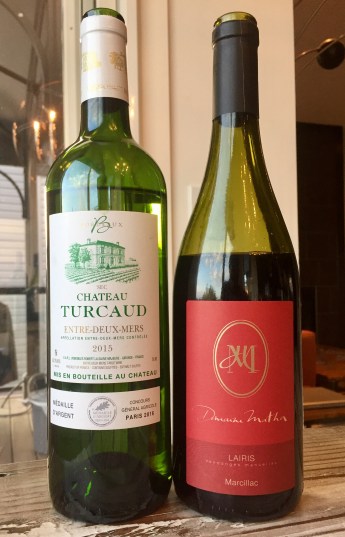
If you missed the start of this ongoing review saga, click here to catch up on what Cellar Direct is all about (TL;DR:  they’re a weekly-offer Canadian e-merchant with an Old World network of connections bordering on the incredible and a passion for low-intervention hand-made wines).  The initial duo of offerings I tasted took us a little bit off the standard retail track, to Loire Valley Cabernet Franc and Cahors Malbec.  Tonight’s pair nearly gets us lost in the wilderness, starting with an obscure white Bordeaux from the lesser-known Entre-Deux-Mers and then dropping the compass and setting the map on fire with a wine made from 100% Fer Servadou grapes grown in the Marcillac region of southwest France.  I didn’t make up any of those words, and I can assure you that after trying the wine they reference, I won’t be forgetting them anytime soon. Read the rest of this entry »


Cellar Direct: Summer Vibes, Part 1

2 08 2017

[These bottles were provided as samples for review purposes.]

FullSizeRender-684

Cellar Direct:  always delivers, figuratively and literally.

And we’re back.  If you’ve seen little activity on this blog for the past few weeks, it’s for good reason:  I was not on mainland North America.  Some family fun in the sun in Maui was an excellent and much-needed recharge, but too much time away from the cellar is a dicey proposition, so I’m revving up the tasting notes and Pop & Pour is ready to rumble again.  And we’re not easing back into blogging life either:  we’re kicking it retro-style tonight with a powerhouse sub-13% abv traditional red duet that’s as Old World as Old World gets, both of which were recent feature offerings at what ever-increasingly appears to be Canada’s can’t-miss online wine club, Cellar Direct.

If you read this blog and that name is familiar to you, there’s good reason, as this will be the fifth time I’ve been lucky enough to experience and describe their wares, dating back to the venture’s launch almost two years ago (see here and here and here for more).  I have yet to taste a Cellar Direct bottle that disappoints.  Sourcing directly from the cellars of producers themselves and focused on classically made, low-intervention, farm-to-bottle offerings from European producers steeped in history, CD gets them to consumers in a 21st-century manner, via regular inbox offers and an online storefront where you can go back and grab more of past winners.  They ship using AST Healthcare’s temperature-controlled delivery services when external temperatures permit (3-4 times per year) and safely store your ordered wines until they’re ready to be delivered to your door.  Cellar Direct’s reach is nationwide, and their inventory is stocked with European treasures that often don’t otherwise see our shores.  Past, meet future.

This is the first of a three-part series of posts offering a snapshot of what Cellar Direct has been offering its members (which can include you, as it’s free to sign up) in spring and summer 2017.  Some of the wines are still around in CD’s online shop; others have sadly sold out with haste; but all are representative of what this venture is all about.  The first two bottles I tried tell you all you need to know. Read the rest of this entry »


Wine Review: $21 Old World Supremacy

11 07 2017

[These bottles were provided as samples for review purposes.]

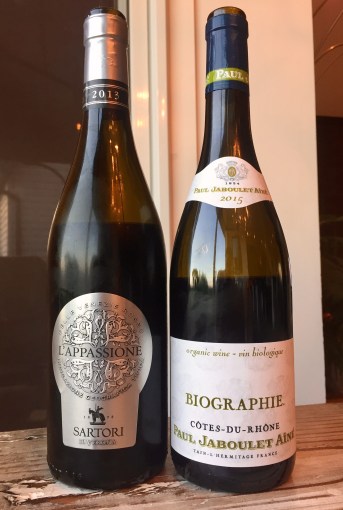
FullSizeRender-676This will be the last PnP post for a while – in a couple days I’ll be escaping the country on summer vacation and will not be thinking much at all about word counts or flavour descriptors while I’m gone.  Expect palm tree and sea turtle Instagram pictures and not much else until the end of the month.  I therefore felt compelled to send off July on the blog with a double-feature, a head-to-head review of two Old World value level wines with near-identical just-a-shade-over-$20 price tags and almost nothing else in common.  It’s Italy vs. France, a contest of different grapes, winemaking styles, vintages and approaches, with the main unifying links being longstanding traditional estates and a quest to over-deliver on quality for a supermarket price tag.  Enjoy the summer! Read the rest of this entry »


Happy Canada Day: Stag’s Hollow Summer Set

1 07 2017

[These bottles were provided as samples for review purposes.]

Happy Canada Day all!  Our majestic and humble home turns 150 today, which makes me both celebratory and reflective, emotions which both inevitably lead to wine.  (OK, many things inevitably lead to wine, but these do too.)  As a nation, even at its sesquicentennial, Canada is still young and developing, growing increasingly confident in its global identity but not yet possessed of that inner calm of countries who have already seen and lived through it all.  As a wine nation, we are younger still:  while grapevines have been planted in Canada since the 19th century, our movement towards becoming a commercial producer of quality wines probably only dates back 40 to 50 years; the oldest producing vinifera vines in British Columbia are likely of a similar age.  In many ways, we are still finding ourselves and only starting to chart our path.

FullSizeRender-668

British Columbia wasn’t blessed in centuries past with Burgundy’s army of soil-testing, site-delineating monks, who segregated cohesive parcels of land and determined which grapes did best in which spots.  As such, and without a suite of indigenous varietals to choose from, BC is playing global catch-up, still trying to sort out what might succeed in its soils and what is destined to fail.  In this New World landscape, it would be useful for the province to have a sort of advance wine scout, someone who is unafraid to push the envelope in terms of planting options and help set the boundaries for the area’s future course.

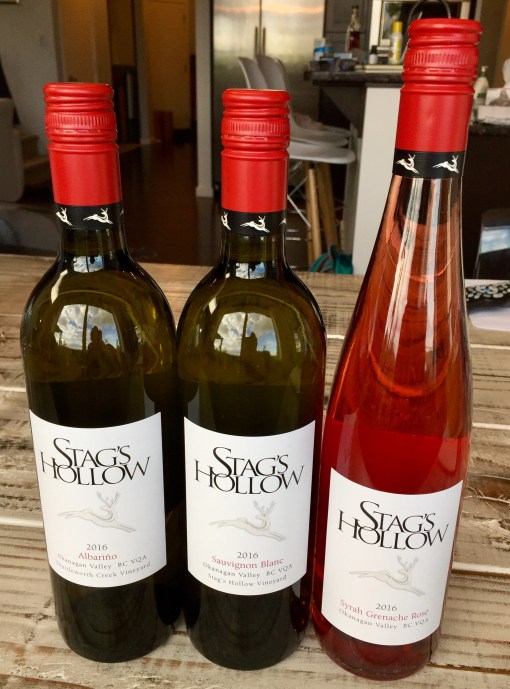
I nominate Stag’s Hollow Winery in the Okanagan Falls, which, led by winemaker Dwight Sick, has done nothing but innovate since I first found out about them.  Make reserve-level small-production Tempranillo?  Check.  Create the Okanagan Valley’s first-ever bottling of Grenache?  Check.  Solera-style fortified wines?  Orange wines?  If you can envision it, Sick and Stag’s Hollow have probably made it, and have expanded the range of possibilities for Canadian wine in the process.  A recent further jump:  Albarino, the crispy, crunchy white grape that is the pride of Galicia in northwest Spain, features heavily in Portugal’s Vinho Verde and has been gaining an increasing worldwide audience.  I had never yet seen a Canadian version of this hot and trendy grape – but if I had had to place a bet on who would be among the first to come up with one, it turns out that I wouldn’t have been wrong.  I got to check out this trail-blazing New World version of Albarino along with a couple other patio-friendly new releases from the winery just in time for summer. Read the rest of this entry »


Calgary Wine Life: Weingut Hiedler Tasting @ Bricks Wine Co.

26 06 2017

FullSizeRender-664

Ludwig Hiedler Jr.

When Ludwig Hiedler Jr. speaks, generations of knowledge echo in his words.  His career has spanned many years of education and experience, multiple shifts in approach, and innumerable hours spent questioning how to create and reveal the truest form of a wine.  He at first chafed against the layers of tradition quietly imposed on him like sediment by his ancestors, and pushed back against them by experimenting in all facets of his self-described “artisanal, emotional” winemaking style, only to eventually discover his own truth where it always was, embedded within his family’s values and legacy.  He is 24 years old.

Ludwig Jr., his father Ludwig Sr. and his brother Dietmar now collectively guide the course of Weingut Hiedler, which has been producing wine in northern Austria’s Kamptal region since 1856, longer than Canada has existed as a country.  Ludwig Jr. represents the fifth generation of Hiedlers to take on winemaking duties at the estate, steering the winery into the future with a nod back into the past, through sustainable chemical-free practices in the vineyard, next to no use of oak for maturation, and wines made as a pure reflection of site and vintage, with no stylistic or flavour preconceptions guiding the journey to the finished product and limited intervention during fermentation.  Hiedler uses native yeasts to ferment all of his wines, but in an interesting way:  he allows the ambient yeasts around the winery to do some of the work during fermentation, but has also harnessed certain selections of these native strains with which he also inoculates the fermenting must, propelling the ferment forward without introducing any element external to the winery.

FullSizeRender-660

Weingut Hiedler is a small piece of a 1,000+ year tradition of winemaking in Austria, and is part of a group of quality-focused producers working on taking the generational knowledge built up and passed down about vineyard sites, soils, aspects and qualities and creating a (long-overdue) formal comprehensive set of vineyard classifications for the country.  The Österreichische Traditionsweinguter (or the ÖTW for short, which translates to “Traditional Austrian Winemakers” and is roughly equivalent to Germany’s VDP) has identified a number of top “Erste Lage” (first growth) vineyards which they hope to see formalized at law in the future, bringing Burgundian rigour to Austrian soils.  Hiedler’s philosophy strives for longevity, tranquility, wisdom, harmony and elegance in its wines, a vision symbolized by the owl that graces its labels and has quickly become the most recognizable visual reference to the estate.

This was Ludwig Hiedler Jr.’s first ever trip to Canada, and his last stop in a hectic North American travel schedule before he returned to winemaking duties in Austria.  Before embarking on a transoceanic flight home, he graciously led us through a remarkable Gruner Veltliner and Riesling Masterclass at one of Calgary’s most impressive boutiques, Inglewood’s Bricks Wine Company.  Through four Gruners and three Rieslings, we got a clear sense of what Ludwig and Weingut Hiedler were all about, yet I still left thinking that there are many more undiscovered layers to both the man and the winery, to be unveiled in the coming decades of Hiedler releases. Read the rest of this entry »


Introducing: wYneYC

21 06 2017

[These bottles were provided as samples for review purposes.]

fullsizerender-648.jpgI grew up in the days of monopolized government liquor sales and distribution in Alberta, and I distinctly remember going into the squat brick AGLC store with my parents when they were on the hunt for a new bottle of wine or spirits.  While government-controlled retail alcohol is still the norm in much of Canada, Alberta thankfully broke free of its state shackles before I hit adulthood, and now, not really that much later, it is a completely different world, with an ever-increasing number of remarkable producers from across the globe available in our market and very few barriers to introducing even more.  Slower to develop have been wine-buying alternatives to the standard visit to a retail shop:  online ordering, home delivery, personalized sourcing.  I can get almost every work of literature ever created from Amazon Prime within two business days, but our gloriously liberal wine commerce architecture has not yet fully embraced the electronic age and the consumer convenience that can come with it.  That’s why I always root for those ventures who come along and try.

wYneYC is just such a venture, an e-subscription wine club with a twist, featuring a revolving door of personally curated sommelier-chosen wines tailored to each customer’s palate and an absolute focus on eliminating hassle for buyers.  You sign up for a monthly subscription at one of three tiers, where a 2-bottle pack costs $36, $50 or $65 depending on your level of choice; you can also pick 4- or 6-bottle packs if you wish, which come with corresponding volume discounts.  But these are not just random bottles, and they are not the same for everyone:  when you subscribe on wyneyc.ca, you fill out a personalized online taste survey for each bottle (which you can later update at will), and wYneYC’s professional winos then pair your monthly selection with your palate preferences. Read the rest of this entry »


Wine Reviews: Red ShowDownUnder

13 06 2017

[These bottles were provided as samples for review purposes.]

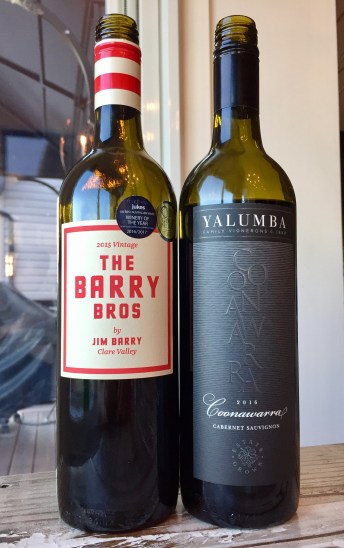
FullSizeRender-646I first got seriously into wine about 10 years ago, when the Australia Phenomenon was in its heyday and Argentinian Malbec was just a glint in some clever investor’s eye in Mendoza.  Yellow Tail Shiraz was my gateway drug, a fact that is assuredly true of more than one of you currently reading this as well.  Looking back now on the Australian wine scene then, there are still tons of similarities.  Critter wines, like it or not, are still a thing. On the quality pinnacle, the high-end wines from Down Under rocking people’s worlds in 2017 aren’t that different from those doing so in 2007.  But I’ve noticed a couple clear differences in the imports from Australia that have evolved over the last decade:  first, a welcome explosion of site-driven elegance from the cooler areas of the country, be it Pinot from Yarra or Mornington or bubbles from Tasmania or the laser purity of some of the post-modern wines coming out of the Adelaide Hills.  Second, a new focus on bottles like the ones below, step-up bottlings, a shade above entry-level in price and a world above the critters in authenticity and quality.  The $20-$30 tier of wines has never had stronger representation on our shelves from Australia than it does currently, as more and more producers zone in on these bottles as the best way to build a lasting relationship of trust with consumers as opposed to an $11 fling.

So what better way to celebrate how far Australia has come as a mature wine producer, and how far I’ve come in my 10 years of Yellow Tail-catalyzed oenophilia, than by lining up two step-up bottles, each from highly respected multi-generational family wineries and legendary regions, and tasting them side-by-side?  It’s not about picking a winner — the mere fact that the exercise is possible is a win in and of itself — but I’m sure that won’t stop Jim Barry and Yalumba from exerting full effort in this battle of reds under screwcap.  Let the showdown from Down Under begin. Read the rest of this entry »


Calgary Wine Life: Checkmate Chardonnay Global Challenge @ Sub Rosa

6 06 2017
FullSizeRender-640

Anthony Gismondi.

Checkmate Artisanal Winery has no shortage of vision or ambition.  It is both a newcomer to the Okanagan wine scene and the oldest of old hands, founded by Mission Hill proprietor Anthony von Mandl after his purchase of a pre-existing winery (Antelope Ridge, just west of Oliver) and some of its vineyards back in 2012.  Thanks in part to von Mandl’s existing land holdings, Checkmate began its life with elite sources of fruit from five top-tier vineyard parcels, the youngest of which is just shy of 20 years old and the oldest of which are some of the most senior in the country.  The vineyards scatter across the southern Okanagan:  there are two near the winery on the Okanagan’s first-ever formal sub-appellation, the Golden Mile Bench, two across the highway to the east on the neighbouring Black Sage Bench, and one literally 30 feet from the Canada/US border southeast of Osoyoos.  The fruit they produce is reflective of Checkmate’s quality vision and laser focus:  the winery makes SIX different Chardonnays and FOUR separate Merlots, and nothing else.  Their price is reflective of von Mandl’s burning ambition to elevate Canadian wine:  the Chardonnays range from $80 to $125 a bottle and the Merlots all clock in at $85.  It is probably safe to say that this country hasn’t yet seen a winery like this.

At the controls of this super-premium venture is winemaker and general manager Phil McGahan, who began his working life as a lawyer (I knew I liked him when I met him for some reason) and then switched gears and did winemaking stints in Australia’s Hunter Valley and for Sonoma cult Pinot and Chardonnay producer Williams Selyem before being lured north by Checkmate’s potential and master plan.  If your first reaction to the idea of a winemaker leaving California for Canada is surprise (or disbelief), McGahan went to great lengths to point to the Okanagan’s location vis-a-vis southern California as a selling feature:  with world temperatures rising in past decades, he saw Canada as being well-placed as a grape-growing region going forward, perhaps even better than existing warmer-climate regions that may soon find themselves outside of the ideal range for viticulture.  The Okanagan’s combination of (very) long summer days, extensive sunlight and substantial diurnal temperature shifts are proving increasingly attractive to grapes now tended with more careful farming practices, all of which makes up for the area’s shorter growing season.

FullSizeRender-635

The Checkmate wines are created with a quality focus from start to finish, consistent with the raison d’être of the winery.  The Chardonnay grapes are handpicked starting at 3:00 a.m., when it’s cooler, and the fruit is then stored in a cool room at 4 degrees Celsius for 24 hours before being hand-sorted and gently whole-bunch pressed.  Long and slow ferments ensue, mostly with wild yeasts to tease out additional flavours, after which the wines spend 16 months in barrel for better oak integration, with lees stirring towards the end before the Chardonnay is bottled unfined and unfiltered.  All six Chardonnays are made in the same fashion, leaving any distinctions or divergences in their flavour profile to be explained by the story of their site.

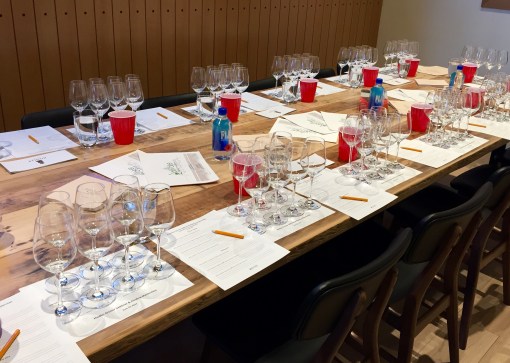
So how do you convince the buying public that not just one but SIX Okanagan Chardonnays are worth $80 or more a bottle, and that what is coming out of British Columbia currently can suit up with the best in the world?  You line them up with the world, don’t tell anyone which is which, and let the public see for itself.  That’s what happened this week in the James Bond villain subterranean lair that is Sub Rosa, the quasi-secret underground speakeasy beneath The Guild restaurant on Stephen Avenue, where Canadian wine luminary Anthony Gismondi and winemaker Phil McGahan led a curious crowd through a Judgment-of-Paris style blind tasting of ten Chardonnays, all at similar price points, six of which were Checkmate’s new 2014 releases and four of which were various international heavy hitters.  We had 30 panicky minutes to taste through the full set of wines and rank our favourites, after which each wine’s identity was revealed.  What did this experiment say about the present and future of cult, super-premium, site-specific Canadian Chardonnay?  Read on. Read the rest of this entry »


Calgary Wine Life: Weingut Thörle Tasting @ Vine Arts

2 06 2017
IMG_6203

Christoph Thörle

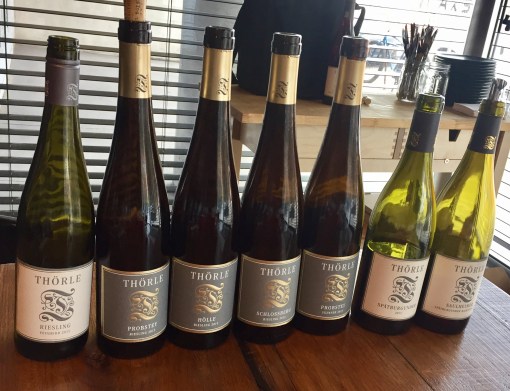
It’s been a bit of a banner wine week, seven days tailored to the precise preferences of my palate.  My personal favourite types of red and white wine are Washington Syrah and German Riesling respectively, and late May has seen visionary producers specializing in each of these areas visit our fair city.  My Washington wine prayers were answered last week when Greg Harrington of Gramercy Cellars put on a remarkable Master Class in Calgary; this week it was Germany’s turn, thanks to an eye-opening portfolio tasting put on by the dynamic Christoph Thörle of the eponymous Weingut Thörle, from the global home of Riesling’s Rheinhessen region.  Through four different earth-shattering Rieslings and seven total wines, Thörle took us through what must be some of the world’s best expressions of my first vinous love.

If you say the word “Rheinhessen” to a wine person, the tenor of their reaction might be a generational one.  The region, located in west-central Germany, due south of Rheingau and southwest of Frankfurt, is the largest in the country in terms of planted acres and is tailor-made for grape-growing:  it’s dry, sunny and relatively warm, with limestone-based soils overlaid by a variety of alluvial deposits, as long ago it was largely part of an underwater seabed.  Rheinhessen once had a reputation to match its physical advantages, and was long considered one of the pinnacle areas of German viniculture.  But a mid-20th-century flirtation with new lab-crossing grape varieties and mass-market, quantity-focused bottlings turned into a 1970s and 80s Liebfraumilch obsession that saw lesser varietals dominate much of the vineyard area and Blue Nun and Black Tower nearly obliterate the world’s prior impressions of German wine.  If you stopped paying attention to Rheinhessen then (as many did), you will have missed out on what’s going there now:  a quiet quality renaissance, and a return to the right grapes properly planted and tended on the right sites, perhaps not better personified than by Christoph Thörle and his brother Johannes.

FullSizeRender-626

They took over the operation of the Thörle family winery in 2006, when Christoph was just 22 and Johannes 24.  Together they have overseen an expansion of the estate’s vineyard holdings and a corresponding increase in annual production, paired with a return to simple, hands-off viticulture and winemaking practices:  no pesticides or herbicides in the vineyards, multiple-pass harvests, all natural yeasts and no additives in the cellar, minimal sulphur at bottling.  Weingut Thörle now has 80 acres of vine holdings, remarkably spread over 100+ different vineyard parcels but largely centered around the town of Saulheim in north-central Rheinhessen.  The area features a wide array of different slopes, soils and sun exposures, allowing for the production of multiple different varietals, and Saulheim itself is surrounded by Thörle’s three crown-jewel vineyards:  Probstey, Schlossberg and Hölle.

Thörle has been generating increasing acclaim for both its white (Riesling, Silvaner, Chardonnay and more) and red (Pinot Noir, known Germanically as Spätburgunder) wines and made its glorious entrance into the Alberta market last year.  Now some new offerings are on their way to the province, and we were fortunate enough to have Christoph talk us through most of them, including a few bottles that might change your perspective on, well, everything. Read the rest of this entry »


Calgary Wine Life: Gramercy Cellars Master Class @ Divino

26 05 2017
FullSizeRender-614

Greg Harrington, Gramercy Cellars

A month ago I had never been out to visit my all-time favourite winery, and they had not yet had the opportunity to come to Calgary for a tasting event.  Three weeks ago I finally made it out to Walla Walla for the first time, and among other amazing wine memories made, I paid a couple visits to my wine pinnacle, Gramercy Cellars, attending their Spring Release party on my birthday.  Almost immediately after I got off the plane in Washington State, I got an email inviting me to Gramercy’s first ever tasting Master Class back in Calgary, led by the winery’s founder and winemaker Greg Harrington.  That tasting was held this week at the marvellous Divino restaurant, and I left thinking that my next trip to Walla Walla couldn’t come fast enough.  It would be an understatement to say that this month has ticked a lot of boxes.

FullSizeRender-612Washington State has both the sun to grow big red grapes and the soil and climate to make them interesting.  The main wine areas are all in the southeastern part of the state, separated from lush, drizzly Seattle by the Cascade Mountain range, whose rain shadow blocks most of the coastal precipitation and creates a warm, dry canvas for grapevines to thrive.  The Walla Walla Valley, straddling the Washington/Oregon border, is bounded on the east side by another mountain range, the Blue Mountains, gaining both altitude and cool nightly winds off the slopes as a result.  Over millennia, the historically recurring Missoula floods have laid fine sandy soil, massive rocks and other alluvial deposits over an already-impressive volcanic basalt soil base.  Put all that together and you end up with an area that sees heat and sunlight during the day but features significant diurnal temperature drops at night, ideal for prolonging ripening and retaining acid in grapes; fine soils with intriguing mineral content that drain well and in which (thanks also to the cold winters) the vine scourge phylloxera cannot survive, allowing all vines to be planted on their own rootstocks; and a remarkable array of slopes, aspects, exposures and microclimates in a relatively concentrated area, letting farmers and producers match specific varietals with specific sites to maximize their potential.  In short, it screams winemaking opportunity.

FullSizeRender-616

The Gramercy winery and tasting room, Walla Walla.

And it screamed loud enough to bring Greg Harrington there.  Harrington, a Master Sommelier holding a prestigious position for a group of New York City restaurants, had a chance tasting of Walla Walla Syrah lead him to a trip to Washington State and then to a life-altering decision to change careers and time zones, all in the span of a couple years in the early 2000s.  After a crash course in winemaking and some assistance with grape sourcing from Washington wine pioneer Norm McKibben of Pepper Bridge in 2004, Gramercy Cellars came into existence and released its first vintage in 2005.  It has been honing its style and its craft since, continually looking for ways to sharpen its approach.  While Gramercy has always aimed for lower ripeness and alcohols and higher acid and longevity in their wines, as of 2014 it strove for further complexity by switching over to all native-yeast fermentation and introducing large square concrete tanks to its winemaking armada.  Future plans include going fully organic with its growers in the vineyard and gaining additional control on the farming side of the process, as evidenced by its recent acquisition of the well-regarded Forgotten Hills vineyard just south of Walla Walla.

FullSizeRender-617

Concrete.  Badass.

Greg Harrington spoke of these things and more across two riveting and information-packed hours with the Calgary wine trade, and at some point while we were at it we also found the time to taste through the bulk of Gramercy Cellars’ portfolio, starting off with the ultra-small production 2016 Picpoul (electric limes! on fire!) as we came in the door and not stopping until we had gone through FOUR consecutive groundbreaking Syrahs that firmly established Washington State’s place as a New World powerhouse.  Buckle up. Read the rest of this entry »


Entering The Hatch, Spring 2017

23 05 2017

[These bottles were provided as samples for review purposes.]

IMG_6146Ever since I first saw The Hatch’s avian-Thomas-Crown-Affair primary logo shortly after it opened a couple years ago, I have been sort of transfixed from a distance, finding both the winery and its artistic ethos strangely compelling despite knowing basically nothing about them.  Based out of a rustic-modern “shack from the future” in the heights of West Kelowna and sourcing grapes from across the Okanagan and Similkameen Valleys, The Hatch initially comes across (quite intentionally) more like an artists’ collective than a commercial winery, listing Salman Rushdie on its personnel page and expounding in esoteric wine-code about “Ross O” and B. Yanco” (I’ll give you a second to sort that one out).  They confidently found their visual style from the outset thanks to the remarkable imagery provided by local western Canadian artist Paul Morstad (who is also found on The Hatch’s personnel page, playing a banjo); once people have been drawn in by the graphics, it’s up to winemaker Jason Parkes to keep their attention.  The whole artistic cacophony and the simultaneously grand yet whimsical presentation lends The Hatch a jolt of personality that the generally strait-laced BC wine scene can happily use…but does the buzz extend to what’s in the bottle?  Happily, I got to find out.

FullSizeRender-601The Hatch releases its wines in stylistic series, of which I had the opportunity to experience two:  the mid-tier Hobo Series wines, featuring a panoply of hand-drawn labels of hobos (seriously) that risk making you cry thanks to their sheer beauty (also seriously), and the ambitious Black Swift Vineyards series wines, which collectively form an expansive single-vineyard project focused on the various facets of BC’s glorious dirt.  The wine, like the winery, was never boring. Read the rest of this entry »


Burrowing Owl Spring Releases

16 05 2017

[These bottles were provided as samples for review purposes.]

Some people chart the seasons using a calendar; others look to the melting snow and the first robins to mark the start of spring.  For me and this blog, the new season only arrives when the box of new releases from Burrowing Owl is delivered and tasted.  I can now happily announce:  spring is here.

FullSizeRender-592

OK, yes, I had a glass of the Chardonnay before the tasting started.  I regret nothing.

Burrowing Owl is one of the few Canadian wineries that has been consistently able to juggle both quantity and quality, producing 35,000 cases annually from 16 different varietals grown across 170 acres and three different estate vineyard sites encircling the scorching southern Okanagan hubs of Oliver and Osoyoos.  It is likely best known for its Bordeaux varietals, but also makes room in its vineyard sites for less expected offerings like Tempranillo and Viognier, not to mention a killer Syrah that is proof of concept of the region’s suitability for the grape.  Burrowing Owl’s two largest vineyards are scant minutes away from the US border, on western-facing slopes angling down towards the temperature-modulating Lake Osoyoos, which both restrains the Okanagan desert heat during the day and extends it at night.  The third is due west of Oliver, in the neighbouring Similkameen Valley, using its proximity to Keremeos Mountain to help grow Bordeaux whites Semillon and Sauvignon Blanc, where 2017’s spring releases conveniently start. Read the rest of this entry »


International Sauvignon Blanc Day: 2016 Adobe Reserva Sauvignon Blanc

5 05 2017

[This bottle was provided as a sample for review purposes.]

FullSizeRender-589

International SB Day 2017!

I swear that not every future entry on this blog will begin with “Happy [Varietal-Specific Holiday] Day!”, but…Happy International Sauvignon Blanc Day!  Yes, there is an entire calendar of world wine days now, each concocted by various marketing geniuses, and as it turns out, a couple weeks after World Malbec Day and a scant four days before World Moscato Day comes a designated day to celebrate the safest grape to pick out of a strange new liquor store and the varietal that first introduced the vinous world to New Zealand, the consistent and omnipresent Sauvignon Blanc.  Unlike today’s grape of honour, I am not omnipresent, and as this piece posts I am actually going to be hanging out in Walla Walla drinking world-class Syrah; International SB Day falls on my birthday this year, and I am spending this spin-around-the-sun in my personal wine Mecca.  So the blog and I will celebrate simultaneously this year, albeit in different places and for different occasions. Read the rest of this entry »


World Malbec Day Review: 2014 Bodega Norton Barrel Select Malbec

17 04 2017

[This bottle was provided as a sample for review purposes.]

FullSizeRender-587

Happy World Malbec Day!

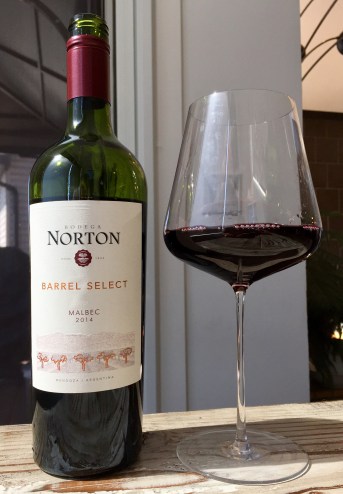
Happy belated Easter to all – I hope your long weekend was filled with family and food and chocolate and wine in some order.  If you headed back to work on Easter Monday and were feeling the post-holiday blues, fear not, because there is another event on today that’s worth celebrating:  April 17th has been designated World Malbec Day, a designation I would bet many people choose to live out far more often.  In a blink sometime in the last decade, Malbec went from being an overlooked Bordeaux blending grape and an esoteric dark and chewy hidden treasure from Cahors to Australian Shiraz’s heir as the friendly, fruity, powerful gateway drug into the wonderful world of wine.  Whereas I stumbled onto Yellow Tail sometime in the early 2000s and worked my way up from there, nascent wine lovers today are heading to the previously non-existent Argentina section of their local liquor store and starting their odyssey with the grape, one that will hopefully last a lifetime. Read the rest of this entry »