Wine Review: Road 13’s Rare Whites

12 07 2019

By Peter Vetsch

[These bottles were provided as samples for review purposes.]

This may be the last post from me for a while, as I imminently prepare to head off of the continent for a little bit on a proper Viking vacation.  (If anybody knows a great wine shop in Copenhagen or Billund, let me know immediately.)  But fear not, Ray will still be here to keep the blog alive for the rest of July, and I have one last gasp of Canadiana in me before I bolt the country.  Tonight’s trio of whites from the Golden Mile Bench’s Road 13 Vineyards makes me realize that I should have been following this winery more closely before now, but I will try to make up for lost time.

IMG_0344

Clean and classic labels, eye-opening wines – but not sure about 2018’s italics.

Road 13 has had an interesting last 12 months, as it was named the Winery of the Year at Wine Align’s National Wine Awards of Canada in 2018 and was then promptly sold before the year was out.  Long-time proprietors Pam and Mick Luckhurst, who acquired the winery (then-called Golden Mile Cellars) and were responsible for first renaming it and then building it into a well-respected national brand, decided to move into retirement (the winery itself having been their first, not-that-relaxing-as-it-turns-out attempt to retire) and accepted an offer from Mission Hill’s / Mark Anthony Brands’ Anthony von Mandl to purchase the company.  The winemaking team remains intact, however, as does the winery’s vision and present focus on the potential of Rhone varieties in British Columbia, an endeavour that I back fully, having had enough marvellous Okanagan Syrah recently to make me wonder what else from the south of France would flourish here.  As it turns out, the white Rhone side of the equation is just as compelling as the red.  But we start with a scion of a Road 13 classic. Read the rest of this entry »


Wine Review: July Patio Samplers

6 07 2019

By Peter Vetsch

[These bottles were provided as samples for review purposes.]

As I sit here writing this on a rainy summer evening (pre-publication, but I bet it’s raining when this goes live too), Calgary has just struggled through a sodden June, and the tide doesn’t seem to be turning.  It is grey, dreary and continually drizzling.  We’ve had hailstorms, windstorms, thunderstorms — all separately and all in the last three weeks.  My kids have declared their nascent skepticism for outdoor sports — who would willingly place themselves outside for an hour at a time in an environment such as this?  Our northern world is free of snow for at most six months a year, and a third of that winterless period for 2019 has been underwater. You get the picture.  It’s bleak.

IMG_0298

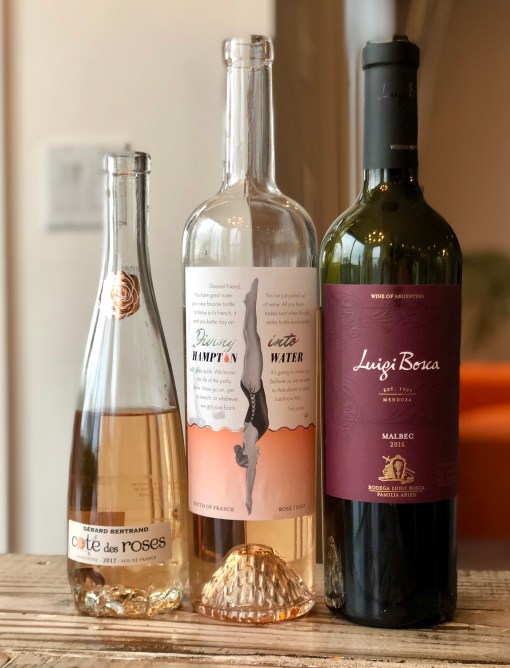
So rather than wait for the appropriate meteorological scene to christen this long-planned summery-wine review set, I have decided to pre-emptively invoke summer by publishing it anyway, in the hopes that this trio of deck-and-BBQ-friendly refreshment will nudge our weather towards more appropriate activities.  I will try anything at this point.  Tonight’s bottles will set a blog record that may never be broken, bear a striking resemblance to each other until they don’t, and confirm that even trendy wines can be old-school sometimes.  They may also be the first time since the Tournament of Pink that we start off with back-to-back rosés, but hopefully we can make that a bit more of a recurring pattern.  Game on. Read the rest of this entry »


Wine Review: The Reds of Sunrock Vineyards

4 07 2019

By Raymond Lamontagne

[These wines were provided as samples for review purposes.]

You cannot make truly good wine without ripe grapes. Simple, no? Insufficient sugar in the fruit is not going to leave much for yeast to consume, and such starved fungi are not going to produce something with sufficient body (and alcohol) to merit any sort of “greatness” mantle. Moreover, grapes need heat if they are to attain physiological ripeness. This refers to the changes in tannins and other chemical components that occur largely in grape skins, stems and seeds during the ripening cycle beyond the mere increase in sugar.  These changes are what produce the key varietal aroma signatures we know and love, preventing a wine from tasting green, weedy, and brittle.

Although sugar ripeness and physiological ripeness are clearly correlated, it would seem that grape hang times might be a stronger predictor of physiological readiness than just heat alone, although in my view (and botanically speaking) you aren’t going to get any degree of maturation, period, without heat. The key question for wine quality is: how much heat is too much? Overly ripe grapes mean clumsy, muddled wines that are boozy, lacking in precision or definition, and often almost devoid of any sense of place or regional character. Such wines are going to be tremendously fruity and powerful, but may not offer much in the way of nuance or balance. As I read up on Sunrock Vineyards, which could very well be the hottest single vineyard site in British Columbia, I wonder how they approach these ripeness issues.

Sunrock is owned by Arterra Wines Canada, formerly the Canadian subsidiary of the massive Constellation Brands, but recently acquired in 2016 by the Ontario Teacher’s Pension Plan (for some reason that tickles my funny bone…I’m sure we drove many a substitute teacher to drink). Arterra farms around 1300 acres of Okanagan vineyard, with the expected corresponding range of quality tiers. Jackson-Triggs might be the best known of Arterra’s brands, and the single-vineyard Sunrock labels formerly carried this name as the top tier of that portfolio. Sunrock is now a standalone winery, a fine example of a large corporate entity with the good sense to recognize and preserve the unique character of a single site. And what a site it is. Read the rest of this entry »


PnP Panel Tasting: Midnight’s Children – The Many Syrahs of The Hatch

14 06 2019

By Raymond Lamontagne

[These bottles were provided as samples for review purposes.]

It has been a prolific week for PnP Panel Tastings! This one was a doozy. Peter, myself, and PnP spirits guru Tyler convened to open some Okanagan wines; we also ended up taking a massively (possibly Okanagan-wine-induced) deep dive into ’90s alternative rock, which was good for a monumental spike of nostalgia and a slew of earworms for the rest of the weekend. Sometimes hangovers sound like Wide Mouth Mason. The company was of course excellent, tolerant of my occasional requests for overly long Rush tunes (OK, it wasn’t all ’90s). That aside, this was the sort of night from which memories are made, frivolously pleasant and soul-searching alike, and what better vinous companion for me than The Hatch?

The-Hatch-Wines-West-KelownaYou see, four of the suspects hailed from the cellars of the Hatch, subject of a previous PnP Panel Tasting and still my favourite BC winery. I defy you to find a similar blend of idiosyncrasy, creativity, whimsy, and sheer stubborn courage in our westernmost province. There is a true artist’s aesthetic behind the wines. These guys do what moves them, unabashedly and without any discernable pretense. That kind of genuine interface with the world at large is becoming an endangered species other than in the world of wine, where uniqueness has long been a virtue, one that has likely only gathered steam in recent years. I think The Hatch has grown by leaps and bounds since its inception, pushing well beyond some initial growing pains into the world of truly fine wine, even as they never truly forsake the uncanny, the weird. After all, “a poet’s work is to name the unnameable, to point at frauds, to take sides, start arguments, shape the world, and stop it going to sleep”. The Hatch shall continue to keep us awake (except perhaps if you kill all four of these on the same night. Not recommended.) Read the rest of this entry »


PnP Panel Tasting: Culmina Spring Releases, Part 2 – Funky Whites Edition

12 06 2019

By Peter Vetsch

[These bottles were provided as samples for review purposes.]

The last set of Culmina releases featured on PnP was so fun to taste that I felt compelled to bring in the band to share the joy of this next group, a trio of weird, wild, semi-experimental whites that are seeking to test boundaries both within and outside of the winery.  Fellow PnPers Ray Lamontagne and Tyler Derksen gathered with me to taste through a lineup that included my own personal Culmina obsession, the incredible Unicus Gruner Veltliner, as well as two even more envelope-pushing whites from Culmina’s recently unveiled small-production Number Series.  Things got fun fast.

IMG_0183

The Number Series was introduced in late 2016 as a way for Culmina’s talented winemaking team to spread its wings a bit.  Part Reserve-level offering and part experimental test drive, each Number Series wine is a limited-production rarity that may only see a single run, never to be repeated again in subsequent vintages.  It represents the best of Culmina’s developmental efforts from that year, either showcasing a standard-rotation Culmina grape in a whole new way (like the inaugural Number Series Wine No. 001, a rich, ripe Riesling styled like an Alsatian Grand Cru) or braving the unknown with a varietal that isn’t part of Culmina’s normal lineup.  The two most recent Number Series bottles below both fall into the latter camp, and show off some intriguing winemaking approaches to boot.

As with all our Panel Tastings, while we discussed the wines as we were tasting them, we came up with our own impressions and our own scores for each bottle and did not share them until everyone’s assessment was complete.  We started, as every meal and tasting and day on this Earth should, with Unicus. Read the rest of this entry »


Wine Review: Culmina Spring Releases, Part 1

30 05 2019

[These wines were provided as samples for review purposes.]

IMG_0135You have to admire a guy like Don Triggs.  After co-founding the eponymous Jackson-Triggs, taking the brand to meteoric heights and carrying the cause of Canadian wine along with it, Don parted from the brand in 2006 when it was subsumed into the massive Constellation empire, his finances and legacy secure, a career in wine that started shortly after his graduation in the late 1960s drawing to a close, retirement beckoning.  But instead of choosing that comfortable path, he threw himself back into the breach once more, this time thinking smaller in scale and fixated on quality.  This next quest started, literally, from the ground up.  With the aid of legendary vineyard consultant Alain Sutre, Triggs spent a year scouring the Okanagan Valley for just the right site, one that could reliably and properly ripen red Bordeaux varietals, including Canada’s white whale, Cabernet Sauvignon.  Finding a promising spot with southeast-facing exposure on what is now the Golden Mile Bench, the Okanagan’s first legally recognized sub-Geographical Indication (GI), they carried out a slew of temperature and soils tests and discovered that the microclimate of the site (at least in terms of degree-days, a measurement that tracks relative aggregate temperature over the course of a growing season) was very similar to that of Bordeaux.  Arise Bench, the inaugural estate vineyard of Culmina Family Estate Winery, was acquired, and Don Triggs’ newest project came to life.

Having located a potentially ideal site for big, chewy reds, Triggs and Sutre only had to look up to find complementary cooler spots for elegant whites.  Two separate and increasingly higher-altitude benches a short hike up the adjacent hillside completed the Culmina vineyard collection:  Margaret’s Bench, at almost 600 metres of elevation a truly unique Okanagan location, welcomes Riesling, Chardonnay and Canada’s top plantings of Gruner Veltliner, while mid-level Stan’s Bench splits time between these whites and Malbec and Petit Verdot to round out Culmina’s Bordeaux blends.  This three-tiered vineyard elevation stairway is the foundation of everything Culmina does, every square inch mapped and studied to maximize the location of each vine planted.

IMG_0144
As Culmina established its identity in the Okanagan, its lineup of releases began expanding: its base Winery Series line, culminating (no pun intended) with Hypothesis, the Bordeaux blend that was the mission statement for the venture, has now been joined by two other sets of releases.  The light-hearted R&D line (which stands for either “research and development” or Don and his twin brother Ron, who are featured in childhood form on the labels) allows Culmina to let its hair down a bit and focus on budget-friendlier wines that are a joy to drink; the limited-release Number Series is a set of small-lot one-offs that push the boundaries of possibility on Culmina’s trio of sites.  I had the opportunity to taste some of the winery’s latest releases, which have just started to hit shelves now, and track the continued upward trajectory of one of Canada’s most exciting wine projects. Read the rest of this entry »


Calgary Wine Life: Technical Tasting with Barolo’s Claudio Viberti

26 05 2019

By Raymond Lamontagne

It all began when Cavalier Antonio Viberti purchased a restaurant, the Locanda del Buon Padre. In 1923, Antonio decided to start making wine in the basement, as many do in this region. The original intent was to keep things simple and just sell the wine to patrons in the restaurant. Well, Antonio’s son Giovanni had other ideas. Things began to expand. Eventually cement tanks for fermentation were installed, and in 1955 wines were sold in nearby markets for the first time. By the 1970s the operation had become a full scale winery, even if the family never forgot their roots as restauranteurs. Giovanni’s son Claudio Viberti, who was our host at this past week’s tasting event at Willow Park Wines & Spirits, took over management of winery and restaurant operations in 2008. He hasn’t looked back since. The man is a dynamo.

IMG_0684

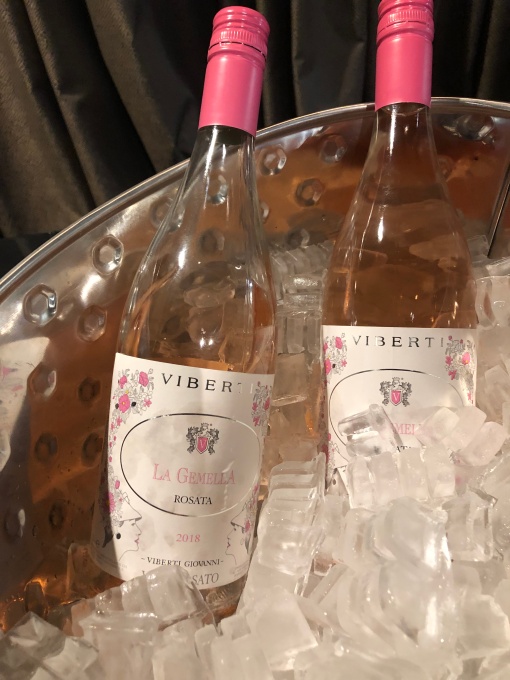
Claudio tells a few of us early birds the story behind the rosé served before the beginning of the formal proceedings. First off, and much to our surprise, this rosé is 100% Nebbiolo. Secondly, the wine is made first as a white wine from Nebbiolo juice obtained via an extremely gentle press. Claudio also makes a small amount of red wine from the same batch, using this to fix the colour of the end product. No combined maceration on the skins was involved, à la pink Champagne. I start scribbling notes. This is dry as a bone but does yield a subtle candied character, with the robust illusion of a sweet finish after a rather dense midpalate. Fairy-like whispers of strawberry, raspberry leaf, and nectarine flit about a more solid core of Parmesan cheese and those pink wintergreen mints, a rather burly rosé with a shimmering coppery finish. This is a rare wine but seems unlikely to remain so. Read the rest of this entry »


The Patient Vintner: Bodega y Cavas de Weinert

24 05 2019

By Peter Vetsch

[These bottles were provided as samples for review purposes.]

If I was to tell you that I was drinking the current release of a mid-tier offering from a well-regarded producer and from a name region, made from 70-110 year-old vines, and that the vintage date on the bottle was 2006, what would you guess the region was?  Rioja – maybe a Reserva offering from a traditional-minded producer?  Champagne, if you are extremely liberal with your definition of “mid-tier”?  Somewhere in Italy?  Portugal?  You would probably be most of the way through the global wine region Rolodex before you landed on Mendoza, Argentina, and once you did, you would probably immediately discard the possibility, knowing this to be the heart of bold, fruity, approachable Malbecs that are released and enjoyed in their youth.  Bodega y Cavas de Weinert, and its current-inventory $25 old-vine 2006 Malbec, will cause you to re-evaluate all of your presumptions; they are an anachronism in all the best ways.

IMG_0079

This classical estate actually has a rather recent history:  the winery dates back to 1890, but its current identity was tied to its acquisition by Brazilian Bernardo Weinert in 1975. Swiss winemaker Hubert Webber has been at the helm since 1996, when he was ensconced at the ripe old age of 27; his mission has been to craft wines from Malbec, Cabernet Sauvignon and Merlot wines that avoid early showmanship and start to reveal themselves after a decade or more, as it is only then that the Bodega will release them to market.  Lengthy barrel aging (up to 5-6 years in large oak foudres in Weinert’s cool granite cellars), then further time in bottle pre-release, is the estate’s hallmark — Weinert follows the old-school Spanish model of only allowing his wines into the public sphere when they are deemed ready to drink, whether or not this follows the standard chronological vintage release playbook.  In other words, don’t necessarily assume that the 2007 will follow the 2006 as the next wine on the shelf.

IMG_0085

The relatively modest prices of the finished wines might be reflective of advantageous land and labour costs in Argentina, but they are not the result of any lack of care in the vineyard:  Weinert’s vineyards, located in Mendoza’s top subregion of Lujan de Cuyo, feature largely ungrafted own-rooted vines that are a minimum of 25 years old and are exclusively hand-harvested.  Fermentation takes place in cement tanks, and Weinert’s cellar boasts both the largest barrel in Argentina (44,000 L) and the oldest barrel in the world, each of which are a reminder that the goal of the Weinert wines’ extended time in barrel is not wood flavour transference (which increases the newer and smaller the barrel is), but gentle, lightly oxidative maturation.  I had the opportunity to taste a trio of Weinert offerings, all 12-13 years old (as is par for the course in this particular corner of Mendoza), to explore this wholly unique take on Argentinian viniculture.  Malbec first, as always. Read the rest of this entry »


Pop & Repour: Preservation Experimentation – The Results

14 05 2019

By Peter Vetsch

I feel like I’m in a time warp.  In this optimistic post from early February, I advised that the blog had been silent for a while due to sickness, but that we were back up and running and that I was testing out a brand new wine preservation gadget, with results to follow shortly.  Well, after that post, about the excitingly simple Repour Wine Saver, the blog fell silent for a while due to sickness (an ear infection and then sinusitis this time, mixing it up from the bronchitis I had before), but I can now advise that we’re back up and running and that I can now report the results of said wine preservation test.  If this cycle repeats one more time, I’m quitting the wine-writing hobbyist biz, but if I can avoid antibiotics for the next hour or two, I will pass along this tale of experimental trials, inadvertent failures of the scientific method and the (largely) successful demonstration of Repour’s mettle, complete with an unexpected twist at the end.

IMG_9674

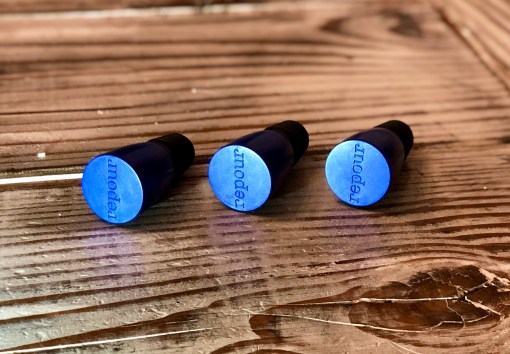
For those who don’t feel like clicking on this link to catch up on my prior introduction to this ingenious device, the Repour is a single-use one-stop-shop for wine preservation, a plastic bottle stopper stuffed with oxygen-absorbing material that actively removes any oxygen remaining in the bottle after each glass pour, leaving the wine inside pristine and untouched by decay-inducing air for (they say) “days, weeks or even months”.  It costs $3-4 CAD and lasts for the entire duration of one bottle of wine, regardless of how many times you go back to the well with that bottle.  I decided to test that marketing promise rather emphatically.  I opened three bottles of 2015 Alfred Merkelbach Urziger Wurzgarten Riesling Kabinett from Germany’s Mosel Valley, drank a healthy dose out of each, then left one as a poor unguarded control bottle without any form of preservation beyond my refrigerator, dosed the second with argon gas (my personal pre-Repour preferred method of preservation) and test-drove the Repour with the third, revisiting them multiple times over the next month and tracking how well each bottle stood up.  My running preservation diary is below.  To refresh your memory, here was my initial tasting note on the Merkelbach Kabinett:

“The wine is a complete throwback to a bygone era, understated and filigreed in style, with canned golden apple, sea spray, petrichor and orange zest aromas giving way to a fragile yet enduring, heavily mineral palate, all quartz dust and steel.  The restrained residual sugar offers relief and key lime accents without weight, the acid is omnipresent but not cutting, and the finish is taut and straight-laced, perfectly formal and polite and German.” Read the rest of this entry »


Calgary Wine Life: Blaufrankisch Masterclass with Georg Prieler of Weingut Prieler

1 05 2019

By Raymond Lamontagne and Peter Vetsch

Austria is renowned for the fruit purity and fine minerality of its wines, and Blaufrankisch is the premier black grape of the region. Grown across Central Europe and going by various monikers (the wonderful “Kekfrankos” in Hungary, and the more prosaic “Lemberger” in Germany), Blaufrankisch is an early-budding, late-ripening variety sometimes dubbed the “Pinot Noir of the East”; its elegance and dexterity earns it that nickname, but its hallmark savoury mineral wildness forges an identity all its own.  Some grapes such as Cabernet Sauvignon or Campania’s Aglianico are said to swamp or overshadow terroir with their sheer varietal character, while others are more protean and can serve as a lens through which the story of their soils and site and climate are reflected.  Blaufrankisch falls firmly into the latter camp, although through its various land-driven expressions one can commonly find dark berry aromas and flavours, vibrant acidity, a pronounced spiciness and that “other” wild rocky character that can set this grape apart.  We were extremely excited to do a specialized tasting of this varietal with Georg Prieler, owner and winemaker of Burgenland’s Weingut Prieler, a dynamic, charismatic, insightful winemaker who carries his family’s history with aplomb…and who might just make the best Pinot Blanc in the world.

IMG_9979

Georg Prieler, Weingut Prieler

Yes, Pinot Blanc. We both first came to know this producer by being absolutely floored by how stunning and utterly fascinating Weingut Prieler’s Pinot Blancs can be.  This particular grape rarely wins this sort of accolade and is often considered a paler, strait-laced shadow of Chardonnay, never fully given the opportunity to take a star turn in any region…except, as it turns out, in Burgenland, where Prieler exalts it among whites and where Georg calls it “the Riesling of the Burgundy varieties”.  That got our Riesling-loving attention, and Prieler’s single-vineyard Pinot Blanc which capped off our tasting held it,  transfixed.

IMG_0576

All that said, Pinot Blanc remains both the winery’s and the region’s “second most important” variety, according to Georg, as nothing in Burgenland knocks Blaufrankisch off its throne. Georg himself hails from (and still lives in) the village of Schützen am Gebirge, population ~1500, known for steely Pinot Blanc but also the sublime Goldberg vineyard, where Blaufrankisch might reach its pinnacle.  He closely oversees operations in both vineyard and winery, inheritor of a legacy that runs from his grandfather to father to sister and now, as of 2011, to Georg himself.  The family’s time in the vineyards predates their work in the cellar — the Prielers have been planting and tending grapes in Burgenland for 150 years, which perhaps is what leads Georg to immediately describe himself as “just a farmer who takes planes and drinks wine”.  After his inaugural visit to Calgary, and with the voice of his wines preceding him, it’s clear that this particular travelling farmer has a global reach. Read the rest of this entry »


Ripasso and Appassimento in Niagara: A Virtual Tasting with Barclay Robinson, Winemaker at The Foreign Affair

15 04 2019

By Raymond Lamontagne

As a wine lover, I often feel I am walking a tightrope of sorts between appreciation of bare-bones, terroir-driven wines of place on the one hand, and esoteric, funky winemaking techniques on the other. My allegiance gravitates implicitly to the former camp, populated by relatively pure expressions of soil and grape variety that eschew the muddying effects of various vinification tricks of the trade. Then again, I can be a sucker for the weird, particularly if there is true intent behind the decision to use a particular cellar technique: the careful realization of a particular vinous vision can be every bit as compelling as what results from a more hands-off approach. It turns out that in some cases, particular techniques are the tradition. And traditions, like other aspects of culture, are meant to be shared, applied to new contexts, and ultimately celebrated.

IMG_0437

Enter Barclay Robinson, winemaker at Ontario producer The Foreign Affair, who recently shared the story and results behind some of these techniques and traditions in a personal virtual tasting.  This was a lot of fun, Barclay being exactly the sort of guy I like tasting with: erudite yet down to earth, funny yet quick to impart knowledge. The winery, situated in the Vineland area of the Niagara Peninsula, is completely unique in the Canadian context. Founders Len and Marisa Crispino lived as expats in Italy, where they fell in love with the Amarone wines of Valpolicella. These burly concoctions are made using the the appassimento process, in which the grapes are dried after harvest for to up to 6 months, typically resting on bamboo racks or straw mats, or alternatively strung up from the ceiling where air can circulate and work its dehydrating magic. These raisined grapes provide a very concentrated must (the juice to which yeast is added after crushing to make wine), which makes fermenting the resulting wine to total dryness quite a challenge. I have grown to appreciate Amarone over the last year or so, although its combination of high alcohol, intense flavour concentration, and a unique nut-like bitterness can be polarizing. The Crispinos decided to bring this winemaking approach to Ontario, albeit using the Bordeaux varietals known to do well in the Niagara Peninsula (alas, Niagara Corvina is not a thing at this juncture). Read the rest of this entry »


Spain, Old and New, Part II: The Wines of Imperial

14 02 2019

By Peter Vetsch

[These bottles were provided as samples for review purposes.]

This is a belated sequel to my introductory post from last November about the marvellous wines and history of Cune, the Riojan benchmark producer melding the traditional and the modern into perfect balance.  Since that post predated Wine Advent and then Vinebox, it’s about 40 posts back on the PnP timeline, and even though it’s only 3 months old it feels like 30.  Perhaps it has aged enough then to allow to slip in a slight correction.  I mentioned way back in 2018 that the Cune brand was made up of 3 different physical wineries and brands, each with their own winemaker:  Cune itself, Vina Real and Contino.  I also mentioned that the Cune brand “also encompasses the higher-level Imperial bottlings, made only in very good years”.  This is ALMOST entirely true:  the wines of Imperial have been made since 1920, only in great vintages, using Cune’s oldest vineyards in Rioja Alta and selected nearby old-vine sites.  Imperial is also still made by Cune’s winemaker, although the label only releases a Reserva and a Gran Reserva red wine, leaving the Crianzas and the whites to the others.  However, further research reveals that, as of 2005, Imperial has its own separate winemaking premises on the Cune property, as outlined in this highly confusing official graphic; it is now a winery-within-a-winery, its own bricks-and-mortar space.  The 3 Cune wineries are actually 4.

IMG_9719

Imperial is a focused and quality-driven enterprise, producing around 200,000 bottles in the vintages good enough to merit its creation, in contrast to Cune’s 5 million.  As of 2004, all fermentations now take place in new oak barrels, as a back-to-the-future nod to history — the Imperials of the pre-1940s were all produced in this fashion, and after decades of dalliances with first concrete, then steel, Cune made the very Riojan determination that sometimes the old ways really are best and went back to its roots.  The winery name comes from a unique historical bottling release for the UK market, the “Imperial pint” size (which is roughly 500mL, a highly underrated and remarkably useful size for a bottle of wine that we should see more of nowadays).  The Imperial brand made more recent history when its 2004 Gran Reserva, an utterly spectacular wine that it pains me to say I have no more of, was named the Wine Spectator Wine Of The Year in 2013, the first such global pinnacle designation for a Spanish wine.  If you ever have the chance to acquaint yourself with the Imperial lineup, do not hesitate.  The current releases continue to showcase the magnificent pedigree of the estate. Read the rest of this entry »


Pop & Repour: Preservation Experimentation

7 02 2019

By Peter Vetsch

And – we’re back.

When I posted the review for Vinebox Day 12 as we polished off our daily reviews for two consecutive holiday wine calendars, I fully intended that the blog would go dark for a little bit while we rested our typing fingers and regrouped.  I did not intend to then catch bronchitis and a cough that wouldn’t die in a house full of plague and contagion, but that’s what happened, leading to a much-longer-than-anticipated blackout period to kick off 2019.  However, I’m back on my feet and Pop & Pour is officially back in business with some compelling content in the wings to kick off our writing new year, starting with a new and intriguing solution to one of my favourite wine questions:  how best to preserve an open bottle.

IMG_9673

I am an unabashed wine preservation geek.  I own a Savino (and it works! at least for shorter storage periods).  I have tried, and ultimately discarded, a number of vacuum pump oxygen-expelling gizmos (which never quite get all the air out and quickly cease to become airtight themselves, thus undermining the whole enterprise).  I have written a lengthy series of real-time preservation reports about the Coravin as I gradually drained bottles with one over the span of six months (a series of posts that continues to get regular views in Iceland to this day, though I could not tell you why).  My current preservation go-to is an argon dispenser, which places a blanket of inert gas over top of the remaining wine in the bottle and acts to prevent further oxygen contact, as oxygen is the primary agent that leads to wine deterioration over time.  I thought I was fairly up to speed on the various different ways to keep wine from spoiling, but little did I know that a new entrant had recently joined the fray.

IMG_9675

The Repour Wine Saver is ingenious in its simplicity.  All wine preservation tools operate by preventing oxygen access to wine in some manner or another.  Some of them fail because they rely on physical or mechanical processes that grow less efficient over time as materials change or fail.  The Repour has no moving parts or components that can get worn down over time, particularly because it’s not meant to be used over time: it’s a single-use disposable bottle stopper that retails for $3-4 CAD, keeps a single bottle of wine fresh for as many times as you care to reopen it, and is then thrown away.  It works not by expelling or blanketing the oxygen in the bottle, but by absorbing it.  The interior of the stopper is crammed full of oxygen-absorbing material (of a type that is also used to help keep food fresh during transit) which, once the cover tab is removed and the stopper is placed in the bottle, starts pulling the oxygen not only out of the air inside the bottle but also out of the wine itself.  No oxygen = no spoilage. Read the rest of this entry »


12 Days of Vinebox: Day 12

5 01 2019

By Peter Vetsch

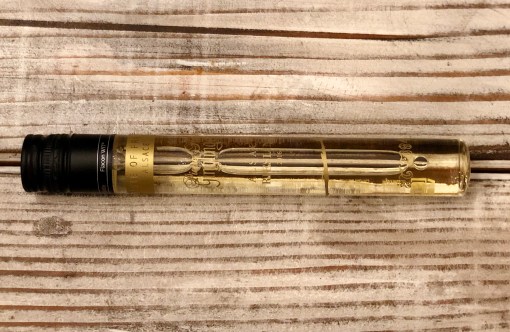
Well, we’ve done it:  scaled the top of a 24-day Advent mountain, and without pausing for breath, immediately continued up to the summit of the second 12-day Vinebox mountain perched directly on top of it.  36 straight days of blogging later, here we are, weary and satisfied and very ready not to write about any goddamned thing tomorrow.  And we end the 12 Days of Vinebox with the wine that maybe surprised me the most in the lineup, not because there’s anything particularly weird about it (although in this age of wine weird-offs marked by escalating departures from the norm, maybe strait-laced in-its-lane Left Bank Bordeaux qualifies as odd in a post-hipster-irony sort of way), but because it appears to be a library offering.  This 2011 Chateau Hourbanon Medoc is easily the oldest wine in our set of test tubes, proving that even back-vintage wines can be relocated and settle peacefully in their new skinny Vinebox homes.

IMG_9584

I gently chided Vinebox yesterday for not supplying much information along with their wines, but tonight’s offering solves that problem itself by way of an information-packed, if insanely disorganized, producer website, wherein the current proprietor of Chateau Hourbanon tells you absolutely everything you would want to know about the history and current philosophy of the estate in nine different potential languages.  I find this sheer earnest desire to share and educate highly welcoming.  Thanks to this glorious fount of information, I can advise that Chateau Hourbanon has long been highly regarded — it was classified as a Cru Bourgeois (or its pre-official predecessor) back in the 19th century — but the subsequent 100 years were not as kind to it, and when reformed dentist Remi Delayat purchased it in 1974 it was all but abandoned, its winery buildings in complete disrepair.  Delayat made it his personal mission to rehabilitate the estate, and after his premature death in 1981 his widow Nicole carried on the quest, followed by  their son, current proprietor and website content-master Hugh, who now manages the estate’s 13 hectares of vines.  In the current more formalistic classification of the Cru Bourgeois wineries, Chateau Hourbanon’s name remains on the list. Read the rest of this entry »


12 Days of Vinebox: Day 9

2 01 2019

By Peter Vetsch

Sicily update:  the streak is over!  Ask and ye shall receive.  After a rather bizarre run of three straight bottles in this dozen from Italy’s most prolific wine island, our request to the cosmos for variety has been granted with fervour, as we are off to the German-est (and thus potentially the best) part of France, Alsace…where, incidentally, my Vetsch family ancestors apparently hailed from five or six or seven generations ago.  Maybe that’s why I love Riesling so much.  Alsace is something of a mystery to me from a vinous perspective, because despite producing solidly priced and consistently high-quality wines, and despite being one of the few Old World locales to actually consider the casual-drinking consumer enough to place grape varietal names on their labels, the region is almost always a hard sell in our market.  Perhaps adopting the white wine focus, gothic scripts and tall fluted bottles from its German forefathers was not the best marketing decision after all.  But when the wine is in a test tube as opposed to a flute…now we’re talking.

IMG_9529

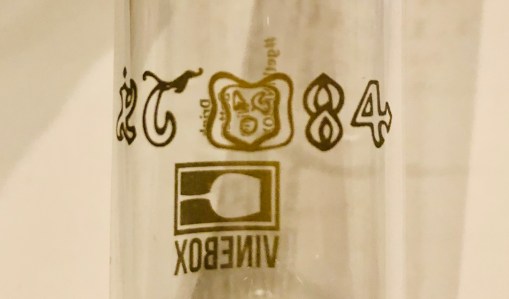
The non-Sicilian wine in question is the 2016 Pierre Henri Ginglinger Riesling, yet another Vinebox offering about which Internet information is strangely nigh-unavailable.  Maybe they are so eager to give you a surprise in the box that they have shut down all worldly sources of data about the bottlings they select.  Maybe their chosen producers have to sign the mother of all NDAs.  Either way, I speak of family estates and generational turnover with admiration quite a bit, but THIS…this is that on an absurd scale.  The Ginglinger family first planted vines in 1610, and generation number TWELVE is currently at the controls of the estate.  Come on.  Their winery building looks like something out of Hansel and Gretel, nestled in the centre of the medieval town of Eguisheim, which is closer to Freiburg in Germany than the Alsatian hub of Strasbourg and is the birthplace of wine in Alsace; the winery’s appearance may have something to do with the fact that it was built in 1684, trivia so good that it makes an appearance on not only Ginglinger’s bottles, but even its Vinebox vial:

IMG_9532

Read the rest of this entry »