[These bottles were provided as samples for review purposes.]
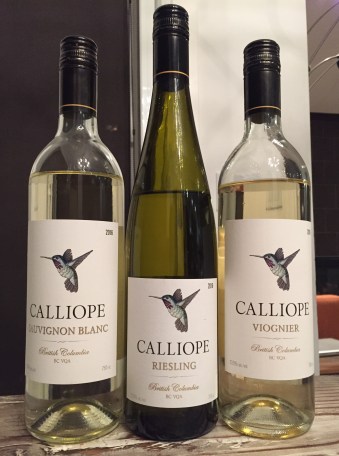
Pop and pour power.
There are a few ways to measure how far British Columbia has come as a wine industry in the past 10-15 years, during which time for my money the jump in quality, understanding and identity has been close to exponential. Here’s one way: 15 years ago, I don’t think you could have convinced me that a BC winery’s SECOND label could produce a suite of balanced, expressive and generally delightful wines worth seeking out. In 2017, Burrowing Owl (or, more accurately, Wyse Family Wines, founders of Burrowing Owl) have managed that exact feat with the 2016 releases of their Calliope label, a lineup of wines that according to the accompanying campaign literature is meant for easy and early enjoyment; a true pop and pour. Sourcing grapes from both the Okanagan and Similkameen Valleys, the Wyse family focuses mostly on whites for Calliope, creating (at times) multi-regional blends under the general “British Columbia” appellation, yet still under the BC VQA banner. These are marketed as easy-drinking patio wines, meant for drinking rather than dissecting…but since we’re all here, let’s dissect them anyway.

Stelvin Rating: 8/10 (See what you can do if you apply yourself to screwcaps? Dead sexy.)
I was provided three different single-varietal examples of Calliope’s white regime: Sauvignon Blanc, Riesling and Viognier. When I’m drinking single-grape wines on the lower end of the price spectrum (these bottles probably straddle the $20 mark Alberta retail), the first thing I look for, even before balance of component elements or general deliciousness, is typicity. In non-wino speak: if the wine is a Sauvignon Blanc, does it smell like a Sauvignon Blanc? Does it taste like a Sauvignon Blanc? Does it help people understand what Sauvignon Blanc is all about, and does it then go the next step and show people what Sauvignon Blanc from its particular home region is all about? Varietal wines that do this exhibit strong typicity, and as such become extraordinarily helpful barometers for both learning about wine and understanding your own preferences. If these 2016 Calliopes have any major strength, it is dialled-in typicity: they are clear and precise examples of what’s in the bottle and what comes out of the ground. Read the rest of this entry »



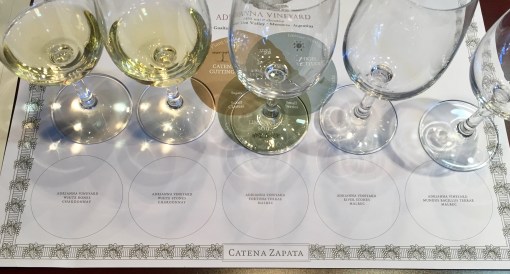


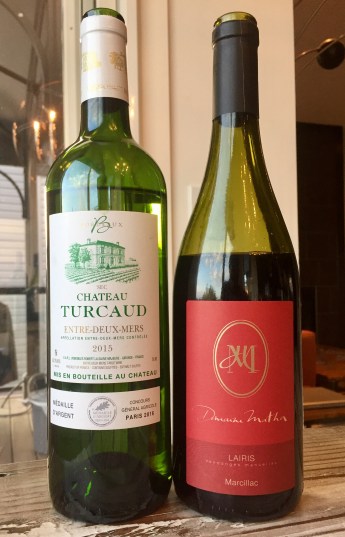


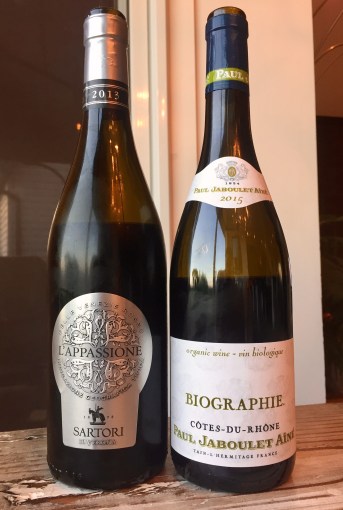 This will be the last PnP post for a while – in a couple days I’ll be escaping the country on summer vacation and will not be thinking much at all about word counts or flavour descriptors while I’m gone. Expect palm tree and sea turtle Instagram pictures and not much else until the end of the month. I therefore felt compelled to send off July on the blog with a double-feature, a head-to-head review of two Old World value level wines with near-identical just-a-shade-over-$20 price tags and almost nothing else in common. It’s Italy vs. France, a contest of different grapes, winemaking styles, vintages and approaches, with the main unifying links being longstanding traditional estates and a quest to over-deliver on quality for a supermarket price tag. Enjoy the summer!



 I grew up in the days of monopolized government liquor sales and distribution in Alberta, and I distinctly remember going into the squat brick AGLC store with my parents when they were on the hunt for a new bottle of wine or spirits. While government-controlled retail alcohol is still the norm in much of Canada, Alberta thankfully broke free of its state shackles before I hit adulthood, and now, not really that much later, it is a completely different world, with an ever-increasing number of remarkable producers from across the globe available in our market and very few barriers to introducing even more. Slower to develop have been wine-buying alternatives to the standard visit to a retail shop: online ordering, home delivery, personalized sourcing. I can get almost every work of literature ever created from Amazon Prime within two business days, but our gloriously liberal wine commerce architecture has not yet fully embraced the electronic age and the consumer convenience that can come with it. That’s why I always root for those ventures who come along and try.
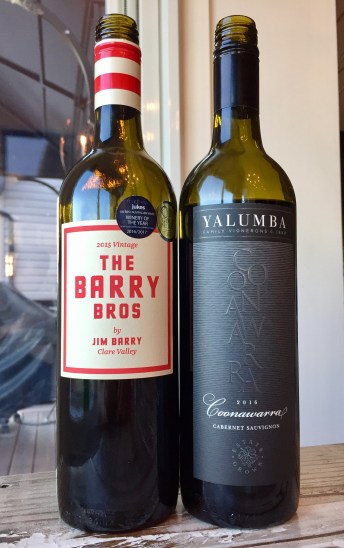 I first got seriously into wine about 10 years ago, when the Australia Phenomenon was in its heyday and Argentinian Malbec was just a glint in some clever investor’s eye in Mendoza. Yellow Tail Shiraz was my gateway drug, a fact that is assuredly true of more than one of you currently reading this as well. Looking back now on the Australian wine scene then, there are still tons of similarities. Critter wines, like it or not, are still a thing. On the quality pinnacle, the high-end wines from Down Under rocking people’s worlds in 2017 aren’t that different from those doing so in 2007. But I’ve noticed a couple clear differences in the imports from Australia that have evolved over the last decade: first, a welcome explosion of site-driven elegance from the cooler areas of the country, be it Pinot from Yarra or Mornington or bubbles from Tasmania or the laser purity of some of the post-modern wines coming out of the Adelaide Hills. Second, a new focus on bottles like the ones below, step-up bottlings, a shade above entry-level in price and a world above the critters in authenticity and quality. The $20-$30 tier of wines has never had stronger representation on our shelves from Australia than it does currently, as more and more producers zone in on these bottles as the best way to build a lasting relationship of trust with consumers as opposed to an $11 fling.




 Washington State has both the sun to grow big red grapes and the soil and climate to make them interesting. The main wine areas are all in the southeastern part of the state, separated from lush, drizzly Seattle by the Cascade Mountain range, whose rain shadow blocks most of the coastal precipitation and creates a warm, dry canvas for grapevines to thrive. The Walla Walla Valley, straddling the Washington/Oregon border, is bounded on the east side by another mountain range, the Blue Mountains, gaining both altitude and cool nightly winds off the slopes as a result. Over millennia, the historically recurring Missoula floods have laid fine sandy soil, massive rocks and other alluvial deposits over an already-impressive volcanic basalt soil base. Put all that together and you end up with an area that sees heat and sunlight during the day but features significant diurnal temperature drops at night, ideal for prolonging ripening and retaining acid in grapes; fine soils with intriguing mineral content that drain well and in which (thanks also to the cold winters) the vine scourge phylloxera cannot survive, allowing all vines to be planted on their own rootstocks; and a remarkable array of slopes, aspects, exposures and microclimates in a relatively concentrated area, letting farmers and producers match specific varietals with specific sites to maximize their potential. In short, it screams winemaking opportunity.


 Ever since I first saw The Hatch’s avian-Thomas-Crown-Affair primary logo shortly after it opened a couple years ago, I have been sort of transfixed from a distance, finding both the winery and its artistic ethos strangely compelling despite knowing basically nothing about them. Based out of a rustic-modern “shack from the future” in the heights of West Kelowna and sourcing grapes from across the Okanagan and Similkameen Valleys, The Hatch initially comes across (quite intentionally) more like an artists’ collective than a commercial winery,
  The Hatch releases its wines in stylistic series, of which I had the opportunity to experience two: the mid-tier Hobo Series wines, featuring a panoply of hand-drawn labels of hobos (seriously) that risk making you cry thanks to their sheer beauty (also seriously), and the ambitious Black Swift Vineyards series wines, which collectively form an expansive single-vineyard project focused on the various facets of BC’s glorious dirt. The wine, like the winery, was never boring.
 cabernetdialectic (Raymond Lamontagne)
 Dan Steeves
 Peter Vetsch
 tylerderksen
 pop & pour