Wine Review: Stag’s Hollow Renaissance Reds

5 04 2018

By Peter Vetsch

[These bottles were provided as samples for review purposes.]

IMG_7892

The big guns.

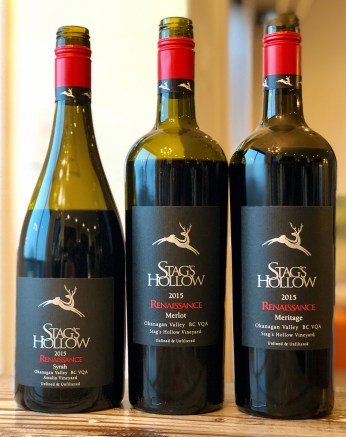
As I have mentioned in reviews past, my first thought of Okanagan Falls’ Stag’s Hollow Winery is always as a forward-thinking, try-everything trailblazer, the continual vanguard of varietal suitability and experimentation in British Columbia, constantly checking in on whether the next potential star grape of the province (be it Albarino, Grenache, Dolcetto, or any number of others in its viticultural Rolodex) might be one that few had previously considered.  So it’s a fun change of pace tonight to sit down and see how they handle the classics, those big red varietal stars so often seen across the Old World and New World alike, the first grapes you expect to see on any wine store shelf.  This review set is a particular treat, because all three of the bottles below hail from Stag’s Hollow Renaissance line, the winery’s premium flagship tier of offerings, produced only in vintages when the wines can live up to the bottle’s special black label.  I have heard rumblings that the 2015 Renaissance set breaks new ground in terms of quality and longevity; I had not previously had the opportunity to test this theory for myself, but it would not surprise me out of a winery that always seems to be improving. Read the rest of this entry »


Co-op Wines: The Social Collection, Bin 107

14 02 2018

By Dan Steeves

[This bottle was provided as a sample for review purposes.]

img_5495
As a follow up to Peter’s review of the first Co-op Social Collection bottle, the Bin 101 Cabernet Sauvignon, we now move onto the second bottle of our trio, Bin 107 Pinot Blanc, which hits a little closer to home.  This bottle’s front label clearly shows it is a product of Canada, and upon examining the back label, you notice further clues as to the wine’s origin. Underneath the grape variety is written “Golden Mile – Oliver, BC Canada”, and further down it shows that the wine was exclusively produced and bottled by Castoro de Oro Estate Winery in Oliver BC.

The region south of the town of Oliver and north of the town of Osoyoos is commonly referred to as the Golden Mile due to the amount of wineries off the highway between the two towns. However, stating “Golden Mile” on a label does not have an official meaning — this term shouldn’t be confused with the very-similar label designation “Golden Mile Bench”, which an area up off the valley floor that shows unique climate and soil types and which is now recognized as an official sub-Geographical Indication within the Okanagan Valley GI. That said, all wines made in this part of the Okanagan are well known for their high quality due to the ideal climate:  hot daytime temperatures, cool nights, and limited rainfall (it is for all intents and purposes a desert).

Read the rest of this entry »


PnP Panel Tasting: Quench! Wines BC Portfolio

1 02 2018

[These bottles were provided as samples for review purposes.]

First, some exciting news:  I’m happy to announce that Pop & Pour Wine Advent 2017 authors Raymond Lamontagne and Dan Steeves are officially going to be sticking around as regular contributors on the blog, bringing their expertise and exuberance to a screen near you and formally making PnP a joint venture from this point forward.  I’m hoping that this will allow the site to be less tied to my schedule and to have a greater presence around events and bottles that interest you (or that interest us, at least – hopefully they will interest you too).  And what better way to go from a solo gig to a group gig than having a panel tasting?

IMG_7474

A highly worthy BC lineup for our first PnP Panel Tasting.

Here’s how we play our game.  Dan, Ray and I got together to jointly taste a (remarkable) set of wines; we discussed while we tried each wine, but we evaluated and scored each bottle separately and independently, without sharing our final assessment until all scores were locked in.  We divvied up the writing duties, but rather than average out the scores or try to come to a numerical consensus, we preserved each person’s score for each bottle to give you a sense as to the level of divergence in the room through the course of the tasting.  Hopefully this will be the first of many such panel reviews, but if you have any thoughts as to the format or results, leave a comment or send me a message and let me know!

The focus of this inaugural Pop & Pour panel tasting was a sextet of offerings from Quench! Wines, a Vancouver Island-based agency exclusively focused on the burgeoning British Columbia production scene.  We got to taste a pair of wines each from three critically acclaimed Okanagan producers:  Terravista, Bella and Fairview Cellars.  You could not have put together three more divergent groups of wines if you tried, a testament to the diversity that is possible in the Okanagan Valley, particularly since each distinct grouping aptly highlighted a different element of the potential of the region.  I got to lead things off. Read the rest of this entry »


Wine Review: It’s Go TIME!

17 01 2018

[These bottles were provided as samples for review purposes.]

IMG_7405

NHL-licensed wine.  Bring on the themes!

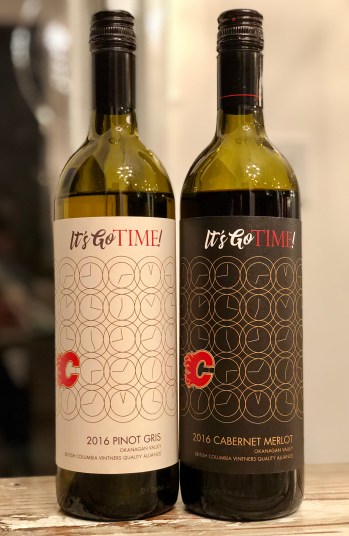
No, that title isn’t me exhorting myself into giving 110% on this wine review, playing for the crest on the front of the jersey and leaving it all out on the ice.  It is in fact the actual, somewhat-punny name of a red and white wine duo made as a commercial and charitable collaboration between the Okanagan’s TIME Winery and my local NHL squad the Calgary Flames, with some of the proceeds from bottle sales going to the team’s philanthropic Flames Foundation.  Having recently been to a WHL Hitmen game, I can confirm that the Saddledome boards themselves officially confirm TIME as the team’s official wine supplier (yes, such a designation is a thing), and the bottles are both served at the arena and sold at a wide array of retailers across town.  TIME is a brand owned by Encore Vineyards, a group led by Harry McWatters, a Canadian wine pioneer who founded Sumac Ridge winery the year I was born (1980) and who already has 50 years of local wine business experience under his belt, perhaps more than any other living person in Canada.  After selling Sumac Ridge, McWatters launched TIME in 2013, basing his winery inside an old movie theatre in Penticton and focusing on grapes from the southern Okanagan for his production.

IMG_7411

It is a long-standing tenet of this blog that I am fully on board with a good theme wine, as long as the gimmick doesn’t come at the expense of the underlying substance.  When theme bottles are done well, you win twice, augmenting the already-pleasurable experience of drinking well-made juice with the added enjoyment of the marketing cleverness surrounding it.  When they are not done well, not only are you left drinking crappy wine, you end up feeling a bit like you’ve been had while doing it.  These two bottles stake a sort of middle ground between those extremes, but when combined with their inoffensive price tag ($19.99 SRP) and their charitable underpinnings, they take no steps to dampen my theme wine enthusiasm.  Let’s get into them; it’s go t– …well, you know what time it is. Read the rest of this entry »


Bricks Wine Advent Calendar 2017: Day 1

1 12 2017

I am a realist when it comes to the reach and impact of this blog.  Calgary has a remarkable, informed, ambitious, impressive local wine scene, and my only goal in starting up this site years ago was to be a tiny voice in that massive chorus and find an outlet for my passion, whether anything came of it or not.  For the most part, I am simply an observer, experiencer and occasional reporter on the goings-on of Calgary wine life.  However, in this case, it’s at least possible that I was the catalyst for a great idea that Bricks Wine Company has now expertly executed.  About 12 and a half months ago, after seeing another set of annual Advent releases go by absent a particular format that I thought would be perfect for the occasion, I vented into the black void of Twitter…and was shocked to see somebody almost immediately respond and take up the task:

It’s one thing to send a two-word response on social media, and quite another to spend the time and effort to specially source two dozen half bottles of wine to assemble an Advent calendar for the NEXT year, so I didn’t allow my hopes to leap too high at the time, but now here we are, on December 1st, 2017, and I’m looking at a wooden crate filled with 24 beautifully wrapped and meticulously selected 375 mL splits, my Advent dream realized and in the flesh.  I am filled with awe and gratitude, and I haven’t even opened anything yet.  Way to go, Bricks — you really did it.

IMG_7027

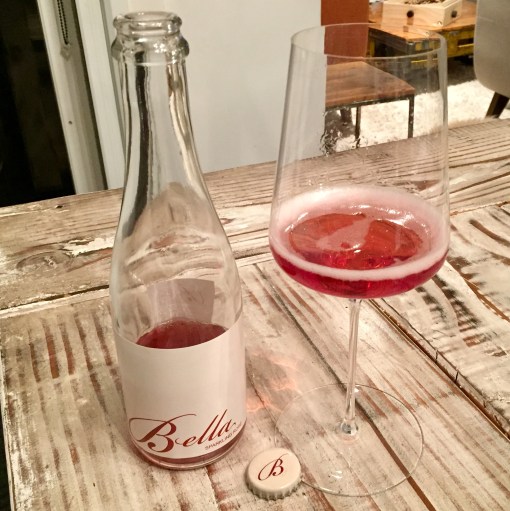
And if I was excited BEFORE peeling back the wrapping on Day #1, my anticipation only intensified after seeing what was on tap for Calgary’s inaugural Half-Bottle Wine Advent Calendar:  wine geek paradise.  Bella Wines is a producer about whom I have heard a ton over the past year, without yet having had the chance to try their wines for myself.  Bella is British Columbia’s only winery that is exclusively devoted to the production of sparkling wine — all bubbles, all the time.  And their approach is brutally uncompromising:  all natural farming, traditional method Champagne-style fermentation (where the secondary fermentation creating the fizz takes place in each individual bottle in which the wine is ultimately sold), all single-vineyard single-varietal expressions, wild yeast fermentation, no additives, no dosage; nowhere to hide, no messing around.  Bella makes multiple different bottlings of both pink and white bubbles, with their pigmented production focused entirely on the Gamay grape, which they believe has unheralded potential in the sparkling world.
IMG_7153

Crown Cap Rating:  8/10 (Stylized and retro, great font, CROWN CAP – I’m all in.)

So if you’re keeping track at home, Day 1 of Wine Advent features an Okanagan traditional-method single-vintage sparkling Gamay natural wine:  the 2016 Bella Sparkling Rosé Brut Natural “Westbank”.  Hot damn.  Bella releases annual sparkling Gamays from vineyards both west and east of Lake Okanagan, and the Westbank hails from the Beaumont Estate Vineyard in West Kelowna, on the slopes of Mount Boucherie. It is a beautifully confident deep watermelon colour in the glass (yay, non-deathly pale rosé!) and makes an emphatically lean, tart and frothy impression, launching aromatic bullets of cranberry, sour cherry and pomegranate fruit laced with grape skins and handfuls of gravel.  The flavours are pure and unforgiving, the lack of any added sugar after secondary fermentation clearly evident, the wine sharp as a razor’s edge on the finish thanks to Ginsu acidity and circular saw bubbles.  This Gamay practically vibrates with energy and electricity from the moment it hits the tongue, and that coiled tension doesn’t ever release:  not when the bubbles burst, not when you hold it in your mouth, not when you swallow.  It’s like watching a thriller movie that never ends.  If this is Day 1, we are in for a SERIOUSLY impressive Advent.  I did not know Okanagan bubbles could be like this.

90+ points

IMG_7151


Wine Review: Black Market Wine Co. – Contraband Portfolio Tasting

15 11 2017

[These bottles were provided as samples for review purposes.]

What do you do if you’re a busy Calgary-based professional with a hectic day job, multiple kids, a swath of family responsibilities, yet an ever-increasing burning passion for wine?  If you’re me, you start a small local blog and struggle to publish one post a week.  (Last post:  13 days ago.  Sorry guys.)  If you’re Rob Hammersley and Michelle Shewchuk, on the other hand, you pick up the hustle, go about 20 light-years further and start your own garagiste winery in the Okanagan on the side, while still juggling full-time careers, volunteer activities and parenthood.

IMG_7037

Branding majesty.

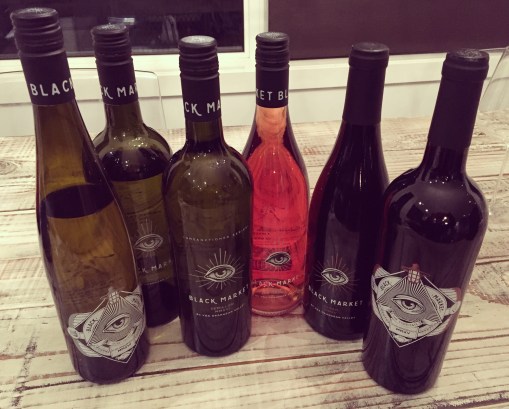
This cunning Calgary cabal has managed to work around their weekday gigs (Rob is in corporate finance; Michelle is a flight attendant) and their location in another province, forge relationships with local growers, learn the ropes of the winemaking business and come up with maybe the single best suite of branding for a winery anywhere in Canada, creating a bit of a cult following along the way.  Add in an early embrace of online sales and the Black Market Wine Company is quickly accelerating from illicit side dream to successful reality.

IMG_7052

I first came across Black Market a couple of years ago and was instantly drawn in by the Illuminati-meets-Ponzi-scheme labelling, looking like the back of the US dollar in some horrific alternate Dan Brown universe.  The striking images on the front labels draw people into the intentional web of secrecy and intrigue expressed in snippy verse on the back of each bottle, piquing curiosity and pulling people further into the glass for answers.  By then, you’re in the winery’s hands, waiting to be led where they want to take you.  It certainly does not hurt that the juice within does not disappoint (and that its creators are from my hometown), and I have followed their progress ever since that initial encounter.  This is the first time I have had an opportunity to taste through the entire Black Market portfolio, but not the last time I will be cracking these wines and letting the mystery wash over me. Read the rest of this entry »


Wine Review: Dirty Laundry, The Whites

2 11 2017

[These bottles were provided as samples for review purposes.]

IMG_7014

One of these things is not like the other…

Now that snow has blanketed the land and any remaining warm thoughts in Calgary’s mind have been augured away by blistering Arctic winds, I can fully admit that I tasted these Dirty Laundry wines in the wrong order.  I cracked the rosé and red portions of my sample pack back when fall was still a thing (last week) and saved the sunny patio portion of the tasting until it seemed like a cruel joke; serves me right for breaking with orthodoxy and not going lightest to heaviest like the textbooks all say.  But we persevere. I’ve always found Dirty Laundry’s white lineup to be a bit more impressive and consistent than its reds, and they have a particular affinity for Gewürztraminer, the grape that everyone seems scared to focus on too heavily but which truly rewards any such special attention.  However, tonight I got to dive into two bottles that I hadn’t tried before today, starting off with my favourite grape of them all. Read the rest of this entry »


Wine Review: Dirty Laundry, Pink & Red

26 10 2017

[These bottles were provided as samples for review purposes.]

IMG_6987

Okanagan label mastery.

Dirty Laundry is a winery best experienced in person, as it features a combination of location, history and brand awareness that is next to impossible to top.  It is perched up above the ideally named Summerland, BC, elevated over the Okanagan’s main highway, with vineyard views for miles and a patio strategically located to be drenched in scenery.  This spot was once, back in the era of the Canadian Pacific Railway’s initial construction, the home of a renowned and well-attended laundry service run by an AWOL railroad construction worker who had found a more lucrative calling; his fortune, and the popularity of his laundry business, was due in no small measure to the brothel being run discreetly on the upper floor while the clothes were cleaned below.  A couple of centuries later, the business currently occupying the land knows a good story when it sees one and has turned the tale of the dirty laundry into a branding behemoth that seeps into everything from wine names to labels to tasting room decor to the guest homes for rent on the property, the Bordello House and the Parlour House.  They commit to the identity, keep their humour on high alert and leave their prudishness at the door, and people keep coming back.

The wines themselves may be in a state of flux, caught between wanting to appeal to the widest possible audience and the crowds in for a good time and a novelty bottle-stopper and aiming for a higher level of quality, a product that captures attention in a different way.  I am rooting for them to succeed, as personality and creativity and branding effort are more than welcome in my own world of wine.  The below releases, recent rose and red offerings from Dirty Laundry and the first of a two-part review series, were an excellent chance for me to check in on the winery for the first time in a while and see where they were on their cheeky, quirky voyage. Read the rest of this entry »


Wine Review: Stag’s Hollow Fall Reds

18 10 2017

[These bottles were provided as samples for review purposes.]

IMG_6962

If this is where we are in the Okanagan, we’re in good hands.

What’s this?  Two reviews in the span of three days??  Is this inspiration or panic?  Turns out it’s a little of both.  For reasons that will shortly become clear, the next couple of months are going to be content-intense here at Pop & Pour HQ (aka my kitchen table), which has me geared up and focused on my current inventory of samples to make sure everything gets its full and proper due.  But I’ve also had a lingering eye on these particular wines ever since they landed on my doorstep, as they represent the latest missive in a wonderful conversation I’ve been having over the past months and years with one of the most intrepid, curiosity-filled, quality-focused wineries in the Okanagan Valley, Stag’s Hollow.  Over the summer I looked in on the white and pink side of their portfolio, but now that my trees no longer have leaves, the time has come to fully commit to autumn, and tonight’s trio of reds has me in the mood to cast off thoughts of T-shirts and shorts and embrace my favourite season.  This lineup features an Okanagan stalwart, only rarely done justice; an utter Okanagan rarity, borne of winemaker Dwight Sick’s unabashed intention to push viticultural limits in the region; and a burgeoning Okanagan star that will hopefully soon get the attention and acreage it deserves.  Pinot Noir, Grenache (!), Syrah. Read the rest of this entry »


Wine Review: Calliope White Trio

3 10 2017

[These bottles were provided as samples for review purposes.]

IMG_6891

Pop and pour power.

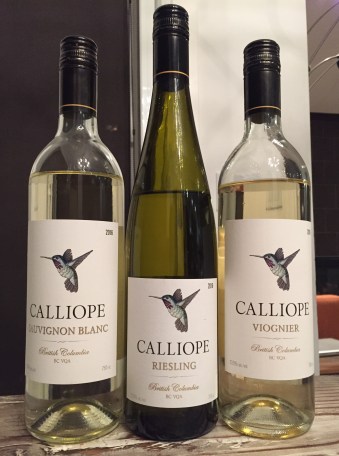
There are a few ways to measure how far British Columbia has come as a wine industry in the past 10-15 years, during which time for my money the jump in quality, understanding and identity has been close to exponential.  Here’s one way:  15 years ago, I don’t think you could have convinced me that a BC winery’s SECOND label could produce a suite of balanced, expressive and generally delightful wines worth seeking out.  In 2017, Burrowing Owl (or, more accurately, Wyse Family Wines, founders of Burrowing Owl) have managed that exact feat with the 2016 releases of their Calliope label, a lineup of wines that according to the accompanying campaign literature is meant for easy and early enjoyment; a true pop and pour.  Sourcing grapes from both the Okanagan and Similkameen Valleys, the Wyse family focuses mostly on whites for Calliope, creating (at times) multi-regional blends under the general “British Columbia” appellation, yet still under the BC VQA banner.  These are marketed as easy-drinking patio wines, meant for drinking rather than dissecting…but since we’re all here, let’s dissect them anyway.

IMG_6897

Stelvin Rating:  8/10 (See what you can do if you apply yourself to screwcaps?  Dead sexy.)

I was provided three different single-varietal examples of Calliope’s white regime:  Sauvignon Blanc, Riesling and Viognier.  When I’m drinking single-grape wines on the lower end of the price spectrum (these bottles probably straddle the $20 mark Alberta retail), the first thing I look for, even before balance of component elements or general deliciousness, is typicity.  In non-wino speak:  if the wine is a Sauvignon Blanc, does it smell like a Sauvignon Blanc?  Does it taste like a Sauvignon Blanc?  Does it help people understand what Sauvignon Blanc is all about, and does it then go the next step and show people what Sauvignon Blanc from its particular home region is all about?  Varietal wines that do this exhibit strong typicity, and as such become extraordinarily helpful barometers for both learning about wine and understanding your own preferences.  If these 2016 Calliopes have any major strength, it is dialled-in typicity:  they are clear and precise examples of what’s in the bottle and what comes out of the ground. Read the rest of this entry »


Happy Canada Day: Stag’s Hollow Summer Set

1 07 2017

[These bottles were provided as samples for review purposes.]

Happy Canada Day all!  Our majestic and humble home turns 150 today, which makes me both celebratory and reflective, emotions which both inevitably lead to wine.  (OK, many things inevitably lead to wine, but these do too.)  As a nation, even at its sesquicentennial, Canada is still young and developing, growing increasingly confident in its global identity but not yet possessed of that inner calm of countries who have already seen and lived through it all.  As a wine nation, we are younger still:  while grapevines have been planted in Canada since the 19th century, our movement towards becoming a commercial producer of quality wines probably only dates back 40 to 50 years; the oldest producing vinifera vines in British Columbia are likely of a similar age.  In many ways, we are still finding ourselves and only starting to chart our path.

FullSizeRender-668

British Columbia wasn’t blessed in centuries past with Burgundy’s army of soil-testing, site-delineating monks, who segregated cohesive parcels of land and determined which grapes did best in which spots.  As such, and without a suite of indigenous varietals to choose from, BC is playing global catch-up, still trying to sort out what might succeed in its soils and what is destined to fail.  In this New World landscape, it would be useful for the province to have a sort of advance wine scout, someone who is unafraid to push the envelope in terms of planting options and help set the boundaries for the area’s future course.

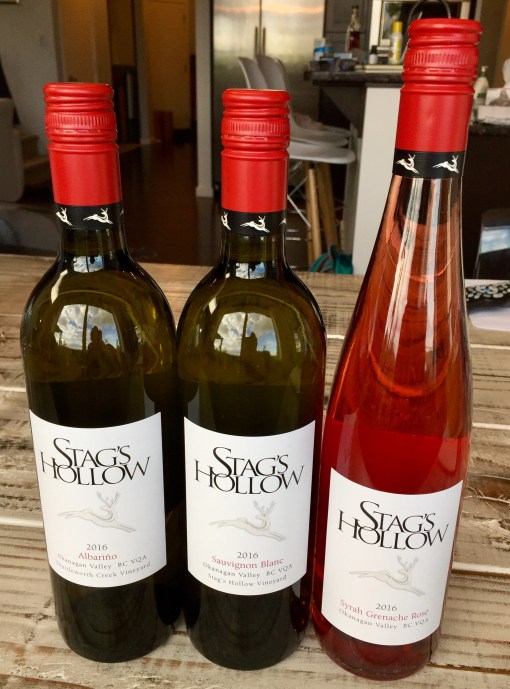
I nominate Stag’s Hollow Winery in the Okanagan Falls, which, led by winemaker Dwight Sick, has done nothing but innovate since I first found out about them.  Make reserve-level small-production Tempranillo?  Check.  Create the Okanagan Valley’s first-ever bottling of Grenache?  Check.  Solera-style fortified wines?  Orange wines?  If you can envision it, Sick and Stag’s Hollow have probably made it, and have expanded the range of possibilities for Canadian wine in the process.  A recent further jump:  Albarino, the crispy, crunchy white grape that is the pride of Galicia in northwest Spain, features heavily in Portugal’s Vinho Verde and has been gaining an increasing worldwide audience.  I had never yet seen a Canadian version of this hot and trendy grape – but if I had had to place a bet on who would be among the first to come up with one, it turns out that I wouldn’t have been wrong.  I got to check out this trail-blazing New World version of Albarino along with a couple other patio-friendly new releases from the winery just in time for summer. Read the rest of this entry »


Calgary Wine Life: Checkmate Chardonnay Global Challenge @ Sub Rosa

6 06 2017
FullSizeRender-640

Anthony Gismondi.

Checkmate Artisanal Winery has no shortage of vision or ambition.  It is both a newcomer to the Okanagan wine scene and the oldest of old hands, founded by Mission Hill proprietor Anthony von Mandl after his purchase of a pre-existing winery (Antelope Ridge, just west of Oliver) and some of its vineyards back in 2012.  Thanks in part to von Mandl’s existing land holdings, Checkmate began its life with elite sources of fruit from five top-tier vineyard parcels, the youngest of which is just shy of 20 years old and the oldest of which are some of the most senior in the country.  The vineyards scatter across the southern Okanagan:  there are two near the winery on the Okanagan’s first-ever formal sub-appellation, the Golden Mile Bench, two across the highway to the east on the neighbouring Black Sage Bench, and one literally 30 feet from the Canada/US border southeast of Osoyoos.  The fruit they produce is reflective of Checkmate’s quality vision and laser focus:  the winery makes SIX different Chardonnays and FOUR separate Merlots, and nothing else.  Their price is reflective of von Mandl’s burning ambition to elevate Canadian wine:  the Chardonnays range from $80 to $125 a bottle and the Merlots all clock in at $85.  It is probably safe to say that this country hasn’t yet seen a winery like this.

At the controls of this super-premium venture is winemaker and general manager Phil McGahan, who began his working life as a lawyer (I knew I liked him when I met him for some reason) and then switched gears and did winemaking stints in Australia’s Hunter Valley and for Sonoma cult Pinot and Chardonnay producer Williams Selyem before being lured north by Checkmate’s potential and master plan.  If your first reaction to the idea of a winemaker leaving California for Canada is surprise (or disbelief), McGahan went to great lengths to point to the Okanagan’s location vis-a-vis southern California as a selling feature:  with world temperatures rising in past decades, he saw Canada as being well-placed as a grape-growing region going forward, perhaps even better than existing warmer-climate regions that may soon find themselves outside of the ideal range for viticulture.  The Okanagan’s combination of (very) long summer days, extensive sunlight and substantial diurnal temperature shifts are proving increasingly attractive to grapes now tended with more careful farming practices, all of which makes up for the area’s shorter growing season.

FullSizeRender-635

The Checkmate wines are created with a quality focus from start to finish, consistent with the raison d’être of the winery.  The Chardonnay grapes are handpicked starting at 3:00 a.m., when it’s cooler, and the fruit is then stored in a cool room at 4 degrees Celsius for 24 hours before being hand-sorted and gently whole-bunch pressed.  Long and slow ferments ensue, mostly with wild yeasts to tease out additional flavours, after which the wines spend 16 months in barrel for better oak integration, with lees stirring towards the end before the Chardonnay is bottled unfined and unfiltered.  All six Chardonnays are made in the same fashion, leaving any distinctions or divergences in their flavour profile to be explained by the story of their site.

So how do you convince the buying public that not just one but SIX Okanagan Chardonnays are worth $80 or more a bottle, and that what is coming out of British Columbia currently can suit up with the best in the world?  You line them up with the world, don’t tell anyone which is which, and let the public see for itself.  That’s what happened this week in the James Bond villain subterranean lair that is Sub Rosa, the quasi-secret underground speakeasy beneath The Guild restaurant on Stephen Avenue, where Canadian wine luminary Anthony Gismondi and winemaker Phil McGahan led a curious crowd through a Judgment-of-Paris style blind tasting of ten Chardonnays, all at similar price points, six of which were Checkmate’s new 2014 releases and four of which were various international heavy hitters.  We had 30 panicky minutes to taste through the full set of wines and rank our favourites, after which each wine’s identity was revealed.  What did this experiment say about the present and future of cult, super-premium, site-specific Canadian Chardonnay?  Read on. Read the rest of this entry »


Entering The Hatch, Spring 2017

23 05 2017

[These bottles were provided as samples for review purposes.]

IMG_6146Ever since I first saw The Hatch’s avian-Thomas-Crown-Affair primary logo shortly after it opened a couple years ago, I have been sort of transfixed from a distance, finding both the winery and its artistic ethos strangely compelling despite knowing basically nothing about them.  Based out of a rustic-modern “shack from the future” in the heights of West Kelowna and sourcing grapes from across the Okanagan and Similkameen Valleys, The Hatch initially comes across (quite intentionally) more like an artists’ collective than a commercial winery, listing Salman Rushdie on its personnel page and expounding in esoteric wine-code about “Ross O” and B. Yanco” (I’ll give you a second to sort that one out).  They confidently found their visual style from the outset thanks to the remarkable imagery provided by local western Canadian artist Paul Morstad (who is also found on The Hatch’s personnel page, playing a banjo); once people have been drawn in by the graphics, it’s up to winemaker Jason Parkes to keep their attention.  The whole artistic cacophony and the simultaneously grand yet whimsical presentation lends The Hatch a jolt of personality that the generally strait-laced BC wine scene can happily use…but does the buzz extend to what’s in the bottle?  Happily, I got to find out.

FullSizeRender-601The Hatch releases its wines in stylistic series, of which I had the opportunity to experience two:  the mid-tier Hobo Series wines, featuring a panoply of hand-drawn labels of hobos (seriously) that risk making you cry thanks to their sheer beauty (also seriously), and the ambitious Black Swift Vineyards series wines, which collectively form an expansive single-vineyard project focused on the various facets of BC’s glorious dirt.  The wine, like the winery, was never boring. Read the rest of this entry »


Burrowing Owl Fall Release Set

12 11 2016

[These bottles were provided as samples for review purposes.]

Burrowing Owl Fall Release Week is quickly becoming one of the highlights of the Pop & Pour blogging calendar.  The winery is highly engaged with consumers and media alike and  is ahead of the game in terms of finding new ways to get its wines into the collective consciousness, and its renown is expanding well beyond its home province of BC as a result.  When the season’s current releases arrive in Calgary around harvest time, I’m ready to do my small part to spread the word.  Bring on the new vintages!

fullsizerender-462

A glorious Pop & Pour fall tradition.

Burrowing Owl is an Okanagan Valley stalwart, and it’s become such a ubiquitous part of the region that it’s easy to forget the winery is less than 20 years old.  The story started in 1993, when founder Jim Wyse replanted a series of vineyards between Oliver and Osoyoos in the extreme southern Okanagan.  There were no immediate plans to build a winery, but Wyse’s vision expanded once he saw the quality of the new grapes.  Burrowing Owl’s first vintage was 1997, and construction on the gravity-flow winery and massive underground cellar on the property was completed in 1998.

fullsizerender-468

 Initially focused on Cabernet Sauvignon, Merlot, Chardonnay and Pinot Gris planted on a single 130-acre site, Burrowing Owl is now up to 14 different planted varietals on 170 acres of estate vineyards in three different sites. It is no accident that the winery is named after the rare underground-nesting owl that was declared extinct in British Columbia in 1980 but is now back on the upswing due to the dedicated conservation efforts of a small group of individuals:  Wyse is one of those individuals, having contributed significant amounts of both time and money to the burrowing owl’s preservation.

fullsizerender-472

Stelvin Rating: 8/10 (Love the colour, love the side pattern and smoothness; not a huge fan of the top embossing.)

 This year I was fortunate enough to have the opportunity to try a sextet of different bottles from the Burrowing Owl 2013 and 2014 vintages, including return engagements with a couple of wines I had in last year’s releases, the Cabernet Sauvignon and the particularly eye-opening Syrah.  Let’s see how the fall 2016 lineup compared, starting with my introduction to one of Burrowing Owl’s founding whites:  Chardonnay.

Read the rest of this entry »


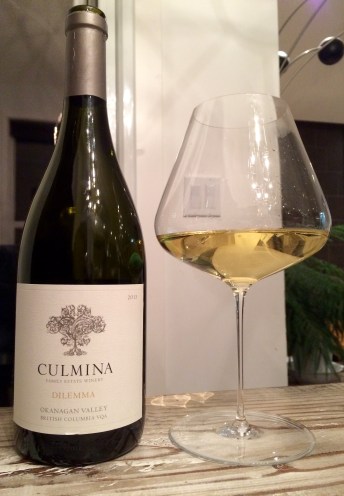
Wine Review: 2013 Culmina Dilemma

7 01 2016

[This bottle was provided as a sample for review purposes.]

Great story, great wine.  And check out the sick Zalto Burgundy glasses I got for Christmas!

Great story, great wine. And check out the sick Zalto Burgundy glasses I got for Christmas!

Back in the saddle, and back to wine, for 2016!  I hope everyone had a happy and restful holiday season; I had a relaxing blog-free week and a half following my arduous 25-day whisky Advent marathon but am raring to start the new year of PnP off right, so I opted for a bottle that I highly suspected would be good.  Suspicions:  confirmed.

Culmina is one of Canada’s top wineries in my books and one of the most compelling stories on the Okanagan wine scene.  A spare-no-expense passion project spearheaded by iconic proprietor Don Triggs (the Triggs from Jackson-Triggs) and his family, Culmina has only been around for a few years, but through careful site study and selection and meticulous planting, it has been churning out wines of intrigue and quality from its inception.  I have previously waxed on about the winery and a number of its bottlings here and here , but this is my first time writing about what could very well end up being the crown jewel of its portfolio, the Dilemma Chardonnay.  I hope it’s not my last.

Read the rest of this entry »