Happy Canada Day: Stag’s Hollow Summer Set

1 07 2017

[These bottles were provided as samples for review purposes.]

Happy Canada Day all!  Our majestic and humble home turns 150 today, which makes me both celebratory and reflective, emotions which both inevitably lead to wine.  (OK, many things inevitably lead to wine, but these do too.)  As a nation, even at its sesquicentennial, Canada is still young and developing, growing increasingly confident in its global identity but not yet possessed of that inner calm of countries who have already seen and lived through it all.  As a wine nation, we are younger still:  while grapevines have been planted in Canada since the 19th century, our movement towards becoming a commercial producer of quality wines probably only dates back 40 to 50 years; the oldest producing vinifera vines in British Columbia are likely of a similar age.  In many ways, we are still finding ourselves and only starting to chart our path.
FullSizeRender-668

British Columbia wasn’t blessed in centuries past with Burgundy’s army of soil-testing, site-delineating monks, who segregated cohesive parcels of land and determined which grapes did best in which spots.  As such, and without a suite of indigenous varietals to choose from, BC is playing global catch-up, still trying to sort out what might succeed in its soils and what is destined to fail.  In this New World landscape, it would be useful for the province to have a sort of advance wine scout, someone who is unafraid to push the envelope in terms of planting options and help set the boundaries for the area’s future course.

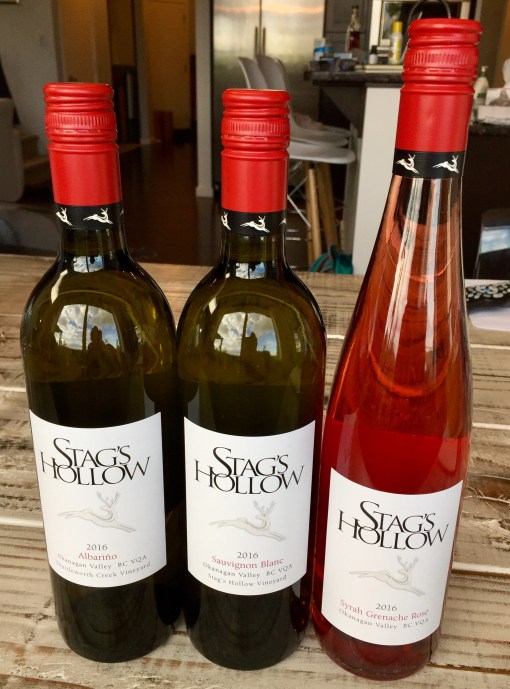
I nominate Stag’s Hollow Winery in the Okanagan Falls, which, led by winemaker Dwight Sick, has done nothing but innovate since I first found out about them.  Make reserve-level small-production Tempranillo?  Check.  Create the Okanagan Valley’s first-ever bottling of Grenache?  Check.  Solera-style fortified wines?  Orange wines?  If you can envision it, Sick and Stag’s Hollow have probably made it, and have expanded the range of possibilities for Canadian wine in the process.  A recent further jump:  Albarino, the crispy, crunchy white grape that is the pride of Galicia in northwest Spain, features heavily in Portugal’s Vinho Verde and has been gaining an increasing worldwide audience.  I had never yet seen a Canadian version of this hot and trendy grape – but if I had had to place a bet on who would be among the first to come up with one, it turns out that I wouldn’t have been wrong.  I got to check out this trail-blazing New World version of Albarino along with a couple other patio-friendly new releases from the winery just in time for summer. Read the rest of this entry »


Calgary Wine Life: Moet & Chandon Winemaker Tasting @ Ruth’s Chris

24 03 2017

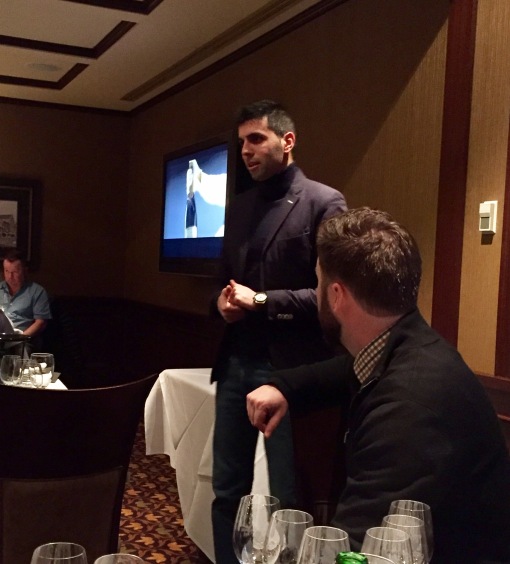
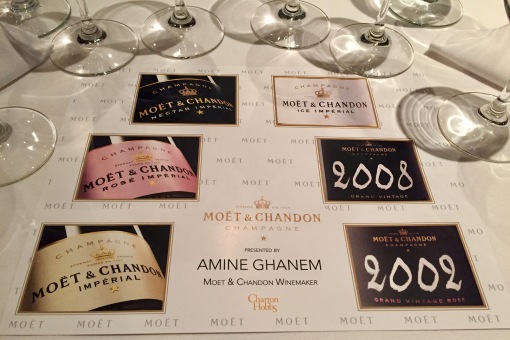
As it turns out, there is no inopportune time for Champagne.  Although the bubbly beverage has built its brand on being the drink of choice for special occasions and other times of celebration, it turns out that it’s equally nice to kick back with a glass of fine bubbles on an otherwise-normal Thursday afternoon.  It’s even better to kick back with six of them, which is what I was fortunate enough to do when Moet & Chandon winemaker Amine Ghanem came to town to lead an attentive and appreciative group through a good portion of the Champagne powerhouse’s portfolio.

FullSizeRender-565

Amine Ghanem, Moet & Chandon.

Ghanem is one of 10 winemakers employed by Moet & Chandon in addition to their cellarmaster, or chef de cave, who directs and decides on the ultimate blend for each of the house’s Champagnes.  Moet has been doing its thing for centuries (since 1743, to be exact – Ghanem informed us that the very first bottle of Moet & Chandon Champagne arrived in Canada in 1839, before we were even a country!), and as such has honed its house style to a fine point, with very clear goals as to the characteristics it seeks to draw out in its Champagnes and specific strategies in place to reach them.  The three pillars of the Moet & Chandon style are, in Ghanem’s words:  (1) “bright fruitiness”, which is attained in part by careful non-oxidative winemaking techniques, even to the point where the house has developed a technique for “jetting” oxygen out of the neck of the bottle after disgorgment to avoid degradation during the maturation process; (2) “seductive palate”, with a welcoming, easy-to-drink texture aided by full malolactic fermentation; and (3) “elegant maturity”, achieved largely through extended lees contact pre-disgorgment, for much longer periods than required by law.  These foundational principles must be working, as we were told that there is currently a bottle of Moet being popped somewhere around the world every second.

FullSizeRender-566

In case the ten full-time winemakers on staff wasn’t a tip-off, Moet & Chandon is a massive undertaking.  It is the biggest house in Champagne and the owner of its largest vineyard holdings, amounting to almost 10% of the entire area under vine in the region.  Since 1962, it has even had its own brand of proprietary yeast, which helps accentuate the characteristics that reflect the house style.  Moet’s primary brand is Imperial, so named in recognition of founder Claude Moet’s 18th century friendship with a certain French emperor, none other than Napoleon Bonaparte.  Napoleon visited the winery many times and was a steadfast consumer of Moet Champagnes, and in 1869 the Imperial brand was christened in recognition of the 100th anniversary of his birth.  The Imperial NV blend starts out as 800 different base wines, which are gradually combined into 3 proposed blends (each featuring solid proportions of all three of Champagne’s grape varieties: Pinot Noir, Pinot Meunier and Chardonnay) before one is selected.  The blending is as much of the artistry as the winemaking itself, and the efforts show in the bottle, which led off our tour-of-Moet tasting. Read the rest of this entry »


Champagne Day: Taittinger Portfolio Tasting

21 10 2016

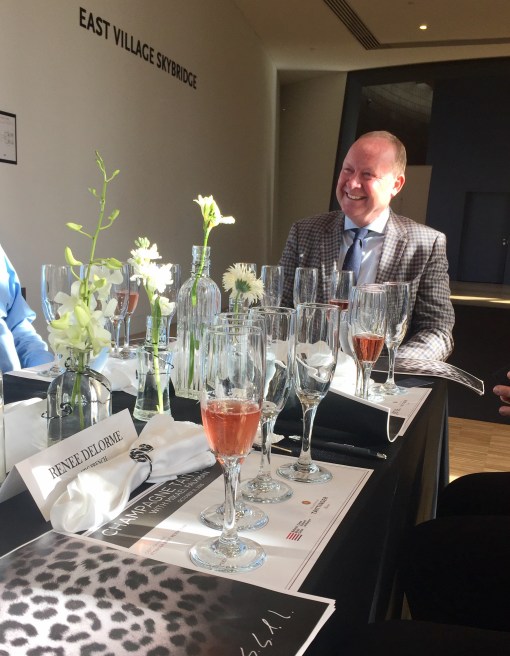
Happy International Champagne Day, all!  If you follow wine media long enough you realize there’s a designated day for basically every country, region and varietal imaginable, but if someone wants to concoct an additional reason for me to drink Champagne, I will take them up on it.  To celebrate this illustrious occasion, I was fortunate enough to take part in a comprehensive tasting of a selection of Taittinger’s impressive lineup of Champagnes, which was particularly special for two reasons:  Taittinger’s International Business Developer Mikael Falkman had flown in from Sweden to lead us through it, and it was the inaugural Alberta release of the astonishingly rare and collectible 2008 Taittinger Collection Series, a bottle unlike any other I have seen to date.  Adding to the auspiciousness of the event was that it was held in the Skybridge of the spectacular new National Music Centre in Calgary, an event space suspended over a road and constructed as a piece of living art, complete with a ceiling fixture made from old instruments that emitted a continual buzzy tune aligned with the vibrations of the building.  Suffice to say it was not your usual Friday.

fullsizerender-445

Mikael Falkman, Taittinger; impeccable brand ambassador.

Taittinger has been around for nearly a century but is particularly catching fire in my neck of the woods right now as the fastest growing Champagne brand in western Canada.  Founder Pierre-Charles Taittinger was a soldier who was wounded in battle in World War I and who recuperated in a town in Champagne, in a memorable old castle that was being used as a command post.  He grew to love the area so much that he vowed he’d return someday and buy the castle, and he did, taking over the chateau and its vineyards in 1932 from Champagne house Forest-Fourneaux and rechristening it in his family name.  Taittinger stayed in the family until 2005, when it was sold (over the objections of one family member, Pierre-Emmanuel Taittinger) to Starwood Capital Group, which owns the Starwood chain of hotels.  The purchasers’ interest was largely in other portions of the Taittinger empire, which included hotels and a parfumerie, and the Champagne business was shortly on the market again.  Pierre-Emmanuel Taittinger managed to get a financing group together and bring the house back to the family that gave it its name, a move that may have saved both the family’s legacy and the quality and reputation of the brand.

fullsizerender-440

Mikael Falkman has been with Taittinger for many years and has lived through its various recent changes of ownership, and he radiated a sense of ease and confidence about where the house is now and where it is going.  Falkman led us through a lineup of five wines, starting with the clean, linear Taittinger Brut Reserve NV and progressing into a quartet of the house’s finest offerings, each reviewed in detail below.  He spoke at length about Taittinger’s house style, which has remained consistent since the house got its current name, focused on freshness, elegance and minerality, eschewing heavy oak and focusing primarily on the Chardonnay grape.  “Notice that there are no spittoons on the table,” he intoned to start, his meaning evident:  this was exquisite, expensive, premium Champagne, and we would be drinking all of it.  Didn’t have to tell me twice. Read the rest of this entry »


Wine Review: 2015 Gramercy Cellars Olsen Vineyard Rosé

19 07 2016
FullSizeRender-386.jpg

Think pink.  And WA State.

This is the first time in a long time that I’ve sat down to write about a wine just because I wanted to.  I love (and am continually amazed by) the opportunity this blog has afforded me to try new bottles and attend incredible tasting events, but every once in a while it’s nice to step back and recalibrate and share the experience of a wine for the sheer joy of doing so.  And since there are few things that give me more joy in this world than opening a bottle of Gramercy Cellars (my favourite producer and a winery that currently occupies about 15% of my cellar), and since I’ve been waiting for this bottle of rosé to land for months now, this is definitely the wine for the task.

The story of Gramercy Cellars is the story of America’s youngest Master Sommelier, who went from serving, then sourcing, wines for some of the pinnacle dining establishments in various major US centres to making his own in rural Walla Walla, Washington, drawn to the desert in the Pacific Northwest by the potential he saw in the area’s Syrahs.  After graduating from Cornell University, Greg Harrington attained the Master Sommelier designation at age 26 (he was until recently the Chair of the Court of Master Sommeliers, Americas and is now on the Board as a Chair Emeritus) while working in New Orleans for famed chef Emeril Lagasse.  Stints for Wolfgang Puck in Las Vegas and the B.R. Guest Restaurant group in New York followed, but a chance tasting of Walla Walla Syrah in NYC led to a trip out to Washington State, which very quickly led to Greg and his wife Pam quitting their jobs, uprooting their lives and fast forwarding a far-off retirement dream of making their own wine to the here and now.  For me at least, Gramercy is one of a small group of Washington producers that is unwrapping the state’s wine potential in real time, turning out nuanced, textured and ageworthy wines that turn New World stereotypes on their heads. Read the rest of this entry »


Domaines Paul Jaboulet Ainé: Parallele 45 Trio

6 07 2016

[These bottles were provided as samples for review purposes.]

There are not many producer names as synonymous with their home region as Jaboulet and France’s Rhone Valley.  From their pinnacle bottling La Chapelle from the world-renowned hill of Hermitage (which I have had once and vividly remember to this day) down through the rest of their lineup, the wines of Domaines Paul Jaboulet Ainé are known and revered the world over, although until recently they were decidedly under-represented in our market.  That has now thankfully changed, and Alberta once again has full access to some of the best wines the Rhone has to offer.

FullSizeRender-379

The Jaboulet winery was first started by Antoine Jaboulet in 1834, who then passed it to his two sons, Paul and Henri, to carry on his legacy.  Paul, the older son, gave the winery his name (the “Ainé” in “Domaines Paul Jaboulet Ainé” literally translates to “eldest”), and it stayed in the family for almost 175 years before finally being sold in 2006 to the Freys, a family of French winemakers with properties in Champagne and Bordeaux.  Caroline Frey (fittingly the eldest daughter of the family), who is now 37 and so was in her late 20s at the time of the acquisition, assumed the mantle of winemaker and has instituted sustainable vineyard practices and carried forward Jaboulet’s reputation for classic quality.

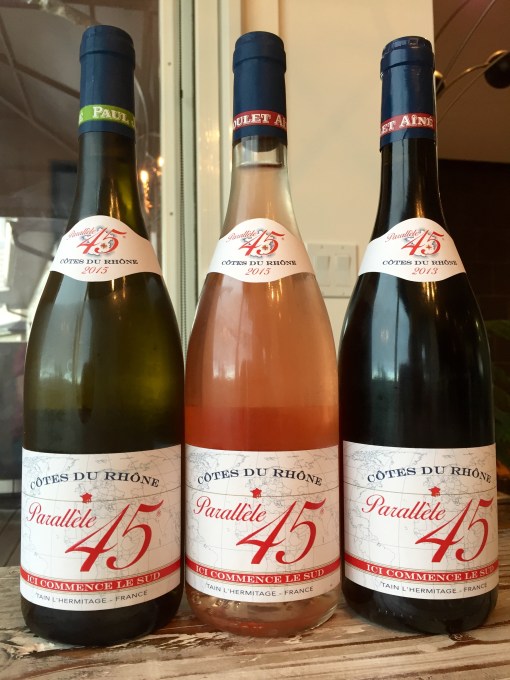
Parallele 45 is Jaboulet’s entry-level lineup of Cotes du Rhone wines, so named because the 45th parallel of northern latitude runs right through the Rhone Valley, bisects some of the Domaine’s vineyards and is only a couple kilometres from its cellars.  The bottles all bear an inscription found on a monument in the nearby village of Pont de l’Isere (which, and I am not making this up, is at 45.0040 degrees N latitude):  “Ici Commence Le Sud” – The South Starts Here.  Post de l’Isere looks to be on the southern edge of the Northern Rhone as opposed to the northern edge of the South, but the mantra still fits, and Jaboulet’s wines straddle both sides of the Valley.  I got to taste through the full Parallele 45 lineup – white, pink and red, all of which share the same $18ish wallet-friendly price tag – and see how well they carried forward the tradition of this great name. Read the rest of this entry »


Torres New/Old World Value Duet

8 09 2015

[These bottles were provided as samples for review purposes.]

New/Old World.  Pink/red.  Value/value.

New/Old World. Pink/red. Value/value.

Over the past couple years, Torres has become my Old Reliable, the brand that never lets me down regardless which sub-$20 value offering I’m trying, regardless where in the world it’s from, and regardless of my level of expectation or uncertainty going in.  It has now been named the World’s Most Admired Wine Brand for two years running by Drinks International (to get a sense of that accomplishment, others in the top 15 this year include Vega Sicilia, Chateau d’Yquem, Ridge, the First Growth Chateaux Margaux, Latour and Haut-Brion, and Tignanello), and it succeeds without a multi-hundred-dollar wine on its resume and with wineries on three separate continents, focused on marrying high quality with affordable pricing wherever it goes.  That combination is not easy to achieve, but Torres makes it look routine.  I had a chance to toast the end of summer amidst the weekend snow in Calgary with two QPR (quality-to-price-ratio) gems from the Torres portfolio, one from the New World and one from the Old, each crafted with the same evident care and attention. Read the rest of this entry »


Wine Review: 2014 Bila-Haut Rose

13 07 2015

[This bottle was provided as a sample for review purposes.]

Winning producer, winning value.  And look at that colour!

Winning producer, winning value. And look at that colour!

I just got back on the weekend from a sunny California vacation, and as I was coming from hot, humid San Diego into hot, dry Calgary (this was pre-torrential thunderstorms) after the end of a long travel day with two young children, I had my first ever legit rose craving.  Don’t get me wrong:  I like rose just fine, but until this moment I had always been on the “perfectly happy to drink it” side of the fence as opposed to the “insatiable desire for it” side.  But something about that day made me long for a bottle that was crisp and cool yet fruity and substantial, a summer wine niche that rose fits to the tee.  Almost immediately after dropping off the suitcases I went to my neighbourhood liquor store, browsed their abysmal pre-chilled rose selection, and escaped with the one non-White Zinfandel bottle I could find:  a Michel Chapoutier rose called Beaurevoir (pictured below) from pink wine’s spiritual homeland of Tavel in south-eastern France.  After downing it probably more quickly than I should have, I realized that I had another Chapoutier rose in my cellar and promised that I would take my time with this one.  Consider this a kick-off for what looks to be a busy Pop & Pour summer! Read the rest of this entry »


Wine Review: Torres Patio Party

16 06 2015

[These bottles were provided as samples for review purposes.]

Summer fun - ideally outside, without rain.

Summer fun – ideally outside, without rain.

Call it countercyclical marketing or just really bad weather judgment, but I’ve managed to hold off on writing up a patio-wine-themed review duet until the week when we’re due to get utterly deluged with rain.  In the event that you’re soaking wet while reading this, consider it a faint flicker of hope for the future.  So far the forecast has been, as usual, wrong, which will hopefully allow you to disregard this entire paragraph.

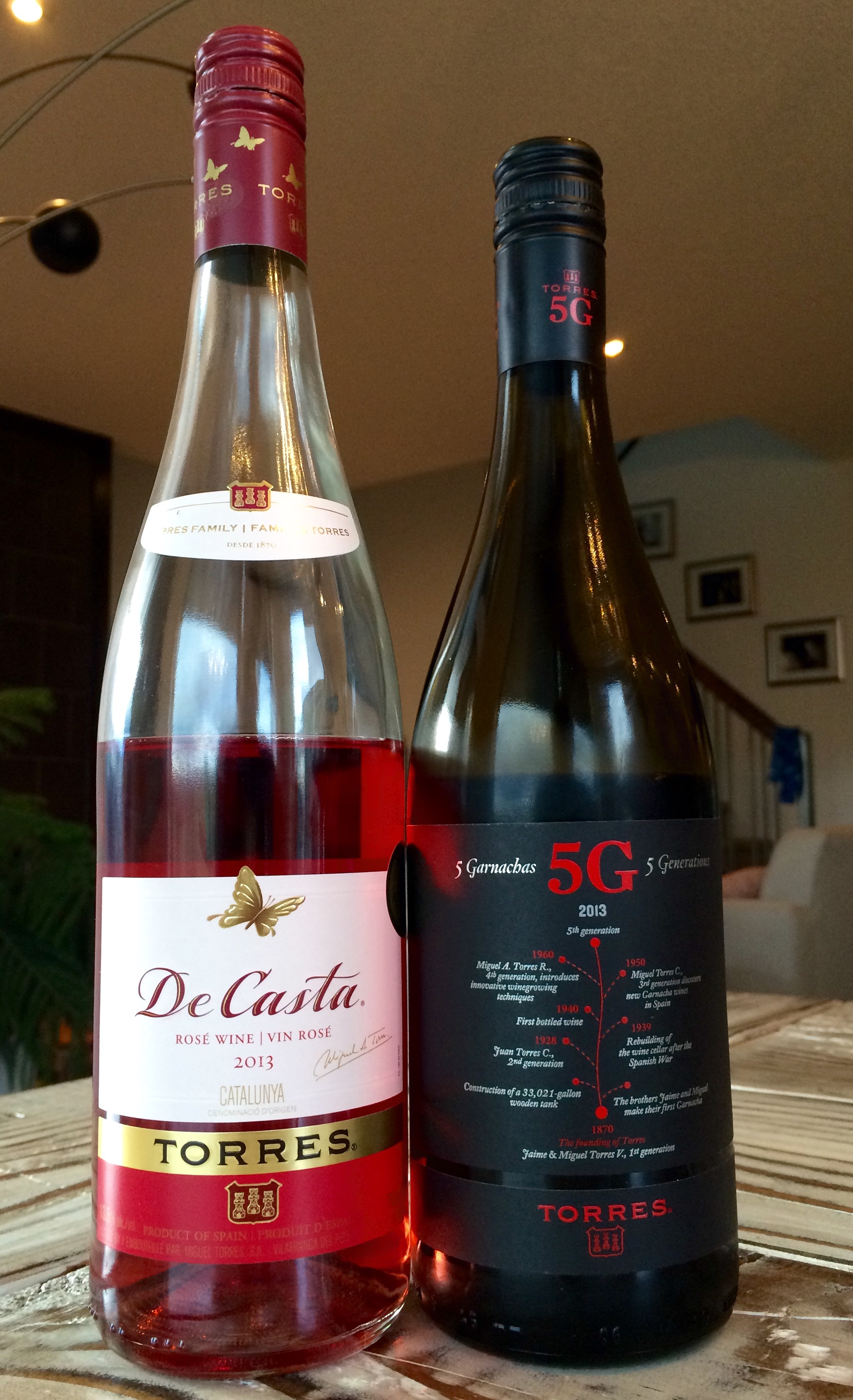
I wanted to write up these two wines together because they share both a similar grape source (Garnacha, better known in the New World as Grenache) and a similar vision:  to be a cheap and cheerful source of quality fun out of a bottle.  Of course, they also share a producer, Miguel Torres, whose fifth generation family estate has become one of the most solid wine bets out there, a name that evokes trust regardless of the region, country, grape or style of the wine behind the label.  These relatively new releases are twin 2013 Torres bottlings of Garnacha-based wines:  the De Casta Rose, which blends Garnacha with Carinena (Carignan), and the 5G, a 100% Garnacha representing five generations of the Torres family tree and the winery’s constant hunt for perfection in that grape.  Both are value-priced (under $15 and under $20 respectively) and both are meant for easy and early enjoyment. Read the rest of this entry »


Wine Review: 2012 Miguel Torres Santa Digna Brut Estelado Rose

9 02 2015

[This bottle was provided as a sample for review purposes.]

From Chile, with love.

From Chile, with love.

Whatever your opinion is on Valentine’s Day, it has had a highly valuable (and surely unintended) side effect on the wine industry:  for one lone day a year, it has shone the spotlight brightly on pink wine.  Rose wines continue to be misunderstood, undervalued, unfairly derided and almost absurdly underrated, so I will happily sing the praises of any day that brings the world’s attention to them ever so briefly, even if it’s a Hallmark-created one.  And if you’re going to grab a pink wine to celebrate February 14th with your true love (and after all the effort I put into the last two sentences, you’d better), I humbly suggest it should be this one, whose flavours are matched equally by its story…and its price.

Miguel Torres is one of Spain’s largest and best regarded wine empires, still entirely family-run after 5 generations.  Torres brands show up in all of Spain’s top wine regions, but the family is also highly prevalent in Chile, where current CEO Miguel Torres Maczassek lived for three years starting in 2009 to head up operations.  Despite being a European, international company, Torres is passionately devoted to telling a local story with each of its labels, and Torres Maczassek himself has a clear love for Chile that shows through when you talk to him and is reflected in his wines.

Read the rest of this entry »


Calgary Wine Life: Wines of Portugal Tasting @ Market

7 11 2013

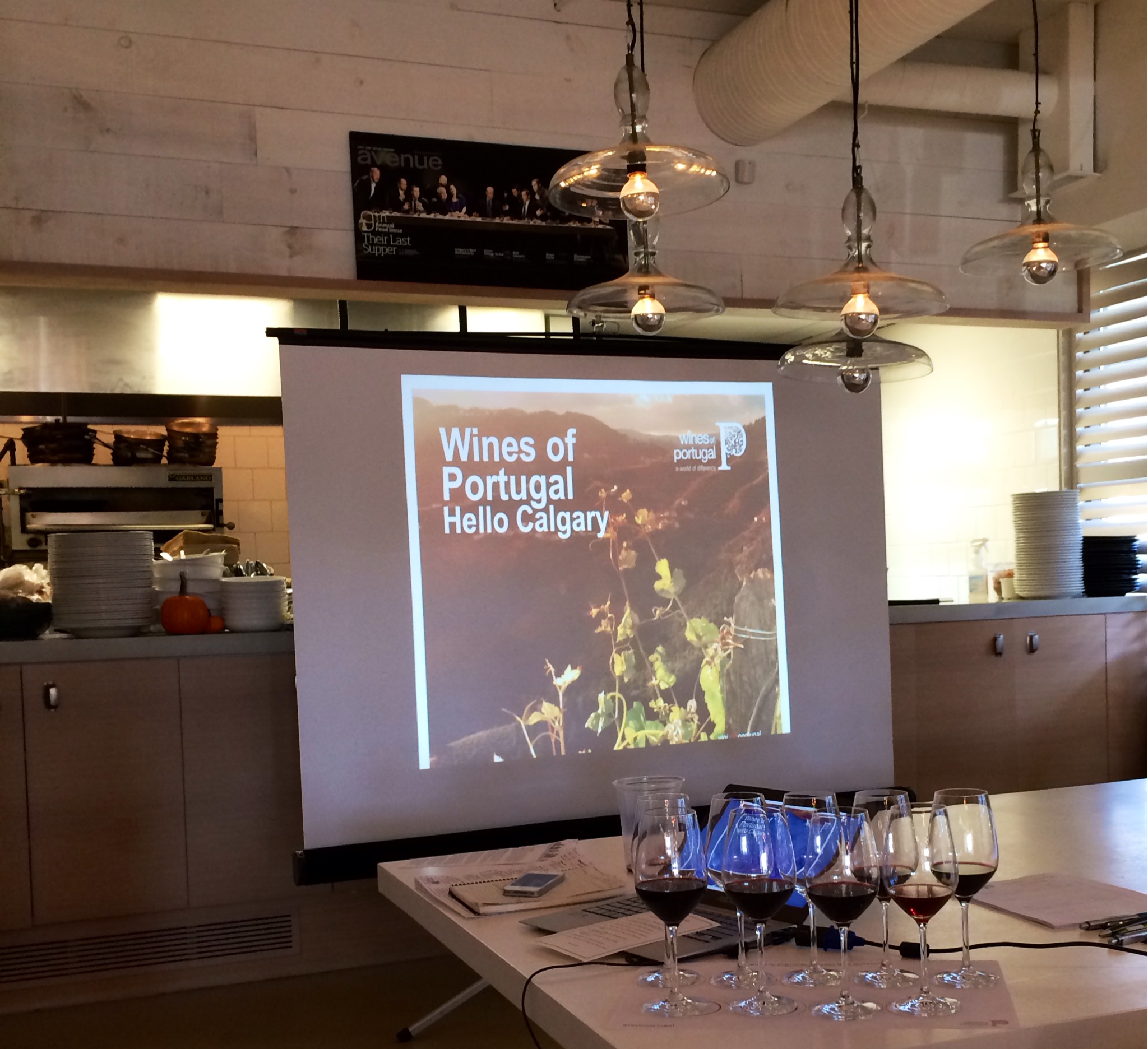
It appears to be Underappreciated Wine Region Month here at Pop & Pour.  Last week I was exposed to the new wave of bottlings coming out of the southern Italian island of Sicily; this week it was Portugal, another unheralded European wine area, that was aiming to bring its remarkable wines to the attention of international export markets.  I got the opportunity to sit in on a guided tasting put on by the Wines of Portugal and led by energetic and well-versed sommelier extraordinaire DJ Kearney, who brought us up to speed on everything from the number of indigenous grape varieties found in Portugal (250+) to the proper pronunciation of key Portuguese wine terms (hint:  if it ends in an E, don’t pronounce the E, no matter how much you want to).  The tasting was held at Market Restaurant on 17th Avenue, which I had never been to before but which proceeded to serve us an absolutely stellar three-course lunch that will be reason enough to bring me back very soon.

image-9

It was sort of fitting that I got to experience Portugal’s wine story after sitting in on Sicily’s, because the two regions have much in common.  Both are home to large numbers of local grape varietals that are barely found anywhere else, and both have made the conscious choice to embrace these lesser-known grapes and focus their quality production around them.  As a result of a lack of name recognition and a dearth of critical attention on these under-the-radar wines, both can offer tremendous value for money for those consumers brave enough to take the plunge (I think Portugal might win the worldwide gold medal for these kinds of bargains).  And both tend to focus more on wines that are blends of multiple different grapes as opposed to single varietal offerings, with Portuguese wine in particular almost always a group vinous effort as opposed to a solo act.  Kearney channeled her inner Wino Karl Marx when talking blending, urging us through these wines to shed the shackles of varietal typicity and embrace the communal symphony of these intrepid groups of local grapes (featuring reds Touriga Nacional, Touriga Franca, Tinta Roriz [aka Tempranillo] and Baga, and whites Alvarinho [aka Albarino], Arinto, Encruzado and many more) all working together to make something greater than themselves.

Read the rest of this entry »


Wine Review: 2010 Dirty Laundry “Hush” Rosé

7 12 2011

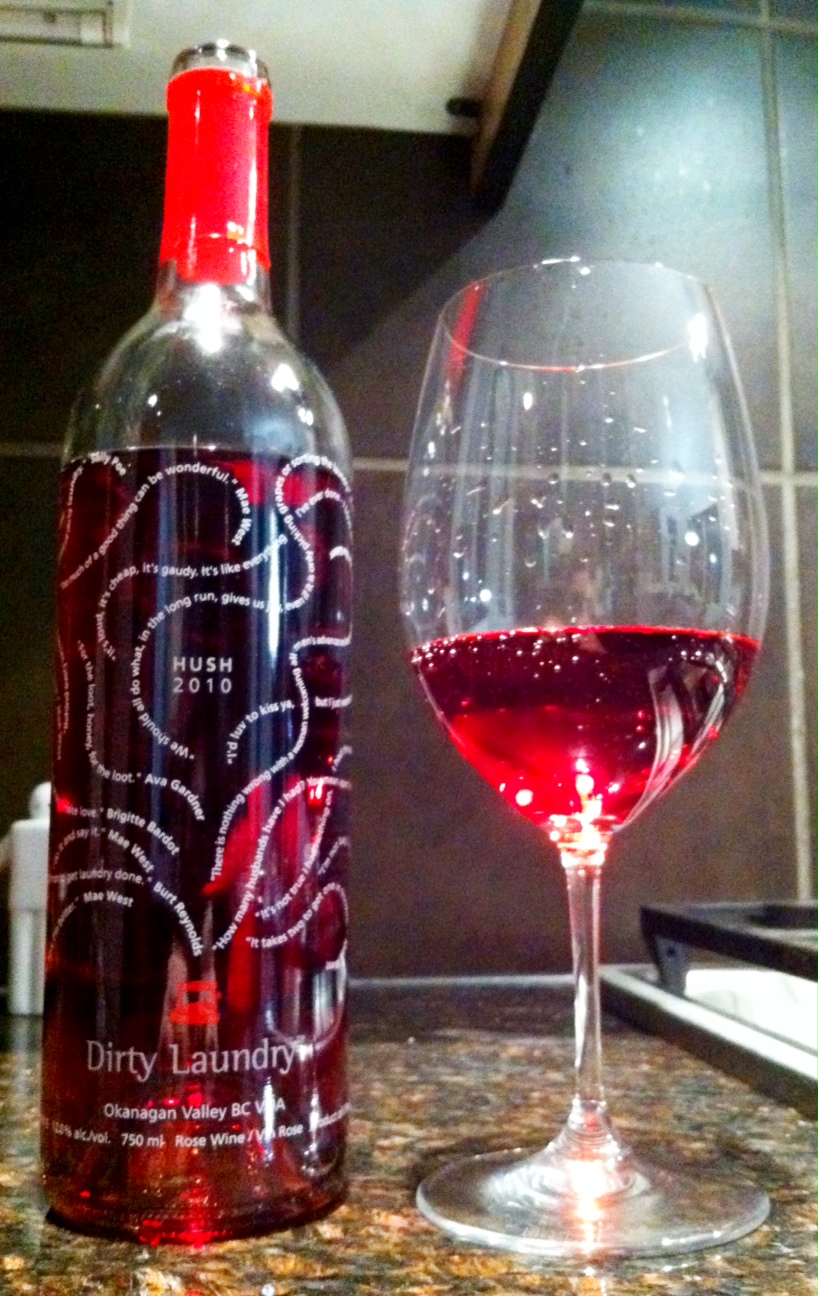
Maybe it's season-suitable after all -- it looks like a Christmas light. That's turned on.

I don’t drink as much rosé as I should.  Even though I know that most of it isn’t the sweet and insipid stuff of stereotype, whenever I’m in wine-buying mode there always seems to be something else on the shelf that pulls me in more.  In fact, I’m pretty sure that this, Wine Review #82, is Pop & Pour’s first rosé write-up.  Yikes.  I promise to do better in the future.

While this is PnP’s inaugural rosé feature, it’s the second wine from the Dirty Laundry winery in Summerland, BC that I’ve reviewed, and (thankfully) the first I haven’t been horribly disappointed in.  For those of you who missed the tale of my September visit to Dirty Laundry and my lack of admiration for their Madam’s Vines Gewürztraminer, click here for the full scoop.  This rosé was the only other wine I grabbed from DL, and the wine in their cellar-door tasting lineup that I liked the most, so I popped and poured tonight hoping for bigger and better things.

Read the rest of this entry »