Calgary Wine Life: Paul Jaboulet Aine Tasting with Adrien Laurent @ Calgary Petroleum Club, Part II

2 05 2018

By Raymond Lamontagne

To read Part I of this epic tasting write up, click here.

IMG_1356I was attempting to pace myself until the second half of this tasting, wishing to avoid palate fatigue and endeavoring to preserve a fresh mindset for the crown jewels near the end. That delicious St.-Joseph in particular made this sort of patience challenging. I glance to the end of the written materials and there’s even a dessert wine to close things out. Wow. We did move quickly and this was a good thing. There was just enough time to analyze and enjoy some brief discussion about each wine. Part II begins with the “roasted slope”, peaks on Hermitage hill (the big reason we are all here!), and ends in … Beaumes de Venise?! Read on, faithful.

2015 Cote Rotie Domaine des Pierrelles (~$123)

Cote Rotie could serve as the centrepiece in a tasting such as this, and no one in the know would complain much. An appellation short on geographical landmass but long on excitement, some of the steepest viticultural slopes in France are found here, so much so that the region became moribund in the 1970s: The back-breaking labour required did not provide sufficient economic returns. Eventually the folly in this view was recognized once and for all. The vineyards are angled so as to maximize the ripening effects of the sun (thus the moniker), although the wines are not baked in what is still a rather stark and harsh climate, instead evidencing a sublime savoury perfume. These grapes hail from a 1.5 ha biodynamic plot in Cote Blonde, known for graceful wines suitable for early consumption (relatively speaking). The vines are 40+ years old and are rooted in soils composed of mica-schist and dusty old exposures of iron oxide. Read the rest of this entry »


Calgary Wine Life: Paul Jaboulet Aine Tasting with Adrien Laurent @ Calgary Petroleum Club, Part I

29 04 2018

By Raymond Lamontagne

Not a bad way to dust off my blogging chops after a lull. A chance to taste a 100-point wine? Sure thing. The fact that said 100-point wine happens to be the 2015 Paul Jaboulet Aine Hermitage La Chapelle causes my already surging excitement to soar into the stratosphere. Although I am not personally enamoured with the Parker-style point system nor its myriad effects on winemaking and consumer preferences, such a feat STILL means something even to this skeptic. I am truly happy for winemaker Caroline Frey. My sincere congratulations! This was a generous enough spread of wines that two posts are in order. I shall try to do the first set of these marvels justice here, stricken as I have been (by Bacchus himself?) with some sort of virulent bug that makes my bones feel like rheumy old birch twigs stashed away in a mausoleum. And I was hoping to sip something while writing this … Discretion is probably the better part of valour.

IMG_1347

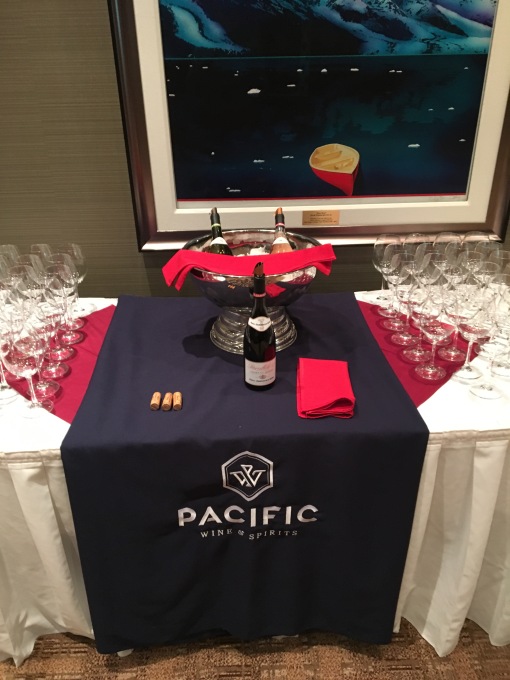
We were greeted with some entry level Jaboulet Parallel 45 Cotes du Rhone bottles … A red, a white, and a rose … I sampled them all, of course. 😉

Our host Adrien Laurent felt like a kindred spirit, keeping things scholarly while occasionally flashing an understated charisma or busting out some hilarious off-colour jokes about the French distaste for monarchies (you had to be there). This tasting featured not just the one legendary new release but THREE Hermitage selections, plus an additional spread of whites and reds in what turned out to be a guided tour of nearly the entire Northern Rhone, through the lens of a single producer. How utterly marvellous. I shall cover them all, after first providing some background on the region and this historic producer. Read the rest of this entry »


Wine Review: Famille Sichel Bordeaux Tiers

15 04 2018

By Peter Vetsch

[These bottles were provided as samples for review purposes.]

IMG_7943

What a Bordeaux progression looks like.

Bordeaux is one of those regions that any aspiring wine geek finds out about roughly 15 seconds after beginning their vinous adventure.  It leads off many textbooks, is (rightly) touted as the spiritual homeland of red grape overlord Cabernet Sauvignon and its consigliere Merlot and is held up as a must-try area both so that new oenophiles can get a sense of the classics and because top-flight Bordeaux can be so memorable that its first-chapter place in all future textbooks is likely assured.  Of course, all of that comes at a price, one that seems to be increasing by the year, as wines from the top chateaux become more luxury commodity and less agricultural product and as international demand in new markets shoots through the roof.  So what are the non-obscenely wealthy wine-curious to do?  Here’s one way to start:  find a reputable producer and taste your way up their lineup, through the quality tiers and nesting-doll classifications layered throughout the Bordeaux appellation.  Even if you don’t make it all the way up to the grand vin flagship of the chateau, you will end up with a really good sense of what makes this rarefied region tick and also start to understand why those tiers exist in the first place.

IMG_7947

I was fortunate enough to test this tasting theory with the wines of Famille Sichel, a producer with whom I didn’t initially think I was familiar until discovering that they are the owners of one of Bordeaux’s hidden gem producers, Margaux’s Chateau d’Angludet.  While the winery is centuries old and the Sichel family’s history in Bordeaux is almost equally entrenched (they have been established in the region as a negociant since 1883 and are on their sixth generation of family ownership), their two paths didn’t cross until the 1960s, when d’Angludet was in a state of extreme disrepair and was bought and revived by Peter Sichel thanks to an extensive replanting and restoration program.  Current proprietor Benjamin Sichel continues both the negociant business (under the Maison Sichel banner) and the Chateau’s estate bottlings with a heavier focus in the vineyard and a defter touch in the cellar.  I have previously enjoyed Chateau d’Angludet on numerous occasions and now got to experience the trail of bottles that leads up to it. Read the rest of this entry »


Calgary Wine Life: Domaine Chandon Sparkling Wine Dinner @ Elwood and the Rabbit

13 04 2018

By Dan Steeves

Chandon is a name that instantly makes me think of the luxurious Champagnes from the famous (and largest) Champagne house Moët & Chandon, but its North American offspring Domaine Chandon is not just a clone of its majestic parent company.  It has a vision to be different and create its own legacy by providing a pure expression of what California is all about, while at the same time maintaining the quality that is inherent in its French pedigree.

When Domaine Chandon was established in the Napa Valley in 1973 it was not the first international venture for Moët & Chandon (Chandon Argentina was established first in 1959, and California was succeeded by Brazil in 1973, Australia in 1986, China in 2013, and most recently India in 2014) but it was the first French-owned sparkling wine venture into the US, which now hosts operations from many of the large Champagne houses. Moët & Chandon recognized the potential of the area for sparkling wine production, especially Carneros, which at the time was seen as too cold and infertile to grow grapes (coming from Champagne, they knew it’d be perfect). Moët & Chandon purchased 400 acres of Carneros vineyard land for mere pennies on the dollar in today’s market. It was a humble California beginning for the M & C Winery on March 26, 1973, whose official address was John Wright’s garage, but within a few years the current winery facility was built and opened to the public and the house’s name was officially changed to Domaine Chandon. The 45th anniversary of Domaine Chandon just passed a few weeks ago with the winery holding firm as a longstanding powerhouse in Napa Valley, seeing over 200,000 visitors a year and likely holding the honour of being the largest producer of traditional method sparkling wine in the US.

The line up of Domaine Chandon California wines available in Alberta –  Blanc de Noirs, Brut, and Rosé

Having visited the Moët & Chandon mothership in Épernay (the heart of Champagne) a couple years ago and being fan of all their Champagne wines, I was ecstatic at the opportunity to try the Chandon California wines alongside some delicious food from Bridgeland’s Elwood and the Rabbit. The dinner was hosted by Brian Fairleigh, the Brand and Wine Educator for Domaine Chandon, whose infectious passion for sparking wines is matched closely by a wealth of knowledge about every aspect of Domaine Chandon. Brian made it clear that comparing Moët & Chandon Champagne with Domaine Chandon is like comparing apples to oranges: the two are very different, although they share the same adherence to quality and excellence in the vineyard and cellars. Domaine Chandon aims to showcase the fun, vibrant, sunny California fruit flavours and builds wines that are accessible, enjoyable, and made for everyone to enjoy all year round. Many people only reserve sparkling wines for times of celebration, and although they are perfect for those times, they are equally as enjoyable for a casual sip with friends or an accompaniment to almost any meal. Brian was happy to show us some great pairings. Read the rest of this entry »


Wine Review: Stag’s Hollow Renaissance Reds

5 04 2018

By Peter Vetsch

[These bottles were provided as samples for review purposes.]

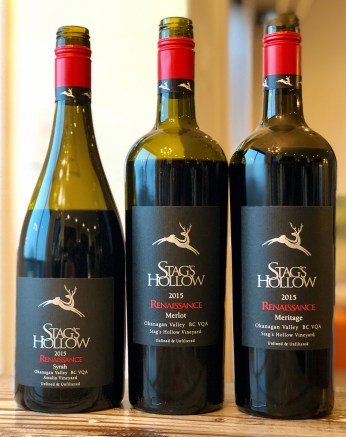
IMG_7892

The big guns.

As I have mentioned in reviews past, my first thought of Okanagan Falls’ Stag’s Hollow Winery is always as a forward-thinking, try-everything trailblazer, the continual vanguard of varietal suitability and experimentation in British Columbia, constantly checking in on whether the next potential star grape of the province (be it Albarino, Grenache, Dolcetto, or any number of others in its viticultural Rolodex) might be one that few had previously considered.  So it’s a fun change of pace tonight to sit down and see how they handle the classics, those big red varietal stars so often seen across the Old World and New World alike, the first grapes you expect to see on any wine store shelf.  This review set is a particular treat, because all three of the bottles below hail from Stag’s Hollow Renaissance line, the winery’s premium flagship tier of offerings, produced only in vintages when the wines can live up to the bottle’s special black label.  I have heard rumblings that the 2015 Renaissance set breaks new ground in terms of quality and longevity; I had not previously had the opportunity to test this theory for myself, but it would not surprise me out of a winery that always seems to be improving. Read the rest of this entry »


Cellar Direct: Underdog Whites

27 03 2018

By Peter Vetsch

[These bottles were provided as samples for review purposes.]

IMG_7833Close-following Pop & Pour adherents (if such things exist) will have been waiting for this moment for a couple of months.  In my last write-up about the tremendous Euro-tacular wine offerings of Cellar Direct, I teased that the two Italian reds going head-to-head in that review were not the only bottles (or colours) from that country that Cellar Direct had sent my way, but I opted to hold back the indigenous Italian white wine from that set so that it could shine in an all-white duet in a later post.  Well, here we are, and tonight’s 100% Arneis lead-off hitter is joined in the batting order by a rather mysterious and off-grid white Burgundy (to the extent that anything Burgundy can be considered off-grid), each bottle a tantalizing find that proves both that even famous regions have hidden values and that you often need some expert assistance to find that value needle in the prestige haystack.  If Cellar Direct is anything, they are that Old World value sherpa, leading you to consistent quality at credible price points over and over again.  Their streak of never sending me a bad bottle lives on. Read the rest of this entry »


Calgary Wine Life: Veuve Clicquot Release Tasting @ Yellow Door Bistro

23 03 2018

By Peter Vetsch and Raymond Lamontagne

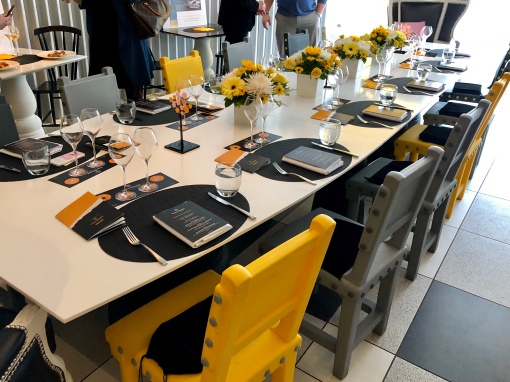
Sometimes the best times to celebrate are the times when there is nothing obvious to celebrate.  It’s a dreary weekday in late March in still-snowy Calgary, but Champagne lifts all spirits and makes all occasions special, and this was no exception.  The eponymous yellow door of the Yellow Door Bistro at Hotel Arts perfectly foreshadowed the array of yellow labels awaiting us inside, including the brand new release from Champagne’s powerhouse (and power-house) Veuve Clicquot.  Winemaker Bertrand Varoquier expertly guided us through a series of Veuve releases, not least of which was the winery’s latest concoction, the Extra Brut Extra Old NV, soon to be available on retail shelves across Calgary.

IMG_7792

Veuve Clicquot is one of the oldest houses in Champagne, founded in 1772 by banker Philippe Clicquot-Muiron, who was then proceeded at the winery by his son Francois.  When Francois suddenly died young in 1805, his widow Barbe-Nicole Clicquot-Ponsardin stepped forward to take over the reins and run the business, a daring decision for a 27 year-old woman in early 19th century France.  The young widow (or veuve, in French) persevered, and her strong vision and fierce entrepreneurial spirit took the winery to new heights, leading to some significant innovations in tradition-laden Champagne.  Madame Clicquot was the first to create a rosé Champagne made from 100% wine (previous renditions of pink Champagne were created by mixing white wine with elderberry juice).  She is also credited with creating the riddling process that allows the dead yeast cells from Champagne’s in-bottle secondary fermentation to slip down into the neck of the bottle so that they can be frozen and disgorged, to keep the finished wine from being cloudy; before this, Champagne was served hazy and decanted to let the leesy sludge settle before pouring.  Clicquot-Ponsardin contributed so much to the region over her lifetime that she was nicknamed “La Grande Dame” of Champagne, a name that since 1872 has also been used for the house’s prestige cuvée.  Her impact on the winery was so significant that the entire brand was renamed in her honour.
IMG_7794

Bertrand Varoquier is a native son of Champagne, born in the heart of the region in the town of Reims; as he puts it, “my blood is bubbly”.  For the past six years of his extensive 18-year wine career, he has been at Veuve Clicquot, where he is currently responsible for all red wine vinification.  Due to the house’s production size, and in order to ensure that its winemaking happens as close as possible to the vineyards where the grapes are harvested, the red grapes that go into Veuve’s cuvées (primarily Pinot Noir, which is at the core of Veuve Clicquot’s identity) are processed and vinified in their own standalone facility in Buzy.  Each discrete parcel of each red vineyard is vinified separately, and after alcoholic fermentation is complete and scores of still wines are created (some with very limited colour due to restricted skin contact, some fully red for use in rosé Champagne creation, all produced solely for future blending), the lots are sent to Veuve HQ in Reims for malolactic fermentation and blending.

IMG_7809

Bertrand Varoquier, winemaker at Veuve Clicquot

Unlike almost any other top wine region in the world, which tends to glorify single-vineyard and single-vintage expressions of time and place, Champagne’s focus is on achieving and maintaining each house’s unique signature style with precision and consistency, year in and year out.  The mammoth challenge of this task is almost unquantifiable, but this will give you a sense of it.  In addition to his winemaking duties, Bertrand is on the Veuve Clicquot tasting committee along with Cellar Master Dominique Demarville and others.  Every year, from the start of November until the start of March, the committee tastes 24 different sample lots of still wines PER DAY out of the roughly 1,200 (!!!) already-vinified non-bubbly base wines aging in full stainless steel tanks in Veuve’s cellars in order to determine which wines will be used to populate each of the house’s different Champagne releases.  These base wines are from the present year’s harvest plus nearly twenty prior vintages, and all are ultimately rolled into a multi-vintage, multi-source patchwork tapestry that the Cellar Master weaves into the emblem of Veuve Clicquot, so that the buying public gets the taste experience they expect out of every single Veuve Champagne, regardless of the year in which they buy it. Read the rest of this entry »


Wine Review: Red Blends of the Eternal Ice Age

20 03 2018

By Peter Vetsch

[These bottles were provided as samples for review purposes.]

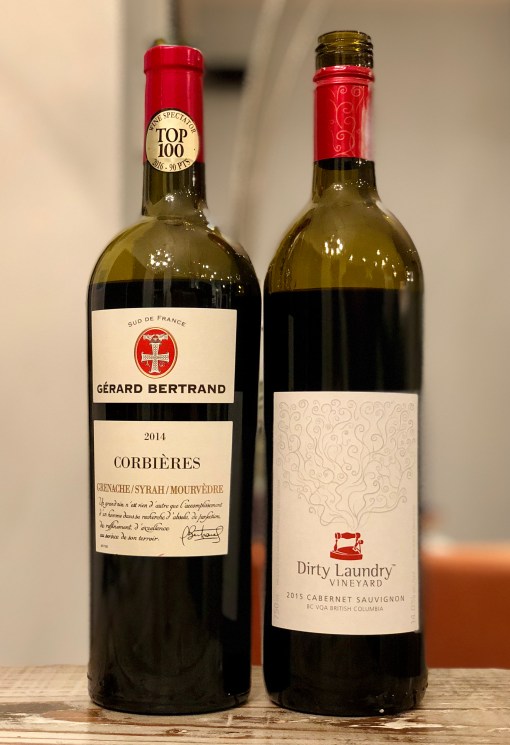
Happy first day of spring.  Spare me.  Yeah, I’ve seen all of the (obviously non-local) articles and Instagram pics and Twitter updates about new rosé and bubble releases and patio beers and T-shirt weather.  Meanwhile I have snowbanks bordering each side of my driveway that are taller than each of my children and still see the minus sign side the thermometer heading to work every morning.  It’s supposed to snow again on Thursday morning and there is no god and we are in some kind of forsaken meteorological time loop that will have no end.  So forget you, frizzy pink refreshing splashes and dainty Prosecco; I’m gearing up for blustery Armageddon, armed with a pair of full reds that scoff at the entire concept of spring.  I need to find joy somewhere, after all.

IMG_7747

Forget you, “spring”.

2014 Gerard Bertrand Corbieres (~$20)

I know from past experience that Gerard Bertrand is a value wine savant, and that his legend in the south of France is ever-growing.  I also knew that this particular bottle of Corbieres, part of his “Terroirs” regional collection of bottlings, hit the wine awards mother lode in 2016 by landing the #55 spot in the much-anticipated Wine Spectator Top 100 list — not bad for a $20 bottle from a little-known region.  What I didn’t know about Bertrand was that he was a prodigious professional rugby player before he followed in his family’s footsteps and turned to winemaking, even juggling a pro career with vigneron duties in the aftermath of his father’s death as he took over the reins of his ancestors’ business.  He has now hung up the cleats for good but brings some of his sport’s scrappiness to all of the wines that bear his name.   Read the rest of this entry »


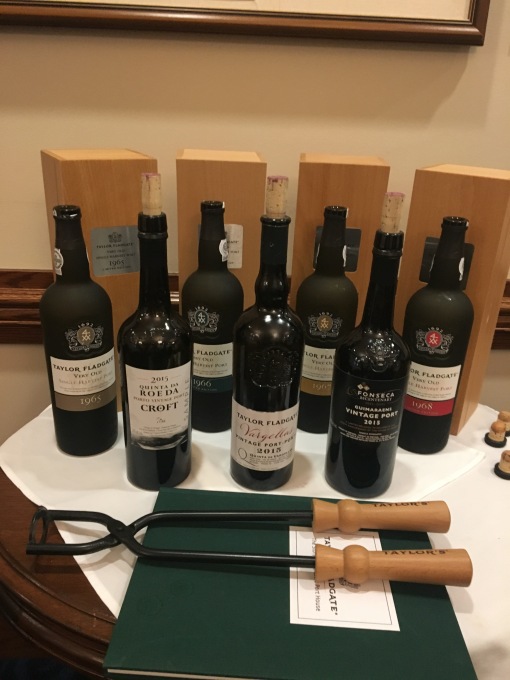
Calgary Wine Life: Taylor Fladgate 1968 Single Harvest Port Release

17 03 2018

By Raymond Lamontagne

Although I am deathly tired of the evil winter weather that simply will not give up the ghost in this city, I am more than happy to brave one more snowstorm (please, just one more?) in order to carry on the Pop and Pour tradition of covering the annual release of a Taylor Fladgate Single Harvest Port.  These bottles capitalize on Taylor Fladgate’s extensive back catalogue of aged Port stocks.  They are tawny Ports, meaning that they are aged in barrels for many years, exposed to oxygen and thereby mellowed into a resplendent golden brown. They are also Colheitas, or tawnies where all of the bottled grapes hail from a single vintage.  Taylor Fladgate eschews the term Colheita on these labels in favour of a more anglicized approach.  Regardless of the naming convention employed, Port connotes a sense of pageantry, giving off a regal vibe that this self-styled progressive enjoys basking in from time to time. I wander through the fine wooden décor of Calgary’s Ranchmen’s Club, past a litany of taxidermied game, following my nose into the tasting room where fragrant pourings have already sat for some time.

IMG_1123

Our host Cynthia Opsal, Brand Manager for The Fladgate Partnership for Pacific Wine & Spirits, leads us off with a video that features an interview with Alistair Robertson, principal shareholder in the Fladgate Partnership.  Robertson explains that terroir is fundamental to good Port.  According to Taylor Fladgate winemaker David Guimaraes, 12 different indigenous grape varieties are planted, with four providing the majority of production.  Some grapes such as the vogue Touriga Nacional provide tannic grip, while others such as Tinta Barroca provide more color and sugar content.  Robertson explains that a day of work on the estate involves eight hours of picking grapes, followed by four hours of foot treading in the case of high quality bottlings.  Production of all Port involves adding grape spirit to stop fermentation just before its midpoint, which at Taylor Fladgate occurs around three days into the fermentation process, when about 5-6% alcohol has been produced.  Enough spirit is added to bring the alcohol up to around 20% (which in turn kills off any remaining yeast).  David Guimaraes has stated that a recent trend toward use of more clean and pure spirits means that vintage Ports are approachable sooner, with more fruity expression.  This latter point seems particularly relevant, as this year we get a welcome break from tradition:  instead of the preliminary offering of blended tawny ports that were tasted in prior Release years, we get to sample three 2015 vintage Ports — Single-Quinta vintages, that is.

Read the rest of this entry »


Calgary Wine Life: A Special Evening with Cinzia Merli of Le Macchiole @ Centini

15 03 2018

By Raymond Lamontagne

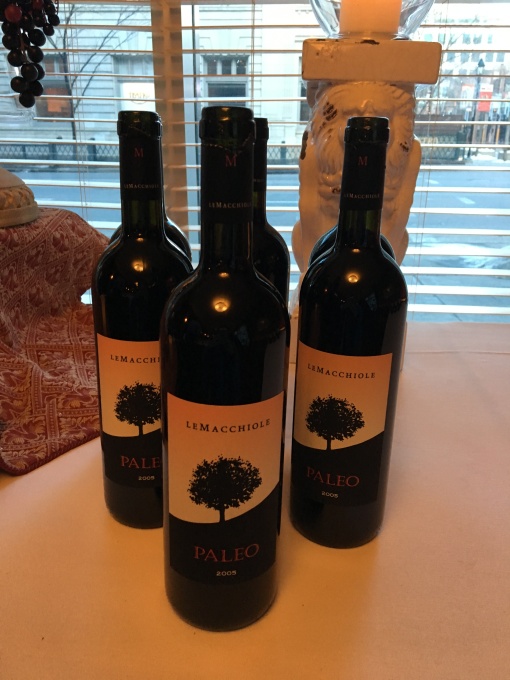
It was while reading my very first book on wine, the 6th edition of Ed McCarthy and Mary Ewing-Mulligan’s “Wine for Dummies”, that I first encountered the term “Super Tuscan”.  I instantly became enamored with the concept.  Some Tuscan producers became wary of traditional wine-making laws that they perceived as stifling innovation. Part of the motivation here was that these producers wanted to experiment with “international varieties”, particularly those famous for yielding Bordeaux blends in France.  Such grapes could be grown.  The kicker was that wines made from them could initially be labelled only as “vino da tavola” (or table wine), as they clearly violated Italian DOC production guidelines which emphasized native varietals.  However, it became apparent that parts of Tuscany were in fact better suited to growing international varieties than native son Sangiovese.  It was absurd to equate quality wines from such areas with the multitude of serviceable but undistinguished table wines found across the country, and thus the marketing concept of the Super Tuscan was born – described on the Italian Wine Central website as “a maverick wine of great breeding but living outside the Establishment”.

IMG_1109

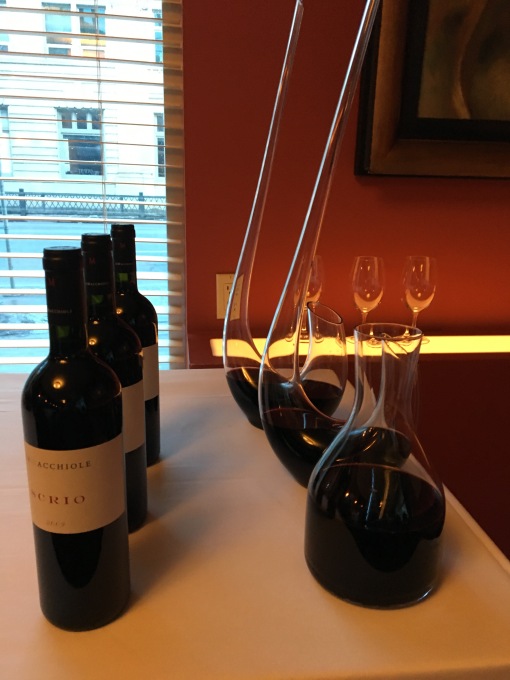
Cinzia Merli does not resemble any stereotype of a maverick.  My initial impression was one of a quiet, conservative, perhaps strict woman, full of resolve and perhaps possessing a keen wit underneath her stolid outward presentation.  She first apologized for her English, which by my reckoning is quite good.  She then provided a fantastic overview of the Bolgheri region and her own wine estate, Le Macchiole, during which her passion and unrelenting dedication to her craft became apparent.  I was already in awe coming into this event:  these wines are legendary.  Cinzia’s presentation only served to stoke the flames.  This evening shall live on in my memory as one of the most fun tastings that I have ever experienced with total strangers (strangers no more!).  I should add that Centini provided exceptional dinner service and perfect ambience.  Read on for my takes on five burly reds (including two vintages of the iconic Paleo), plus a sprinkling of relevant history.

IMG_1110 Read the rest of this entry »


Calgary Wine Life: Tabarrini Montefalco Tasting Seminar @ Model Milk

12 03 2018

By Raymond Lamontagne and Dan Steeves

We have always been impressed by the selection of Austrian and German wines in Salivate Wines’ portfolio, so we were thrilled at the opportunity to sample wines from one of the importer’s Italian producers, Tabarrini.  Hailing from smack dab in the middle of Italy, in Montefalco within the Umbria region (the only wine region in Italy that does not have a coastline or border another country), Tabarrini is a well-respected winery known for its big, brooding single-vineyard reds based on the Sagrantino grape, as well as for an interesting white wine made from the little-known Trebbiano Spoletino. Although maybe not quite as famous as other Umbrians such as Saint Francis of Assisi, Monica Bellucci or black truffles (a full 60% of the world’s supply of the latter originates from the region), there is no doubt that Tabarrini is producing some serious wines that have rightfully been getting global attention.

Tabarrini’s director of sales and marketing, Daniele Sassi, led us through an informative (and entertaining – Daniele is a natural comedian, and the jokes are not always politically correct!) tasting of three of the winery’s offerings:  the Adarmando Bianco (a white Trebbiano Spoletino), the Boccatone Rosso (a Sangiovese and Sagrantino red blend), and the Colle Grimaldesco Sangrantino (one of the estate’s premium single-vineyard dry Sagrantinos).  Read on for our combined thoughts and notes on each bottle. Read the rest of this entry »


Wine Review: Winter Warmers, Part 2

27 02 2018

By Raymond Lamontagne

[These bottles were provided as samples for review purposes.]

Red or white? Before wine became a serious subject of study for me, I gravitated towards whites, and not premium quality ones either, a preference that was likely the product of early learning (e.g., that box of German plonk that was a nigh-permanent fixture on the kitchen counter) coupled with an irrational phobia of such mythological creatures as “tannin-induced hangovers”. As it turns out, there is a general trend in humans towards a greater appreciation for bitter flavors and pucker-inducing sensations that comes with age and experience. Years later, I adore red wine while continuing to appreciate characterful whites. At this point the distinction between red versus white is but a minor factor in my choice of which wine to consume at a given point in time, one that can sometimes influence me at the very early stages of decision-making (“is it a red or a white night?”), but that ultimately carries less weight than varietal, region, style, or what’s for dinner. The Agriculture and Agri-Food Canada webpage indicates that at the national level, Canadians prefer red wine to white, with the exception of British Columbia, where whites are more popular. Heedless of the overall trend, many (myself included) continue to associate winter with hearty reds. Without further ado, let’s launch into part 2 of our robust red reviews, following Dan’s introduction from late last week.

IMG_1038

2011 Montecillo Rioja Reserva ($18)

Spain has more area under vines than any other country and is the third largest producer of wine in the world. Spanish wine on the whole was considered rather rustic and ragged until a major shift towards improved quality occurred in the mid-20th century, before which time it was not unheard of to dilute the wine with lemonade to increase palatability (!). Rioja remains the best-known area for red wine production in Spain, although recently a few upstart regions have made inroads. Tempranillo is Spain’s top indigenous variety, with plantings doubling across the country over the past decade, and is the dominant grape in almost all Rioja reds. I found a great quote from a top Rioja producer in Benjamin Lewin’s book “Wine: Myths and Reality”: “Everywhere in the world, people want to make wine like Burgundy. But it is not in our history, we have  always blended”. Historically, Rioja’s very warm vineyards resulted in full ripening of any given grape varietal, such that blending was necessary to achieve the desired complexity. In a traditional blend, fruitiness came from Tempranillo, while Garnacha (Grenache) provided more color, body, and alcohol, with relative rarity Graciano providing acid to offset the softness of the other two. This classic blend often yielded wines featuring what Lewin calls “savory, almost animal notes of mature red fruits”. Use of American oak for aging has also led some to conclude that Tempranillo is rather neutral flavor-wise, with vanilla and char notes from oak constituting Rioja’s “true” distinctive flavor profile. Regardless, much Rioja is now made in a soft, fruit-forward style. Some producers have decided to split the difference and offer both traditional and modern bottlings. Read the rest of this entry »


Wine Review: Winter Warmers, Part 1

23 02 2018

By Dan Steeves

[These bottles were provided as samples for review purposes.]

The end of February is slowly approaching and we are less than a month away from the first day of spring. That means warmer weather is in our sights and we soon won’t have to deal with any more snow, right? That might be wishful thinking, but we can certainly hope it is the case! Until that warmer weather shows up and takes permanent residency in the prairies, we will need to keep staying warm and spending our evenings huddled around the fireplace with a nice glass of full-bodied red wine. Although I personally drink all types of wines all throughout the year (nobody should deprive themselves of rosé for months on end), there is no doubt that I enjoy more red wines over the cooler winter months, not only for the warming effects of a 15% ABV Cabernet Sauvignon, but also because we tend to eat more hearty full-flavoured comfort foods during this time and less light and refreshing fare.

To get you through the next month until you start seeing green on the ground, we have reviewed a few robust red wines that will be great at keeping you warm and satisfied until the spring flowers start blooming. We kick off this two-part series with reviews of great value reds from two regions known for their big red wines:  Bordeaux, France and the Colchagua Valley, Chile.

Read the rest of this entry »


Co-op Wines: The Social Collection, Bin 105

17 02 2018

By Raymond Lamontagne

[This bottle was provided as a sample for review purposes.]

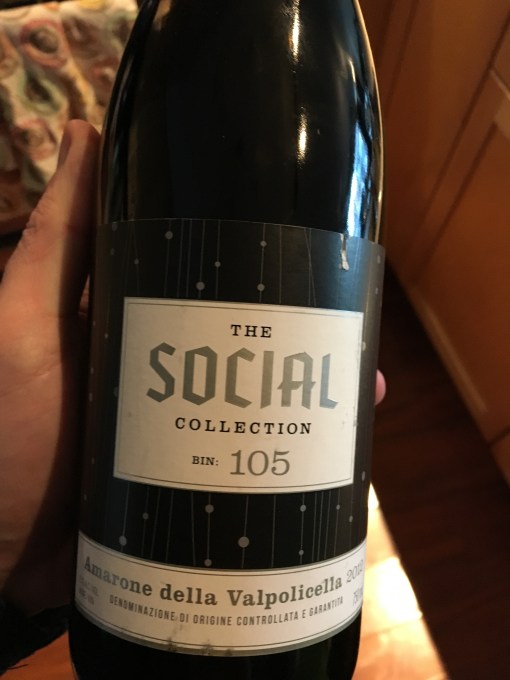
Here is the final installment of our Co-op Social Collection feature, and we are ending with a potentially big wine, one that I would not expect to see in a curated series such as this: the 2015 Bin 105 Amarone della Valpolicella. There is something seemingly incongruous about an Amarone inclusion in a line of negociant wines intended for affordable easy drinking, although with the Social Collection there appears to be a well-intentioned and laudable desire to preserve some degree of regional character and varietal typicity. I’m intrigued. I support the notion of an Amarone “for the people”, or at least an introduction to the style at a lower price point (lower, not low!) for those who are unfamiliar with what can be a daunting, polarizing, but ultimately rather compelling wine. It is worth noting that this bottle won an Alberta Beverage Award for Judges’ Selection in Veneto Blends, as adjudicated by the stellar Culinaire Magazine.

IMG_0844
The Valpolicella region is close to Verona and produces a sequence of red wines that ascend in degree of concentration and power. At the top of the density hierarchy, Amarone is a blend of red grapes, of which Corvina Veronese is typically the most dominant, with DOGC regulations mandating that this thick-skinned grape constitute 45% to 95% of the blend. Partner Corvinone, a grape with larger berries and clusters than Corvina, was long thought to be a clone of the latter but instead turns out to be an entirely distinct variety. This vine can occasionally serve as the foundation of an Amarone, but is more commonly used to provide additional tannic structure to Corvina’s base of cherry-like red fruit. Corvinone can substitute up to 50% of a similar percentage of Corvina. Rondinella, which generally can comprise 5% to 30% of the blend, provides a key seasoning in the form of herbal notes that add a savoury character. Only Corvina and its progeny Rondinella are mandatory in Amarone, but the law permits other native “non-aromatic” red grapes to be included as up to 25% of the blend, with none of these individually exceeding 10%. Some of these grapes are fascinating but fall beyond the scope of the present review. Read the rest of this entry »


Calgary Wine Life: Famille Perrin Tasting with Thomas Perrin @ Avec Bistro

15 02 2018

By Dan Steeves

Excited is an understatement of how I felt yesterday as I was on my way to an amazing vinous and culinary experience at Avec Bistro featuring the wines of Famille Perrin and proprietor Thomas Perrin. I have always been fond of the wines of the southern Rhone, especially after travelling through the area a few years ago an experiencing the culture, the landscape…and, of course, the wine! Being guided through a tasting by any winery owner is always a privilege. Hearing directly from them about the history of their area, small details of their wines and their actual impressions of each bottle creates a personal connection that makes it such a memorable experience. Combine this with impeccably paired cuisine and it is elevated to a new level of sublime indulgence.

img_5565

Famille Perrin is a family-owned and -operated producer (Thomas, the 5th generation, along with his siblings and cousins, all work for the family business) in the southern Rhône Valley which is most notably known for their flagship label from Châteauneuf-du-Pape, Chateau de Beaucastel, although they have an extensive collection of wines from many other areas in the southern Rhone. They have been established for just shy of 110 years and are the leading organic grape grower in the area after Thomas’s grandfather, Jacques Perrin, pioneered organic farming practices in the 1950s which was followed by biodynamic practices in the 1970s. All wines produced by Famille Perrin are blends consisting of at least two grape varieties which are grown, vinified and matured separately and then blended to create a harmonious wine.  With there being 13 different grape varieties allowed in Châteauneuf-du-Pape (all of which are used in the Chateau de Beaucastel CdP, one of the only estates to do so) and still other varieties used in other wines elsewhere in the region, you can imagine how long and busy the harvest season is for Perrin. The harvest starts in August with the early ripening Cinsault and ends two months later with Mourvedre and Counoise. Vinification is then done separately using stainless steel, concrete, or wooden tanks with very limited oak ageing done, at least in the sense that no new oak is used to avoid imparting oak characteristics in the wines.

The tasting consisted of six wines from the Famille Perrin collection – a rosé aperitif, followed by a white and four reds, each accompanied with their own food pairing. Below are details for each wine (and food pairing). Read the rest of this entry »