Wine Review: 2014 Yalumba Old Bush Vine Grenache

18 09 2015

[This bottle was provided as a sample for review purposes.]

Raise a glass to Grenache!

Raise a glass to Grenache!

This is a bottle of eager-to-ripen Grenache from the scorching Barossa Valley in Australia.  This is a delicate, pretty, dainty, almost ethereal wine.  These sentences are both somehow true.  Happy International Grenache Day, everyone!

Yes, the third Friday of every September is set aside to celebrate the wonders of a grape that is prominent on the world wine scene, yet still strangely underrated, often anonymously doing the heavy lifting in a Rhone-style blend and only occasionally stepping out into the spotlight on its own.  This is my second time toasting the grape in September:  I revelled in the glory of the Okanagan’s first ever Grenache back in 2013.  I appear to have missed this global vinous holiday last year, but am now fully prepared to make up for lost time.

Yalumba is Australia’s oldest family-owned winery, founded 166 years ago in 1849 and still in the family today.  You may know them for their string of top notch value wines (the Y Series Viognier is particularly awesome for what it costs), but they have offerings all across the price spectrum, and their standing and longevity has given them access to the types of fruit sources necessary to put quality in the bottle.  With respect to Grenache in particular, Yalumba owns some of the oldest Grenache vineyards in the Barossa Valley; the fruit sourced for this bottle was planted between 1898 and 1973.  Vines that pre-date your great-grandparents used for a $22 wine!  Yalumba is also the only winery in the Southern Hemisphere to have their own cooperage, so they select and import oak and then toast it to their liking and make their own barrels.  Cool. Read the rest of this entry »


Wine Review: 2014 Plan B Riesling “OD”

14 09 2015

[This bottle was provided as a sample for review purposes.]

Riesling, it's been too long.

Riesling, it’s been too long.

Wow, HOW long has it been since I’ve reviewed a Riesling on here?  Seven months??  What is wrong with me?  I have let my favourite grape down.  Time to make amends, and I have definitely found the right bottle for the job, from probably the most underrated country in the world for good Riesling:  Australia.  This New World nation, home of terrifying spiders and monster Shiraz, is probably not the first place you think of for elegant, aromatic, cool-climate whites, but there are pockets of land in this otherwise mostly barren desert, moderated by altitude or coastal proximity or both, in which Germany’s most prized vinous export thrives.

This particular Riesling hails from the relatively obscure Frankland River region, known to me as one of the only producing areas in western Australia not called Margaret River that’s getting any play internationally.  While Margaret River sits right on Australia’s western coast, just south of Perth, Frankland River is a little farther east and inland and is a sub-zone of Australia’s largest singular wine region, the questionably named Great Southern region.  (As you can see here, it is much more west than south in the national scheme of things, and most of the country’s wine regions are actually located further south than it is.  It had better actually be Great there.)  The gents at Plan B Wines seem to be on a mission to make the wine biz loose and fun again while still producing great quality product from top sites, a task that I would suggest is perfectly suited to Australians.  Their website at planbwines.com is well worth a visit and contains some incredible illustration work done by the winemaker himself; just watch that you don’t Canadianize the URL or slip up on Google and go to planb.ca, northern Internet home of the morning after pill.  You have been warned. Read the rest of this entry »


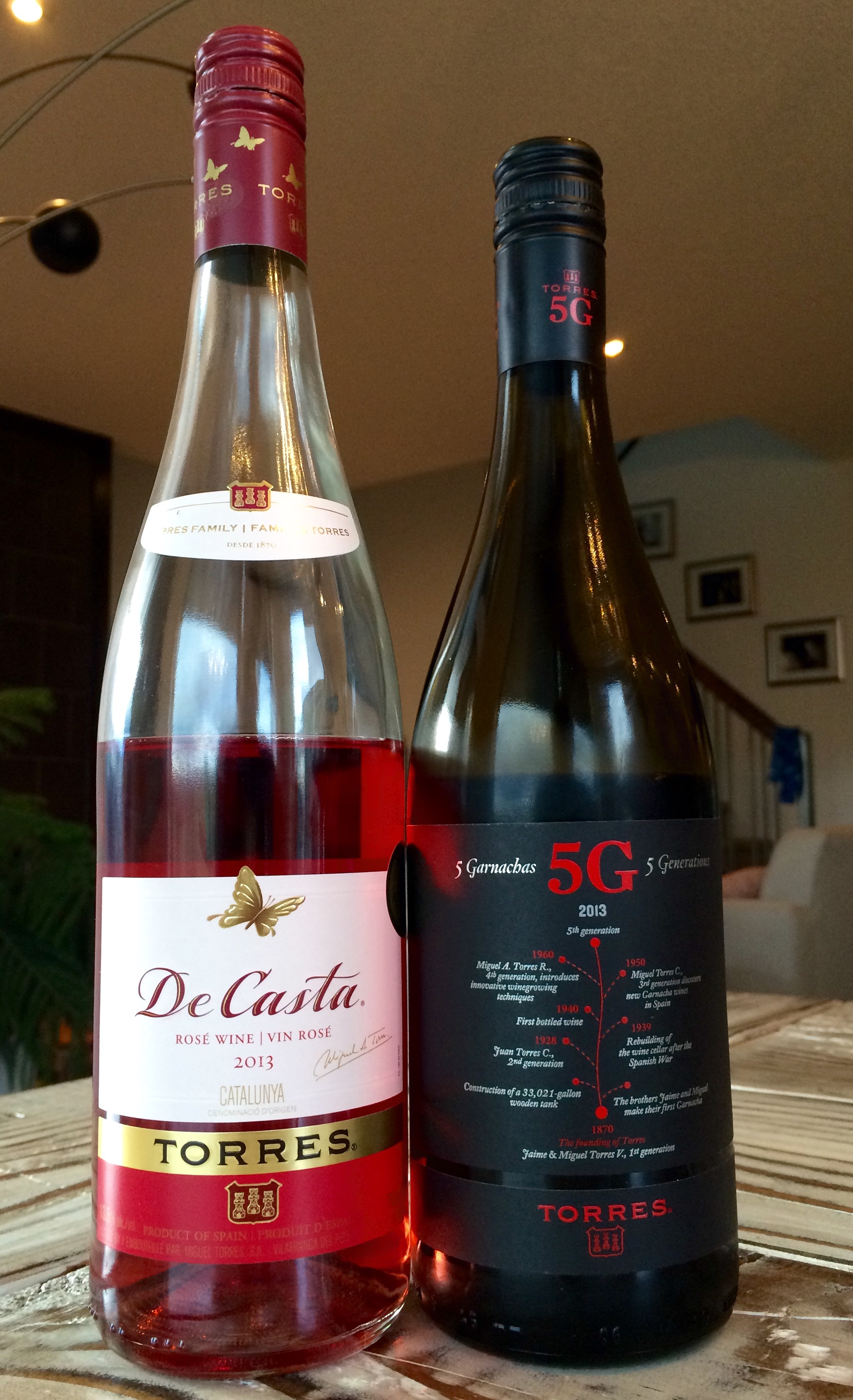
Torres New/Old World Value Duet

8 09 2015

[These bottles were provided as samples for review purposes.]

New/Old World.  Pink/red.  Value/value.

New/Old World. Pink/red. Value/value.

Over the past couple years, Torres has become my Old Reliable, the brand that never lets me down regardless which sub-$20 value offering I’m trying, regardless where in the world it’s from, and regardless of my level of expectation or uncertainty going in.  It has now been named the World’s Most Admired Wine Brand for two years running by Drinks International (to get a sense of that accomplishment, others in the top 15 this year include Vega Sicilia, Chateau d’Yquem, Ridge, the First Growth Chateaux Margaux, Latour and Haut-Brion, and Tignanello), and it succeeds without a multi-hundred-dollar wine on its resume and with wineries on three separate continents, focused on marrying high quality with affordable pricing wherever it goes.  That combination is not easy to achieve, but Torres makes it look routine.  I had a chance to toast the end of summer amidst the weekend snow in Calgary with two QPR (quality-to-price-ratio) gems from the Torres portfolio, one from the New World and one from the Old, each crafted with the same evident care and attention. Read the rest of this entry »


Wine Review: Menti & Marabino, Natural Italy

20 08 2015

[These bottles were provided as samples for review purposes.]

If you are a massively wine-obsessed civilian, you have probably had at least a passing thought about it.  I can think of a half dozen wine friends off the top of my head with whom I’ve had the conversation.  You know something about wine, you have a particular love for a particular region, you’ve found a lesser-known producer or two there whose wines aren’t currently brought in to your jurisdiction…what if I just imported them myself?  I could be a wine agent on the side…who WOULDN’T want to buy these wines?

Small importer, statement wines.

Small importer, statement wines.

Of course, it takes much more than a passion for wine and an idle dream to make a go of it in the wine import world, an extremely competitive sphere full of others who have been at it a long time and know what they’re doing.  This is why I am behind a keyboard right now instead of combing Washington State and Oregon for hidden gems.  But I have the utmost respect for the people who do take the plunge, who put their money where their mouth is and find a way to step a little bit further into the world of wine.  Maxim Atanassov is one of those people, populating the white collar world by day and crusading for all-natural biodynamic Italian wines on evenings and weekends through his agency Vino Al Vino.  He has assembled a tight-knit group of producers from the southern and eastern edges of Italy who share a steadfast mission to let the land do the talking and a hands-off approach to winemaking.  I got the chance to try two bottles from the white side of his wine portfolio, and they proved to be some of the most interesting wines I’ve ever been asked to review. Read the rest of this entry »


Wine Review: 2014 Bila-Haut Rose

13 07 2015

[This bottle was provided as a sample for review purposes.]

Winning producer, winning value.  And look at that colour!

Winning producer, winning value. And look at that colour!

I just got back on the weekend from a sunny California vacation, and as I was coming from hot, humid San Diego into hot, dry Calgary (this was pre-torrential thunderstorms) after the end of a long travel day with two young children, I had my first ever legit rose craving.  Don’t get me wrong:  I like rose just fine, but until this moment I had always been on the “perfectly happy to drink it” side of the fence as opposed to the “insatiable desire for it” side.  But something about that day made me long for a bottle that was crisp and cool yet fruity and substantial, a summer wine niche that rose fits to the tee.  Almost immediately after dropping off the suitcases I went to my neighbourhood liquor store, browsed their abysmal pre-chilled rose selection, and escaped with the one non-White Zinfandel bottle I could find:  a Michel Chapoutier rose called Beaurevoir (pictured below) from pink wine’s spiritual homeland of Tavel in south-eastern France.  After downing it probably more quickly than I should have, I realized that I had another Chapoutier rose in my cellar and promised that I would take my time with this one.  Consider this a kick-off for what looks to be a busy Pop & Pour summer! Read the rest of this entry »


Wine Review: Torres Patio Party

16 06 2015

[These bottles were provided as samples for review purposes.]

Summer fun - ideally outside, without rain.

Summer fun – ideally outside, without rain.

Call it countercyclical marketing or just really bad weather judgment, but I’ve managed to hold off on writing up a patio-wine-themed review duet until the week when we’re due to get utterly deluged with rain.  In the event that you’re soaking wet while reading this, consider it a faint flicker of hope for the future.  So far the forecast has been, as usual, wrong, which will hopefully allow you to disregard this entire paragraph.

I wanted to write up these two wines together because they share both a similar grape source (Garnacha, better known in the New World as Grenache) and a similar vision:  to be a cheap and cheerful source of quality fun out of a bottle.  Of course, they also share a producer, Miguel Torres, whose fifth generation family estate has become one of the most solid wine bets out there, a name that evokes trust regardless of the region, country, grape or style of the wine behind the label.  These relatively new releases are twin 2013 Torres bottlings of Garnacha-based wines:  the De Casta Rose, which blends Garnacha with Carinena (Carignan), and the 5G, a 100% Garnacha representing five generations of the Torres family tree and the winery’s constant hunt for perfection in that grape.  Both are value-priced (under $15 and under $20 respectively) and both are meant for easy and early enjoyment. Read the rest of this entry »


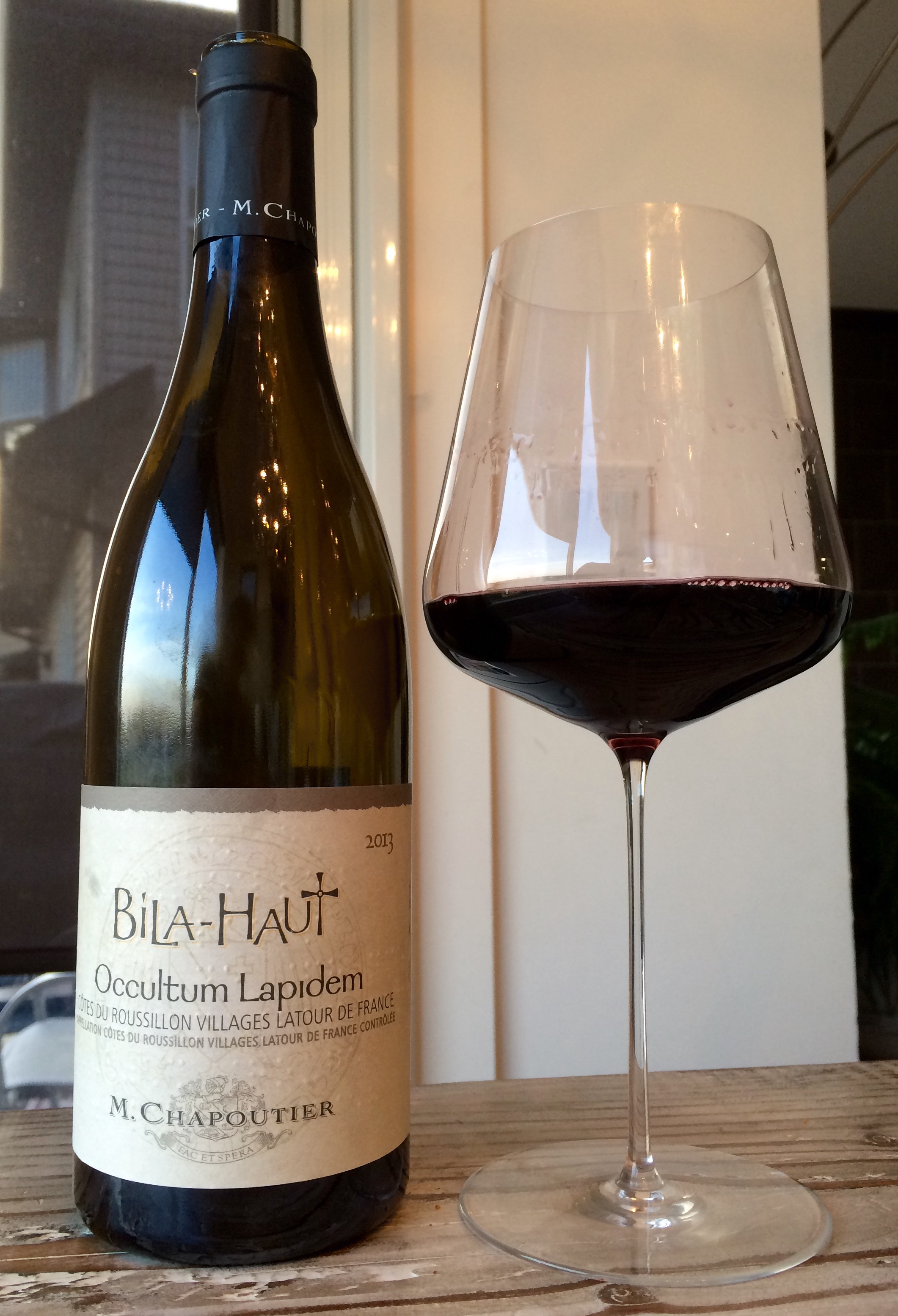
Wine Review: 2013 Bila-Haut Occultum Lapidem

14 05 2015

[This bottle was provided as a sample for review purposes.]

Find this.

Find this.

I have been drinking this particular wine for four vintages now, seeking it out as soon as the new annual offering hit the shelves. It’s one of my favourite widely available wines, and I still have fond memories of the 2010 release, which I purchased repeatedly and brought over to many a dinner.  Well, this 2013 is even better, the best Bila-Haut yet, and has the chance to be something special.

I’m getting ahead of myself.  Bila-Haut is the Roussillon-based domaine of Michel Chapoutier, renowned winemaker of France’s Rhone valley (and one of the only producers to put braille on all of his labels).  Chapoutier is a legend in the Rhone, where his wines range from solid value examples of key regions to the absolute pinnacle that the valley has to offer, but it was only relatively recently, in 1999, that he expanded his empire to the very southern tip of France and acquired this estate in Roussillon.  More specifically, Bila-Haut is in a designated quality subregion of Roussillon that bears the longest appellation name I have ever seen:  Cotes du Roussillon Villages Latour de France.  Add “Bila-Haut Occultum Lapidem” to the front of that and you get a very awkward wine label — and a lot of braille. Read the rest of this entry »


Malbec World Day Challenge: Luigi Bosca Showdown

17 04 2015

[These bottles were provided as samples for review purposes.]

Malbec World Day Challenge contenders.

Malbec World Day Challenge contenders.

Happy Malbec World Day everyone!  If you weren’t previously aware, April 17th was declared an international day of Malbec celebration by the Wines of Argentina back in 2011 in commemoration of the date back in 1853 when the Argentine government submitted a bill to the legislature for the formation of a School of Agriculture and with the objective of boosting and diversifying the country’s wine industry.  The bill quickly became law and led directly to the introduction of the Malbec grape (among other French varietals) to Argentine soils by noted agronomist Michel Aime Pouget.  The rest, as they say, was history.  You might know Argentine Malbec as something of a recent trend, but it’s been a presence in the country for longer than Canada has existed as a nation, and one of the reasons it was well-positioned to take the world by storm in the 2000s was the wealth of remarkable wine infrastructure already present in Argentina, old-vine Malbec vineyards that had been planted a century earlier.  This is actually my second recent brush with a country feting its ex-French national varietal:  I helped Chile celebrate World Carmenere Day back in November.  If any other parts of South America have grape holidays they want broadcast (International Tannat Day, Uruguay?), I’m totally there. Read the rest of this entry »


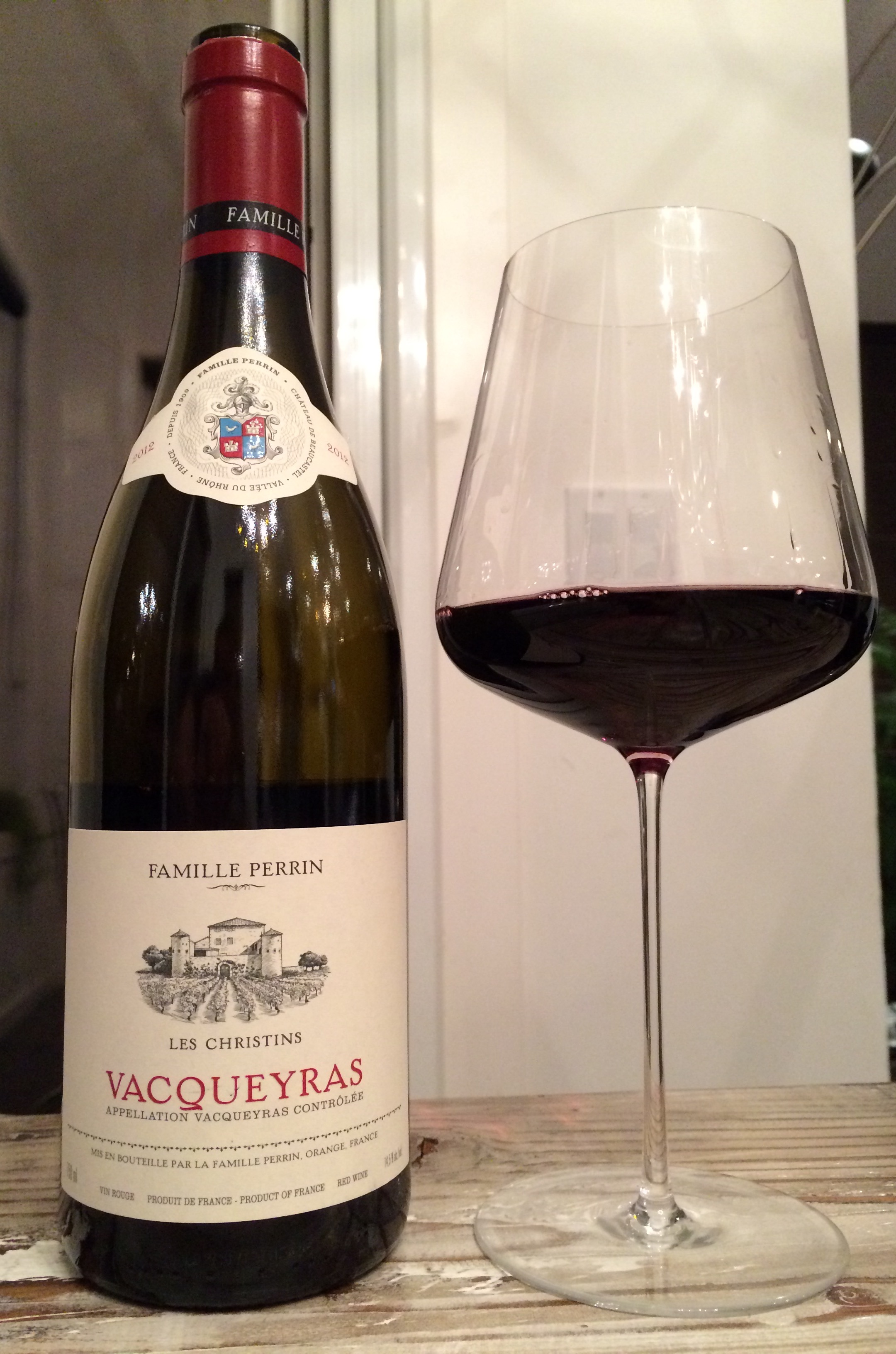
Crowdsourced Wine Review: 2012 Famille Perrin Vacqueyras

27 01 2015

I’m trying something new today – submitting to the will of the people:

Your wish is my command, Twitter followers!  The online community has been nice enough to read and follow this blog for over three years now, and I’ve thought off and on about ways to make Pop & Pour a little more interactive, so consider this a trial balloon for a blog responsiveness initiative.  Thanks to reader @JimSueMaddocks for the excellent review suggestion — I hope this is one of many that roll in going forward!  If you have a wine in mind that you’ve always loved, or on which you’ve always wanted a second opinion, and if it doesn’t cost an arm and a leg, drop me a line or a tweet and you might see it up on here sooner rather than later.

Proof positive:  the people will not lead you astray.

Proof positive: the people will not lead you astray.

I found this wine at Highlander Wine & Spirits in town for $23.95 retail.  The review request I received was for the Perrin Gigondas or Vacqueyras, but I went for the Vacqueyras partly because it was immediately available and partly because everyone always seems to opt for the Gigondas in this situation, making Vacqueyras the perpetual ugly stepsister in the CNDP Alternative category.  I think it’s high time that changed.

Sorry, I’m getting ahead of myself.  In France’s Southern Rhone Valley, it’s pretty much established that Chateauneuf-de-Pape is wine royalty.  It’s the most famous and most critically acclaimed region in the area, and its red blends focused around Grenache, Syrah and Mourvedre (among others) have been copied worldwide, but all of this attention also makes it the most expensive, by a wide margin.  Consumers are slowly coming around to the fact that other Southern Rhone regions, practically adjacent to King Chateauneuf, are almost its equal in quality at vastly superior pricing; this value renaissance has been helped in part by a surge of top-end production in these overshadowed areas.

The two best known Chateauneuf-de-Pape understudy regions are probably Gigondas and Vacqueyras, both located just northeast of the heart of CNDP (Vacqueyras is just 5 kilometres away), both using the same principal grapes, both the source of a number of monstrous values.  I’ve noticed Gigondas start to get a lot of critical attention in recent years, to the point where calling it underrated is starting to ring a bit hollow.  But Vacqueyras has largely stayed in the background, despite being Gigondas’ immediate neighbour and quality equal.  The region has a great story to tell, and wines like this one will help tell it. Read the rest of this entry »


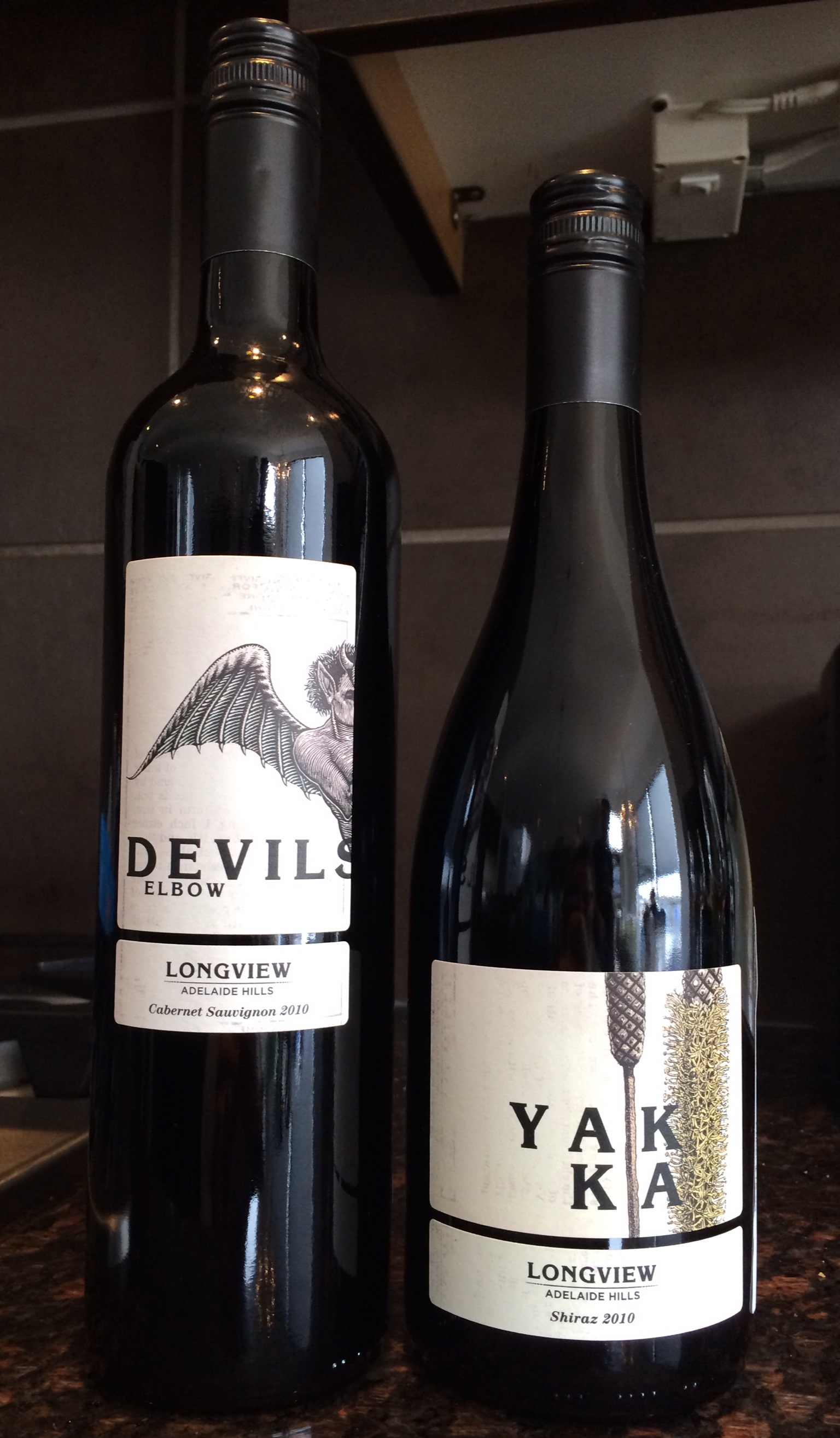
Longview Showdown: 2010 Devils Elbow Cabernet Sauvignon vs. 2010 Yakka Shiraz

18 03 2014

[These bottles were provided as samples for review purposes.]

Cab. Shiraz. The ultimate battle.

Cab. Shiraz. The ultimate battle.

This is the kind of tasting opportunity that wine geeks drool over:  two bottles from the same producer (Longview), same region (Adelaide Hills in Australia), same vintage (2010) and same single vineyard (the aptly named Longview Vineyard), made using the same winemaking techniques (fermentation on skins, 18-20 months aging in French oak), differing only by their grape variety, Cab vs. Shiraz.  The Devils Elbow Cabernet Sauvignon was named after a treacherous hairpin turn in the windy road leading up the hills into Longview Vineyard; the Yakka Shiraz was named after a spiny prehistoric-looking plant that grows in it.  Both red offerings epitomize the New Australia now being unveiled to the wine world:  many recent efforts from Down Under try to sell themselves as a counterpoint to the stereotypical blowsy Aussie fruit bombs of years past, but these wines from Longview take that philosophy absolutely to the hilt, offering up balanced, restrained, nuanced flavours and a take on each grape that is dripping with Old World influence.  The similarities between the two reds are plentiful, but when poured side by side, the differences slowly emerge. Read the rest of this entry »


Wine Review: 2011 Les Halos de Jupiter Cotes du Rhone

11 02 2014

[This bottle was provided as a sample for review purposes.]

You can take the emptiness of the bottle as a sign of how good this wine is.

You can take the emptiness of the bottle as a sign of how good this wine is.

It had all the hallmarks of a crappy week:  utterly frigid weather, lack of sleep due to a teething baby, tons of stuff to do at the office.  But everything changed yesterday afternoon when I had an unexpected visitor at work:  a courageous rep from The Wine Syndicate who braved the cold to drop off a box of 5 killer-looking wines for me to try.  One of them in particular caught my eye, a French red from the Southern Rhone with a decidedly un-French approach to branding.  It was the first vin de France I had ever seen with a planetary body on the label, and I knew as soon as I saw it that I was opening it that night.  As it turns out, I lucked out, because this is a comfort wine to the nth degree, the ideal way to warm up after plunging through gruesome winter on the way home.

Les Halos de Jupiter is a negociant operation (where grapes are sourced largely or entirely from vineyards not owned by the winery) overseen by French master consultant Philippe Cambie, who provides his expert touch to a number of famous Rhone labels and has taken this on as his own personal side project.  The obvious first question on my (and everyone’s) mind:  what’s with the name?  The label explains that Jupiter (in Roman mythology, the same as Zeus in Greek mythology) is the king of gods and humans, the head of the patriarchal family of deities.  It’s also the biggest planet in our solar system, and Halo is the closest of its rings.  Cambie believes that Grenache is the king of all grapes and the “natural leader of Rhone varietals”; it’s the Jupiter of viticulture, and its Halos are the various subregions of the Rhone Valley that best allow it to express itself.  If this were an SAT questionthe best SAT question ever, its answer would be Halos:Jupiter :: Rhone regions:Grenache.  Cambie’s Halos span the most prestigious areas of the Southern Rhone, from Chateauneuf-de-Pape to Gigondas and Vacqueyras, but they also extend to areas where hidden values can be found.  Cotes du Rhone is a catch-all appellation that basically covers all of the areas of the Rhone that aren’t scooped up by a sexier subregion, but this particular wine is a single vineyard offering grown at elevation just outside of the quality region of Rasteau, yielding top-end old vines Grenache without the CNDP price premium. Read the rest of this entry »


Wine Review: 2007 Bodegas Montecillo Rioja Reserva

2 10 2013

[This bottle was provided as a sample for review purposes.]

I heart traditional Rioja.

I heart traditional Rioja.

The closest I’ve ever come to having a wine from my birth vintage (1980, by all accounts an absolutely terrible vintage everywhere, which explains why I can’t find any) was a bottle of 1981 Bodegas Montecillo Gran Reserva from Spain’s famed Rioja region, a bottle that I randomly stumbled upon with a friend at Co-op Crowfoot.  His birth year was 1982, so we decided that we’d split the difference and share the wine.  Montecillo is primarily a value-based producer whose wines steer clear from the ultra-expensive, but despite its non-insane price tag the 1981 was still gracefully present 32 years later, a shade past its peak consumption window but still a tremendously enjoyable drinking experience.  This longevity is partly due to Rioja’s traditional winemaking style and lengthy legally mandated aging periods:  for all wines designated as Gran Reservas, minimum 2 years aging in oak barrels and 5 years total aging is required before bottle release, and for Reservas, minimum 1 year oak aging and 3 years total aging is required.  This maturation process leaves the young wines exposed to air and leads to some flavour integration with the barrels themselves, resulting in finished wines that forego primary fruit flavours in favour of oak- and oxygen-induced secondary characteristics and complexity and that often have extraordinary staying power in the bottle.  While almost all wines are not meant to age, and while that maxim usually applies even more broadly to inexpensive wines, some traditional Rioja can be found on the shelves for bargain prices and can last for ages. Read the rest of this entry »


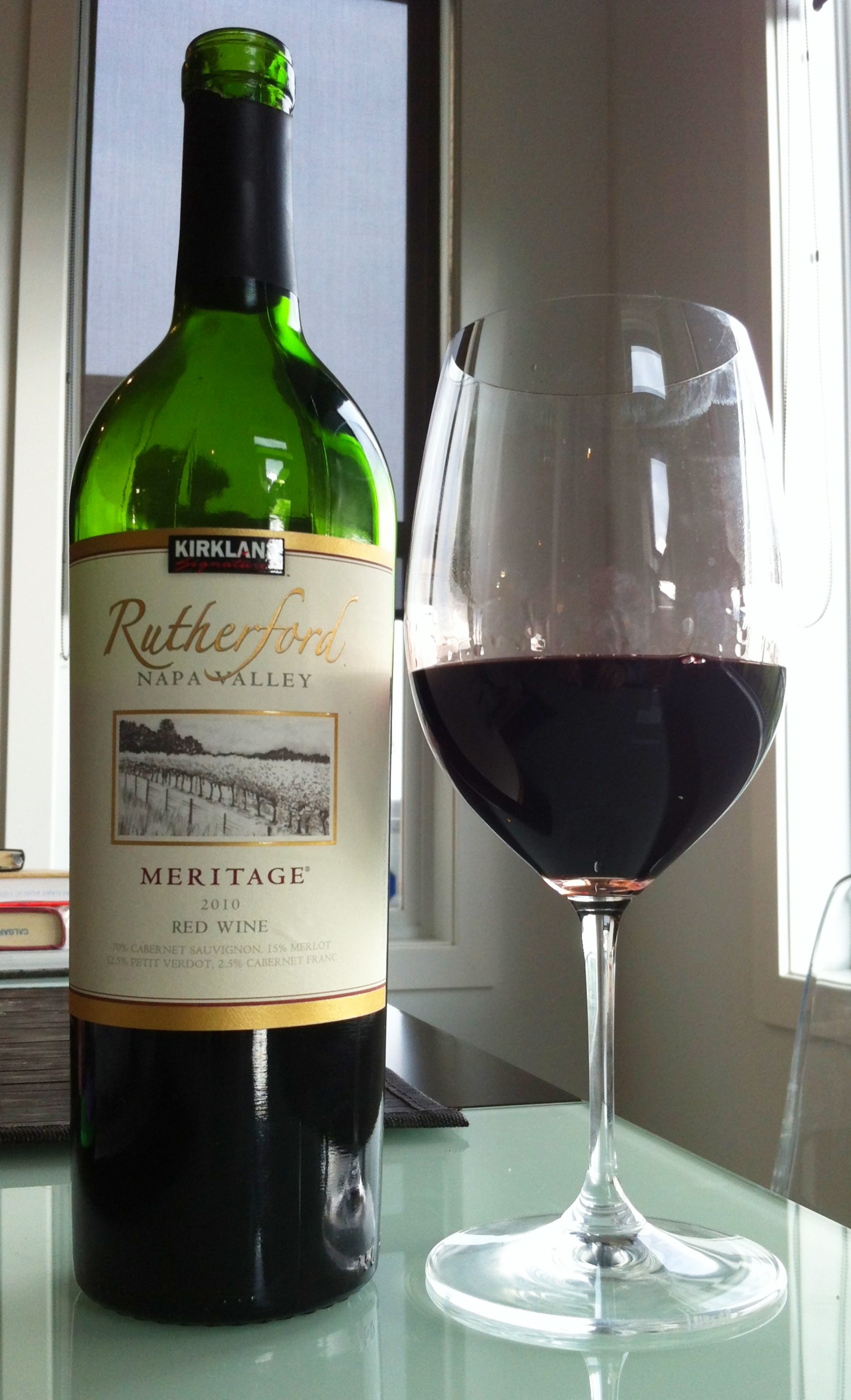
Wine Review: 2010 Kirkland Rutherford Meritage

15 08 2012

Not just wine FROM Costco, wine BY Costco. Too weird.

I had to.  Every time I’ve gone into Costco to grab a bottle or two, my eyes always linger for a moment with morbid curiosity on the various Kirkland bottles for sale.  I can wrap my head around Costco-brand ketchup or Costco-brand paper towel, but I have no idea what to make of Costco-brand wine, particularly since Kirkland (Costco’s proprietary label) keeps spitting out offerings from a vast array of well-to-do regions like Chateauneuf-de-Pape, Champagne, and, as seen here, Napa Valley.  These areas have an established pedigree in the wine world:  this particular bottle comes from Rutherford, arguably Napa’s most prestigious, highest-quality and most expensive sub-region.  Rutherford is a tiny area in the heart of the Valley — when I went to Napa it took about 3 minutes for us to drive from one end of it to the other — and is one of the best places in the world to grow the Cabernet Sauvignon grape, and its name on a label usually signifies that you’re going to be shelling out at least $50-$60 (and often much more) for the privilege of the bottle.  This bottle was $17.  The utter dichotomy in my head between “Rutherford wine” and “produced by Costco” made me have to see what was inside.  One disturbingly inexpensive Napa Cab later, I cracked the Kirkland tonight feeling equal parts anticipation and dread. Read the rest of this entry »


Some Notes About Scoring

21 03 2011

It has been (correctly) pointed out to me that, in most cases, a wine’s rating or score is not an absolute value.  It’s not a direct measure of how good a particular wine is as matched up against every other wine in the world, but instead is a somewhat-relative reflection of how well a winemaker has created a wine of his or her chosen style, how well a producer has hit the vinicultural mark at which they were aiming.  So if you have two wines that are rated 90 points, it doesn’t necessarily mean that they’re equally matched to each other in every way in terms of flavour and quality; to properly assess these ratings, each wine is more accurately matched against others of a similar ilk.

My ratings don’t quite work that way. Read the rest of this entry »