Wine Review: 2016 Buena Vista North Coast Cabernet Sauvignon

17 10 2018

By Peter Vetsch

[This bottle was provided as a sample for review purposes.]
IMG_8980

A rare sighting.

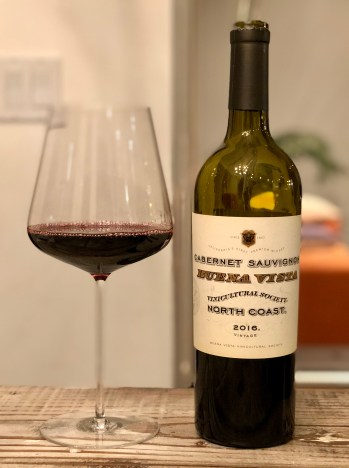
The $25 California Cabernet Sauvignon is an endangered species nowadays; once a stalwart gateway drug for luring novice wine drinkers into a lifetime of vinous enlightenment, it has now been superseded in that endeavour by numerous other New World crowd-pleasers that are managing to offer similarly accessible and overt pleasure at wallet-friendlier prices.  The combination of rising land costs, fire- and drought-inspired production difficulties and the utter shredding of the Canadian dollar as compared to the US greenback on world currency markets has more or less eliminated California as a source of solid value wine in our market.  Buena Vista Winery is trying to change that, but with this series of factors arrayed against it, it’s fighting an uphill battle.

I have previously written about the remarkable, riotous, barely credible but actually true history of Buena Vista, the proud owner of the label “first commercial winery in California”.  It is well worth refreshing your memory about, but the Coles Notes version must at least mention:  (1) Agoston Haraszthy, who may have been the first Hungarian to emigrate to the United States, who founded the winery and who essentially crammed six lifetimes of zaniness and adventure into one shortened 19th century thrill ride; (2) 1857, the year Haraszthy founded Buena Vista, part of a major ambition to establish high-quality vitis vinifera grapes in hospitable California soils; (3) Nicaragua, where Haraszthy fled barely a decade after Buena Vista was first established, with angry and misled company investors potentially at his heels; and (4) alligators, which apparently ate him there.  Never a dull moment at Buena Vista in the 1850s and 60s. Read the rest of this entry »


Wine Review: Finca La Linda Malbec Tiers

26 07 2018

By Peter Vetsch

[These bottles were provided as samples for review purposes.]

In some ways, trendy grapes have it tough.  Malbec has a proud and lengthy heritage as one of the six permitted grapes in red Bordeaux (yes, I’m still counting Carmenere, and shall ever continue to do so) and as the dauntingly famous Black Wine of Cahors, and it is almost single-handedly responsible for giving an entire country a vinous identity that has led to the rediscovery and cultivation of astonishingly high-altitude decades-old vineyards and a re-imagination of what grapes are capable of achieving in Argentina.  It is both an Old World stalwart and a New World trailblazer, pulling off both with equal aplomb and giving itself new life in the process.  But with raging-wildfire levels of success comes an inevitable fight against consumer boredom, particularly amongst the more avant-garde and adventurous in the wine world, which creates a sort of quiet undercurrent of peer pressure to steer clear of what is currently painfully a la mode.

IMG_8463

Great labels, but why is one bottle a third taller than the other??

I feel this way quite a bit, pulled away from the customer staple of the day in part because of my own desire to see what else is out there, but in part because of some innate resistance that I see amongst other wine geeks, some refusal to go along with what is everywhere.  So it was with Australian Shiraz; so it is with Argentinian Malbec; so it will be with whatever comes next.  I don’t really have a hard stance on this, but I have recently tried to make sure that my efforts at open-mindedness in wine extend equally to those grapes and styles that are suddenly ubiquitous as to those that remain esoteric.  I have also tried hard to remember that I once relied very heavily on the Shiraz-laden fads of the day as a gateway that set wine’s hooks into me for the first time, and I enjoyed the living hell out of them.  Fifteen years later, I have a WSET Advanced certification and have been publishing reviews on a wine blog for seven years.  Trends can lead somewhere.  So let’s start somewhere. Read the rest of this entry »


Wine Review: White Australia

19 07 2018

By Peter Vetsch

[These bottles were provided as samples for review purposes.]

Sometimes your moneymaker becomes your millstone.  Australia, which had been making wine for a couple centuries without raising much of a global fuss about it, burst onto international liquor store shelf traffic jam within the past two or three decades thanks to a flamboyant, fruity, brash, ripe style of Shiraz, buttressed by a New World-friendly Cabernet Sauvignon that was easy on the pocketbook.  A mammoth export industry emerged, but typecasting of Australian wine as a whole inevitably followed, leaving those longstanding producers with histories older than the Dominion of Canada stuck in their own misleading shadow.

IMG_8444

Now the Shiraz spotlight has pulled back a bit, giving everyone a bit of room to breathe and again find comfort in the space of their own natural identities; for longstanding affiliates Pewsey Vale and Yalumba, this has meant a continued push to enhance the white side of Australia’s wine spectrum, and perhaps the sowing of a few carefully nurtured seeds which might ultimately settle the debate of what should be known as Australia’s signature white grape.  Two deserving contestants, from two benchmark wineries, lie below. Read the rest of this entry »


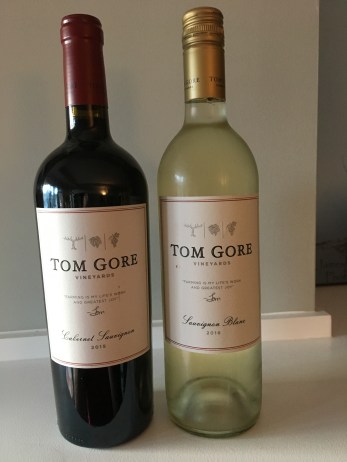
Wine Review: Tom Gore Vineyards, A Tale of Two Sauvignons

14 07 2018

By Raymond Lamontagne

[These bottles were provided as samples for review purposes.]IMG_1713

Cabernet Sauvignon remains the most widely grown quality wine grape in the world, so it is perhaps appropriate that in at least one regard, “Cab” started me off on the path to becoming a serious scholar of wine.  I had previously acquired a taste for certain Canadian Gewurtztraminers, spellbound by how a grape could smell and taste so exotic, although hard-won experience has taught me that many such wines recall one of those chemically augmented gym nuts who can flip a giant tire from a mining truck once or twice, only to catastrophically gas out immediately thereafter: initially powerful but ultimately quite flabby.  Rather wary of this focus, I then snagged a few wine books from a local book sale, thinking that this subject’s unique combination of history, geography, botany, technology, and gustatory delight would give my brain something new and compelling over which to obsess. I noticed right away that in these sundry tomes, blackcurrant or cassis was an aroma descriptor frequently associated with Cab. As someone who adores this particular flavour, I did further research. Not just cassis, but cedar, “cigar box” (I’ve always been intrigued by this one), blackberry, even vanilla and cola and chocolate cake. Wine smells like these things?! I was officially hooked, all this before even seriously tasting a Cab.

Once the actual drinking started in earnest, I rapidly encountered one of Cab’s parents: Sauvignon Blanc. My dad ordered a New Zealand example one nice evening in a Calgary steakhouse, as an aperitif, telling my mother:  “It’s one of those really grapefruity ones you like.” Grapefruit, you say? A cursory look at a tasting wheel for Sauvignon Blanc ultimately reveals a whole litany of “green” aromas, with these ultimately outnumbering the also prominent citrus and sometimes tropical fruits. There are classics like grass, gooseberry, and green bell pepper, along with rather more esoteric takes such as matcha, lemon grass, apple blossom, or even “cat pee”. Maybe we should stick with grapefruit or “tomato leaf”. Go crush and sniff a tomato leaf… You’ll probably get at least an inkling of pipi du chat, if nothing else in the form of a vague association with “funky” or “rank”. Some claim that this character, driven by organic compounds called thiols, is in fact a fault due to vineyard overproduction. Maybe so, although I experience cheap Sauvignon Blanc as something more akin to dilute lemonade in which a few broken fluorescent bulb filaments have been macerated, largely devoid of character across the board. A quick spray of thiols would often do this stuff a favour.

Sauvignon-Blanc-grape-variety-wine-aroma-profile-flavors-fruit-spices-Social-Vignerons

From http://socialvignerons.com/2015/12/10/infographics-guide-to-sauvignon-blanc-wine-grape-variety/.  This thing is comprehensive and rather fascinating…and there it is, cat pee, complete with schematic depiction.

So in addition to capturing aromas that I find pleasant (maybe at this point forget I mentioned cat pee), Cabernet Sauvignon and Sauvignon Blanc are both associated with formative memories in my quest to experience as much of the wine world as possible. Fitting then that I drew this assignment to review these two varietal bottlings, which interestingly enough hail from the first California wine label named after a grape grower.

Read the rest of this entry »


Wine Review: Officially Summer Trio

9 07 2018

By Peter Vetsch

[These bottles were provided as samples for review purposes.]

IMG_8409Sometimes you have to force seasonal drinking posts, and other times the season and the drinks just fall right into your lap.  Stampede is here in Calgary, the thermometer has just recently clocked over 30C, and we’re well-ensconced into July, which turns my sample pile ponderings to thoughts of whatever I can chill for refreshment most effectively.  After landing on an ideal trio of bottles that achieved that lofty goal, I noticed something odd that bound them together:  they have all at one time or another previously graced the pages of Pop & Pour.  Even though the blog is now 7½ years old and counting, that basically never happens.  Sometimes summer is just meant to be.  Game on.

2016 Ricasoli Albia Bianco Toscano (~$20)

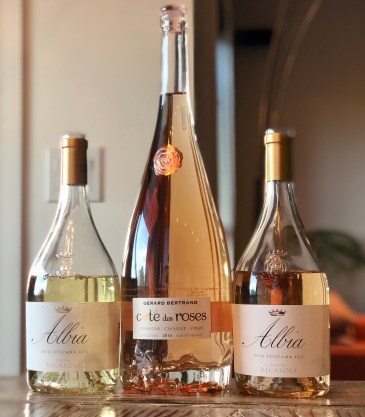
I believe this is the second ever time that an identical bottle will get two separate reviews on PnP:  when Ray had the pleasure of meeting Tuscan winemaker Francesco Ricasoli at a tasting luncheon back in February, this 2016 Albia Bianco was the first bottle they cracked.  If you want a detailed backstory on Francesco, the Ricasoli estate and the family’s critical contributions to Chianti Classico as we now know it, click the link above for the whole enthralling narrative.  While I don’t have a five-course meal to pair with tonight’s wines, I do have both this Albia Bianco and its sibling the Albia Rose on the menu, both scions of Barone Ricasoli’s “fresh and fragrant” early-drinking Albia label.  Both come in gorgeous, hefty, gourd-like bottles that you first admire for making this $20 wine look like it costs double that amount, but then curse effusively once you realize the heavy-punted broad base is about a millimetre away from not fitting at all in any standard wine racking.  Suffice to say the labels suffered some mild to medium collateral damage as I reamed the bottles into place with every ounce of strength I had. Read the rest of this entry »


Wine Review: 2014 Schlossgut Ebringen Spätburgunder Trocken

4 07 2018

By Peter Vetsch

[This bottle was provided as a sample for review purposes.]

Ever since I first got into wine about a decade ago, I have come across the eternal, nigh-unsolvable question many times:  where can you look for consistent, top-quality, good-value Burgundy?  Well, I have finally solved the riddle — turns out it’s been in Germany all along.

IMG_8390

Mesmerizing.  Germany, wow.

It might not be in France, and it might have just broken my heart in the World Cup, but Germany has been quietly elevating its Pinot Noir bona fides.  This fickle and finicky red grape is known here as Spätburgunder (literally, “late Pinot”, or “late Burgundy”, due to its relatively late-ripening tendencies) and is in the process of taking the next step in Germany’s warmer climes, aided imperceptibly by climate change and to a larger degree by greater clonal awareness and vineyard attention.  But it is not every country that can suddenly become a Pinot success story; Germany’s natural advantages (including patches of Burgundian-style limestone soil) are finally being properly cultivated, and almost as importantly, shared with the world.

IMG_8396

I don’t think I had ever seen a wine from Germany’s Baden region on an Alberta retail shelf until 2018, and after a taste of what Schlossgut Ebringen can do with possibly the hardest grape of all to do well (and don’t even get me started on their utterly mind-bending Chasselas “S”, which belongs in another dimension), it makes me wonder what has taken us so long to get on board.  A quick primer for the uninitiated:  Baden is in the extreme southwest corner of Germany, just a stone’s throw and a border crossing away from Alsace, due west from Munich until you almost hit France.  It is closer to Zurich, Switzerland than any major German city.  Baden is built like Chile, in a long narrow north-south stripe, within which lies 9 surprisingly different subregions.  Pinot Noir/Spätburgunder is the most commonly planted grape (at around 35% of all plantings), though on the whole white grapes outnumber reds 60/40.  In the south of Baden, just south of the famous Baden-Baden spas, lies the top subregion of Markgräflerland, known largely for Chasselas (locally known as “Gutadel” just to add more proper nouns to your life) but also a burgeoning Pinot power.  Baden’s other top attraction, the Black Forest (Schwarzwald), lies to the east, and in its foothills lies the village of Ebringen and the hero of tonight’s story. Read the rest of this entry »


PnP Panel Tasting: The Hatch – Library Release

28 05 2018

[These bottles were provided as samples for review purposes.]

IMG_8224

(Re)Entering The Hatch.  In stereo.

It had been far too long since we last held a panel tasting, and we were missing it – there’s something about tasting outside of the echo chamber of your own brain that is gloriously refreshing and invigorating.  Plus multiple wines and multiple friends is generally a guaranteed recipe for a proper time.  One of us (Ray) wondered about reaching out to his friends at the Okanagan’s weirdest and most interesting winery, The Hatch, for inspiration.  We naturally assumed that we would get some intriguing and tasty wines from this divergent, artistic, even edgy winery (the latter word is drastically overused but still rather works in this case).  The common approach would have been to send a set of current releases, bottles that the reading public could come scoop if they were so inclined.  Well, The Hatch is not common.  PnP’s second ever Panel Tasting turned into a library release celebration, focused on a trio of bottles with a few years on them, from the mysterious and mildly depraved depths of the winery’s cellars.  It not only allowed us to get a sneak peek at what the future might hold for some more recent bottles that we were holding, but it also gave us a chance to answer a question that nags at a number of people in our home and native land just getting into wine:  can Canadian wine age?  Does it improve?

IMG_8240

The answers, in order, are “yes” and “it depends”; in the upper echelons of our national wine industry are scores of producers who are creating layered, complex, long-term wines that easily stand the test of time.  The eye-opening part of this tasting wasn’t so much that ageworthy BC wine was possible, but that it was starting to be accessible even at lower price points, another sign of the province’s rapid progression into a globally competitive wine power.  After this, there will be far more local bottles that spend more cellar time before seeing the light of day.  It made sense for us to each choose a bottle to write up, but rest assured there was much group analysis of everything we were tasting, making the below report a true joint effort. Read the rest of this entry »


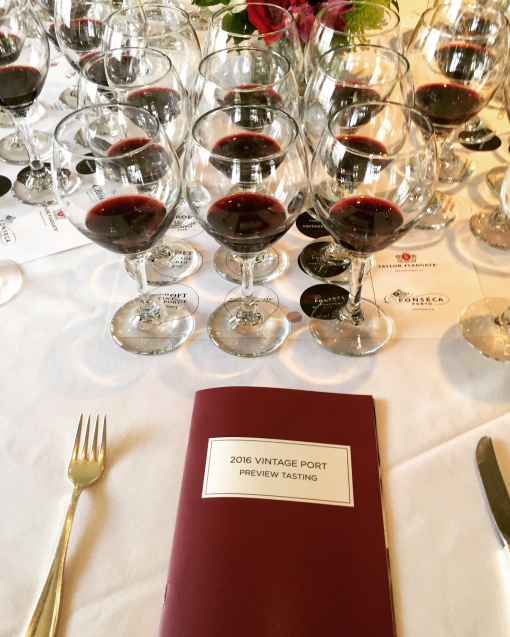
Calgary Wine Life: The Fladgate Partnership 2016 Vintage Port Release Tasting @ La Chaumiere

9 05 2018

By Dan Steeves & Raymond Lamontagne

Vintage Port, undoubtedly one of the crown jewels of the wine world, is celebrated as one of the Earth’s most complex and robust wines, one that has a superior ability to age and mature in bottle, often only fully revealing itself after several decades. Having never tasted a vintage Port with less than 10 years of age on it, we were very interested in the opportunity to preview the brand new 2016 Vintage Ports from The Fladgate Partnership (literally, they were just bottled a couple weeks ago for sampling purposes, well before what will be their commercial release).

The Fladgate Partnership includes three iconic Port houses: Croft, Taylor Fladgate, and Fonseca. Each house enjoys centuries of history producing Port, and between them they hold the most revered vineyards in the Douro, giving the Partnership the ability to make some of the best and most sought after Ports on the market. Croft, founded in 1588 and thus the oldest Port house in the world, possesses the Quinta da Roêda estate, which has been termed the “jewel of the Douro Valley”. Taylor Fladgate has three main estates: Quinta de Vargellas (well known as a pinnacle wine estate), and two Pinhão Valley estates (Quinta de Terra Feita and Quinta do Junco). Fonseca, the relative newcomer in the Fladgate trifecta at the fresh age of 203 (founded in 1815), also has three significant estates: Quinta do Panascal in the Távora Valley, and Quinta  de Cruzeiro and Quinta de Santa António, both located in the Pinhão Valley. It is these special estate vineyards, with their prime soil, ideal climate conditions, and significant plantings of decades-old vines, which contribute most to the style and personality of each House’s classic vintage Port. As we shall see, there are compelling genuine differences in house style.

Vintage Port is made only in the very best of years when the fruit is exceptional and the wines are determined to be monumental in character, showing early evidence of the ability to age that all great Ports should have. It is a house by house decision, made in the second spring following the harvest once the wines have undergone initial aging and blending. If the producer believes the wine has the characteristics of a great Vintage Port (and the regulating body agrees), they make a formal vintage declaration and begin preparations for bottling. For Fladgate, this declaration occurs on April 23rd and it historically happens roughly three times each decade. The last vintage declared for Fladgate was 2011, which followed 2009, 2007, 2003, and 2000. Taylor Fladgate has declared 32 Vintages from 1900-2016, whilst Croft has declared only 24 vintages in the same period.

Jorge Ramos, the export manager for The Fladgate Partnership, led us through a tasting of three vintages (2003, 2007, and the new 2016) from each of the Fladgate Partnership houses. The opportunity to taste various Vintage Ports from all three producers, side by side, really brought into stark relief the differences in their identities. From the luscious fruit flavours of Croft to the soft yet strong complexity of Taylor Fladgate and the muscular power of Fonseca, these were all stunningly delicious with their own personalities. We’ve summarized our tasting notes below by vintage year, in the manner they were tasted. First up, the 2003 vintage, which had a near perfect start to the growing season and periods of intense summer heat in August which allowed for perfect ripening of the fruit. Read the rest of this entry »


Wine Review: Famille Sichel Bordeaux Tiers

15 04 2018

By Peter Vetsch

[These bottles were provided as samples for review purposes.]

IMG_7943

What a Bordeaux progression looks like.

Bordeaux is one of those regions that any aspiring wine geek finds out about roughly 15 seconds after beginning their vinous adventure.  It leads off many textbooks, is (rightly) touted as the spiritual homeland of red grape overlord Cabernet Sauvignon and its consigliere Merlot and is held up as a must-try area both so that new oenophiles can get a sense of the classics and because top-flight Bordeaux can be so memorable that its first-chapter place in all future textbooks is likely assured.  Of course, all of that comes at a price, one that seems to be increasing by the year, as wines from the top chateaux become more luxury commodity and less agricultural product and as international demand in new markets shoots through the roof.  So what are the non-obscenely wealthy wine-curious to do?  Here’s one way to start:  find a reputable producer and taste your way up their lineup, through the quality tiers and nesting-doll classifications layered throughout the Bordeaux appellation.  Even if you don’t make it all the way up to the grand vin flagship of the chateau, you will end up with a really good sense of what makes this rarefied region tick and also start to understand why those tiers exist in the first place.

IMG_7947

I was fortunate enough to test this tasting theory with the wines of Famille Sichel, a producer with whom I didn’t initially think I was familiar until discovering that they are the owners of one of Bordeaux’s hidden gem producers, Margaux’s Chateau d’Angludet.  While the winery is centuries old and the Sichel family’s history in Bordeaux is almost equally entrenched (they have been established in the region as a negociant since 1883 and are on their sixth generation of family ownership), their two paths didn’t cross until the 1960s, when d’Angludet was in a state of extreme disrepair and was bought and revived by Peter Sichel thanks to an extensive replanting and restoration program.  Current proprietor Benjamin Sichel continues both the negociant business (under the Maison Sichel banner) and the Chateau’s estate bottlings with a heavier focus in the vineyard and a defter touch in the cellar.  I have previously enjoyed Chateau d’Angludet on numerous occasions and now got to experience the trail of bottles that leads up to it. Read the rest of this entry »


Calgary Wine Life: Domaine Chandon Sparkling Wine Dinner @ Elwood and the Rabbit

13 04 2018

By Dan Steeves

Chandon is a name that instantly makes me think of the luxurious Champagnes from the famous (and largest) Champagne house Moët & Chandon, but its North American offspring Domaine Chandon is not just a clone of its majestic parent company.  It has a vision to be different and create its own legacy by providing a pure expression of what California is all about, while at the same time maintaining the quality that is inherent in its French pedigree.

When Domaine Chandon was established in the Napa Valley in 1973 it was not the first international venture for Moët & Chandon (Chandon Argentina was established first in 1959, and California was succeeded by Brazil in 1973, Australia in 1986, China in 2013, and most recently India in 2014) but it was the first French-owned sparkling wine venture into the US, which now hosts operations from many of the large Champagne houses. Moët & Chandon recognized the potential of the area for sparkling wine production, especially Carneros, which at the time was seen as too cold and infertile to grow grapes (coming from Champagne, they knew it’d be perfect). Moët & Chandon purchased 400 acres of Carneros vineyard land for mere pennies on the dollar in today’s market. It was a humble California beginning for the M & C Winery on March 26, 1973, whose official address was John Wright’s garage, but within a few years the current winery facility was built and opened to the public and the house’s name was officially changed to Domaine Chandon. The 45th anniversary of Domaine Chandon just passed a few weeks ago with the winery holding firm as a longstanding powerhouse in Napa Valley, seeing over 200,000 visitors a year and likely holding the honour of being the largest producer of traditional method sparkling wine in the US.

The line up of Domaine Chandon California wines available in Alberta –  Blanc de Noirs, Brut, and Rosé

Having visited the Moët & Chandon mothership in Épernay (the heart of Champagne) a couple years ago and being fan of all their Champagne wines, I was ecstatic at the opportunity to try the Chandon California wines alongside some delicious food from Bridgeland’s Elwood and the Rabbit. The dinner was hosted by Brian Fairleigh, the Brand and Wine Educator for Domaine Chandon, whose infectious passion for sparking wines is matched closely by a wealth of knowledge about every aspect of Domaine Chandon. Brian made it clear that comparing Moët & Chandon Champagne with Domaine Chandon is like comparing apples to oranges: the two are very different, although they share the same adherence to quality and excellence in the vineyard and cellars. Domaine Chandon aims to showcase the fun, vibrant, sunny California fruit flavours and builds wines that are accessible, enjoyable, and made for everyone to enjoy all year round. Many people only reserve sparkling wines for times of celebration, and although they are perfect for those times, they are equally as enjoyable for a casual sip with friends or an accompaniment to almost any meal. Brian was happy to show us some great pairings. Read the rest of this entry »


Wine Review: Stag’s Hollow Renaissance Reds

5 04 2018

By Peter Vetsch

[These bottles were provided as samples for review purposes.]

IMG_7892

The big guns.

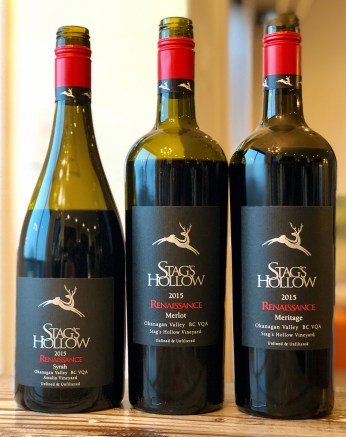
As I have mentioned in reviews past, my first thought of Okanagan Falls’ Stag’s Hollow Winery is always as a forward-thinking, try-everything trailblazer, the continual vanguard of varietal suitability and experimentation in British Columbia, constantly checking in on whether the next potential star grape of the province (be it Albarino, Grenache, Dolcetto, or any number of others in its viticultural Rolodex) might be one that few had previously considered.  So it’s a fun change of pace tonight to sit down and see how they handle the classics, those big red varietal stars so often seen across the Old World and New World alike, the first grapes you expect to see on any wine store shelf.  This review set is a particular treat, because all three of the bottles below hail from Stag’s Hollow Renaissance line, the winery’s premium flagship tier of offerings, produced only in vintages when the wines can live up to the bottle’s special black label.  I have heard rumblings that the 2015 Renaissance set breaks new ground in terms of quality and longevity; I had not previously had the opportunity to test this theory for myself, but it would not surprise me out of a winery that always seems to be improving. Read the rest of this entry »


Cellar Direct: Underdog Whites

27 03 2018

By Peter Vetsch

[These bottles were provided as samples for review purposes.]

IMG_7833Close-following Pop & Pour adherents (if such things exist) will have been waiting for this moment for a couple of months.  In my last write-up about the tremendous Euro-tacular wine offerings of Cellar Direct, I teased that the two Italian reds going head-to-head in that review were not the only bottles (or colours) from that country that Cellar Direct had sent my way, but I opted to hold back the indigenous Italian white wine from that set so that it could shine in an all-white duet in a later post.  Well, here we are, and tonight’s 100% Arneis lead-off hitter is joined in the batting order by a rather mysterious and off-grid white Burgundy (to the extent that anything Burgundy can be considered off-grid), each bottle a tantalizing find that proves both that even famous regions have hidden values and that you often need some expert assistance to find that value needle in the prestige haystack.  If Cellar Direct is anything, they are that Old World value sherpa, leading you to consistent quality at credible price points over and over again.  Their streak of never sending me a bad bottle lives on. Read the rest of this entry »


Wine Review: Red Blends of the Eternal Ice Age

20 03 2018

By Peter Vetsch

[These bottles were provided as samples for review purposes.]

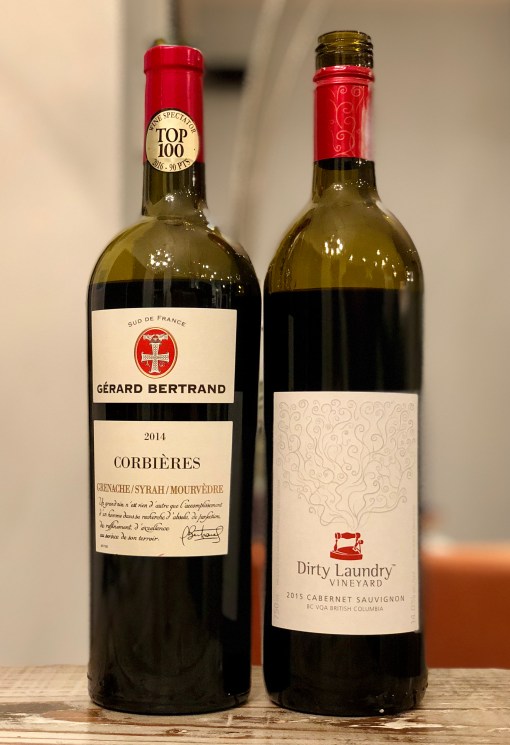
Happy first day of spring.  Spare me.  Yeah, I’ve seen all of the (obviously non-local) articles and Instagram pics and Twitter updates about new rosé and bubble releases and patio beers and T-shirt weather.  Meanwhile I have snowbanks bordering each side of my driveway that are taller than each of my children and still see the minus sign side the thermometer heading to work every morning.  It’s supposed to snow again on Thursday morning and there is no god and we are in some kind of forsaken meteorological time loop that will have no end.  So forget you, frizzy pink refreshing splashes and dainty Prosecco; I’m gearing up for blustery Armageddon, armed with a pair of full reds that scoff at the entire concept of spring.  I need to find joy somewhere, after all.

IMG_7747

Forget you, “spring”.

2014 Gerard Bertrand Corbieres (~$20)

I know from past experience that Gerard Bertrand is a value wine savant, and that his legend in the south of France is ever-growing.  I also knew that this particular bottle of Corbieres, part of his “Terroirs” regional collection of bottlings, hit the wine awards mother lode in 2016 by landing the #55 spot in the much-anticipated Wine Spectator Top 100 list — not bad for a $20 bottle from a little-known region.  What I didn’t know about Bertrand was that he was a prodigious professional rugby player before he followed in his family’s footsteps and turned to winemaking, even juggling a pro career with vigneron duties in the aftermath of his father’s death as he took over the reins of his ancestors’ business.  He has now hung up the cleats for good but brings some of his sport’s scrappiness to all of the wines that bear his name.   Read the rest of this entry »


Wine Review: Winter Warmers, Part 2

27 02 2018

By Raymond Lamontagne

[These bottles were provided as samples for review purposes.]

Red or white? Before wine became a serious subject of study for me, I gravitated towards whites, and not premium quality ones either, a preference that was likely the product of early learning (e.g., that box of German plonk that was a nigh-permanent fixture on the kitchen counter) coupled with an irrational phobia of such mythological creatures as “tannin-induced hangovers”. As it turns out, there is a general trend in humans towards a greater appreciation for bitter flavors and pucker-inducing sensations that comes with age and experience. Years later, I adore red wine while continuing to appreciate characterful whites. At this point the distinction between red versus white is but a minor factor in my choice of which wine to consume at a given point in time, one that can sometimes influence me at the very early stages of decision-making (“is it a red or a white night?”), but that ultimately carries less weight than varietal, region, style, or what’s for dinner. The Agriculture and Agri-Food Canada webpage indicates that at the national level, Canadians prefer red wine to white, with the exception of British Columbia, where whites are more popular. Heedless of the overall trend, many (myself included) continue to associate winter with hearty reds. Without further ado, let’s launch into part 2 of our robust red reviews, following Dan’s introduction from late last week.

IMG_1038

2011 Montecillo Rioja Reserva ($18)

Spain has more area under vines than any other country and is the third largest producer of wine in the world. Spanish wine on the whole was considered rather rustic and ragged until a major shift towards improved quality occurred in the mid-20th century, before which time it was not unheard of to dilute the wine with lemonade to increase palatability (!). Rioja remains the best-known area for red wine production in Spain, although recently a few upstart regions have made inroads. Tempranillo is Spain’s top indigenous variety, with plantings doubling across the country over the past decade, and is the dominant grape in almost all Rioja reds. I found a great quote from a top Rioja producer in Benjamin Lewin’s book “Wine: Myths and Reality”: “Everywhere in the world, people want to make wine like Burgundy. But it is not in our history, we have  always blended”. Historically, Rioja’s very warm vineyards resulted in full ripening of any given grape varietal, such that blending was necessary to achieve the desired complexity. In a traditional blend, fruitiness came from Tempranillo, while Garnacha (Grenache) provided more color, body, and alcohol, with relative rarity Graciano providing acid to offset the softness of the other two. This classic blend often yielded wines featuring what Lewin calls “savory, almost animal notes of mature red fruits”. Use of American oak for aging has also led some to conclude that Tempranillo is rather neutral flavor-wise, with vanilla and char notes from oak constituting Rioja’s “true” distinctive flavor profile. Regardless, much Rioja is now made in a soft, fruit-forward style. Some producers have decided to split the difference and offer both traditional and modern bottlings. Read the rest of this entry »


Wine Review: Winter Warmers, Part 1

23 02 2018

By Dan Steeves

[These bottles were provided as samples for review purposes.]

The end of February is slowly approaching and we are less than a month away from the first day of spring. That means warmer weather is in our sights and we soon won’t have to deal with any more snow, right? That might be wishful thinking, but we can certainly hope it is the case! Until that warmer weather shows up and takes permanent residency in the prairies, we will need to keep staying warm and spending our evenings huddled around the fireplace with a nice glass of full-bodied red wine. Although I personally drink all types of wines all throughout the year (nobody should deprive themselves of rosé for months on end), there is no doubt that I enjoy more red wines over the cooler winter months, not only for the warming effects of a 15% ABV Cabernet Sauvignon, but also because we tend to eat more hearty full-flavoured comfort foods during this time and less light and refreshing fare.

To get you through the next month until you start seeing green on the ground, we have reviewed a few robust red wines that will be great at keeping you warm and satisfied until the spring flowers start blooming. We kick off this two-part series with reviews of great value reds from two regions known for their big red wines:  Bordeaux, France and the Colchagua Valley, Chile.

Read the rest of this entry »