By Raymond Lamontagne
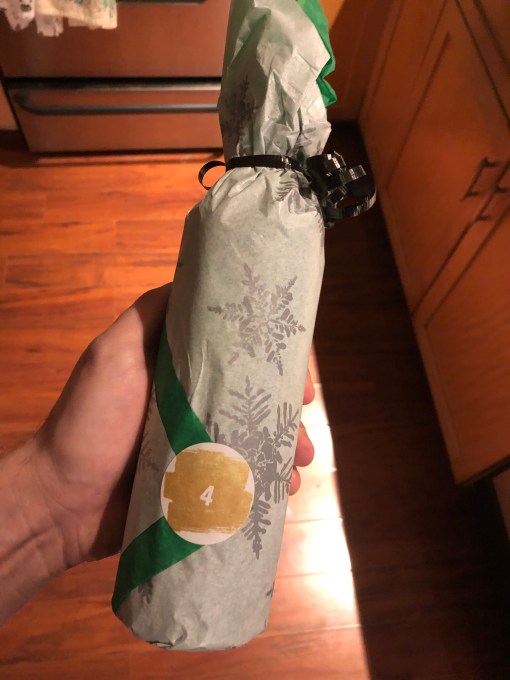
After three days of alternative bottle shapes and even a can, Day 4 sees something more conventional lurking under the tissue paper. The previous Bricks calendars were true world tours that struck chords across the wine-making globe, hitting many of the classic regions and styles without disregarding lesser-known up-and-comers. Will I draw an Austrian wine this year? Of course I will, but not yet. If I do have a horse in the wine-making country race, one that I always return to no matter what, even if my favourite grape (Pinot Noir) is a bit player there at best, it is Italy. I am enamored by the diversity of grape varieties and terroirs, a patchwork quilt of regions and styles that often bleed influence into one another even as they remain distinctive and true to their own traditions. So in other words, today’s bottle suits me just fine.
Last Advent season I took the opportunity to hike up the word count and write a bit of a love letter to Chianti Classico. I’m pleased to report that my feelings have changed little since then. I’m a sucker for temperamental grapes of the earth, with Sangiovese dutifully translating the nuances of soil and climate into its finished wines even as it stubbornly clings to a sour-cherry-meets-tea-leaf-and-damp-earth calling card. I remain fascinated by the history of the wine region itself, which has seemingly (and finally) found its footing in the world of fine wine after decades of bloated growth, political upheaval, and an unhelpful tenacity when it comes to clinging to tradition. There can come a time when one must change in the interest of making better wines, and today’s iconic producer, Isole e Olena, directly embodies Chianti’s many ups and downs.
The properties previously associated with Isole e Olena had a quality problem until the 1960s, when they were purchased by the Piedmontese family of current proprietor Paolo de Marchi. Given that Chianti period had a quality problem around this time, this should surprise no one. Paolo’s father in fact purchased two adjoining small estates, ‘Isole’ and ‘Olena’, and thus Isole e Olena was born. The headaches were many and the road to better wine was tortuous. Indeed, Paolo started running the property at 25 years of age, dutifully making a Sangiovese-based wine that included white grapes in the blend in a nod to tradition that the winemaking law then demanded, and one now almost universally and justifiably derided as detrimental to quality. Weary of this and not afraid to take a stand, in 1980 Paulo released Cepparello, a 100% Sangiovese wine that could not legally be labelled Chianti but that did go on to become one of the famous so-called “Super Tuscans”. Finally, Paulo took full advantage of key changes to the Chianti productions rules in the 1990s to banish the white grapes, wryly commenting that “it is much easier to make red wine out of red grapes”. Enter the bottle I now hold in my hand. Dubbed “Mr. Sangiovese” (which is a sweet handle), Paolo continues to pay close attention in both vineyard and wine cellar, carrying on the legacy of what has become one of the most prominent producers in the region, and one widely credited as key to the quality turnaround that saved Chianti from the doldrums of mediocre commodity.

This estate’s vines cover a range of exposures but are largely planted on clay with a few contributions from limestone and volcanic rocks. “Mr. Sangiovese” moniker notwithstanding, here Paolo spiced up 82% Sangiovese with 15% classic blending partner Canaiolo and (fascinatingly) 3% Syrah, which Paolo himself reintroduced to Chianti Classico after a long absence in the hope that small amounts could contribute body and texture. As an interesting aside, in recent years he has decreased the percentage of Syrah used, which some argue can be rather coarse when grown in this region. All grapes were estate-grown, hand-harvested and fermented in temperature-controlled stainless steel tanks with approximately 15 days maceration, with pumping-over taking place twice a day during fermentation. Maturation occurs for one year in large oak casks. No small new barrels you say? Lovely. Sangiovese needs vanilla like Hollywood needs more sketchy reboots.

Cork Rating: 3.5/10 (At least the producer is named, and the vintage.)
The 2015 Isole e Olena Chianti Classico presents a lovely middle path ruby hue that wafts up pleasing aromas of pie cherry, raspberry, sun-dried tomato and fresh salsa in approximately equal measure, with oregano, anise, menthol lozenge, dried cranberry, paprika and graphite lock lubricant, all wreathed in a perfumed floral corona of dried roses, lilacs, and carnations. There’s some brooding smoke but no overblown oaky fire to blot out the tangy nuances. I start doing a happy Sangiovese rock in my chair… Some blackberry bramble and Damson plum join the red fruits on the palate, along with a blood-like iron tang and singed orange peel. Everything is in its right place, the fresh acidity pooling over chalky tannins while the ripe fruits power forward. If this had an engine I’d certainly gun it a few times. Lithe and sinewy with bold fruit but no excess weight, thoughtfully constructed yet unmarred by crass commercialism. Classico indeed, with a modern twist.
89+ points

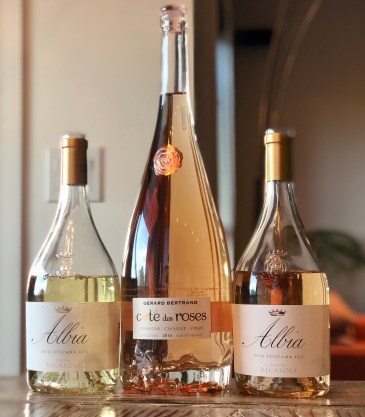 Sometimes you have to force seasonal drinking posts, and other times the season and the drinks just fall right into your lap. Stampede is here in Calgary, the thermometer has just recently clocked over 30C, and we’re well-ensconced into July, which turns my sample pile ponderings to thoughts of whatever I can chill for refreshment most effectively. After landing on an ideal trio of bottles that achieved that lofty goal, I noticed something odd that bound them together: they have all at one time or another previously graced the pages of Pop & Pour. Even though the blog is now 7½ years old and counting, that basically never happens. Sometimes summer is just meant to be. Game on.
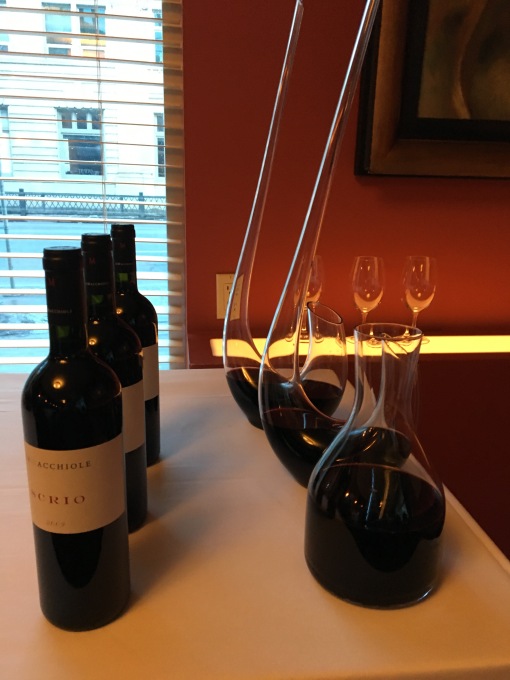
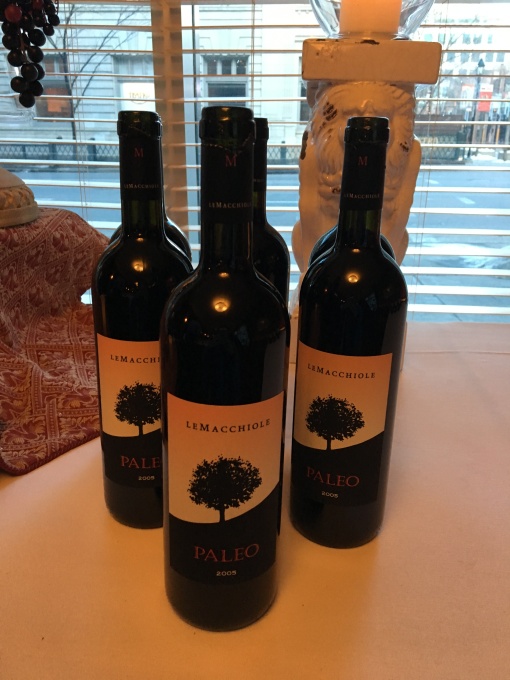

 When Francesco, a professional photographer, finally entered the world of winemaking, Bettino Ricasoli’s beloved Castello di Brolio estate had spent some time being passed from one multinational to the next. Enter a “contractual loophole” that gave Francesco a chance to purchase his family’s legacy from Hardy’s, based in Australia. Although he was initially unsure about whether this was a good idea, some helpful advice and prodding from a friend at Castello di Fonterutoli sealed the deal. Alas, there was much work to do. Francesco wanted to restore his wines to glory. He commissioned a three-year study to clarify the agronomic potential of his property and conducted trial plantings of fifty different Sangiovese clones, eventually determining which would perform best in his vineyard soils. The latter are largely calcareous clay with additional stony components and occur at a wide range of altitudes. Francesco was careful to explain his philosophy of “precision viticulture”. Under this approach, every vineyard parcel is a distinct entity yielding a unique vinous product. Parcels are each farmed according to their individual characters. The wines are all vinified separately to preserve their distinct attributes and are then thoughtfully blended. It became clear that Francesco does not like leaving winemaking to chance. “Why make mistakes that can be avoided?”, he asked, in response to a question about whether he uses selected yeasts for fermentation. However, he is passionate about preserving grape character. This is a highly intelligent man who thinks deeply about his wines, one who has the utmost respect for nature’s raw materials but who is not shy about steering vinification exactly where he wants it to go, according to his vision.






 cabernetdialectic (Raymond Lamontagne)
 Dan Steeves
 Peter Vetsch
 tylerderksen
 pop & pour