Wine Review: Cloudline Pinot Duo

2 03 2016

[These bottles were provided as samples for review purposes.]

FullSizeRender-245

OK, yes, I totally had a glass of the PG before taking this picture.

The flourishing Pinot Noir vine of Oregon’s wine history is largely rooted in a man named David Lett, the founder of Eyrie Vineyards, the first person to plant Pinot Gris in the United States and the trailblazer who cemented Oregon’s place as a safe haven for Burgundian varietals.  Known as Papa Pinot, Lett entered his 1975 Eyrie Vineyards Reserve Pinot Noir in a prestigious 1979 blind tasting competition in Paris called the Wine Olympics, which featured hundreds of entries from around the world.  Absolutely nobody outside of Oregon in 1979 thought of it as a wine region, let alone a globally competitive one, but that started to change when the Eyrie Pinot placed in the top ten, beating many top Burgundies along the way.

One person who noticed the result was Robert Drouhin, third-generation head of Burgundy’s renowned Maison Joseph Drouhin.  The following year, unbeknownst to Lett, Drouhin set up his own Burgundy/Oregon rematch, pitting Eyrie Vineyards blind against a field of some of his top wines.  The Eyrie Pinot came in second in the group, just a hair behind Drouhin’s legendary 1959 Chambolle-Musigny.  As if that wasn’t feather enough in Oregon’s cap, Drouhin then proceeded to buy the cap too.  He visited Oregon, noted that its cooler, more temperate climate was a more welcoming environment for Burgundy’s Pinot Noir and Chardonnay than neighbouring California, had his daughter Veronique come work harvest with the Letts and others in 1986, then purchased land himself in the Willamette Valley’s Dundee Hills to grow the Pinot that had impressed him so much. Read the rest of this entry »


Calgary Wine Life: Thomas Perrin Beaucastel Component Tasting

23 02 2016

FullSizeRender-242I’m having myself a bit of a tasting month here.  A week after sitting down to some incredible 50, 51 and 52 year old Taylor Fladgate Ports, I was treated to one of the most memorable experiences of my wine life:  a chance to taste through the individual varietal component wines of the unparalleled Chateau de Beaucastel with proprietor Thomas Perrin, the first time such a tasting had ever been held in Alberta.  Beaucastel is the legendary estate of Chateauneuf-du-Pape, the top region in France’s Southern Rhone Valley and the first area declared to be an Appellation d’Origine Controllee (AOC – now Appellation d’Origine Protegee, or AOP) in 1936, known for producing rich, dense and complex reds and whites of remarkable quality and longevity.  The Perrin family has owned Beaucastel for over 100 years, having purchased it shortly after most of the vineyards were ravaged by the phylloxera louse and just before the scourge of World War I. Two wars, 100 hectares and five generations later, Thomas Perrin and his family members carry on the legacy of the Chateau and the Perrin name.

Beaucastel’s winemaking philosophy was created and entrenched largely by Thomas’ grandfather Jacques Perrin, whose name graces the estate’s top wine, Hommage a Jacques Perrin, released only in top years.  The elder Perrin converted the entire estate to organic viticulture back in 1962, when almost nobody would even have known what that meant and the prevailing wisdom pushed hard the opposite way, toward the increased use of vineyard chemicals and pesticides.  Chateauneuf-du-Pape permits the use of an astounding 13 different grape varietals, 14 if you count the white version of Grenache (reds – Grenache, Syrah, Mourvedre, Cinsault, Counoise, Terret Noir, Muscardin, Vaccarese; whites – Grenache Blanc, Roussanne, Clairette, Picpoul, Bourboulenc, Picardin), which is way more than your standard high-end rigid French appellation; Beaucastel makes a special point of using them all, white and red, in every vintage of its CNDP release.  They plant, harvest, vinify and mature each varietal separately, as each has a different growth curve and ripeness window, but in all cases they aim to tell the harmonious story of grape, soil, climate and region, of terroir, in their wines.

FullSizeRender-236

Read the rest of this entry »


Calgary Wine Life: Taylor Fladgate 1966 Single Harvest Port Release

17 02 2016

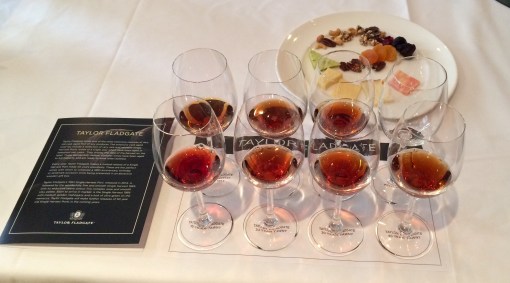
There are tastings and there are TASTINGS; this one deserves capitalization.  To celebrate the impending release of Taylor Fladgate’s 1966 Single Harvest Port to the Alberta market (coming next month to a store near you!), this 50 year-old wine was opened up at a special release event this afternoon along with its older siblings the 1964 and 1965.  153 combined years of Port later, I had a good day.

FullSizeRender-230

By way of quick refresher, Port is a fortified wine made from (usually) a blend of grapes grown in the Douro region in northern Portugal.  The grapes are crushed and at first fermented just like dry table wine, but halfway through the fermentation, when there is still considerable sugar left in the grape juice that has yet to be converted to alcohol, the juice is spiked with 70% abv grape brandy, which kills the yeast, stops the fermentation and (obviously) increases the alcohol level of the now-finished wine, resulting in a sweet, fruity, 20-ish% abv Port.  All Port is made in this way, but how each Port ends up looking, smelling and tasting after you open the bottle depends largely on how it is matured.

Ruby Ports, blends from multiple vintages made for early consumption, get a couple of years of barrel age and are bottled young and fruity.  Vintage Ports, single-year wines released only in top years, get a similar barrel treatment but are so dense and concentrated that they are intended to age for years or decades in bottle before they are opened.  Tawny Ports, also multi-year blends, are aged oxidatively in barrels until they are ready for release, with air exposure leading to their brownish colour, mellow texture and nutty, caramel-y flavours. The Port Wine Institute only allows Tawny Ports to be bottled with an age designation of 10, 20, 30 or 40 Years, with the number denoting the average age of the wines in the blend.

FullSizeRender-229

When a Tawny Port is made from grapes of a single year’s harvest, it is known as a Colheita, a single vintage Tawny.  “Colheita” (pronounced “Kohl-YAY-tah”) is the Portuguese word for “harvest”, and to obtain this designation, any one-year Tawny must be aged at least 7 years in barrel before bottling.  Taylor Fladgate, thanks to a fortuitous acquisition of another Port house with significant back-vintage reserves, started a program three years ago for the annual release of a special Very Old Single Harvest (Colheita) Port on its 50th anniversary.  In 2014 they released the 1964 Colheita, followed by the 1965 in 2015 and now this year’s 1966.  If you know anybody celebrating a 50th birthday or anniversary in 2016, I know what you can get them. Read the rest of this entry »


Beautiful Bubbles: Benjamin Bridge Trio

3 02 2016

[These wines were provided as samples for review purposes.]

If you have a passing familiarity with the Canadian wine scene, you’re probably pretty comfortable about what’s where.  You know that the two big players are the Okanagan and Niagara.  You know where to look for dynamite Riesling, Gewurz, Gamay and Cab Franc.  You may know about the potential rise of Syrah out west, about new possibilities in the Similkameen and a focus on subregional quality in Prince Edward County and the Golden Mile Bench.

But did you know that the best sparkling wine in Canada may well be made in…Nova Scotia?

IMG_3824

A Nova Scotia awakening.

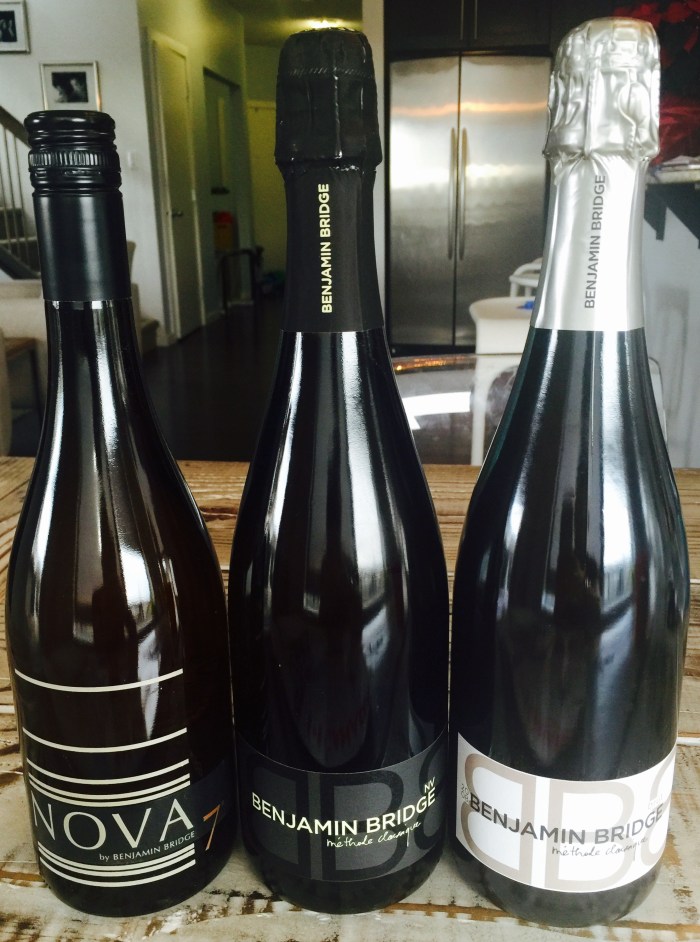
Despite only being in existence for just over a decade, Benjamin Bridge definitely deserves a place at Canada’s bubbly head table, and to my mind they are already the cream of the crop.  Located in the Gaspereau Valley northwest of Halifax, in north-central Nova Scotia (bordering the Bay of Fundy as opposed to the Atlantic), Benjamin Bridge is without question the most acclaimed and well-known winery east of Niagara, producing a wide range of bottlings but focusing heavily on traditional method sparkling wines.  The Gaspereau, with its (unsurprising) cool climate and maritime breezes, delivers a colder, shorter growing season promoting leaner ripening and lower yields, one remarkably similar to bubbly’s Mecca, Champagne in France.  The marginal conditions and harsh winters mandate partial reliance on hardier and earlier-ripening hybrid grapes, which are not usually known for their complexity and delicacy in the bottle, but somehow the winery makes them sing, embracing rather than hiding them and adding a unique sense of intrigue to the wines as a result. Read the rest of this entry »


Wine Review: 2012 Marabino Noto

20 01 2016

[This bottle was provided as a sample for review purposes.]

FullSizeRender-216

I admit: I had to do a little research for this one. But well worth it!

Sicily is hot right now (figuratively at least; literally, it’s about +8 Celsius right now, and it’s 4:00 a.m. tomorrow morning).  After a lengthy history of exporting purely bulk wines for blending and bottling wines only for domestic consumption, this large island off the toe of Italy’s boot is suddenly undergoing a rapid and massive quality transformation, showcasing its indigenous varietals to the world and beginning to show up on wine lists and in boutiques all over town.  There are wines from vines grown on the side of an active volcano (Etna) and wines so close to the ocean they can smell the salt.  More and more Sicilian wine is being targeted for import, filling a gap in our drinking experience we never knew was there.

This is the second bottle of Marabino that I’ve had the opportunity to try; the first was their fantastic Eureka Chardonnay, exactly five months ago today.  Marabino is a relative newcomer to the island, established in 2002 as a fully biodynamic winery focused on growing Moscato, Nero d’Avola and Chardonnay, the first two native to the region.  Marabino is based in the Noto DOC, a UNESCO world heritage site featuring surprising white soils in the very southeast corner of Sicily.  While the number of classified Denomination of Origin zones in Sicily is continually growing, Noto has held this designation since 1974 and has an entrenched place in Sicilian wine history. Read the rest of this entry »


Wine Review: Jim Barry Value Red Showdown

13 01 2016

[These bottles were provided as samples for review purposes.]

I'm not making up the vertical/horizontal label dichotomy, right?  Totally something thematic there.

I’m not making up the vertical/horizontal label dichotomy, right? Totally something thematic there.

Australian wine is in sort of a weird place right now.  I first got into wine during the Great Shiraz Rush just over a decade ago, when critter wines ran rampant and the overtly ripe, sweet, boozy style and approachable branding of big-name Aussie Shiraz rolled over the global wine scene like a tsunami, spawning copycats galore and creating ripples that are only now just starting to settle.  The behemoth brands at the front of this wave are mostly still around today, and their bold, fruity, slightly concocted style certainly retains its share of popularity with casual drinkers, but the world has moved on to other phenomena and the scene in Australia seems caught in aftermath phase, not wanting to totally abandon what brought it to global prominence but understanding that its long-term prosperity is likely tied to being something more than liquor store filler.  The country is taking steps to avoid being a one-hit wonder, surprisingly churning out some of the best Riesling you’ve never tried, finding cooler pockets for Pinot Noir and (especially in Tasmania) sparkling wine, using its plentitude of remarkably old vines to its advantage, and dialling its Shiraz back a notch or two while still keeping it lush and appealing to New World palates.  It is also finding stronger and more quality-focused expressions of its value wines which are less industrial commodities and more genuine expressions of grape and place.  This is where Jim Barry comes in.

This family-owned producer is now run by second-generation executive winemaker Peter Barry, the son of eponymous founder Jim, who was the first qualified winemaker in South Australia’s Clare Valley, where the winery is based.  Its tailored lineup of wines runs the gamut from dynamite supermarket bargains (see below) to one of Australia’s very best and priciest bottles, The Armagh Shiraz (as experienced by me in one of my favourite tastings ever).  I was first converted to the Jim Barry cause a few years ago when I bought the Cover Drive Cabernet Sauvignon on a whim because of its circus-tent striping on the neck foil and the cricket player on the main label and was wowed by what I found inside.  I could be wrong, but by its participation in the JB value red duel below, I believe Cover Drive becomes the very first wine in PnP history to be reviewed in three separate vintages, following its write-ups here and here.  Can it hold off a spirited challenge from its neck-striped brother, the Lodge Hill Shiraz?  Let’s find out. Read the rest of this entry »


Wine Review: 2013 Culmina Dilemma

7 01 2016

[This bottle was provided as a sample for review purposes.]

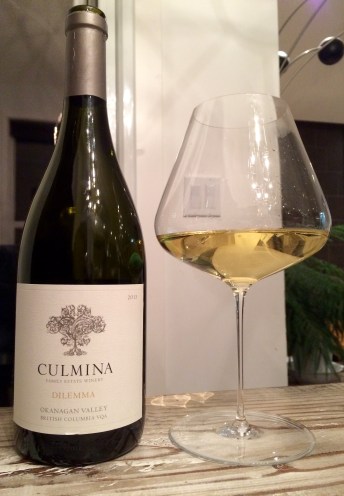
Great story, great wine.  And check out the sick Zalto Burgundy glasses I got for Christmas!

Great story, great wine. And check out the sick Zalto Burgundy glasses I got for Christmas!

Back in the saddle, and back to wine, for 2016!  I hope everyone had a happy and restful holiday season; I had a relaxing blog-free week and a half following my arduous 25-day whisky Advent marathon but am raring to start the new year of PnP off right, so I opted for a bottle that I highly suspected would be good.  Suspicions:  confirmed.

Culmina is one of Canada’s top wineries in my books and one of the most compelling stories on the Okanagan wine scene.  A spare-no-expense passion project spearheaded by iconic proprietor Don Triggs (the Triggs from Jackson-Triggs) and his family, Culmina has only been around for a few years, but through careful site study and selection and meticulous planting, it has been churning out wines of intrigue and quality from its inception.  I have previously waxed on about the winery and a number of its bottlings here and here , but this is my first time writing about what could very well end up being the crown jewel of its portfolio, the Dilemma Chardonnay.  I hope it’s not my last.

Read the rest of this entry »


Wine Review: 2008 Ratzenberger Bacharacher Riesling Sekt Brut

13 12 2015

[This bottle was provided as a sample for review purposes.]

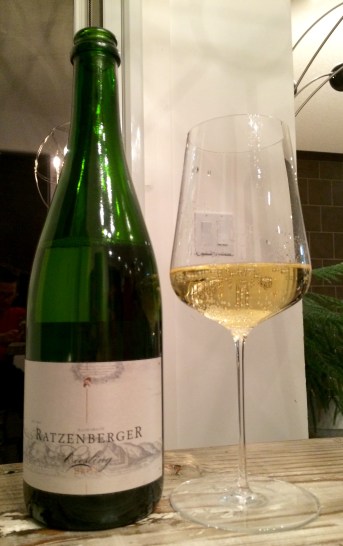
Redefining the world of German bubbly.

Redefining the world of German bubbly.

What’s this?  A wine review?  Isn’t this a whisky blog now?  OK, I probably deserved that.  But Advent only comes around once per year, and since no one yet has taken up the torch of my idea to find 24 good half-bottles and make a Wine Advent Calendar, this is what you get instead.  For those wine lovers out there just dying for the calendar to turn to January, this one’s to tide you over.

This bottle is another selection from Cellar Direct (cellardirect.ca), the online Canadian Natural Wine Club that allows people from all over the country to have high-quality, artisanal, naturally made wines shipped to their door via an array of tailored subscription packages ranging from $40 to $80 per month depending on your location and the package selected.  Since I last wrote about the service back in September, it has revamped its website, introduced an offer of two free bonus bottles for every 24-bottle annual subscription, and added an online shop (which will be operational in January) where Cellar Direct members can order more of their favourite bottles over and above their subscription.  It has also gotten rave reviews in BC, where price increases and regulatory chaos have otherwise made reasonably priced access to many good wines a pipe dream.

The one thing I can so far say for sure about Cellar Direct is that its selections are not fooling around; each of the three bottles I’ve now had the chance to try from their library have been of exceptional quality and proud ambassadors of where they’re from.  These are wines from somewhere as opposed to wines that could be from anywhere, and this gets all the more impressive given that this latest wine is a bottle of Sekt.  Nobody usually makes quality and terroir proclamations about Sekt (German sparkling wine), and for good reason:  most Sekt doesn’t deserve it.  In fact, it’s hard to say anything specific about Sekt as a category because it might be the least regulated category of Old World wine I’ve come across.  German wine law doesn’t mandate that Sekt be made of any particular types of grapes; it doesn’t even require those grapes to be from Germany; and it doesn’t require the wine to attain its bubbles any particular way.  Sekt is required to be at least 10% abv, but after that, all bets are off. Read the rest of this entry »


Bargain Bubbles: Prosecco Showdown

7 11 2015

[These bottles were provided as samples for review purposes.]

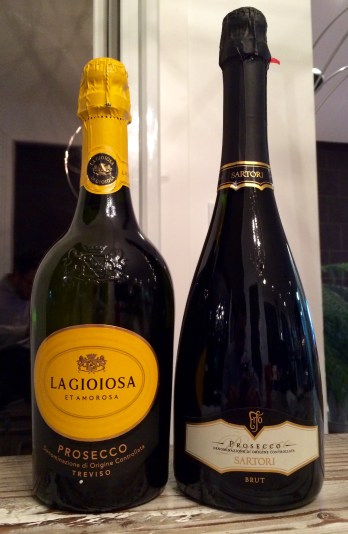
Bring on the bubbles!

Bring on the bubbles!

Sparkling wine is instantly celebratory — unless you’re opening two bottles simultaneously, by yourself, at your kitchen table, on a weeknight, like I did.  Even then, the brisk pops of the corks out of the bottles lightened my mood and made my analytical tasting exercise a little more festive.  You almost can’t drink Prosecco and be in a bad mood.

Prosecco is very, very hot right now.  Global sales of this Italian sparkler have increased by double digit percentages every year since 1998 (!), and last year they were up an astonishing 32% (!!) over the year before, five times the sales growth of sparkling wine overall (!!!).  In 2013, global Prosecco sales actually overtook global Champagne sales at over 300 million bottles.  Suffice to say it is on trend, buoyed by its general approachability, fruit-centered flavours and highly attractive price tag.  And yet, before now, Prosecco had never featured on Pop & Pour:

Screen Shot 2015-11-06 at 8.44.02 PM

So since this is uncharted blog territory, allow me to toss out a bit of a primer before we get into the bubbles themselves.  Prosecco is made in the Veneto and Fruili regions of northeast Italy; the Prosecco DOC quality region actually spans and overlaps most of both.  The wine is named after the village of Prosecco (which may have been its birthplace) near Trieste on Italy’s eastern border at the top of the boot.  Its made primary from a grape that used to also be called Prosecco, but as of 2009 is now known as Glera, primarily to annoy you and make it harder for you to remember it.  Just like all quality sparkling wine, it is created by first making a low-alcohol still base wine and then starting a second fermentation of that wine (by adding extra yeast and unfermented juice to it) in an airtight container, such that the carbon dioxide created as a byproduct of the fermentation cannot escape and becomes trapped in the wine, making it bubbly. Read the rest of this entry »


Border Crossing: Kaiken Ultra Wines

28 10 2015

[These bottles were provided as samples for review purposes.]

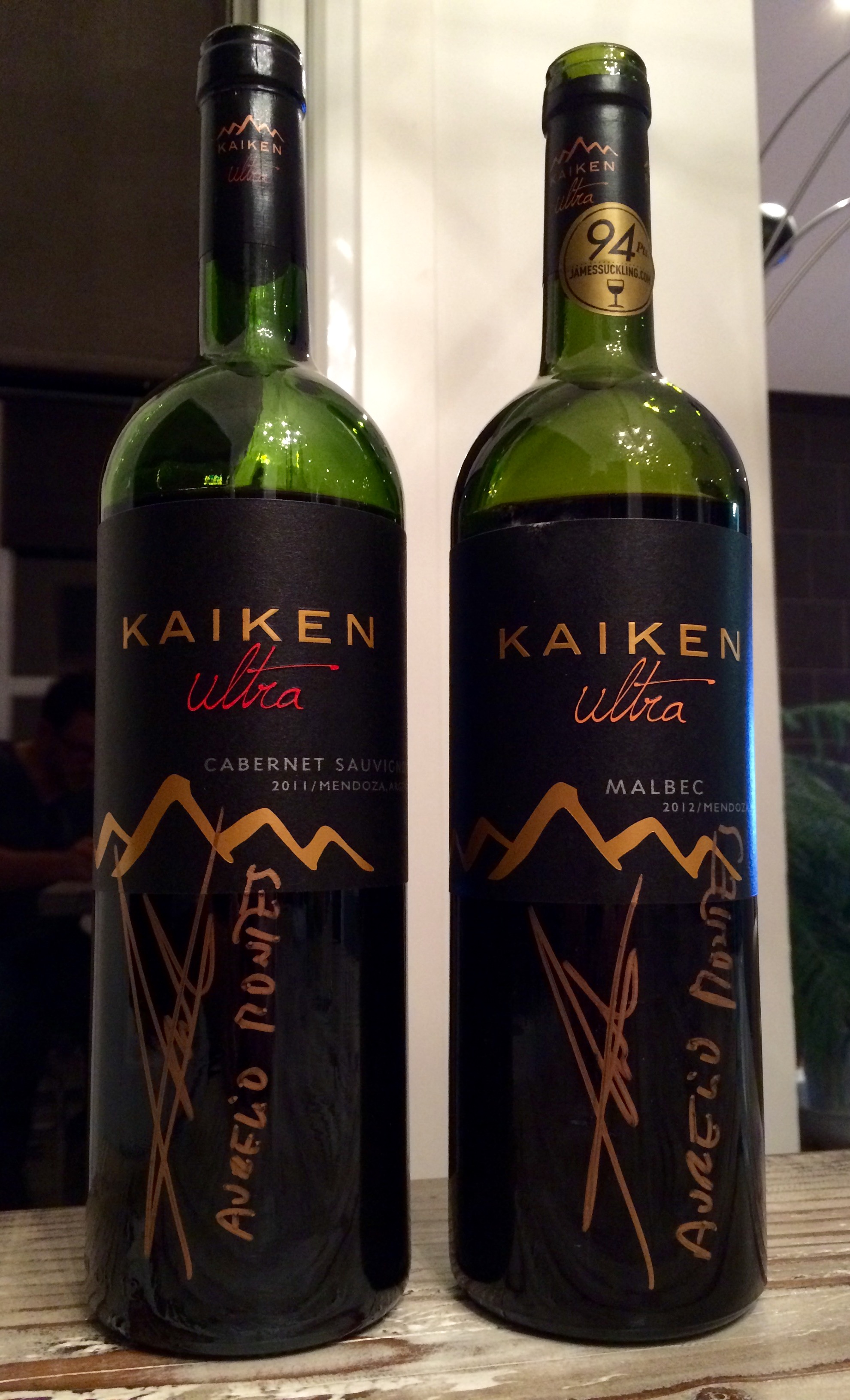
From Chile to Argentina with love.

From Chile to Argentina with love.

It’s not uncommon to see producers from other countries head to Argentina to create a second label or side project.  There’s lots to like about the South American nation as a startup hub, from truly unique altitude-induced terroir to surprising access to old-vine plantings to ultra-low input costs. What is unusual is for the immigrating winery to come from right next door:  Argentina’s skinny western neighbour Chile offers many of the same producer advantages and is often similarly sought after by wineries off the continent for new ventures, but you rarely see a producer from one of these countries set foot in the other to make wine.  That’s what makes these bottles interesting.

The Montes family is one of Chile’s pioneering wine clans, and its Vina Montes may be the country’s best known winery, churning out everything from weeknight wine champions to top-end stunners like Montes Folly, an unprecedented Syrah from Apalta that’s one of my favourite wines of all time.  Patriarch Aurelio Montes Sr. visited Argentina in 2001 and was immediately intrigued by the Andes-hugging Mendoza region; he wasted no time in deciding to expand operations there, starting up the Kaiken label in 2002.  The word “Kaiken” is an anglicized version of “Caiquen”, a type of wild goose that regularly travels over the Andes Mountains from Chile to Argentina, just like Montes himself.  Once the winery was up and running, he made the call to keep the winemaking in the family, recently naming his son Aurelio Montes Jr. as winemaker.  Kaiken owns three vineyards in Mendoza, two in and around the Lujan de Cuyo region near the town of Mendoza itself and one in the Uco Valley further south; one of the vineyards is fully biodynamic, a set of principles Kaiken is working to embrace. Read the rest of this entry »


Wine Review: 2011 Barone Ricasoli Brolio Chianti Classico Riserva

30 09 2015

[This bottle was provided as a sample for review purposes.]

Modern Traditional Chianti.

Modern Traditional Chianti.

Barone Ricasoli holds itself out as the oldest winery in Italy.  Its history certainly marches in lockstep with that of its region, Chianti:  the winery’s eponymous founder was the man who first suggested the modern “recipe” for the standard Chianti blend — largely Sangiovese, blended with indigenous varieties Canaiolo, Trebbiano and Colorino — in a letter in 1872.  That mix has expanded and adapted since then, but Ricasoli has remained a constant in the area, producing Chianti at all price and quality points, from the entry level to the sublime.

This particular bottle is from the sub-zone of Chianti Classico, the traditional Chianti heartland at the centre of the region encompassing the original lands upon which that name was bestowed.  Chianti has now expanded significantly beyond that area, some might say for largely economic reasons and to the detriment of its reputation, as the lands surrounding Classico often do not quite live up to its hallmarks of quality.  The symbol of Chianti Classico, emblazoned proudly on this bottle in multiple places, is the black rooster, the gallo nero.  Why?  Legend has it that, back when the provinces of Florence (in the north) and Siena (in the south) were fighting over the territory of Chianti (right in the middle), they settled on a contest to determine their mutual border:  they would each pick their best knight, who would ride from his city towards his opponent as fast as his horse could take him once the rooster crowed, and wherever they met would mark the new edge of each province’s lands.  The Florentines had a black rooster, and before the date of the contest they kept it locked up in a box with no food, so that when it was finally released on the day of the race, it crowed much, much earlier than dawn, giving Florence’s knight a massive head start.  The Florentine met the Sienese knight just outside of Siena’s walls and thus scooped all of Chianti for Florence, giving the black rooster mythical status in the process.  This is the best part about wine:  everything has a story.  You just have to find it. Read the rest of this entry »


PnP Featured in Culinaire Magazine!

4 09 2015

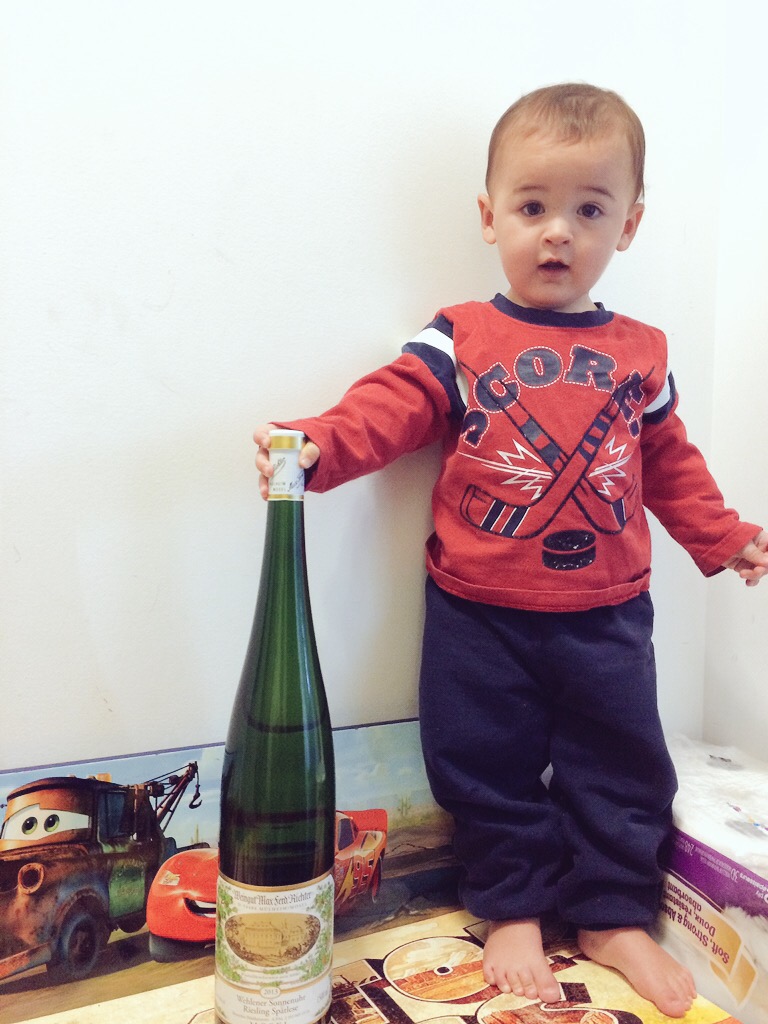
Well, after over four years of blogging and nearly 300 posts, it has happened:  I have been photographed going down a slide in a tot lot with a magnum of Riesling for a real life magazine.  Culinaire Magazine, a fantastic monthly publication focused on all parts of Calgary’s thriving food and beverage scene, has a monthly feature on the inside of its back cover called “Open That Bottle”, where a local personality is profiled and discusses a special bottle in their cellar that they’re saving for a specific occasion.  For the September 2015 issue, I was honoured to get the call and share the story of my favourite kind of wine, from my favourite vineyard, that I’m holding for one of my favourite people in the world:  my son Max.  See the story below:

If for some reason the media link above doesn’t work, the online version of the article can be found on the Culinaire website here.  Also in the September issue (it was a good issue!) was a joint article about drinking boldly and dodging the usual suspect grapes that I wrote with YYC Wine’s Adrian Bryksa, which you can read here:

Stuff like this doesn’t happen without people like you taking the time to find and read what I write on here, so I am eternally grateful to everyone who has supported this site.  Never did I think that this little passion project would turn up in a magazine; I can’t wait to see where it goes next.  Thank you!!

Max at 16 months, with his birth year mag, October 2014.

Max at 16 months, with his birth year magnum, October 2014.


Calgary Wine Life: 6 Wines To Try Before You Die @ Vine Arts

3 12 2012

[Cross-posted at http://www.calgaryisawesome.com]

There are wine tastings and there are WINE TASTINGS.  And then, about 500 feet above those, there was the tasting I went to this past weekend.  It is not blog-boosting hyperbole to say that most of us who walked into Vine Arts on Friday night were stepping into a once-in-a-lifetime opportunity to try wines that we would literally never see again.  The rarity of the event was not lost on the buying public:  the Friday tasting sold out so quickly that Vine Arts scrambled to add an encore showing on Saturday, which sold out just as fast.

Photo1-131

What was so incredible about it, you ask?  It was the near-unheardof chance to taste six of the world’s most famous, celebrated, acclaimed and expensive wines in a single sitting.  Over a span of two hours, I crossed a number of vinous firsts off of my bucket list:  Try a 100-point rated wine.  Try the top dessert wine in the world.  Try a well-aged First Growth Bordeaux.  Try one of the all-time best wines from my favourite region.  And so on.  I have never seen ANY of the bottles in Friday night’s lineup available at another tasting in town, so having all of them together in one room for one occasion was a huge coup for owner Jesse Willis and the Vine Arts team:  it would be like a music lover arranging for the Beatles, the Rolling Stones, Pink Floyd and Bruce Springsteen to play at a single concert, with the Beach Boys and Queen as opening acts.  For wine geeks like me, this was almost a religious experience.  If you’re not a wine geek, hopefully the excited rambling above has gotten across that this was kind of a big deal. Read the rest of this entry »


Happy Anniversary, PnP

12 03 2012

I'm reasonably sure that both birthday and anniversary pics are applicable.

I guess it’s sort of trite to wish yourself a happy anniversary, and borderline creepy to do so to a non-sentient website that you’ve created, but here we are.  This past Friday, March 9th, was exactly one year from the date of my very first post on Pop & Pour.  The brevity of that piece (something that got lost along the way) didn’t conceal my evident ignorance about what I was getting myself into and my indecision about what I wanted this site to be.  152 posts, 730 tags and 181 comments later, it’s turned into more than I ever could have hoped.  By big-game Internet standards it’s still a tiny operation, a blip on the search engine radar, but I initially didn’t know if I’d keep up my posting beyond the first couple of weeks, and I especially didn’t know if what I put out there would be picked up by anybody.  Twelve months later, I’m psyched that there are people who actually read this blog (I was at a very good friend’s wedding this past weekend, and when I was introduced to the groom’s mom, the first thing she said to me was that she was a regular PnP reader!  Thanks Chris!) and humbled by the opportunities that have come my way because of it (my monthly calgaryisawesome.com column, as well as a sweet new gig that will be announced shortly).  Here are a few insider Pop & Pour stats, accurate as of today thanks to the crack team at the WordPress Analytics Department, detailing some of the numbers behind PnP’s first year: Read the rest of this entry »


PnP Ratings Database Update — December 2011

21 12 2011

My plan is to find a different picture for the DB update post every month. On month 2, it's already hard.

Merry Christmas (or non-denominational secular equivalent) everyone!!  With the big day fast approaching, I hope this finds you gearing up for some well-deserved time off with friends and family.  That’s certainly the case for me:  after tonight I will be taking a brief blogging break for a week or so, if only to avoid annoying people by whipping out my tasting notepad in the middle of Christmas dinner (not to say that that won’t happen anyway…).  However, I thought I would leave you with December’s update to the Pop & Pour Ratings Database spreadsheet, which now includes all of the wines I’ve ever tasted and reviewed on this site up to this week.  If you’re looking for a last-minute XMas gift that delivers bang for the buck, just download the Excel spreadsheet by clicking on the links below and look for a wine with a high (0.65 and above) QPR rating, which is a rough guide to sniffing out bargains:  it tells you how many PnP ratings points above a baseline of 75 each wine-buying dollar gets you with respect to a particular bottle.  The top 10 highest-scoring QPR wines all cost $22 or less, so find them if you can!  Download the spreadsheets here (new Excel file first, then old Excel):

Pop & Pour Ratings Database Dec 2011

Pop & Pour Ratings DB Dec 2011 Old Excel

Have a safe a happy holiday season — may your glasses never be empty and your wine never be corked!