Co-op Wines: The Social Collection, Bin 107

14 02 2018

By Dan Steeves

[This bottle was provided as a sample for review purposes.]

img_5495
As a follow up to Peter’s review of the first Co-op Social Collection bottle, the Bin 101 Cabernet Sauvignon, we now move onto the second bottle of our trio, Bin 107 Pinot Blanc, which hits a little closer to home.  This bottle’s front label clearly shows it is a product of Canada, and upon examining the back label, you notice further clues as to the wine’s origin. Underneath the grape variety is written “Golden Mile – Oliver, BC Canada”, and further down it shows that the wine was exclusively produced and bottled by Castoro de Oro Estate Winery in Oliver BC.

The region south of the town of Oliver and north of the town of Osoyoos is commonly referred to as the Golden Mile due to the amount of wineries off the highway between the two towns. However, stating “Golden Mile” on a label does not have an official meaning — this term shouldn’t be confused with the very-similar label designation “Golden Mile Bench”, which an area up off the valley floor that shows unique climate and soil types and which is now recognized as an official sub-Geographical Indication within the Okanagan Valley GI. That said, all wines made in this part of the Okanagan are well known for their high quality due to the ideal climate:  hot daytime temperatures, cool nights, and limited rainfall (it is for all intents and purposes a desert).

Read the rest of this entry »


Co-op Wines: The Social Collection, Bin 101

12 02 2018

By Peter Vetsch

[This bottle was provided as a sample for review purposes.]

IMG_7510

Get Social.

Negociant-style wines have long been a staple of the Old World wine economy:  instead of a winery planting, tending and harvesting a vineyard then using those estate-grown grapes to make wine, an enterprising producer or brand instead either buys grapes from a grower for use in their own winemaking or, more simply, buys already-made wine from a winery that is maturing in barrel or bottle and then sticks their own label on it. This may not accord with the most romantic notions of pastoral family-farmhouse wineries that automatically spring to mind when we think about the industry in the abstract, but it has a ton of advantages as a full-estate alternative, mostly tied to the division of labour.  To create and sell your own wine, you no longer need to own any land, purchase expensive wine-making equipment (or wine-aging vessels – do you have any idea how much oak barrels cost??) or have any winemaking education or expertise; you just need to get contact with the right subject-matter experts and have a vision for how to make it all come together cohesively.  The negociant approach drastically reduces barriers to entry in the wine production industry and also provides an additional market for those who grow grapes or operate winery facilities, and while it has always been a part of the industry in the New World, it now seems to be taking on an increased presence, particularly in the realm of branded grocery store wines.

IMG_7511

Ultra-transparent for a Cab!

This is actually not a new topic to this blog — a few years ago, I had the pleasure and challenge of trying to dig behind what was behind the cover label of the PC brand of wines, which resulted in some truly entertaining (if somewhat strange) juice.  Now Co-op Wine and Spirits has released its own lineup of sommelier-curated negociant wines called The Social Collection, sourced from around the world and targeted towards “the socialite and modern wine drinker”.  Translation, I think:  these are mainstream wines intended for easy enjoyment while still striving to properly represent their varietal and region at a wallet-friendly price.  I was sent a trio of examples from this new branding effort to taste and decided to make a group event out of it.  Dan and Ray will taste and report on a couple of subsequent Co-op releases later in the week, but I’m kicking things off tonight from where it all started for The Social Collection:  Bin 101. Read the rest of this entry »


Calgary Wine Life: Barone Ricasoli Luncheon @ Alloy Fine Dining

10 02 2018

By Raymond Lamontagne

I spent a lot of time at my grandparents’ growing up. Amongst the many fond memories (including my grandmother’s never-ending tolerance of my boundless energy and predilection for getting into various forms of trouble), I can recall that there were always a few fiascos kicking around the house, those round-bottomed bottles covered with a close-fitting straw basket that shall be forever associated with one of the world’s great wines: Chianti. Although the wine contained in most of these vessels was far from remarkable, over time a serious quality revolution occurred, one that led to the creation of the Chianti Classico DOCG designation. This important development was associated with a renewed commitment to meticulous winemaking as well as the elimination of winemaking techniques that were eventually appreciated to hinder quality (e.g., blending white grapes into a must that was largely red). At the same time, there was a dedication to preserving a unique identity; Chianti was and is a Sangiovese-dominant blend, not a varietal wine (at least usually…it turns out that Chianti Classico can be 100% Sangiovese!). As a newly christened regular contributor to Pop & Pour, I could not have been more keen to draw this tasting assignment, hosted by none other than Francesco Ricasoli. You see, Francesco’s ancestor Bettino actually invented the style.

IMG_0808When Francesco, a professional photographer, finally entered the world of winemaking, Bettino Ricasoli’s beloved Castello di Brolio estate had spent some time being passed from one multinational to the next. Enter a “contractual loophole” that gave Francesco a chance to purchase his family’s legacy from Hardy’s, based in Australia. Although he was initially unsure about whether this was a good idea, some helpful advice and prodding from a friend at Castello di Fonterutoli sealed the deal. Alas, there was much work to do. Francesco wanted to restore his wines to glory. He commissioned a three-year study to clarify the agronomic potential of his property and conducted trial plantings of fifty different Sangiovese clones, eventually determining which would perform best in his vineyard soils. The latter are largely calcareous clay with additional stony components and occur at a wide range of altitudes. Francesco was careful to explain his philosophy of “precision viticulture”. Under this approach, every vineyard parcel is a distinct entity yielding a unique vinous product. Parcels are each farmed according to their individual characters. The wines are all vinified separately to preserve their distinct attributes and are then thoughtfully blended. It became clear that Francesco does not like leaving winemaking to chance. “Why make mistakes that can be avoided?”, he asked, in response to a question about whether he uses selected yeasts for fermentation. However, he is passionate about preserving grape character. This is a highly intelligent man who thinks deeply about his wines, one who has the utmost respect for nature’s raw materials but who is not shy about steering vinification exactly where he wants it to go, according to his vision. Read the rest of this entry »


PnP Panel Tasting: Quench! Wines BC Portfolio

1 02 2018

[These bottles were provided as samples for review purposes.]

First, some exciting news:  I’m happy to announce that Pop & Pour Wine Advent 2017 authors Raymond Lamontagne and Dan Steeves are officially going to be sticking around as regular contributors on the blog, bringing their expertise and exuberance to a screen near you and formally making PnP a joint venture from this point forward.  I’m hoping that this will allow the site to be less tied to my schedule and to have a greater presence around events and bottles that interest you (or that interest us, at least – hopefully they will interest you too).  And what better way to go from a solo gig to a group gig than having a panel tasting?

IMG_7474

A highly worthy BC lineup for our first PnP Panel Tasting.

Here’s how we play our game.  Dan, Ray and I got together to jointly taste a (remarkable) set of wines; we discussed while we tried each wine, but we evaluated and scored each bottle separately and independently, without sharing our final assessment until all scores were locked in.  We divvied up the writing duties, but rather than average out the scores or try to come to a numerical consensus, we preserved each person’s score for each bottle to give you a sense as to the level of divergence in the room through the course of the tasting.  Hopefully this will be the first of many such panel reviews, but if you have any thoughts as to the format or results, leave a comment or send me a message and let me know!

The focus of this inaugural Pop & Pour panel tasting was a sextet of offerings from Quench! Wines, a Vancouver Island-based agency exclusively focused on the burgeoning British Columbia production scene.  We got to taste a pair of wines each from three critically acclaimed Okanagan producers:  Terravista, Bella and Fairview Cellars.  You could not have put together three more divergent groups of wines if you tried, a testament to the diversity that is possible in the Okanagan Valley, particularly since each distinct grouping aptly highlighted a different element of the potential of the region.  I got to lead things off. Read the rest of this entry »


Cellar Direct: On To Italy!

24 01 2018

[These bottles were provided as samples for review purposes.]

IMG_7455

Italy is not kidding around.

Over the past couple of years, I have come to know the wares of virtual Canadian wine merchant and weekly offer club Cellar Direct pretty well.  Over the course of half a dozen reviews and nearly twice as many bottles, I’ve grown accustomed to the Old World bona fides and seemingly effortless consistency of the wines sourced by CD founder Ron Van Schilt from family estates strewn across Europe:  France all day, Germany for sure, with a bit of Spain thrown in for good measure.  But I had never yet tasted anything from the fourth pillar of Cellar Direct’s traditional sourcing ground, the most glaring omission from the vinous Euro-stars above:  Italy, the focus of multiple prior online offerings but no corks popped at my kitchen table.  That changed tonight, and my perception of what this virtual venture is bringing into the country climbed ever higher.  The focus tonight is two dynamic, bombastic Italian reds, with a wild Cellar Direct white (Arneis!!) from the same country to come a bit later.  Let’s start where my Italian heart lies. Read the rest of this entry »


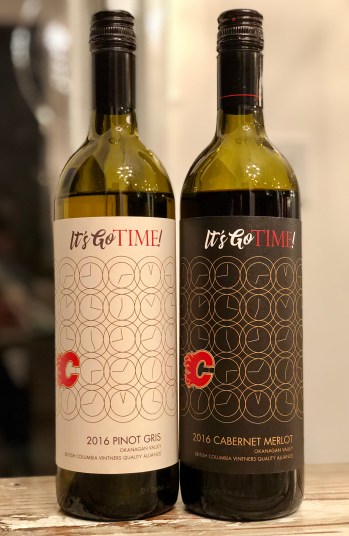
Wine Review: It’s Go TIME!

17 01 2018

[These bottles were provided as samples for review purposes.]

IMG_7405

NHL-licensed wine.  Bring on the themes!

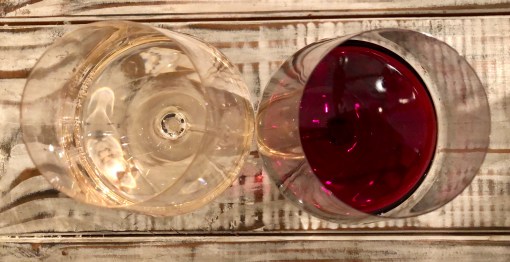
No, that title isn’t me exhorting myself into giving 110% on this wine review, playing for the crest on the front of the jersey and leaving it all out on the ice.  It is in fact the actual, somewhat-punny name of a red and white wine duo made as a commercial and charitable collaboration between the Okanagan’s TIME Winery and my local NHL squad the Calgary Flames, with some of the proceeds from bottle sales going to the team’s philanthropic Flames Foundation.  Having recently been to a WHL Hitmen game, I can confirm that the Saddledome boards themselves officially confirm TIME as the team’s official wine supplier (yes, such a designation is a thing), and the bottles are both served at the arena and sold at a wide array of retailers across town.  TIME is a brand owned by Encore Vineyards, a group led by Harry McWatters, a Canadian wine pioneer who founded Sumac Ridge winery the year I was born (1980) and who already has 50 years of local wine business experience under his belt, perhaps more than any other living person in Canada.  After selling Sumac Ridge, McWatters launched TIME in 2013, basing his winery inside an old movie theatre in Penticton and focusing on grapes from the southern Okanagan for his production.

IMG_7411

It is a long-standing tenet of this blog that I am fully on board with a good theme wine, as long as the gimmick doesn’t come at the expense of the underlying substance.  When theme bottles are done well, you win twice, augmenting the already-pleasurable experience of drinking well-made juice with the added enjoyment of the marketing cleverness surrounding it.  When they are not done well, not only are you left drinking crappy wine, you end up feeling a bit like you’ve been had while doing it.  These two bottles stake a sort of middle ground between those extremes, but when combined with their inoffensive price tag ($19.99 SRP) and their charitable underpinnings, they take no steps to dampen my theme wine enthusiasm.  Let’s get into them; it’s go t– …well, you know what time it is. Read the rest of this entry »


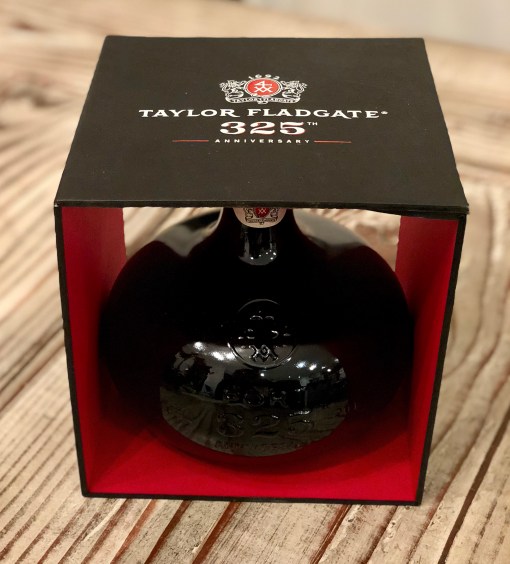
Wine Review: Taylor Fladgate 325th Anniversary Limited Edition Port

9 01 2018

Happy New Year!  Pop & Pour returns after a lengthy and dearly needed post-Wine-and-Whisky-Advent break with a bottle that would have graced this page last year but for the 49 other calendar-based things that had to do so in December instead.  Rest assured that the delay is no commentary on what’s in the bottle.  2017 would have been a preferable year to write up Taylor Fladgate’s 325th Anniversary special-release Tawny Port, if for no other reason than that it was the actual year of the 325th anniversary in question, thanks to Taylor’s founding way back in 1692.  Thankfully, the juice is just as delicious in 2018, and there are still a number of stores in town that have stock remaining (though this Limited Edition is sold out at the import agent level, so act fast if you want some!).

IMG_7381

Happy (belated) anniversary, Taylor Fladgate!  We’re back!!

Unlike most fancy commemorative releases from leading lights in the world of wine, Taylor Fladgate has done something daring and remarkable and borderline audacious with this celebratory flask:  it has made it accessible to the drinking audience at large.  Rather than building this one-off Tawny from ultra-rarified sources and then pricing it into the stratosphere (which it could easily have done, and quite successfully), it instead opted to take the top component lots of wines otherwise destined for its 10 through 40 Year Tawny lineup, blend them to about a 15 Year average, then age them together for 18 months so that it could release this (utterly spectacular looking) bottle at a shade below $50 retail.  Taylor intended this to be celebratory and drinkable at large, a monument for the masses, a conversation piece rather than a museum piece.  If this does not instantly become the next birthday gift you want to buy for the wine lover in your life, I worry for you. Read the rest of this entry »


KWM Whisky Advent Calendar 2017: Day 24

24 12 2017

First of all:  Merry Christmas Eve everyone!  Thanks for following along down this long and windy Whisky Advent road — it’s been a thrill to discover and discuss these incredible whiskies along with you!  Second of all:  UGGGGHHHHHH.  I had thought that I might be able to skate through the 2017 calendar without encountering my nemesis distillery, the one I admire in so many ways but can’t quite wrap my head around hedonistically, the one featured in FIVE prior hopeful but ultimately unhappy PnP whisky reviews from calendars past.  I had thought that by reaching the prestige cardboard door #24 I would be officially safe.  I was wrong.  Kilchoman is BACK.

IMG_7313

Advent cannot escape.

To be clear, this is probably very good news for most calendar drinkers, and certainly most whisky connoisseurs.  Kilchoman is a fascinating new distillery, the first that has opened its doors on Islay in over a century (during which time a great deal many of them shut down or were bulldozed), and one of the only ones that plants and farms its own grains (as noted with respect to Vancouver Island’s Shelter Point and its identical approach on Day 11).  This particular bottling of Kilchoman is also a special, exclusive one:  retailing for $200, it is a KWM-selected 25th Anniversary Single Cask, and also the first 10 Year Kilchoman for sale anywhere in Canada (not a huge surprise, since the producer is only 12 years old).  Only 212 full-size bottles — and obviously 380-odd tiny sample bottles — were made out of Kilchoman Cask 255 of 2007, matured in ex-Bourbon barrels and clocking in at 56.6% abv.  I would be more hopeful were it not for the fact that this is the third straight Advent Calendar with a Kilchoman Single Cask in it, and no prior one has turned me around (see here, here, here, here and here if you’re a masochist).

The Kilchoman 10 Year KWM Single Cask is a strange aromatic mix of the refined and the rugged, peaches and cream on top of oily peat, a delicacy in a longshoreman’s vessel.  Tar, pitch, pepper and dank undergrowth roil around, with some of Bourbon’s friendly maple and vanilla trying to peek through.  That off-putting (to me) cheesy Parmesan-rind funk that I’ve come to associate with Kilchoman is the first thing that hits on the tongue, followed by heavy briny peat, scorched apple, iodine, liniment, charcoal and grime; anise and melted plastic predominate the finish.  The complexity is all there, the flavours impressively layered, and any Kilchoman fan will likely find this their finest hour.  It still just misses me, unfortunately.  It’s not you, Kilchoman, it’s me.


Bricks Wine Advent Calendar 2017: Day 21

21 12 2017

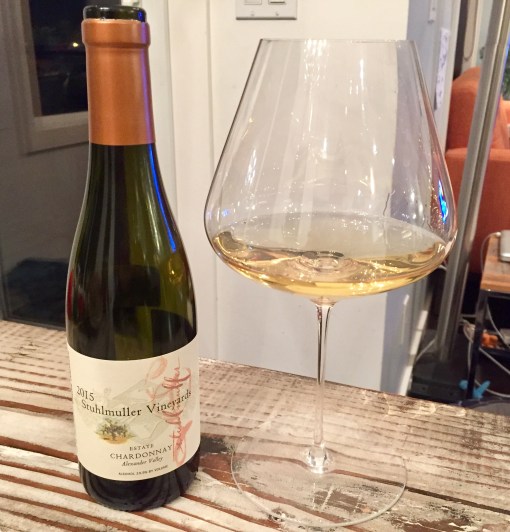
This is my second last wine post of Advent 2017:  the coming two days will see Dan and Ray post their Bricks calendar wrap-ups, and the next time you hear from me will be on Christmas Eve, for the grand half-bottle Advent finale.  It’s almost hard to believe our countdown to Christmas is almost done; it’s almost harder to believe that I actually survived it (though perhaps I shouldn’t say that yet).  And Bricks appears determined to send me off in style, because Day 21’s wrapping comes off to reveal an absolute firecracker of a Chardonnay:  the 2015 Stuhlmuller Vineyards from Sonoma’s Alexander Valley.  I think this grape is still in a down phase when it comes to much of the consumer world, but we seem to be entering a period where many of the regions previously responsible for Chard’s worst oaky boozy excesses have started to dial it in just right, at least on the quality wine side of the spectrum.  And there is no better representative of this evolution than California.

IMG_7307

Stuhlmuller Vineyards was founded by a husband and wife team who got their start in 1982 growing and supplying grapes to neighbouring wineries.  They didn’t become a full-fledged estate winery until 2000 but have already developed a reputation in the crowded California wine scene, particularly for Chardonnay, which makes up over half of its acreage.  The Alexander Valley is in the northeast corner of Sonoma, inland from the coast and due north of the better-known Russian River Ralley; its eponymous Russian River runs up and along the eastern edge of Stuhlmuller’s vineyards in Alexander’s southwest corner, where it and the Russian River Valley come together with Dry Creek Valley.  Much like Napa, the grape-growing conditions in the Alexander Valley are helped by two separate ocean-induced effects:  morning fog coursing in daily through the Chalk Hill gap, and cool nights spurred by ocean breezes, both of which provide the grapes relief from the scorching California heat, help preserve precious acidity and lead to more balanced ripening.  This bottle shows the results of all that climatic effort, clocking in at 13.9% abv.

IMG_7308

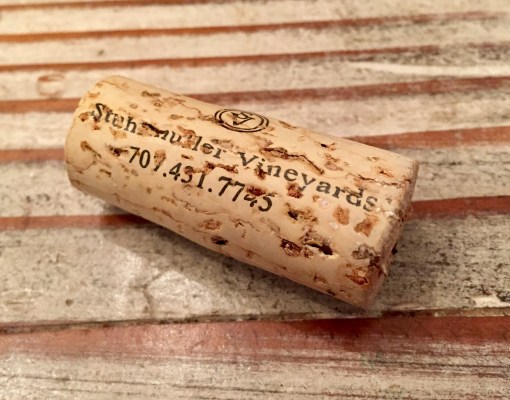
Cork Rating:  3/10 (Friendly advice – no phone numbers or websites on corks. This has both.)

This is Stuhlmuller’s “entry-level” Chardonnay, but it’s clear from the start that no shortage of care went into its creation.  It was fermented sur lie (on its spent yeast cells) over 8 months and matured in French oak, mostly small-barrel barriques but only 5% new.  It is a rich golden colour in the glass and finds that perfect harmony between Chardonnay’s careful fruit and oak’s at-times exuberant influence, mixing fresh pear, peach and Granny Smith apple pie with ginger chews, almond shortbread, oatmeal cookies and rubber boots.  Simultaneously full and cutting on the palate, the Stuhlmuller’s oak-aided roundness is run through with a table saw of slicing acidity.  It is beautifully poised on the tongue without losing the weight and body that is a defining feature of Chardonnay, a honeyed swirl of caramel apple, white flowers and a bracing quality on the finish like a cool sea breeze.  Refined and restrained but still California in essence — exactly what New World Chardonnay should be.

92 points


KWM Whisky Advent Calendar 2017: Day 21

21 12 2017

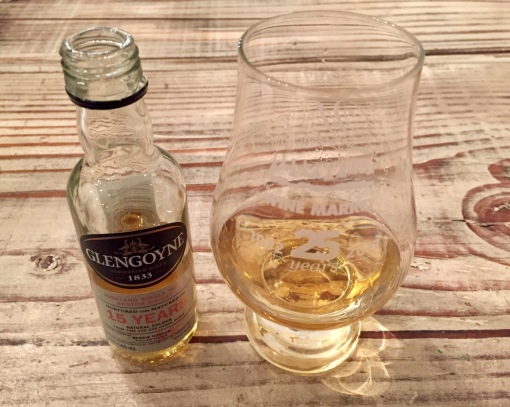
Our 21st day of whisky; our 6th Glen, giving us a Glen percentage of 28.6%.  Not too shabby.  If you’re counting at home, it’s been:  Dailuaine-Glenlivet (Day 1 – sort of a cheater Glen), Glentauchers (Day 8), Glenmorangie (Day 9), Glenfiddich (Day 10), Glenglassaugh (Day 15), and now today’s Glengoyne, a Highland distillery whose 18 Year Single Malt graced last year’s calendar on Day 12.  I wasn’t much of a fan back then, but for tonight’s 15 Year I am much more enthused.  Glengoyne got its start illegally, distilling scotch surreptitiously in the 1820s for tax avoidance purposes before deciding to go legit a decade later.  Around that time, they signed the contract of the (19th) century, lining up a 99-year lease for the pure spring water of the adjacent burn for the measly sum of £8!!  That would be £5,000 or so in today’s currency, but still – that’s a century of water.  They have obviously retained their colourful spirit (no pun intended) into modern times:  in 2004 they rented a pirate ship and landed in the harbour at the Islay Whisky Festival with a hold full of unpeated whisky, just to be contrarian.  You almost have to like them just for that.

IMG_7288

The Glengoyne 15 Year is a gorgeous shimmering amber colour and comes out firing with an aromatic barrage of burnt orange peel, clove, all-spice, carrot cake and tennis balls, immediately announcing itself as more forward and somehow more developed than its 18 Year sibling from last year.  Perhaps it’s the first-fill Bourbon barrel aging before the Glengoyne mandatory sherry cask finish on this bottle, but whatever the reason, it hits the tongue loaded with sweet comfort food flavour, a rich and warm blend of Cabane à Sucre (frozen maple), treacle, butter tarts, Terry’s Chocolate Orange and Golden Grahams.  The decade and a half in barrel left this mellow and loaded with confectionary depth, making it a joyous breeze to drink and a stellar value at $77.  Four more days!!


Bricks Wine Advent Calendar 2017: Day 20

20 12 2017

When the days hit double digits starting in 2s, I know our calendar work is almost done.  I’m not going to lie:  I’m ready not to be writing tasting notes and blogging on a daily basis, at least for a little bit.  But then I unwrap a bit of an Advent mystery and find myself sucked in all over again, pulled once more into the insatiable curiosity that goes with loving wine.  This time it came from revealing a bottle bolding displaying “Sancerre”, likely THE Old World heartland of Sauvignon Blanc and a renowned white region in France’s eastern Loire Valley…but then noticing things that seemed off.  Did it seem kind of dark inside?  Is that a maroon neck foil?  Wait – does that say Sancerre ROUGE?  (Granted, I have already had a white wine in this calendar say that it was a red wine by mistake, but this bottle actually IS one.)

IMG_7300

It turns out that red wine makes up close to 20% of Sancerre’s yearly production, all of which is required by appellation rules to be 100% Pinot Noir.  And there is perhaps no estate in Sancerre that takes its reds more seriously than Domaine Vacheron, which plants 11 hectares of Pinot alongside 34 hectares of Sauvignon Blanc and doesn’t treat it like an afterthought in the cellar.  The Domaine is now in its fourth generation of family ownership and has revamped all of its vineyard practices in the hands of the two young cousins who now direct its operations, Jean-Laurent and Jean-Dominique Vacheron.  They converted the estate to biodynamics in the early 2000s and now only fertilize the chalk and silex soils with composts made on the property, harvest by hand, ferment using only native yeasts and bottle according to the lunar cycle.  Their Pinot Noirs are partly matured in stainless steel tanks to preserve their fruit and partly in large neutral barrels for oxidative effect without oak flavours.

IMG_7301

Cork Rating:  2.5/10 (Not only is it boring as sin, it doesn’t do that great a job at its primary function of holding in liquid.)

This is my first ever bottle of Vacheron, the 2014 Sancerre Rouge, from a property that is almost at the literal centre of France.  I was a little leery from the outset as the cork came out of the bottle completely sodden and squeaky, but the wine inside seemed to bear no ill effects.  It was a fully transparent ruby in the glass and emitted a distinctive and attention-grabbing set of aromas:  beyond the more expected Pinot smells of cranberry, underripe raspberry and violets, there is a pronounced vegetal greenness (dill/pickles; Ray says nettles), a tangy citric bite (tangerine, gooseberry) and a base industrial rockiness (flint, car tire skid marks) that differs markedly from your run-of-the-mill Old World Pinot earthiness.  The palate adds salted watermelon, pomegranate, lava dust and crushed roses on a light, deft body structured mainly by prominent papery tannins.  This is a compelling mirror of its rocky soil and a suggestion that Pinot has the potential to ascend from its eternal Sancerre understudy status.

88- points


KWM Whisky Advent Calendar 2017: Day 15

15 12 2017

By my count this is “Glen” whisky #5 (well, 4 1/2) in 15 days of 2017 Advent, after Glenfiddich, Glenmorangie, Glentauchers and Dailuaine-Glenlivet all the day back on Day 1.  But the more important number for this particular Glen, Highlands’ Glenglassaugh, is three.  The distillery was founded in 1875, but like so many others it was mothballed in the 1980s (1986 to be exact), only to be near-miraculously purchased and re-opened 22 years later in 2008 (then purchased again by BenRiach in 2013, but that’s not part of this story).  I had never heard of Glenglassaugh back in 2014, when on December 7th I opened the KWM Advent Calendar door and discovered the very first whisky it had released after opening its doors again, aptly named the Revival.  The next year, on December 8th, 2015, we were treated to the SECOND ever whisky from the new Glenglassaugh, the Evolution.  And now we arrive to today, December 7+8 = 15th, and back to the number three:  today’s Glenglassaugh Torfa is the third new whisky to come out of the distillery’s doors.  The difference with this one is that it’s peated — according to the label, RICHLY Peated, although at 20 ppm (less than half of The English Smokey’s 45, which itself wasn’t over the top) it might be exaggerating things a bit.

IMG_7226

The rather odd name of the whisky, Torfa, is a nod to its burnt-moss-imbued nature, as it is an old Norse word for peat (turf).  It is an orangey golden colour and certainly exhibits some of its namesake on the nose, beaming out the shoe leather, moss and marsh bog aromas associated with peat, but measuring those with a honeyed sweetness and a lingering grassiness…despite its “Richly Peated” boast, it doesn’t come close to overwhelming.  Coming closer is the flamethrower of a palate that takes no prisoners at 50% abv, even with added water, but behind the alcoholic rage lies more careful peat balance, the smokiness never bullying the other notes of apple crisp, sandpaper, tangerine, black pepper and fallen leaves.  But the telltale slithery griminess shows up on both the attack and the finish, bookending a fun and fascinating dram.  Here’s to a fourth and fifth and many more, Glenglassaugh.


Wine Review: Black Market Wine Co. – Contraband Portfolio Tasting

15 11 2017

[These bottles were provided as samples for review purposes.]

What do you do if you’re a busy Calgary-based professional with a hectic day job, multiple kids, a swath of family responsibilities, yet an ever-increasing burning passion for wine?  If you’re me, you start a small local blog and struggle to publish one post a week.  (Last post:  13 days ago.  Sorry guys.)  If you’re Rob Hammersley and Michelle Shewchuk, on the other hand, you pick up the hustle, go about 20 light-years further and start your own garagiste winery in the Okanagan on the side, while still juggling full-time careers, volunteer activities and parenthood.

IMG_7037

Branding majesty.

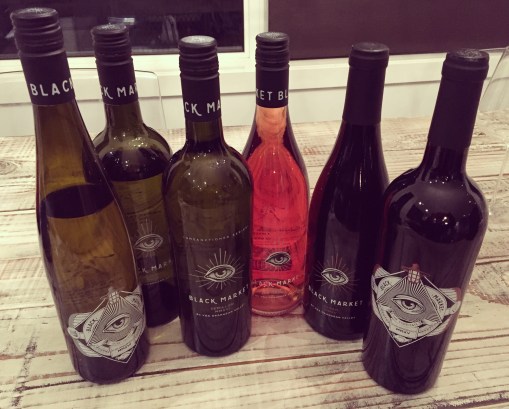
This cunning Calgary cabal has managed to work around their weekday gigs (Rob is in corporate finance; Michelle is a flight attendant) and their location in another province, forge relationships with local growers, learn the ropes of the winemaking business and come up with maybe the single best suite of branding for a winery anywhere in Canada, creating a bit of a cult following along the way.  Add in an early embrace of online sales and the Black Market Wine Company is quickly accelerating from illicit side dream to successful reality.

IMG_7052

I first came across Black Market a couple of years ago and was instantly drawn in by the Illuminati-meets-Ponzi-scheme labelling, looking like the back of the US dollar in some horrific alternate Dan Brown universe.  The striking images on the front labels draw people into the intentional web of secrecy and intrigue expressed in snippy verse on the back of each bottle, piquing curiosity and pulling people further into the glass for answers.  By then, you’re in the winery’s hands, waiting to be led where they want to take you.  It certainly does not hurt that the juice within does not disappoint (and that its creators are from my hometown), and I have followed their progress ever since that initial encounter.  This is the first time I have had an opportunity to taste through the entire Black Market portfolio, but not the last time I will be cracking these wines and letting the mystery wash over me. Read the rest of this entry »


Wine Review: Dirty Laundry, The Whites

2 11 2017

[These bottles were provided as samples for review purposes.]

IMG_7014

One of these things is not like the other…

Now that snow has blanketed the land and any remaining warm thoughts in Calgary’s mind have been augured away by blistering Arctic winds, I can fully admit that I tasted these Dirty Laundry wines in the wrong order.  I cracked the rosé and red portions of my sample pack back when fall was still a thing (last week) and saved the sunny patio portion of the tasting until it seemed like a cruel joke; serves me right for breaking with orthodoxy and not going lightest to heaviest like the textbooks all say.  But we persevere. I’ve always found Dirty Laundry’s white lineup to be a bit more impressive and consistent than its reds, and they have a particular affinity for Gewürztraminer, the grape that everyone seems scared to focus on too heavily but which truly rewards any such special attention.  However, tonight I got to dive into two bottles that I hadn’t tried before today, starting off with my favourite grape of them all. Read the rest of this entry »


Wine Review: Dirty Laundry, Pink & Red

26 10 2017

[These bottles were provided as samples for review purposes.]

IMG_6987

Okanagan label mastery.

Dirty Laundry is a winery best experienced in person, as it features a combination of location, history and brand awareness that is next to impossible to top.  It is perched up above the ideally named Summerland, BC, elevated over the Okanagan’s main highway, with vineyard views for miles and a patio strategically located to be drenched in scenery.  This spot was once, back in the era of the Canadian Pacific Railway’s initial construction, the home of a renowned and well-attended laundry service run by an AWOL railroad construction worker who had found a more lucrative calling; his fortune, and the popularity of his laundry business, was due in no small measure to the brothel being run discreetly on the upper floor while the clothes were cleaned below.  A couple of centuries later, the business currently occupying the land knows a good story when it sees one and has turned the tale of the dirty laundry into a branding behemoth that seeps into everything from wine names to labels to tasting room decor to the guest homes for rent on the property, the Bordello House and the Parlour House.  They commit to the identity, keep their humour on high alert and leave their prudishness at the door, and people keep coming back.

The wines themselves may be in a state of flux, caught between wanting to appeal to the widest possible audience and the crowds in for a good time and a novelty bottle-stopper and aiming for a higher level of quality, a product that captures attention in a different way.  I am rooting for them to succeed, as personality and creativity and branding effort are more than welcome in my own world of wine.  The below releases, recent rose and red offerings from Dirty Laundry and the first of a two-part review series, were an excellent chance for me to check in on the winery for the first time in a while and see where they were on their cheeky, quirky voyage. Read the rest of this entry »