Meat (!) Review: Carnivore Club

16 04 2016

[The following meat was provided as a sample for review purposes.]

We are living in a golden age of things you can get delivered to your house in a box on a monthly basis.  Whatever your inclination, there is probably a monthly mail subscription service for it.  Wine?  Naturally.  Tea?  Of course.  Last year I was part of one offering a regular postal helping of socks.

Meat?

FullSizeRender-281

There is now.

FullSizeRender-282

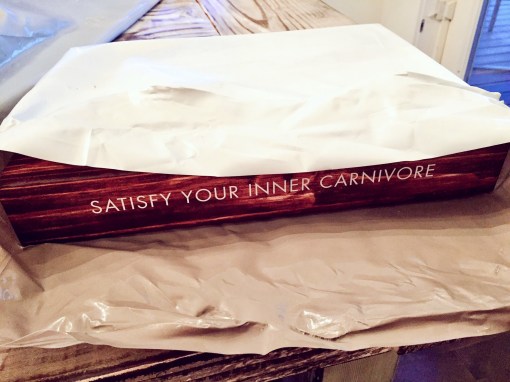
I know what you’re thinking:  (1) YES!!  MEAT IN THE MAIL!!! …and then, a couple seconds later, (2) …um, meat in the mail?  Can they DO that?  When the meat in question is salt-cured and vacuum-sealed and perfectly capable of remaining consumable after a multi-day cross-country trek, they certainly can.  “They” in this case is Carnivore Club, a phenomenally named meat curation agency that sources an incredible array of farm-to-table meats from an ever-rotating rolodex of local suppliers and puts them on your doorstop in a faux-wooden box.  For $50/month (including shipping), you get about as much meat as your arteries can handle on a monthly basis (in this particular case, it was about 2 pounds’ worth), all made with love from top-end sources.  Dreams really do come true. Read the rest of this entry »


Wine Review: 2012 Jim Barry The McRae Wood Shiraz

5 04 2016

[This bottle was provided as a sample for review purposes.]

FullSizeRender-272

Serious, serious Shiraz.

I decided to have a good start to the week.  I usually hew to the age-old rule of opening nice stuff on weekends but sticking to the cheaper end of the cellar on Monday, but yesterday I said to hell with it:  forget convention, I’m opening something fun.  This led me to the upper echelon of my sample rack, and to one of the better Australian Shirazes I’ve ever had, Jim Barry’s The McRae Wood.  Excellent Monday decision.

Jim Barry’s wines are no stranger to this blog – I’ve reviewed his highly impressive entry-level Cab and Shiraz and his mind-blowing, Grange-challenging top-end Shiraz The Armagh.  This bottle is closer to the latter than the former, a reserve-level Shiraz clocking in at around $60 and often known as The Armagh’s little brother.  Jim Barry is based out of the Clare Valley in South Australia, an elevated and cooler-climate region due north of Adelaide and just northwest of Big Shiraz Mecca, the Barossa Valley.  Clare is best known as Riesling country and is about as stylistically different from the Barossa as you can get by travelling 100 km or so, producing leaner, less ripe and more elegant wines and rethinking what it means to be an Aussie Shiraz as a result.  The McRae Wood Shiraz is sourced from a special single vineyard in the Clare Valley, a 70-acre plot of land that Jim Barry purchased from his neighbour Duncan McRae Wood in 1964 to plant his very first Shiraz vineyard.  This eponymous bottling honouring the initial owner of the land was first released in 1992, making this the 20th anniversary vintage of The McRae Wood. Read the rest of this entry »


Wine Review: 2012 Torres Celeste Crianza

29 03 2016
FullSizeRender-268

Mysterious heavens. Mysterious brown bottle.

I must admit that the weekly sale flyer from my neighbourhood Solo Liquor store doesn’t usually flood me with inspiration,  but this past week, nestled in its pages amongst the Barefoots and the Yellow Tails, was an offer that made me make a special trip down the block.  The current edition (and 10th anniversary vintage) of Torres’ Celeste Crianza, a 100% Tempranillo bottling from the famed Ribera del Duero region in north-central Spain, was on sale for $17.99, down from its usual $26ish.  I now regret buying only one at that price.  It’s becoming harder and harder with the sordid state of the Canadian dollar to find a well-made go-to bottle of wine for under $20, but for one glorious long weekend, this one easily fit the bill.

Torres is as trustworthy a wine name as there is at this kind of price point.  I’ve had a wide range of their offerings over the past couple of years, some of which ($15 Chilean rose?) did not necessarily spike my expectations going in, but all of which delivered quality, character, consistency and obscene value, to the point where I now seek them out in junk mail flyers.  They are a Spanish family-based winery, but their headquarters are in the far east of the country, in Catalunya near Barcelona; Celeste is their first bottling from Ribera del Duero.  Made from grapes grown in the upper reaches of the region, at close to 900 metres of elevation where they are exposed to blisteringly hot days but remarkably chilly nights, the Celeste is able to offer up full fruit ripeness without coming across as loose or flabby.  The wine’s name and label emphasize the celestial, showcasing the heavenly bodies on display nightly above the elevated vineyard which keep watch over the crop. Read the rest of this entry »


Wine Review: Pewsey Vale’s Regal Rieslings

16 03 2016

[These bottles were provided as samples for review purposes.]

FullSizeRender-262

I believe, Eden Valley. I believe.

I’ve talked before about how valuable comparative tastings can be.  Want to understand what Malbec tastes like, or what makes California Cabernet different from the same grape grown in Bordeaux, or what oak aging does to Chardonnay?  Don’t buy one bottle and drink it in isolation; buy two or three, which belong to your target group or establish your desired contrast, and have them together.  In this case my research question was:  how does Australian Riesling age, and what happens to it when it does?  My sample set was about as perfect as you can get:  two Rieslings from a star region (Eden Valley), from the same producer (Riesling expert Pewsey Vale), even from the same VINEYARD, separated only by six years of bottle age and the winery’s Museum Reserve library release program.  The results were phenomenal.

The Pewsey Vale Vineyard in the cool and elevated (and thus strangely named) Eden Valley, located northeast of Adelaide and right beside and above the Shiraz mecca (and actual valley) Barossa Valley, is a specialized Riesling-only shrine, exactly what you would see in the textbook description of a great Riesling site:  cooler climate (brought on in this case by its 500m altitude), poor rocky soils, hilly landscape.  The vineyard is 169 years old and has the distinction of being the very first spot planted to grapes in the area; when it was first planted in 1847, those inaugural vines included a few plantings of Riesling.  After the vineyard fell into disuse and disrepair, subsequent owners recognized its potential and single-planted the whole vineyard to Riesling in the 1960s, using cuttings from those first 19th century Riesling vines to do so.  Today all of Pewsey Vale Vineyard’s plantings have been propagated from those original 1847 vines. Read the rest of this entry »


Wine Review: Cloudline Pinot Duo

2 03 2016

[These bottles were provided as samples for review purposes.]

FullSizeRender-245

OK, yes, I totally had a glass of the PG before taking this picture.

The flourishing Pinot Noir vine of Oregon’s wine history is largely rooted in a man named David Lett, the founder of Eyrie Vineyards, the first person to plant Pinot Gris in the United States and the trailblazer who cemented Oregon’s place as a safe haven for Burgundian varietals.  Known as Papa Pinot, Lett entered his 1975 Eyrie Vineyards Reserve Pinot Noir in a prestigious 1979 blind tasting competition in Paris called the Wine Olympics, which featured hundreds of entries from around the world.  Absolutely nobody outside of Oregon in 1979 thought of it as a wine region, let alone a globally competitive one, but that started to change when the Eyrie Pinot placed in the top ten, beating many top Burgundies along the way.

One person who noticed the result was Robert Drouhin, third-generation head of Burgundy’s renowned Maison Joseph Drouhin.  The following year, unbeknownst to Lett, Drouhin set up his own Burgundy/Oregon rematch, pitting Eyrie Vineyards blind against a field of some of his top wines.  The Eyrie Pinot came in second in the group, just a hair behind Drouhin’s legendary 1959 Chambolle-Musigny.  As if that wasn’t feather enough in Oregon’s cap, Drouhin then proceeded to buy the cap too.  He visited Oregon, noted that its cooler, more temperate climate was a more welcoming environment for Burgundy’s Pinot Noir and Chardonnay than neighbouring California, had his daughter Veronique come work harvest with the Letts and others in 1986, then purchased land himself in the Willamette Valley’s Dundee Hills to grow the Pinot that had impressed him so much. Read the rest of this entry »


Calgary Wine Life: Thomas Perrin Beaucastel Component Tasting

23 02 2016

FullSizeRender-242I’m having myself a bit of a tasting month here.  A week after sitting down to some incredible 50, 51 and 52 year old Taylor Fladgate Ports, I was treated to one of the most memorable experiences of my wine life:  a chance to taste through the individual varietal component wines of the unparalleled Chateau de Beaucastel with proprietor Thomas Perrin, the first time such a tasting had ever been held in Alberta.  Beaucastel is the legendary estate of Chateauneuf-du-Pape, the top region in France’s Southern Rhone Valley and the first area declared to be an Appellation d’Origine Controllee (AOC – now Appellation d’Origine Protegee, or AOP) in 1936, known for producing rich, dense and complex reds and whites of remarkable quality and longevity.  The Perrin family has owned Beaucastel for over 100 years, having purchased it shortly after most of the vineyards were ravaged by the phylloxera louse and just before the scourge of World War I. Two wars, 100 hectares and five generations later, Thomas Perrin and his family members carry on the legacy of the Chateau and the Perrin name.

Beaucastel’s winemaking philosophy was created and entrenched largely by Thomas’ grandfather Jacques Perrin, whose name graces the estate’s top wine, Hommage a Jacques Perrin, released only in top years.  The elder Perrin converted the entire estate to organic viticulture back in 1962, when almost nobody would even have known what that meant and the prevailing wisdom pushed hard the opposite way, toward the increased use of vineyard chemicals and pesticides.  Chateauneuf-du-Pape permits the use of an astounding 13 different grape varietals, 14 if you count the white version of Grenache (reds – Grenache, Syrah, Mourvedre, Cinsault, Counoise, Terret Noir, Muscardin, Vaccarese; whites – Grenache Blanc, Roussanne, Clairette, Picpoul, Bourboulenc, Picardin), which is way more than your standard high-end rigid French appellation; Beaucastel makes a special point of using them all, white and red, in every vintage of its CNDP release.  They plant, harvest, vinify and mature each varietal separately, as each has a different growth curve and ripeness window, but in all cases they aim to tell the harmonious story of grape, soil, climate and region, of terroir, in their wines.

FullSizeRender-236

Read the rest of this entry »


Calgary Wine Life: Taylor Fladgate 1966 Single Harvest Port Release

17 02 2016

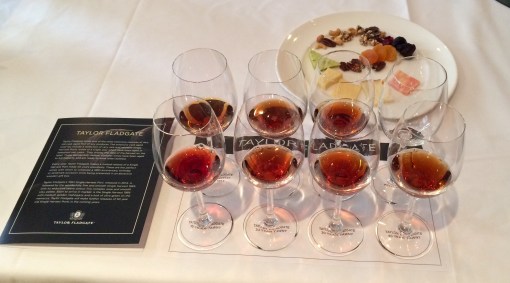
There are tastings and there are TASTINGS; this one deserves capitalization.  To celebrate the impending release of Taylor Fladgate’s 1966 Single Harvest Port to the Alberta market (coming next month to a store near you!), this 50 year-old wine was opened up at a special release event this afternoon along with its older siblings the 1964 and 1965.  153 combined years of Port later, I had a good day.

FullSizeRender-230

By way of quick refresher, Port is a fortified wine made from (usually) a blend of grapes grown in the Douro region in northern Portugal.  The grapes are crushed and at first fermented just like dry table wine, but halfway through the fermentation, when there is still considerable sugar left in the grape juice that has yet to be converted to alcohol, the juice is spiked with 70% abv grape brandy, which kills the yeast, stops the fermentation and (obviously) increases the alcohol level of the now-finished wine, resulting in a sweet, fruity, 20-ish% abv Port.  All Port is made in this way, but how each Port ends up looking, smelling and tasting after you open the bottle depends largely on how it is matured.

Ruby Ports, blends from multiple vintages made for early consumption, get a couple of years of barrel age and are bottled young and fruity.  Vintage Ports, single-year wines released only in top years, get a similar barrel treatment but are so dense and concentrated that they are intended to age for years or decades in bottle before they are opened.  Tawny Ports, also multi-year blends, are aged oxidatively in barrels until they are ready for release, with air exposure leading to their brownish colour, mellow texture and nutty, caramel-y flavours. The Port Wine Institute only allows Tawny Ports to be bottled with an age designation of 10, 20, 30 or 40 Years, with the number denoting the average age of the wines in the blend.
FullSizeRender-229

When a Tawny Port is made from grapes of a single year’s harvest, it is known as a Colheita, a single vintage Tawny.  “Colheita” (pronounced “Kohl-YAY-tah”) is the Portuguese word for “harvest”, and to obtain this designation, any one-year Tawny must be aged at least 7 years in barrel before bottling.  Taylor Fladgate, thanks to a fortuitous acquisition of another Port house with significant back-vintage reserves, started a program three years ago for the annual release of a special Very Old Single Harvest (Colheita) Port on its 50th anniversary.  In 2014 they released the 1964 Colheita, followed by the 1965 in 2015 and now this year’s 1966.  If you know anybody celebrating a 50th birthday or anniversary in 2016, I know what you can get them. Read the rest of this entry »


Beautiful Bubbles: Benjamin Bridge Trio

3 02 2016

[These wines were provided as samples for review purposes.]

If you have a passing familiarity with the Canadian wine scene, you’re probably pretty comfortable about what’s where.  You know that the two big players are the Okanagan and Niagara.  You know where to look for dynamite Riesling, Gewurz, Gamay and Cab Franc.  You may know about the potential rise of Syrah out west, about new possibilities in the Similkameen and a focus on subregional quality in Prince Edward County and the Golden Mile Bench.

But did you know that the best sparkling wine in Canada may well be made in…Nova Scotia?

IMG_3824

A Nova Scotia awakening.

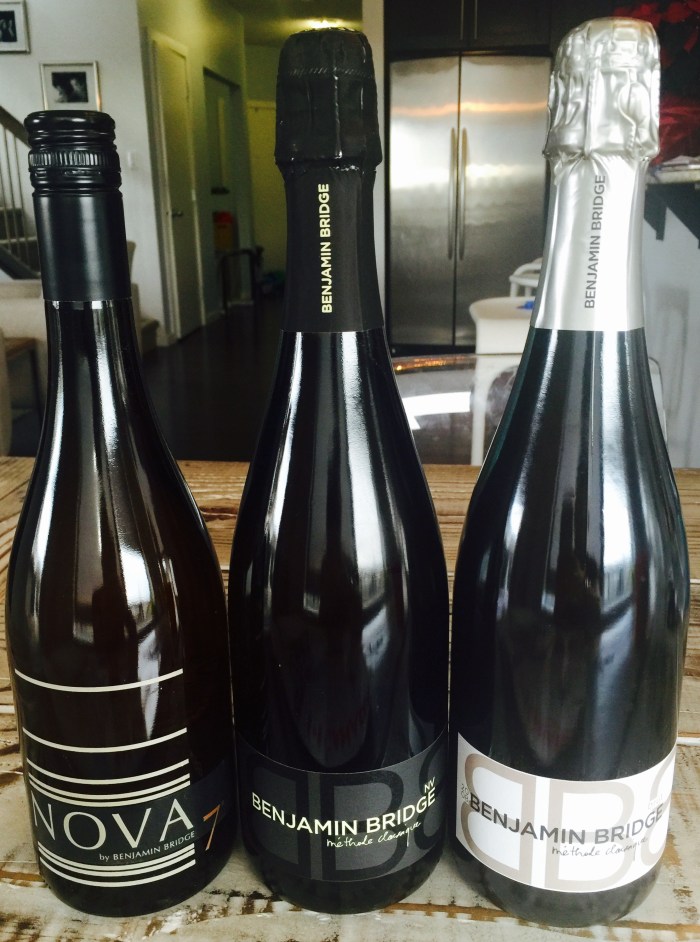
Despite only being in existence for just over a decade, Benjamin Bridge definitely deserves a place at Canada’s bubbly head table, and to my mind they are already the cream of the crop.  Located in the Gaspereau Valley northwest of Halifax, in north-central Nova Scotia (bordering the Bay of Fundy as opposed to the Atlantic), Benjamin Bridge is without question the most acclaimed and well-known winery east of Niagara, producing a wide range of bottlings but focusing heavily on traditional method sparkling wines.  The Gaspereau, with its (unsurprising) cool climate and maritime breezes, delivers a colder, shorter growing season promoting leaner ripening and lower yields, one remarkably similar to bubbly’s Mecca, Champagne in France.  The marginal conditions and harsh winters mandate partial reliance on hardier and earlier-ripening hybrid grapes, which are not usually known for their complexity and delicacy in the bottle, but somehow the winery makes them sing, embracing rather than hiding them and adding a unique sense of intrigue to the wines as a result. Read the rest of this entry »


The Great Coravin Test, Part 5: Six Months Later

26 01 2016

To catch you up on the epic journey that is concluding with this post:

  • I got to borrow a Coravin back in July (Part 1)
  • I accessed three awesome bottles with it and wrote tasting notes (Part 2)
  • I checked back on them two weeks later to see how they were doing (Part 3)
  • I dove into some cellar treasures and gave some final Coravin thoughts (Part 4)
  • I promised to come back to my three test bottles one last time…in half a year.

FullSizeRender-217

Take 5. One last time.

How time flies.  Suddenly it’s six months from the week of my original Coravin tasting write-up and I owe this story an epilogue.  After seeing this trio of my bottles front and centre in my cellar on a daily basis and accessing them multiple times through the Coravin needle, I actually felt sort of bad cutting off the foils and pulling the corks out of them like they were any old weeknight wines.  But science does not wilt for sentiment, and I had a job to do.

Read the rest of this entry »


Wine Review: 2012 Marabino Noto

20 01 2016

[This bottle was provided as a sample for review purposes.]

FullSizeRender-216

I admit: I had to do a little research for this one. But well worth it!

Sicily is hot right now (figuratively at least; literally, it’s about +8 Celsius right now, and it’s 4:00 a.m. tomorrow morning).  After a lengthy history of exporting purely bulk wines for blending and bottling wines only for domestic consumption, this large island off the toe of Italy’s boot is suddenly undergoing a rapid and massive quality transformation, showcasing its indigenous varietals to the world and beginning to show up on wine lists and in boutiques all over town.  There are wines from vines grown on the side of an active volcano (Etna) and wines so close to the ocean they can smell the salt.  More and more Sicilian wine is being targeted for import, filling a gap in our drinking experience we never knew was there.

This is the second bottle of Marabino that I’ve had the opportunity to try; the first was their fantastic Eureka Chardonnay, exactly five months ago today.  Marabino is a relative newcomer to the island, established in 2002 as a fully biodynamic winery focused on growing Moscato, Nero d’Avola and Chardonnay, the first two native to the region.  Marabino is based in the Noto DOC, a UNESCO world heritage site featuring surprising white soils in the very southeast corner of Sicily.  While the number of classified Denomination of Origin zones in Sicily is continually growing, Noto has held this designation since 1974 and has an entrenched place in Sicilian wine history. Read the rest of this entry »


Wine Review: Jim Barry Value Red Showdown

13 01 2016

[These bottles were provided as samples for review purposes.]

I'm not making up the vertical/horizontal label dichotomy, right?  Totally something thematic there.

I’m not making up the vertical/horizontal label dichotomy, right? Totally something thematic there.

Australian wine is in sort of a weird place right now.  I first got into wine during the Great Shiraz Rush just over a decade ago, when critter wines ran rampant and the overtly ripe, sweet, boozy style and approachable branding of big-name Aussie Shiraz rolled over the global wine scene like a tsunami, spawning copycats galore and creating ripples that are only now just starting to settle.  The behemoth brands at the front of this wave are mostly still around today, and their bold, fruity, slightly concocted style certainly retains its share of popularity with casual drinkers, but the world has moved on to other phenomena and the scene in Australia seems caught in aftermath phase, not wanting to totally abandon what brought it to global prominence but understanding that its long-term prosperity is likely tied to being something more than liquor store filler.  The country is taking steps to avoid being a one-hit wonder, surprisingly churning out some of the best Riesling you’ve never tried, finding cooler pockets for Pinot Noir and (especially in Tasmania) sparkling wine, using its plentitude of remarkably old vines to its advantage, and dialling its Shiraz back a notch or two while still keeping it lush and appealing to New World palates.  It is also finding stronger and more quality-focused expressions of its value wines which are less industrial commodities and more genuine expressions of grape and place.  This is where Jim Barry comes in.

This family-owned producer is now run by second-generation executive winemaker Peter Barry, the son of eponymous founder Jim, who was the first qualified winemaker in South Australia’s Clare Valley, where the winery is based.  Its tailored lineup of wines runs the gamut from dynamite supermarket bargains (see below) to one of Australia’s very best and priciest bottles, The Armagh Shiraz (as experienced by me in one of my favourite tastings ever).  I was first converted to the Jim Barry cause a few years ago when I bought the Cover Drive Cabernet Sauvignon on a whim because of its circus-tent striping on the neck foil and the cricket player on the main label and was wowed by what I found inside.  I could be wrong, but by its participation in the JB value red duel below, I believe Cover Drive becomes the very first wine in PnP history to be reviewed in three separate vintages, following its write-ups here and here.  Can it hold off a spirited challenge from its neck-striped brother, the Lodge Hill Shiraz?  Let’s find out. Read the rest of this entry »


Wine Review: 2013 Culmina Dilemma

7 01 2016

[This bottle was provided as a sample for review purposes.]

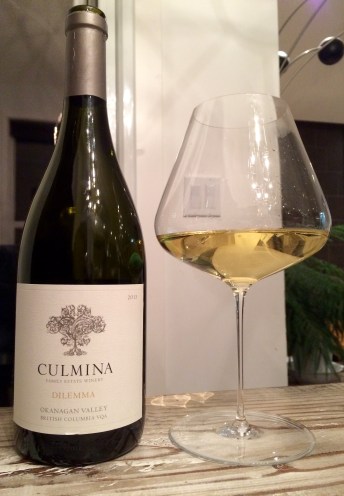
Great story, great wine.  And check out the sick Zalto Burgundy glasses I got for Christmas!

Great story, great wine. And check out the sick Zalto Burgundy glasses I got for Christmas!

Back in the saddle, and back to wine, for 2016!  I hope everyone had a happy and restful holiday season; I had a relaxing blog-free week and a half following my arduous 25-day whisky Advent marathon but am raring to start the new year of PnP off right, so I opted for a bottle that I highly suspected would be good.  Suspicions:  confirmed.

Culmina is one of Canada’s top wineries in my books and one of the most compelling stories on the Okanagan wine scene.  A spare-no-expense passion project spearheaded by iconic proprietor Don Triggs (the Triggs from Jackson-Triggs) and his family, Culmina has only been around for a few years, but through careful site study and selection and meticulous planting, it has been churning out wines of intrigue and quality from its inception.  I have previously waxed on about the winery and a number of its bottlings here and here , but this is my first time writing about what could very well end up being the crown jewel of its portfolio, the Dilemma Chardonnay.  I hope it’s not my last.

Read the rest of this entry »


Wine Review: 2008 Ratzenberger Bacharacher Riesling Sekt Brut

13 12 2015

[This bottle was provided as a sample for review purposes.]

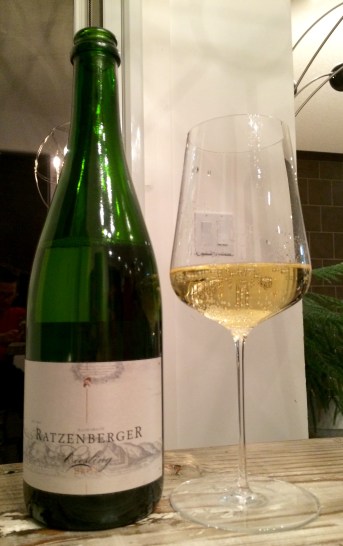
Redefining the world of German bubbly.

Redefining the world of German bubbly.

What’s this?  A wine review?  Isn’t this a whisky blog now?  OK, I probably deserved that.  But Advent only comes around once per year, and since no one yet has taken up the torch of my idea to find 24 good half-bottles and make a Wine Advent Calendar, this is what you get instead.  For those wine lovers out there just dying for the calendar to turn to January, this one’s to tide you over.

This bottle is another selection from Cellar Direct (cellardirect.ca), the online Canadian Natural Wine Club that allows people from all over the country to have high-quality, artisanal, naturally made wines shipped to their door via an array of tailored subscription packages ranging from $40 to $80 per month depending on your location and the package selected.  Since I last wrote about the service back in September, it has revamped its website, introduced an offer of two free bonus bottles for every 24-bottle annual subscription, and added an online shop (which will be operational in January) where Cellar Direct members can order more of their favourite bottles over and above their subscription.  It has also gotten rave reviews in BC, where price increases and regulatory chaos have otherwise made reasonably priced access to many good wines a pipe dream.

The one thing I can so far say for sure about Cellar Direct is that its selections are not fooling around; each of the three bottles I’ve now had the chance to try from their library have been of exceptional quality and proud ambassadors of where they’re from.  These are wines from somewhere as opposed to wines that could be from anywhere, and this gets all the more impressive given that this latest wine is a bottle of Sekt.  Nobody usually makes quality and terroir proclamations about Sekt (German sparkling wine), and for good reason:  most Sekt doesn’t deserve it.  In fact, it’s hard to say anything specific about Sekt as a category because it might be the least regulated category of Old World wine I’ve come across.  German wine law doesn’t mandate that Sekt be made of any particular types of grapes; it doesn’t even require those grapes to be from Germany; and it doesn’t require the wine to attain its bubbles any particular way.  Sekt is required to be at least 10% abv, but after that, all bets are off. Read the rest of this entry »


Multi-Wine Review: Calliope/Burrowing Owl Octet

24 11 2015

[These wines were provided as samples for review purposes.]

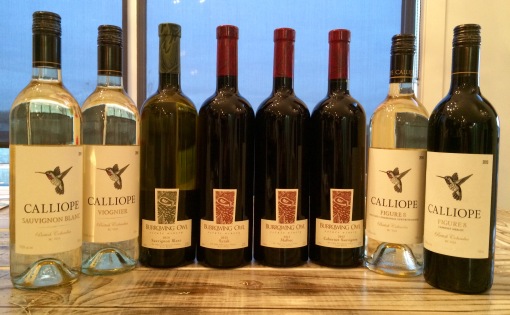
No time to spare for a huge intro tonight, as we have a whole whack of impressive Canadian wines to assess in what is sure to be a super-sized review.  I was fortunate enough to get the chance to taste through a series of recent releases from Okanagan stalwart Burrowing Owl, which is based in the scorching deep south of the Valley, near the US border in Oliver, British Columbia.  The tasting pack included a quartet of bottles from the parent winery and a quartet from its new offspring, Burrowing Owl’s second label Calliope Wines.  In keeping with the main estate’s unusual-bird-based theme, Calliope is named after a tiny hummingbird (Canada’s smallest bird) found in southern BC (not to be confused with the Greek muse or the steam organ of the same name).  According to its website, Calliope “is a full line of easy sipping, fruit-forward wines, designed to pair with casual lunches on the patio, or with contemporary cuisine”.  According to the pictures on the website, the wines also appear to pair with unnaturally beautiful Photoshopped women and neck beards.  Polite suggestion to Calliope:  Your wines are solid.  Your website is trying too hard.  It needs to relax.

FullSizeRender-169

I had often heard strong praise about the Burrowing Owl lineup from Wine People Who Know Things but hadn’t previously gotten around to experiencing it for myself, so getting to dive into a sizeable chunk of the portfolio all at once was an amazing way to get caught up on one of the brightest lights in Canadian wine.  Without further ado, here are eight mini wine reviews, starting with the second label and finishing with the main house (all prices based on Alberta retail).

Read the rest of this entry »


Rioja Quality Ladder: Bodegas Montecillo

11 11 2015

[These bottles were provided as samples for review purposes.]

Crianza vs. Reserva.  And one of the hardest sets of labels to photograph well.

Crianza vs. Reserva. And one of the hardest sets of labels to photograph well.

If I had to pick one European red wine region that was my Old Faithful, that always delivered quality and intrigue, regularly delighted and rarely disappointed, it would be Rioja.  Something about the wines coming out of Spain’s original star region just speak to me, offering up traditional character and depth and a unique voice at often-amazing prices.  Rioja is perched at altitude in north-central Spain, closer to Bordeaux (a 4 hour drive north) than Barcelona (5.5 hours east), and has long been the king of the Spanish wine world:  it was the first D.O. (Denominacion de Origen, or classified geographical quality region) in the country to be granted super-elite D.O. Calificada status in 1991, the highest quality category in Spanish wine law.  Only one other region, Priorat, has been awarded the designation since.  There are always challengers for Rioja’s crown in a country with soils, grapes, styles and traditions as rich and varied as Spain, but at its best, there is nothing quite like it. Read the rest of this entry »