Return of The Mules: Torres Summer Values

12 06 2016

[These bottles were provided as samples for review purposes.]

It’s been so long since I sat down and wrote a straightforward normal wine review that I’m having trouble remembering how to start one.  Thankfully, I’m aided by an old PnP standby:  if they’re not there already, the Torres family of wines has to be close to the record for largest number of individual write-ups on this site, aided in part by their broad-based dual-continent operation and vast lineup but mostly by their consistent ability to deliver quality and identity for less than you’d expect.  I made the mistake last year of prejudging their “Las Mulas” line of entry-level Chilean wines by its lighthearted name and beast of burden on the label, only to be reminded by the emphatically delicious Las Mulas Rose that Torres takes all its wines seriously.  This year, with the Sauvignon Blanc and Cabernet Sauvignon from the Las Mulas brand, I will not make the same error twice.

FullSizeRender-375

The wines for Las Mulas come from Chile’s warm, flat and fertile Central Valley, where the benign climate and the absence of most common vine diseases make it the country’s most productive and most popular grape-growing region.  This can be both a good thing and a bad thing:  obviously getting your crop to ripen without heroic efforts is a benefit, but wine grapes specifically tend to derive much of their flavour concentration and character from having to struggle a bit to grow, and when they’re deprived of that opportunity to strive the results in the glass can be flat and uninteresting.  To combat the Central Valley’s generosity, Torres planted the Las Mulas grapes on nutrient-poor soils and entirely avoided the use of herbicides or pesticides (the vineyard sites are certified organic).  The vineyards are wholly hand-harvested, with nary a machine in sight, making this New World wine done in old school ways…yet somehow still hovering around the $15 CAD mark on the shelf.  Each of the offerings below cleared by (pre-primed) expectations for that price point with ease. Read the rest of this entry »



NZSB Playoff Challenge

4 05 2016

[These bottles were provided as samples for review purposes.]

FullSizeRender-306

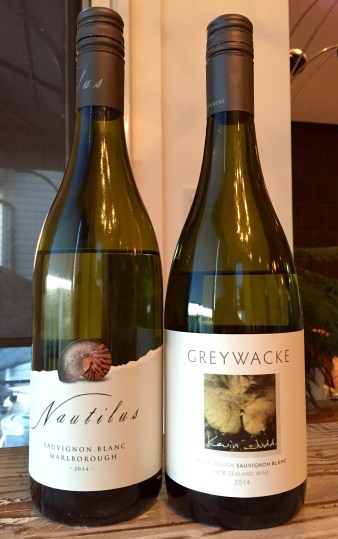
Two enter, one leaves. Well, actually zero leave; there were no leftovers.

I need very little reason to open and taste two bottles side by side, especially when their comparison can tell me even more about them and where they’re from.  Somebody decided that Friday, May 6th would be known as Sauv Blanc Day (or #SauvBlanc Day, to be more accurate, even though it makes no sense to put a space in a hashtag), although this is a fact not without controversy, as others seem to have settled on April 24th for International Sauvignon Blanc celebration.  We can all agree that some time within this two-week window would be a great opportunity to open some Sauv Blanc, and with the playoffs upon us in two of the four major professional sports leagues, my dining table was also primed for a showdown of some sort.  Enter the titans.

These two bottles are excellent references for each other, as both are from the same vintage (2014, a shorter growing season with a wet harvest), the same country (New Zealand), the same region (Marlborough, the kickstarter of the NZ wine industry and of global New Era Sauv Blanc) and the same grape (the aforementioned SB).  Flavour and textural differences thus largely stem from slight climatic and geographic alterations at the vineyard level and minor distinctions in winemaking choices by the producers, as well as whatever cosmic forces make good wines end up just so.  Going in, I have to admit I was leaning toward the 2014 Greywacke Sauvignon Blanc as the likely favourite; this winery, run by former Cloudy Bay winemaker Kevin Judd (who literally put New Zealand on the world wine map with a now-ubiquitous tropical/herbaceous style of Sauv Blanc), now turns out deeply personal, characterful expressions of the grape year after year.  They are no stranger to love from this blog.  But strange things can happen in the playoffs.  Onward. Read the rest of this entry »


Multi-Wine Review: Calliope/Burrowing Owl Octet

24 11 2015

[These wines were provided as samples for review purposes.]

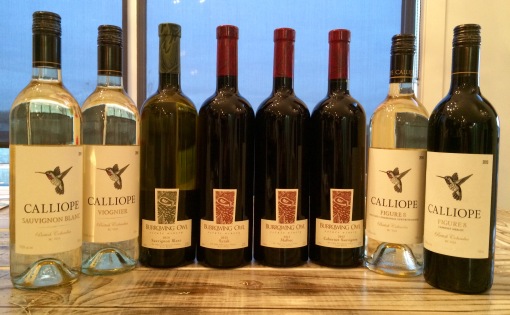
No time to spare for a huge intro tonight, as we have a whole whack of impressive Canadian wines to assess in what is sure to be a super-sized review.  I was fortunate enough to get the chance to taste through a series of recent releases from Okanagan stalwart Burrowing Owl, which is based in the scorching deep south of the Valley, near the US border in Oliver, British Columbia.  The tasting pack included a quartet of bottles from the parent winery and a quartet from its new offspring, Burrowing Owl’s second label Calliope Wines.  In keeping with the main estate’s unusual-bird-based theme, Calliope is named after a tiny hummingbird (Canada’s smallest bird) found in southern BC (not to be confused with the Greek muse or the steam organ of the same name).  According to its website, Calliope “is a full line of easy sipping, fruit-forward wines, designed to pair with casual lunches on the patio, or with contemporary cuisine”.  According to the pictures on the website, the wines also appear to pair with unnaturally beautiful Photoshopped women and neck beards.  Polite suggestion to Calliope:  Your wines are solid.  Your website is trying too hard.  It needs to relax.

FullSizeRender-169

I had often heard strong praise about the Burrowing Owl lineup from Wine People Who Know Things but hadn’t previously gotten around to experiencing it for myself, so getting to dive into a sizeable chunk of the portfolio all at once was an amazing way to get caught up on one of the brightest lights in Canadian wine.  Without further ado, here are eight mini wine reviews, starting with the second label and finishing with the main house (all prices based on Alberta retail).

Read the rest of this entry »


Calgary Wine Life: Cakebread Tasting with Dennis Cakebread

15 04 2015

I have long held a soft spot for Cakebread Cellars wines, dating back to when my knowledge and interest in wine were in their infancy.  At the end of my articling year a decade ago, my co-workers and I were out at a nice dinner courteously paid for by our firm the night before we were to find out who would be hired back after articles.  There was suitably fancy wine to go with the upscale meal at our group’s aptly named Last Supper, but the only bottle I remember from that night came after dessert, when a couple wine-loving fellow students ordered a bottle of Cakebread Sauvignon Blanc to the table.  I know (now) that this isn’t Cakebread’s go-to grape or claim to fame, but it stopped me in my tracks.  I had never had a wine like it.  It was instantly memorable and made me understand how people could invest so much time, attention and money in the enjoyment of fine wine, which I have now spent the last ten years doing myself.  When I was in Napa a few years ago I made sure to stop by Cakebread (and have matching wine glasses at home to prove it), all because of that one bottle of Sauvignon Blanc.  So when I got invited a few weeks back to taste through a lineup of Cakebread’s wines with its VP and second-generation owner Dennis Cakebread, my wine life flashed in front of my eyes a little bit.  It was like coming full circle.

FullSizeRender-52

Read the rest of this entry »


Wine Review: 2013 Cliff Lede Sauvignon Blanc

4 12 2014

[This bottle was provided as a sample for review purposes.]

Sauv Blanc:  my reawakening continues.

Sauv Blanc: my reawakening continues.

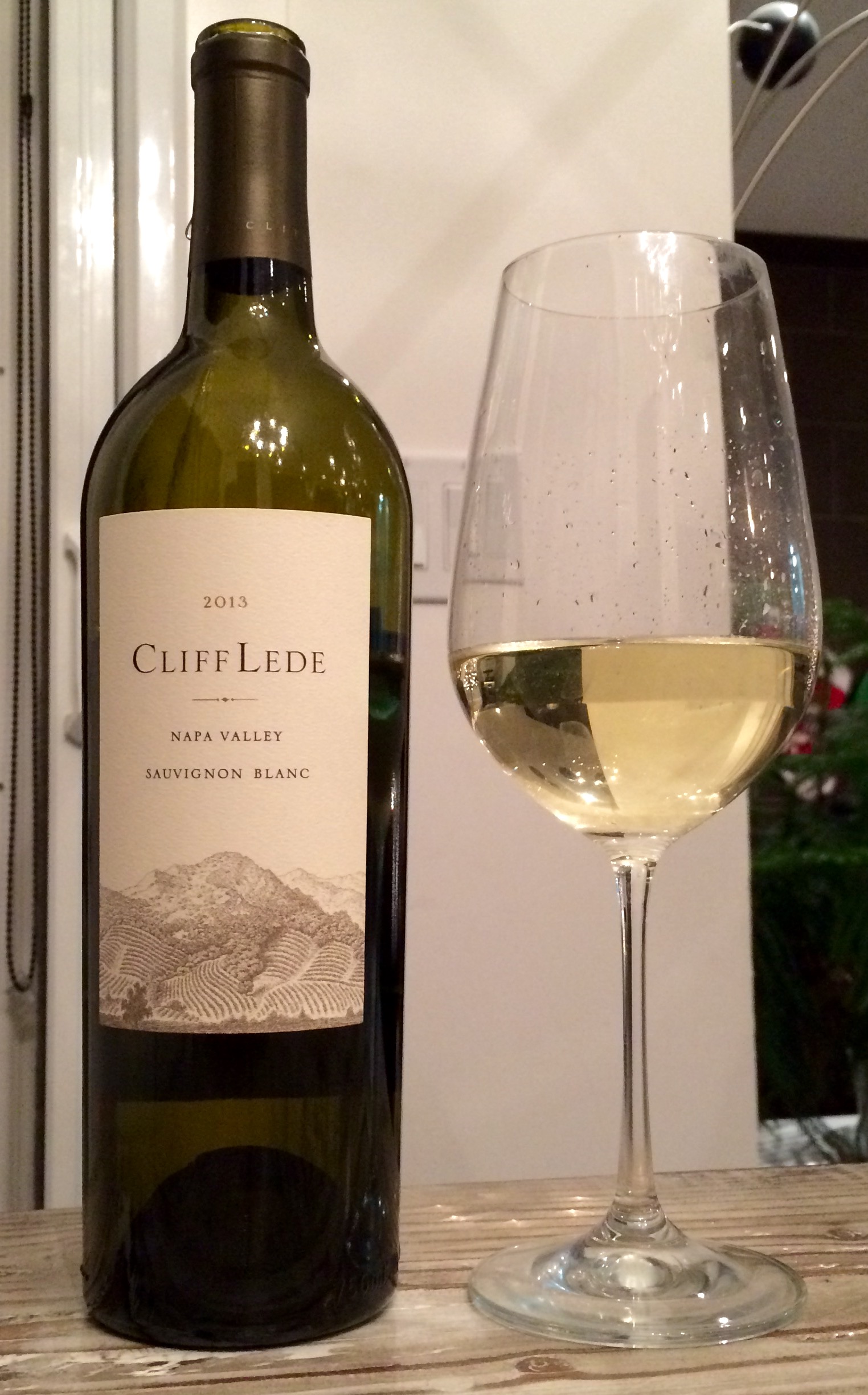
I’ve been experiencing a sort of Sauvignon Blanc renaissance lately.  For the longest time I all but ignored the grape:  I had tried and was clinically impressed but not emotionally roused by many of the SBs and blends of Bordeaux and the Loire; I had lapsed firmly into the camp of “if you’ve tried one New Zealand Sauv Blanc you’ve tried them all”; and I did not hold out much faith that California (too hot) or Canada (too nondescript) could work any magic with the varietal.  But wine, if you let it, has a funny way of pointing out the absurdity in rigidity and making sure your horizons are always boundless.  In the past few months I’ve been blown away by the remarkable and wildly original Greywacke Wild Ferment Sauvignon Blanc from Marlborough and equally amazed by the textural magic of the Alice May Pathfinder Sauvignon Blanc from Cali.  Now add a third one to the list:  the Cliff Lede Sauvignon Blanc, from Napa Valley of all places, not only offers a dynamite sensory experience but also seamlessly exudes a sense of place while doing so. Read the rest of this entry »


Calgary Wine Life: Greywacke Tasting with Kevin Judd

7 10 2014

Kevin Judd is a New Zealand visionary, a trailblazer who has left a permanent imprint on the nation’s young wine culture.  As the founding winemaker of Cloudy Bay, now the near-ubiquitous signpost for the sharp, tangy, herbal style of Sauvignon Blanc that is instantly recognizable in the glass, Judd pioneered a flavour profile for New Zealand’s signature grape that put the country on the world wine map.  He helmed the ship at Cloudy Bay for 25 years, taking it from an unknown producer in an anonymous wine nation to a whirlwind New World phenomenon, the crown jewel of a Sauvignon Blanc revolution that saw millions of bottles fly off the shelves.

IMG_2063

After Cloudy Bay was sold to luxury brand behemoth LVMH (whose wine portfolio includes such luminaries as Krug, Dom Perignon, Chateau d’Yquem and Cheval Blanc, upper-crusters all), Judd finally realized a lifelong dream of starting his own label and making wines in a manner that best suited his palate:  riper batches of fruit, slightly softer acid, yet retaining all of the structure and complexity that a cooler climate can provide.  He called the new venture Greywacke, a name he had quietly reserved 15 years earlier while waiting for his opportunity:  the word (pronounced “grey-wacky”) refers to the grey sandstone rocks that are commonly strewn across New Zealand’s vineyards.

Read the rest of this entry »


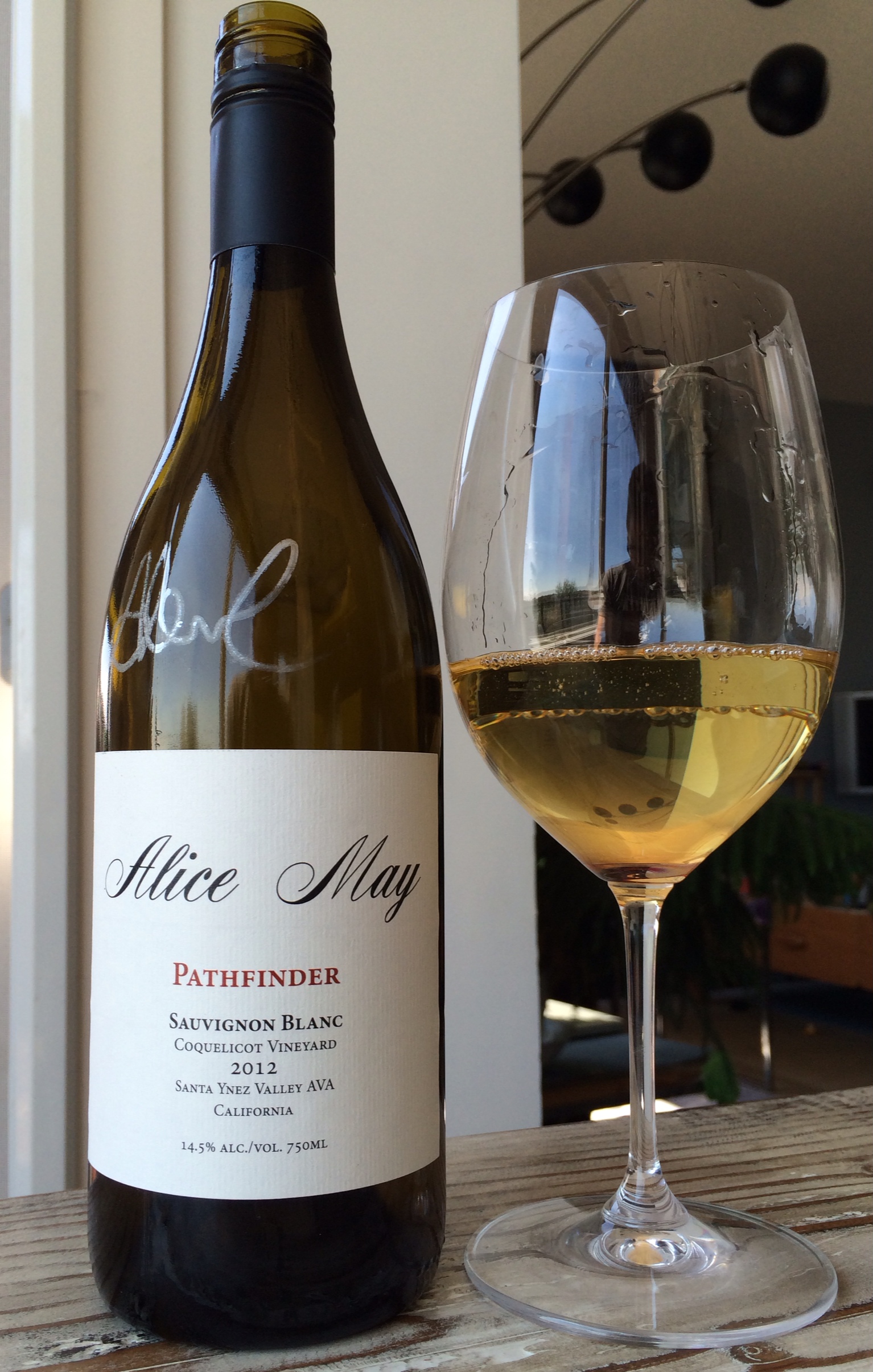
Wine Review: 2012 Alice May Pathfinder Sauvignon Blanc

27 07 2014

[This bottle was provided as a sample for review purposes.]

Cali grapes, Calgary soul.  This one sticks with you.

Cali grapes, Calgary soul. This one sticks with you.

Earlier this year I was first introduced to Alice May wines, made by Calgary sommelier Alex Good in collaboration with California stalwart producer Barrel 27, thanks to its Cote-Rotie inspired Crosswinds Syrah, which made me sit up and take notice of this new source of killer value wine with a local heart.  Alice May was (and still is) a label focused on the production of Rhone varietals in southern California’s Santa Barbara County, but this, their inaugural white release, has a different French homeland:  Sauvignon Blanc is found both in white Bordeaux (blended with Semillon and Muscadelle) and in Sancerre and Pouilly-Fume in the Loire Valley (where it is a single varietal star).  While this may not have been Good’s initially planned direction for his Pathfinder wine (which will be made of the much more Rhone-y Grenache Blanc and Roussanne as of next year), he got the proverbial offer he couldn’t refuse to take some prime Sauvignon from the highly esteemed Coquelicot Vineyard in the Santa Ynez Valley and he ran with it.  Coquelicot is a cooler climate site situated right close to the Pacific Ocean almost due west from Los Angeles, biodynamically farmed by a top vineyard manager and churning out powerful yet balanced fruit full of character.  And it shows. Read the rest of this entry »


Calgary Wine Life: Cloudy Bay Winemaker Tasting at Alloy

26 09 2013

If you’re into New Zealand Sauvignon Blanc, you’ve heard of Cloudy Bay.  When I bought my first book about wine a few years ago, the first couple pages of the chapter on New Zealand were the story of this winery:  one of very few producers scattered across the Marlborough region of New Zealand in the mid-1980s, when nobody was paying any attention to NZ wine and nobody on the northern half of the globe was buying it, without any vineyards of its own, making Sauvignon Blanc in a style that has since become synonymous with the nation and the grape (crisp, aromatic, intense, herbaceous), exploding onto the international scene, and shining the spotlight of the wine world on this scenic region on the northern tip of the country’s South Island.  This isn’t ancient history:  New Zealand was an afterthought of a wine nation with only a small handful of producers at a point during my lifetime (I’m 33).  Now it has turned into a thriving and exciting contributor to the world of wine that is home to over 700 wineries, and in large part Cloudy Bay is to thank for this surge of success.  One of the main reasons that “New Zealand Sauvignon Blanc” possesses the same instant and tangible sense of identity in the psyche of wine drinkers as “Australian Shiraz” (or “Cali Cab”, or “German Riesling”, or “Argentinian Malbec”) is the work of this trendsetting producer that started small and turned itself into a national icon with a world-renowned style.

photo 1

In 2003, Cloudy Bay was purchased by luxury brand supergroup LVMH (Louis Vuitton Moet Hennessy), which was charged with maintaining the legacy of New Zealand’s most famous liquid export.  This responsibility is now in the capable hands of lead winemaker Tim Heath, who has spent the past 9 years at the winery trying to ensure that Cloudy Bay’s historic voice is as strong as ever within its wines while simultaneously helping them evolve and grow.  Heath recently made his inaugural journey to Canada to showcase his latest creations and discuss the impending release of Cloudy Bay’s 2013 Sauvignon Blanc (just put in bottle in August!), which should be out on the shelves in a matter of weeks.  I was fortunate enough to join him and a few others for a stellar lunch at Alloy, my favourite restaurant in town, to talk and taste New Zealand wine. Read the rest of this entry »


The Prospect Winery White Showdown

5 11 2012

[The bottles below were provided as samples for review purposes.]

The competitors.

Over the past few weeks I have become quite a fan of BC’s Ganton & Larsen Prospect Winery.  I have long retained a lingering suspicion about any bottle of inexpensive Canadian wine, fearing that elements both natural (shortened and uneven growing seasons/smaller ripening windows) and economic (high land costs in winegrowing areas/little access to cheap labour) would inevitably combine to make it impossible for a homegrown bottle to compete for my $15 Tuesday Night Bottle attention with those bastions of cheap and cheerful wine:  Australia, Argentina, California, Chile, Spain.  While I am increasingly convinced that we’re in the midst of a quality revolution in Canadian wine, I saw little hope that it would trickle down to the entry-level bottles in any winery’s lineup.  Then I got sent a six-pack sampler from the folks behind the Prospect Winery, an Okanagan producer with ownership ties to the more famous Mission Hill and a focus on the budget-conscious end of the retail shelf.  First a remarkably complex Shiraz and then a substantial Merlot captured my attention as each were downed with surprise and admiration and made the subject of solo reviews.  Left in the sampler box were four whites from Prospect’s 2011 vintage:  Pinot Grigio, Sauvignon Blanc, Riesling and Chardonnay.  Quicker than you could say “easy excuse for a tasting”, I knew what had to be done.  I rounded up my tasting panel from this summer’s Mission Hill Pinot Olympics and we went to work on a head-to-head-to-head-to-head showdown of Prospect Winery’s whites. Read the rest of this entry »


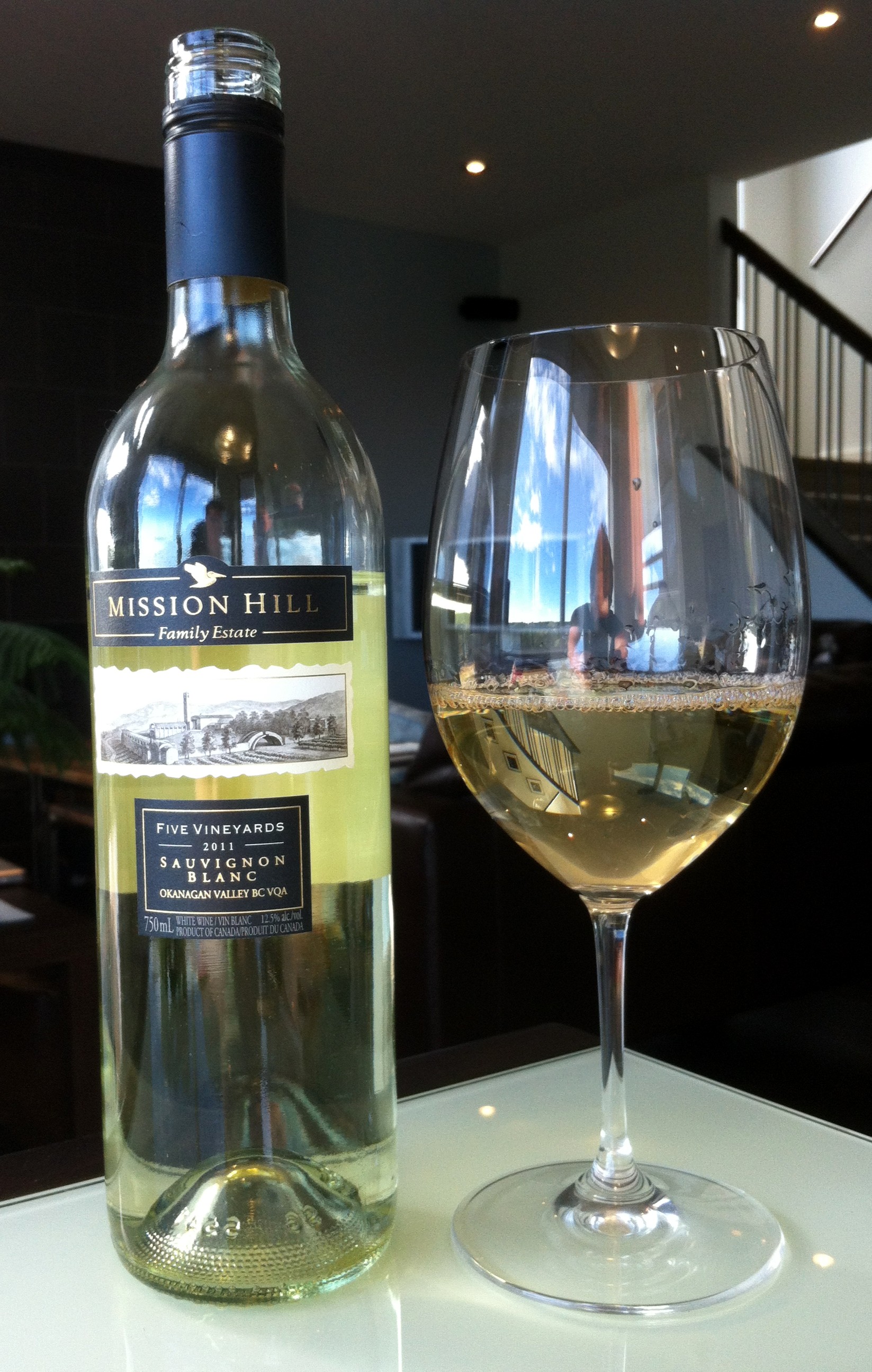
Wine Review: 2011 Mission Hill Five Vineyards Sauvignon Blanc

5 07 2012

[This bottle was provided as a sample for review purposes.]

General tip: clear bottle = open soon!

You know it’s officially summer when I can sit outside on my deck and write up a review of a crisp white patio sipper.  The sun is shining, there’s a slight breeze blowing through the trees, and it’s almost-but-not-quite-scorching hot — perfect Sauvignon Blanc weather.  This is the second white I’ve written up recently from the good folks at Mission Hill — I took a look at their Reserve Riesling just over a week ago.   This bottle will be an interesting contrast, because not only are we dealing with a different grape, one with somewhat less of a track record in Canada, but we’re also taking a step down Mission Hill’s quality hierarchy to their introductory level bottlings, which retail for $15ish in Alberta.  The Five Vineyards line of MH wines are sourced from (guess how many) five different estate vineyards scattered across BC’s Okanagan Valley:  Osoyoos and Oliver in the south (just north of the Washington State border), Pinehill and Naramata slightly further north, and the aptly-named Mission Hill Road vineyard surrounding MH’s winery just outside of Kelowna in the northern part of the region.  Each vineyard features differing soils, altitudes and microclimates — Oliver and Osoyoos are near-desert conditions, while the other vineyards along the shoreline of the vast Lake Okanagan, which cools and moderates the growing temperatures — all of which makes it easier to grow grapes with a variety of different characteristics to facilitate the creation of a blended wine that is fairly consistent year over year.  I was surprised to note that the two vineyards that Mission Hill’s website mention specifically for Sauvignon Blanc production are the two hottest ones, Osoyoos and Oliver, although I would guess that some of the grapes in this bottle come from other locations as well. Read the rest of this entry »


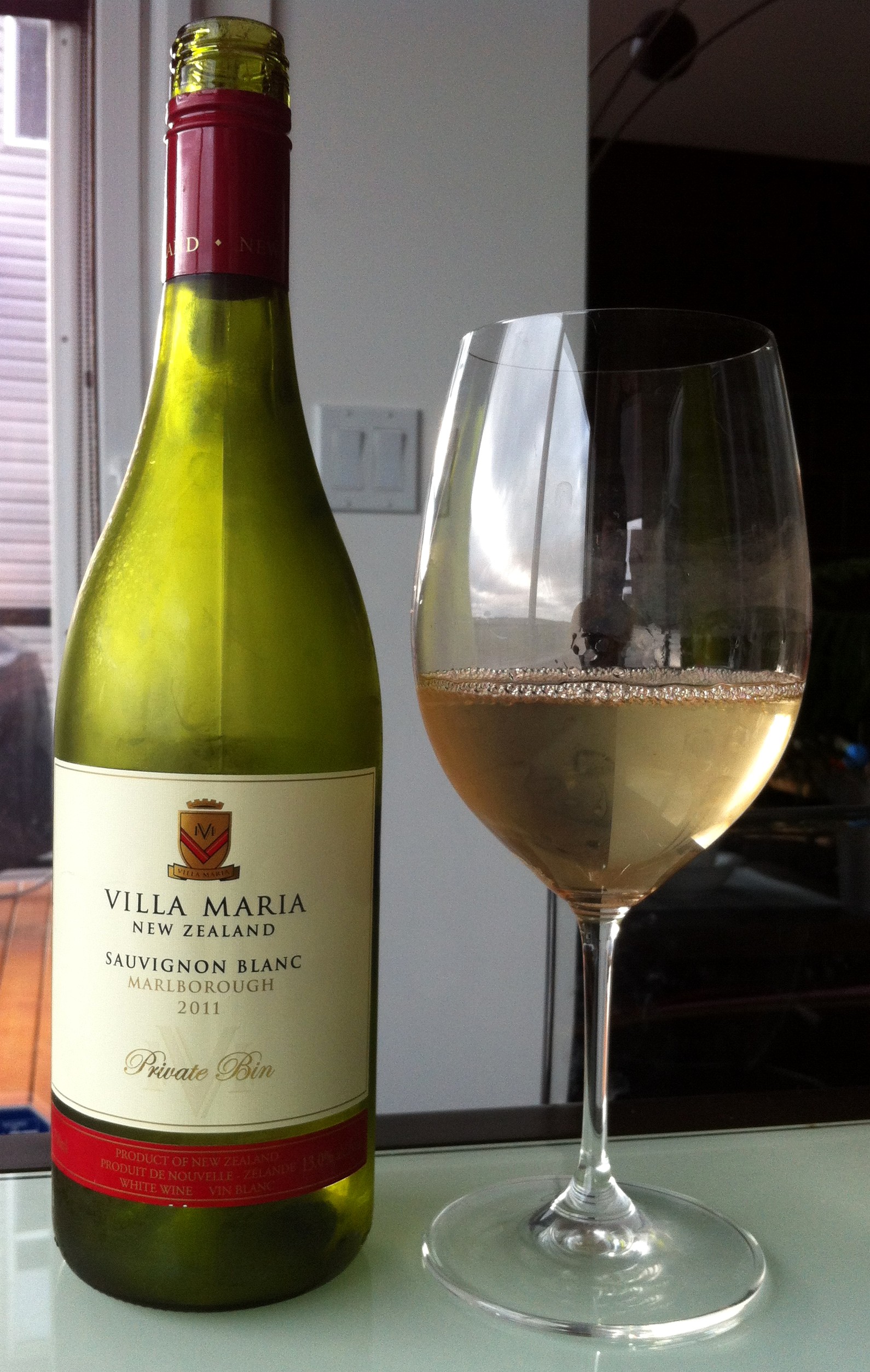
Wine Review: 2011 Villa Maria Marlborough Private Bin Sauvignon Blanc

4 06 2012

[This bottle was provided as a sample for review purposes.]

Cold and young: the best way to enjoy NZ Sauv Blanc.

For my generation of wine drinkers, New Zealand Sauvignon Blanc is a white wine mainstay, both a defining expression of the Sauvignon Blanc grape and one of the first whites that comes to mind during a trip to the wine store.  However, this level of penetration into the world’s vinous consciousness is a very new phenomenon:  NZSB didn’t attract international attention until the mid-1980s, when the bright, crisp, fruit-packed bottlings from the country’s star Marlborough region first took foreign palates by storm.  New Zealand has seen exponential growth in its wine production in the nearly 30 years since, and most of the Sauv Blancs you see on the shelves now are a product of this modern white revolution, only recently arrived to the SB scene.  But not this one.  In 2011, Villa Maria celebrated its 50th year as a producer, which, in a country that is relatively new to the world wine limelight, makes it a true New Zealand pioneer.  Its Private Bin bottling of Marlborough Sauvignon Blanc is sourced from grapes grown all over the region and shows that even recent wine history leaves a strong flavour footprint. Read the rest of this entry »