Bricks Wine Advent Calendar 2018: Day 4

4 12 2018

By Peter Vetsch

Well, Ray got his blast from Wine Advent past yesterday, continuing his baffling streak of Austrian dominance (which I believe is now at FOUR Austrian calendar wines in a row, somehow).  Mine came today.  Last year, I was a fresh-faced Wine Advent newbie on December 4, 2017 when I pulled a Manoir du Carra Cru Beaujolais from the Bricks calendar.  Tonight, on December 4, 2018, I unwrapped my designated Advent bottle to find…a Manoir du Carra Cru Beaujolais.  I quickly checked my calendar to ensure I had the right year.
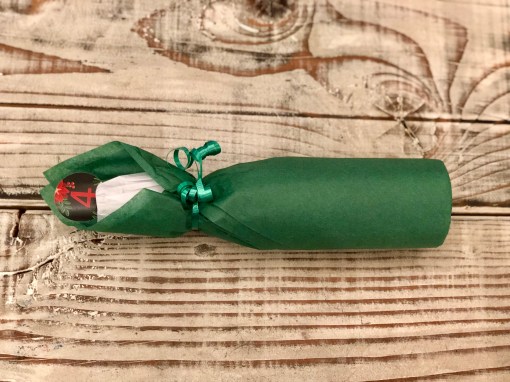
IMG_9360

To be clear, it’s a different Manoir du Carra Cru Beaujolais this time around.  This producer is on its fifth generation of family ownership and has accumulated 34 hectares of vineyard land in an astonishing FIFTY different plots scattered throughout Beaujolais. Last year’s wine was from one of the better-known of the 10 Beaujolais Cru subzones, Fleurie; tonight’s option is from the larger but lesser-known (or at least less visible on shelves here) Brouilly, the biggest and southernmost of the Crus which by itself comprises 20% of the Cru vineyard land in the region.  Brouilly is so named for a massive volcanic hill at the heart of the area, Mont Brouilly, which is itself named for Brulius, a lieutenant in the Roman legion who apparently liked naming volcanoes after himself.  This particular wine comes from the Combiaty lieu-dit (or small plot/area bearing a traditional wine) in the village of St. Etienne le Varenne, located in the south of Brouilly and known best for its dry, nutrient-poor pink granite soils.

IMG_9363

I have a strange relationship with Manoir du Carra, in that I have had their wines on at least a dozen different occasions, but NEVER yet in a full-sized bottle — I’ve had a few splits, a number of glass pours, and a strange but incredible 500 mL bottle (which is a remarkably effective size for a bottle of wine and should be produced in greater quantities).  I assume they actually make normal bottles but cannot confirm.  The Terre de Combiaty comes from Gamay vines that average 50 years of age which are hand-harvested (like everything in the Manoir du Carra portfolio), treated with minimal intervention in the cellar and fermented using semi-carbonic maceration, where the intracellular fermentation processes within the individual grape berries from the carbonic maceration process are joined with simultaneous normal alcoholic fermentation from the crushed berries at the bottom of the fermentation tank, resulting in more colour and tannin than pure carbonic maceration and a scaled-back version of the bubble-gummy carbonic flavour set.
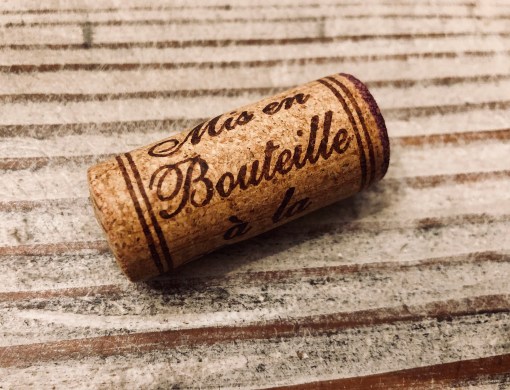
IMG_7088

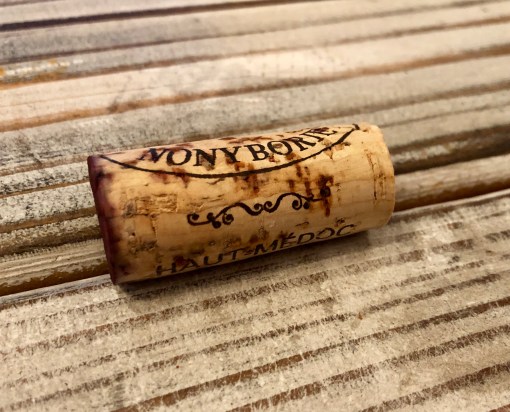
Cork Rating:  1.5/10 (Further deduction from last year’s edition for not changing the nondescript “Mis en Bouteille” nonsense after being blog-warned.)

This sort-of carbonic Brouilly is a sharp purple colour in the glass but thins quite markedly at the rim.  It is initially much darker than expected aromatically, date and slate and dirt emerging first, with black cherry and chalk peeking through underneath.  Over time, a Banana Runts (with banana leaf?) top note emerges, a nod to its carbonic half, as well as the more anticipated raspberry-rooted Gamay sense of joy.  Fresher and plummier on the palate, the wine showcases its clean, squeaky tannins almost immediately, and fairly laissez-faire acidity results in this Gamay seeming more broad and expansive than its standard varietal signature, albeit while retaining a feathery, wispy sort of texture.  The mineral streak noticeable on first smell lasts throughout, iron and rock dust and magnets, but red fruit blooms as you go along to keep anything from seeming severe.  Bricks, I’d say you are 4 for 4.

88 points


Bricks Wine Advent Calendar 2018: Day 2

2 12 2018

By Peter Vetsch

Day 2.  The spirit is still strong, the Advent joy still coursing through my veins, and now the Christmas decor is up and running in my household, so we are officially in the season.  I’m not sure what I was expecting when peeling back the wrapping paper on the sophomore bottle of this calendar, but Cru Bourgeois Bourdeaux wasn’t it.  This could bode well.  Let’s find out.

IMG_9349

Chateau Caronne Ste. Gemme was THIS close to the big time.  As far as global wine locales go, it is quite nicely situated in Bordeaux’s esteemed Haut-Medoc region, but through a misfortune of cartography it fell a scant 500 metres from where they drew the border for the much more esteemed sub-zone of St. Julien, home of legendary classed-growths Leoville-Las Cases, Ducru-Beaucaillou, Leoville-Barton, Gruaud-Larose, Langoa-Barton and other pricy hyphenated estates.  Its vineyards are actually right beside Gruaud-Larose’s, but on the other side of the appellation tracks and thus on the outside looking in of the 1855 Classification and Bordeaux’s power hierarchy.

IMG_9351

That said, it’s not the legendary estates where the bargains are found; it’s their neighbours.  Caronne Ste. Gemme has been owned by the same family since 1900, but in the last 25 years the current generation of owners has overseen a quality explosion thanks in part to a renewed focus on their 45 hectares of Gruaud-adjacent estate vineyards, planted on a mound of Cabernet Sauvignon-friendly gravel over sandstone.  The wines are fittingly largely Cab (60%), rounded out by Merlot (34%) and Petit Verdot (6%) and see around a year in barrique (20-25% new barrel) and further time in bottle before release.

IMG_1455

Cork Rating:  3/10 (Better idea: put the CHATEAU name on the cork, not the proprietor’s name.)

This is SUCH a textbook, classic Bordeaux.  The 2014 Ste. Gemme is a deep thick ruby-purple colour and smells as though it’s just starting to trace the contours of its aging curve:  blackberry and blackcurrant fruit, tomato leaf, juniper, new pennies (back when those were a thing), pink erasers, campfire embers and topsoil.  An interesting beam of supporting raspberry red joins the chorus once the wine hits the tongue, joined by pipe tobacco, cedar shavings, moss and leather, surrounded by still-scratchy tannins that frame rather than block the flavour symphony.  This is a wine that could simply be nothing else.  It is a dream tasting wine, because it purely and accurately displays exactly what it is without overdoing it; varietal and regional typicity squared.  The Bordeaux that I own I’m trying to age, so I haven’t cracked a bottle of youthful Bordeaux in some time.  This makes the argument that I should, while simultaneously making me mull over what it might taste like in another 5 or 10 years.  Value Bordeaux, I have found you.

89+ points


Bricks Wine Advent Calendar 2018: Day 1

1 12 2018

By Peter Vetsch

It is again the most wonderful time of the year, and the busiest time in the Pop & Pour blogging calendar — booze Advent.  For the second year in a row, we will be live-blogging every 375 mL day of the Bricks Half-Bottle Wine Advent Calendar, from today until Christmas Eve (following which we will immediately start blogging the 12 Days of Vinebox Christmas beginning Christmas Day…because, well, we’re crazy like that).  Last year, Bricks Advent began with a bubbly bang, so I was wondering if this year might start the same way; I was quite thrilled not only to find out that it did indeed, but that the bubbles in question were already indelibly seared into my memory, a monument to possibly the single greatest moment of my 2018.

IMG_9339

It begins…

I am a Washington Capitals fan.  Always have been.  I don’t know why.  I was born in 1980 in Gretzky-era Edmonton, to Edmonton-area parents, and from the age of 3 or so, from the time I understood what hockey was, Washington was my team.  Those of you with a passing knowledge of NHL hockey will understand that this was not previously a recipe for contentment.  Washington went from being what is still the worst expansion team in the history of the NHL (8-67-5 record in 1974) to being good-but-not-good-enough to being that team whose heart always got broken in a more novel and unbelievable way every playoffs to being that flashy run-and-gun early-Ovechkin squad that “didn’t know how to win” to being clearly the best team in the NHL until it really mattered to being past their window for success.  They pushed all their chips in the season before last, loaded up their team for their last shot at glory – and lost.  To Pittsburgh.  Again.  Last season was supposed to be the start of a slow descent back into irrelevance.  Until it wasn’t.  On June 7th, I watched in tearful disbelief as my team, that I watched fail over and over for 38 years, somehow won it all and raised the Stanley Cup, the culmination of a literal lifetime dream.  I promptly reached for the first bottle — or half-bottle — of bubbles I could find.

IMG_8313

And lo and behold, 6 months later, I peel back the Day 1 2018 Advent wrapping paper, and am greeted with:  my Stanley Cup wine.  I am instantly transported back to watching Ovechkin shrug off the doubt and unfair criticism of the hockey world and hoist the Cup over his head, screaming in triumph.  I remember the stream of excited messages filling my phone, the post-game interviews, the order of players who got their turn to lift the Cup, as soon as I see the label.  Wine, man.  Barone Pizzini and I will forever be connected because of that finally-captured moment of glory. Read the rest of this entry »


Burrowing Owl Fall Release Trio

8 11 2018

By Peter Vetsch

[These wines were provided as samples for review purposes.]

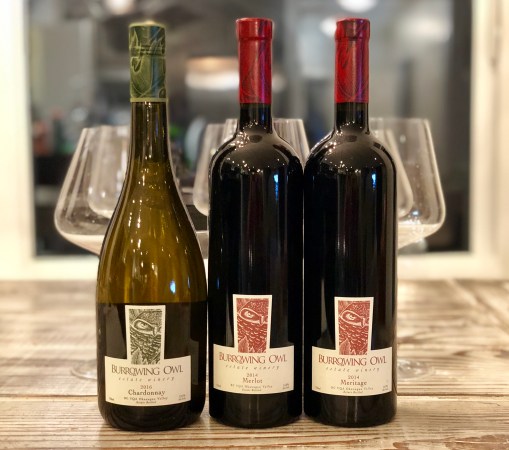
I have now been receiving and reviewing Burrowing Owl releases since 2015, and in addition to some minor shock about my blogging longevity, this has also given me enough familiarity and enough reps with the wines to truly help me understand the winery’s house style.  The whites tend to be creamy and generous, often buoyed and propelled by oak but not at the expense of the underlying fruit.  The reds are bold and ripe yet not overdone, a strong reflection of the scorching desert-like climate of the estate’s Oliver, BC home.

IMG_9158

Year over year, the releases and the winemaking choices behind them come across as impressively consistent, part of the reason why Burrowing Owl has long been on the short list of top quality wineries in the Okanagan Valley.  Now that the snow on the ground here in Calgary seems permanently settled in until April, it feels like there’s no better time to tuck into this trilogy of warm, rich, classic bottles, which always seem to be best enjoyed with a notable chill in the air, starting with a wine that just might be setting a new PnP record. Read the rest of this entry »


Wine Review: 2016 Buena Vista North Coast Cabernet Sauvignon

17 10 2018

By Peter Vetsch

[This bottle was provided as a sample for review purposes.]

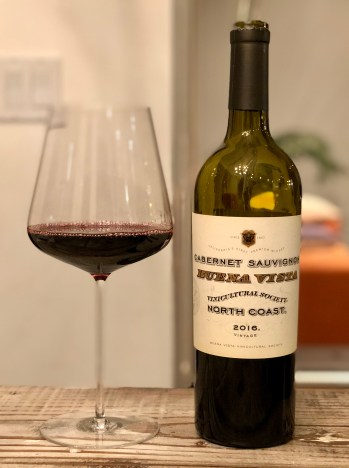
IMG_8980

A rare sighting.

The $25 California Cabernet Sauvignon is an endangered species nowadays; once a stalwart gateway drug for luring novice wine drinkers into a lifetime of vinous enlightenment, it has now been superseded in that endeavour by numerous other New World crowd-pleasers that are managing to offer similarly accessible and overt pleasure at wallet-friendlier prices.  The combination of rising land costs, fire- and drought-inspired production difficulties and the utter shredding of the Canadian dollar as compared to the US greenback on world currency markets has more or less eliminated California as a source of solid value wine in our market.  Buena Vista Winery is trying to change that, but with this series of factors arrayed against it, it’s fighting an uphill battle.

I have previously written about the remarkable, riotous, barely credible but actually true history of Buena Vista, the proud owner of the label “first commercial winery in California”.  It is well worth refreshing your memory about, but the Coles Notes version must at least mention:  (1) Agoston Haraszthy, who may have been the first Hungarian to emigrate to the United States, who founded the winery and who essentially crammed six lifetimes of zaniness and adventure into one shortened 19th century thrill ride; (2) 1857, the year Haraszthy founded Buena Vista, part of a major ambition to establish high-quality vitis vinifera grapes in hospitable California soils; (3) Nicaragua, where Haraszthy fled barely a decade after Buena Vista was first established, with angry and misled company investors potentially at his heels; and (4) alligators, which apparently ate him there.  Never a dull moment at Buena Vista in the 1850s and 60s. Read the rest of this entry »


Cellar Direct: RMW&F Festival Edition!

11 10 2018

By Peter Vetsch

[These bottles were provided as samples for review purposes.]

IMG_8930

Find the booth, for wines like this!

It’s October, and here in Calgary we’ve already been bombarded with two feet of snow in the last week and are craving the spring that’s a winter away, which can only mean one thing:  it’s coming up to Rocky Mountain Wine and Food Festival time.  The massive tasting event, now in its 21st year in the city, is kicking off tomorrow in Calgary (Oct. 12-13) and is heading north to Edmonton the following weekend (Oct. 19-20).  In addition to a massive number of wineries, breweries and restaurants, in attendance for the first time this year will be our blog’s favourite national wine club Cellar Direct, the Old World-focused provider of finely crafted low-intervention traditional-styled wine that ships its offerings across Canada and has been known best on this page for never yet providing a bad bottle over multiple years of tasting experiences.  If you happen to be attending the Festival (which you should, if you can), stop by the Four Corners booth (#309 in YYC, #903 in YEG) to say hi to the founders and brainchildren behind the Cellar Direct venture and sign up for their mailing list, which will give you access to wines like the ones below, which I recently received as a sort of Festival lead-up.  It will likely be the only place you can find these bottles in the country. Read the rest of this entry »


Wine Review: Finca La Linda Malbec Tiers

26 07 2018

By Peter Vetsch

[These bottles were provided as samples for review purposes.]

In some ways, trendy grapes have it tough.  Malbec has a proud and lengthy heritage as one of the six permitted grapes in red Bordeaux (yes, I’m still counting Carmenere, and shall ever continue to do so) and as the dauntingly famous Black Wine of Cahors, and it is almost single-handedly responsible for giving an entire country a vinous identity that has led to the rediscovery and cultivation of astonishingly high-altitude decades-old vineyards and a re-imagination of what grapes are capable of achieving in Argentina.  It is both an Old World stalwart and a New World trailblazer, pulling off both with equal aplomb and giving itself new life in the process.  But with raging-wildfire levels of success comes an inevitable fight against consumer boredom, particularly amongst the more avant-garde and adventurous in the wine world, which creates a sort of quiet undercurrent of peer pressure to steer clear of what is currently painfully a la mode.

IMG_8463

Great labels, but why is one bottle a third taller than the other??

I feel this way quite a bit, pulled away from the customer staple of the day in part because of my own desire to see what else is out there, but in part because of some innate resistance that I see amongst other wine geeks, some refusal to go along with what is everywhere.  So it was with Australian Shiraz; so it is with Argentinian Malbec; so it will be with whatever comes next.  I don’t really have a hard stance on this, but I have recently tried to make sure that my efforts at open-mindedness in wine extend equally to those grapes and styles that are suddenly ubiquitous as to those that remain esoteric.  I have also tried hard to remember that I once relied very heavily on the Shiraz-laden fads of the day as a gateway that set wine’s hooks into me for the first time, and I enjoyed the living hell out of them.  Fifteen years later, I have a WSET Advanced certification and have been publishing reviews on a wine blog for seven years.  Trends can lead somewhere.  So let’s start somewhere. Read the rest of this entry »


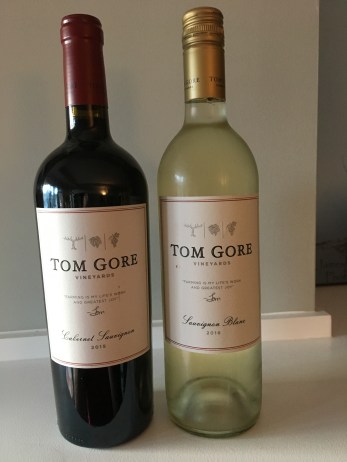
Wine Review: Tom Gore Vineyards, A Tale of Two Sauvignons

14 07 2018

By Raymond Lamontagne

[These bottles were provided as samples for review purposes.]IMG_1713

Cabernet Sauvignon remains the most widely grown quality wine grape in the world, so it is perhaps appropriate that in at least one regard, “Cab” started me off on the path to becoming a serious scholar of wine.  I had previously acquired a taste for certain Canadian Gewurtztraminers, spellbound by how a grape could smell and taste so exotic, although hard-won experience has taught me that many such wines recall one of those chemically augmented gym nuts who can flip a giant tire from a mining truck once or twice, only to catastrophically gas out immediately thereafter: initially powerful but ultimately quite flabby.  Rather wary of this focus, I then snagged a few wine books from a local book sale, thinking that this subject’s unique combination of history, geography, botany, technology, and gustatory delight would give my brain something new and compelling over which to obsess. I noticed right away that in these sundry tomes, blackcurrant or cassis was an aroma descriptor frequently associated with Cab. As someone who adores this particular flavour, I did further research. Not just cassis, but cedar, “cigar box” (I’ve always been intrigued by this one), blackberry, even vanilla and cola and chocolate cake. Wine smells like these things?! I was officially hooked, all this before even seriously tasting a Cab.

Once the actual drinking started in earnest, I rapidly encountered one of Cab’s parents: Sauvignon Blanc. My dad ordered a New Zealand example one nice evening in a Calgary steakhouse, as an aperitif, telling my mother:  “It’s one of those really grapefruity ones you like.” Grapefruit, you say? A cursory look at a tasting wheel for Sauvignon Blanc ultimately reveals a whole litany of “green” aromas, with these ultimately outnumbering the also prominent citrus and sometimes tropical fruits. There are classics like grass, gooseberry, and green bell pepper, along with rather more esoteric takes such as matcha, lemon grass, apple blossom, or even “cat pee”. Maybe we should stick with grapefruit or “tomato leaf”. Go crush and sniff a tomato leaf… You’ll probably get at least an inkling of pipi du chat, if nothing else in the form of a vague association with “funky” or “rank”. Some claim that this character, driven by organic compounds called thiols, is in fact a fault due to vineyard overproduction. Maybe so, although I experience cheap Sauvignon Blanc as something more akin to dilute lemonade in which a few broken fluorescent bulb filaments have been macerated, largely devoid of character across the board. A quick spray of thiols would often do this stuff a favour.

Sauvignon-Blanc-grape-variety-wine-aroma-profile-flavors-fruit-spices-Social-Vignerons

From http://socialvignerons.com/2015/12/10/infographics-guide-to-sauvignon-blanc-wine-grape-variety/.  This thing is comprehensive and rather fascinating…and there it is, cat pee, complete with schematic depiction.

So in addition to capturing aromas that I find pleasant (maybe at this point forget I mentioned cat pee), Cabernet Sauvignon and Sauvignon Blanc are both associated with formative memories in my quest to experience as much of the wine world as possible. Fitting then that I drew this assignment to review these two varietal bottlings, which interestingly enough hail from the first California wine label named after a grape grower.

Read the rest of this entry »


Wine Review: Officially Summer Trio

9 07 2018

By Peter Vetsch

[These bottles were provided as samples for review purposes.]

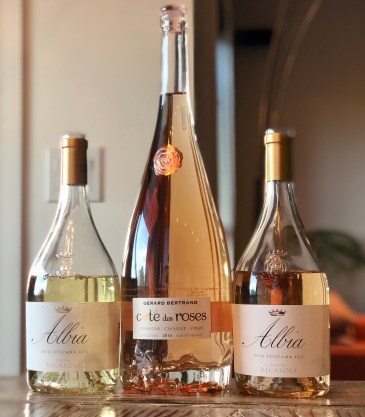
IMG_8409Sometimes you have to force seasonal drinking posts, and other times the season and the drinks just fall right into your lap.  Stampede is here in Calgary, the thermometer has just recently clocked over 30C, and we’re well-ensconced into July, which turns my sample pile ponderings to thoughts of whatever I can chill for refreshment most effectively.  After landing on an ideal trio of bottles that achieved that lofty goal, I noticed something odd that bound them together:  they have all at one time or another previously graced the pages of Pop & Pour.  Even though the blog is now 7½ years old and counting, that basically never happens.  Sometimes summer is just meant to be.  Game on.

2016 Ricasoli Albia Bianco Toscano (~$20)

I believe this is the second ever time that an identical bottle will get two separate reviews on PnP:  when Ray had the pleasure of meeting Tuscan winemaker Francesco Ricasoli at a tasting luncheon back in February, this 2016 Albia Bianco was the first bottle they cracked.  If you want a detailed backstory on Francesco, the Ricasoli estate and the family’s critical contributions to Chianti Classico as we now know it, click the link above for the whole enthralling narrative.  While I don’t have a five-course meal to pair with tonight’s wines, I do have both this Albia Bianco and its sibling the Albia Rose on the menu, both scions of Barone Ricasoli’s “fresh and fragrant” early-drinking Albia label.  Both come in gorgeous, hefty, gourd-like bottles that you first admire for making this $20 wine look like it costs double that amount, but then curse effusively once you realize the heavy-punted broad base is about a millimetre away from not fitting at all in any standard wine racking.  Suffice to say the labels suffered some mild to medium collateral damage as I reamed the bottles into place with every ounce of strength I had. Read the rest of this entry »


Wine Review: 2014 Schlossgut Ebringen Spätburgunder Trocken

4 07 2018

By Peter Vetsch

[This bottle was provided as a sample for review purposes.]

Ever since I first got into wine about a decade ago, I have come across the eternal, nigh-unsolvable question many times:  where can you look for consistent, top-quality, good-value Burgundy?  Well, I have finally solved the riddle — turns out it’s been in Germany all along.

IMG_8390

Mesmerizing.  Germany, wow.

It might not be in France, and it might have just broken my heart in the World Cup, but Germany has been quietly elevating its Pinot Noir bona fides.  This fickle and finicky red grape is known here as Spätburgunder (literally, “late Pinot”, or “late Burgundy”, due to its relatively late-ripening tendencies) and is in the process of taking the next step in Germany’s warmer climes, aided imperceptibly by climate change and to a larger degree by greater clonal awareness and vineyard attention.  But it is not every country that can suddenly become a Pinot success story; Germany’s natural advantages (including patches of Burgundian-style limestone soil) are finally being properly cultivated, and almost as importantly, shared with the world.

IMG_8396

I don’t think I had ever seen a wine from Germany’s Baden region on an Alberta retail shelf until 2018, and after a taste of what Schlossgut Ebringen can do with possibly the hardest grape of all to do well (and don’t even get me started on their utterly mind-bending Chasselas “S”, which belongs in another dimension), it makes me wonder what has taken us so long to get on board.  A quick primer for the uninitiated:  Baden is in the extreme southwest corner of Germany, just a stone’s throw and a border crossing away from Alsace, due west from Munich until you almost hit France.  It is closer to Zurich, Switzerland than any major German city.  Baden is built like Chile, in a long narrow north-south stripe, within which lies 9 surprisingly different subregions.  Pinot Noir/Spätburgunder is the most commonly planted grape (at around 35% of all plantings), though on the whole white grapes outnumber reds 60/40.  In the south of Baden, just south of the famous Baden-Baden spas, lies the top subregion of Markgräflerland, known largely for Chasselas (locally known as “Gutadel” just to add more proper nouns to your life) but also a burgeoning Pinot power.  Baden’s other top attraction, the Black Forest (Schwarzwald), lies to the east, and in its foothills lies the village of Ebringen and the hero of tonight’s story. Read the rest of this entry »


PnP Panel Tasting: The Hatch – Library Release

28 05 2018

[These bottles were provided as samples for review purposes.]

IMG_8224

(Re)Entering The Hatch.  In stereo.

It had been far too long since we last held a panel tasting, and we were missing it – there’s something about tasting outside of the echo chamber of your own brain that is gloriously refreshing and invigorating.  Plus multiple wines and multiple friends is generally a guaranteed recipe for a proper time.  One of us (Ray) wondered about reaching out to his friends at the Okanagan’s weirdest and most interesting winery, The Hatch, for inspiration.  We naturally assumed that we would get some intriguing and tasty wines from this divergent, artistic, even edgy winery (the latter word is drastically overused but still rather works in this case).  The common approach would have been to send a set of current releases, bottles that the reading public could come scoop if they were so inclined.  Well, The Hatch is not common.  PnP’s second ever Panel Tasting turned into a library release celebration, focused on a trio of bottles with a few years on them, from the mysterious and mildly depraved depths of the winery’s cellars.  It not only allowed us to get a sneak peek at what the future might hold for some more recent bottles that we were holding, but it also gave us a chance to answer a question that nags at a number of people in our home and native land just getting into wine:  can Canadian wine age?  Does it improve?

IMG_8240

The answers, in order, are “yes” and “it depends”; in the upper echelons of our national wine industry are scores of producers who are creating layered, complex, long-term wines that easily stand the test of time.  The eye-opening part of this tasting wasn’t so much that ageworthy BC wine was possible, but that it was starting to be accessible even at lower price points, another sign of the province’s rapid progression into a globally competitive wine power.  After this, there will be far more local bottles that spend more cellar time before seeing the light of day.  It made sense for us to each choose a bottle to write up, but rest assured there was much group analysis of everything we were tasting, making the below report a true joint effort. Read the rest of this entry »


Wine Review: Famille Sichel Bordeaux Tiers

15 04 2018

By Peter Vetsch

[These bottles were provided as samples for review purposes.]

IMG_7943

What a Bordeaux progression looks like.

Bordeaux is one of those regions that any aspiring wine geek finds out about roughly 15 seconds after beginning their vinous adventure.  It leads off many textbooks, is (rightly) touted as the spiritual homeland of red grape overlord Cabernet Sauvignon and its consigliere Merlot and is held up as a must-try area both so that new oenophiles can get a sense of the classics and because top-flight Bordeaux can be so memorable that its first-chapter place in all future textbooks is likely assured.  Of course, all of that comes at a price, one that seems to be increasing by the year, as wines from the top chateaux become more luxury commodity and less agricultural product and as international demand in new markets shoots through the roof.  So what are the non-obscenely wealthy wine-curious to do?  Here’s one way to start:  find a reputable producer and taste your way up their lineup, through the quality tiers and nesting-doll classifications layered throughout the Bordeaux appellation.  Even if you don’t make it all the way up to the grand vin flagship of the chateau, you will end up with a really good sense of what makes this rarefied region tick and also start to understand why those tiers exist in the first place.

IMG_7947

I was fortunate enough to test this tasting theory with the wines of Famille Sichel, a producer with whom I didn’t initially think I was familiar until discovering that they are the owners of one of Bordeaux’s hidden gem producers, Margaux’s Chateau d’Angludet.  While the winery is centuries old and the Sichel family’s history in Bordeaux is almost equally entrenched (they have been established in the region as a negociant since 1883 and are on their sixth generation of family ownership), their two paths didn’t cross until the 1960s, when d’Angludet was in a state of extreme disrepair and was bought and revived by Peter Sichel thanks to an extensive replanting and restoration program.  Current proprietor Benjamin Sichel continues both the negociant business (under the Maison Sichel banner) and the Chateau’s estate bottlings with a heavier focus in the vineyard and a defter touch in the cellar.  I have previously enjoyed Chateau d’Angludet on numerous occasions and now got to experience the trail of bottles that leads up to it. Read the rest of this entry »


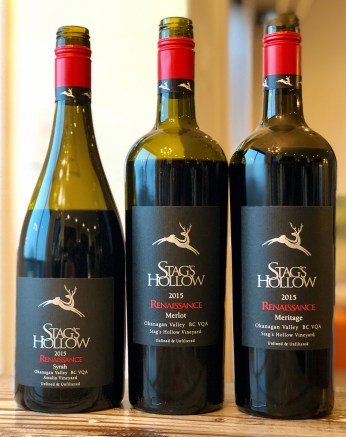
Wine Review: Stag’s Hollow Renaissance Reds

5 04 2018

By Peter Vetsch

[These bottles were provided as samples for review purposes.]

IMG_7892

The big guns.

As I have mentioned in reviews past, my first thought of Okanagan Falls’ Stag’s Hollow Winery is always as a forward-thinking, try-everything trailblazer, the continual vanguard of varietal suitability and experimentation in British Columbia, constantly checking in on whether the next potential star grape of the province (be it Albarino, Grenache, Dolcetto, or any number of others in its viticultural Rolodex) might be one that few had previously considered.  So it’s a fun change of pace tonight to sit down and see how they handle the classics, those big red varietal stars so often seen across the Old World and New World alike, the first grapes you expect to see on any wine store shelf.  This review set is a particular treat, because all three of the bottles below hail from Stag’s Hollow Renaissance line, the winery’s premium flagship tier of offerings, produced only in vintages when the wines can live up to the bottle’s special black label.  I have heard rumblings that the 2015 Renaissance set breaks new ground in terms of quality and longevity; I had not previously had the opportunity to test this theory for myself, but it would not surprise me out of a winery that always seems to be improving. Read the rest of this entry »


Cellar Direct: Underdog Whites

27 03 2018

By Peter Vetsch

[These bottles were provided as samples for review purposes.]

IMG_7833Close-following Pop & Pour adherents (if such things exist) will have been waiting for this moment for a couple of months.  In my last write-up about the tremendous Euro-tacular wine offerings of Cellar Direct, I teased that the two Italian reds going head-to-head in that review were not the only bottles (or colours) from that country that Cellar Direct had sent my way, but I opted to hold back the indigenous Italian white wine from that set so that it could shine in an all-white duet in a later post.  Well, here we are, and tonight’s 100% Arneis lead-off hitter is joined in the batting order by a rather mysterious and off-grid white Burgundy (to the extent that anything Burgundy can be considered off-grid), each bottle a tantalizing find that proves both that even famous regions have hidden values and that you often need some expert assistance to find that value needle in the prestige haystack.  If Cellar Direct is anything, they are that Old World value sherpa, leading you to consistent quality at credible price points over and over again.  Their streak of never sending me a bad bottle lives on. Read the rest of this entry »


Calgary Wine Life: Veuve Clicquot Release Tasting @ Yellow Door Bistro

23 03 2018

By Peter Vetsch and Raymond Lamontagne

Sometimes the best times to celebrate are the times when there is nothing obvious to celebrate.  It’s a dreary weekday in late March in still-snowy Calgary, but Champagne lifts all spirits and makes all occasions special, and this was no exception.  The eponymous yellow door of the Yellow Door Bistro at Hotel Arts perfectly foreshadowed the array of yellow labels awaiting us inside, including the brand new release from Champagne’s powerhouse (and power-house) Veuve Clicquot.  Winemaker Bertrand Varoquier expertly guided us through a series of Veuve releases, not least of which was the winery’s latest concoction, the Extra Brut Extra Old NV, soon to be available on retail shelves across Calgary.

IMG_7792

Veuve Clicquot is one of the oldest houses in Champagne, founded in 1772 by banker Philippe Clicquot-Muiron, who was then proceeded at the winery by his son Francois.  When Francois suddenly died young in 1805, his widow Barbe-Nicole Clicquot-Ponsardin stepped forward to take over the reins and run the business, a daring decision for a 27 year-old woman in early 19th century France.  The young widow (or veuve, in French) persevered, and her strong vision and fierce entrepreneurial spirit took the winery to new heights, leading to some significant innovations in tradition-laden Champagne.  Madame Clicquot was the first to create a rosé Champagne made from 100% wine (previous renditions of pink Champagne were created by mixing white wine with elderberry juice).  She is also credited with creating the riddling process that allows the dead yeast cells from Champagne’s in-bottle secondary fermentation to slip down into the neck of the bottle so that they can be frozen and disgorged, to keep the finished wine from being cloudy; before this, Champagne was served hazy and decanted to let the leesy sludge settle before pouring.  Clicquot-Ponsardin contributed so much to the region over her lifetime that she was nicknamed “La Grande Dame” of Champagne, a name that since 1872 has also been used for the house’s prestige cuvée.  Her impact on the winery was so significant that the entire brand was renamed in her honour.

IMG_7794

Bertrand Varoquier is a native son of Champagne, born in the heart of the region in the town of Reims; as he puts it, “my blood is bubbly”.  For the past six years of his extensive 18-year wine career, he has been at Veuve Clicquot, where he is currently responsible for all red wine vinification.  Due to the house’s production size, and in order to ensure that its winemaking happens as close as possible to the vineyards where the grapes are harvested, the red grapes that go into Veuve’s cuvées (primarily Pinot Noir, which is at the core of Veuve Clicquot’s identity) are processed and vinified in their own standalone facility in Buzy.  Each discrete parcel of each red vineyard is vinified separately, and after alcoholic fermentation is complete and scores of still wines are created (some with very limited colour due to restricted skin contact, some fully red for use in rosé Champagne creation, all produced solely for future blending), the lots are sent to Veuve HQ in Reims for malolactic fermentation and blending.

IMG_7809

Bertrand Varoquier, winemaker at Veuve Clicquot

Unlike almost any other top wine region in the world, which tends to glorify single-vineyard and single-vintage expressions of time and place, Champagne’s focus is on achieving and maintaining each house’s unique signature style with precision and consistency, year in and year out.  The mammoth challenge of this task is almost unquantifiable, but this will give you a sense of it.  In addition to his winemaking duties, Bertrand is on the Veuve Clicquot tasting committee along with Cellar Master Dominique Demarville and others.  Every year, from the start of November until the start of March, the committee tastes 24 different sample lots of still wines PER DAY out of the roughly 1,200 (!!!) already-vinified non-bubbly base wines aging in full stainless steel tanks in Veuve’s cellars in order to determine which wines will be used to populate each of the house’s different Champagne releases.  These base wines are from the present year’s harvest plus nearly twenty prior vintages, and all are ultimately rolled into a multi-vintage, multi-source patchwork tapestry that the Cellar Master weaves into the emblem of Veuve Clicquot, so that the buying public gets the taste experience they expect out of every single Veuve Champagne, regardless of the year in which they buy it. Read the rest of this entry »