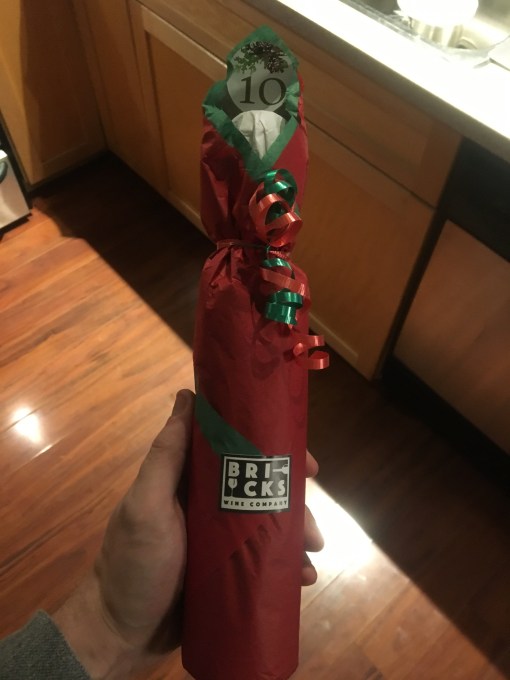
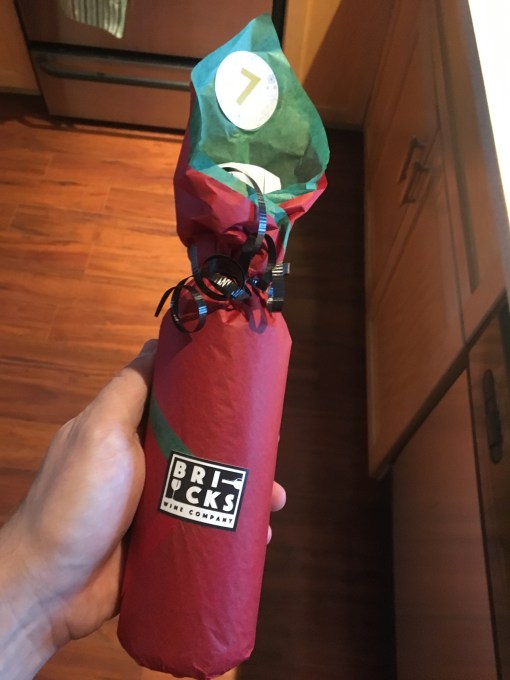
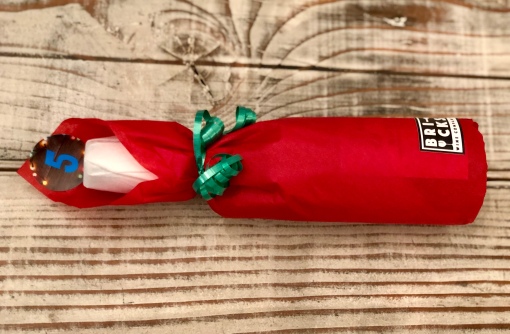
Bricks Wine Advent Calendar 2018: Day 18

18 12 2018

By Peter Vetsch

Well, any wine was going to have its hands full tonight, following on the heels of the toughest act to follow so far in the 2018 calendar, last night’s masterpiece single-vineyard Pinot Noir from Ken Wright.  Like a schedule loss on the second night of a back-to-back home-and-home set in the NHL, Bricks may have strategically selected what I would guess is the least expensive bottle in the whole calendar ($15ish for a full bottle) to take one for the team right after we all revelled in the most expensive bottle in the calendar.  The Advent backup goalie in this case is the 2016 Ram’s Leap Semillon Sauvignon Blanc from New South Wales, Australia, a bottle that continues what is now a Bricks Advent tradition of vinous animals leaping, after the highly tasty Frog’s Leap Zin from 2017.  Stag’s Leap next year?  Most definitely.

IMG_9462

Ram’s Leap is part of the Canonbah Bridge range of wines, a producer with which I was not previously familiar, possibly because the place where their estate vineyard is planted is not even a recognized wine region!  It forms part of the broader appellation of New South Wales, but so does 30% of the Australian wine industry.  The 80-acre vineyard was strategically planted on an old riverbed in the middle of a 30,000-acre sheep farm near Warren, slightly west of the Hunter Valley, a couple hours northwest of Sydney.  Half of the plantings are Shiraz, and the other half are, well, everything else:  Merlot, Grenache, Mourvedre, Semillon, Verdelho, Chardonnay and Tempranillo.  It remains the only commercial vineyard in this highly arid area, with scorching hot days and cool nights that facilitate the practice of organic viticulture (there are no plant-attacking fungi, mildews or moulds in the desert, so less need for herbicides).  Canonbah Bridge takes their organic principles one step further by aiming to avoid any intervention with the vineyard soils whatsoever:  no tilling, all weeding (and much fertilizing) performed via wandering sheep service, cover crops preventing the spread of unwanted plant life, etc. Read the rest of this entry »


Bricks Wine Advent Calendar 2018: Day 17

17 12 2018

By Peter Vetsch

I can often tell how much I like a wine by how many notes I take.  Even when it doesn’t hit me at first how much I am taken by a bottle, I’ll suddenly look down and a whole notebook page is filled up of musings and guesswork and random sensory impressions, the various threads through which I eventually try to sort out the essence of the wine and how it speaks to me.  On blog days where the bottle doesn’t have much to say, or doesn’t quite spur the imagination, the pen moves very slowly.  Tonight I have three pages of notes in about 30 minutes, and I had to stop myself from writing more so that I could post this early enough for people to actually read it.  This was the first bottle in Advent history that had me autonomically exclaim “WOW.”, reflex-like, as soon as I opened the bottle.  I had never had a Ken Wright Pinot Noir before, but I was very well aware the level of quality it represented.  For my first bottle to be his 2015 Shea Vineyard, from the now-famous plot that he almost single-handedly put on the map, can’t be more perfect.  Welcome to the last week of the calendar, which almost surely can’t get better than this.

IMG_9452

Ken Wright was first exposed to wine as a waiter and student in Kentucky, and the regular staff tastings at his part-time job soon led to a complete change of vocation and an enrolment in the prestigious UC Davis viticulture program in California.  He spent close to a decade in the state honing his craft, but a single visit to Oregon in 1976 convinced him that his destiny lay there, where he felt North America’s pinnacle expressions of Pinot Noir could be made.  He loaded up his family and all his earthly belongings and founded his first Oregon winery in 1986 (Panther Creek Cellars, which still exists today, though Wright has since sold it), then his eponymous winery in 1994, which focuses entirely on single-vineyard expressions, mostly of Pinot Noir, from 13 different vineyard sites.  Shea Vineyard, the home of tonight’s bottle, is in the Yamhill-Carlton AVA in the northern part of the Willamette Valley, a sub-AVA that Ken helped define and create (along with five others) back in 2004.  Ken also established his winery’s tasting room in the heart of the small town of Carlton, echoing his belief in the power of site for his grapes by connecting his business directly to their land of origin.  His was the first winery to take root in Carlton, and it has now been joined by a large tasting room in the town’s old train station. Read the rest of this entry »


Bricks Wine Advent Calendar 2018: Day 16

16 12 2018

By Raymond Lamontagne

I love rare birds. I’ve been a birdwatcher since about the age of 10, one of those “twitcher” types that needs to keep a life list of every bird I’ve seen. Of course, a particular brand of nerd status and glory is affixed to the rarities. There is something deeper at work as well here, at least for me. I was a psychology resident in Vancouver in 2008, and frankly it was one of the worst years of my life. Everything seemed like it was falling apart. One way I coped was by spending most Fridays at a beach close to UBC campus, sneaking out there almost every week (rain or shine) when I was supposed to be working on a research paper. If my supervisor knew (and she probably did), she had the forbearance to turn a blind eye. One day I was hiking down the wooden steps as a band-tailed pigeon exploded past my head. Not even that much of a rarity, but it was a first for the life list, and it felt like at least one tiny win that I majorly needed. I’m a pretty good archivist and a half-decent birder. Well, I do the same thing with wine grapes. I keep a life list. Birds are beautiful but wine smells better and you can drink it. Although I’ve had dry Rotgipfler before, from this very same producer, unwrapping this distinctly-shaped bottle still made me feel some of what I felt when I saw that damn pigeon (despite the fact that my life is a whole lot better now). What a pleasant surprise. And of course, my Pop & Pour Advent Austria streak remains alive. Zum Wohl!

IMG_2452

Look at how long this sucker is… Great field mark for an Auslese split.

Rotgipfler (and what a name…) makes full-bodied spicy white wines in Austria’s Thermenregion, a true local specialty. The grape is a half-sibling of my beloved Gruner Veltliner. The name refers to the red colour of the vine’s shoot tips (“rot” = “red” in Austrian). The aroma is typically compared to peaches or apricots. As far as white grapes go, this one is a bit of a tank. Known for great concentration and a heavy, unctuous body, Rotgipfler is often paired with Zierfandler, another Thermenregion specialty that adds needed acidity and minerality to the blend. I enjoyed Reinisch’s entry level Rotgipfler with an importer buddy of mine and although the wine had seen no oak, it somehow featured a pungent smoky  nose and was bursting at the seams with banana peel, peach, mango, and gooseberry notes. Huge concentration indeed but elegant at the same time. Read the rest of this entry »


Bricks Wine Advent Calendar 2018: Day 15

15 12 2018

By Raymond Lamontagne

Cue the expletives. They put a BAROLO in this thing?! I’m not sure what else to say about such unbridled generosity. I love Nebbiolo for many of the same reasons I love Pinot Noir. The grape shows a remarkable fidelity to site, an otherworldly ability to decode the land into delicate, haunting aromatics that evoke the classic descriptors of “tar and roses”. The grape is shockingly pale of hue considering its reputation for both ferocious tannins and high acidity. These traits mean that the best Nebbiolo ages well, its fruit aroma a discreet red rather than an opulent black. Pinot and Nebbiolo are like yin and yang, two sides of the same viticultural coin, and Nebbiolo itself embodies a duality… It is a giant, yes, but a genteel, cultured one, like a Japanese oni steeped in the Bushido code or Atlas bearing all of Piedmont on his broad shoulders.

IMG_2441.jpg

This Barolo is not an entry-level bottling, but instead hails from a single vineyard, Rocche dell’ Annunziata in La Morra, one that many consider to be amongst the top 10 sites in the entire Barolo DOCG. This site is said to yield “feminine” and graceful Barolos, characterized by a particularly prominent floral perfume of violets and roses, dark red fruit, brown spices, and tannins that skew towards fine and “silky”. These wines can be enjoyed relatively early but still age with an elegant poise. Vintage reports suggest that 2012 was a cooler year, with many ups and downs weather-wise that yielded a similar variability in the wines, although generally they can be described as mid-weight and fresh, with some a touch on the slender side. Read the rest of this entry »


Bricks Wine Advent Calendar 2018: Day 14

14 12 2018

By Raymond Lamontagne

After last night’s quirky yet mightily delicious Rioja, I’ve got the distinct feeling that this weekend run of three wines is going to deliver fireworks. Lo and behold, today’s reveal is a Chablis from one of the best known, most emblematic producers in the region. Burgundy remains my favourite wine region despite many strong contenders. And Chablis, that northern Burgundian outpost of stark minerality and abject crystalline purity, is a particularly singular wine region unto itself. Plagued by viticultural hazards, including regular springtime frosts and the odd unpredictable hailstorm, grape growing is no easy task in this hinterland. I continue to marvel at exactly how these hard-working vintners can distill these harsh conditions into such sheer, stony, precise, pixelated and elegant wines. They are known for a distinctive “gunflint” note, described as “goût de pierre à fusil“, or “steely” if you prefer something rather less martial. ‘Minerality” remains hard to definitively pin down as a construct. We have to date identified no specific “mineral” receptors in the human gustatory system, and yet one cannot reasonably deny the existence of such aromas in certain wines. I’ve even heard the argument that Chablis is where Chardonnay shines most brightly, its true spiritual home. The notion that this grape’s genuine essence could be more ethereal mineral than gaudy fruit intrigues me to no end, subjective viewpoint though it may be.
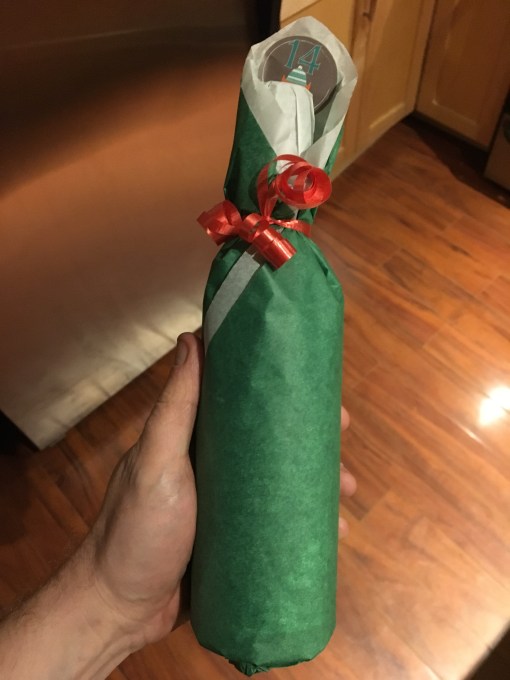
IMG_2436

William Fevre began with the 1959 harvest, although William’s father Maurice was growing grapes back in the 1930s, mainly in Chablis’ Grand Cru vineyards. Today William Fevre owns the largest number of Grand and Premier Cru vineyards in the region, populated mostly by old, low-yielding vines. The estate was purchased by the Henriot family of Champagne in 1998. Although such a takeover can sometimes be a harbinger of decreased quality, the Henriots instead implemented a new philosophy geared towards better preservation of the nuances of Chablis terroir: use of new oak was abolished in favour of old barrels with an average age of 6 years. Grapes are grown organically, although the estate isn’t particularly fussy about getting official certification. William Fevre seeks to preserve even the most muted variations across individual sites. This focus is coupled with an emphasis on “instant appeal” in the wines, one of those ideological melds of tradition and avant-garde technology that works, and works well.

IMG_2437

The 2015 vintage in Chablis was characterized by a late onset of winter, with some frost and rain until the end of May followed by hot, dry weather at the start of June until the end of August. This is pretty optimal for the Petit Chablis and (non-Cru) Chablis vineyards, lesser sites where grapes can struggle to reach an appropriate degree of ripeness. Indeed, the fine folks at Bricks chose well here. According to William Fevre cellarmaster Didier Seguier, “It’s a perfect vintage for the lower appellations, Petit Chablis and Chablis… These can be difficult in cool, late years, but in ’15 they have a good level of ripeness and freshness.” The entry level Chablis AOC profiled here is harvested manually, with the grapes receiving a brief, gentle pneumatic press followed by gravity settling of the juice. Some fine lees is retained, and the wine does undergo malolactic fermentation (many basic Chablis do not, although I believe the practice has become more common in the region of late). Maturation occurs only in stainless steel.

IMG_E2439

Cork Rating: 3.0/10 (Points for total and utter clarity as to region and vintage. Alas, there is little else to score here.)

This all sounds textbook. Frankly, that’s exactly what I am expecting here, in the very best way. I am not disappointed. The fruits include tart Granny Smith apple and the most stern and austere of the green pears, followed by some suggestions of under-ripe hard nectarine, lemon and watermelon rinds (you know, that watery white stuff), a few ghosts of pineapple and starfruit. White berries do occur in nature (e.g. the snowberry) but they are largely unpalatable. If one were indeed edible, I feel I would detect such a note in this taut, precise little dynamo. A pleasing minerality of matchlock musket, chalkboards, and Epsom salts begins to billow from the glass, and I welcome more associations of green banana peel, salted cultured butter, margarita glass rim, and Siberian peashrub/caragana flowers (let’s go with “acacia” for those of you following along on a tasting wheel). The fresh acid is far from meek, malo notwithstanding, and the finish recalls an abrupt sharp slap followed by a few conciliatory caresses. This aggression will not stand, man. Truth be told, this is far too classy to merit more than a few allusions to anything truly bellicose.

89+ points


Bricks Wine Advent Calendar 2018: Day 13

13 12 2018

By Peter Vetsch

Rioja!  I stand to be corrected, but I believe this is the first bottle of Rioja in which we have ever partaken in an Advent calendar…thus my Groundhog Day Advent 2018 curse comes to an end and I get to dive into something sui generis to close out my blogging week.  In.  After last night’s more eclectic offering, tonight seems as safe and comforting as a St. Bernard with a collar barrel of brandy, and it barely misses continuing the 2013 vintage trend we’ve seen a lot of over the past week, although the 2014 vintage designation on this bottle suggests it’s a year beyond the likely current vintage of this wine.  “This wine”, in this case, is the 2014 Bodegas Franco-Espanolas Bordon Rioja Crianza, which is a mouthful to say, let alone type.  But as with so many things wine-related, the name tells a story.

IMG_9421

If you were reaching for your Spanish phrasebook or your Google Translate bookmark, I will save you the trouble:  yes, the producer’s name actually DOES mean “The French-Spanish Winery”.  The winery was founded back in 1890, when a great deal many Frenchmen in the viticulture and viniculture industries were fleeing a country where their livelihoods were literally being eaten away by the phylloxera louse, a scourge that absolutely decimated the vineyards of entire regions in France before the antidote of grafting native vitis vinifera vines onto American bug-resistant vine rootstocks was discovered.  One such Frenchman was Bordelais (and remarkably French-sounding) Frederick Saurat Anglade, who was one of many winemakers from Bordeaux to find refuge in Rioja and then like it so much that he decided to stay.  Along with Spanish partners, he founded his multinational bodegas, perched in prime territory on the banks of the Ebro River, which has since grown into one of Rioja’s biggest.

IMG_9423

This might be the first old-school wine from Rioja that I’ve seen use varietal labelling, but there’s the word “Tempranillo” plain as day on the front label.  This dose of consumer informational assistance is not quite as helpful as it seems, because the 2014 Bordon Crianza is actually only 80% Tempranillo and 20% Garnacha.  Close enough?  The wine spends 15 months in the traditional Riojan staple, American oak barrels (which the winery website is kind enough to advise come from the oak haven of Ohio), followed by additional time (minimum one year) in bottle before release in satisfaction of its legal “Crianza” designation aging requirements.

IMG_8353

Cork Rating:  5.5/10 (Amazing coverage and graphics, but major deduction for being, by FAR, the shortest cork of December to date – see corkscrew evidence above.)

The result of this regimented aging process is a gorgeous rich ruby hue and a slate of classic Spanish aromas, from tobacco and new leather jackets to wet beach, smoked meat/chorizo and cedar with quietly fresh purple fruit overlaid with the dried red berry rendition most commonly associated with 100+ year-old Riojan wineries.  Bright and juicy, the Crianza hums with vibrant acid, its luxuriant round fruitiness a nod to modern influence but its wood-aided papery tannin and its cigar smoke, dust and char flavours a throwback to the good old days.  The two eras of this legendary region dance together marvellously here, and to this day I still haven’t met a Rioja I didn’t like.

90 points


Calgary Wine Life: Dom Pérignon Luncheon with Winemaker Nicholas Lane

13 12 2018

By Dan Steeves

It’s hard to believe that almost six months has passed since my last post on Pop & Pour (I’m still getting used to the deprivation of free time with a further expansion to our family!) and I was thrilled at the opportunity to get back into it by attending a luncheon with the beautiful wines of Dom Pérignon, paired with stellar cuisine from Chef Dave Bohati at Murrieta’s Bar & Grill Calgary.  Thrilled is definitely an understatement, actually. I’ve always enjoyed Champagne, but after travelling to the region a few years ago, I really fell in love with the bubbly concoction for which the region is so famous. Seeing with my own eyes the vineyards, the massive underground cellars, how these magical wines are actually made, and tasting many different bottles from various Champagne houses, all gave me a connection with the region that I am reminded about every time I pop open a bottle. So having the opportunity to try the legendary wines of Dom Pérignon with one of the actual winemakers…well, let’s just say it was more of a dream come true!

img_0414.jpg

A throwback to the time we were crazy enough to vacation in Champagne with a 6 month old baby. Luckiest baby ever? Definitely!

Dom Pérignon is the prestige brand from Champagne giant Moët & Chandon, and is one of the oldest prestige cuvees to be marketed by any of the top Champagne houses, with the first vintage being the 1921, which was released in 1935. It is named after the Benedictine monk, Dom Pierre Pérignon, who in 1668 became the cellarer at the Abbey of Hautvillers, located just outside the Champagne capital of Épernay. Although he is commonly credited as being the creator of Champagne, Dom Pérignon did not invent sparkling wine (at the time it was considered a fault), but he did provide many advances to wine production in Champagne. His goal was to create the best wine in the world, an ambitious task for anyone and especially those in the cool and harsh Champagne region, but his work perfecting the science of blending various grape varieties and pressing to create white wines from black grapes set the foundation of the great Champagne wines we have today. Read the rest of this entry »


Bricks Wine Advent Calendar 2018: Day 12

12 12 2018

By Peter Vetsch

Halfway!!  As in past years of blogging Advent, I arrive at the midway point of the calendar wondering what the hell I’ve gotten myself into and why on Earth I keep doing this every December.  The pre-Christmas pressure is getting to all of us, but we persevere — these wines aren’t going to analyze themselves.  The random division of blogging days is starting to coalesce into possibly pre-ordained wine patterns:  while Ray’s calendar selections tend to focus on things from 2013 and things from Austria, mine all seem trapped in calendar nostalgia, directly harkening back to bottles we pulled one year ago.  And here we go again:  tonight’s wine is a trip down memory lane squared.  When I first opened the wrapping paper I actually thought it WAS the very same bottle that kicked off the inaugural Half-Bottle Advent:  the 2016 Bella Wines Rose Brut Natural “Westbank”.  From the front it looks identical, but closer examination of the back label reveals that, while this is also a Bella traditional-method sparkling Gamay, it’s from a different vintage (2017 vs. 2016) and a different vineyard.  And what a difference both of those things can make.

IMG_9416

Bella Wines is uncompromising in its vision and is probably unlike anything the Okanagan Valley has otherwise seen:  a 100% bubbles-only natural wine producer that makes only single-varietal, single-vineyard offerings, most of which are from a single vintage.  They source grapes from organic vineyards, avoid any additives in the winemaking process, ferment only with indigenous yeasts and use cooler fall and winter outdoor temperatures to help with cold stabilization.  The goal is to create the purest and most transparent picture of the place and time that gave the grapes life; the flip side of that coin is that, when the land and the season do not want to cooperate, the picture painted may not be an appealing one.  But Bella is like a war-zone photographer:  the idea is not to appeal, it’s to reveal. Read the rest of this entry »


Bricks Wine Advent Calendar 2018: Day 11

11 12 2018

By Raymond Lamontagne

As we approach the halfway point of this Advent campaign, I gingerly unwrap today’s offering and the bemusement arrives as if on cue: Another 2013! 2013 is the new 2018. Or something. And its a Barbera d’Asti with a lovely label. Hmmm. I begin recalling what I know about this grape. Barbera is a high acid low tannin variety, although it is also very darkly pigmented, containing roughly twice the color compounds of Nebbiolo. Although the grape does best in Piedmont, and in the Asti DOCG specifically, it is the third most widely planted black grape in Italy. Barbera is lauded as being easy to grow and rather tolerant of mistakes in the vineyard or cellar; it yields decent wines even at high yields in rich soil. Although historically such wines were quite austere and characterized by piercing acidity, they have evolved into an approachable, soft, rich style that is often permeated by the telltale chocolate and vanilla aromas of new oak. As is the case with most indulgences, moderation is everything. Some argue that the trend towards oak aging has gone too far. Regardless, Barbera could be a grape on the cusp of international superstardom. It does well outside of its native land and its pacific temperament lends itself to a whole range of styles, from crushable easy-going reds full of juicy red and black cherries to wines more regal and age-worthy.

IMG_2424

Not afraid of oak is La Spinetta, founded by Giuseppe and Lidia Rivetti in 1977. La Spinetta produced the first single vineyard Moscato in Italy, and the present wine, Ca’ Di Pian, was their inaugural red. La Spinetta eventually added holdings in both Barbarsco and Barolo, even spreading beyond Piedmont into Tuscany. Their philosophy is summarized as ” 90% of the work we do at La Spinetta is in the vineyards, with just 10% in the cellar”. 75% of their vineyards are farmed in accordance with biodynamic principles, and chemicals are used at a bare minimum in those that are not. Indigenous varieties are coveted, with La Spinetta seeking to let native grapes reflect local conditions as opposed to using international varieties to score points. Besides, Barbera is more than capable of providing colour. Vine ages range from 35 to 65 years old. Green harvesting is used to keep yields low. Cooperage is 80% new medium toast French oak barrels (225 liter barriques) and the cellar is constantly controlled for temperature and humidity. This is all well and good. My burning question is, why the rhino? Read the rest of this entry »


Bricks Wine Advent Calendar 2018: Day 10

10 12 2018

By Raymond Lamontagne

Riesling. I’ve been waiting for this Advent moment. In his delightful book “Reading Between The Wines”, Terry Theise proposes that Riesling is the greatest of all wine grapes, stating that nothing else so perfectly captures the essence of the land. Riesling is said to repress its own very nature in favour of serving as a pure conduit through which soil, climate, sunlight, farming practices, and the like can shine through: a changeling that mirrors the terroir. I’m not entirely sure about this, as I find Riesling pretty distinctive on the palate heedless of the wine region. Perhaps I’m being overly analytical. The sentiment is beautiful, and such a grape-land symbiosis likely fuels the ability to great Rieslings to provide a spiritual experience (if you believe wine can do such a thing… And I do).

IMG_2417

Alsace Rieslings typically have less floral character than their German counterparts, often showing rather firm and lean in their youth. In the best vintages this austere baseline eventually blossoms into wines that can seem rather rich and “big”, but able to reflect vineyard character as adeptly as their German counterparts. Alsace is the driest wine region in France, far away from maritime influence and with the Vosges mountains providing further shelter. This warm, dry climate allows grapes to ripen slowly, yielding good aromas but not at the expense of acidity. Many top producers consider Riesling to be the most noble of the Alsace noble varieties, albeit one that can be difficult to work with due to its late-ripening proclivities and aforementioned responsiveness to site variation. Unlike the soft and immediately aromatic Gewurztraminer, Alsace Riesling requires patience, a dedicated cellar master with a fine attention to detail in the vineyard but a corresponding savvy around what to leave well enough alone during the winemaking itself. Enter the Hugel family. Read the rest of this entry »


Bricks Wine Advent Calendar 2018: Day 9

9 12 2018

By Peter Vetsch

Before getting into tonight’s wine, allow me a brief moment of self-reflection.  I realized partway through the current Advent blogging blitz that one of these recent half-bottle calendar posts marked the 500th piece of posted content in Pop & Pour’s history.  I have been writing this blog since March 2011, and never in my wildest dreams did I think it would reach half a thousand articles.  So much has changed in my life, my work and my family since then, but PnP has remained a constant, and it has been immensely gratifying to see it grow and expand with new writers, each with their own new approaches and perspectives.  It has been even more gratifying to have people engage with the site and remind me that I’m not just writing into a vacuum, screaming into the void.  See you all in a few years at post #1000, I hope.

IMG_9410

Back to tonight.  After Ray enjoyed consecutive new takes from Moldova (of all places) and cool-climate Cali, I jump back into the fray and seem to continue the Advent 2017 nostalgia tour, with yet another bottle that takes me right back to last year around this time.  Day 8 of 2017 was the 2012 Chante Cigale Chateauneuf-du-Pape, a bottle that I felt was already markedly past its prime, a surprising disappointment from a top-end region.  Tonight brings another five year-old half-bottle from CNDP, this time the 2013 Domaine de Cristia Chateauneuf-du-Pape, from which I hope for better things.

IMG_9411

This family estate started 70 years ago with 2 hectares’ worth of Grenache plantings owned by founder Etienne Grangean.  Etienne’s son expanded the property and added Syrah and Mourvedre to the varietal mix a few decades later (although Grenache remains 85% of the total acreage), and a decade ago Etienne’s two grandchildren came on board.  Now the Domaine has 58 hectares under vine, 20 of which are in Chateauneuf-du-Pape proper, in the eastern sandier part of the appellation. The parcels there face northeast, away from the afternoon sun, promising slower ripening and longer hang-time.  Domaine de Cristia was certified organic in 2008 and use no chemical fertilizers, pesticides or herbicides in its vineyards; it also focuses on indigenous yeast fermentation in the cellar, at lower temperatures in an effort to preserve freshness.  “Of prime importance are finesse and elegance”, says their website.  Sounds good to me, but the proof, as always, is in the bottle. Read the rest of this entry »


Bricks Wine Advent Calendar 2018: Day 8

8 12 2018

By Raymond Lamontagne

I am on a Chardonnay kick of late. Admittedly, though, California Chardonnay has not been on the docket much. If it were, Carneros would perhaps be one logical starting point for a guy who enjoys delicate renditions. This AVA spans both Napa and Sonoma counties, is moderately cool and windy, and enjoys a number of day degrees comparable to Beaune. Make no mistake, however. The sunshine is more intense and the growing season is longer than in Burgundy, leading to more prominent fruit flavours even as the grape’s acidity is preserved. A gentle winemaking hand yields a sip full of pure crystalline citrus and apple fruit character, gracefully lifted up by the acid and a distinct silky texture. A heavy-handed approach mars this regional signature almost completely, yielding a wine that might score points with some reviewers but that shows little distinction by way of place.

IMG_2411

With family roots in the Rheingau, Koerner Rombauer, his wife Joan, and their two children arrived in the Napa Valley in 1972. They became partners in Conn Creek winery, learning the wine business there and then staking out on their own in 1982. Rombauer vineyards was a run-away success, serving as an initial home base for numerous other up and coming California wineries (e.g., Duckhorn, Spottswood) while Koerner and Joan also made their own wines. Rombauer Vineyards purchased its first Chardonnay from the Carneros region in 1990, from the Sangiacomo family. This partnership fit lock and key, with Carneros grapes and Rombauer’s winemaking providing a synergy that resulted in numerous accolades, including four appearances on Wine Spectator’s “Top 100 Wines” list. The Rombauers purchased their own vineyard in Carneros in 2002, the same year that Joan tragically died from pancreatic cancer. Today a third generation of Rombauers remains employed at the winery. Carneros Chardonnay remains one of their standard bearers, with Wine Spectator claiming that “Rombauer defines the California Chardonnay style that so many adore”. So a big boozy white, ripe with tropical fruit aromas, buttery and decadent? Hmmm. Read the rest of this entry »


Bricks Wine Advent Calendar 2018: Day 7

7 12 2018

By Raymond Lamontagne

Now THIS I was not expecting. Seeing tonight’s label takes me back to an industry tasting maybe a year ago. I finagled an invite as “media” (delusions of grandeur) and it was a standard event, really: big crowds and tiny pours. Even at such large events, however, I am consistently astonished by how generous and approachable wine folks are. (Sure, there were a few awkward moments. Me: “I think I like this Viognier the best…really nice floral stuff on the nose”. Guy pouring samples: *blank stare*.) I won’t ever forget meeting these two dudes at the Purcari table, representatives from the near-anonymous wine nation of Moldova. One was maybe in his 20s and the other was on the older side of middle-aged. I wish I could recall their names. The younger guy seemed quite business-savvy, and the older gentleman was more focused on vines and harvest dates and the like. My friend (none other than fellow Pop & Pour author and wine guy extraordinaire Dan Steeves) and I must have spent an hour there, tasting through the entire ensemble and hearing the stories behind each of their wines. The older guy reminded me of my maternal grandfather, a no-nonsense, bright member of the proletariat, very willing to share these unprepossessing but fascinating stories. What a marvellous hobby we have, and what a tremendous memory, revisited in full force by tonight’s Negru de Purcari red, from the winery of those very gentlemen.

IMG_2390

A brief primer of this lesser-known wine region is certainly in order. Moldova is one of Europe’s poorest nations but has the third greatest vineyard area of the former Soviet republics (only the Ukraine has more, if we are talking about states with significant wine production). Grapes have grown in Moldova for millennia, and wine production reached an apex in the 15th century. Turkish occupation struck a severe blow to wine production due to the Islamic prohibition of alcohol, but then recovered after the country was annexed by Russia in 1812 (phew!). Vine varieties from France became ascendant until phylloxera smacked them back down. Grafting was adopted in 1906 and the tzars provided incentives to grow higher quality varieties, only to have the Second World War once again devastate the vineyards. Undaunted, the resilient and industrious Moldovans set about planting more international varieties while simultaneously preserving at least some of the native vine diversity, weathered a few Soviet importation bans on Moldovan wine, and basically kept flipping the proverbial bird at retrograde political, religious, and other forces that sought to threaten their vineyards.

Read the rest of this entry »


Bricks Wine Advent Calendar 2018: Day 6

6 12 2018

By Raymond Lamontagne

Expectations met can be a wonderful thing. Chianti is one of the world’s truly great wine styles, so such a bottle basically HAS to appear in a calendar like this, no? We had a good showing last year, and I rarely feel disappointed when confronted with vibrant red fruit and pungent savoury herbs coupled with some degree of tannic power. The best of these wines walk a tightrope between force and elegance, erring on the side of varietal fruit character and earth as opposed to sporting a pancake makeup overdose of oak. I prefer those primal Chiantis that speak directly of their native land, even if they are a tad gnarly, like old elementals draped in garrigue and clods of mud. Those that skew more towards the diktats of flying winemakers and a ceaseless push for more concentration rapidly lose my interest. Bigger ain’t always better, particularly with this delicate, rather temperamental grape. This is not a moral pronouncement or a rigidly clasped axiom. You know, it’s just like, my opinion, man. Nature is not perfect… nor is good wine. When everything tastes the same, we lose our ability to be wowed, however hedonistic the benchmark may be.

IMG_2379

Chianti Classico was officially delimited in 1716, although what is now one sub-region among eight initially WAS Chianti, full stop. As the wine became an international star, demand soared and grape-growing expanded into nearby towns and countryside to meet said demand. The moniker “Classico” was eventually added to wines made within the original Chianti area, with the sub-region established as its own DOCG in 1984. This came about largely because producers in Chianti Classico felt that their wines were more historical, distinctive, and ultimately superior to those produced in surrounding areas, perhaps a classic(o) case of “we were here first”. It turns out that the self-styled old guard might have a point, as the DOCG does enjoy more strict rules of production, including longer minimum age requirements compared to the Chianti DOCG (alas, home to many subpar vineyards) and a minimal Sangiovese composition of 80% with no white grapes in the blend. My mind knows that there are other interesting terroirs across the sub-regions, but my heart guides me toward a more conservative approach such that I usually look for the tell-tale black rooster when browsing the Italian section.

IMG_2380

Villa Cafaggio is technically situated in the hamlet of Greve, typically known for full bodied renditions of Sangiovese with concentrated fruit flavours. However, the broader region of Greve itself includes Panzano, a separate village with its own distinctive and long-standing history of wine-making. Yes, even the sub-regions here have sub-regions. I try not to let my head explode. A consortium of Panzano winegrowers are in fact lobbying to have the region separate from Greve entirely. This push has met with no official success to date, yet that has not stopped these intrepid folk, the  Unione Viticoltori Panzano (UVP), from going ahead and forming the first consolidated district for organic wine production in Italy, in which 90 per cent of its vineyards are organically farmed. The government won’t listen? That’s hardly new. We shall simply do our own thing regardless. Some of this sounds strangely familiar. Villa Cafaggio is a proud member of the UVP. Interestingly enough not all Panzano producers are, and defining specific geographical boundaries in a fashion that makes wine-growing sense remains a going concern across the greater Chianti region. Suffice to say, Panzano has staked a claim to its own historical and modern identities. Villa Cafaggio seeks to deliver savoury, perfumed wines that capture this culture. Read the rest of this entry »


Bricks Wine Advent Calendar 2018: Day 5

5 12 2018

By Peter Vetsch

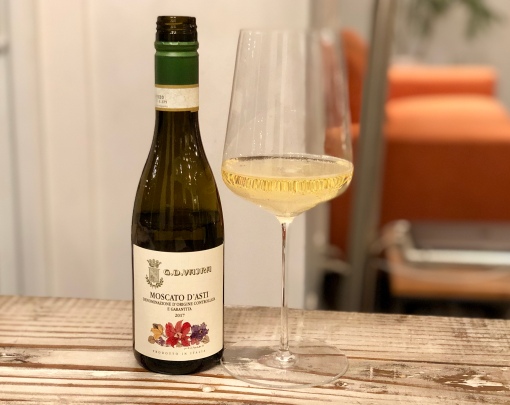
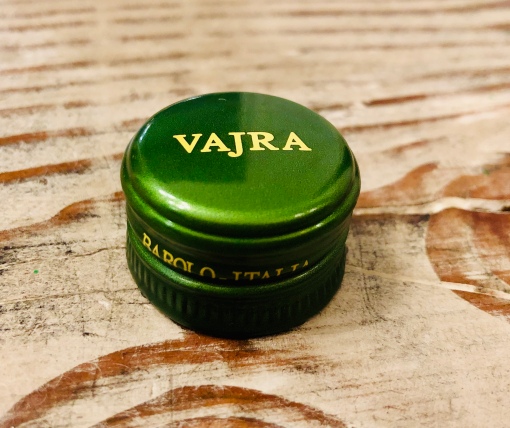
Once more into the breach, my friends, and on Day 5 of Advent 2018, once more into the bag of Advent 2017 synonyms:  a Moscato d’Asti from a strong producer, much like last year’s Day 10.  That wine (I maintain to this day) struggled with some bottle condition issues, and I am happy to say that this one is clean as a whistle and full of youthful spirit. It is the 2017 G.D Vajra Moscato d’Asti, and spawns stories of history, of production method, of flavour.  Which to tell first?

IMG_9367

Let’s start from the start, I suppose…which it turns out is much more recent than I expected.  Despite its highly traditional-seeming name and labelling, G.D Vajra is barely 45 years old, a complete baby by the standards of Barolo, founded in 1972 (albeit from family vineyards from a couple decades earlier) with its first commercial vintage not released until 1978.  It is named after founder Aldo Vajra’s father and was started because, in Fresh Prince of Bel-Air style, Aldo participated in a student protest revolt in the city where he lived at age 15 and was thereafter immediately sent out to the Barolo countryside to live with his grandfather on a farm for the summer, away from the sway of proletariat rebellion.  That summer in Barolo (as it likely would for all of us) triggered a deep and abiding passion for wine, which ultimately resulted in the bottle here before us.  One little fight and his mom got scared…

IMG_9369

My favourite thing about Moscato d’Asti, apart from its dangerous low-alcohol crushability, is the trivia behind how it’s made.  It is one of the few types of sparkling (or frizzante, in this case – lightly sparkling) wines that do not go through two fermentations:  one to vinify a dry base wine, the other to re-ferment that wine with additional yeast and sugar to create the bubbles.  Instead, it combines both processes into one through a highly ingenious process called the Asti method.  Fermentation begins as per usual, but in a pressurized steel tank that is sealed off from air partway through the process, with the result that the carbon dioxide that is a fermentation byproduct cannot escape the tank and is trapped in the wine.  Then, when the half-bubbly wine is still quite sweet and considerable amounts of yeast and sugar remain that would normally continue to make sweet magic and craft a higher-alcohol dry wine, the tank and the wine inside are chilled to near-freezing to halt fermentation (yeast don’t like cold much).  The yeast is then filtered out of the tank while it is still under pressure (so that fermentation with the remaining sugar does not continue when the wine warms back up) and the wine is bottled under pressure — only lightly bubbly, at 5-6% alcohol and with a bunch of residual sugar.  Brilliant.

IMG_8726

Stelvin Rating:  8/10 (That green is just beautiful, especially in person, and the powdery sheen works.)

This particular Moscato hails from a single vineyard in the perfectly named commune of Mango, located on a steep slope at elevation in the Moscato d’Asti region.  It is a gleeful tropical fruit salad on the nose:  mango (of course), kiwi, canned oranges and pears, banana leaf, star fruit, and onward down the orchard Rolodex, spiked with gobs of potpourri and spring flowers and chemically Alka Seltzer and city pool chlorine.  Lush and quite notably sweet, even for Moscato standards, it is lent a sense of airiness due to its sloshy frizzy bubbles, which are not quite as penetrating or scouring as you might anticipate, a product of the not-quite-sparkling frizzante fermentation process (which is also why this can be bottled in a normal bottle and closure as opposed to a thicker Champagne-style bottle — it’s under a lot less pressure).  All I can taste is pineapple Life Savers, cream soda and every single flavour of Gummy Worm on overdrive.  The finish is slightly cloying, thanks to acid that doesn’t quite stretch all the way to the end of the line and can’t quite balance out the Moscato’s immense sweetness.

As a beverage, this is freaking delicious.  It took no time at all for the entire half-bottle to disappear.  As a wine, I wouldn’t rank it among the top Moscatos I’ve had because the rest of the wine can’t quite keep up with the sugar levels, leading to things getting a little bit flouncy.  But it’s hard to be too unhappy after a couple glasses of Moscato.

87 points