Calgary Wine Life: Technical Tasting with Barolo’s Claudio Viberti

26 05 2019

By Raymond Lamontagne

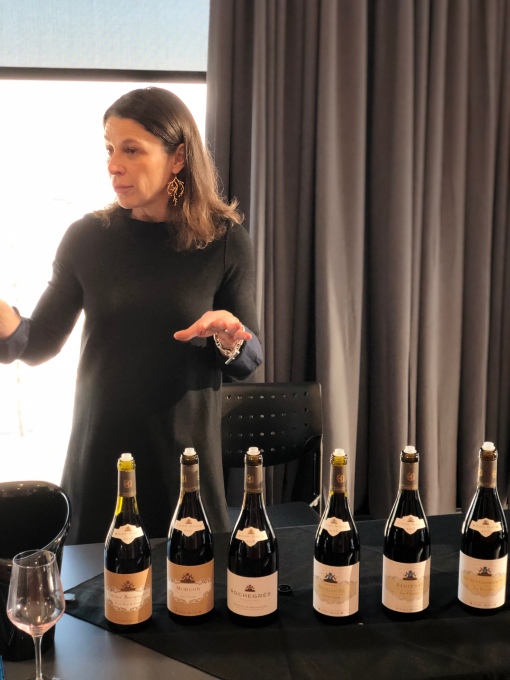
It all began when Cavalier Antonio Viberti purchased a restaurant, the Locanda del Buon Padre. In 1923, Antonio decided to start making wine in the basement, as many do in this region. The original intent was to keep things simple and just sell the wine to patrons in the restaurant. Well, Antonio’s son Giovanni had other ideas. Things began to expand. Eventually cement tanks for fermentation were installed, and in 1955 wines were sold in nearby markets for the first time. By the 1970s the operation had become a full scale winery, even if the family never forgot their roots as restauranteurs. Giovanni’s son Claudio Viberti, who was our host at this past week’s tasting event at Willow Park Wines & Spirits, took over management of winery and restaurant operations in 2008. He hasn’t looked back since. The man is a dynamo.
IMG_0684

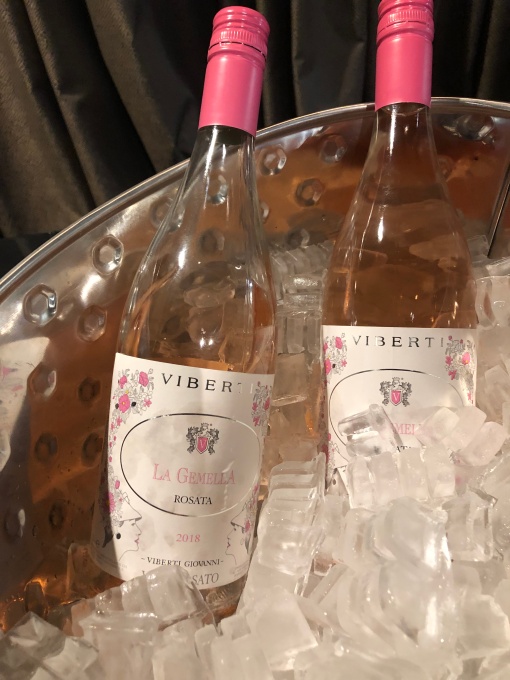
Claudio tells a few of us early birds the story behind the rosé served before the beginning of the formal proceedings. First off, and much to our surprise, this rosé is 100% Nebbiolo. Secondly, the wine is made first as a white wine from Nebbiolo juice obtained via an extremely gentle press. Claudio also makes a small amount of red wine from the same batch, using this to fix the colour of the end product. No combined maceration on the skins was involved, à la pink Champagne. I start scribbling notes. This is dry as a bone but does yield a subtle candied character, with the robust illusion of a sweet finish after a rather dense midpalate. Fairy-like whispers of strawberry, raspberry leaf, and nectarine flit about a more solid core of Parmesan cheese and those pink wintergreen mints, a rather burly rosé with a shimmering coppery finish. This is a rare wine but seems unlikely to remain so. Read the rest of this entry »




The Patient Vintner: Bodega y Cavas de Weinert

24 05 2019

By Peter Vetsch

[These bottles were provided as samples for review purposes.]

If I was to tell you that I was drinking the current release of a mid-tier offering from a well-regarded producer and from a name region, made from 70-110 year-old vines, and that the vintage date on the bottle was 2006, what would you guess the region was?  Rioja – maybe a Reserva offering from a traditional-minded producer?  Champagne, if you are extremely liberal with your definition of “mid-tier”?  Somewhere in Italy?  Portugal?  You would probably be most of the way through the global wine region Rolodex before you landed on Mendoza, Argentina, and once you did, you would probably immediately discard the possibility, knowing this to be the heart of bold, fruity, approachable Malbecs that are released and enjoyed in their youth.  Bodega y Cavas de Weinert, and its current-inventory $25 old-vine 2006 Malbec, will cause you to re-evaluate all of your presumptions; they are an anachronism in all the best ways.

IMG_0079

This classical estate actually has a rather recent history:  the winery dates back to 1890, but its current identity was tied to its acquisition by Brazilian Bernardo Weinert in 1975. Swiss winemaker Hubert Webber has been at the helm since 1996, when he was ensconced at the ripe old age of 27; his mission has been to craft wines from Malbec, Cabernet Sauvignon and Merlot wines that avoid early showmanship and start to reveal themselves after a decade or more, as it is only then that the Bodega will release them to market.  Lengthy barrel aging (up to 5-6 years in large oak foudres in Weinert’s cool granite cellars), then further time in bottle pre-release, is the estate’s hallmark — Weinert follows the old-school Spanish model of only allowing his wines into the public sphere when they are deemed ready to drink, whether or not this follows the standard chronological vintage release playbook.  In other words, don’t necessarily assume that the 2007 will follow the 2006 as the next wine on the shelf.

IMG_0085

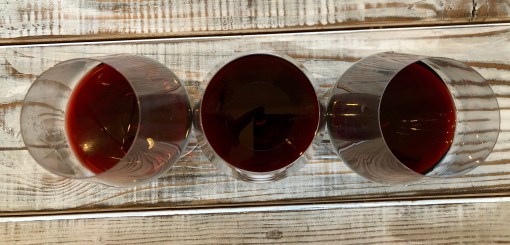
The relatively modest prices of the finished wines might be reflective of advantageous land and labour costs in Argentina, but they are not the result of any lack of care in the vineyard:  Weinert’s vineyards, located in Mendoza’s top subregion of Lujan de Cuyo, feature largely ungrafted own-rooted vines that are a minimum of 25 years old and are exclusively hand-harvested.  Fermentation takes place in cement tanks, and Weinert’s cellar boasts both the largest barrel in Argentina (44,000 L) and the oldest barrel in the world, each of which are a reminder that the goal of the Weinert wines’ extended time in barrel is not wood flavour transference (which increases the newer and smaller the barrel is), but gentle, lightly oxidative maturation.  I had the opportunity to taste a trio of Weinert offerings, all 12-13 years old (as is par for the course in this particular corner of Mendoza), to explore this wholly unique take on Argentinian viniculture.  Malbec first, as always. Read the rest of this entry »


Calgary Wine Life: Blaufrankisch Masterclass with Georg Prieler of Weingut Prieler

1 05 2019

By Raymond Lamontagne and Peter Vetsch

Austria is renowned for the fruit purity and fine minerality of its wines, and Blaufrankisch is the premier black grape of the region. Grown across Central Europe and going by various monikers (the wonderful “Kekfrankos” in Hungary, and the more prosaic “Lemberger” in Germany), Blaufrankisch is an early-budding, late-ripening variety sometimes dubbed the “Pinot Noir of the East”; its elegance and dexterity earns it that nickname, but its hallmark savoury mineral wildness forges an identity all its own.  Some grapes such as Cabernet Sauvignon or Campania’s Aglianico are said to swamp or overshadow terroir with their sheer varietal character, while others are more protean and can serve as a lens through which the story of their soils and site and climate are reflected.  Blaufrankisch falls firmly into the latter camp, although through its various land-driven expressions one can commonly find dark berry aromas and flavours, vibrant acidity, a pronounced spiciness and that “other” wild rocky character that can set this grape apart.  We were extremely excited to do a specialized tasting of this varietal with Georg Prieler, owner and winemaker of Burgenland’s Weingut Prieler, a dynamic, charismatic, insightful winemaker who carries his family’s history with aplomb…and who might just make the best Pinot Blanc in the world.

IMG_9979

Georg Prieler, Weingut Prieler

Yes, Pinot Blanc. We both first came to know this producer by being absolutely floored by how stunning and utterly fascinating Weingut Prieler’s Pinot Blancs can be.  This particular grape rarely wins this sort of accolade and is often considered a paler, strait-laced shadow of Chardonnay, never fully given the opportunity to take a star turn in any region…except, as it turns out, in Burgenland, where Prieler exalts it among whites and where Georg calls it “the Riesling of the Burgundy varieties”.  That got our Riesling-loving attention, and Prieler’s single-vineyard Pinot Blanc which capped off our tasting held it,  transfixed.

IMG_0576

All that said, Pinot Blanc remains both the winery’s and the region’s “second most important” variety, according to Georg, as nothing in Burgenland knocks Blaufrankisch off its throne. Georg himself hails from (and still lives in) the village of Schützen am Gebirge, population ~1500, known for steely Pinot Blanc but also the sublime Goldberg vineyard, where Blaufrankisch might reach its pinnacle.  He closely oversees operations in both vineyard and winery, inheritor of a legacy that runs from his grandfather to father to sister and now, as of 2011, to Georg himself.  The family’s time in the vineyards predates their work in the cellar — the Prielers have been planting and tending grapes in Burgenland for 150 years, which perhaps is what leads Georg to immediately describe himself as “just a farmer who takes planes and drinks wine”.  After his inaugural visit to Calgary, and with the voice of his wines preceding him, it’s clear that this particular travelling farmer has a global reach. Read the rest of this entry »


Ripasso and Appassimento in Niagara: A Virtual Tasting with Barclay Robinson, Winemaker at The Foreign Affair

15 04 2019

By Raymond Lamontagne

As a wine lover, I often feel I am walking a tightrope of sorts between appreciation of bare-bones, terroir-driven wines of place on the one hand, and esoteric, funky winemaking techniques on the other. My allegiance gravitates implicitly to the former camp, populated by relatively pure expressions of soil and grape variety that eschew the muddying effects of various vinification tricks of the trade. Then again, I can be a sucker for the weird, particularly if there is true intent behind the decision to use a particular cellar technique: the careful realization of a particular vinous vision can be every bit as compelling as what results from a more hands-off approach. It turns out that in some cases, particular techniques are the tradition. And traditions, like other aspects of culture, are meant to be shared, applied to new contexts, and ultimately celebrated.

IMG_0437

Enter Barclay Robinson, winemaker at Ontario producer The Foreign Affair, who recently shared the story and results behind some of these techniques and traditions in a personal virtual tasting.  This was a lot of fun, Barclay being exactly the sort of guy I like tasting with: erudite yet down to earth, funny yet quick to impart knowledge. The winery, situated in the Vineland area of the Niagara Peninsula, is completely unique in the Canadian context. Founders Len and Marisa Crispino lived as expats in Italy, where they fell in love with the Amarone wines of Valpolicella. These burly concoctions are made using the the appassimento process, in which the grapes are dried after harvest for to up to 6 months, typically resting on bamboo racks or straw mats, or alternatively strung up from the ceiling where air can circulate and work its dehydrating magic. These raisined grapes provide a very concentrated must (the juice to which yeast is added after crushing to make wine), which makes fermenting the resulting wine to total dryness quite a challenge. I have grown to appreciate Amarone over the last year or so, although its combination of high alcohol, intense flavour concentration, and a unique nut-like bitterness can be polarizing. The Crispinos decided to bring this winemaking approach to Ontario, albeit using the Bordeaux varietals known to do well in the Niagara Peninsula (alas, Niagara Corvina is not a thing at this juncture). Read the rest of this entry »


Calgary Wine Life: Taylor Fladgate 1969 Single Harvest Port Release

8 03 2019

By Peter Vetsch

“All wine would be Port if it could.”

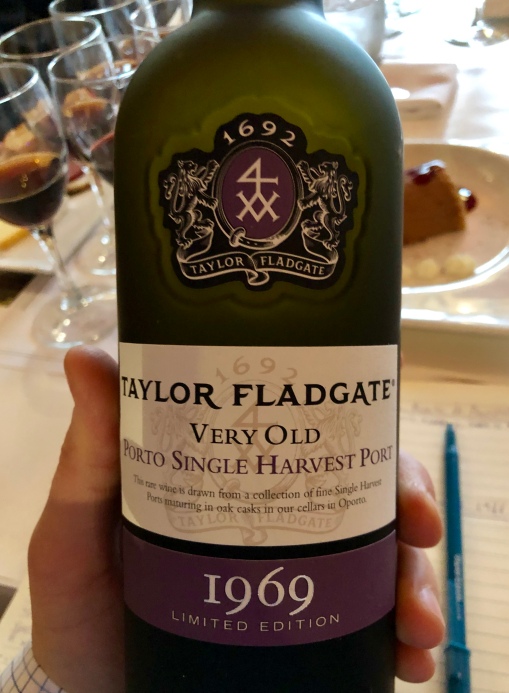
And with that, Cynthia Opsal, Brand Manager for The Fladgate Partnership at Pacific Wine & Spirits, kicked off this year’s rendition of one of my favourite annual tastings in the Calgary wine calendar, perhaps the only one to have now been blogged four separate times on this site.  On a quiet Thursday afternoon in Calgary, a small group of us became the first people in Canada to taste Taylor Fladgate’s most recent 50 year-old Port release, the 1969 Very Old Single Harvest Port.  It was worth the half-century wait.

IMG_9834

I’ll back up.  Taylor Fladgate was founded in 1692, is now 327 years old, and is still being run by the same family that started it all, whose holdings have since expanded to include three other legendary Port houses.  In 1998, The Fladgate Partnership acquired Fonseca, whose winemaker David Guimaraens now crafts the Ports of all of the houses, and in 2001 it acquired Croft, the oldest active Port producer in the world (now 431 years old and counting).  The last acquisition was Wiese & Krohn, a relative baby compared to the others, having only been founded 154 years ago in 1865, but possessed of considerable cellar stocks of Tawny Port dating back decades.  This fact was particularly relevant for Fladgate’s desire to go beyond the standard 10, 20, 30 and 40 Year Tawny Port designations and create a novel 50 Year Port.  It is likely not coincidental that the Krohn purchase came in 2013 and the initial 50 Year release followed a year later.

IMG_9833Of course, wine laws being what they are and no story being remotely as interesting without some twists and turns, it wasn’t as easy as just slapping a “50 Year Tawny” label on a blended Tawny whose average wine age hit the half-century number.  This designation did not and does not exist — there is no permitted vintage-blended aged Tawny Port designation above 40 Year.  Presumably Portuguese wine lobbying is not a productive pursuit.  So what to do?  There is a separate recognized class of Tawny called a Colheita (“kohl-YAY-ta”) Port:  a Tawny Port whose constituent wines were all harvested in the same single vintage, effectively a Vintage Port that is oxidatively aged like a Tawny instead of being bottled early.  Other than a requirement that Colheitas have to spend at least 7 years in barrel, there was no other limit on how old a Colheita could be and when it had to be bottled, so as long as The Fladgate Partnership had access to enough back-vintage Tawny to bottle a batch for each successive vintage (which they now did), their 50 Year dream could be realized.
The first Taylor Fladgate Very Old Single Harvest Port was the 1964, released in 2014.  We are now on year five of the program and the inaugural release of the 1969, a wine which almost didn’t come to be due to the significant challenges associated with the vintage (any rough edges of which seem to have been smoothed away by fortification and 50 years to relax in barrel).  We began the afternoon tasting Single Quinta Vintage Ports from the crown-jewel vineyards of each of the Partnership’s main three houses, and ended off with a running four-year vertical of the most recent Very Old Single Harvest releases, which I almost immediately realized were the four prior releases that PnP has covered, putting me face to face with my own history as well as that of the estates in the glass. Read the rest of this entry »


Yalumba: Coonawarra Cabernet Classes

28 02 2019

[These wines were provided as samples for review purposes.]

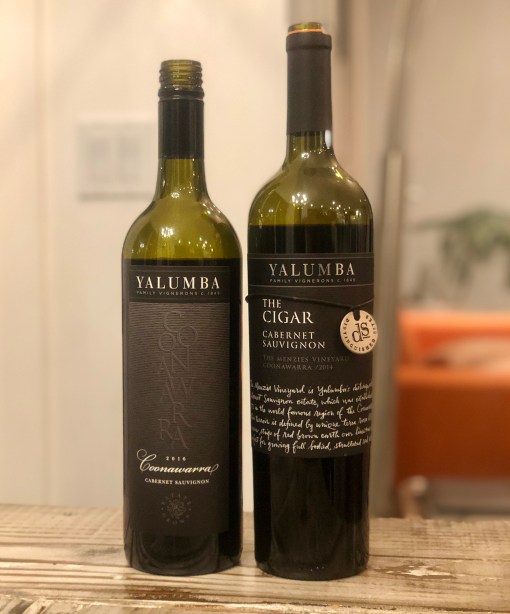
Tonight’s bottle duet replicates one of the most common questions that plagues burgeoning wine consumers:  when it is worth it to jump a tier?  If you’ve tasted and enjoyed the entry-level offering from a given producer, should you invest the extra few bucks to try their next level up?  Will you get more in return, enough more to justify the additional expense?  Value judgments and personal preference are always at least somewhat subjective, but objectively, when you move from a winery’s starter bottle to the next level up, and when you pay more for that privilege, it’s often because you’re getting one or more of:  (1) better, more consistent, more carefully sorted grapes, (2) better vineyard sources, or older vines from within the same vineyard, (3) more estate fruit grown by the producer itself, (4) better (or at least more expensive) winemaking and maturation practices, including more time aging in oak barrels (my legal career confirms that, in some ways at least, time is in fact money), and/or (5) better lots, blends or barrels from the results of the winemaking process.  You can see the similarities in style, region and approach common to the producer between the entry-level or next-level bottles, but in theory at least, due in part to the factors above, you should see some elevation in quality and product as you climb the hierarchy.

IMG_9778

That isn’t to say that pricier is always better; diminishing returns are real in the world of wine, particularly when you enter the realm of luxury wines that cannot hope to deliver the value per dollar of their earthbound affiliates.  But in my experience, the price jump from the cheapest offering of a given brand to its next level up almost always pays off in quality; the patience and precision and commitment required to make truly good wine can be strained when you’re also trying to keep below a $20 price tag, and even the slightest bit of economic leeway can make a massive difference.  Neither of tonight’s offerings fall fully into the entry-level category, but they represent the first and second rungs of Yalumba’s Coonawarra Cab quality tiers, so they will serve nicely to illustrate the considerations that go into whether to make the jump. Read the rest of this entry »


Spain, Old and New, Part II: The Wines of Imperial

14 02 2019

By Peter Vetsch

[These bottles were provided as samples for review purposes.]

This is a belated sequel to my introductory post from last November about the marvellous wines and history of Cune, the Riojan benchmark producer melding the traditional and the modern into perfect balance.  Since that post predated Wine Advent and then Vinebox, it’s about 40 posts back on the PnP timeline, and even though it’s only 3 months old it feels like 30.  Perhaps it has aged enough then to allow to slip in a slight correction.  I mentioned way back in 2018 that the Cune brand was made up of 3 different physical wineries and brands, each with their own winemaker:  Cune itself, Vina Real and Contino.  I also mentioned that the Cune brand “also encompasses the higher-level Imperial bottlings, made only in very good years”.  This is ALMOST entirely true:  the wines of Imperial have been made since 1920, only in great vintages, using Cune’s oldest vineyards in Rioja Alta and selected nearby old-vine sites.  Imperial is also still made by Cune’s winemaker, although the label only releases a Reserva and a Gran Reserva red wine, leaving the Crianzas and the whites to the others.  However, further research reveals that, as of 2005, Imperial has its own separate winemaking premises on the Cune property, as outlined in this highly confusing official graphic; it is now a winery-within-a-winery, its own bricks-and-mortar space.  The 3 Cune wineries are actually 4.

IMG_9719

Imperial is a focused and quality-driven enterprise, producing around 200,000 bottles in the vintages good enough to merit its creation, in contrast to Cune’s 5 million.  As of 2004, all fermentations now take place in new oak barrels, as a back-to-the-future nod to history — the Imperials of the pre-1940s were all produced in this fashion, and after decades of dalliances with first concrete, then steel, Cune made the very Riojan determination that sometimes the old ways really are best and went back to its roots.  The winery name comes from a unique historical bottling release for the UK market, the “Imperial pint” size (which is roughly 500mL, a highly underrated and remarkably useful size for a bottle of wine that we should see more of nowadays).  The Imperial brand made more recent history when its 2004 Gran Reserva, an utterly spectacular wine that it pains me to say I have no more of, was named the Wine Spectator Wine Of The Year in 2013, the first such global pinnacle designation for a Spanish wine.  If you ever have the chance to acquaint yourself with the Imperial lineup, do not hesitate.  The current releases continue to showcase the magnificent pedigree of the estate. Read the rest of this entry »


Calgary Wine Life: A Field Guide to the Wines of Albert Bichot

10 02 2019

By Raymond Lamontagne

Peter has kicked off the 2019 blogging campaign in style, with an intriguing comparison of wine preservation methods that will make a significant contribution to the annals of Pop & Pour science. And me? Well, I’m back doing one of the things I do most frequently on this blog: covering a tasting. This one was a casual drop-in scenario, bypassing the formal sit-down presentation, and on this date that was just fine by me. The frigid weather has left me irascible and more than a little crabby. Fortunately, we’ve got a prescription for those blues… and its not more cowbell. It is glorious, glorious Burgundy.

IMG_0110

I’ve mentioned my love affair with Burgundy (and Pinot Noir more generally) enough times on PnP, so I won’t belabour the point here. I had not tried any wines from Albert Bichot before, but I was promptly faced with 15 (!) of them, in a carefully curated sequence of whites and reds, from Chablis to Grand Cru, complete with a bonus round detour into Beaujolais Cru territory. Fifteen! I was titillated and daunted in approximately equal measure. How the hell is a guy supposed to keep these all straight, what with the small pours, limited analysis time, and numerous distractions around the table? I like to meditate on a half-bottle or more, savouring and seeing how the wine develops over time, as one’s palate habituates to the initial impressions. This is another kettle of fish entirely, with a pace more like Whac-A-Mole than a game of chess, although I do have my tricks, particularly a powerful secret weapon: “Beginner’s mind”. This is an application of mindfulness, where one deliberately pays attention to the present moment, concentrating the attention into a laser beam focused only on the wine in the glass, and then seeing what associations are dredged up. With beginner’s mind, you explicitly adopt a form of make-believe in which you imagine that the liquid in the glass is foreign, entirely novel, never before encountered, and see what this clean slate provides. Might sound hokey, but give it a try during a tasting. It’s like a palate cleanser for the brain. All this aside, I will not take much credit for the fact that I WAS ultimately able to keep all these wines distinct in my mind’s eye. This was more testament to the artistry of the 6th generation producer Domaines Albert Bichot. Read the rest of this entry »


12 Days of Vinebox: Day 12

5 01 2019

By Peter Vetsch

Well, we’ve done it:  scaled the top of a 24-day Advent mountain, and without pausing for breath, immediately continued up to the summit of the second 12-day Vinebox mountain perched directly on top of it.  36 straight days of blogging later, here we are, weary and satisfied and very ready not to write about any goddamned thing tomorrow.  And we end the 12 Days of Vinebox with the wine that maybe surprised me the most in the lineup, not because there’s anything particularly weird about it (although in this age of wine weird-offs marked by escalating departures from the norm, maybe strait-laced in-its-lane Left Bank Bordeaux qualifies as odd in a post-hipster-irony sort of way), but because it appears to be a library offering.  This 2011 Chateau Hourbanon Medoc is easily the oldest wine in our set of test tubes, proving that even back-vintage wines can be relocated and settle peacefully in their new skinny Vinebox homes.

IMG_9584

I gently chided Vinebox yesterday for not supplying much information along with their wines, but tonight’s offering solves that problem itself by way of an information-packed, if insanely disorganized, producer website, wherein the current proprietor of Chateau Hourbanon tells you absolutely everything you would want to know about the history and current philosophy of the estate in nine different potential languages.  I find this sheer earnest desire to share and educate highly welcoming.  Thanks to this glorious fount of information, I can advise that Chateau Hourbanon has long been highly regarded — it was classified as a Cru Bourgeois (or its pre-official predecessor) back in the 19th century — but the subsequent 100 years were not as kind to it, and when reformed dentist Remi Delayat purchased it in 1974 it was all but abandoned, its winery buildings in complete disrepair.  Delayat made it his personal mission to rehabilitate the estate, and after his premature death in 1981 his widow Nicole carried on the quest, followed by  their son, current proprietor and website content-master Hugh, who now manages the estate’s 13 hectares of vines.  In the current more formalistic classification of the Cru Bourgeois wineries, Chateau Hourbanon’s name remains on the list. Read the rest of this entry »


12 Days of Vinebox: Day 11

4 01 2019

By Peter Vetsch

It’s the penultimate day of the Vinebox 12 Days of Christmas calendar, and while Christmas feels like a long time ago, there’s never a bad time to use the word “penultimate” when you have an occasion in need of its natural meaning.  Thanks to the outcome of the one-by-one Vinebox vial draft that I had with Ray, I ended up with the last two days of this miniature vinous adventure, and I certainly sat up and took notice when I pulled a 100 mL test tube of Chateauneuf-du-freaking-Pape out of the box and knew that it had to be mine.  When Vinebox says that they quality-control like crazy and look to represent the best in their sets, it’s not just marketing talk; the level of the wines across this dozen tastes has been consistently legit.

IMG_9573

Where I might give Vinebox a bit of constructive feedback is in the relatively slim amount of information that comes along with each vial.  The Vinebox reveal website for this calendar (which I might as well give you now that it’s the penultimate day of our countdown — see how useful and awesome that word is??) tells me only that tonight’s wine is the “Graveirette Chateauneuf de Pape”; the label of the tube adds that this is the 2014 rendition of this wine.  As the current vintage of this Chateauneuf is the 2015, and as it is not a widely known producer or wine in this market, it is next to impossible to track down any information about this specific bottle, which can be exceedingly frustrating when you’re the Type A kind of person who wants to know these things but can’t find them.  If future reveal sites could at least include the vintage, blend, vineyard details and winemaking and aging regime for the wines, it would be of tremendous assistance in bringing crucial context to the sensory impressions that this wine has in spades.

IMG_9575

Here’s what I can tell you:  Domaine de la Graveirette was founded in 2005 by Julien Mus, a native of the small southern Rhone village of Bédarrides, located in between Orange and Avignon in the Chateauneuf-du-Pape appellation, immediately east of the famed new castle of the Pope itself.  Mus was a relative rarity in that he left home to pursue a formal wine education in Beaune, Burgundy, and was perhaps even more rare in that, after said certified advancement of his profession, he came back to his very same tiny hometown to work, first growing grapes which he sold to the local cooperative, but then in 2005 founding his own estate that would allow him to forge his own winemaking path.  This estate, Graveirette, has been organically farmed since 2012 and Demeter-certified biodynamic since 2015.  Under the Graveirette name, Mus makes everything from prestige-cuvee CNDP to experimental micro-vat offerings (100% Marselan, anyone? I’m in) that are intentionally downgraded to the Vin de France designation to allow for creativity and flexibility in how the finished product comes about, freed from restrictive appellation legalities. Read the rest of this entry »


12 Days of Vinebox: Day 10

3 01 2019

By Raymond Lamontagne

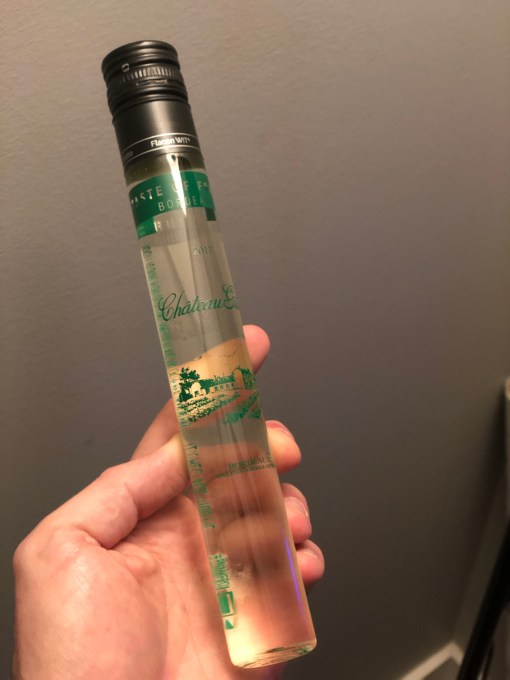
My final vial of this inaugural Canadian Vinebox run hails from a producer with which I am familiar, at least in an academic sense: Chateau Gillet. The Nadau family has made Bordeaux wines for around 150 years. The Gillet vineyards fall smack dab on the limestone plateau that comprises the heart of Entre-Deux-Mers. Although Gillet makes red, rose, and white wines, the Entre-Deux-Mers region is best known for white Bordeaux. The area is vast, sandwiched between the Dordogne and Garonne Rivers (hence the name), and you will only see “Entre-Deux-Mers AOC” on white wines, with reds from this region labelled with the generic “Bordeaux AOC”. Confusingly, though, many producers of whites from the area now eschew the more specific regional appellation in favour of “Bordeaux Blanc AOC” or even just “Bordeaux AOC”, as is the case for the present vial. Ugh. According to Stephen Brook in his omnibus The Complete Bordeaux, there is little point in trying to navigate this morass of tedious bureaucracy and confusing regional laws. At least for today, I am inclined to agree. Suffice to say, Entre-Deux-Mers is too large and too flat to yield consistently great wines, although here and there are pockets of limestone that can elevate the grapes that comprise the typical white Bordeaux blend.

z2mrelk6sgibqjgo+jsmag

Chateau Gillet’s white consists of 60% Semillon and 40% Sauvignon Blanc from 25 year-old vines. This is rather “old school” at a time when more and more white Bordeaux is dominated by Sauvignon Blanc, presumably in an attempt to capitalize on the popularity of this grassy, tart varietal in the New World. Traditionally Semillon provides the body and some texture. Personally I am fond of this grape’s rather unique aromas, which can be reminiscent of fresh linens and other textiles, candle wax, and so-called “wet wool”. Although the best white Bordeaux typically sees oak, many entry-level bottlings from less prestigious appellations are made in a fresher style. Such is the case here, fermented and aged in stainless steel. It would seem that Vinebox and oak do not mix, eh? Have we had even one oaked wine in this thing?! Maybe Day 2. I wonder how strategic this state of affairs might be. Read the rest of this entry »


12 Days of Vinebox: Day 9

2 01 2019

By Peter Vetsch

Sicily update:  the streak is over!  Ask and ye shall receive.  After a rather bizarre run of three straight bottles in this dozen from Italy’s most prolific wine island, our request to the cosmos for variety has been granted with fervour, as we are off to the German-est (and thus potentially the best) part of France, Alsace…where, incidentally, my Vetsch family ancestors apparently hailed from five or six or seven generations ago.  Maybe that’s why I love Riesling so much.  Alsace is something of a mystery to me from a vinous perspective, because despite producing solidly priced and consistently high-quality wines, and despite being one of the few Old World locales to actually consider the casual-drinking consumer enough to place grape varietal names on their labels, the region is almost always a hard sell in our market.  Perhaps adopting the white wine focus, gothic scripts and tall fluted bottles from its German forefathers was not the best marketing decision after all.  But when the wine is in a test tube as opposed to a flute…now we’re talking.

IMG_9529

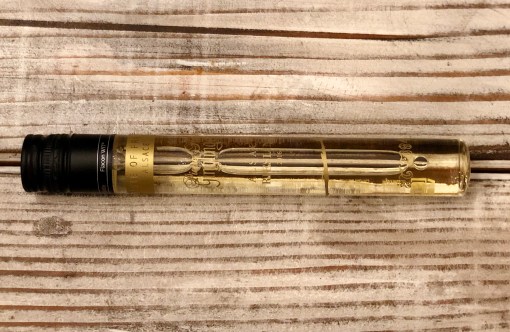
The non-Sicilian wine in question is the 2016 Pierre Henri Ginglinger Riesling, yet another Vinebox offering about which Internet information is strangely nigh-unavailable.  Maybe they are so eager to give you a surprise in the box that they have shut down all worldly sources of data about the bottlings they select.  Maybe their chosen producers have to sign the mother of all NDAs.  Either way, I speak of family estates and generational turnover with admiration quite a bit, but THIS…this is that on an absurd scale.  The Ginglinger family first planted vines in 1610, and generation number TWELVE is currently at the controls of the estate.  Come on.  Their winery building looks like something out of Hansel and Gretel, nestled in the centre of the medieval town of Eguisheim, which is closer to Freiburg in Germany than the Alsatian hub of Strasbourg and is the birthplace of wine in Alsace; the winery’s appearance may have something to do with the fact that it was built in 1684, trivia so good that it makes an appearance on not only Ginglinger’s bottles, but even its Vinebox vial:

IMG_9532

Read the rest of this entry »


12 Days of Vinebox: Day 8

1 01 2019

By Peter Vetsch

Happy New Year!!  As we leave 2018 behind and stride into 2019, I think Vinebox might find itself in the midst of a bit of a rut, in need of a New Year’s resolution or two.  You know when the record groove glitches and the same loop of sound plays again, over and over?  We may be within that repeating loop of time now.  If you have a seasonal collection of wine that is 12 bottles large, I would resist having any two bottles in a row come from the same place.  When you hit THREE identically situated bottles in a row, and when the locale in question is Sicily, I start to wonder a bit.  This is not a slight against Sicilian wine, which is often quite wonderful, but it is a query about whether it should make up the whole of Act 2 of the 12 Days of Christmas, particularly when the drinking audience for this set is likely in large part unfamiliar with it.  Add that all 3 of the bottles in question appear to be made by the same producer, and I start to yearn for a little more variety.

IMG_9502

All that said, sometimes the variety can be found within the produce of the winery itself. To be sure, the leaner whites from Days 6 and 7 don’t give me a lot of common ground from which to judge this CABERNET SAUVIGNON.  Sicilian Cab?  It is rare, but it exists, and here is allowed to stretch its legs in 100% pure-varietal form.  This is the 2017 Cantine Grosso Baldovino Cabernet Sauvignon, made from grapes grown in northeast Sicily, a highly friendly area for viticulture thanks to tons of sun, moderating ocean influence and mineral-laden soils.  This is been a home to cultivated grapes since Roman times but is just now being rediscovered by modern audiences.  Cantine Grosso is now five generations into its stewardship of Sicily’s long vinous history, having been founded way back in 1887.  Maybe 3 straight Vinebox days aren’t too many after all. Read the rest of this entry »


12 Days of Vinebox: Day 7

31 12 2018

By Raymond Lamontagne

Day 7 finds us sampling different wines from the same winery in close succession, presenting us with another native Sicilian grape, from the very same producer as Day 6. Or is it grapes, plural? What I’m glomming onto right away is the name “Inzolia Catarratto” on the vial. “Inzolia” is reminiscent of “Trebbiano”, in that this name actually refers to numerous white grape varieties that are in fact distinct. Most commonly this word is an incorrect but still commonly used moniker for Ansonica, a widely planted, golden-skinned, low acid Sicilian variety that has also made some inroads into Tuscany. Which brings us to Catarratto. This is another broadly planted Sicilian white grape, in this case in the high-acid camp. Yup, this is a 50-50 blend of Ansonica and Catarratto, two workhorses, presumably intended to capitalize on a balance between Inzolia’s relative bulk and Catarratto’s fresher edge.

LrNRCmklTLy11ri2KGTcAA

Ansonica is interesting in that it is so prevalent in the hot Sicilian climate despite being a low acid variety. On the plus side, it is drought-resistant. Turns out that Tuscany might be a better locale for it despite this grape’s Sicilian roots; in Sicily the wines tend to be citrusy and light-bodied, whereas in Tuscan island regions such as Elba the grape yields sturdier, richer wines that recall golden orchard fruits with a saline bite. In either case, Ansonica is also a rare example of a naturally tannic white grape. The name Catarratto (or Catarratto Bianco) means “waterfall”, which refers not to some pretty landscape feature but rather to the effusive quantities of wine this grape is capable of producing. Hoooo boy… When a grape name refers to a wine lake rather than some unique aspect of of its vinous personality, one has to wonder how it’s going to show in the glass. In any event, Ian D’Agata compares Catarratto to Chardonnay, stating that it can conjure up notes of savoury herbs, banana and butter. He also acknowledges that these conceits might have more to do with wine-making technique than they do with any innate characteristics of the grape itself (which, hey, actually does sound rather like Chardonnay). The technical sheet on the Feudo Solaria website reassures us that we can pair the wine with snapper, “with no fear of being banal”. Hmmm… Maybe there’s at least a little fear. Read the rest of this entry »


12 Days of Vinebox: Day 6

30 12 2018

By Raymond Lamontagne

We are halfway through Vinebox. And back in Italy, albeit this time in the deep south, Sicily. Like its more northerly counterpart Puglia, Sicily grows tremendous quantities of grapes, most of which go into “IGT Terre di Sicilia” or “Terre Siciliane IGP” commodity wines. The heat and relatively flat, fertile land lend themselves to mass production of fruit-forward, easy-drinking and (most importantly) cheap wines, beverages to enjoy without need for much in the way of weighty analysis. And this is all well and good. There is a place for plonk, I suppose. Fortunately though, Sicily is like most Italian wine regions in that it is also a storehouse of unique, fascinating native grape varieties as well as some interesting terroir. In fact, Italy on the whole has more indigenous grape varieties than any other wine-producing country. The good news for wine nerds is that this heritage is being increasingly nurtured, protected, and celebrated. Enter the present grape, Frappato.

aDSlLgLYQ72SXGxRRV1ukw

Frappato is a Sicilian native and apparently enjoys a parent-child relationship with Sangiovese (although the specific direction of this relationship remains unknown). The grape is known for rather low acidity/high pH, low levels of delicate, soft tannins, low sugars, and (you guessed it) relatively low levels of colour compounds. This grape of diminutives was once rare as a varietal, instead used as a softening component in blends with heftier grapes such as the better-known Nero d’Avola. Although Frappato is challenging in the vineyard, it is rather forgiving in the winery. Its reductive nature does require exposure to enough oxygen during fermentation to avoid the production of sulphurous off-odors (for example, by frequently pumping of the must over the cap, a technique which also aids extraction of what few colour compounds and tannins are present in the grape). The resulting wines are typically light, fresh, aromatic, and meant to be drunk young. “Don’t expect the colour of Merlot”, says one viticulturist quoted by Ian D’Agata in his book Native Wine Grapes of Italy. (By the way, if you are any sort of wine nerd who is at all intrigued by Italy, this book is essential reading.) Read the rest of this entry »