Calgary Wine Life: Cakebread Tasting with Dennis Cakebread

15 04 2015

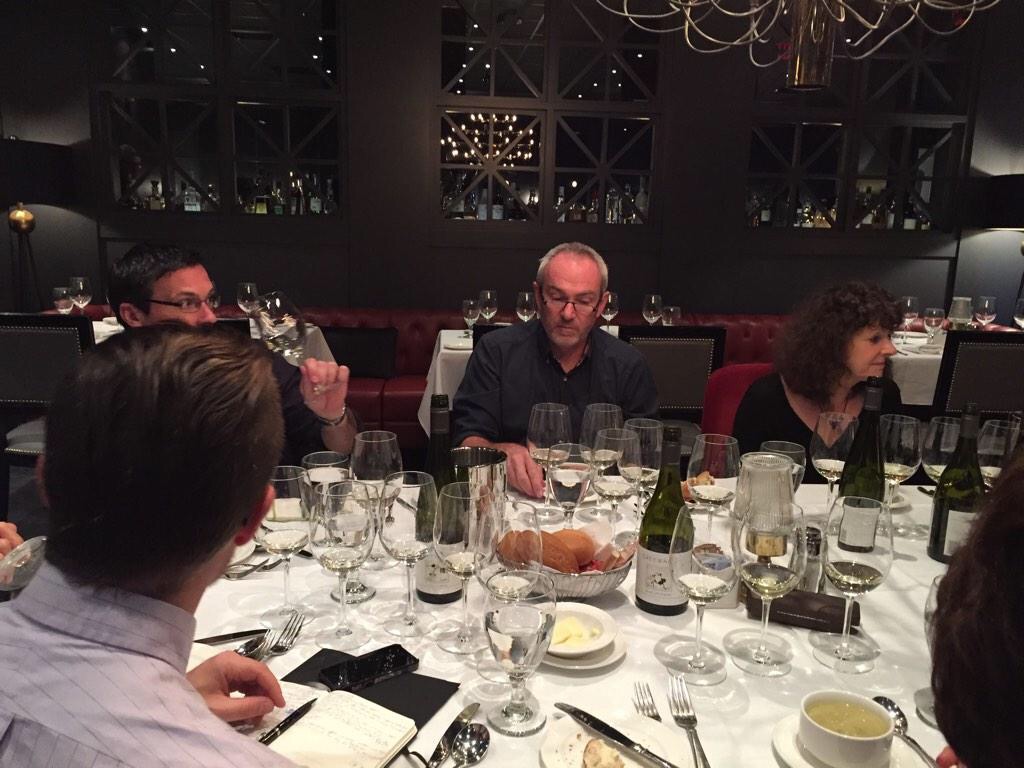
I have long held a soft spot for Cakebread Cellars wines, dating back to when my knowledge and interest in wine were in their infancy.  At the end of my articling year a decade ago, my co-workers and I were out at a nice dinner courteously paid for by our firm the night before we were to find out who would be hired back after articles.  There was suitably fancy wine to go with the upscale meal at our group’s aptly named Last Supper, but the only bottle I remember from that night came after dessert, when a couple wine-loving fellow students ordered a bottle of Cakebread Sauvignon Blanc to the table.  I know (now) that this isn’t Cakebread’s go-to grape or claim to fame, but it stopped me in my tracks.  I had never had a wine like it.  It was instantly memorable and made me understand how people could invest so much time, attention and money in the enjoyment of fine wine, which I have now spent the last ten years doing myself.  When I was in Napa a few years ago I made sure to stop by Cakebread (and have matching wine glasses at home to prove it), all because of that one bottle of Sauvignon Blanc.  So when I got invited a few weeks back to taste through a lineup of Cakebread’s wines with its VP and second-generation owner Dennis Cakebread, my wine life flashed in front of my eyes a little bit.  It was like coming full circle.

FullSizeRender-52

Read the rest of this entry »


FEL Wines: Pinot Showdown

11 01 2015

[These bottles were provided as samples for review purposes.]

Happy New Year!  I took a bit of a holiday blogging break after 24 straight days of whisky-induced Advent madness in December, but I always had it in my mind to start up 2015 (and return to actually producing wine-related content on this wine blog) with these two bottles of California glory.  Although they come from what might technically be considered a new producer, their roots and history are inextricably linked to a California stalwart…and, as it turns out, to my home province of Alberta too.

Great wines, plus new wine glasses - to be the subject of a separate post.

Great wines, plus new wine glasses – to be the subject of a separate post.

FEL Wines came into being less than a year ago, in March 2014.  It is the brainchild of Cliff Lede, whose eponymous Napa Sauvignon Blanc helped renew my faith in the grape a month ago.  Lede is well known for creating those rarest of beasts, Napa Valley value wines, and he’s also a born-and-raised Albertan who is well known outside of the wine world as one of the owners and senior executives of the Ledcor Group, which was founded by his father (how the construction lawyer in me failed to mention that in the last review is beyond me).  FEL represents Lede’s foray outside of Napa’s welcoming confines and into the cooler climate areas of California, and it also seems to be underlaid by a personal passion:  FEL is so named for Cliff’s mother Francis Elsie Lede, who helped kindle his love of wine as a child. Read the rest of this entry »


Calgary Wine Life: Greywacke Tasting with Kevin Judd

7 10 2014

Kevin Judd is a New Zealand visionary, a trailblazer who has left a permanent imprint on the nation’s young wine culture.  As the founding winemaker of Cloudy Bay, now the near-ubiquitous signpost for the sharp, tangy, herbal style of Sauvignon Blanc that is instantly recognizable in the glass, Judd pioneered a flavour profile for New Zealand’s signature grape that put the country on the world wine map.  He helmed the ship at Cloudy Bay for 25 years, taking it from an unknown producer in an anonymous wine nation to a whirlwind New World phenomenon, the crown jewel of a Sauvignon Blanc revolution that saw millions of bottles fly off the shelves.

IMG_2063

After Cloudy Bay was sold to luxury brand behemoth LVMH (whose wine portfolio includes such luminaries as Krug, Dom Perignon, Chateau d’Yquem and Cheval Blanc, upper-crusters all), Judd finally realized a lifelong dream of starting his own label and making wines in a manner that best suited his palate:  riper batches of fruit, slightly softer acid, yet retaining all of the structure and complexity that a cooler climate can provide.  He called the new venture Greywacke, a name he had quietly reserved 15 years earlier while waiting for his opportunity:  the word (pronounced “grey-wacky”) refers to the grey sandstone rocks that are commonly strewn across New Zealand’s vineyards.

Read the rest of this entry »


Wine Review: 2010 Mission Hill Martin’s Lane Pinot Noir

22 08 2012

[This bottle was provided as a sample for review purposes.]

As aptly pointed out by my 19 month old son: P!!!

It was with great sadness that I uncorked (OK, unscrewed) the last of the sample bottles that the Okanagan’s Mission Hill winery had sent my way.  When MH sent me their small-batch limited edition Martin’s Lane Riesling a few weeks ago, they included with it the Riesling’s vineyard twin, the inaugural release of the Martin’s Lane Pinot Noir.  This bottle of Pinot was many years in the making (the vineyard was planted in 1995), but MH held back on releasing it as a single-vineyard offering until the vines and the grapes were fully ready to show their stuff.  I laid out the story behind Martin’s Lane in my Riesling review, but to quickly recap, it’s a high-quality, steeply-sloped vineyard located right by Mission Hill’s winery property just outside of Kelowna, and it’s named as a tribute to MH proprietor Anthony von Mandl’s late father Martin.  Only 485 cases of this Pinot were produced, and this is the first bottle I’ve seen in this province, so unless you live near the winery, this bottle is probably hard to come by.  All the more reason to enjoy it if you have it! Read the rest of this entry »


The Mission Hill Pinot Olympics

17 07 2012

[The bottles below were provided as samples for review purposes.]

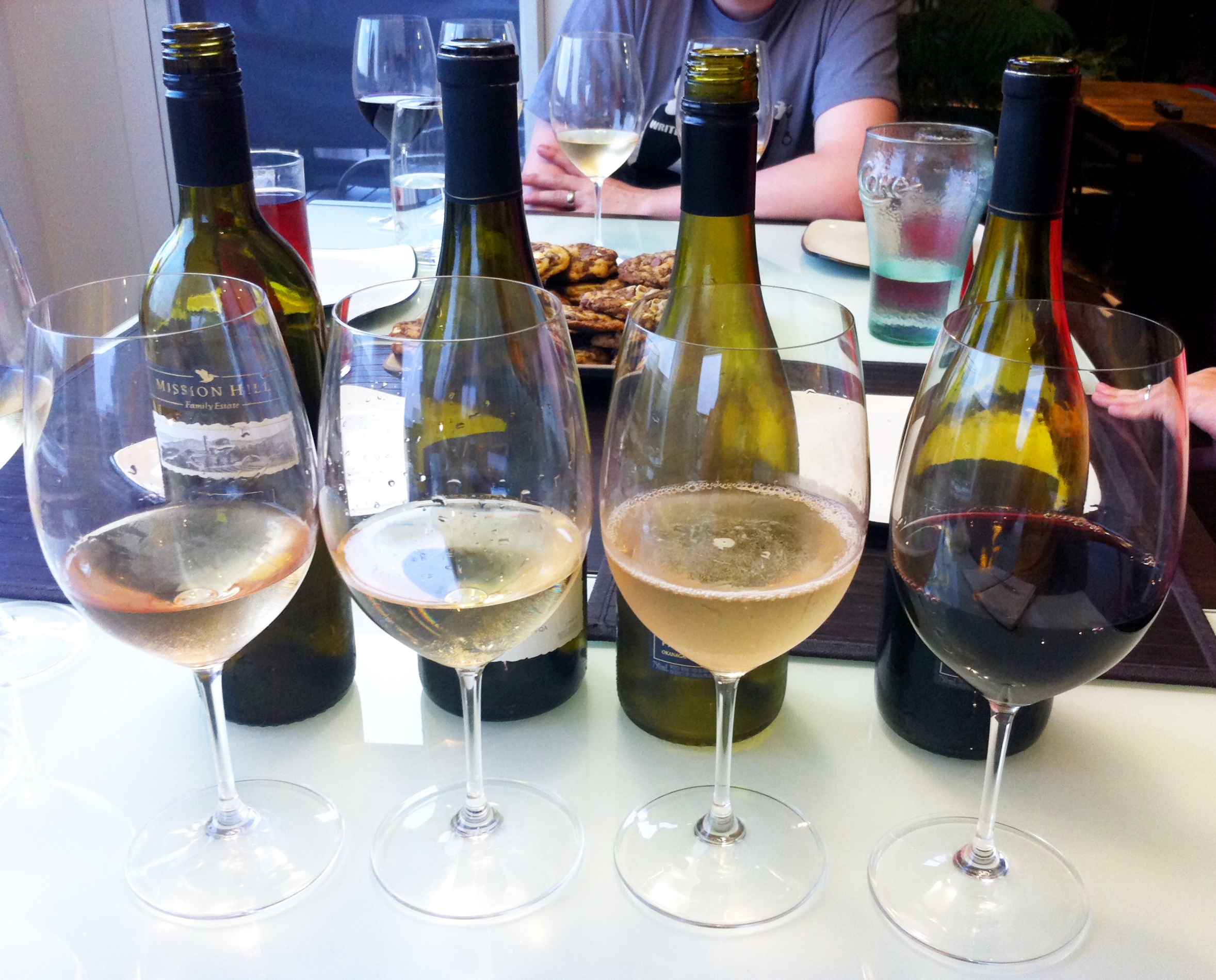
As tactfully mentioned by the disclaimer above, I recently received a mixed six-pack of sampler bottles from the good folks at Mission Hill Family Estate winery in the Okanagan Valley.  Two of these bottles, the 2011 Reserve Riesling and the 2011 Five Vineyards Sauvignon Blanc, have received separate PnP review treatment over the past couple of weeks:  see here and here for the full write-ups.  But I couldn’t bring myself to split up the other four bottles and rate them separately, because it was clear that they belonged together, bound as they were by a common provenance:  the family name Pinot.  Pinot Grigio, Pinot Gris, Pinot Blanc and Pinot Noir all sat side by side in the MH sample box like a monochromatic grape rainbow, their shared forename a reminder of their common genetic ancestor (Pinots Grigio and Gris are the same grape, and both PG and Pinot Blanc are mutations of Pinot Noir, which is well-known for being genetically unstable).  Since the fortunes of these bottles were clearly tied together, and since it’s July 2012 and our athletes are preparing to head off to London for the Summer Games, I did the only thing I could do and hosted the inaugural Mission Hill Pinot Olympiad at my house over the weekend.

In order: Grigio, Gris, Blanc, Noir. Let the Games begin.

Here’s how our game was played:  I invited over a couple of fellow wine enthusiasts, opened all four bottles of MH Pinot, and we tasted through the lineup and separately ranked each of the wines as against its peers, individually coming up with our gold, silver, bronze, and, um, whatever’s below bronze (lead? aluminum? tungsten?) medal choices.  I then added all of the placements together to come up with a cumulative judges’ score (for example, a wine ranked 1st, 2nd and 3rd by the three different judges would get a total score of 1 + 2 + 3 = 6); the lower the score, the better.  The lowest total score won the overall prize, which basically meant that the bottle was emptied the fastest.  We tasted the wines from whites to red, lightest to heaviest, and my notes below are in the same order.  Who emerged victorious?  Read on! Read the rest of this entry »


Wine Review: 2010 Villa Maria Marlborough Private Bin Pinot Noir

13 06 2012

[This bottle was provided as a sample for review purposes.]

Marlborough spreads its wings…who needs SB?

This wine is the red corollary to the Villa Maria Sauvignon Blanc I reviewed last week, but (through no fault of the SB, which I quite enjoyed) I found myself much more excited to open this bottle because it was uncharted territory for me.  I (and you, and any other casual-or-more wine drinker) have had the famous Sauvignon Blanc from New Zealand’s Marlborough region many times before, but I can count the times I’ve had Marlborough wine made from ANY other grape on one hand…actually, one finger.  I was enthralled by The Doctors’ Riesling by Forrest Wines, a producer daring enough to take Marlborough vineyard land guaranteed to sell with SB and plant something else instead, and I’m doubly intrigued to open my very first red from this sacred Sauvignon Blanc area.  The most famous region in New Zealand for Pinot Noir is probably Central Otago, located in the southern half of NZ’s South Island and known for generating Pinots with distinctive, if potentially off-putting, gamey/meaty/Band-aidy aromas; I had no idea if Marlborough would be more of the same or if it would show off its own individual Pinot style.  No better way to find out… Read the rest of this entry »


Wine Review: 2009 Evening Land “Blue Label” Pinot Noir

9 01 2012


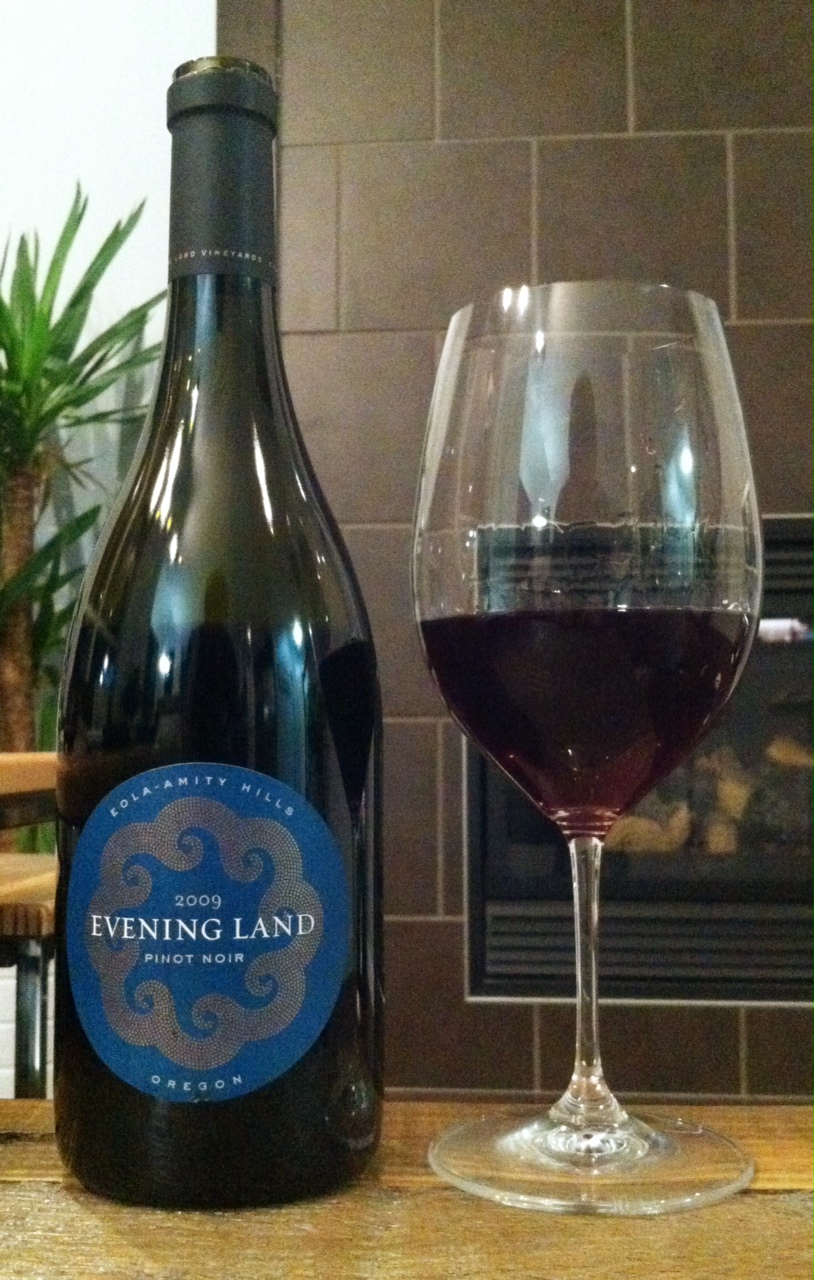
One of my favourite labels in recent memory, and a great bottle to boot.

As I mentioned last post, although buying and drinking Burgundy is my top mission for (at least the first half of) 2012, in order to go about it the right way and actually learn something, I’m going to be deferring much of my Burgundy tasting/writing for a few weeks while I source wines and firm up a drinking plan.  Since I tasted a 2009 Bourgogne Rouge last week, I thought it would be an interesting contrast to follow it up with what is effectively its New World equivalent:  a 2009 Pinot Noir from Oregon, from the Burgundy-inspired rising stars at Evening Land Vineyards.  Even though Evening Land’s first vintage was in 2007, less than five years ago, it has quickly gained attention and critical acclaim for its lineup of true-to-the-land wines from the classic Burgundian varieties of Pinot Noir and Chardonnay.  I had known them as an Oregon producer (I tried two of their Oregon Pinots in WSET class) and was quite surprised to discover that they actually make wine in 4 different Pinot/Chard heartlands around the world:  Oregon’s Willamette Valley, California’s Sonoma Coast and Santa Rita Hills, and Burgundy itself.  While I’m sure that other wineries must do this too, I can’t think of another one off the top of my head that produces wine from different countries under the same name and label.  Colour me intrigued.

Read the rest of this entry »


Wine Review: 2007 Boedecker Cellars Stewart Pinot Noir

3 08 2011

Just smell this wine once...then keep on smelling.

Oregon!  By now you know that Washington State, especially Washington State Syrah, has a big piece of my wine-loving heart, but my affections actually spread further across the Pacific Northwest, even though Oregon’s wine scene is considerably different from its northern neighbour’s.  Most of Washington’s wines are grown in the southeast part of the state, which is in the rain shadow of the Cascade Mountain range and is almost desert-like:  dry and hot during the day and quite a bit cooler at night.  The heat allows thicker-skinned, warmer-weather grapes like Cabernet Sauvignon and Syrah to ripen fully, while the nightly colder spells give the resulting wines a little restraint and keep them from becoming alcoholic fruit bombs.  Oregon is totally different, with a climate that more closely resembles what you’d expect from the northern Pacific coast (and I lived in Victoria BC for three years, so I know):  cooler, more continental, less sunny and quite a lot rainier.  The big powerful red grapes would struggle to ripen fully here, but their more delicate, thinner-skinned, colder-climate brethren absolutely thrive, especially Pinot Noir.  In my (only partially-informed) opinion and (fairly limited) experience, I would venture to say that Oregon has more promise as a Pinot Noir region than anywhere else on Earth other than Burgundy, France, the grape’s ancestral homeland — it’s better suited for the grape than established Pinot zones like California; more impressive than other up-and-coming areas like Central Otago, New Zealand or Yarra Valley/Mornington Peninsula, Australia; and more intriguing than long-time European growing zones like Germany or Austria.  Oregon has only been noticed as a serious wine region in the last 50 years, but its affinity for Pinot Noir has seen it gain an astronomical amount of international respect in a very short time.  It has since started branching out with some of the white grapes from Alsace, France (Pinot Gris and Pinot Blanc), but Pinot Noir is its meal ticket and its justified claim to fame.  I’m not a huge Pinot fan, but (possibly because I don’t find myself drinking $150+ Burgundy all that often) Oregon’s renditions of the grape are probably my favourite. Read the rest of this entry »


Wine Review: 2008 Maison Roche de Bellene Cote de Nuits-Villages

9 06 2011

I’m pretty sure this is the first Burgundy that’s made its way onto PnP; I don’t drink a lot of it because the cheaper stuff tends to taste that way and almost all of the good stuff tends to be out of my price range.  However, I’m trying to put a little more effort into discovering the wines of that region, because top quality Burgundies are some of the most alluring, complex, memorable wines in the world.  I got a chance to try some high-end white and red Burgundy at my WSET course a couple weekends ago (a Domaine Leflaive Puligny-Montrachet [white] and a Domaine Roy Marc Gevrey-Chambertin [red], if you’re curious) and started to understand what all the fuss is about, so tonight I dug up this wine, which comes from one of the few solid value producers in the area, to continue my Burgundy initiation. Read the rest of this entry »


Tips & Tricks: Red Wine with Fish?

23 05 2011

The very first “ironclad” wine and food pairing rule that I was ever told is so ubiquitous that I’m sure you’ve all heard it too:  red wine with meat, white wine with fish.  But is this prohibition on mixing red wines and fish fact or fiction?  As with any good urban legend, it’s a bit of both.

There really is no caption that can improve on this picture.

First the fact:  it is a good idea to avoid pairing particularly oily foods with wines that are high in tannin (for a longer explanation on what tannin is, click here) because the two combine to produce unpleasant metallic or tinny flavours on the palate.  Generally speaking, fish is quite oily as compared to other cuts of meat, and red wines are the most likely candidates to be high in tannin, as white wines usually have little to no detectable tannins; as a result, it is certainly true that some red wines and some fish will not be a happy mix.  The iodine present in fish can also have a similar negative reaction with tannin (and, at least according to this article, the traces of iron in certain red wines will clash with fish), so following the basic “no red wine with fish” rule can help you avoid disastrous gastronomic consequences.

However, it is fiction to say that red wine and fish can never be successfully paired together. Read the rest of this entry »