Wine Review: Menti & Marabino, Natural Italy

20 08 2015

[These bottles were provided as samples for review purposes.]

If you are a massively wine-obsessed civilian, you have probably had at least a passing thought about it.  I can think of a half dozen wine friends off the top of my head with whom I’ve had the conversation.  You know something about wine, you have a particular love for a particular region, you’ve found a lesser-known producer or two there whose wines aren’t currently brought in to your jurisdiction…what if I just imported them myself?  I could be a wine agent on the side…who WOULDN’T want to buy these wines?

Small importer, statement wines.

Small importer, statement wines.

Of course, it takes much more than a passion for wine and an idle dream to make a go of it in the wine import world, an extremely competitive sphere full of others who have been at it a long time and know what they’re doing.  This is why I am behind a keyboard right now instead of combing Washington State and Oregon for hidden gems.  But I have the utmost respect for the people who do take the plunge, who put their money where their mouth is and find a way to step a little bit further into the world of wine.  Maxim Atanassov is one of those people, populating the white collar world by day and crusading for all-natural biodynamic Italian wines on evenings and weekends through his agency Vino Al Vino.  He has assembled a tight-knit group of producers from the southern and eastern edges of Italy who share a steadfast mission to let the land do the talking and a hands-off approach to winemaking.  I got the chance to try two bottles from the white side of his wine portfolio, and they proved to be some of the most interesting wines I’ve ever been asked to review. Read the rest of this entry »



Calgary Wine Life: Vasse Felix Winemaker’s Dinner @ The Lake House

16 07 2015

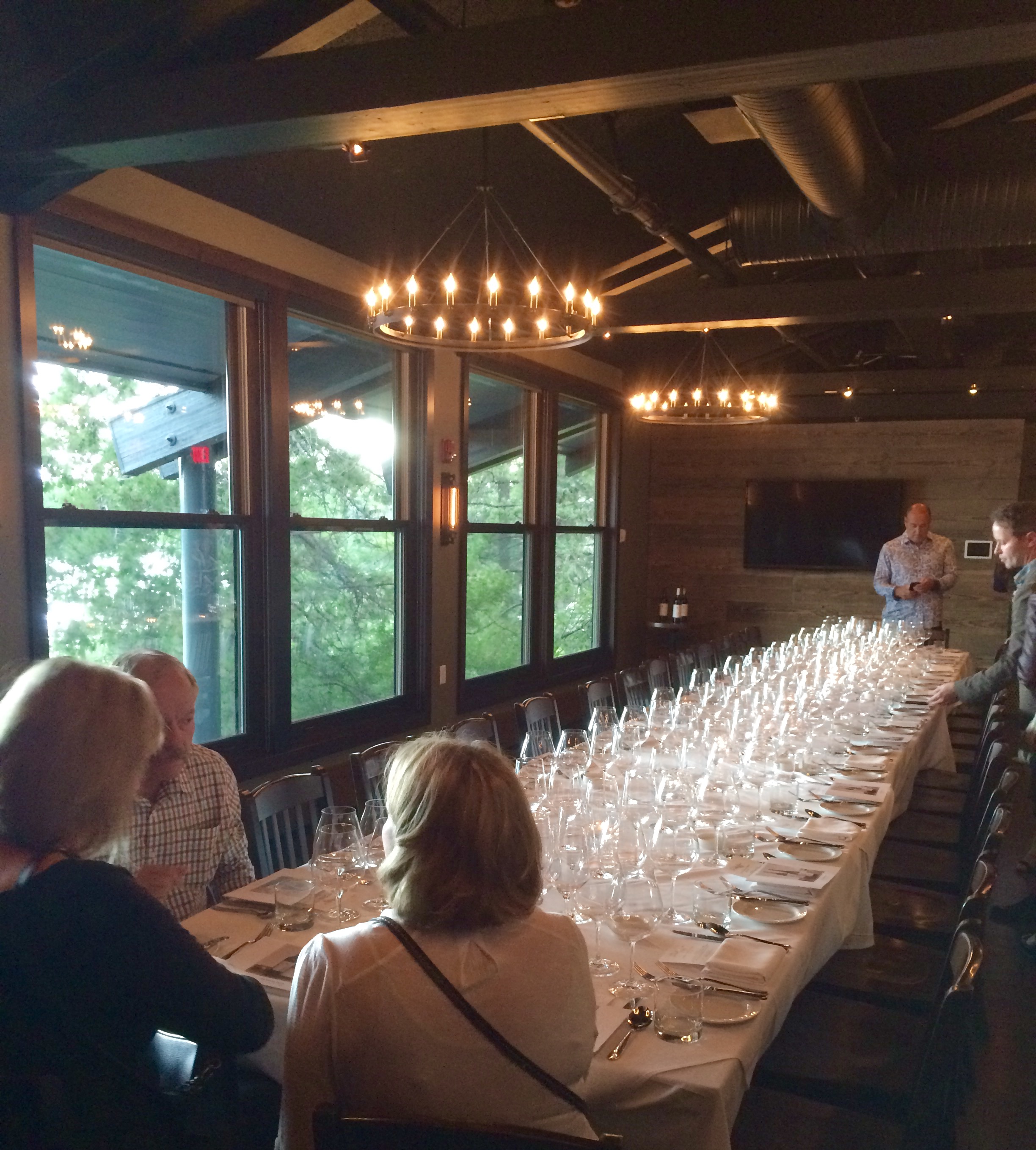
Let’s play word association.  I say:  “Australian wine”.  You immediately think — ?  You are probably lying if you don’t say “Shiraz”, and with that comes immediate images of big, lush, ripe, fruity, alcoholic reds, bursting with flavour and spice if lacking slightly in nuance.  The wine scene in Aus is certainly becoming more varied and complex as the years go on, but consumer memory changes slowly and initial impressions run deep.  That’s why one of the first instructions that Virginia Willcock, esteemed winemaker at southwestern Australia’s Vasse Felix winery, gave us about her wines was:  “Don’t call them Australian wines.  They’re not.”  At least not in the preconceived way we all think about them.

LakeHouseRoom

Vasse Felix is located in the Margaret River region, a 3 hour drive south of Perth, which is a city surrounded by, well, nothing.  Willcock calls it “the most isolated wine region in the world”, but what it lacks in proximity it makes up for in a much cooler, more temperate, maritime climate than the rest of the country, a growing season that is often compared to that in Bordeaux, and resulting wines that exhibit finesse, elegance and character, wholly unlike the fruit monsters on which Australia made its international name.  Vasse Felix is the first wine estate founded in Margaret River, established in 1967, and it produced the area’s first Cabernet Sauvignon in 1972.  It continues to specialize in Cabernet, and also in Chardonnay, both classic Margaret River varietals, and it does not produce any other types of wines.  As Willcock says, they elected to be the master of a couple trades instead of a jack of all of them (a lesson that many other New World wineries could be well served in learning). Read the rest of this entry »


Calgary Wine Life: Cakebread Tasting with Dennis Cakebread

15 04 2015

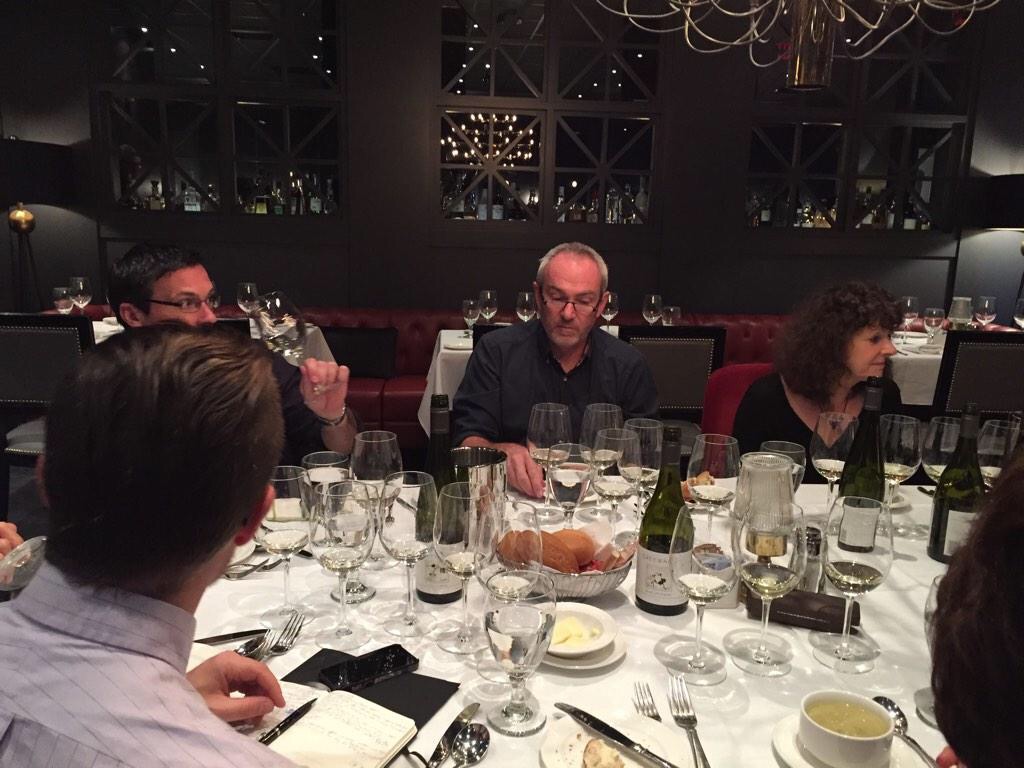
I have long held a soft spot for Cakebread Cellars wines, dating back to when my knowledge and interest in wine were in their infancy.  At the end of my articling year a decade ago, my co-workers and I were out at a nice dinner courteously paid for by our firm the night before we were to find out who would be hired back after articles.  There was suitably fancy wine to go with the upscale meal at our group’s aptly named Last Supper, but the only bottle I remember from that night came after dessert, when a couple wine-loving fellow students ordered a bottle of Cakebread Sauvignon Blanc to the table.  I know (now) that this isn’t Cakebread’s go-to grape or claim to fame, but it stopped me in my tracks.  I had never had a wine like it.  It was instantly memorable and made me understand how people could invest so much time, attention and money in the enjoyment of fine wine, which I have now spent the last ten years doing myself.  When I was in Napa a few years ago I made sure to stop by Cakebread (and have matching wine glasses at home to prove it), all because of that one bottle of Sauvignon Blanc.  So when I got invited a few weeks back to taste through a lineup of Cakebread’s wines with its VP and second-generation owner Dennis Cakebread, my wine life flashed in front of my eyes a little bit.  It was like coming full circle.

FullSizeRender-52

Read the rest of this entry »


Calgary Wine Life: Greywacke Tasting with Kevin Judd

7 10 2014

Kevin Judd is a New Zealand visionary, a trailblazer who has left a permanent imprint on the nation’s young wine culture.  As the founding winemaker of Cloudy Bay, now the near-ubiquitous signpost for the sharp, tangy, herbal style of Sauvignon Blanc that is instantly recognizable in the glass, Judd pioneered a flavour profile for New Zealand’s signature grape that put the country on the world wine map.  He helmed the ship at Cloudy Bay for 25 years, taking it from an unknown producer in an anonymous wine nation to a whirlwind New World phenomenon, the crown jewel of a Sauvignon Blanc revolution that saw millions of bottles fly off the shelves.

IMG_2063

After Cloudy Bay was sold to luxury brand behemoth LVMH (whose wine portfolio includes such luminaries as Krug, Dom Perignon, Chateau d’Yquem and Cheval Blanc, upper-crusters all), Judd finally realized a lifelong dream of starting his own label and making wines in a manner that best suited his palate:  riper batches of fruit, slightly softer acid, yet retaining all of the structure and complexity that a cooler climate can provide.  He called the new venture Greywacke, a name he had quietly reserved 15 years earlier while waiting for his opportunity:  the word (pronounced “grey-wacky”) refers to the grey sandstone rocks that are commonly strewn across New Zealand’s vineyards.

Read the rest of this entry »


The Prospect Winery White Showdown

5 11 2012

[The bottles below were provided as samples for review purposes.]

The competitors.

Over the past few weeks I have become quite a fan of BC’s Ganton & Larsen Prospect Winery.  I have long retained a lingering suspicion about any bottle of inexpensive Canadian wine, fearing that elements both natural (shortened and uneven growing seasons/smaller ripening windows) and economic (high land costs in winegrowing areas/little access to cheap labour) would inevitably combine to make it impossible for a homegrown bottle to compete for my $15 Tuesday Night Bottle attention with those bastions of cheap and cheerful wine:  Australia, Argentina, California, Chile, Spain.  While I am increasingly convinced that we’re in the midst of a quality revolution in Canadian wine, I saw little hope that it would trickle down to the entry-level bottles in any winery’s lineup.  Then I got sent a six-pack sampler from the folks behind the Prospect Winery, an Okanagan producer with ownership ties to the more famous Mission Hill and a focus on the budget-conscious end of the retail shelf.  First a remarkably complex Shiraz and then a substantial Merlot captured my attention as each were downed with surprise and admiration and made the subject of solo reviews.  Left in the sampler box were four whites from Prospect’s 2011 vintage:  Pinot Grigio, Sauvignon Blanc, Riesling and Chardonnay.  Quicker than you could say “easy excuse for a tasting”, I knew what had to be done.  I rounded up my tasting panel from this summer’s Mission Hill Pinot Olympics and we went to work on a head-to-head-to-head-to-head showdown of Prospect Winery’s whites. Read the rest of this entry »


Burgundy: White Tasting, Part III

23 04 2012

When you spend hundreds of dollars over multiple months to build a tasting, you stretch out the write-up as much as possible.  To read the introductory entry in this Chardonnay-fuelled marathon, click here.  To read about the jump from basic Bourgogne Blanc to village-level bottlings, click here.  To read about the exciting ascent into the mystical and expensive world of Premier Cru white Burgundy, well, keep reading.

THIRD FLIGHT

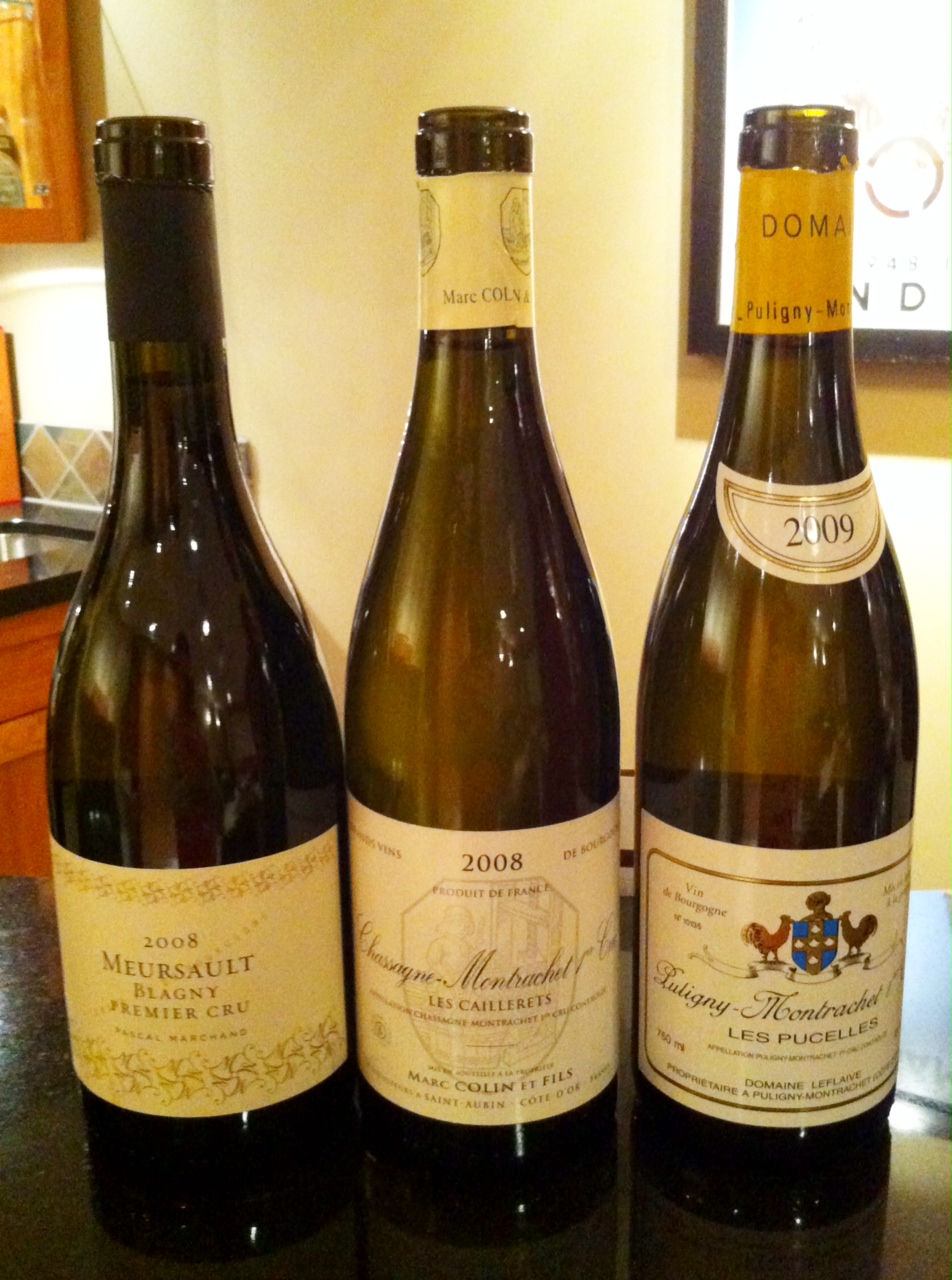
Time to hit up the big leagues.

Now we officially move from the wines that you might pop open on a Friday or Saturday if you feel deserving after a hard week to the wines that you agonize over opening until just the right spot in their drinking window and just the right occasion because you know your budget won’t easily permit a replacement.  The combined retail cost of the flight of 3 village-level white Burgundies was about $180; the combined retail cost of the 3 Premier Crus below is almost double that, $340.  This is why I didn’t buy any other wine from January until April.  In the third flight of the evening we continued to highlight the top white Burgundy villages of Meursault, Chassagne-Montrachet and Puligny-Montrachet, and instead of village bottlings made from grapes that could be sourced from anywhere in the adjoining area, we narrowed our focus and opened a bottle from each sub-region made from grapes grown in a particular highly-regarded Premier Cru vineyard near the village in question.  Every inch of land in Burgundy’s famed Cote d’Or region has been analyzed and classified over centuries, and those areas with the best soils, slopes, exposure to sunlight, drainage and growing conditions were isolated as Premier Cru or Grand Cru.  That’s what we’re getting into:  hundreds of years of liquid history. Read the rest of this entry »


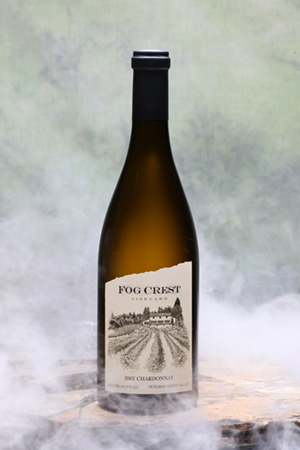
Wine Review: 2008 Fog Crest Vineyard “Laguna West” Chardonnay

15 02 2012

I had to use the promo pic from the website instead of my actual pic, for obvious reasons. Sure is foggy.

I just finished reading the book Judgment of Paris by George Taber, which is primarily a recounting of the now-legendary 1976 Judgment of Paris tasting where California Cabernets and Chardonnays shockingly upset top French Bordeaux and Burgundies in a blind tasting evaluated by renowned French judges, but which also tangentially describes the birth and rapid growth of the California wine industry.  The truly amazing thing about the J of P tasting wasn’t that the California wines upset the French; it was that the California wineries represented in the competition didn’t even exist a decade earlier.  Many of them entered their first, second or third vintages EVER in a tasting contest against historic French bottlings that dated back centuries, which in the world of wine should have been a recipe for embarrassment.  I now think about this every time I open a Cali Cab or Chard because, as a recent disciple of wine, I’ve only ever known California as a world vinous powerhouse; it’s remarkable to think that 40 years ago it would have been laughable to describe it that way.

To coincide with my finishing the book, I felt it only appropriate to open a California wine in commemoration, and the Fog Crest has been a bottle I’ve been very interested in trying, largely because the producer brings in ultra-famous Cali winemaker David Ramey as a consultant to help craft its Chardonnays and Pinot Noirs.  Fog Crest is based out of the Russian River Valley sub-region of Sonoma County, an area known for having a notably cooler climate than the surrounding area, helped in part by cold morning fogs (hence the winery name).  These climatic conditions make RRV an ideal spot for growing grapes like Chardonnay that show their best in cooler sites.  My favourite thing about this wine has to be its thematically-accurate, dry-ice-induced foggy promo pic from its website (see above left), the set up for which almost inevitably involved some marketing guru saying:  “See, FOG Crest?  Get it?”  (I get it.)   Read the rest of this entry »
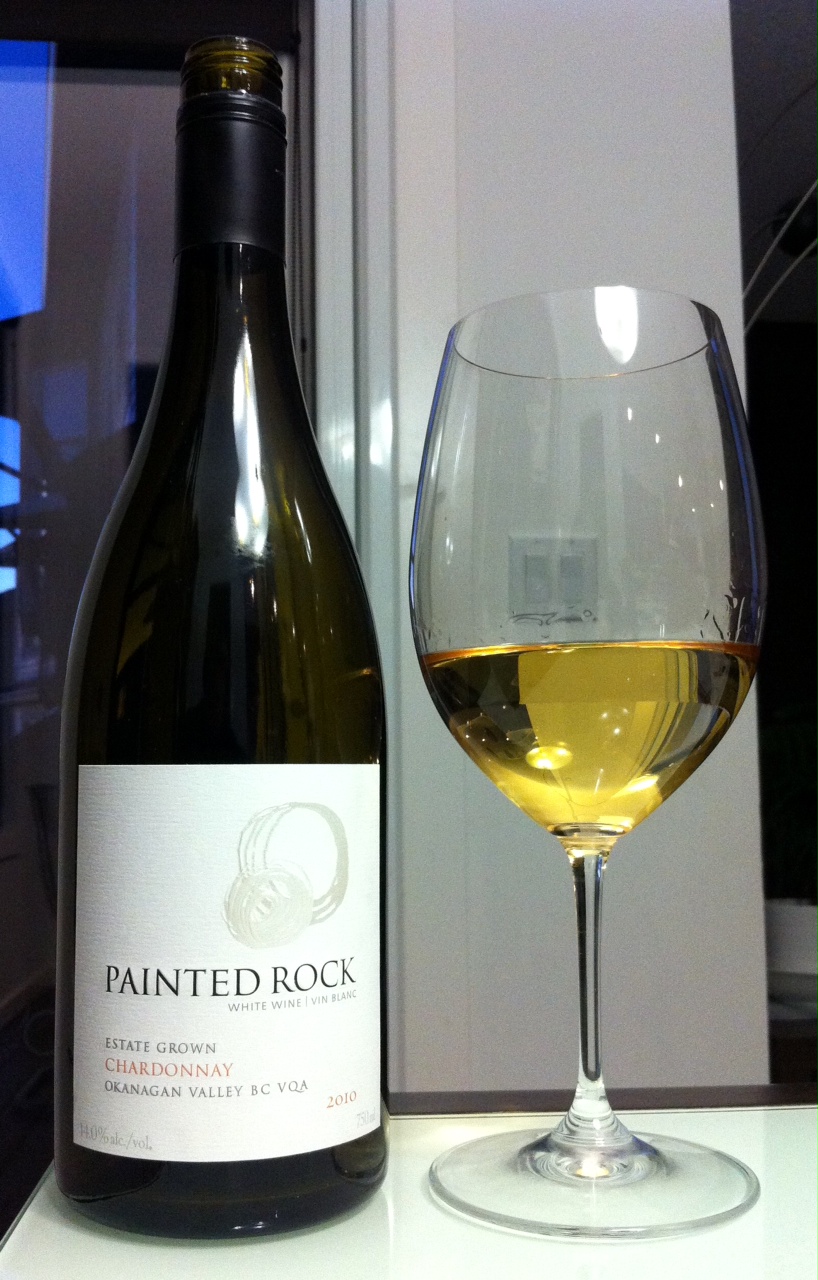


Wine Review: 2010 Painted Rock Chardonnay

3 02 2012

Although a newer vintage than the 2009, it's still like going back in time.

The coolest thing about this blog having been around awhile, other than the fact that I’ve miraculously managed to regularly publish an Internet wine blog for the better part of a year, is that I’m starting to come across second vintages in the bottles I open:  current vintage wines whose predecessors I have previously featured on PnP.  Case in point:  the 2010 Painted Rock Chardonnay from the Okanagan Valley, which is probably already facing an uphill battle in this review due to monstrously high expectations because I totally loved the 2009 PR Chard back in September.  I think Painted Rock is a producer on the forefront of the Canadian wine scene, one that is starting to show that we don’t have to settle for local wines that only measure up as against their neighbours, but that can also stand tall on the international market.  While PR focuses primarily on red wine, their lone white is a testament to the wonders of cool-climate Chardonnay, and I thought enough about the ’09 vintage that I absolutely loaded up on the 2010 as soon as it became available.

Read the rest of this entry »


Calgary Wine Life: Co-op Wine & Spirits Judgment of Paris Tasting, Part 1

23 10 2011

Last night I went to the longest and most expensive retail wine tasting of my life (5 hours and $250 respectively):  Co-op Wine and Spirits’ modern day re-enactment of the historic 1976 Judgment of Paris tasting, the event that first put California and Napa Valley on the world’s vinous radar screen.  The original Judgment of Paris was a promotional stunt organized by Steve Spurrier, the owner of a well-known Paris wine shop, pitting top French reds from Bordeaux and whites from Burgundy against Napa Cabernets and Chardonnays.  While today that might seem like an alcoholic battle of the titans, 35 years ago California wine had basically no international presence or prestige, and it certainly was not viewed as a wine region whose products could stand up to the aristocracy of France’s top names.  As a result, especially because 9 of the 11 hand-selected judges at the tasting were French (and a 10th, Steve Spurrier himself, was British), the J of P was expected to be an Old World massacre.  10 reds and 10 whites (6 US/4 French, for some reason) were poured blind and the judges rated and ranked them without knowing which wine belonged to which producer/country.  When the scores were tallied, France’s divine right to make the best wine in the world was shattered as California took top prize in both the red (Stags Leap Wine Cellars Cabernet) and white (Chateau Montelena Chardonnay) categories.  One reporter covered the tasting and wrote up the shocking upset in Time Magazine; less than half a century later, out of these humble beginnings, Napa Valley is one of the most famous, critically acclaimed and expensive wine regions on Earth.

Ready to (re)make history?

Read the rest of this entry »


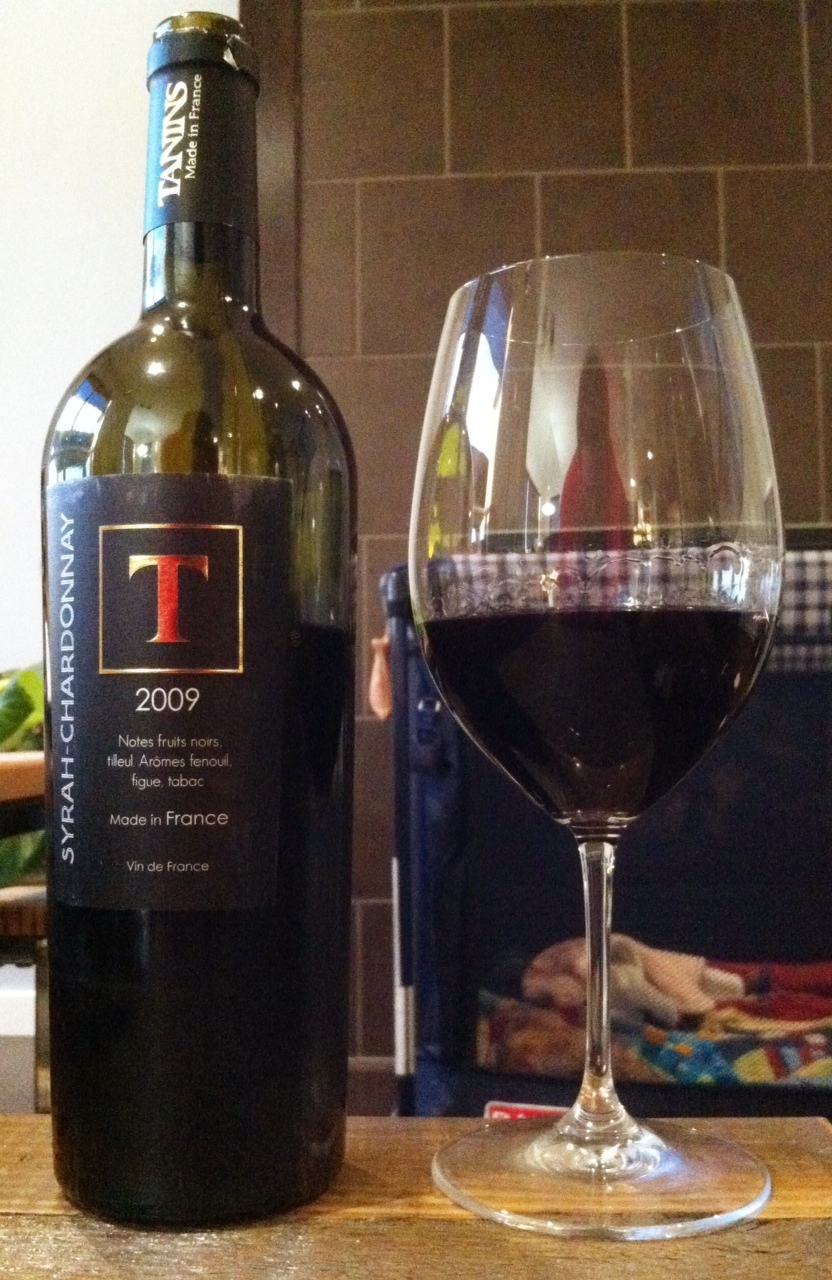
Wine Review: 2009 Tanins Syrah Chardonnay

19 10 2011

Syrah. And Chardonnay. Just because. You know you secretly want to try it.

I’m sorry, what?

That wasn’t a typo.  Tonight’s wine is ACTUALLY a blend of Syrah and Chardonnay.  It may not surprise you to learn that this is the first time I’ve ever had that blatantly crazy combo of grapes together.  It would not surprise me to learn that LSD was involved in the producer’s blending decisions.  But here we are.  Obviously taking their cue from the long-standing Northern Rhone tradition of blending in a touch of white Viognier with red Syrah, French producer Tanins (sic?) has put together another red-white mashup, only casting the world’s most well-known white grape in the usual Viognier role.  It’s a strange choice:  Viognier is added to Rhone reds because it is intensely aromatic and thus adds pizzazz and complexity to the blend’s nose.  Chardonnay is the exact opposite, a generally neutral varietal without any strong aromas to call its own.  I have no idea what motivated its selection, and this bottle has turned out to be nearly impossible to research electronically, so I’ll just have to take the plunge in the dark.  Morbid curiosity, prepare to be satisfied. Read the rest of this entry »


Wine Review: 2009 Painted Rock Chardonnay

21 09 2011

In wine, as in life, discrimination is wrong.

I’m experiencing a sort of Chardonnay renaissance right now. Like so many people, I had soured on the grape after a couple of initial bad experiences with cheap, gloppy, steroidally-oaked monsters that led me to believe that Chard was overrated and undeservedly well-known, the sellout of the white grape family. This, it turns out, is a tragically limited worldview that illustrates the dangers of drawing conclusions based on a small sample size; the problem wasn’t actually that I didn’t like Chardonnay (which is responsible for some of the best, most acclaimed and most expensive white wines in the world), but that I didn’t like bad Chardonnay (which, thankfully, isn’t a problem at all). I have started to distance myself from this rough start with the grape, and despite my previously-ingrained bias, I’ve been noticing that almost every single Chardonnay I’ve had recently has been, well, good. The oak-and-alcohol-bomb style previously so rampant throughout the New World is starting to recede, and the current movement in the world of Chardonnay seems to be more geared toward balance and allowing the flavours of the actual grape (rather than only the barrel it was aged in) to express themselves. This is a positive development for the Canadian wine industry, as this grape probably does its best work in cooler climates, retaining the structure that can be so easily lost in warmer zones yet still ripening even in shorter, colder growing seasons. I was therefore quite surprised during my recent trip to the Okanagan when one winery owner told me that they would be reining back their production of Chardonnay in favour of other white varietals — they made a tremendous, restrained yet flavourful Chard, but they were turning away from it because they thought that Pinot Gris could outsell it 5 to 1. My newfound appreciation for the world’s best-known white grape must have hit me then, because my first immediate thought was: “Has everybody gone nuts?”

Read the rest of this entry »


Wine Review: 2009 Laughing Stock Chardonnay

11 07 2011

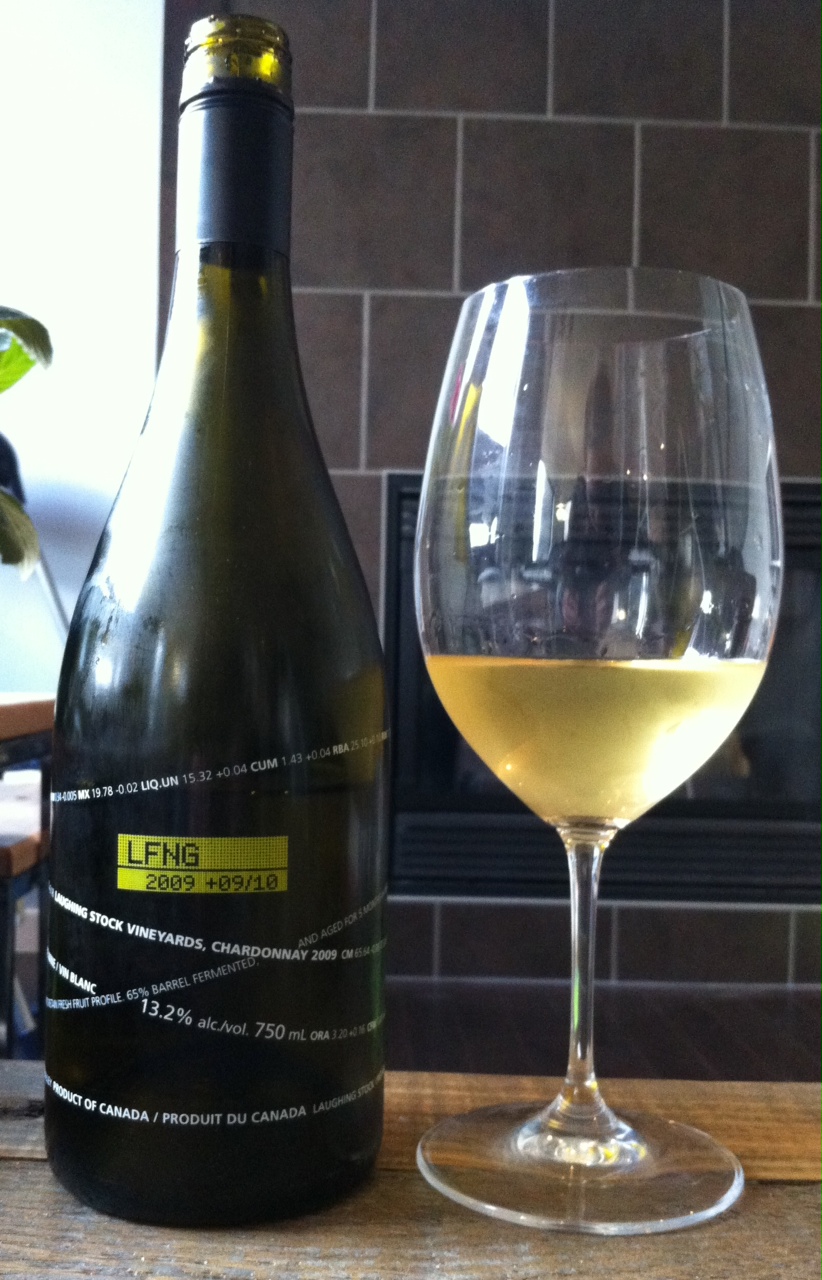
In case my constant compulsive pumping of Riesling didn’t already tell you this about me, I’m not much of a Chardonnay guy.  I’m not an active hater, but I can generally take it or leave it, and it’s definitely not where my eyes go on a white wine list.  I find most oak-aged Chardonnays to be a bit of a blunt instrument, tasering the taste buds into submission with a lumberyard of wood (often accompanied by crazy high alcohol) and overwhelming the sense of delicacy that I think the best white wines possess.  Conversely, I find most unoaked Chardonnays to be, well, extraordinarily boring:  Chardonnay is a fairly neutral grape by itself, without any intense flavours, and with no oak providing backup vocals it can lack the layer of intrigue that it sorely needs.  Of course, this dreary portrait doesn’t apply to all Chards out there (Burgundy fans, put down your pitchforks — I can’t afford your wines anyway), but it covers more of them than it should.

Great bottle, great marketing, great wine.

But leave it to my (now official) favourite Canadian producer to walk that difficult middle ground between extreme oakiness and mind-numbing neutrality.  Coming off the extremely strong showing of their signature red blend Portfolio back in May, the Okanagan’s Laughing Stock Vineyards kept the PnP love fest going with their 2009 Chardonnay, which struck a perfect balance.  The LS label info alone gave me high hopes, for two reasons.  First, the alcohol level was only 13.2%, not a percent and a half higher like some New World Chardonnays; since all the alcohol in wine comes from the sugars in ripe grapes, this non-astronomical alcohol level means that the grapes weren’t crazily overripe when they were fermented, which in turn means that the resulting wine likely won’t be overly full and will likely retain some much-needed acidity.  Second, instead of being aged in small oak barrels for a long period of time (usually a year or more), the LS Chardonnay was actually fermented in oak and then aged in larger oak barrels called puncheons (the bigger the barrel, the less surface area contact with the wine and the less flavour imparted) for only 5 months.  As compared to strictly aging in oak, barrel fermentation generally results in more controlled, better integrated and softer oak flavours being imparted into the wine, all good things for someone easing their way into oaky whites.  This is why more information on wine labels is always better than less! Read the rest of this entry »


Wine Review: 2010 H. Stagnari Chardonnay “De Virginia”

10 05 2011

Brian from Ferocious Grape doesn’t owe me money.

When I was somewhat skeptical (read: incredulous) about the idea of paying over $20 for a Chardonnay from the vinuous hotbed of Uruguay as he was suggesting, we made a bet:  if I tried the wine and gave it less than 85 points on PnP, he’d buy it back from me.  Always one to step up to a challenge and jump at the chance of drinking guaranteed wine from random South American countries, I grabbed the bottle and made plans to crack it ASAP.  After a weekend of extravagant wine drinking, I thought there was no better way to get my palate down to Earth than with a solid bottle of Uruguaian Chardonnay… Read the rest of this entry »