Bricks Wine Advent Calendar 2019: Day 1

1 12 2019

By Peter Vetsch

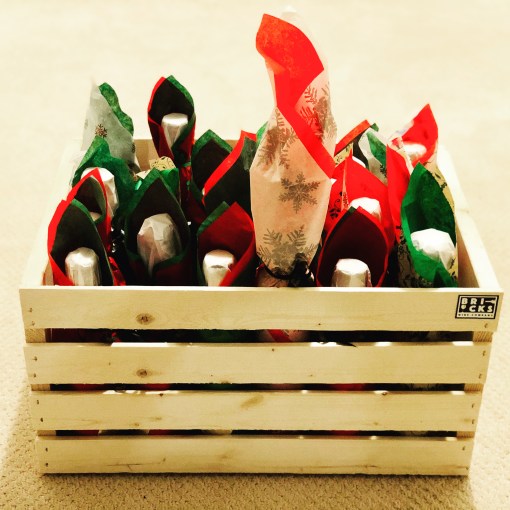
And we’re off.  This marks the SIXTH straight year that this site has run a daily play-by-play blog of a boozy Advent calendar (sometimes more than one at once, which inevitably leads to massive regret on my part).  For the last couple years, this has included following along with the wonderfully diverse Bricks Wine Company Half-Bottle Advent Calendar, a concept long considered and now gloriously fulfilled, finding new range with each passing year.  This marks the third annual edition of the Bricks calendar, and if the shapes and tops of the various gift-wrapped 375 mL entrants into this year’s Advent derby are any indication, we may be in for our most intriguing field yet.
DFF6609D-E2CF-4B8F-8CB2-40E947C6DC21

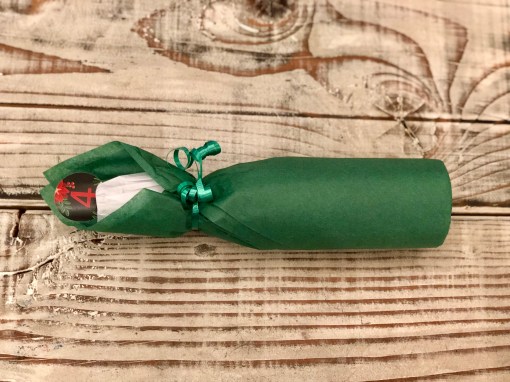
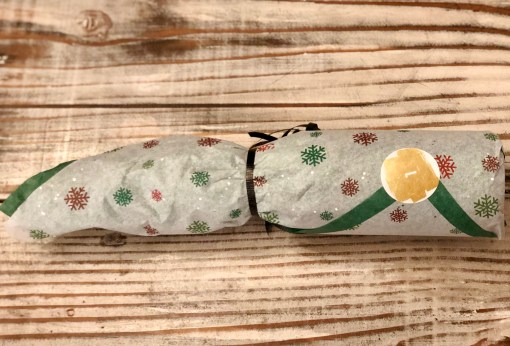
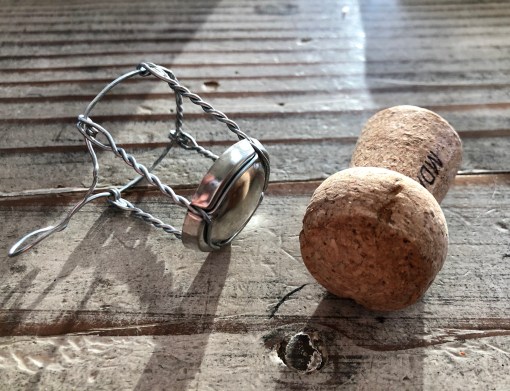
Case in point:  Day 1.  That is NOT a standard screwcap or neck foil that I feel under the wrapping paper.  The prior Bricks calendars have always ended off with bubbles on Day 24, but the wire cage and jumbo pressure-withstanding cork protruding from the gift wrap of this inaugural 2019 offering suggests that this year’s calendar may well be starting off with them too.  And so it is, as the tissue paper falls away to reveal…a hell of a good start.
IMG_1038

The 2016 Tawse Spark Brut hails from my personal favourite winery in Ontario, one that has won the prestigious award for Canada’s Winery of the Year four times (including an impressive three-peat from 2010 through 2012) despite only being 18 years old.  Tawse is a family-owned organic and biodynamic estate that is heavily focused on Burgundian grapes Chardonnay and Pinot Noir (to such an extent that founder and owner Moray Tawse also has a project in Burgundy itself, a collaboration with the renowned Pascal Marchand called, unoriginally, Marchand-Tawse), although it first came to my notice for remarkable Riesling and Cabernet Franc.  Tawse’s focus in the vineyard is to make each swath of vines a complete self-sustaining ecosystem, one that is constantly in balance without the need for any chemicals or external artificial additives to do the balancing.  Animals play a major role in this effort, including chickens (who eat vineyard bugs), sheep (who eat away the lower vine leaves, exposing the grapes to more sunlight) and horses (who are used in lieu of tractors so as to avoid excessive soil compaction).

IMG_1041

The Spark Brut is a traditional-method Champagne-style sparkling wine, made by inducing a secondary fermentation of a previously made still wine within a sealed bottle, which traps escaping CO2 within the resulting wine that is created and allows it extensive contact with the dead yeast cells that remain after the bubble-inducing effort is successful, creating a myriad of textures and flavours not otherwise found in the world of wine.  This offering is made from a surprising 44% Pinot Gris in addition to Champagne stalwarts Pinot Noir (31%) and Chardonnay (25%).  Pinot Gris does not often get the Champagne treatment anywhere outside of Alsace, but Tawse sees fit to elevate it alongside its more renowned Pinot cousin; each of the varietals here are yield-thinned and hand-harvested, then left on lees for 12 months after secondary fermentation before a slight touch of sweetness is added back ahead of bottling.  Each grape used in this wine hails from a different Tawse vineyard, including the Chardonnay, harvested from the mighty Quarry Road (anyone who has had the Tawse Quarry Road Vineyard Chardonnay will understand my singling it out).
IMG_1042

Cork Rating:  1/10 (Shiner cork AND shiner wire cage?  I thought this was Advent!!)

Day 1 emerges an extremely pale lemon colour amidst a steady stream of tiny bubbles, their size and energy a clear indicator of the traditional method at work.  The aromas are pleasantly vibrant for a Champagne-style wine, perhaps a sign of what Pinot Gris can add to a bubble party:  banana leaf, lime curd and honeydew, swirling across southern biscuits and struck match.  Instantly drying on the tongue, the Spark’s lees-induced flavours stand firm and take precedence over the fruit, reasserting the dominance of its winemaking method and erasing any perceptible trace of residual sugar; elastic bands and sourdough bread stretch over tangy melon, tangerine and Granny Smith apple, lending heft and gravitas to an otherwise-playful wine.  This is not ragingly complex, but it’s crispy and approachable and delicious, the kind of thing you would use to kick off a party that sees you crush 24 bottles in 24 days.  Here’s to another wine Advent.

88+ points


Bricks Wine Advent Calendar 2018: Day 24

24 12 2018

By Peter Vetsch

Merry Almost-Christmas!  We are now 24 days and nearly 24 bottles into December, the Bricks Half-Bottle Advent crate is empty, Santa is somewhere over the Atlantic and we’re into Advent reminiscing mode yet again.  I would say that it went by in a flash, but it didn’t — each bottle and each producer and each story took time to find and understand and tell, and after a dozen such efforts in a month I am wearing the effort of them all, but I would (and will) do it again.  Kudos to the fine folks at Bricks Wine Company, who I think clearly surpassed their inaugural wine Advent effort last year with this year’s magnificent beta model.  The bottles of 2018 were stronger almost across the board, impressively consistent and in some instances simply show-stopping; I feel quite comfortable that I got my money’s worth on this vinous adventure, and all of the work that went into finding and sourcing these two cases of month-long 375 mL glory did not go unnoticed.

IMG_9533

As Ray and I wrap up our run of daily holiday blogging (only to start into our next run of daily holiday blogging TOMORROW, as Vinebox’s 12 Days of Christmas kick off, because we’re deranged), just like last year, I thought we’d finish our Wine Advent run with a look at each of our podium wines, as well as our value Dark Horse.  As I expected, there was some clear overlap in our choices, as well as a second straight year of an unanimous Advent victor.

Ray Lamontagne’s Top 3 Wines

  1.  2015 Ken Wright Cellars Shea Vineyard Pinot Noir (Day 17):  Just a truly ethereal wine, good for the soul.  Deft yet flavoursome.  Fruity yet spicy.  A wine of a specific place yet timelessly delicious no matter where you are.
  2. 2014 Woodward Canyon Artist Series Cabernet Sauvignon (Day 22):  Scratches a classic Cab itch without being tiresomely grandiose.
  3. 2012 Rocche Costamagna Barolo Rocche Dell’Annunziata (Day 15):  Taps into that rare middle-ground wellspring — can drink now or hold, and you won’t be bummed either way.  Still thinking about all those blue flowers.
  4. DARK HORSE – 2014 Bodegas Franco-Espanolas Bordon Rioja Crianza (Day 13):  Tiny cork notwithstanding, this similarly straddled two paradigms (in this case, modern and traditional Rioja) with aplomb.  This region never disappoints.

IMG_9544

My Top 3 Wines

  1. 2015 Ken Wright Cellars Shea Vineyard Pinot Noir (Day 17):  This just was not close for me — the Ken Wright towered over all other wines in the calendar.  Just impeccably balanced, driven and sure of what it was, while still being jaw-droppingly gorgeous from start to finish.
  2. 2016 Weingut Brundlmayer Gruner Veltliner Kamptal Terrassen (Day 3):  The front half of the calendar is gone but not forgotten, and this Gruner (not to mention Ray’s streak of amazing Austria reviews) was about as classic and dexterous as it gets.
  3. 2014 Woodward Canyon Artist Series Cabernet Sauvignon (Day 22):  As a Washington wine devotee and wannabe historian, getting to taste a pioneer of the region and understand why they drew so many more to make such great wines in Washington State is a unique thrill.
  4. DARK HORSE – 2016 Ferdinand Wines Albarino IN A CAN (Day 20):  I got confirmation via Instagram after posting this write-up, from the winemaker himself, that the Spanish-vareital-focused Ferdinand Wines IS in fact named after the big red bull of my childhood story times.  Investigative journalism is not dead.  Let’s change our views of wine vessels; I know we can.

IMG_9546

Just like last year, bottle #24 this year is a Champagne.  Entirely unlike last year, the Champagne is in pristine condition, and is determined to end off the calendar with a bang.  We wrap with the Pierre Paillard Les Parcelles Bouzy Grand Cru NV, and in that list of French words is a compelling story.  Pulling the threads one by one:  Pierre Paillard is a “grower Champagne” house with centuries of history in the region, having planted vines and made wines in Champagne since 1799.  Les Parcelles is one of their Champagne offerings, made from grapes picked from 22 different parcels all within the Grand Cru village of Bouzy, a key home of Pinot Noir within Champagne’s boundaries.  Although this is a non-vintage wine, meaning that the wines within the finished bottle hail from more than one growing season, I can’t help but notice that this particular rendition of Les Parcelles is designated “XIII” on the label.  This seems to refer to the primary vintage used in this specific batch:  this bottling is 80% made from 2013 vintage grapes, 14% from 2012 and 6% from…2004!  It is 70% Pinot Noir and 30% Chardonnay, is made in minimally interventionist fashion, and sits for 4 years sur lie after secondary fermentation in Paillard’s 19th century cellars, located 53 feet underground on the winery grounds, where temperatures are a constant and eternal 10 degrees Celsius. Read the rest of this entry »


Bricks Wine Advent Calendar 2018: Day 22

22 12 2018

By Raymond Lamontagne

This is my penultimate entry for this project. It has been a long run. I am glad you are still with us. We told you it would be opinionated. Pretending that everything tastes the same or somehow manages to land on the same quality benchmark as everything else would be disingenuous. Rest assured, though, I very much appreciate the fine work ALL of these grape growers and vintners have put into this beverage, this agricultural product, this work of art we call wine. I was pleasantly surprised by today’s reveal. For you see, I am a Pinot Noir guy who still manages to really loves Cab, in all of its decadent, rich, lavish glory.

IMG_2527

Woodward Canyon was founded in 1981 by Rick Small and his wife Darcey. Named for the canyon where Rick’s family has farmed the land for multiple generations, Woodward was the second winery to be bonded in the Walla Walla Valley, with the Smalls playing an integral role in the process by which the Walla Walla AVA was created in 1984. The focus has been largely on Cabernet Sauvignon and Bordeaux blends, with some grapes grown on estate vineyards while others are sourced from select growers in the Columbia Valley. This emphasis on farming first typically yields wines of place, although Woodward Canyon is not averse to blending across sites to yield a particular style. Enter the present bottle. Read the rest of this entry »


Bricks Wine Advent Calendar 2018: Day 21

21 12 2018

By Peter Vetsch

I will admit it, Advent team:  I am nearing the end of my blogging rope.  The culmination of the calendar, Christmas shopping, pre-holiday work deadlines and child sport activities has me completely drained, so as half-bottle Advent peaks to its climax, I am beginning to wear down.  Nevertheless, we aren’t about to stop with the end so near.  We fight with words and persevere.

IMG_9490

So out of the wrapping paper tonight comes…ANOTHER Pinot?  That oddly makes three in five days, after Monday’s Day 17 Ken Wright Oregon masterpiece and Wednesday’s Day 19 Cristom Oregon encore.  This one is…not from Oregon, I guess?  That’s not entirely fair.  If I had pulled this from the calendar on Day 4, or in the midst of the weird run of 2013s, I suspect I would have been pretty psyched about it.  The 2016 Shaw + Smith Pinot Noir from Adelaide Hills is a $50+ bottle retail, from an exciting new-wave producer known for quality.

The winery was founded in 1989 by Michael Hill Smith and his cousin Martin Shaw, both of whom were impeccably credentialed for the venture:  Smith was initially part of the family ownership of Yalumba before being bought out in 1986, and is also a Cordon Bleu-trained chef and Australia’s first-ever Master of Wine, while Shaw was himself a well-known wine consultant who was sought after by many producers needing winemaking assistance.  They grounded their venture in the chilly Adelaide Hills, which is in central-southern Australia near Barossa but 4 degrees cooler on average during the day and a whopping 8 degrees cooler at night, allowing for longer, gentler ripening and the preservation of precious grape acidity.  Grapes have been planted here for two centuries, but it wasn’t until my lifetime that viticulture really came alive on a global scale (not that I can take any credit).  “Higher, colder, wetter” is how Shaw + Smith summarize their Mount Lofty Ranges subregion as compared to nearby Barossa; while only a half hour from coastal Adelaide, it is at 700 metres above sea level…things go up in a hurry. Read the rest of this entry »


Bricks Wine Advent Calendar 2018: Day 20

20 12 2018

By Peter Vetsch

From the very first day I bought this year’s Bricks Half-Bottle Advent Calendar, it was eminently clear that one of these neatly wrapped things was not like the others.  This is that thing:

IMG_9474

Why settle for a half-bottle when you can have a full can?  Although alternative wine packaging has developed quite the stigma over the years (whether cans, or bag-in-box, or tetra-packs, or anything other than tall glass bottles), and although it has often been relegated to the purview of forgettable plonk, a few forward-thinking and quality-minded producers are slowly starting to try to take it back.  As a huge proponent of wines in novel containers, I think wines in cans are utterly brilliant.  Cans offer a number of advantages over bottles:

  1. Aluminum is much, much lighter than glass, which saves on shipping costs (often charged by weight), takes less energy to transport and at least theoretically should reduce the shelf price of the product accordingly.
  2. Cans are fully opaque and do not let any damaging UV light through to the wine (which can cause chemical reactions and form sulphurous compounds within the wine that are notably unpleasant).  Glass, on the other hand, especially CLEAR glass…
  3. A sealed can allows no oxygen penetration into the wine and thus acts as a foolproof preservative.  There’s a reason why all your bomb shelter food is canned.
  4. No corks mean no risk of cork taint and closure-based wine spoilage.  Away, TCA!
  5. Cans are easily portable and allow for casual (and, as needed, discreet) enjoyment wherever you happen to be.

The increase of halfway-decent wines in cans is one of the best vinous developments of the decade, and the inclusion of this one in the calendar is at least partially indicative of the growing popular acceptance of the can as a wine-holding medium.  Not a moment too soon. Read the rest of this entry »


Bricks Wine Advent Calendar 2018: Day 18

18 12 2018

By Peter Vetsch

Well, any wine was going to have its hands full tonight, following on the heels of the toughest act to follow so far in the 2018 calendar, last night’s masterpiece single-vineyard Pinot Noir from Ken Wright.  Like a schedule loss on the second night of a back-to-back home-and-home set in the NHL, Bricks may have strategically selected what I would guess is the least expensive bottle in the whole calendar ($15ish for a full bottle) to take one for the team right after we all revelled in the most expensive bottle in the calendar.  The Advent backup goalie in this case is the 2016 Ram’s Leap Semillon Sauvignon Blanc from New South Wales, Australia, a bottle that continues what is now a Bricks Advent tradition of vinous animals leaping, after the highly tasty Frog’s Leap Zin from 2017.  Stag’s Leap next year?  Most definitely.

IMG_9462

Ram’s Leap is part of the Canonbah Bridge range of wines, a producer with which I was not previously familiar, possibly because the place where their estate vineyard is planted is not even a recognized wine region!  It forms part of the broader appellation of New South Wales, but so does 30% of the Australian wine industry.  The 80-acre vineyard was strategically planted on an old riverbed in the middle of a 30,000-acre sheep farm near Warren, slightly west of the Hunter Valley, a couple hours northwest of Sydney.  Half of the plantings are Shiraz, and the other half are, well, everything else:  Merlot, Grenache, Mourvedre, Semillon, Verdelho, Chardonnay and Tempranillo.  It remains the only commercial vineyard in this highly arid area, with scorching hot days and cool nights that facilitate the practice of organic viticulture (there are no plant-attacking fungi, mildews or moulds in the desert, so less need for herbicides).  Canonbah Bridge takes their organic principles one step further by aiming to avoid any intervention with the vineyard soils whatsoever:  no tilling, all weeding (and much fertilizing) performed via wandering sheep service, cover crops preventing the spread of unwanted plant life, etc. Read the rest of this entry »


Bricks Wine Advent Calendar 2018: Day 17

17 12 2018

By Peter Vetsch

I can often tell how much I like a wine by how many notes I take.  Even when it doesn’t hit me at first how much I am taken by a bottle, I’ll suddenly look down and a whole notebook page is filled up of musings and guesswork and random sensory impressions, the various threads through which I eventually try to sort out the essence of the wine and how it speaks to me.  On blog days where the bottle doesn’t have much to say, or doesn’t quite spur the imagination, the pen moves very slowly.  Tonight I have three pages of notes in about 30 minutes, and I had to stop myself from writing more so that I could post this early enough for people to actually read it.  This was the first bottle in Advent history that had me autonomically exclaim “WOW.”, reflex-like, as soon as I opened the bottle.  I had never had a Ken Wright Pinot Noir before, but I was very well aware the level of quality it represented.  For my first bottle to be his 2015 Shea Vineyard, from the now-famous plot that he almost single-handedly put on the map, can’t be more perfect.  Welcome to the last week of the calendar, which almost surely can’t get better than this.

IMG_9452

Ken Wright was first exposed to wine as a waiter and student in Kentucky, and the regular staff tastings at his part-time job soon led to a complete change of vocation and an enrolment in the prestigious UC Davis viticulture program in California.  He spent close to a decade in the state honing his craft, but a single visit to Oregon in 1976 convinced him that his destiny lay there, where he felt North America’s pinnacle expressions of Pinot Noir could be made.  He loaded up his family and all his earthly belongings and founded his first Oregon winery in 1986 (Panther Creek Cellars, which still exists today, though Wright has since sold it), then his eponymous winery in 1994, which focuses entirely on single-vineyard expressions, mostly of Pinot Noir, from 13 different vineyard sites.  Shea Vineyard, the home of tonight’s bottle, is in the Yamhill-Carlton AVA in the northern part of the Willamette Valley, a sub-AVA that Ken helped define and create (along with five others) back in 2004.  Ken also established his winery’s tasting room in the heart of the small town of Carlton, echoing his belief in the power of site for his grapes by connecting his business directly to their land of origin.  His was the first winery to take root in Carlton, and it has now been joined by a large tasting room in the town’s old train station. Read the rest of this entry »


Bricks Wine Advent Calendar 2018: Day 13

13 12 2018

By Peter Vetsch

Rioja!  I stand to be corrected, but I believe this is the first bottle of Rioja in which we have ever partaken in an Advent calendar…thus my Groundhog Day Advent 2018 curse comes to an end and I get to dive into something sui generis to close out my blogging week.  In.  After last night’s more eclectic offering, tonight seems as safe and comforting as a St. Bernard with a collar barrel of brandy, and it barely misses continuing the 2013 vintage trend we’ve seen a lot of over the past week, although the 2014 vintage designation on this bottle suggests it’s a year beyond the likely current vintage of this wine.  “This wine”, in this case, is the 2014 Bodegas Franco-Espanolas Bordon Rioja Crianza, which is a mouthful to say, let alone type.  But as with so many things wine-related, the name tells a story.

IMG_9421

If you were reaching for your Spanish phrasebook or your Google Translate bookmark, I will save you the trouble:  yes, the producer’s name actually DOES mean “The French-Spanish Winery”.  The winery was founded back in 1890, when a great deal many Frenchmen in the viticulture and viniculture industries were fleeing a country where their livelihoods were literally being eaten away by the phylloxera louse, a scourge that absolutely decimated the vineyards of entire regions in France before the antidote of grafting native vitis vinifera vines onto American bug-resistant vine rootstocks was discovered.  One such Frenchman was Bordelais (and remarkably French-sounding) Frederick Saurat Anglade, who was one of many winemakers from Bordeaux to find refuge in Rioja and then like it so much that he decided to stay.  Along with Spanish partners, he founded his multinational bodegas, perched in prime territory on the banks of the Ebro River, which has since grown into one of Rioja’s biggest.

IMG_9423

This might be the first old-school wine from Rioja that I’ve seen use varietal labelling, but there’s the word “Tempranillo” plain as day on the front label.  This dose of consumer informational assistance is not quite as helpful as it seems, because the 2014 Bordon Crianza is actually only 80% Tempranillo and 20% Garnacha.  Close enough?  The wine spends 15 months in the traditional Riojan staple, American oak barrels (which the winery website is kind enough to advise come from the oak haven of Ohio), followed by additional time (minimum one year) in bottle before release in satisfaction of its legal “Crianza” designation aging requirements.

IMG_8353

Cork Rating:  5.5/10 (Amazing coverage and graphics, but major deduction for being, by FAR, the shortest cork of December to date – see corkscrew evidence above.)

The result of this regimented aging process is a gorgeous rich ruby hue and a slate of classic Spanish aromas, from tobacco and new leather jackets to wet beach, smoked meat/chorizo and cedar with quietly fresh purple fruit overlaid with the dried red berry rendition most commonly associated with 100+ year-old Riojan wineries.  Bright and juicy, the Crianza hums with vibrant acid, its luxuriant round fruitiness a nod to modern influence but its wood-aided papery tannin and its cigar smoke, dust and char flavours a throwback to the good old days.  The two eras of this legendary region dance together marvellously here, and to this day I still haven’t met a Rioja I didn’t like.

90 points


Bricks Wine Advent Calendar 2018: Day 12

12 12 2018

By Peter Vetsch

Halfway!!  As in past years of blogging Advent, I arrive at the midway point of the calendar wondering what the hell I’ve gotten myself into and why on Earth I keep doing this every December.  The pre-Christmas pressure is getting to all of us, but we persevere — these wines aren’t going to analyze themselves.  The random division of blogging days is starting to coalesce into possibly pre-ordained wine patterns:  while Ray’s calendar selections tend to focus on things from 2013 and things from Austria, mine all seem trapped in calendar nostalgia, directly harkening back to bottles we pulled one year ago.  And here we go again:  tonight’s wine is a trip down memory lane squared.  When I first opened the wrapping paper I actually thought it WAS the very same bottle that kicked off the inaugural Half-Bottle Advent:  the 2016 Bella Wines Rose Brut Natural “Westbank”.  From the front it looks identical, but closer examination of the back label reveals that, while this is also a Bella traditional-method sparkling Gamay, it’s from a different vintage (2017 vs. 2016) and a different vineyard.  And what a difference both of those things can make.

IMG_9416

Bella Wines is uncompromising in its vision and is probably unlike anything the Okanagan Valley has otherwise seen:  a 100% bubbles-only natural wine producer that makes only single-varietal, single-vineyard offerings, most of which are from a single vintage.  They source grapes from organic vineyards, avoid any additives in the winemaking process, ferment only with indigenous yeasts and use cooler fall and winter outdoor temperatures to help with cold stabilization.  The goal is to create the purest and most transparent picture of the place and time that gave the grapes life; the flip side of that coin is that, when the land and the season do not want to cooperate, the picture painted may not be an appealing one.  But Bella is like a war-zone photographer:  the idea is not to appeal, it’s to reveal. Read the rest of this entry »


Bricks Wine Advent Calendar 2018: Day 9

9 12 2018

By Peter Vetsch

Before getting into tonight’s wine, allow me a brief moment of self-reflection.  I realized partway through the current Advent blogging blitz that one of these recent half-bottle calendar posts marked the 500th piece of posted content in Pop & Pour’s history.  I have been writing this blog since March 2011, and never in my wildest dreams did I think it would reach half a thousand articles.  So much has changed in my life, my work and my family since then, but PnP has remained a constant, and it has been immensely gratifying to see it grow and expand with new writers, each with their own new approaches and perspectives.  It has been even more gratifying to have people engage with the site and remind me that I’m not just writing into a vacuum, screaming into the void.  See you all in a few years at post #1000, I hope.

IMG_9410

Back to tonight.  After Ray enjoyed consecutive new takes from Moldova (of all places) and cool-climate Cali, I jump back into the fray and seem to continue the Advent 2017 nostalgia tour, with yet another bottle that takes me right back to last year around this time.  Day 8 of 2017 was the 2012 Chante Cigale Chateauneuf-du-Pape, a bottle that I felt was already markedly past its prime, a surprising disappointment from a top-end region.  Tonight brings another five year-old half-bottle from CNDP, this time the 2013 Domaine de Cristia Chateauneuf-du-Pape, from which I hope for better things.

IMG_9411

This family estate started 70 years ago with 2 hectares’ worth of Grenache plantings owned by founder Etienne Grangean.  Etienne’s son expanded the property and added Syrah and Mourvedre to the varietal mix a few decades later (although Grenache remains 85% of the total acreage), and a decade ago Etienne’s two grandchildren came on board.  Now the Domaine has 58 hectares under vine, 20 of which are in Chateauneuf-du-Pape proper, in the eastern sandier part of the appellation. The parcels there face northeast, away from the afternoon sun, promising slower ripening and longer hang-time.  Domaine de Cristia was certified organic in 2008 and use no chemical fertilizers, pesticides or herbicides in its vineyards; it also focuses on indigenous yeast fermentation in the cellar, at lower temperatures in an effort to preserve freshness.  “Of prime importance are finesse and elegance”, says their website.  Sounds good to me, but the proof, as always, is in the bottle. Read the rest of this entry »


Bricks Wine Advent Calendar 2018: Day 8

8 12 2018

By Raymond Lamontagne

I am on a Chardonnay kick of late. Admittedly, though, California Chardonnay has not been on the docket much. If it were, Carneros would perhaps be one logical starting point for a guy who enjoys delicate renditions. This AVA spans both Napa and Sonoma counties, is moderately cool and windy, and enjoys a number of day degrees comparable to Beaune. Make no mistake, however. The sunshine is more intense and the growing season is longer than in Burgundy, leading to more prominent fruit flavours even as the grape’s acidity is preserved. A gentle winemaking hand yields a sip full of pure crystalline citrus and apple fruit character, gracefully lifted up by the acid and a distinct silky texture. A heavy-handed approach mars this regional signature almost completely, yielding a wine that might score points with some reviewers but that shows little distinction by way of place.

IMG_2411

With family roots in the Rheingau, Koerner Rombauer, his wife Joan, and their two children arrived in the Napa Valley in 1972. They became partners in Conn Creek winery, learning the wine business there and then staking out on their own in 1982. Rombauer vineyards was a run-away success, serving as an initial home base for numerous other up and coming California wineries (e.g., Duckhorn, Spottswood) while Koerner and Joan also made their own wines. Rombauer Vineyards purchased its first Chardonnay from the Carneros region in 1990, from the Sangiacomo family. This partnership fit lock and key, with Carneros grapes and Rombauer’s winemaking providing a synergy that resulted in numerous accolades, including four appearances on Wine Spectator’s “Top 100 Wines” list. The Rombauers purchased their own vineyard in Carneros in 2002, the same year that Joan tragically died from pancreatic cancer. Today a third generation of Rombauers remains employed at the winery. Carneros Chardonnay remains one of their standard bearers, with Wine Spectator claiming that “Rombauer defines the California Chardonnay style that so many adore”. So a big boozy white, ripe with tropical fruit aromas, buttery and decadent? Hmmm. Read the rest of this entry »


Bricks Wine Advent Calendar 2018: Day 5

5 12 2018

By Peter Vetsch

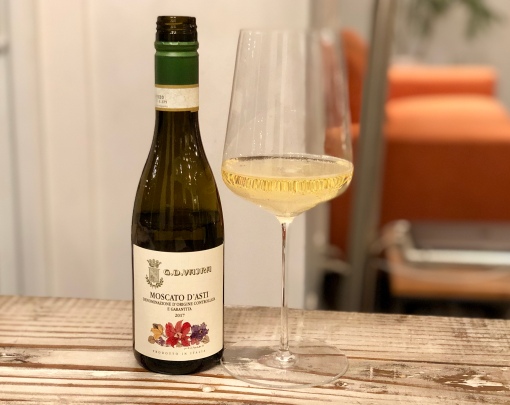
Once more into the breach, my friends, and on Day 5 of Advent 2018, once more into the bag of Advent 2017 synonyms:  a Moscato d’Asti from a strong producer, much like last year’s Day 10.  That wine (I maintain to this day) struggled with some bottle condition issues, and I am happy to say that this one is clean as a whistle and full of youthful spirit. It is the 2017 G.D Vajra Moscato d’Asti, and spawns stories of history, of production method, of flavour.  Which to tell first?

IMG_9367

Let’s start from the start, I suppose…which it turns out is much more recent than I expected.  Despite its highly traditional-seeming name and labelling, G.D Vajra is barely 45 years old, a complete baby by the standards of Barolo, founded in 1972 (albeit from family vineyards from a couple decades earlier) with its first commercial vintage not released until 1978.  It is named after founder Aldo Vajra’s father and was started because, in Fresh Prince of Bel-Air style, Aldo participated in a student protest revolt in the city where he lived at age 15 and was thereafter immediately sent out to the Barolo countryside to live with his grandfather on a farm for the summer, away from the sway of proletariat rebellion.  That summer in Barolo (as it likely would for all of us) triggered a deep and abiding passion for wine, which ultimately resulted in the bottle here before us.  One little fight and his mom got scared…

IMG_9369

My favourite thing about Moscato d’Asti, apart from its dangerous low-alcohol crushability, is the trivia behind how it’s made.  It is one of the few types of sparkling (or frizzante, in this case – lightly sparkling) wines that do not go through two fermentations:  one to vinify a dry base wine, the other to re-ferment that wine with additional yeast and sugar to create the bubbles.  Instead, it combines both processes into one through a highly ingenious process called the Asti method.  Fermentation begins as per usual, but in a pressurized steel tank that is sealed off from air partway through the process, with the result that the carbon dioxide that is a fermentation byproduct cannot escape the tank and is trapped in the wine.  Then, when the half-bubbly wine is still quite sweet and considerable amounts of yeast and sugar remain that would normally continue to make sweet magic and craft a higher-alcohol dry wine, the tank and the wine inside are chilled to near-freezing to halt fermentation (yeast don’t like cold much).  The yeast is then filtered out of the tank while it is still under pressure (so that fermentation with the remaining sugar does not continue when the wine warms back up) and the wine is bottled under pressure — only lightly bubbly, at 5-6% alcohol and with a bunch of residual sugar.  Brilliant.

IMG_8726

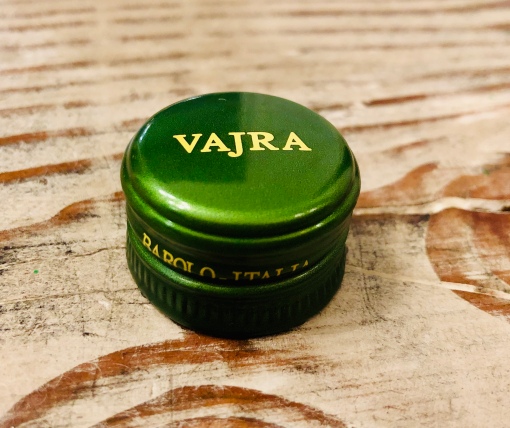
Stelvin Rating:  8/10 (That green is just beautiful, especially in person, and the powdery sheen works.)

This particular Moscato hails from a single vineyard in the perfectly named commune of Mango, located on a steep slope at elevation in the Moscato d’Asti region.  It is a gleeful tropical fruit salad on the nose:  mango (of course), kiwi, canned oranges and pears, banana leaf, star fruit, and onward down the orchard Rolodex, spiked with gobs of potpourri and spring flowers and chemically Alka Seltzer and city pool chlorine.  Lush and quite notably sweet, even for Moscato standards, it is lent a sense of airiness due to its sloshy frizzy bubbles, which are not quite as penetrating or scouring as you might anticipate, a product of the not-quite-sparkling frizzante fermentation process (which is also why this can be bottled in a normal bottle and closure as opposed to a thicker Champagne-style bottle — it’s under a lot less pressure).  All I can taste is pineapple Life Savers, cream soda and every single flavour of Gummy Worm on overdrive.  The finish is slightly cloying, thanks to acid that doesn’t quite stretch all the way to the end of the line and can’t quite balance out the Moscato’s immense sweetness.

As a beverage, this is freaking delicious.  It took no time at all for the entire half-bottle to disappear.  As a wine, I wouldn’t rank it among the top Moscatos I’ve had because the rest of the wine can’t quite keep up with the sugar levels, leading to things getting a little bit flouncy.  But it’s hard to be too unhappy after a couple glasses of Moscato.

87 points


Bricks Wine Advent Calendar 2018: Day 4

4 12 2018

By Peter Vetsch

Well, Ray got his blast from Wine Advent past yesterday, continuing his baffling streak of Austrian dominance (which I believe is now at FOUR Austrian calendar wines in a row, somehow).  Mine came today.  Last year, I was a fresh-faced Wine Advent newbie on December 4, 2017 when I pulled a Manoir du Carra Cru Beaujolais from the Bricks calendar.  Tonight, on December 4, 2018, I unwrapped my designated Advent bottle to find…a Manoir du Carra Cru Beaujolais.  I quickly checked my calendar to ensure I had the right year.

IMG_9360

To be clear, it’s a different Manoir du Carra Cru Beaujolais this time around.  This producer is on its fifth generation of family ownership and has accumulated 34 hectares of vineyard land in an astonishing FIFTY different plots scattered throughout Beaujolais. Last year’s wine was from one of the better-known of the 10 Beaujolais Cru subzones, Fleurie; tonight’s option is from the larger but lesser-known (or at least less visible on shelves here) Brouilly, the biggest and southernmost of the Crus which by itself comprises 20% of the Cru vineyard land in the region.  Brouilly is so named for a massive volcanic hill at the heart of the area, Mont Brouilly, which is itself named for Brulius, a lieutenant in the Roman legion who apparently liked naming volcanoes after himself.  This particular wine comes from the Combiaty lieu-dit (or small plot/area bearing a traditional wine) in the village of St. Etienne le Varenne, located in the south of Brouilly and known best for its dry, nutrient-poor pink granite soils.

IMG_9363

I have a strange relationship with Manoir du Carra, in that I have had their wines on at least a dozen different occasions, but NEVER yet in a full-sized bottle — I’ve had a few splits, a number of glass pours, and a strange but incredible 500 mL bottle (which is a remarkably effective size for a bottle of wine and should be produced in greater quantities).  I assume they actually make normal bottles but cannot confirm.  The Terre de Combiaty comes from Gamay vines that average 50 years of age which are hand-harvested (like everything in the Manoir du Carra portfolio), treated with minimal intervention in the cellar and fermented using semi-carbonic maceration, where the intracellular fermentation processes within the individual grape berries from the carbonic maceration process are joined with simultaneous normal alcoholic fermentation from the crushed berries at the bottom of the fermentation tank, resulting in more colour and tannin than pure carbonic maceration and a scaled-back version of the bubble-gummy carbonic flavour set.

IMG_7088

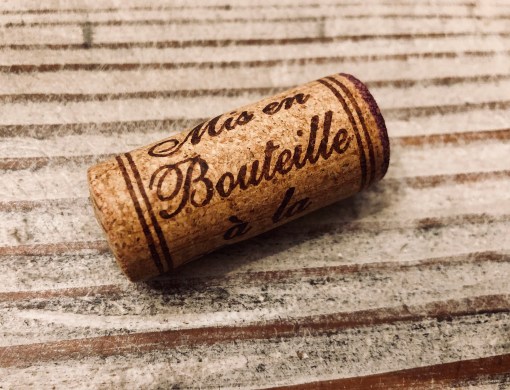
Cork Rating:  1.5/10 (Further deduction from last year’s edition for not changing the nondescript “Mis en Bouteille” nonsense after being blog-warned.)

This sort-of carbonic Brouilly is a sharp purple colour in the glass but thins quite markedly at the rim.  It is initially much darker than expected aromatically, date and slate and dirt emerging first, with black cherry and chalk peeking through underneath.  Over time, a Banana Runts (with banana leaf?) top note emerges, a nod to its carbonic half, as well as the more anticipated raspberry-rooted Gamay sense of joy.  Fresher and plummier on the palate, the wine showcases its clean, squeaky tannins almost immediately, and fairly laissez-faire acidity results in this Gamay seeming more broad and expansive than its standard varietal signature, albeit while retaining a feathery, wispy sort of texture.  The mineral streak noticeable on first smell lasts throughout, iron and rock dust and magnets, but red fruit blooms as you go along to keep anything from seeming severe.  Bricks, I’d say you are 4 for 4.

88 points


Bricks Wine Advent Calendar 2018: Day 2

2 12 2018

By Peter Vetsch

Day 2.  The spirit is still strong, the Advent joy still coursing through my veins, and now the Christmas decor is up and running in my household, so we are officially in the season.  I’m not sure what I was expecting when peeling back the wrapping paper on the sophomore bottle of this calendar, but Cru Bourgeois Bourdeaux wasn’t it.  This could bode well.  Let’s find out.

IMG_9349

Chateau Caronne Ste. Gemme was THIS close to the big time.  As far as global wine locales go, it is quite nicely situated in Bordeaux’s esteemed Haut-Medoc region, but through a misfortune of cartography it fell a scant 500 metres from where they drew the border for the much more esteemed sub-zone of St. Julien, home of legendary classed-growths Leoville-Las Cases, Ducru-Beaucaillou, Leoville-Barton, Gruaud-Larose, Langoa-Barton and other pricy hyphenated estates.  Its vineyards are actually right beside Gruaud-Larose’s, but on the other side of the appellation tracks and thus on the outside looking in of the 1855 Classification and Bordeaux’s power hierarchy.

IMG_9351

That said, it’s not the legendary estates where the bargains are found; it’s their neighbours.  Caronne Ste. Gemme has been owned by the same family since 1900, but in the last 25 years the current generation of owners has overseen a quality explosion thanks in part to a renewed focus on their 45 hectares of Gruaud-adjacent estate vineyards, planted on a mound of Cabernet Sauvignon-friendly gravel over sandstone.  The wines are fittingly largely Cab (60%), rounded out by Merlot (34%) and Petit Verdot (6%) and see around a year in barrique (20-25% new barrel) and further time in bottle before release.

IMG_1455

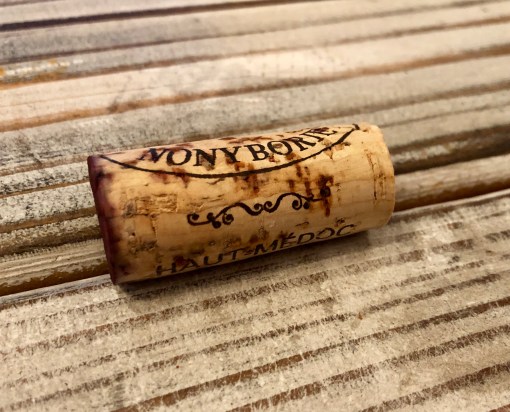
Cork Rating:  3/10 (Better idea: put the CHATEAU name on the cork, not the proprietor’s name.)

This is SUCH a textbook, classic Bordeaux.  The 2014 Ste. Gemme is a deep thick ruby-purple colour and smells as though it’s just starting to trace the contours of its aging curve:  blackberry and blackcurrant fruit, tomato leaf, juniper, new pennies (back when those were a thing), pink erasers, campfire embers and topsoil.  An interesting beam of supporting raspberry red joins the chorus once the wine hits the tongue, joined by pipe tobacco, cedar shavings, moss and leather, surrounded by still-scratchy tannins that frame rather than block the flavour symphony.  This is a wine that could simply be nothing else.  It is a dream tasting wine, because it purely and accurately displays exactly what it is without overdoing it; varietal and regional typicity squared.  The Bordeaux that I own I’m trying to age, so I haven’t cracked a bottle of youthful Bordeaux in some time.  This makes the argument that I should, while simultaneously making me mull over what it might taste like in another 5 or 10 years.  Value Bordeaux, I have found you.

89+ points


Bricks Wine Advent Calendar 2018: Day 1
1 12 2018

By Peter Vetsch

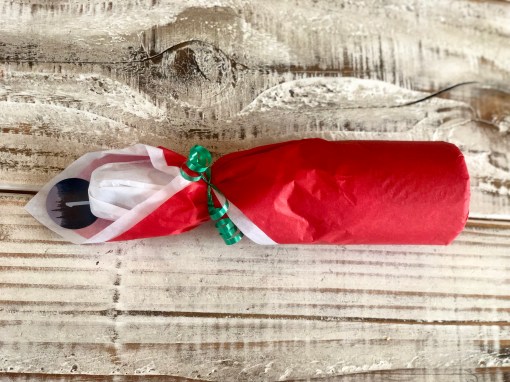
It is again the most wonderful time of the year, and the busiest time in the Pop & Pour blogging calendar — booze Advent.  For the second year in a row, we will be live-blogging every 375 mL day of the Bricks Half-Bottle Wine Advent Calendar, from today until Christmas Eve (following which we will immediately start blogging the 12 Days of Vinebox Christmas beginning Christmas Day…because, well, we’re crazy like that).  Last year, Bricks Advent began with a bubbly bang, so I was wondering if this year might start the same way; I was quite thrilled not only to find out that it did indeed, but that the bubbles in question were already indelibly seared into my memory, a monument to possibly the single greatest moment of my 2018.

IMG_9339

It begins…

I am a Washington Capitals fan.  Always have been.  I don’t know why.  I was born in 1980 in Gretzky-era Edmonton, to Edmonton-area parents, and from the age of 3 or so, from the time I understood what hockey was, Washington was my team.  Those of you with a passing knowledge of NHL hockey will understand that this was not previously a recipe for contentment.  Washington went from being what is still the worst expansion team in the history of the NHL (8-67-5 record in 1974) to being good-but-not-good-enough to being that team whose heart always got broken in a more novel and unbelievable way every playoffs to being that flashy run-and-gun early-Ovechkin squad that “didn’t know how to win” to being clearly the best team in the NHL until it really mattered to being past their window for success.  They pushed all their chips in the season before last, loaded up their team for their last shot at glory – and lost.  To Pittsburgh.  Again.  Last season was supposed to be the start of a slow descent back into irrelevance.  Until it wasn’t.  On June 7th, I watched in tearful disbelief as my team, that I watched fail over and over for 38 years, somehow won it all and raised the Stanley Cup, the culmination of a literal lifetime dream.  I promptly reached for the first bottle — or half-bottle — of bubbles I could find.

IMG_8313

And lo and behold, 6 months later, I peel back the Day 1 2018 Advent wrapping paper, and am greeted with:  my Stanley Cup wine.  I am instantly transported back to watching Ovechkin shrug off the doubt and unfair criticism of the hockey world and hoist the Cup over his head, screaming in triumph.  I remember the stream of excited messages filling my phone, the post-game interviews, the order of players who got their turn to lift the Cup, as soon as I see the label.  Wine, man.  Barone Pizzini and I will forever be connected because of that finally-captured moment of glory. Read the rest of this entry »