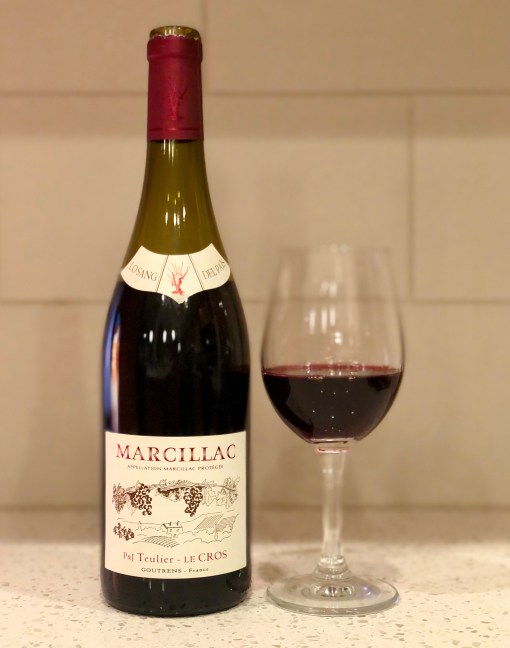
Cellar Direct Winter Wines: Lo Sang del Pais

7 12 2019

By Peter Vetsch

[This bottle was provided as a sample for review purposes.]

It’s been a little over a year since we featured a wine from Cellar Direct on PnP, and in the meantime the first pan-Canadian artisanal wine club has been busy behind the scenes, preparing its next suite of offers and tweaking its approach in order to maximize buying efficiency and aim for the best of both worlds in the online wine purchasing sphere:  time-limited features and repeat buying capability.  Once a week, on Saturday, Cellar Direct will release a new offer on its website and to its mailing list.  Offered bottles are available in multiples of 3 and can be shipped across Canada, with any such transport taking place in temperature-controlled trucks to avoid any damage to the wines in transit due to extreme heat or cold.  Full case purchases of a single wine attract discounts off the standard offer price and the most effective shipping rates, but buyers can also accumulate 3-packs or 6-packs of different wines and have them shipped together.  Once an offer week comes to an end, any remaining bottles left over from the offer can still be purchased from the online shop at Cellar Direct’s website, so if a particular order bowls you over, there may be a chance to get more.  Did I mention they ship across Canada?  Readers in government liquor monopoly provinces, take note — this is your chance at freedom.

IMG_1008

The first of Cellar Direct’s new offers dropped today, and to mark the occasion we are bringing you a contemporaneous review of the bottle now available for online purchase everywhere in the country.  We will be doing the same thing over the next five Saturdays (yes, even through Wine Advent, because we’re crazy), so feel free to check out our notes on the weekly wine to assist in your buying decisions.  The inaugural Cellar Direct release of this new offer season is one that rang a few distant bells, but it took some digging through the Pop & Pour archives to find out why. Read the rest of this entry »


Wine Review: Moraine Winery Spring/Summer Set

28 06 2019

[These wines were provided as samples for review purposes.]

Wine is indelible.  It can leave impressions and fasten itself onto moments or events with surprising, graceful ease.  Show me a bottle or producer that I’ve had before and I will often be immediately taken to the scene where I had it last, even if it was otherwise unmemorable.  In the case of Naramata’s Moraine Winery, the scene already had memories to spare, and every bottle since has carried them back to me.

IMG_0254

My first encounter with the wines of then-up-and-coming Moraine was almost exactly six years ago today.  I remember because Calgary was underwater, as the great flood of 2013 wreaked havoc on the heart of my hometown.  I also remember because I had become a dad for the second time ten days prior, on Father’s Day; the power and energy of the tempests that made the waters rise seem to have imbued themselves in my son Max ever since.  The white, black and red labels of Moraine marked my first return to the blog after Max’s birth.  He just finished kindergarten two days ago.  The wheels of time continue to spin, but our wines mark our occasions.

IMG_0260

Moraine was founded by current owners Oleg and Svetlana Aristarkhov, ex-Albertans who headed west to follow their passion into the world of wine.  Their two estate vineyards, the older and larger Anastasia and the younger Pinot Noir-devoted Sophia, are named after their two daughters; the winery name reflects the glacially deposited rocks that form a key part of the terroir at their Naramata site.  When I first came across Moraine it was in its early stages of life, just finding its way as a new winery.  In this current encounter it is in a different phase of life, and in the midst of a significant transformation:  a new winemaking facility and cellar is being built, a new larger tasting room and hospitality centre has just opened, and as of last year the wines are being crafted by a new winemaker, albeit one who is a familiar face on the BC wine scene.  Dwight Sick, who spent the last decade as the winemaker at Stag’s Hollow, came to Moraine just before the 2018 harvest, the final critical piece to this next stage of the winery’s growth and development.  Yet Moraine’s focus still remains anchored in Anastasia and Sophia, and the ever-maturing vines they hold.  I got the opportunity to taste some of Sick’s first Moraine releases, as well as an early single-vineyard Pinot Noir from Sophia, to get a sense of how far Moraine Winery has come. Read the rest of this entry »


PnP Panel Tasting: Midnight’s Children – The Many Syrahs of The Hatch

14 06 2019

By Raymond Lamontagne

[These bottles were provided as samples for review purposes.]

It has been a prolific week for PnP Panel Tastings! This one was a doozy. Peter, myself, and PnP spirits guru Tyler convened to open some Okanagan wines; we also ended up taking a massively (possibly Okanagan-wine-induced) deep dive into ’90s alternative rock, which was good for a monumental spike of nostalgia and a slew of earworms for the rest of the weekend. Sometimes hangovers sound like Wide Mouth Mason. The company was of course excellent, tolerant of my occasional requests for overly long Rush tunes (OK, it wasn’t all ’90s). That aside, this was the sort of night from which memories are made, frivolously pleasant and soul-searching alike, and what better vinous companion for me than The Hatch?

The-Hatch-Wines-West-KelownaYou see, four of the suspects hailed from the cellars of the Hatch, subject of a previous PnP Panel Tasting and still my favourite BC winery. I defy you to find a similar blend of idiosyncrasy, creativity, whimsy, and sheer stubborn courage in our westernmost province. There is a true artist’s aesthetic behind the wines. These guys do what moves them, unabashedly and without any discernable pretense. That kind of genuine interface with the world at large is becoming an endangered species other than in the world of wine, where uniqueness has long been a virtue, one that has likely only gathered steam in recent years. I think The Hatch has grown by leaps and bounds since its inception, pushing well beyond some initial growing pains into the world of truly fine wine, even as they never truly forsake the uncanny, the weird. After all, “a poet’s work is to name the unnameable, to point at frauds, to take sides, start arguments, shape the world, and stop it going to sleep”. The Hatch shall continue to keep us awake (except perhaps if you kill all four of these on the same night. Not recommended.) Read the rest of this entry »


PnP Panel Tasting: Culmina Spring Releases, Part 2 – Funky Whites Edition

12 06 2019

By Peter Vetsch

[These bottles were provided as samples for review purposes.]

The last set of Culmina releases featured on PnP was so fun to taste that I felt compelled to bring in the band to share the joy of this next group, a trio of weird, wild, semi-experimental whites that are seeking to test boundaries both within and outside of the winery.  Fellow PnPers Ray Lamontagne and Tyler Derksen gathered with me to taste through a lineup that included my own personal Culmina obsession, the incredible Unicus Gruner Veltliner, as well as two even more envelope-pushing whites from Culmina’s recently unveiled small-production Number Series.  Things got fun fast.

IMG_0183

The Number Series was introduced in late 2016 as a way for Culmina’s talented winemaking team to spread its wings a bit.  Part Reserve-level offering and part experimental test drive, each Number Series wine is a limited-production rarity that may only see a single run, never to be repeated again in subsequent vintages.  It represents the best of Culmina’s developmental efforts from that year, either showcasing a standard-rotation Culmina grape in a whole new way (like the inaugural Number Series Wine No. 001, a rich, ripe Riesling styled like an Alsatian Grand Cru) or braving the unknown with a varietal that isn’t part of Culmina’s normal lineup.  The two most recent Number Series bottles below both fall into the latter camp, and show off some intriguing winemaking approaches to boot.

As with all our Panel Tastings, while we discussed the wines as we were tasting them, we came up with our own impressions and our own scores for each bottle and did not share them until everyone’s assessment was complete.  We started, as every meal and tasting and day on this Earth should, with Unicus. Read the rest of this entry »


Pop & Repour: Preservation Experimentation – The Results

14 05 2019

By Peter Vetsch

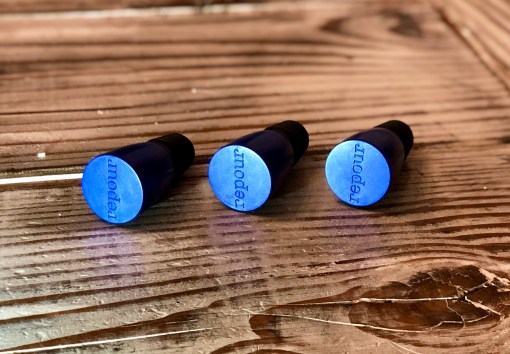
I feel like I’m in a time warp.  In this optimistic post from early February, I advised that the blog had been silent for a while due to sickness, but that we were back up and running and that I was testing out a brand new wine preservation gadget, with results to follow shortly.  Well, after that post, about the excitingly simple Repour Wine Saver, the blog fell silent for a while due to sickness (an ear infection and then sinusitis this time, mixing it up from the bronchitis I had before), but I can now advise that we’re back up and running and that I can now report the results of said wine preservation test.  If this cycle repeats one more time, I’m quitting the wine-writing hobbyist biz, but if I can avoid antibiotics for the next hour or two, I will pass along this tale of experimental trials, inadvertent failures of the scientific method and the (largely) successful demonstration of Repour’s mettle, complete with an unexpected twist at the end.

IMG_9674

For those who don’t feel like clicking on this link to catch up on my prior introduction to this ingenious device, the Repour is a single-use one-stop-shop for wine preservation, a plastic bottle stopper stuffed with oxygen-absorbing material that actively removes any oxygen remaining in the bottle after each glass pour, leaving the wine inside pristine and untouched by decay-inducing air for (they say) “days, weeks or even months”.  It costs $3-4 CAD and lasts for the entire duration of one bottle of wine, regardless of how many times you go back to the well with that bottle.  I decided to test that marketing promise rather emphatically.  I opened three bottles of 2015 Alfred Merkelbach Urziger Wurzgarten Riesling Kabinett from Germany’s Mosel Valley, drank a healthy dose out of each, then left one as a poor unguarded control bottle without any form of preservation beyond my refrigerator, dosed the second with argon gas (my personal pre-Repour preferred method of preservation) and test-drove the Repour with the third, revisiting them multiple times over the next month and tracking how well each bottle stood up.  My running preservation diary is below.  To refresh your memory, here was my initial tasting note on the Merkelbach Kabinett:

“The wine is a complete throwback to a bygone era, understated and filigreed in style, with canned golden apple, sea spray, petrichor and orange zest aromas giving way to a fragile yet enduring, heavily mineral palate, all quartz dust and steel.  The restrained residual sugar offers relief and key lime accents without weight, the acid is omnipresent but not cutting, and the finish is taut and straight-laced, perfectly formal and polite and German.” Read the rest of this entry »


12 Days of Vinebox: Day 8

1 01 2019

By Peter Vetsch

Happy New Year!!  As we leave 2018 behind and stride into 2019, I think Vinebox might find itself in the midst of a bit of a rut, in need of a New Year’s resolution or two.  You know when the record groove glitches and the same loop of sound plays again, over and over?  We may be within that repeating loop of time now.  If you have a seasonal collection of wine that is 12 bottles large, I would resist having any two bottles in a row come from the same place.  When you hit THREE identically situated bottles in a row, and when the locale in question is Sicily, I start to wonder a bit.  This is not a slight against Sicilian wine, which is often quite wonderful, but it is a query about whether it should make up the whole of Act 2 of the 12 Days of Christmas, particularly when the drinking audience for this set is likely in large part unfamiliar with it.  Add that all 3 of the bottles in question appear to be made by the same producer, and I start to yearn for a little more variety.

IMG_9502

All that said, sometimes the variety can be found within the produce of the winery itself. To be sure, the leaner whites from Days 6 and 7 don’t give me a lot of common ground from which to judge this CABERNET SAUVIGNON.  Sicilian Cab?  It is rare, but it exists, and here is allowed to stretch its legs in 100% pure-varietal form.  This is the 2017 Cantine Grosso Baldovino Cabernet Sauvignon, made from grapes grown in northeast Sicily, a highly friendly area for viticulture thanks to tons of sun, moderating ocean influence and mineral-laden soils.  This is been a home to cultivated grapes since Roman times but is just now being rediscovered by modern audiences.  Cantine Grosso is now five generations into its stewardship of Sicily’s long vinous history, having been founded way back in 1887.  Maybe 3 straight Vinebox days aren’t too many after all. Read the rest of this entry »


12 Days of Vinebox: Day 2

26 12 2018

By Peter Vetsch

Happy Boxing Day!  Hopefully you are full of holiday cheer and post-holiday deals, have all of the presents you want to return neatly stacked in a corner and are ready to get down to business on the world’s coolest post-Advent calendar, one vial at a time.  Let me be the first to tell you that blogging 100mL of wine is a highly stressful experience — you get 2/3 of a glass to fully formulate an impression and write detailed tasting notes, so every drop matters.  It definitely aids the focus, as near-panic often does.  Hopefully you can be a bit more frivolous with your vial.

IMG_9356

I picked this test tube in my Vinebox blogging selection draft with Ray because I was highly curious to check out a Provençal red, a relative rarity in these parts.  Provence is globally known for being the pink wine hub of the world, and for good reason:  80-90% of the bottles that come out of the Cotes de Provence are roses.  They are a well-oiled pink buzzsaw of a production region, dialled into the patio trade in massive quantities…but they are also, more quietly, home to high-quality reds and whites, and in fact, the top producers in the area often make all three.  One such producer is the historic Chateau de Bregançon, centered around an 18th century castle built on a slope overlooking the Mediterranean Sea.  The estate has been owned by the same family for over 200 years, which is now in its 7th generation of stewardship of the grounds, including 52 hectares of vineyards in prime growing areas, on exposed hillsides featuring tons of sun and surprisingly little rain given their oceanfront locales.  If you HAVE to make wine anywhere, why not make it the Mediterranean riviera?

IMG_9357

Quick tangent that may be of interest to only me:  Chateau de Bregançon is one of 18 estates to have been awarded the “Cru Classé” designation in Provence, which it turns out is the only French wine region besides Bordeaux to have a classification/ranking system tied to producers as opposed to vineyards.  The “Cru Classé” was conceptualized in 1947 by some of the longstanding wineries in the area, who commissioned a series of experts to research the winemaking chops and history of the local producers and create a listing of the best of the best.  They did so in 1955, and of the original 14 Bregançon made the cut and was therefore immortalized as elite (because once you’re named Cru Classé, you can’t be un-named).  Sadly, the designation doesn’t appear on the Vinebox vial, but I know it’s there in spirit.

IMG_3838

I had difficulty locating any information at all about this 2015 Bregançon Cotes de Provence, but based on the reds currently listed on their website, it’s a good bet that this one contains healthy proportions of both Syrah and Mourvedre, two of Provence’s principal red varieties (the others being Cinsault, Grenache and the lesser-known Tibouren).  What I can advise with more certainty is that the wine is surprisingly deep and rich in colour, especially after you’re used to yet another pale pink Provençal rose, a hefty ruby-purple that is just shy of opaque.  You can smell it as soon as you crack the bottle, flint and whetstone, blueberry and currant, hot rocks and sauna, flesh blood and ink (the latter set making Syrah seem ever more likely).  Sharply structured, the wine’s most prominent features on the palate are firm scrubby tannins and whiplash acidity, but these are softened and broadened by pure red fruit and violets arranged over this Cru Classé’s iron spine.  A thoroughly impressive Vinebox debut for me – can’t wait to see what the future holds.

90 points


Bricks Wine Advent Calendar 2018: Day 12

12 12 2018

By Peter Vetsch

Halfway!!  As in past years of blogging Advent, I arrive at the midway point of the calendar wondering what the hell I’ve gotten myself into and why on Earth I keep doing this every December.  The pre-Christmas pressure is getting to all of us, but we persevere — these wines aren’t going to analyze themselves.  The random division of blogging days is starting to coalesce into possibly pre-ordained wine patterns:  while Ray’s calendar selections tend to focus on things from 2013 and things from Austria, mine all seem trapped in calendar nostalgia, directly harkening back to bottles we pulled one year ago.  And here we go again:  tonight’s wine is a trip down memory lane squared.  When I first opened the wrapping paper I actually thought it WAS the very same bottle that kicked off the inaugural Half-Bottle Advent:  the 2016 Bella Wines Rose Brut Natural “Westbank”.  From the front it looks identical, but closer examination of the back label reveals that, while this is also a Bella traditional-method sparkling Gamay, it’s from a different vintage (2017 vs. 2016) and a different vineyard.  And what a difference both of those things can make.

IMG_9416

Bella Wines is uncompromising in its vision and is probably unlike anything the Okanagan Valley has otherwise seen:  a 100% bubbles-only natural wine producer that makes only single-varietal, single-vineyard offerings, most of which are from a single vintage.  They source grapes from organic vineyards, avoid any additives in the winemaking process, ferment only with indigenous yeasts and use cooler fall and winter outdoor temperatures to help with cold stabilization.  The goal is to create the purest and most transparent picture of the place and time that gave the grapes life; the flip side of that coin is that, when the land and the season do not want to cooperate, the picture painted may not be an appealing one.  But Bella is like a war-zone photographer:  the idea is not to appeal, it’s to reveal. Read the rest of this entry »


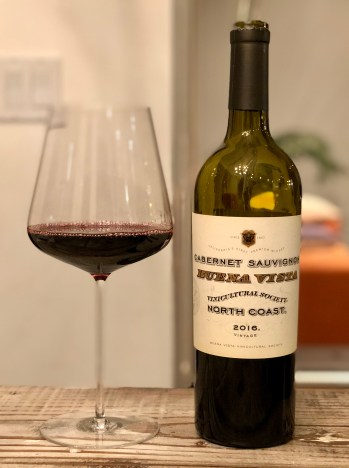
Wine Review: 2016 Buena Vista North Coast Cabernet Sauvignon

17 10 2018

By Peter Vetsch

[This bottle was provided as a sample for review purposes.]

IMG_8980

A rare sighting.

The $25 California Cabernet Sauvignon is an endangered species nowadays; once a stalwart gateway drug for luring novice wine drinkers into a lifetime of vinous enlightenment, it has now been superseded in that endeavour by numerous other New World crowd-pleasers that are managing to offer similarly accessible and overt pleasure at wallet-friendlier prices.  The combination of rising land costs, fire- and drought-inspired production difficulties and the utter shredding of the Canadian dollar as compared to the US greenback on world currency markets has more or less eliminated California as a source of solid value wine in our market.  Buena Vista Winery is trying to change that, but with this series of factors arrayed against it, it’s fighting an uphill battle.

I have previously written about the remarkable, riotous, barely credible but actually true history of Buena Vista, the proud owner of the label “first commercial winery in California”.  It is well worth refreshing your memory about, but the Coles Notes version must at least mention:  (1) Agoston Haraszthy, who may have been the first Hungarian to emigrate to the United States, who founded the winery and who essentially crammed six lifetimes of zaniness and adventure into one shortened 19th century thrill ride; (2) 1857, the year Haraszthy founded Buena Vista, part of a major ambition to establish high-quality vitis vinifera grapes in hospitable California soils; (3) Nicaragua, where Haraszthy fled barely a decade after Buena Vista was first established, with angry and misled company investors potentially at his heels; and (4) alligators, which apparently ate him there.  Never a dull moment at Buena Vista in the 1850s and 60s. Read the rest of this entry »


Wine Review: White Australia

19 07 2018

By Peter Vetsch

[These bottles were provided as samples for review purposes.]

Sometimes your moneymaker becomes your millstone.  Australia, which had been making wine for a couple centuries without raising much of a global fuss about it, burst onto international liquor store shelf traffic jam within the past two or three decades thanks to a flamboyant, fruity, brash, ripe style of Shiraz, buttressed by a New World-friendly Cabernet Sauvignon that was easy on the pocketbook.  A mammoth export industry emerged, but typecasting of Australian wine as a whole inevitably followed, leaving those longstanding producers with histories older than the Dominion of Canada stuck in their own misleading shadow.

IMG_8444

Now the Shiraz spotlight has pulled back a bit, giving everyone a bit of room to breathe and again find comfort in the space of their own natural identities; for longstanding affiliates Pewsey Vale and Yalumba, this has meant a continued push to enhance the white side of Australia’s wine spectrum, and perhaps the sowing of a few carefully nurtured seeds which might ultimately settle the debate of what should be known as Australia’s signature white grape.  Two deserving contestants, from two benchmark wineries, lie below. Read the rest of this entry »


Spirits Review: Hennessy V.S. Cognac

15 06 2018

By Dan Steeves

There is something about sipping on an exquisite fine spirit that provides a sense of sophistication and high class. It wasn’t always like that for me though. What was once an exercise of trying to stomach such liquids in the presence of my older and wiser siblings, a rite of passage you might say, eventually grew into an appreciation of their flavours and aromas once I was finally able to see past that burning sensation in my throat. I slowly gained a preference for whisky, single malt scotch, aged tequila and brandy, and these have been staples in my liquor cabinet ever since. When I was recently sent a sample bottle of Hennessy Cognac for review, I was pleasantly surprised and excited at the opportunity to taste and write up a spirit, instead of a wine, especially a bottle from one of the most iconic and best known Cognac producers (a place on the podium it has rightfully earned).

The unmistakable bottle shape of the Hennessy Very Special Cognac

Cognac is a type of brandy, a spirit made from grapes and the distillation of wine, that is produced is the Cognac region of France, just a short drive North from the famous Bordeaux wine region. The art of distilling the traditionally neutral and low-alcohol wines from the region has been practiced for hundreds of years and was originally done by Dutch merchants as a means of prolonging the life of the wines for transport to other markets. By law, Cognac must be produced using a specific copper pot still (the Charentais pot still, which is named after the Charente river that passes through the region). The base wine used for the production of Cognac can be made from up to eight different grape varieties, with the most popular being Ugni Blanc (more broadly known as Trebbiano). Grapes are grown at high yields which produce rather simple and, frankly, boring base wines with high acidity and low alcohol. The low alcohol levels in the initial wine mean that the finished spirit must be heavily concentrated through the distillation process to meet the legally required minimum alcohol levels for the spirit, which in turn also means a significant concentration of the aromas and flavours as well.

No additives (chaptalisation, sulphur dioxide, etc.) or other shortcuts are allowed in the production of the base wine so as to keep it as pure as possible and prevent any potential off flavours and aromas being emphasized in the final spirit. After distillation, the spirit (also known as the “eau-de-vie”, or “water of life”) is then placed into oak barrels for maturation for a minimum of two years before it can be called Cognac. Similar to the large Champagne houses, Cognac producers each have a signature style and character that is dutifully replicated every year through masterful blending of various aged eaux-de-vie, such that finished Cognacs are non-vintage (or, more accurately, multi-vintage) creatures, each classified according the age of the youngest spirit in the blend. The three main designations are V.S. (Very Special, 2 year minimum aging), V.S.O.P. (Very Superior Old Pale, 4 year minimum aging), and X.O. (Extra Old, 6 year minimum aging).  If only all legal alcohol designations had such cool acronyms. Although these minimum aging requirements are relatively low, it is very common for the blends to have eaux-de-vie with an average age far exceeding the minimum.

A five star label on the Hennessy V.S. (originally called the three star)

Cognac is dominated by a small handful of large producers that account for over 90% of the production in the region. Although all of these top producers are well known (Remy Martin, Courvoisier, Camus, etc.), Hennessy is the most well known and popular producer, especially in North America, where it has been exported for over 225 years and is the #1 market for the brand. Hennessy has also been at the forefront of Cognac innovation,  being one of the first spirits producers to offer its product in bottles rather than shipping oak barrels and also being the creator of the amazingly named Very Special, V.S.O.P and X.O. designations. Hennessy sets a benchmark with all their Cognac, be it the Very Special or Extra Old,  and thanks in part to the largest collection of eaux-de-vie in the world has created some of the most premium Cognac in the world. It’s no wonder it is part of LVMH (Louis Vuitton Moet Hennessy) group representing all of life’s luxuries. Read the rest of this entry »


Spirits of Calgary: Buffalo Trace Tasting @ One18 Empire

1 06 2018

By Tyler Derksen

IMG_5037

Drew Mayville of Buffalo Trace.

It’s not every Wednesday that I get to leave work in the middle of the day to try nine whiskeys (if you’re being pedantic, actually eight whiskeys and one whisky, as the spelling of the spirit varies with its location of production), but this past Wednesday was one of those days.  I had the absolute pleasure to attend a tasting of Sazerac offerings chaired by Buffalo Trace’s Master Blender, Drew Mayville.  Buffalo Trace is part of the larger Sazerac company, whose myriad of other brands we also got to enjoy.  While the whiskey was the star of the show, it was Drew’s presentation and engagement with the subject matter and with all of us that really made the tasting special.  Drew is a Canadian who began his career in spirits at the Seagram’s plant in Waterloo, Ont. in 1980, eventually becoming the company’s fourth ever Master Blender.  After Seagram ceased to be, Drew then took his talents to Buffalo Trace, which at the time he joined was a relative unknown in the whiskey world, a fact that is hard to believe now that it has earned over 500 awards nationally and internationally over the last decade.

Drew’s passion for whiskey was readily apparent.  As Buffalo Trace’s current Master Blender, it is his job to take the aged spirits created by the Master Distiller and weave them into both established product lines and new and exciting projects.  Drew’s favourite whiskey is “the one he hasn’t made yet”.  In answer to the follow-up question “how do you make a better whiskey?”, Drew immediately said, “I don’t know”, reflecting his continuous stretch for further improvement.  Perhaps my biggest takeaway was Drew’s love of experimentation, embraced by both Buffalo Trace and Sazerac, which has created at least 50 different bottling “experiments” since 2006.  He freely acknowledges that not all of the experiments are successful and lead to new product lines, but this adventurous spirit is part of the fabric of Sazerac.  This is all the more impressive when one considers the extended aging process in the creation of whiskey.  Sazerac has even built a warehouse, Warehouse X, solely for the purpose of manipulating the many variables that go into the creation of whiskey (including light, temperature, air flow, wood grain, and others) to better understand the impact of those variables on the finished product and to use that knowledge to create that elusive “better whiskey”.

IMG_5039

Drew’s other point of emphasis was the recipe for the whiskey, which he came back to with each successive whiskey we tried.  Buffalo Trace’s bourbons are made of a combination of 6 main ingredients (Drew would never tell us exactly how much of each).  First, any bourbon must legally be made from at least 51% corn, which gives the spirit its sweet and fruity characteristics.  Next is rye, which adds spice, pepper and herbaceous notes.  Third is barley malt, which doesn’t add flavour so much as enzymes vital to the fermentation process.  As an alternative to rye, wheat can also be used, but this is far less common and wheat bourbons make up less than 5% of the overall spirit created.  Add limestone-filtered water and yeast and you’re almost finished.  The one ingredient that is not often talked about with bourbon, but that has a profound impact on its character, is time.  As was made clear when we started sampling, Buffalo Trace ages its whiskey longer than many of its competitors.  Speaking of sampling, now would be a good time to shine a spotlight on the fantastic whiskeys we tried. Read the rest of this entry »


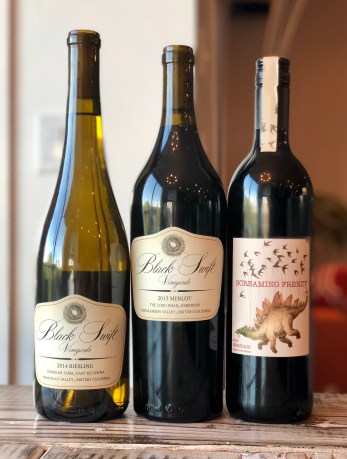
PnP Panel Tasting: The Hatch – Library Release

28 05 2018

[These bottles were provided as samples for review purposes.]

IMG_8224

(Re)Entering The Hatch.  In stereo.

It had been far too long since we last held a panel tasting, and we were missing it – there’s something about tasting outside of the echo chamber of your own brain that is gloriously refreshing and invigorating.  Plus multiple wines and multiple friends is generally a guaranteed recipe for a proper time.  One of us (Ray) wondered about reaching out to his friends at the Okanagan’s weirdest and most interesting winery, The Hatch, for inspiration.  We naturally assumed that we would get some intriguing and tasty wines from this divergent, artistic, even edgy winery (the latter word is drastically overused but still rather works in this case).  The common approach would have been to send a set of current releases, bottles that the reading public could come scoop if they were so inclined.  Well, The Hatch is not common.  PnP’s second ever Panel Tasting turned into a library release celebration, focused on a trio of bottles with a few years on them, from the mysterious and mildly depraved depths of the winery’s cellars.  It not only allowed us to get a sneak peek at what the future might hold for some more recent bottles that we were holding, but it also gave us a chance to answer a question that nags at a number of people in our home and native land just getting into wine:  can Canadian wine age?  Does it improve?

IMG_8240

The answers, in order, are “yes” and “it depends”; in the upper echelons of our national wine industry are scores of producers who are creating layered, complex, long-term wines that easily stand the test of time.  The eye-opening part of this tasting wasn’t so much that ageworthy BC wine was possible, but that it was starting to be accessible even at lower price points, another sign of the province’s rapid progression into a globally competitive wine power.  After this, there will be far more local bottles that spend more cellar time before seeing the light of day.  It made sense for us to each choose a bottle to write up, but rest assured there was much group analysis of everything we were tasting, making the below report a true joint effort. Read the rest of this entry »


Wine Review: Famille Sichel Bordeaux Tiers

15 04 2018

By Peter Vetsch

[These bottles were provided as samples for review purposes.]

IMG_7943

What a Bordeaux progression looks like.

Bordeaux is one of those regions that any aspiring wine geek finds out about roughly 15 seconds after beginning their vinous adventure.  It leads off many textbooks, is (rightly) touted as the spiritual homeland of red grape overlord Cabernet Sauvignon and its consigliere Merlot and is held up as a must-try area both so that new oenophiles can get a sense of the classics and because top-flight Bordeaux can be so memorable that its first-chapter place in all future textbooks is likely assured.  Of course, all of that comes at a price, one that seems to be increasing by the year, as wines from the top chateaux become more luxury commodity and less agricultural product and as international demand in new markets shoots through the roof.  So what are the non-obscenely wealthy wine-curious to do?  Here’s one way to start:  find a reputable producer and taste your way up their lineup, through the quality tiers and nesting-doll classifications layered throughout the Bordeaux appellation.  Even if you don’t make it all the way up to the grand vin flagship of the chateau, you will end up with a really good sense of what makes this rarefied region tick and also start to understand why those tiers exist in the first place.

IMG_7947

I was fortunate enough to test this tasting theory with the wines of Famille Sichel, a producer with whom I didn’t initially think I was familiar until discovering that they are the owners of one of Bordeaux’s hidden gem producers, Margaux’s Chateau d’Angludet.  While the winery is centuries old and the Sichel family’s history in Bordeaux is almost equally entrenched (they have been established in the region as a negociant since 1883 and are on their sixth generation of family ownership), their two paths didn’t cross until the 1960s, when d’Angludet was in a state of extreme disrepair and was bought and revived by Peter Sichel thanks to an extensive replanting and restoration program.  Current proprietor Benjamin Sichel continues both the negociant business (under the Maison Sichel banner) and the Chateau’s estate bottlings with a heavier focus in the vineyard and a defter touch in the cellar.  I have previously enjoyed Chateau d’Angludet on numerous occasions and now got to experience the trail of bottles that leads up to it. Read the rest of this entry »


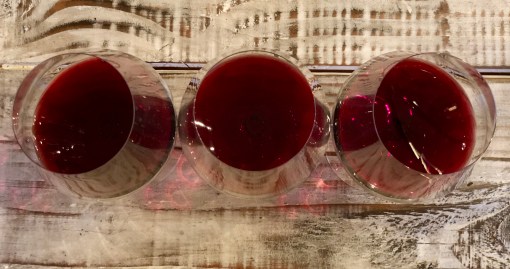
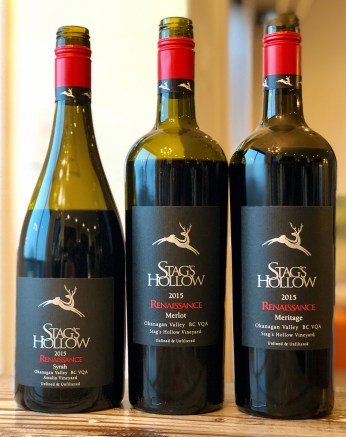
Wine Review: Stag’s Hollow Renaissance Reds

5 04 2018

By Peter Vetsch

[These bottles were provided as samples for review purposes.]

IMG_7892

The big guns.

As I have mentioned in reviews past, my first thought of Okanagan Falls’ Stag’s Hollow Winery is always as a forward-thinking, try-everything trailblazer, the continual vanguard of varietal suitability and experimentation in British Columbia, constantly checking in on whether the next potential star grape of the province (be it Albarino, Grenache, Dolcetto, or any number of others in its viticultural Rolodex) might be one that few had previously considered.  So it’s a fun change of pace tonight to sit down and see how they handle the classics, those big red varietal stars so often seen across the Old World and New World alike, the first grapes you expect to see on any wine store shelf.  This review set is a particular treat, because all three of the bottles below hail from Stag’s Hollow Renaissance line, the winery’s premium flagship tier of offerings, produced only in vintages when the wines can live up to the bottle’s special black label.  I have heard rumblings that the 2015 Renaissance set breaks new ground in terms of quality and longevity; I had not previously had the opportunity to test this theory for myself, but it would not surprise me out of a winery that always seems to be improving. Read the rest of this entry »