Burrowing Owl Spring Releases

16 05 2017

[These bottles were provided as samples for review purposes.]

Some people chart the seasons using a calendar; others look to the melting snow and the first robins to mark the start of spring.  For me and this blog, the new season only arrives when the box of new releases from Burrowing Owl is delivered and tasted.  I can now happily announce:  spring is here.

FullSizeRender-592

OK, yes, I had a glass of the Chardonnay before the tasting started.  I regret nothing.

Burrowing Owl is one of the few Canadian wineries that has been consistently able to juggle both quantity and quality, producing 35,000 cases annually from 16 different varietals grown across 170 acres and three different estate vineyard sites encircling the scorching southern Okanagan hubs of Oliver and Osoyoos.  It is likely best known for its Bordeaux varietals, but also makes room in its vineyard sites for less expected offerings like Tempranillo and Viognier, not to mention a killer Syrah that is proof of concept of the region’s suitability for the grape.  Burrowing Owl’s two largest vineyards are scant minutes away from the US border, on western-facing slopes angling down towards the temperature-modulating Lake Osoyoos, which both restrains the Okanagan desert heat during the day and extends it at night.  The third is due west of Oliver, in the neighbouring Similkameen Valley, using its proximity to Keremeos Mountain to help grow Bordeaux whites Semillon and Sauvignon Blanc, where 2017’s spring releases conveniently start. Read the rest of this entry »


2015 Testalonga El Bandito Cortez

19 03 2017
FullSizeRender-562

What a label. What a wine.

OK, so it’s been a long time.  I wasn’t intending to drop off the map for over a month after my last post, but a work tornado and a series of weekend Timbits tournaments then morphed into bronchitis that knocked me out of commission for a couple of weeks.  Thankfully, the antibiotics have run their course, my lungs and tastebuds are back to almost-normal and Pop & Pour is again ready to roll.

And what better way to get back in the swing of things than with something fantastically different?  And what better qualifier for that category than a $48 South African natural wine Chenin Blanc with a catchy pop-art label?  Seriously, this is one of the best labels I have ever seen on a bottle of wine.  As soon as I saw it, I knew I was buying the bottle, which is about as big a compliment as you can possibly pay to a branding tool.  The label for this Cortez bottling by Testalonga changes every year, but they absolutely killed this one, which tugs on my (and presumably every other father’s) heartstrings.  I love it.

Read the rest of this entry »


The Tournament of Pink (1st Ed.)

28 01 2017

[These bottles were provided as samples for review purposes.]

Rosé:  it’s not just for summer anymore.  Well, it was never just for summer, but the shelves of your local wine shop wouldn’t have given you that impression a few short years ago.  I had a tremendously difficult time a couple years back trying to source some pink wines in November/December for use in office client Christmas gifting packages, because for many retailers, the presence of rosé within store walls was decidedly seasonal.  This remains the case to some extent (because it is virtually impossible to beat a chilled rosé as an out-on-your-deck-on-a-summer-evening wine), but I had an agent tell me recently that their pink sales outlook for this winter might just outpace their summer, and I’ve seen more rosé on Calgary shelves with snow on the ground this year than ever before.  This is an enlightened change for the better:  there may be no type of wine more versatile and more universally appealable to all types of cuisines and personalities than a good rosé.

fullsizerender-539

There can be only one.

So when I noticed that I had a quartet of bottles of rosé sitting by themselves in an unassuming pink group in my cellar, the time of year did not remotely deter me in coming to the obvious conclusion:  let’s open them all and drink them all at once, and let’s do so in a Kickboxer-style fight-to-the-death tournament.  Thus the Tournament of Pink was born.

The actual Tournament took place a week or so ago and was simulcast on Twitter and Facebook, but work commitments have kept me from immortalizing the results on PnP until now.  If you weren’t following along at the time, we played our game by splitting our four rosés into two qualifying heats where they battled for the right to face off for the Tournament of Pink crown in the final.  Game on. Read the rest of this entry »


Sub-$16 Red Throwdown: Old vs. New World

11 01 2017

[These bottles were provided as samples for review purposes.]

fullsizerender-532

Have you EVER seen a red wine bottle shaped like the one on the left?

The $15 bottle of wine is a vanishing category nowadays, and what you can actually get for that price may often make you wish you couldn’t.  A combination of the struggling Canadian dollar, increased liquor taxes and the inexorable power of inflation is slowly pushing up that minimum purchase threshold where you can expect to find decent quality…if you look hard enough amongst the oceans of double entendre-named or critter-adorned labels at that price point.  However, there are still a select few value crusaders scattered here and there in this cost category, from under-appreciated regions where production costs remain low and climatic abundance makes ripening easy.  I happened to have two such examples lying around, one from the Old World and one from the New, so what better way to make use of them than to have them battle to the death for my weeknight enjoyment?  Since the estimated retail price on each creeps barely over $15.00, we’ll play it safe and call to order the first ever Pop & Pour Sub-$16 Wine Challenge.

In this corner, from the Old World, comes a representative from arguably the most overlooked source of good, solid, inexpensive table wine:  Portugal. Read the rest of this entry »


2015 Alvear Alange Tempranillo

28 09 2016

[This bottle was provided as a sample for review purposes.]

fullsizerender-423

ALANGE SMASH!!

Some bottles immediately grab your attention for reasons you can’t quite put your finger on.  Other bottles grab your attention by screaming strange Spanish words in 128-point font.  Alvear’s Alange (sorry – ALANGE) is an example of the latter.  Its minimalist / maximalist label and Beetlejuice-like neck pinstriping are designed for the visually primed North American market, as is the consumer-friendly bottle indication of the grape inside (100% Tempranillo), a rarity on Old World wines.  It is a daring display from one of the older family-run wineries in the world, but it serves its purpose well, making you pause for that split second and linger over the bottle; after that, its price tag (a shade over $15) and the quality of the juice inside does the rest.

Alvear is truly a dynastic estate, now on its 8th generation of family winemaking.  The Alvear bodega was first constructed nearly three hundred years ago, in 1729.  Since then, it has not only stayed in the family but is now handled in all aspects by Alvears — there are currently over 50 members of the extended family involved in some capacity.  Alvear is known primarily for sherry, made in the region of Jerez in Spain’s arid southwest corner, but it is also gaining traction as a table wine producer, growing estate grapes due north of Jerez in the Ribera del Guadiana sub-zone of Extremadura.  To say this is an under-the-radar global area for red wine would be a marked understatement, but it’s places like this where values are often found.  Ribera del Guadiana is known primarily for scorching hot summers, freezing cold winters, reddish clay soils and an obscene array of planted grapes: while Tempranillo takes up the most acreage, the area is home to a crazy mix of red and white indigenous and international varietals, from Sauvignon Blanc and Pinot Noir (!) to Pedro Ximenez and Graciano. Read the rest of this entry »


Wine Review: 2015 Gramercy Cellars Olsen Vineyard Rosé

19 07 2016
FullSizeRender-386.jpg

Think pink.  And WA State.

This is the first time in a long time that I’ve sat down to write about a wine just because I wanted to.  I love (and am continually amazed by) the opportunity this blog has afforded me to try new bottles and attend incredible tasting events, but every once in a while it’s nice to step back and recalibrate and share the experience of a wine for the sheer joy of doing so.  And since there are few things that give me more joy in this world than opening a bottle of Gramercy Cellars (my favourite producer and a winery that currently occupies about 15% of my cellar), and since I’ve been waiting for this bottle of rosé to land for months now, this is definitely the wine for the task.

The story of Gramercy Cellars is the story of America’s youngest Master Sommelier, who went from serving, then sourcing, wines for some of the pinnacle dining establishments in various major US centres to making his own in rural Walla Walla, Washington, drawn to the desert in the Pacific Northwest by the potential he saw in the area’s Syrahs.  After graduating from Cornell University, Greg Harrington attained the Master Sommelier designation at age 26 (he was until recently the Chair of the Court of Master Sommeliers, Americas and is now on the Board as a Chair Emeritus) while working in New Orleans for famed chef Emeril Lagasse.  Stints for Wolfgang Puck in Las Vegas and the B.R. Guest Restaurant group in New York followed, but a chance tasting of Walla Walla Syrah in NYC led to a trip out to Washington State, which very quickly led to Greg and his wife Pam quitting their jobs, uprooting their lives and fast forwarding a far-off retirement dream of making their own wine to the here and now.  For me at least, Gramercy is one of a small group of Washington producers that is unwrapping the state’s wine potential in real time, turning out nuanced, textured and ageworthy wines that turn New World stereotypes on their heads. Read the rest of this entry »
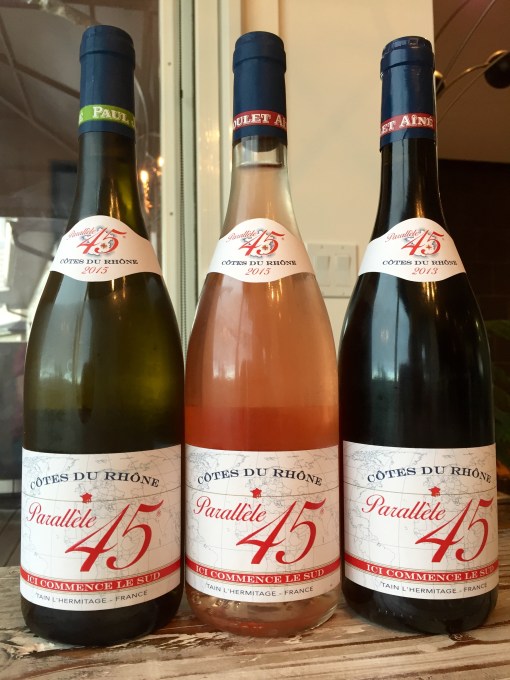


Domaines Paul Jaboulet Ainé: Parallele 45 Trio

6 07 2016

[These bottles were provided as samples for review purposes.]

There are not many producer names as synonymous with their home region as Jaboulet and France’s Rhone Valley.  From their pinnacle bottling La Chapelle from the world-renowned hill of Hermitage (which I have had once and vividly remember to this day) down through the rest of their lineup, the wines of Domaines Paul Jaboulet Ainé are known and revered the world over, although until recently they were decidedly under-represented in our market.  That has now thankfully changed, and Alberta once again has full access to some of the best wines the Rhone has to offer.

FullSizeRender-379

The Jaboulet winery was first started by Antoine Jaboulet in 1834, who then passed it to his two sons, Paul and Henri, to carry on his legacy.  Paul, the older son, gave the winery his name (the “Ainé” in “Domaines Paul Jaboulet Ainé” literally translates to “eldest”), and it stayed in the family for almost 175 years before finally being sold in 2006 to the Freys, a family of French winemakers with properties in Champagne and Bordeaux.  Caroline Frey (fittingly the eldest daughter of the family), who is now 37 and so was in her late 20s at the time of the acquisition, assumed the mantle of winemaker and has instituted sustainable vineyard practices and carried forward Jaboulet’s reputation for classic quality.

Parallele 45 is Jaboulet’s entry-level lineup of Cotes du Rhone wines, so named because the 45th parallel of northern latitude runs right through the Rhone Valley, bisects some of the Domaine’s vineyards and is only a couple kilometres from its cellars.  The bottles all bear an inscription found on a monument in the nearby village of Pont de l’Isere (which, and I am not making this up, is at 45.0040 degrees N latitude):  “Ici Commence Le Sud” – The South Starts Here.  Post de l’Isere looks to be on the southern edge of the Northern Rhone as opposed to the northern edge of the South, but the mantra still fits, and Jaboulet’s wines straddle both sides of the Valley.  I got to taste through the full Parallele 45 lineup – white, pink and red, all of which share the same $18ish wallet-friendly price tag – and see how well they carried forward the tradition of this great name. Read the rest of this entry »


Return of The Mules: Torres Summer Values

12 06 2016

[These bottles were provided as samples for review purposes.]

It’s been so long since I sat down and wrote a straightforward normal wine review that I’m having trouble remembering how to start one.  Thankfully, I’m aided by an old PnP standby:  if they’re not there already, the Torres family of wines has to be close to the record for largest number of individual write-ups on this site, aided in part by their broad-based dual-continent operation and vast lineup but mostly by their consistent ability to deliver quality and identity for less than you’d expect.  I made the mistake last year of prejudging their “Las Mulas” line of entry-level Chilean wines by its lighthearted name and beast of burden on the label, only to be reminded by the emphatically delicious Las Mulas Rose that Torres takes all its wines seriously.  This year, with the Sauvignon Blanc and Cabernet Sauvignon from the Las Mulas brand, I will not make the same error twice.

FullSizeRender-375

The wines for Las Mulas come from Chile’s warm, flat and fertile Central Valley, where the benign climate and the absence of most common vine diseases make it the country’s most productive and most popular grape-growing region.  This can be both a good thing and a bad thing:  obviously getting your crop to ripen without heroic efforts is a benefit, but wine grapes specifically tend to derive much of their flavour concentration and character from having to struggle a bit to grow, and when they’re deprived of that opportunity to strive the results in the glass can be flat and uninteresting.  To combat the Central Valley’s generosity, Torres planted the Las Mulas grapes on nutrient-poor soils and entirely avoided the use of herbicides or pesticides (the vineyard sites are certified organic).  The vineyards are wholly hand-harvested, with nary a machine in sight, making this New World wine done in old school ways…yet somehow still hovering around the $15 CAD mark on the shelf.  Each of the offerings below cleared by (pre-primed) expectations for that price point with ease. Read the rest of this entry »


Whisky Advent Calendar 2015: Day 24

24 12 2015

Merry Christmas Eve, everybody!  While the children are tucked all snug in their beds, I’m drinking scotch at my kitchen table and writing about it for the 24th day in a row.  The penultimate whisky of the 2015 Advent Calendar is giving me a couple different flashbacks, first to 12 days and half a calendar ago, when on Day 12 KWM rocked the Glenfarclas 21 Year Single Malt, and then to exactly one year ago tonight, Christmas Eve 2014, when the prior calendar’s final whisky was the $720-a-bottle Glenfarclas 40 Year Single Malt.  Tonight we fall somewhere in between, with the $215 Glenfarclas 25 Year rounding out the 50 mL selections in the current calendar (there’s a special bonus super-sized 100 mL bottling for Christmas tomorrow).  I heartily concur with the value distribution in 2015 as opposed to 2014, as I can say with certainty that there isn’t a $505 quality and flavour difference between the 25 and the 40 Year, and the savings from that selection had significant effects on what else was able to be offered this time around.

FullSizeRender-203

I don’t have many production details on this whisky, but like the 21 Year it was aged in sherry casks, although it doesn’t show it in the flavour profile quite as much as its younger brother.  A dense amber colour, it billowed out intense yet relaxed aromas of smoke, carrot cake, molasses, burnt honey, spicy oak, graham crackers and celery stalks, that last lingering vegetal hint keeping the surrounding sweetness grounded.  Its quarter-century in oak made it soft and mellow on the palate, dripping with chocolate orange, roasted marshmallow, mesquite, charred wood, pumpkin spice, honey and Fig Newtons.  This is basically the perfect fireside whisky on a cold winter’s night like tonight, the ideal Santa pick-me-up.  Important epilogue:  I swear to god I didn’t read or refer back to my notes of the Glenfarclas 21 before writing these ones, but reading them side by side now, you sure can tell they’re family, can’t you?  I don’t think I’ve ever used the term “carrot cake” to describe any wine or spirit before, but it’s the first thing that came to mind with this scotch, and there it was in the Glen 21 aroma writeup; “pumpkin spice” too.  Deja vu!  Have a great one tomorrow – one last writeup to come!


Whisky Advent Calendar 2015: Day 23

23 12 2015

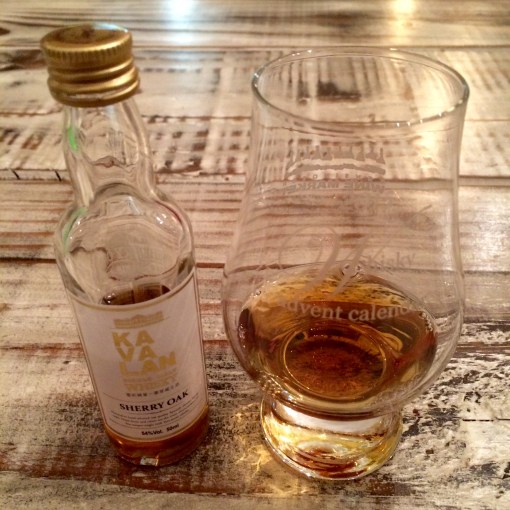
Well, I’m officially on Christmas holidays from work…but not from this blog or my daily whisky spirit quest, which is now three days away from completion.  So close.  The Whisky Advent Calendar usually finishes with a flourish, and tonight did not disappoint in that regard, as we returned to Taiwan and a producer that’s quickly becoming a podium distillery for me, the world-renowned Kavalan.  Taiwan’s only distillery first showed up in the calendar on Day 5 with its superb cask strength ex-Bourbon bottling, a whisky so good that my father-in-law promptly (and quite properly) went out and grabbed the last bottle in the province after trying it.  That whisky was a pale transparent gold in colour.  This one, not so much.  Same cask strength series, same base spirit, likely a similar aging period (that is:  not that long a one, as Taiwan’s heat and humidity supercharges the maturation period and allows for maximum barrel character transfer in a minimal time window), but different aging vessels, as we go from Bourbon’s brightness to the colourful depths of Oloroso Sherry casks.  Oloroso is an oxidative style of sherry where the wine is aged with full exposure to oxygen for many years, giving it a deep tawny colour like fresh coffee, and that hue obviously sticks with the barrels, because tonight’s Kavalan cask strength (54%) Sherry Oak Single Malt was easily the darkest whisky yet, an amazing shadowy bronze.  It’s clearly darker than yesterday’s Balblair 1990, and that one aged in oak for 24 years; Kavalan’s only been in existence for 10, and I bet this malt only saw barrel for half that or less.  How crazy is that??

FullSizeRender-202

This whisky smells EXACTLY like fresh pancakes and maple syrup, almost to the extent that I don’t want to write another aroma note about it.  It’s eerie.  If I must expand, I would go with French Toast Crunch (Cinnamon Toast Crunch’s lesser-known cousin, which also smells like pancakes and maple syrup), cinnamon twists, cabane a sucre, raisins and mincemeat.  You will not be surprised after looking at this that it was hearty and warming on the palate, with mind-warping depth of flavour for a whisky so young.  There was a purity to it, like tasting French press coffee as compared to office coffeemaker coffee (particularly since it actually did taste like coffee), with warm accompanying notes like marzipan, salted caramel and walnuts mixed with toasty oak, elastic bands, fruitcake and suntan lotion.  The finish was extended and all Oloroso – deep, rich and sherried.  I would call this a value for $160, even though stylistically I may prefer the ex-Bourbon slightly; the margin between the two is razor thin for me.  Kavalan just can’t lose.


Whisky Advent Calendar 2015: Day 22

22 12 2015

So remember way, way back in Day 1 of the calendar when I said that the calendar’s inaugural whisky, the vintage-dated 2003 Balblair Highland Single Malt, was released at the same time as the 1990 and the 1993 because Balblair’s distillery master holds all his whiskies until they’re exactly ready for release, even if out of chronological order?  (If you actually do remember this without clicking the link I will be shocked.)  Well, that may have been some inadvertent foreshadowing, because here on Day 22 I pulled that 2003’s older release twin out of the box.  Yes, Kensington Wine Market is bringing the thunder tonight with the 1990 Balblair, a 24 year-old malt (bottled in 2014) that is easily the oldest in the calendar to date.  It must be a winner, because it prominently graces the distillery’s cover page online.  Balblair is one of Highland’s oldest distilleries, established before Canada was in 1790, after which it followed the sort of sob story that seems to be par for the course for every Scottish distillery over the last 150 years:  it was sold in 1894, moved in 1895, mothballed in 1911, OCCUPIED BY THE ARMY in 1939, sold in 1948, sold in 1970 and sold in 1996 before being re-themed as a single-vintage-whisky-only producer in 2007.  The 1990 vintage malt was first released in 2008, with this 2014 bottling being the second iteration and release of that vintage.  I’m sure winemakers wish they had the luxury of making more of killer vintages after the fact to please consumer demand; I only know of one that ever did, and that didn’t end so well.

FullSizeRender-201

This 1990 Balblair, 2nd ed., was matured in a mix of American oak ex-Bourbon barrels and Spanish oak ex-sherry casks.  But let’s stop the technical tasting talk for a second and just look at this whisky.  Wow.  Particularly in comparison to the pale greenish colour of the Balblair 2003, this is off the charts incredible, an amazing dark rich brown sugar hue that tells a story by itself.  How can you love whisky and not love looking at that?  The astounding visuals set the stage for the smooth, sweet, treacly nose, a languid mix of Kraft caramels, demerara sugar and those weird hard orange-wrapped hard toffee Hallowe’en candies, lifted and given life and freshness by apricot and mandarin orange fruit.  There is a surprising and prominent spicy edge to the palate that adds a sense of toughness to the flavours of coffee grounds, Mars bars, sultana crackers, melon and citrus, all surrounded by luxurious mellow sugared notes brought on by the long aging process.  I believe that this is the priciest whisky to date at $175, but you can immediately see, smell, taste and feel what the extra investment brings you.  Brilliant stuff.


Whisky Advent Calendar 2015: Day 21

21 12 2015

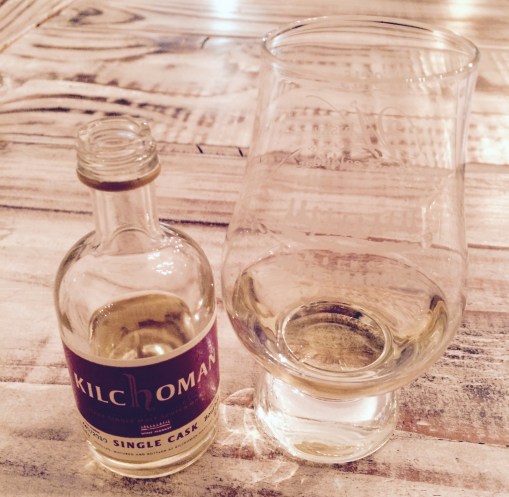
Aaaaaaaghh.  That was my admitted reaction when I opened the door to Day 21, one of four whiskies left in this year’s calendar before the Christmas Day finale from the Single Malt Whisky Society, and came face to face with Kilchoman again.  These last few days before the finish line in the 2014 calendar were home to some real zingers, including my favourite whisky of last year (and one of my favourites ever), the GlenDronach Parliament; to see this coveted calendar spot taken up by a distillery I can’t quite bring myself around to like was a bit painful.  Now, to be clear, as discussed on Day 11 when Kilchoman showed up the first time in 2015:  they are a very highly regarded distillery with a super cool story (the farm-to-table equivalent of the scotch world, Islay’s first new distillery in forever), and I have whisky-savvy friends that go nuts for them, so there’s nothing wrong with them whatsoever, but they just don’t match my taste for whatever reason.  However, if I decipher the label correctly, there seems to be some reason for excitement with this particular bottling, which may only be available in the singular place from which I got the calendar.  The tiny Kilchoman bottle features an even tinier Kensington Wine Market logo right on the official label, which I’m guessing means that this was from a cask purchased by and bottled for the store only.  (Further research just undertaken confirms the theory – cool!)  This Single Cask whisky is from a bourbon barrel identified only as cask #440, from the year 2010.  That means we’re dealing with, at most, a 5 Year malt, one of the youngest whiskies in the whole calendar.

FullSizeRender-200

The KWM Single Cask was bottled at cask strength (meaning that no water was added to it to dilute it and reduce the alcohol to a standard 40%, 43% or 46% level).  In this case that means the scotch is at a mind-melting 60.4% abv, meaning that adding water is imperative to this one unless you’re using it for sterilizing wounds.  This ultra-special Calgary-only version of Kilchoman smelled like, well, Kilchoman, a must-be-from-Islay combination of moccasins, smoky peat, solvent, tennis balls, kelp, orange zest and melted cheese.  A little more fruit shone through on the palate, banana and cantaloupe, but the Islay grime still carried the day, with tons of old shoe leather, burnt tires and exhaust, maltiness and toast, with a glycerol-laden viscosity from the elevated alcohol and a sweet smoothness on the finish – the bourbon cask coming through at last.  This was certainly my favourite Kilchoman that I’ve had so far, although also the most expensive at $140, making it one of the pricier 5 year-old scotches on the shelf.  There is certainly a lot going on here for a spirit a half a decade old, but I still can’t say it’s my thing.  I feel legitimately bad about it, Kilchoman.


Whisky Advent Calendar 2015: Day 20

20 12 2015

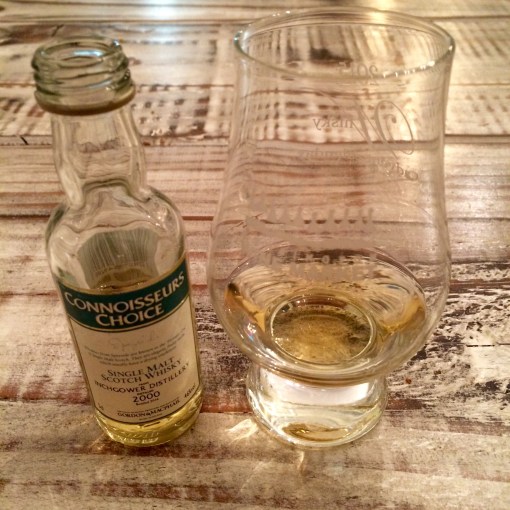
We’re getting close to being able to call this the #GandMCCWhiskyAdvent calendar:  tonight is the FOURTH offering from independent bottler Gordon & Macphail’s Connoisseurs Choice portfolio to come out of the 2015 KWM calendar, after Day 4’s Ledaig 1999, Day 10’s Auchroisk 1996, and just two days ago, Day 18’s Caol Ila 2003.  Thankfully G&M has sufficient options in its insanely huge lineup of whiskies not to have to repeat a distillery, so Day 20’s Connoisseurs Choice has a brand new origin, the Inchgower Distillery…which I can confirm I’ve never heard of before tonight.  This is because almost nothing it makes is bottled under its own name:  less than 1% of its production is labelled and sold as an Inchgower malt, with the bulk of its whisky being routed for major blends like Bell’s, Johnny Walker and White Horse.  Inchgower was somewhat optimistically founded as “The Great Distillery of Inchgower” in 1871, but it won’t surprise you if you’ve been reading along this season that it was liquidated in 1903, sold in 1936, sold again in 1938 and sold at least once more in the 1980s.  It was apparently near-impossible to keep a distillery open and belonging to its original owner in the 20th century.  Inchgower is now part of the Diageo empire, and Gordon & Macphail are one of the very few independent bottlings showcasing it on its own.

FullSizeRender-199

G&M are famous for their absolutely impeccable wood cask selection and whisky maturation program (a massive focus since they don’t make the spirit themselves), to the point where they have an entire separate website devoted only to their cask matching program, which is actually found at wood.gordonandmacphail.com.  You can’t make this stuff up.  They chose refill sherry casks for this Inchgower, a vintage whisky distilled in 2000 and bottled in 2014; the re-used nature of the casks definitely tones any sherried notes way down in the scotch, to the point where the type of barrel didn’t really stand out at all for me.  In fact, not much stood out, in a good or bad way:  the Inchgower had a grassy, stalky, cream soda- and maple-tinged but otherwise very quiet nose, to the point where I got out my Vinturi Spirit aerator to see if it could coax something more out of it.  Post hyper-decant, the aromas may have come across as rounder, but they were still subtle and subdued.  Things brightened up somewhat on the palate, a more energetic mixture of honeycomb, pancakes, whipped cream and vanilla bean, without the vegetal edge I had been smelling.  All in all, though, a pretty straightforward whisky, with a mouth-drying finish.  After some of the incredible values we saw last week sub-$90, I’d be pretty choked to shell out $108 for this unless I was a true whisky connoisseur (maybe the G&M range name is onto something) seeking out a solo Inchgower effort.  That would be some serious scotch dedication.


Whisky Advent Calendar 2015: Day 19

19 12 2015

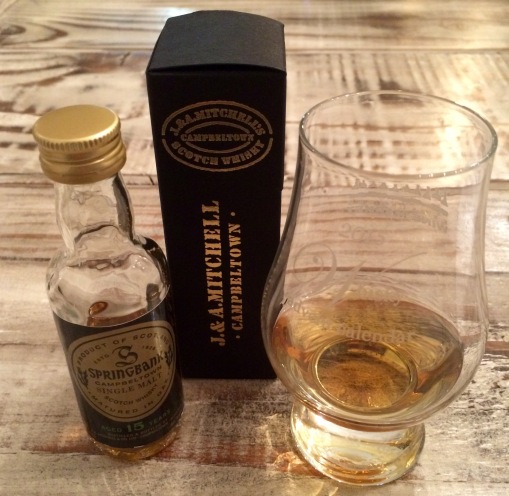
The last weekend of 2015 whisky writing is upon me.  I can smell the end of this December blogging marathon; it smells like scotch.  This is the fifth time in the past two years that I’ve opened a calendar door to see a black cardboard box wedged inside, which can mean only one thing:  a trip back to Campbeltown and its dominant Springbank distillery.  This time it’s the main label whisky as opposed to its sister labels, the triple-distilled Hazelburn (as seen in Day 13 this year and weirdly also in Day 13 last year) and the heavily peated Longrow (as seen in Day 20 last year, and with five more days to make an appearance this time around).  Last year the KWM Whisky Advent Calendar completed the triumvirate with the Springbank 10 Year on Day 18; this year we graduate to the Springbank 15 Year, the staple of the distillery’s core lineup, which runs for $112 at KWM.  Springbank distillery was established in 1828 on the site of an illicit still run by an Archibald Mitchell, and four generations later it remains run by Mitchell’s great great grandson, remaining in the family for close to 200 years.  100% of the whisky-making process for each label’s lineup occurs on site at Springbank, an extreme rarity in the scotch world.  The distillery’s website describes its 15 Year Single Malt in a way that requires remedial English lessons:  “Like a storm gathering off the Kintyre coast, our 15 year-old Springbank is dark and ominous, yet delicious.”  Um.  OK.  How is a gathering storm delicious??  Simile police APB – calling all units.  This sentence was a train wreck from about the third word in.

FullSizeRender-198

Grammatical terror aside, this is a beautiful dram that should please all comers, regardless of their flavour preferences and sensibilities.  It is a rich amber, almost orange in colour, and (especially without water added) smells strongly sherried at first, salt and seashells and yeast added on top of leather, raw pumpkin and Elastoplast aromas.  A few drops of water bring out softer, more welcoming baking spice notes like brown sugar, gingerbread and clove.  Like a storm gathering off the Kintyre coast, this Springbank is concentrated and fiery on the palate, yet delicious, with a viscous mouthfeel and a lingering set of flavours crossing multiple taste groupings.  There’s a sweet honeyed wheatiness to it, like breakfast cereal, a hint of peaty mossiness and smoke, a touch of sherry nuttiness and brine, and a dollop of caramel and fig maturity, all in roughly equal proportions.  This is the Goldilocks whisky, likely to come across as just right to a host of different palates.  Clearly a way better metaphor than the storm thing.  Into the 20s tomorrow!


Whisky Advent Calendar 2015: Day 18

18 12 2015

It is exactly one week until Christmas.  Seven more days, team.  Seven more whiskies, after this one.  Hang in there.  My mild-to-medium annoyance at opening the Day 18 window and pulling out yet another Gordon & Macphail Connoisseurs Choice bottling (the third of the calendar, after Day 4 and Day 10) turned to instant excitement once I saw the name of the featured distillery on the bottle:  Caol Ila, one of my favourites, and one of the best Islay distilleries at managing that delicate but critical balance of peat influence within a whisky’s flavour profile.  Having talked about Connoisseurs Choice twice now, I will avoid repeating (three-peating) myself and talk about Caol Ila instead.  Its name is pronounced “cull-eela”, meaning that I actually was almost saying it right before looking it up, a name that means “Sound of Islay” (referring to the body of water of the same name, not an actual sound, although that would be cooler).  Owned by global spirit behemoth Diageo, Caol Ila is, surprisingly to me, by far Islay’s biggest distillery, churning out more than double the production of the other distilleries on the island.  Much of this whisky is designated for use in blends — like the 2014 calendar’s super-awesome Big Peat, which champions its Caol Ila content on its label — but a smaller percentage of it is bottled in the distillery’s name, either under its own label or by independent bottlers like this.

FullSizeRender-197

This particular bottle of Caol Ila is from a single vintage, 2003, and was bottled this year, making it a 12 Year malt.  It is classic Islay on the nose, a combination of rawhide, old catcher’s mitt, seaweed, liniment and salty sea air, but in a way that smells far nicer than that sounds, using those aromas in the most comfortable way possible.  The depth of flavour and sheer intensity of both the peat-induced and the other notes is just remarkable.  The peatiness has layers, descending from briny/herbal at first to campfire and ash down to something more dank, like tar and pitch.  This ominous progression somehow doesn’t interfere with the development of equally potent notes of peanut brittle, celery sticks, ginger, oiled leather, poached pear, shoe polish…I could go on.  There’s a lot happening in this whisky, especially at only a dozen years of age.  For me it’s one of the best of the calendar so far without question.  I actually wrote at the end of my tasting notes:  “If this is under $100 it’s a screaming deal.”  Well, guess what?  It’s $99.99.  Scream away.