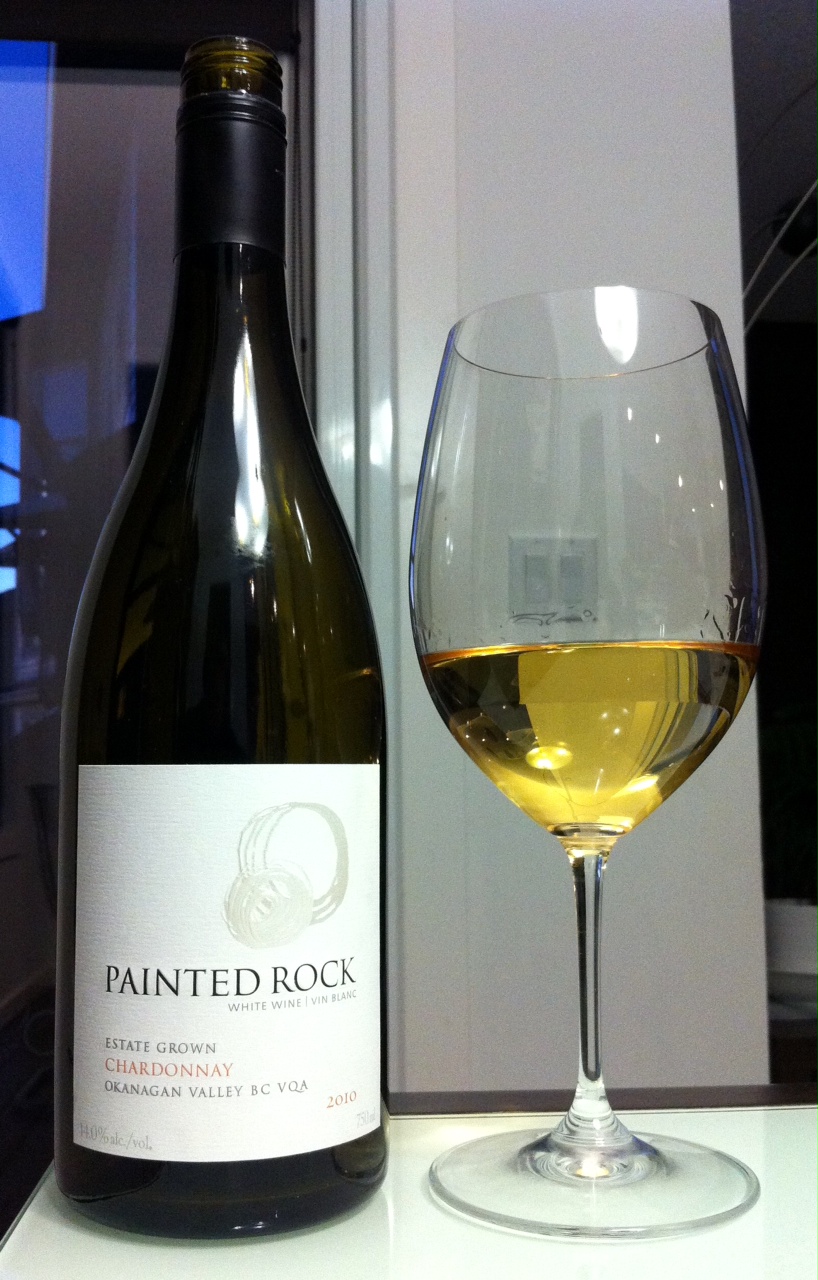
Wine Review: 2010 Painted Rock Chardonnay

3 02 2012

Although a newer vintage than the 2009, it's still like going back in time.

The coolest thing about this blog having been around awhile, other than the fact that I’ve miraculously managed to regularly publish an Internet wine blog for the better part of a year, is that I’m starting to come across second vintages in the bottles I open:  current vintage wines whose predecessors I have previously featured on PnP.  Case in point:  the 2010 Painted Rock Chardonnay from the Okanagan Valley, which is probably already facing an uphill battle in this review due to monstrously high expectations because I totally loved the 2009 PR Chard back in September.  I think Painted Rock is a producer on the forefront of the Canadian wine scene, one that is starting to show that we don’t have to settle for local wines that only measure up as against their neighbours, but that can also stand tall on the international market.  While PR focuses primarily on red wine, their lone white is a testament to the wonders of cool-climate Chardonnay, and I thought enough about the ’09 vintage that I absolutely loaded up on the 2010 as soon as it became available.

Read the rest of this entry »


Wine Review: 2010 Dona Paula “Los Cardos” Malbec

1 02 2012

Marketing note: maybe don't name your wine after a weed.

Many apologies for the blog radio silence over the past few days:  after weeks of avoiding it, I finally ended up catching the sinus/chest cold that every single person in Calgary currently has, so I had to shut down my wine consumption until I was more or less healthy.  The worst has now passed, but I still have a bit of residual congestion, so be warned in advance that the following review could be completely inaccurate…but it’s free, so what do you care?

Malbec!  I have no idea how this is possible, but this is the very first Malbec that has been the feature of its own PnP review.  The grape that has been a part of the blend in red Bordeaux wines for centuries but that has taken the drinking world by storm in the last decade with its single-varietal Argentinian incarnation is definitely the Shiraz of the 2000s, the new red wine that offers such an inexpensive and enjoyable experience that it has put a previously-ignored winemaking country on the vinous map.  I haven’t been avoiding it on purpose — like everyone, I’m a fan of a good Malbec — but after a couple sips of this wine, I knew I was going to regret making it my initial foray into the grape.

Read the rest of this entry »


Wine Review: 2009 Laughing Stock Blind Trust (Red)

19 01 2012

With this seamless a marketing pitch, this wine should always be in demand.

“Assets of the Blind Trust are kept under wrap and seal”, says the neck of Laughing Stock Vineyards’ “just trust us” bottle.  And so they are:  while at first glance you will not find any mention of what grape varieties make up this wine, and while the bottle tells you that the grapes in the blend change every year and never remain consistent, if you make good use of your corkscrew and fully remove the foil covering the top of the bottle, the mystery blend is revealed.  Since this is absolute genius marketing (and most of the fun involved in buying this bottle), I’m not going to spoil the surprise for you, other than to say that (1) the grapes involved are three of the five that go into Bordeaux wines in France (Cabernet Sauvignon, Merlot, Cabernet Franc, Malbec, Petit Verdot) and (2) the ’09 Blind Trust mix is heavily weighted in favour of one of the five.  And it ain’t Petit Verdot.

Read the rest of this entry »


Wine Review: 2009 Gramercy Cellars Syrah

16 01 2012

If you’ve read this blog for any length of time, you’d think this would be a no-brainer for me.  I pump the tires of Washington wine so hard that you’d think I was born in Tacoma.  (I wasn’t.)  In particular, I love what Washington State does to my favourite red grape of all:  Syrah.  Add in a top notch critically-acclaimed producer and it’s a recipe for a killer review, right?  At the end of the day, that’s definitely where it ended up, but it took a little while for it to get there.

Still just a baby, but clearly on the road to BIG things. Cellar if you can resist.

But let’s back up.  This is another bottle from the wine lineup of Washington’s Gramercy Cellars brought into the province by Highlander Wine & Spirits, cousin to the Third Man GSM blend that I glowingly reviewed back in mid-December.  In case you don’t feel like clicking on the link, here’s the Gramercy story in a nutshell:  young NYC Master Sommelier phenom with high-powered resto-job leaves it all behind to pursue his passion and grow Syrah in Walla Walla.  Gramercy makes other wines too (I still have a Cab and a Tempranillo downstairs waiting to be opened, and the Third Man is mainly Grenache), but Syrah is their heart and their focus.  Did I mention that tonight’s bottle is a Syrah?  And did I mention that Syrah’s my favourite?

Read the rest of this entry »


Wine Review: 2008 Kenneth Volk Enz Vineyard Mourvedre

11 01 2012

The bottle looks exactly like it tastes: black label, black wine.

How many old-vine, single-vineyard, 100% Mourvedre wines have you ever heard of coming out of North America?  Before last month, my number stood at zero.  Then my best friend Marc, a burgeoning wine lover himself (I’m working on it), got me this bottle for Christmas; it was one that he had tried at a party and couldn’t get out of his head, leading him to hunt it down and grab one for each of us.  It was about the most intriguing Christmas gift that I got this year — obviously I do good work in picking friends.

While most California winemakers would shy away from grapes like Mourvedre in favour of Cabernet Sauvignon and Merlot and other varietals more recognizable to the general public (and therefore more sellable), Kenneth Volk seems to immerse himself in them.  While his company Kenneth Volk Vineyards also makes the classics, it produces a special series of “Heirloom Varietals” wines that examines and honours “underappreciated rarities” that don’t often get their day in the sun in the US.  Mourvedre certainly qualifies — while I’ve seen it in a GSM (Grenache/Syrah/Mourvedre) or two from my home continent, I’ve never seen it get the spotlight to itself domestically until now.  This particular Mourvedre is from the Enz Vineyard located in the tiny Lime Kiln Valley AVA in central California:  it can be found just southeast of San Jose, about 1/3 of the way south from San Francisco to LA.  Interestingly (or crazily), Lime Kiln Valley finds itself immediately beside the San Andreas Fault, one of the more tectonically unstable places in the world (you want interesting soils as a winemaker?  Plant in an earthquake zone!).  Even cooler, this bottle comes from one of the oldest grapevine plantings in all of California:  almost 90 years old, the Mourvedre vines in Enz Vineyard were planted in 1922.  Think of all the wines that come out of California.  Now think that, pre-dating almost all of them, before “California wine” meant anything to anyone, there was this lone patch of Mourvedre planted in this obscure valley close to the coast.  Who would plant Mourvedre in California in 1922?  Who knows?  But that decision let me, almost a century later, crack open this mysterious and alluring bottle, because it had previously worked its magic on a great friend.  Wine rocks.

Read the rest of this entry »


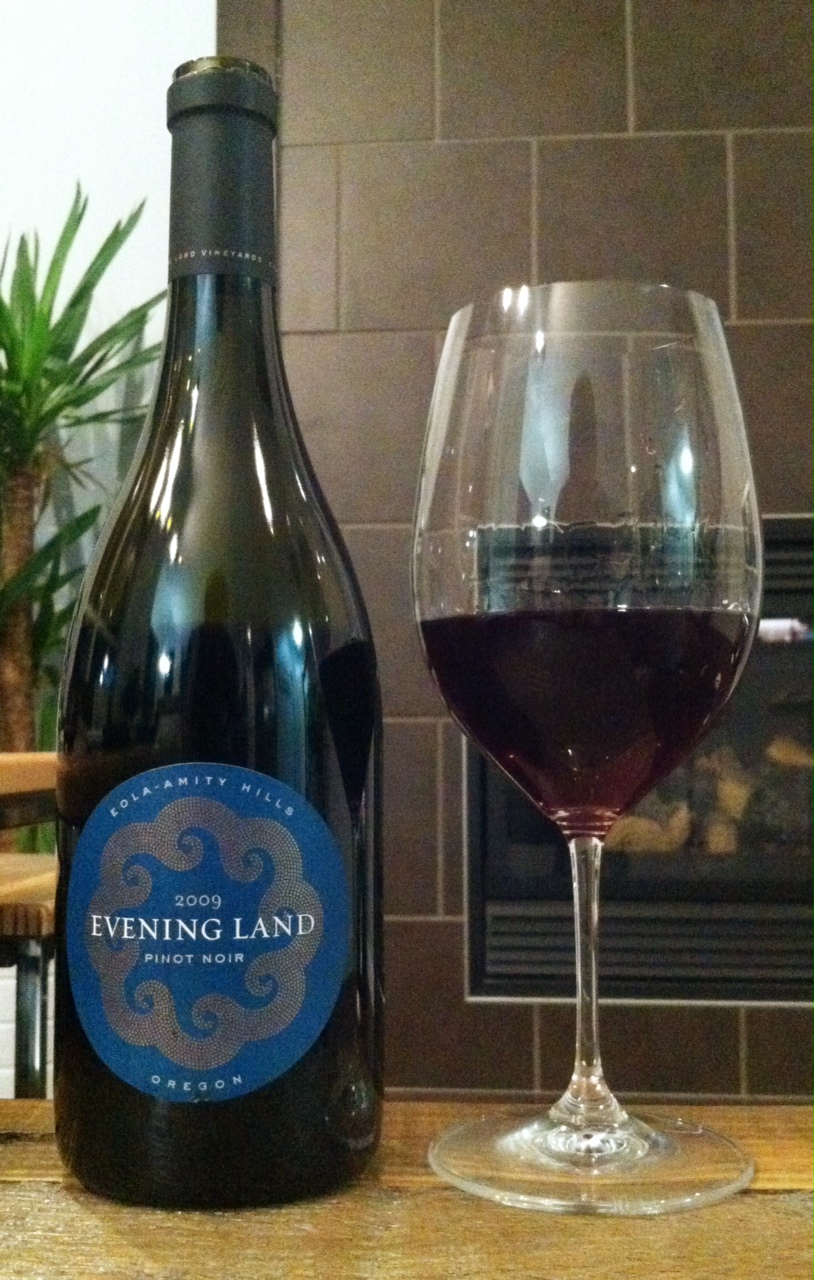
Wine Review: 2009 Evening Land “Blue Label” Pinot Noir

9 01 2012


One of my favourite labels in recent memory, and a great bottle to boot.

As I mentioned last post, although buying and drinking Burgundy is my top mission for (at least the first half of) 2012, in order to go about it the right way and actually learn something, I’m going to be deferring much of my Burgundy tasting/writing for a few weeks while I source wines and firm up a drinking plan.  Since I tasted a 2009 Bourgogne Rouge last week, I thought it would be an interesting contrast to follow it up with what is effectively its New World equivalent:  a 2009 Pinot Noir from Oregon, from the Burgundy-inspired rising stars at Evening Land Vineyards.  Even though Evening Land’s first vintage was in 2007, less than five years ago, it has quickly gained attention and critical acclaim for its lineup of true-to-the-land wines from the classic Burgundian varieties of Pinot Noir and Chardonnay.  I had known them as an Oregon producer (I tried two of their Oregon Pinots in WSET class) and was quite surprised to discover that they actually make wine in 4 different Pinot/Chard heartlands around the world:  Oregon’s Willamette Valley, California’s Sonoma Coast and Santa Rita Hills, and Burgundy itself.  While I’m sure that other wineries must do this too, I can’t think of another one off the top of my head that produces wine from different countries under the same name and label.  Colour me intrigued.

Read the rest of this entry »


Wine Review: 2009 Alex Gambal “Cuvee Les Deux Papis” Bourgogne Rouge

4 01 2012

Burgundy: It begins.

Well, I couldn’t very well write a New Year’s manifesto geared around a promise to drink more Burgundy and then not follow it up with a bottle of Burgundy, so here we are.  However, this might paradoxically be my last bottle from my 2012 classic wine region of choice for a little while.  With some (much-needed) professional help, I am currently formulating a buying and drinking plan for Burgundy that will hopefully maximize my drinking and learning experience within the budget and time window that I have, but since I need to source (and pay for) the wines before this francophilic journey gets underway, you may not hear more about it for a couple weeks.  Even so, rest assured that I have not abandoned my resolution that quickly, and take tonight’s bottle as a symbol of my new Burgundian spirit of adventure.  Or something.

One issue that I and other Burgundy neophytes have to deal with when we’re in that section of the wine shop are the bottle labels:  they’re almost all uniformly boring, and unless you’ve read a few dozen wine books, they almost all contain words that on their surface don’t appear to offer any assistance in telling you what the wine inside is all about.  The key thing to remember when trying to decipher a Burgundian label is that they are first and foremost all about the land:  exactly where the grapes come from and (possibly) how that location has been historically ranked for quality.  The sub-regions of Burgundy are set up as a series of concentric circles, with the smallest ones (top quality single vineyards given the esteemed Premier Cru [very good] or Grand Cru [best] classifications) falling within larger ones (village appellations that include all of the vineyards located by one of the towns in Burgundy like Nuits-St-Georges, Gevrey-Chambertin or Meursault) falling within the general regional appellation of Bourgogne.  Any wines simply labelled “Bourgogne” are made with grapes that can come from anywhere in Burgundy.  Think of it like a dartboard, with Grand Cru/Premier Cru in the middle, village wines the next ring out and Bourgogne the outer border.  Even though the smaller appellations are nested within the larger ones, a wine will always take the narrowest regional name possible (and its prestige and selling price will increase the smaller the sub-region is).  A wine made from grapes from the Grand Cru vineyard of La Tache near the village of Vosne-Romanee in north-central Burgundy will be labelled “La Tache Grand Cru” (and will likely also contain the phrase “Appellation La Tache Controlée” somewhere on the label, confirming that “La Tache” is the name of the appellation in question) instead of “Vosne-Romanee” or “Bourgogne”, even though the grapes are technically from both that village area and that general region.  Make sense?  I almost lost myself in that paragraph, so fingers crossed. Read the rest of this entry »


Wine Review: 2009 Gramercy Cellars “The Third Man” GSM

17 12 2011

I’ve wanted to try a bottle of Gramercy for over a year.  Last fall I bought Wine & Spirits Magazine’s annual Top 100 issue listing their hundred best wineries in the world for 2010, and there for the first time I read about a Washington producer called Gramercy Cellars, started by Greg Harrington, a Master Sommelier (the youngest to earn the title in the US) who quit his prestigious position as wine director for a group of NYC restaurants in order to move to Washington State and start making Syrah, despite no prior winemaking experience and no connection to the Pacific Northwest.  He was inspired by a chance tasting of Walla Walla wines that he attended, moved by their balance and sense of place to such a degree that he was motivated to drop everything and start a new life.  Gramercy Cellars was born in 2005, and within five years it was officially considered a force on the American wine scene; in addition to the top 100 honour in Wine & Spirits in 2010 (a distinction repeated in 2011) and other awards, Gramercy was named Best New Winery by Food & Wine Magazine in 2010 and promptly celebrated, uh, well, like this:

Since all you have to say to get my vinous attention is “Washington” and “Syrah” in the same sentence, I’ve been waiting and hoping to see a bottle of Gramercy around Calgary somewhere, but until very recently it simply wasn’t available.  So imagine my surprise when one of my go-to wine shops, Highlander Wine & Spirits, announced last month that they had arranged the provincial exclusive to carry Gramercy wines and were making a number of them available for immediate sale…it felt like some kind of strange karmic reward.  This particular bottle was an XMas gift from my friend Elliot (thank you!!), but needless to say I also stocked up on some of Gramercy’s varietal Syrah to enjoy at a later date.

Read the rest of this entry »


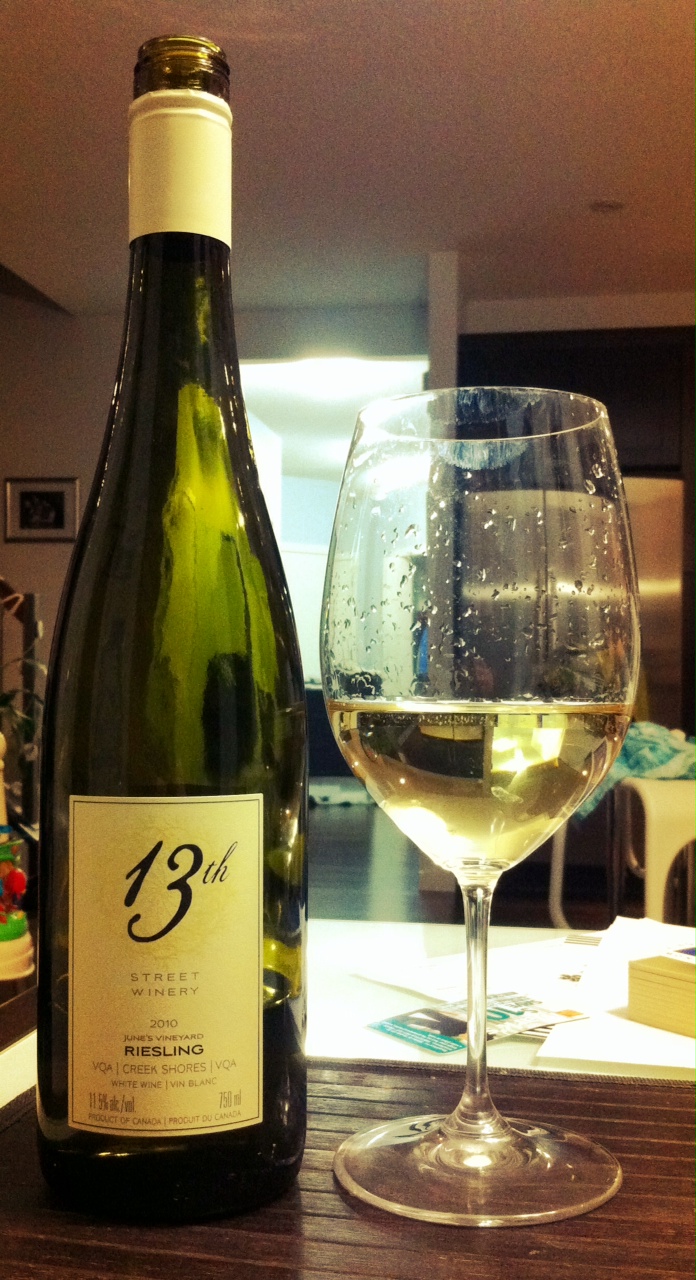
Wine Review: 2010 13th Street June’s Vineyard Riesling

14 12 2011

Try to ignore the obvious Chap Stick stains on the glass...who proofs these photos anyway??

Since my last Canadian Riesling experience was an earth-shattering one, I figured I would go back to the well tonight and see if I could keep the streak going.  While the previous Riesling I had from my home and native land (the 2010 Tantalus) came from British Columbia’s Okanagan Valley, this one comes from over 4,000 km eastward, from the Creek Shores sub-region of Niagara, Ontario.  My friend Corey recently toured the vineyards of Niagara and scooped this bottle for me during a visit to 13th Street Winery (social tip:  good friends remember your favourite grape), which is based in St. Catharines, Ontario and has been around for almost 15 years.  The fruit for this single-vineyard Riesling comes from Lincoln, Ontario, which is halfway between St. Catharines and Hamilton and seems like a really strange wine centre until you realize that it’s bordered on the North AND South by heat-reflecting, temperature-moderating Great Lakes.  Since I see way less Niagara wine around in Calgary than Okanagan wine, I was quite eager to see what the other half of the country had to offer in terms of quality Riesling.  Firmly suppressing my Western Alienation, I de-Stelvined the bottle and got to work.

Read the rest of this entry »


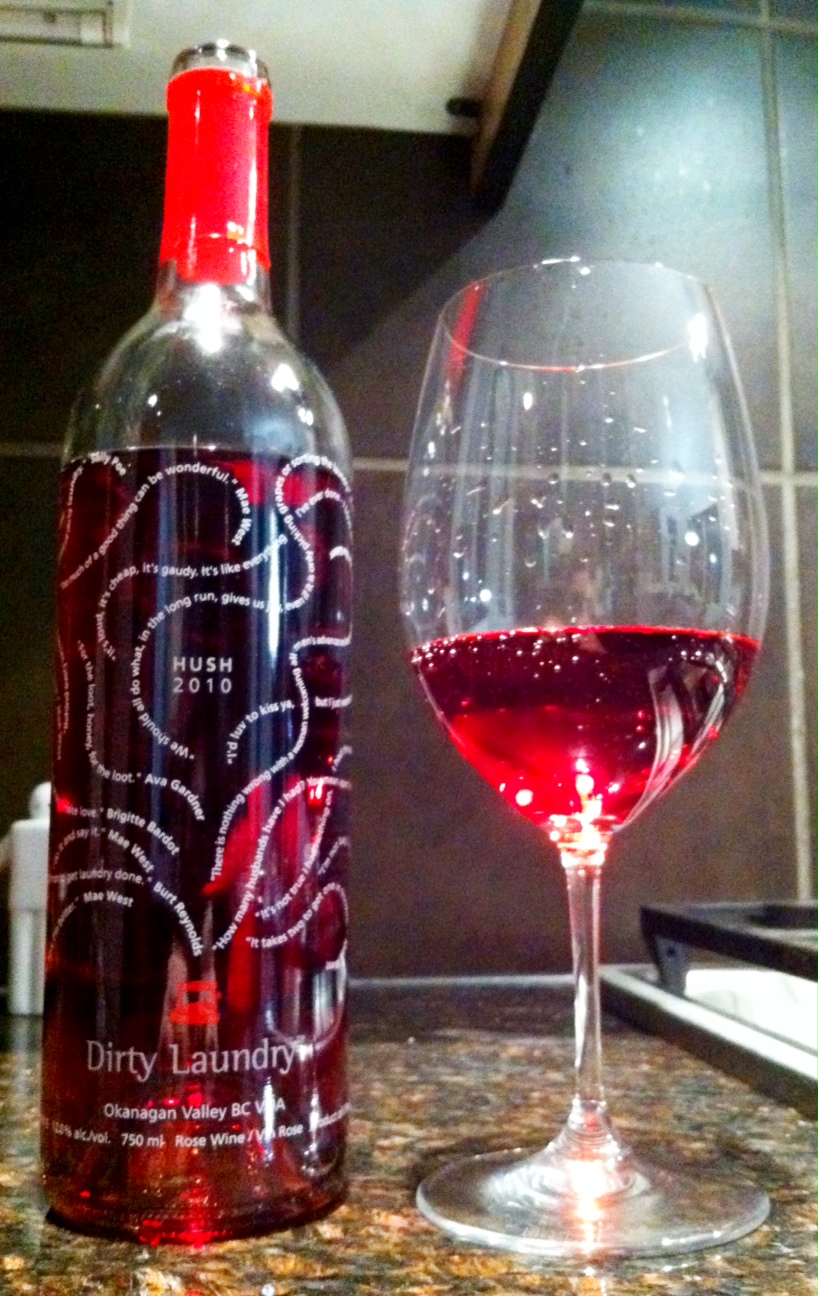
Wine Review: 2010 Dirty Laundry “Hush” Rosé

7 12 2011

Maybe it's season-suitable after all -- it looks like a Christmas light. That's turned on.

I don’t drink as much rosé as I should.  Even though I know that most of it isn’t the sweet and insipid stuff of stereotype, whenever I’m in wine-buying mode there always seems to be something else on the shelf that pulls me in more.  In fact, I’m pretty sure that this, Wine Review #82, is Pop & Pour’s first rosé write-up.  Yikes.  I promise to do better in the future.

While this is PnP’s inaugural rosé feature, it’s the second wine from the Dirty Laundry winery in Summerland, BC that I’ve reviewed, and (thankfully) the first I haven’t been horribly disappointed in.  For those of you who missed the tale of my September visit to Dirty Laundry and my lack of admiration for their Madam’s Vines Gewürztraminer, click here for the full scoop.  This rosé was the only other wine I grabbed from DL, and the wine in their cellar-door tasting lineup that I liked the most, so I popped and poured tonight hoping for bigger and better things.

Read the rest of this entry »


Wine Review: 2004 Pago del Vicario “Agios”

30 11 2011

It may be from a DO farm team, but it can still bring it. Cool bottle too.

It’s 9:30, I’m back from my first Christmas party of the year, I’ve walked the dog, I have the hockey game on TV and I’d like to go to bed within the hour…sounds like the perfect time for a condensed review!  Tonight’s wine is the classic buy-low no-expectations bottle:  although its regular retail price approaches $40CDN, I got it on sale in unusual circumstances for only $15, so I popped the cork not particularly caring whether or not it was a worldbeater.  The producer, Pago del Vicario, is based in the sprawling Castilla region of central Spain, just southeast of Madrid; the official appellation name, Vino de la Tierra de Castilla, signifies that Castilla is kind of a higher-grade appellation in waiting, a second or third division region awaiting promotion to the top tier of the Spanish wine area hierarchy, DO (Denominacion de Origen).  With apologies to those non-hockey fans out there, Vino de la Tierra wines are like the ECHL of the Spanish wine world.  However, that’s not to say that quality wines can’t be found in Castilla — this is one example of a lower-yield artisan wine that has clearly been made with care.

Read the rest of this entry »


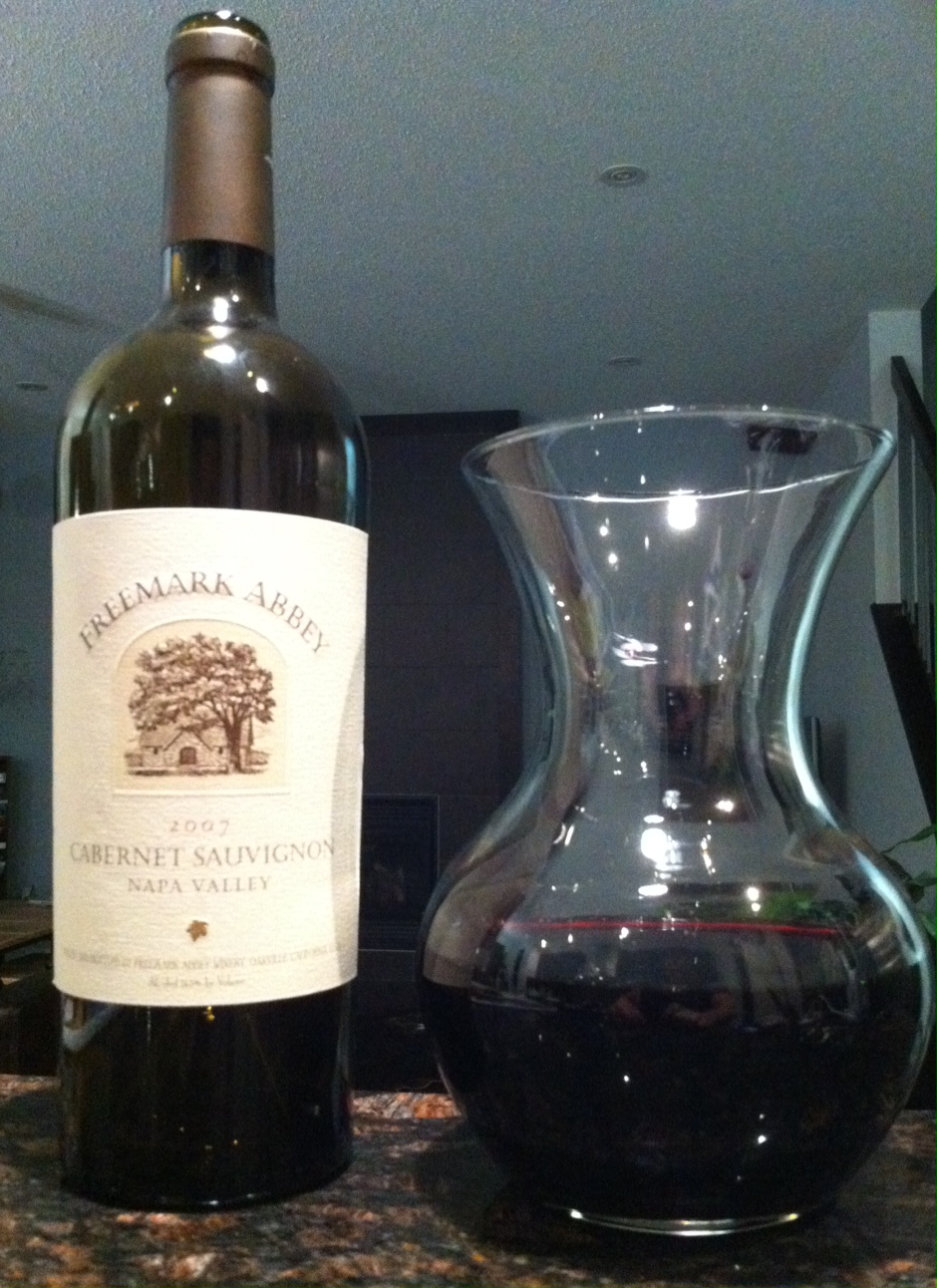
Wine Review: 2007 Freemark Abbey Cabernet Sauvignon

28 11 2011

Can a flower vase be an appropriate decanter? I say yes.

If the name of this wine sounds familiar, it should:  the ’07 Freemark Abbey Cab from the Napa Valley was my ultimate victor in the modern-day Judgment of Paris blind tasting I took part in at Co-op Wine & Spirits a month ago.  Matched up against 9 other top Cabernets including a couple of First Growth Bordeaux (2002 Chateau Haut Brion and 2007 Chateau Mouton Rothschild) and some iconic Napa Cabs (2007 Ridge Monte Bello and 2002 Heitz “Martha’s Vineyard”), by far the cheapest wine of the bunch (average bottle price of the 10 reds:  $277), this $47 little wine that could knocked both my tasting companion and I over and emerged the clear cut JoP winner for each of us.  As soon as the identities of the various wines were unveiled, I knew I had to get my hands on some — a reaction that probably would have been more subdued had the $928 Mouton Rothschild taken the title.  Thankfully for me (and all of you), the Freemark Abbey Cab is currently on sale at Highlander Wine & Spirits for just over $40, which is absolute robbery for a bottle of this quality from a premium region.  If you’re a Cali Cabernet fan, or if you’re not yet done your Christmas shopping, this is your winner.  Thank me later.

Read the rest of this entry »


Wine Review: 2010 Tantalus Riesling

23 11 2011

I feel like I’ve been remiss in not writing this review until now, seeing as how my visit to Tantalus might have been the highlight of my trip to the Okanagan in September.  I’ve been a fan of the winery (one of the few in Canada about which I can honestly make that claim) for awhile, and actually getting to go there and meet some of the people behind the eye-catching mask-labelled bottles only heightened my respect for who they are and what they do.  I was lucky enough to get a guided tour of both the vineyards and the winery from winemaker David Paterson — which is probably the only reason I was able to answer WSET Advanced exam questions about vertical shoot positioning and replacement cane pruning — and I left there as excited about wine as I’ve ever been.

Believe it or not, this is in a city. Did I mention I'm moving to Kelowna?

Unlike many Okanagan wineries which are based in the hotter, drier southern portion of the valley, Tantalus is located right within Kelowna’s city limits, in as pastoral a setting as possible given that the closest Starbucks is less than 10 minutes away.  All of their wines come from grapes grown directly on their estate, and on the rolling slopes of their vineyards they have planted Pinot Noir and a growing amount of Chardonnay; however, to me at least, they are synonymous with brilliant, high-quality Riesling.  They have some of the oldest Riesling vines in Canada (40+ years) on location, where Kelowna’s relatively cooler but lake-moderated climate is ideal for this hardy, late-ripening Germanic grape.  The winemaker has a clear vision about what he’s trying to achieve with this privileged source material, letting the fruit speak for itself and preserving natural acids, and consistently delivers on the site’s potential.  Although Tantalus also makes a reserve Old Vines Riesling from their decades-old vines (and is starting to experiment with sparkling Riesling as well), tonight’s wine is the producer’s base Riesling bottling, which packs more of a punch than anyone has a right to expect for the sub-$25 price.

Read the rest of this entry »


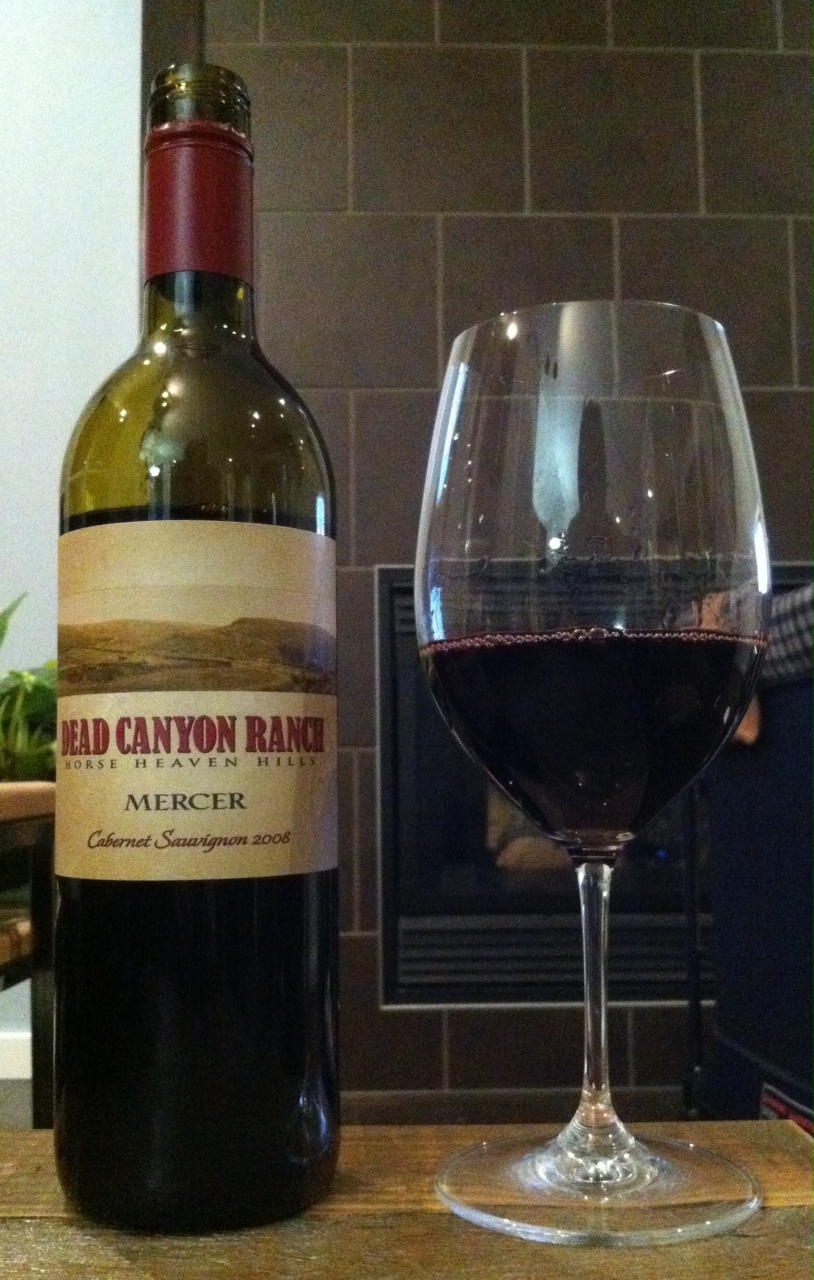
Wine Review: 2008 Mercer Dead Canyon Ranch Cabernet Sauvignon

21 11 2011

Decidedly ghetto label, questionable colour scheme, killer wine.

Time to enshrine another bottle in the pantheon of Killer Value Wines and expand the already-sizeable place in my heart for Washington State, because cheap Cabernet normally doesn’t taste like this.  The Dead Canyon Ranch from Mercer Estates winery vastly outperforms its price point ($20ish CDN) and screams “house wine” to any self-respecting Cab fan.  This was sadly my last of several bottles purchased from Highlander Wine & Spirits, who (I believe) have an exclusive on Mercer’s lineup of wines in the city; I have previously written about Mercer’s Merlot on this site, but in my opinion at least, the Dead Canyon Ranch is an even better wine at half the price.

This wine gets its eye-catching name from the place from which its grapes are sourced, the Dead Canyon Ranch vineyard in the awesomely-named Horse Heaven Hills AVA (American Viticultural Area), located alongside the Columbia River on central Washington’s southern border.  Washington State is divided vertically in two by the Cascade Mountain Range, and the climate of the area varies substantially depending on which side you fall.  If you’re in the western half of the state bordering the Pacific Ocean, it’s grey, wet and rainy enough for fictional tween-adored vampires to call it home, whereas if you’re on the eastern half the state, in the rain shadow of the Mountains, it’s a hot and arid (and presumably vampire-free) desert zone.  The wines that have been growing Washington’s vinous legend over the past few years (including SEVEN of them in the top 50 of Wine Spectator’s just-released top 100 wines of 2011) come from the eastern half, which is where Horse Heaven Hills and Mercer Estates can be found.  While the desert heat and sun make it possible for red wine grapes to reach full ripeness even this far north, the notably cool nights help to retain acids and preserve fresh flavours, which is the kind of built-in balance you look for in a top wine region.

Read the rest of this entry »


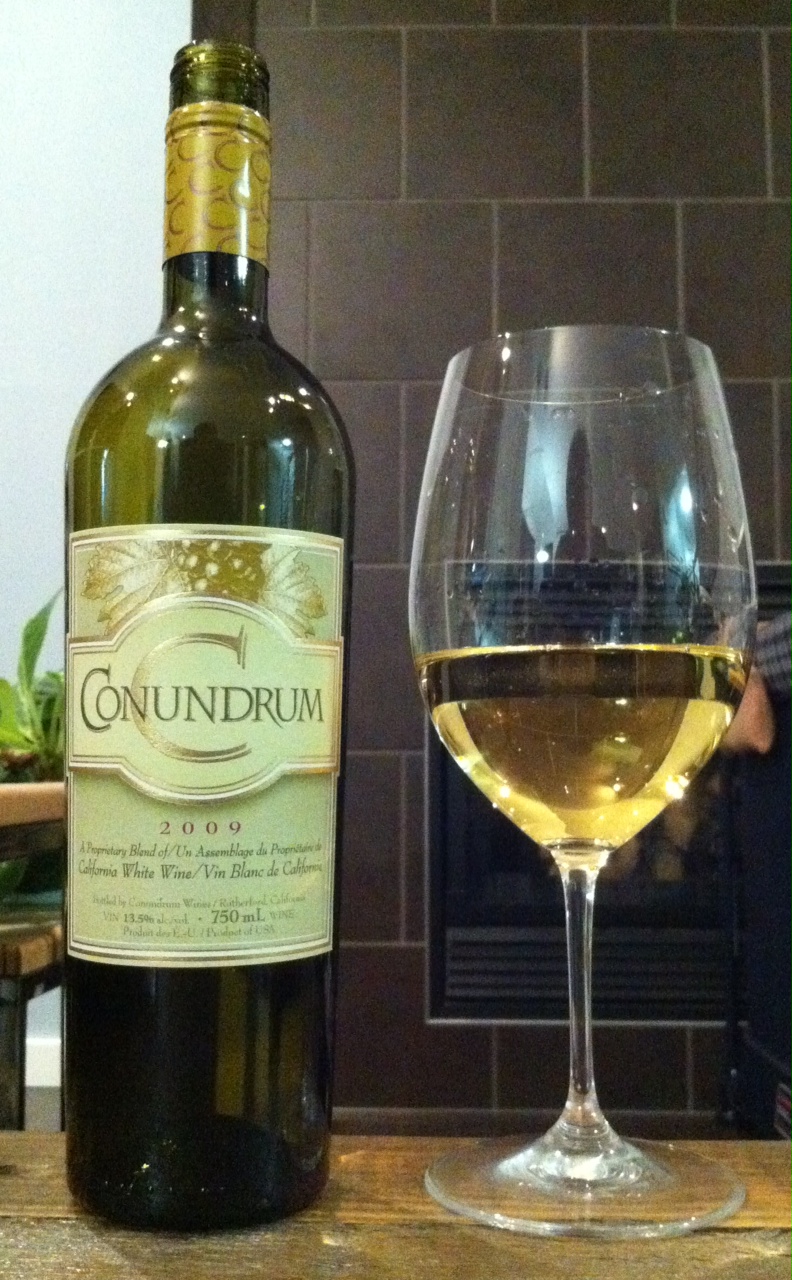
Wine Review: 2009 Conundrum

18 11 2011

I don't think even 2006 Me would have been overly thrilled by this.

True story:  back in 2006, when I was JUST starting to get interested in wine, I went to a long-standing Calgary wine boutique over the holiday season looking for a special celebratory bottle of wine to help ring in the New Year.  I barely bought any wine at all back then, and when I did it rarely exceeded $20 a bottle, but since this was to be a wine for an occasion, I decided to splurge and upped my max budget to $50.  I was directed to a proprietary white wine blend from an iconic Napa Valley producer, Caymus, who was mainly known for making some of California’s best Cabernet Sauvignon; however, as a side project, they had started putting together this fruity, floral, dynamic white that had quickly made a name for itself.  On the shop’s recommendation, I bought and enjoyed a bottle of Caymus’ Conundrum.  It cost me $45.

Fast forward five years.  I bought tonight’s bottle of Conundrum a couple of weeks ago.  It cost $18.

What happened?

Read the rest of this entry »