Calgary Wine Life: Taylor Fladgate 1967 Single Harvest Port Release

11 04 2017

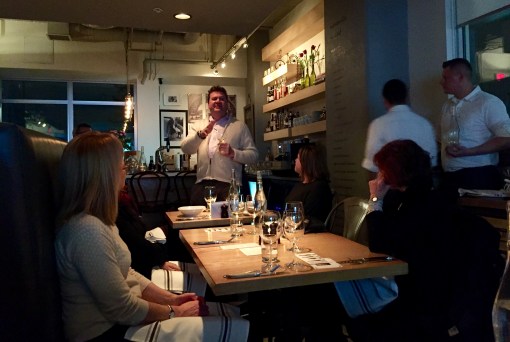
I almost always try to write up a tasting as soon as possible after I’ve experienced it, while memories are still fresh and the wines that were presented are still alive on my senses.  This is unfortunately not one of those times.  I must have triggered some kind of ancient Douro warlock’s curse upon cheerfully exiting La Chaumiere restaurant two weeks ago today, after tasting 100 combined years of Taylor Fladgate tawny Port and a trio of aged single-harvest releases that were collectively over a century and a half old, because within an hour of the tasting I was feeling queasy and unwell.  It only got grimmer and sicker after that, and I’ve only just emerged from that bleary world of nausea and cough drops and decongestants and come back to some semblance of myself.  But even if it was the Port gods who struck me down, it was totally worth it.

FullSizeRender-576

Taylor Fladgate, thanks to savvy rationing and recent acquisitions of significant quantities of extensively aged Port stocks from another historic house, has one of the largest inventories of old cask-aged Port in the world.  In 2014, it decided to make use of this bounty by launching a remarkable program:  releasing a 50 year-old Single Harvest Port on an annual basis commemorating the half-century that came before.  The 1964 Single Harvest Port was the first of the line, but has since been followed by the 1965 in 2015, the 1966 in 2016, and, this year, the impending “new” release of the 1967 Taylor Fladgate Very Old Single Harvest Port.  Each of these bottles retails for around $250 and is the best possible 50th birthday or anniversary present that could exist on this world.  As a special nod to Canada, the 1967 bottling is also a Canadian Centennial edition (at least in this country), with a maple-leaf-adorned box liner marking our country’s 100th birthday on the year of its 150th.
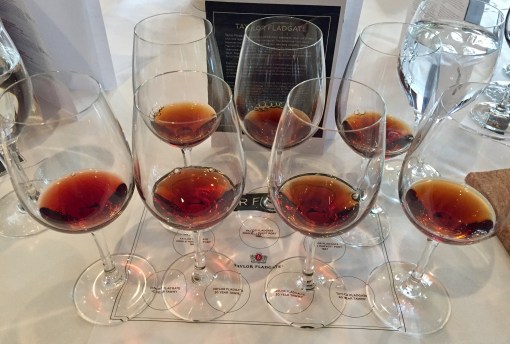
FullSizeRender-578A quick tangent to explain this Port’s name and aging designation.  All Port starts just like other red wines do, with crushed grapes fermented on their skins.  With Port, however, the fermentation is halted halfway through, before much of the sugar has been converted to alcohol, by spiking the juice with high-proof (75+% abv) grape brandy, which kills the yeast, retains a large part of the grapes’ natural sweetness and boosts the alcohol level of the finished product to around 20%.  The Port is then put in large oak barrels for maturation, and what happens next is what determines its final identity.  In top vintages, some of this wine only spends a couple years in wood before being put in bottle for further non-oxidative aging.  This is Vintage Port, arguably Portugal’s crown jewel.  In lesser years, or with other lots, the wine stays a few extra years in barrel before hitting the bottle 4-6 years past vintage; this is Late-Bottled Vintage Port, generally a less ageable, earlier-drinking style, and one that was actually invented by Taylor Fladgate in the 1960s, a rare innovation in a very traditional winemaking landscape. Read the rest of this entry »



Calgary Wine Life: Moet & Chandon Winemaker Tasting @ Ruth’s Chris

24 03 2017

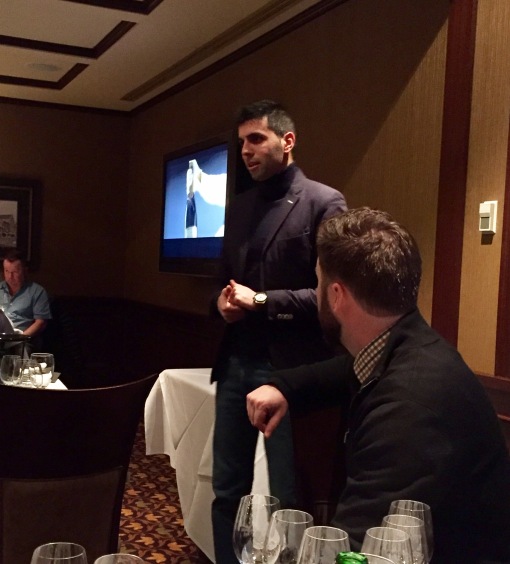
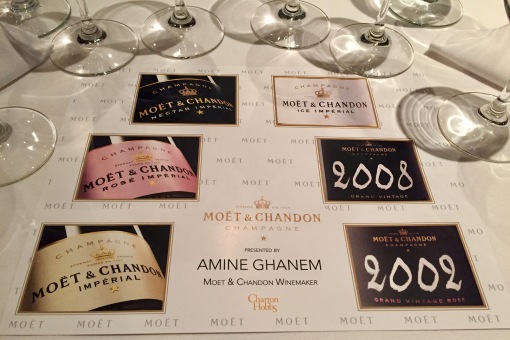
As it turns out, there is no inopportune time for Champagne.  Although the bubbly beverage has built its brand on being the drink of choice for special occasions and other times of celebration, it turns out that it’s equally nice to kick back with a glass of fine bubbles on an otherwise-normal Thursday afternoon.  It’s even better to kick back with six of them, which is what I was fortunate enough to do when Moet & Chandon winemaker Amine Ghanem came to town to lead an attentive and appreciative group through a good portion of the Champagne powerhouse’s portfolio.

FullSizeRender-565

Amine Ghanem, Moet & Chandon.

Ghanem is one of 10 winemakers employed by Moet & Chandon in addition to their cellarmaster, or chef de cave, who directs and decides on the ultimate blend for each of the house’s Champagnes.  Moet has been doing its thing for centuries (since 1743, to be exact – Ghanem informed us that the very first bottle of Moet & Chandon Champagne arrived in Canada in 1839, before we were even a country!), and as such has honed its house style to a fine point, with very clear goals as to the characteristics it seeks to draw out in its Champagnes and specific strategies in place to reach them.  The three pillars of the Moet & Chandon style are, in Ghanem’s words:  (1) “bright fruitiness”, which is attained in part by careful non-oxidative winemaking techniques, even to the point where the house has developed a technique for “jetting” oxygen out of the neck of the bottle after disgorgment to avoid degradation during the maturation process; (2) “seductive palate”, with a welcoming, easy-to-drink texture aided by full malolactic fermentation; and (3) “elegant maturity”, achieved largely through extended lees contact pre-disgorgment, for much longer periods than required by law.  These foundational principles must be working, as we were told that there is currently a bottle of Moet being popped somewhere around the world every second.

FullSizeRender-566

In case the ten full-time winemakers on staff wasn’t a tip-off, Moet & Chandon is a massive undertaking.  It is the biggest house in Champagne and the owner of its largest vineyard holdings, amounting to almost 10% of the entire area under vine in the region.  Since 1962, it has even had its own brand of proprietary yeast, which helps accentuate the characteristics that reflect the house style.  Moet’s primary brand is Imperial, so named in recognition of founder Claude Moet’s 18th century friendship with a certain French emperor, none other than Napoleon Bonaparte.  Napoleon visited the winery many times and was a steadfast consumer of Moet Champagnes, and in 1869 the Imperial brand was christened in recognition of the 100th anniversary of his birth.  The Imperial NV blend starts out as 800 different base wines, which are gradually combined into 3 proposed blends (each featuring solid proportions of all three of Champagne’s grape varieties: Pinot Noir, Pinot Meunier and Chardonnay) before one is selected.  The blending is as much of the artistry as the winemaking itself, and the efforts show in the bottle, which led off our tour-of-Moet tasting. Read the rest of this entry »


2015 Testalonga El Bandito Cortez

19 03 2017
FullSizeRender-562

What a label. What a wine.

OK, so it’s been a long time.  I wasn’t intending to drop off the map for over a month after my last post, but a work tornado and a series of weekend Timbits tournaments then morphed into bronchitis that knocked me out of commission for a couple of weeks.  Thankfully, the antibiotics have run their course, my lungs and tastebuds are back to almost-normal and Pop & Pour is again ready to roll.

And what better way to get back in the swing of things than with something fantastically different?  And what better qualifier for that category than a $48 South African natural wine Chenin Blanc with a catchy pop-art label?  Seriously, this is one of the best labels I have ever seen on a bottle of wine.  As soon as I saw it, I knew I was buying the bottle, which is about as big a compliment as you can possibly pay to a branding tool.  The label for this Cortez bottling by Testalonga changes every year, but they absolutely killed this one, which tugs on my (and presumably every other father’s) heartstrings.  I love it.

Read the rest of this entry »


Calgary Wine Life: Pierre Sparr Tasting @ Cassis Bistro

3 02 2017

Can there be any major French wine region more overlooked and underrated than Alsace?  It has all the frozen-in-time charm of Burgundy, with picturesque centuries-old villages dotting rolling hillsides of vineyards, and all the stately history of Bordeaux, but without the matching dose of self-importance.  Add in a dash of international conflict (the region has passed back and forth between France and Germany many times in the course of modern history) and a pinch of consumer friendliness (unlike almost anywhere else in France, Alsatian wines are all varietally labelled so everyone can easily see the grape that’s in the bottle) and you’d think you’d have a sensation.  But perhaps due to its location, tucked away in the northeastern corner of France, or to its primary focus on white grapes and prevailing Germanic influence, Alsace doesn’t get the hero’s welcome internationally that its fellow French stalwarts do, often left unexplored and misunderstood by New World consumers.  Thankfully, Bernard Sparr and others are out to set things right.

fullsizerender-554

Maison Pierre Sparr, 9th generation.

Bernard is part of the NINTH generation of the Sparr family that it carrying forward the legacy of Maison Pierre Sparr, the Alsatian house named after his grandfather but rooted in a winemaking family going back to 1680 (there’s that history I was talking about).  Pierre persevered through the ravaging of his domaine and vineyards in World War II, expanding the business and passing on a thriving enterprise to his two sons.  Bernard is the son of one of those scions, Rene Sparr, learning the rigours of blind tasting and the rhythms of the family winery from an early age.  Now he is helping expand the profile of the domaine overseas, settled in Quebec and taking on the role of North American ambassador for Pierre Sparr.  He is almost continually on the road, but despite the weariness of travel and an unfortunate cold that sapped his sense of smell, he was a warm and gracious host on Wednesday night, leading a cozy group through a lineup of French wines whose unifying trait was show-stopping value.

fullsizerender-549

In addition to directing international sales for the family domaine, Sparr also arranges for a small portfolio of like-minded tiny-production French producers to find their way into North America.  A few of these joined him for his visit to Calgary, so to accompany an absolutely marvellous five-course meal at Cassis Bistro, we were treated to a mixture of Pierre Sparr classics and intriguing finds from other regions, starting with a rosé with a distinct connection to a PnP favourite… Read the rest of this entry »


The Tournament of Pink (1st Ed.)

28 01 2017

[These bottles were provided as samples for review purposes.]

Rosé:  it’s not just for summer anymore.  Well, it was never just for summer, but the shelves of your local wine shop wouldn’t have given you that impression a few short years ago.  I had a tremendously difficult time a couple years back trying to source some pink wines in November/December for use in office client Christmas gifting packages, because for many retailers, the presence of rosé within store walls was decidedly seasonal.  This remains the case to some extent (because it is virtually impossible to beat a chilled rosé as an out-on-your-deck-on-a-summer-evening wine), but I had an agent tell me recently that their pink sales outlook for this winter might just outpace their summer, and I’ve seen more rosé on Calgary shelves with snow on the ground this year than ever before.  This is an enlightened change for the better:  there may be no type of wine more versatile and more universally appealable to all types of cuisines and personalities than a good rosé.

fullsizerender-539

There can be only one.

So when I noticed that I had a quartet of bottles of rosé sitting by themselves in an unassuming pink group in my cellar, the time of year did not remotely deter me in coming to the obvious conclusion:  let’s open them all and drink them all at once, and let’s do so in a Kickboxer-style fight-to-the-death tournament.  Thus the Tournament of Pink was born.

The actual Tournament took place a week or so ago and was simulcast on Twitter and Facebook, but work commitments have kept me from immortalizing the results on PnP until now.  If you weren’t following along at the time, we played our game by splitting our four rosés into two qualifying heats where they battled for the right to face off for the Tournament of Pink crown in the final.  Game on. Read the rest of this entry »


Sub-$16 Red Throwdown: Old vs. New World

11 01 2017

[These bottles were provided as samples for review purposes.]

fullsizerender-532

Have you EVER seen a red wine bottle shaped like the one on the left?

The $15 bottle of wine is a vanishing category nowadays, and what you can actually get for that price may often make you wish you couldn’t.  A combination of the struggling Canadian dollar, increased liquor taxes and the inexorable power of inflation is slowly pushing up that minimum purchase threshold where you can expect to find decent quality…if you look hard enough amongst the oceans of double entendre-named or critter-adorned labels at that price point.  However, there are still a select few value crusaders scattered here and there in this cost category, from under-appreciated regions where production costs remain low and climatic abundance makes ripening easy.  I happened to have two such examples lying around, one from the Old World and one from the New, so what better way to make use of them than to have them battle to the death for my weeknight enjoyment?  Since the estimated retail price on each creeps barely over $15.00, we’ll play it safe and call to order the first ever Pop & Pour Sub-$16 Wine Challenge.

In this corner, from the Old World, comes a representative from arguably the most overlooked source of good, solid, inexpensive table wine:  Portugal. Read the rest of this entry »


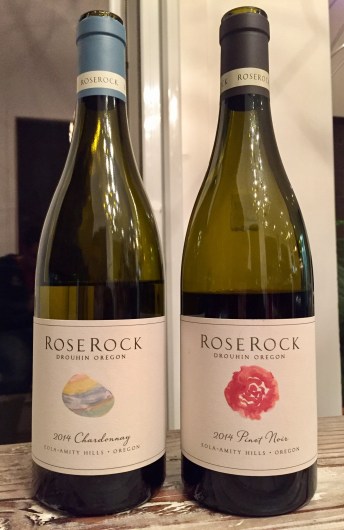
Introducing: Roserock Drouhin Oregon

5 01 2017

[These bottles were provided as samples for review purposes.]

fullsizerender-526

New vineyard, new venture, new heights.

Maison Joseph Drouhin has been a Burgundy mainstay for over a century, but third-generation proprietor Robert Drouhin discovered a kindred spirit location in Oregon close to 40 years ago when he arranged a Judgment of Paris-esque blind tasting competition between a group of classic red Burgundies and some upstart USA Pinot Noirs back in 1979.  At a time when almost nobody even knew that Oregon was producing quality wine and all American hopes were seemingly based on the performance of the California contingent, it was “Papa Pinot” David Lett’s Eyrie Vineyards Oregon Pinot Noir that lapped the New World field in the tasting, placing 2nd overall behind only Drouhin’s own 1959 Chambolle-Musigny, an exalted Burgundy from a top vineyard.  Within less than a decade from this revelatory event, Drouhin had bought land in Oregon’s Dundee Hills (a subregion within the large Willamette Valley located almost equidistant from Portland and the Pacific Ocean) to plant to Pinot and had assigned his own children to carry the family legacy across the ocean, naming his daughter Veronique as winemaker and his son Philippe as viticulturist, positions both still hold at Domaine Drouhin Oregon today.

Fast forward a quarter century.  Drouhin Oregon has established itself as one of the premium producers of the Willamette Valley had has become firmly entrenched in the Oregon community.  On the lookout for additional top vineyard lands outside of Dundee Hills, it never quite comes across what it is seeking…until the Roserock vineyard comes up for sale.  Roserock is located due south of Dundee, right in the centre of Willamette in the well-regarded Eola-Amity Hills subregion, about a half hour south of Portland and just west of the state capital, Salem.  It is replete with features that would make any winery’s ears perk up:  complex, well-draining volcanic soils; high (for Oregon) temperature-controlling elevation, perched between 550-750 feet above sea level; sited in the middle of a wind corridor channelling cool Pacific air right through the vines, maintaining acidity and prolonging ripening.

fullsizerender-527

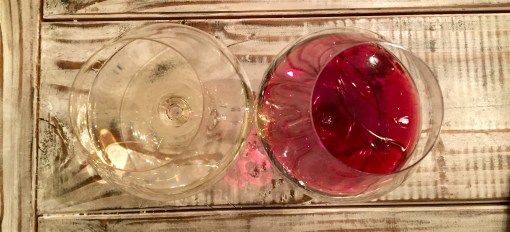
Roserock was planted to 111 acres of Pinot Noir and 11 acres of Chardonnay, Oregon’s (and Burgundy’s) signature grapes and had previously supplied fruit not only to Drouhin but to a laundry list of Willamette’s bright lights, including Soter, Argyle and King.  Drouhin pounced on it, acquiring the entire vineyard in December 2013 in its most significant transaction since starting up business on this continent.  This was not just a blip on the radar of a global wine power:  it single-handedly almost doubled Drouhin Oregon’s vineyard land holdings in the state, and it led to the creation of a new standalone Drouhin brand dedicated to the preservation and celebration of Roserock’s unique identity.  2014 was the inaugural vintage of this new label, and the first Roserock Drouhin Oregon Chardonnay and Pinot Noir make it eminently clear why this vineyard deserves to stand on its own. Read the rest of this entry »


Happy NYE 2016: Piper-Heidsieck Brut NV

30 12 2016

[This bottle was provided as a sample for review purposes.]

Quick – what’s the most festive thing you can think of to drink right now, right in the middle of this holiday season?  Champagne?  Close.  Champagne wrapped up like a present, complete with bright red bow, in its own custom bottle cozy?  Bingo.  I have long been a proponent of seasonally packaged wines (as long as they’re done right – when done wrong, they’re not pretty), and the holiday edition of the Piper-Heidsieck Brut NV Champagne nails the Christmas/New Year’s vibe about as well as anything I’ve ever seen in a bottle.  Seriously, just look at this thing, first wrapped up:

fullsizerender-521

Wait for it…

Then unwrapped:

fullsizerender-523

Oh yeah.  So sweet.

YES.  That is so, so clever.  And it’s reusable!  How can you go to a New Year’s party tomorrow and NOT bring this?  And it’s on sale online at the moment at Willow Park in Calgary, and maybe elsewhere, at a price that’s shockingly friendly for true Champagne from a historic house.  Oh, and most importantly, the juice lives up to the packaging.

Read the rest of this entry »


KWM Whisky Advent Calendar 2016: Day 25

25 12 2016

Well, another Christmas is in the books, another Advent officially over, and another Whisky Advent Calendar now sadly, mercifully empty.  Over the past 3 Decembers I have written 74 different whisky reviews on 74 consecutive Advent days, expanding my whisky knowledge and probably seriously irritating all of the blog’s wine readers in the process, and while I’m not sad the mandatory daily reporting experience is over for another 12 months, I always look back on this calendar and appreciate all the work that must have gone into it.  Andrew Ferguson and the Kensington Wine Market do yeoman’s work every year to source a whole new set of never-used miniature whiskies so that every Whisky Advent experience can be fresh and interesting; it must be extraordinarily demanding and tiring, but every year it pays off.  Well done.

fullsizerender-519

I’d be curious to know what your favourite bottles were in the 2016 calendar and how closely they line up with my list of Whisky Advent award-winners, the creme de la creme of this year’s Advent for me:

  • Best Value Dram:  BenRiach 12 Year (Day 4) — BenRiach is starting to own this spot, as its 10 Year won this same award last year.  $80 may be stretching the value whisky category to its limit, but this bottle delivered magic for that price and tasted like it cost well into the three digits, so I’m sticking to it.
  • Honourable Mention:  Hyde 10 Year Irish Whiskey (Day 9) — I loved this bottle and had it on the podium until the very end of deliberations.  Probably the best Irish whiskey I’ve ever tasted, and one that shows just how much potential that category has.
  • 3rd Place:  Ardbeg Uigeadail (Day 7) — Can I look you in the eye and say that this tastes “good”, by any traditional description?  No.  But it has depth and soul and identity, and it draws you in and leaves its mark on you, which is both rare and worthy of recognition.
  • 2nd Place:  Kavalan ex-Bourbon (Day 19) — Predictable, perhaps, but no less deserving.  An absolutely beautiful dram giving a glimpse into how Asia may soon be rising to the pole position in the whisky world.
  • 1st Place:  Gordon & MacPhail’s Connoisseurs Choice Tomatin 1997 (Day 1) — Since when does the very first whisky in the calendar end up being the best?  It may be a bit anticlimactic on Day 25, but I liked the choice to start strong back then and I like it now.  This was absolutely the most enjoyable whisky of the month, with sneaky quality to back it up, made most evident by its amazing length and flavour development.  Amazing stuff.

Not sure why the first 10 days of the calendar seemed to dominate this year (last year’s picks were from all over the place), but these conclusions in retrospect match what I’ve felt contemporaneously while opening the calendar each day – a great start, a bit of a momentum lag in the middle third of Advent, and a recovery heading into the finish.  Thankfully the calendar ends on a high (and large) note, with a double-sized cask-strength monster offering from the Scotch Malt Whisky Society (SMWS), who obviously understood that what we needed most after 24 days of Whisky Advent was a stiff drink.

fullsizerender-518

The SMWS is like an independent bottler crossed with a subscription whisky club:  they buy hand-picked single casks of whisky from a variety of top distillers, bottle them under their own labels (always with eye-catchingly descriptive names) and then sell them only to their own members at club-level prices.  If you’re not a SMWS subscriber, the only way you may be able to taste these whiskies is through this very calendar, so bring it on.  This year’s Christmas whisky is Society Single Cask No. 41.78, “Poker Night Whisky”, bottled at an abjectly terrifying 60.4% in an attempt to murder us all.  It has been aged for 11 years, but I know nothing else about it, not even the area in Scotland where it was made.  I can confirm that it smells incredible, however, a near-tropical mixture of cantaloupe, watermelon, sweet peas and honey.  If you don’t add water to this your throat will likely implode, but once you do you’ll be able to look beyond the alcoholic hellfire and notice the layers of lime zest, bakers’ chocolate, burnt orange and cinnamon, laid over dirtier notes of topsoil and sweat.  The finish is a little raspy, but if you were 61% alcohol you’d be a little raspy too.

Merry Christmas to all, thank you so much for reading this month, and I am DEFINITELY not blogging tomorrow!


KWM Whisky Advent Calendar 2016: Day 24

24 12 2016

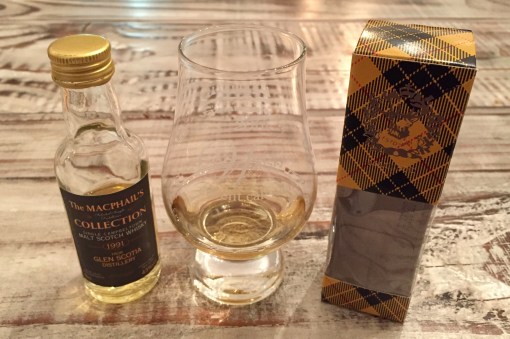
Merry Christmas Eve, everybody!  Hopefully by now the stockings have been hung and the parents can start turning their attention to more important things, like booze.  Back in my first year of KWM Whisky Advent, the December 24th bottle was the end of the line and thus the one everyone waited for the whole month.  This year we get an extra bonus whisky tomorrow, but it’s a special Scotch Malt Whisky Society bottling and is double-miniature-sized, leaving tonight the final standard-format calendar bottle. And it delivers, at least in packaging (every scotch should be sold in a bright tartan box) and age designation (distilled 25 years ago in 1991!).  It is yet another Gordon & MacPhail offering, but from a heretofore unseen line:  The MacPhail’s Collection, a small range from a select line of distilleries (7 in all at the moment).  One of them is Glen Scotia, an ancient distillery located at the tip of the Campbeltown peninsula in southwest Scotland.  Campbeltown isn’t a huge scotch area, known mainly for Springbank and its sister distilleries, so it’s no massive surprise that this is the first whisky from the region we’ve seen in Advent 2016.  One of Glen Scotia’s claims to fame, other than being sold a trillion times and failing in the early 20th century like basically every other whisky producer, is that it’s haunted by the ghost of a prior owner, who drowned himself in Campbeltown Loch after losing everything he had in a bad business deal (hopefully not the purchase of the distillery itself, but you can’t rule that out).

fullsizerender-517

The full title of this bottle is The MacPhail’s Collection 1991 Single Campbeltown Malt Scotch Whisky from Glen Scotia Distillery, but unlike every other whisky so far in 2016 Whisky Advent, there is no other information about it anywhere.  It is only for sale at KWM in mini-bottle format (for $24, suggesting that it would be a $300+ full-sized bottle) and not otherwise available; it is not mentioned on the Gordon & MacPhail site; and it is not available for sale at any online shops I could find, even in the UK, except in miniature form.  Weird.  It’s not as dark as you might think for a 25 year old whisky (although it may not be a 25 Year whisky for age designation purposes if it was bottled a while ago, as age labelling is based on time from distillation to bottling) but carries a pure, malty nose of golden raisin, plum, fresh pear, sourdough bread and trail mix, with a hint of fitting Christmas fruitcake.  However, it then takes a left turn and goes surprisingly sharp, rubbery and industrial, filling the mouth with not-altogether-enjoyable tastes of tennis balls, permanent marker, elastic bands and shoe treads; these factory-floor notes and the whisky’s spiky alcohol combine to nearly overwhelm spicy underlying notes of rock salt, caraway and fennel.  Interesting?  Yes.  Pleasant?  Not entirely.  See you at the 2016 calendar finale, and at Christmas!!


KWM Whisky Advent Calendar 2016: Day 23

23 12 2016

GlenDronach!  Peated!  I’m always fascinated by peated expressions of traditionally non-peated whiskies (which encompass almost all whiskies distilled anywhere other than the Islay region of Scotland), particularly when the whisky in question is one with which I am otherwise very familiar.  My old calendar friend GlenDronach, as recently covered in Day 18, is an Advent stalwart, having shown up (quite successfully) four previous times in the last three years; those prior releases unveiled the bulk of GlenDronach’s core range, but all of them are entirely unpeated, making tonight’s further core entry a category of its own for the distillery.  GlenDronach decided to release a Peated expression fairly recently as a nod to how the distillery used to make whisky back in the 19th century, although since its founding in 1826 it’s been a sort of rocky road until recently.  Stop me if you’ve seen this kind of Scottish distillery timeline before:  sold 1830, sold 1920 (to the son of the founder of Glenfidditch), sold 1962, mothballed 1996-2002 (not that long ago!!), taken over 2005 (by Chivas), taken over 2008 (by BenRiach, who makes some pretty awesome whisky in its own right and has presided over a highly impressive GlenDronach resurgence in the past 8 years), taken over (along with BenRiach) earlier this year (although so far the same folks have been left in charge).  No job security in whisky-making.

fullsizerender-516

The peating in GlenDronach’s first ever (modern-day) peated offering is done…pleasantly?  Is that a thing?  The peat effect is definitely noticeable, but far from in-your-face, adding aromatic traces of lantern oil, sweet compost, old leather and moss to GlenDronach’s stone fruit and florals, which are otherwise not lost or mellowed in maturation in this younger non-age-designated malt.  The palate is similar, part oily and part sweet, either adding perfumed refinement to the peat’s underlying funk or adding some necessary grime to an otherwise potentially too-pristine Highland whisky, depending on how you look at it.  The result is a little bit of everything:  pistachio pudding, suede jackets, distress flares, car exhaust, marmalade, apple crisp…I could keep going.  What a value at $83.  Can’t wait to see what Christmas Eve has in store!


KWM Whisky Advent Calendar 2016: Day 22

22 12 2016

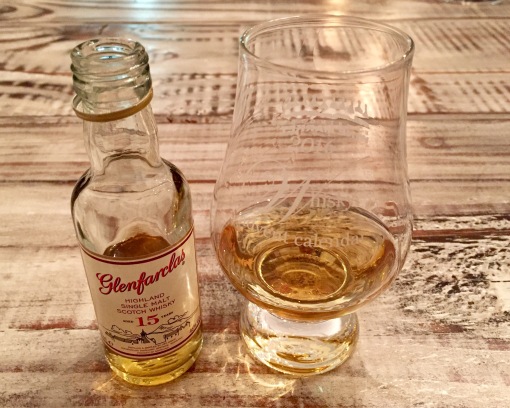
I have started to think of Glenfarclas as the official mascot scotch (mascotch?) of the KWM Whisky Advent Calendar, after 2014’s special Christmas Eve 40 Year and 2015’s Christmas Eve redux 25 Year, not to mention two other entries in calendars past.  I was sort of wondering if we’d see a third straight December 24th whisky from the distillery, but I also suspected we were starting to run out of super-old Glenfarclas releases to slot in that esteemed end-of-calendar spot.  Well, it got Day 22 this year, with the notably younger $95 15 Year Single Malt – still a respectable position if not an exalted one.  Glenfarclas is one of the few pre-20th century distilleries not to be shut down or sold to a gigantic beverage empire in modern times, owned by the Grant family since 1865 when patriarch John Grant bought it for just shy of £512.  That sounds astoundingly cheap even in 1865 money, and it is:  it equates to around £59,000 today, or around $98,000 CAD.  Nice buy, John.  We are now six generations of Grants (all of whom have been named either John or George) into the family’s stewardship of Glenfarclas, which is known for producing one of the classic examples of Speyside whisky out of the region’s largest stills.

fullsizerender-515

To obtain the legal designation of “scotch whisky”, a spirit has to (1) be aged in oak casks (2) which are no larger than 700L (3) for at least three years (4) in Scotland.  Glenfarclas uses both plain new oak casks (which we haven’t heard much of in this year’s calendar) and ex-Sherry casks (with which we have been bombarded by this year’s calendar, and by the whisky industry in general), and it is definitely known for its emphatic use of the latter.  The 15 Year is a glimmering dark amber colour reflective of its barrel time and has a few different aromatic identities:  confectionary (butterscotch chips, and nougat, like the inside of a Three Musketeers bar), nutty (almonds, oatmeal), herbaceous (corn husks, grass).  Bold and fiery as soon as it touches the tongue, this is not messing around, slinging toast and spice, banana Runts, mandarin orange, Americano, char and vegetal flavours with authority and powering into a lacquered finish.  It is punchy and powerfully concentrated, coming across like a cask strength whisky despite its 46% abv.  Mammoth scotch.


KWM Whisky Advent Calendar 2016: Day 21

21 12 2016

Into the 20s, guys.  Five days left – and we start the final countdown to Christmas with a mystery.  I pulled out an old-school-looking bottle of Stronachie 18 Year Small Batch Release and thought:  “Cool, another lesser-known distillery find.”  Then I saw the A.D. Rattray logo, last seen in Day 14 with the independent bottler’s Cask Islay release, and thought:  “Cool, this must be like their Distillery Label series”, similar to fellow independent bottler Gordon & MacPhail’s collaborative set of releases with smaller producers tasted in Day 8 and Day 16.  Then I saw the tiny notation in the top right corner: “Distilled at Benrinnes Distillery”.  Um, what?  That’s one label headliner too many.

fullsizerender-514

Here’s the story.  Stronachie IS a lesser-known distillery…but it’s lesser-known because it was mothballed in 1928 and destroyed in 1930.  It was first built in the 1890s in a (questionably chosen, in hindsight) remote, nearly inaccessible mountain location that required the construction of a 5-mile private railway just to get the spirit to a transportation route.  The initial distributor of Stronachie was actually a relative of A.D Rattray, and in the early 2000s, consumed by curiosity about the distillery, Rattray’s present owner bought at auction a bottle of Stronachie that was distilled a century prior, in 1904, one of only 4 bottles left in the world.  After tasting it (props to them for actually opening it), Rattray then embarked on a project to try to re-create the historic distillery’s flavour profile using spirit from a similarly situated high-altitude producer.  It’s one part honourable and one part creepy, like going from trying to commune with your dead aunt via seance to building your own effigy of her for your living room, but it is certainly bold and unique, two things I don’t get to say enough about the whisky world.

Benrinnes is another distillery that often does its work anonymously, not often receiving the single malt attention, which makes me feel sort of bad that it’s getting this particular star treatment as a sort of tribute cover band for another producer that’s been closed for 88 years and a pile of rubble for 86.  Its faux-Stronachie 18 Year was aged in a combination of ex-Bourbon and ex-Sherry casks (which is becoming the main maturation theme of Whisky Advent 2016) and smelled as pleasantly old-fashioned as it was probably supposed to, mixing saltwater taffy, unsweetened licorice, smoke and bitter orange.  Smouldering and long-acting on the palate, its flavours are almost on delayed release, starting spicy and peppery but then blooming into vast florals, citrus fruits, hickory, creme brulee and candied ginger.  In spite of that it never gets away from itself, staying straight-laced and minding its manners, like the quiet distillery up on the mountain that’s now nothing but a ghost, kept alive through loving tribute.


KWM Whisky Advent Calendar 2016: Day 20

20 12 2016

As we near the finish line of 2016 Whisky Advent, we’re coming a bit full circle, back to the distillery (if not the bottler) that brought us Day 1.  We started off Advent with Gordon & MacPhail’s take on a Tomatin whisky, and tonight we let the distillery speak for itself, continuing the calendar’s now-three-year streak of Tomatin releases, after 2014’s blasé 18 Year on Day 12 and 2015’s awesome Port-aged 14 Year on Day 17.  The difference between those bottles and this one is twofold:  this one is cask strength, as the largest capitalized letters on the front label tell you, and it also has no age designation whatsoever, suggesting that it’s probably too young to market as a number.  The $73 price tag would go along with that theory.  (Incidentally, if you’re a whisky spendthrift, you should probably focus your scotch dollars on cask strength whiskies — you get the same volume of whisky at up to 50% higher alcohol, without a price premium in many cases, and when you pour yourself a serving you have to add water to it, something the distillery does itself to get its non-cask strength releases down to 40% or 46%.  In other words, you often pay the same price for post-dilution bottles as for pre-dilution bottles which you then dilute yourself, giving you way more whisky concentrate for your money at cask strength.)

fullsizerender-513

This bottle’s packaging is an exercise in earnest oxymorons:  lilting italic script informs you that this whisky represents “The Softer Side of the Highlands”, immediately below the double-sized block letters stating “CASK STRENGTH” and immediately above the 57.5% abv listing.  I could describe this whisky in many different ways and it would not end up on the softer side of anything.

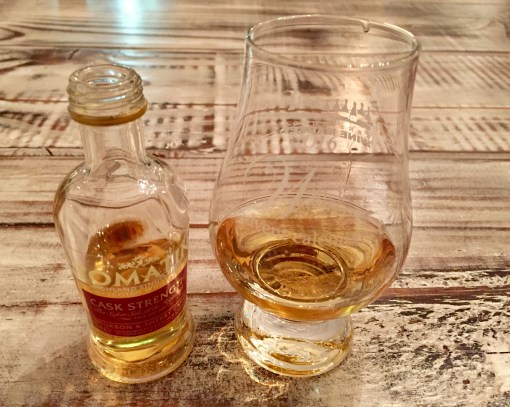
This is Tomatin’s first cask strength bottling in its core range of whiskies and saw (an unknown amount of) time in a combination of Bourbon and Oloroso Sherry casks before being bottled.  It was a fairly eye-catching dark golden wheat colour for a bottle coy about its age, yet unlike most whiskies which are aromatically the sum of its parts, this one just smelled like the parts, like barley and barrel and fermentation:  malt, grain, yeast, spice, salt, seawater.  You then completely forget about that, and everything else, once this Tomatin hits your tongue and your brain starts bubbling like it’s on a griddle.  The whisky is massive, overwhelmingly lush and nearly gelatinous in texture, to the point where it almost doesn’t even feel like a liquid.  A strange mixture of honey, baby oil, firewood, shortbread, spackle, flaxseed and rye bread, it is a raging beast of decidedly cautious flavours, a meek monster.  On an oddly bitter yet sweet-tinged finish, it leaves me with no other concluding thought than:  this is just so weird.


KWM Whisky Advent Calendar 2016: Day 19

19 12 2016

To say that things are heating up in the last week of Advent would be a massive understatement.  Yesterday we hit upon my favourite calendar whisky distiller in GlenDronach, and today we meet up with the only other producer that has managed to reach similar Advent highs, Taiwan’s Kavalan, which took second AND third place in last year’s calendar for me and which seems to do nothing but produce show-stopping whiskies in what on its face seems like one of the least likely locations on Earth.  But here’s the secret:  Taiwan is much, much hotter year-round than Scotland is, and massively more humid.  So?  So when you’re freshly distilled whisky spirit, sitting in a barrel and waiting for maturation magic to happen, those climatic conditions make the aging dance between cask and liquid go into hyperdrive, accelerating evaporation (which speeds up oxidation) and allowing the wood grain to penetrate into and flavour the whisky much more quickly.  The result:  a distillery that’s barely 10 years old with products on the shelf that you would taste blind and swear they’ve been aging for well over 20.  In the whisky world, you can’t ask for a better and more distinct advantage than that.

fullsizerender-512

This is a particularly interesting bottling because it is ALMOST, but not quite, identical to the Kavalan from Day 5 of 2015.  Like this one, that was also an ex-Bourbon cask bottling, but it was a cask-strength offering (like most of Kavalan’s lineup), whereas this is the first Kavalan whisky I’ve had that isn’t, bottled at 46% to give Kavalan a sort of “entry-level” whisky in its lineup.  Those words are in scare quotes because the bottle still costs $140, but I am here to tell you that it’s worth it.  It was bottled in mid-2015 (at 11:16 a.m., according to the hyper-specific back label info) and likely only spent a few years in Bourbon barrels, but the Taiwan time warp effect made it deep and rich and gold in the glass, albeit more yellow than amber.  It smells like the most delicious confection you could ever come up with:  part toasted marshmallow and vanilla bean, part wafer cookie and whipped cream, with some Corn Pops and hickory on the edges for good measure.  It then beams out the most outrageously tropical set of fruit flavours I have seen in a whisky.  Cantaloupe?  OK.  But guava?  Papaya?  WATERMELON?  What is happening??  Coconut flakes and Rice Krispie squares round out an absurdly delicious six-days-till-Christmas whisky:  exotic and playful, complex but oh so hedonistic.  I sense another podium finish, Kavalan.