Wine Review: The Whites of Castoro de Oro

31 07 2019

By Raymond Lamontagne

[These wines were provided as samples for review purposes.]

It’s alive. The blog, that is. Peter is enjoying some much needed R & R overseas and got to sample hybrid grape Solaris for the first time. Don’t get too jealous of that particular detail. Although I’d welcome a chance to add this one to my life list, apparently we aren’t missing out on all that much. Meanwhile, let yours truly guide you through another Pop & Pour Okanagan run that will span two posts and six wines. I’ve enjoyed tasting these, particularly as I reflect on how this family owned winery has seamlessly melded careful viticulture, whimsical yet clever branding, and an earnest appeal to passion and hard work. All this yields a singular focus on making award-winning handcrafted wines from grape to glass. It seems warranted to begin with the whites. But first, some further background.
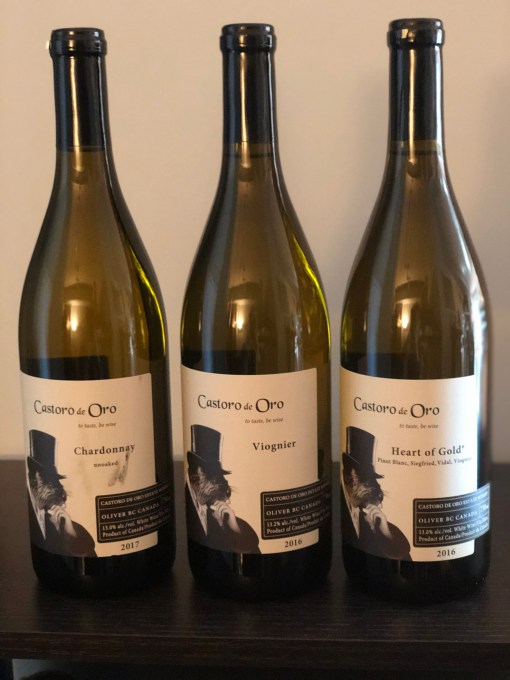
IMG_E0849The Castoro de Oro estate vineyard was planted in 1980. Located in the esteemed Golden Mile, this site seems engineered by Mother Nature to deliver full ripeness in the grapes, yet not at the expense of acidity. Here we have vines facing southeast to provide ample sunshine, with the grapes also growing on a slope right next to a lake, factors that together work to mitigate any effects of frost. This is all well and good, but too much heat can cause flabby wines that lack precision. Fortunately, a mountain provides evening shade that permits the grapes to cool off during the summer, preserving tartness and resulting in a key balance between acid and ripe fruit flavours. This is particularly important for white wines, for which acidity is the only source of freshness and structure (well… for the most part. Tannins from wine skins and barrels sometimes play a small role).

Enter Bruno Kelle and (Calgarian) Stella Schmidt, self-described “partners in life and wine-making”. They acquired this site and launched the Castoro de Oro winery in 2006, farmers who like to make wines that most people can afford. I can jive with that, although I can find it hard to relinquish the role of “guy who is supposed to assess these wines in a serious way according to certain criteria”. I’m going to wear that black hat here, because to some extent I have to… AND, I’m also going to attempt to appreciate these wines based on the winemakers’ own vision. Here we go. Read the rest of this entry »



Wine Review: Road 13’s Rare Whites

12 07 2019

By Peter Vetsch

[These bottles were provided as samples for review purposes.]

This may be the last post from me for a while, as I imminently prepare to head off of the continent for a little bit on a proper Viking vacation.  (If anybody knows a great wine shop in Copenhagen or Billund, let me know immediately.)  But fear not, Ray will still be here to keep the blog alive for the rest of July, and I have one last gasp of Canadiana in me before I bolt the country.  Tonight’s trio of whites from the Golden Mile Bench’s Road 13 Vineyards makes me realize that I should have been following this winery more closely before now, but I will try to make up for lost time.

IMG_0344

Clean and classic labels, eye-opening wines – but not sure about 2018’s italics.

Road 13 has had an interesting last 12 months, as it was named the Winery of the Year at Wine Align’s National Wine Awards of Canada in 2018 and was then promptly sold before the year was out.  Long-time proprietors Pam and Mick Luckhurst, who acquired the winery (then-called Golden Mile Cellars) and were responsible for first renaming it and then building it into a well-respected national brand, decided to move into retirement (the winery itself having been their first, not-that-relaxing-as-it-turns-out attempt to retire) and accepted an offer from Mission Hill’s / Mark Anthony Brands’ Anthony von Mandl to purchase the company.  The winemaking team remains intact, however, as does the winery’s vision and present focus on the potential of Rhone varieties in British Columbia, an endeavour that I back fully, having had enough marvellous Okanagan Syrah recently to make me wonder what else from the south of France would flourish here.  As it turns out, the white Rhone side of the equation is just as compelling as the red.  But we start with a scion of a Road 13 classic. Read the rest of this entry »


Wine Review: July Patio Samplers

6 07 2019

By Peter Vetsch

[These bottles were provided as samples for review purposes.]

As I sit here writing this on a rainy summer evening (pre-publication, but I bet it’s raining when this goes live too), Calgary has just struggled through a sodden June, and the tide doesn’t seem to be turning.  It is grey, dreary and continually drizzling.  We’ve had hailstorms, windstorms, thunderstorms — all separately and all in the last three weeks.  My kids have declared their nascent skepticism for outdoor sports — who would willingly place themselves outside for an hour at a time in an environment such as this?  Our northern world is free of snow for at most six months a year, and a third of that winterless period for 2019 has been underwater. You get the picture.  It’s bleak.

IMG_0298

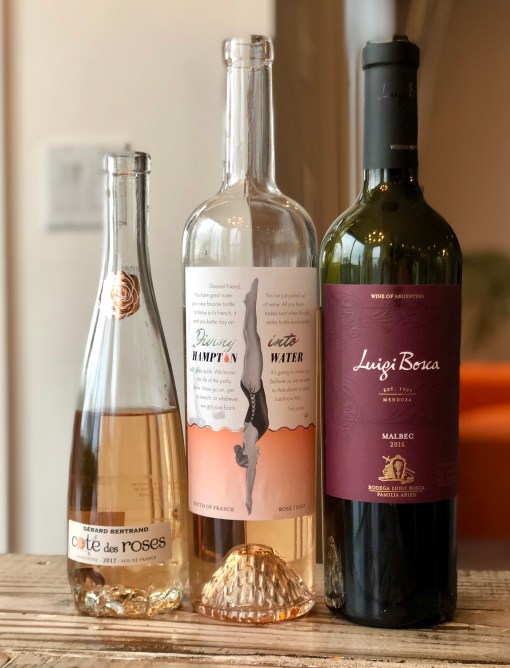
So rather than wait for the appropriate meteorological scene to christen this long-planned summery-wine review set, I have decided to pre-emptively invoke summer by publishing it anyway, in the hopes that this trio of deck-and-BBQ-friendly refreshment will nudge our weather towards more appropriate activities.  I will try anything at this point.  Tonight’s bottles will set a blog record that may never be broken, bear a striking resemblance to each other until they don’t, and confirm that even trendy wines can be old-school sometimes.  They may also be the first time since the Tournament of Pink that we start off with back-to-back rosés, but hopefully we can make that a bit more of a recurring pattern.  Game on. Read the rest of this entry »


Wine Review: The Reds of Sunrock Vineyards

4 07 2019

By Raymond Lamontagne

[These wines were provided as samples for review purposes.]

You cannot make truly good wine without ripe grapes. Simple, no? Insufficient sugar in the fruit is not going to leave much for yeast to consume, and such starved fungi are not going to produce something with sufficient body (and alcohol) to merit any sort of “greatness” mantle. Moreover, grapes need heat if they are to attain physiological ripeness. This refers to the changes in tannins and other chemical components that occur largely in grape skins, stems and seeds during the ripening cycle beyond the mere increase in sugar.  These changes are what produce the key varietal aroma signatures we know and love, preventing a wine from tasting green, weedy, and brittle.

Although sugar ripeness and physiological ripeness are clearly correlated, it would seem that grape hang times might be a stronger predictor of physiological readiness than just heat alone, although in my view (and botanically speaking) you aren’t going to get any degree of maturation, period, without heat. The key question for wine quality is: how much heat is too much? Overly ripe grapes mean clumsy, muddled wines that are boozy, lacking in precision or definition, and often almost devoid of any sense of place or regional character. Such wines are going to be tremendously fruity and powerful, but may not offer much in the way of nuance or balance. As I read up on Sunrock Vineyards, which could very well be the hottest single vineyard site in British Columbia, I wonder how they approach these ripeness issues.

Sunrock is owned by Arterra Wines Canada, formerly the Canadian subsidiary of the massive Constellation Brands, but recently acquired in 2016 by the Ontario Teacher’s Pension Plan (for some reason that tickles my funny bone…I’m sure we drove many a substitute teacher to drink). Arterra farms around 1300 acres of Okanagan vineyard, with the expected corresponding range of quality tiers. Jackson-Triggs might be the best known of Arterra’s brands, and the single-vineyard Sunrock labels formerly carried this name as the top tier of that portfolio. Sunrock is now a standalone winery, a fine example of a large corporate entity with the good sense to recognize and preserve the unique character of a single site. And what a site it is. Read the rest of this entry »