Bricks Wine Advent Calendar 2018: Day 6

6 12 2018

By Raymond Lamontagne

Expectations met can be a wonderful thing. Chianti is one of the world’s truly great wine styles, so such a bottle basically HAS to appear in a calendar like this, no? We had a good showing last year, and I rarely feel disappointed when confronted with vibrant red fruit and pungent savoury herbs coupled with some degree of tannic power. The best of these wines walk a tightrope between force and elegance, erring on the side of varietal fruit character and earth as opposed to sporting a pancake makeup overdose of oak. I prefer those primal Chiantis that speak directly of their native land, even if they are a tad gnarly, like old elementals draped in garrigue and clods of mud. Those that skew more towards the diktats of flying winemakers and a ceaseless push for more concentration rapidly lose my interest. Bigger ain’t always better, particularly with this delicate, rather temperamental grape. This is not a moral pronouncement or a rigidly clasped axiom. You know, it’s just like, my opinion, man. Nature is not perfect… nor is good wine. When everything tastes the same, we lose our ability to be wowed, however hedonistic the benchmark may be.

IMG_2379

Chianti Classico was officially delimited in 1716, although what is now one sub-region among eight initially WAS Chianti, full stop. As the wine became an international star, demand soared and grape-growing expanded into nearby towns and countryside to meet said demand. The moniker “Classico” was eventually added to wines made within the original Chianti area, with the sub-region established as its own DOCG in 1984. This came about largely because producers in Chianti Classico felt that their wines were more historical, distinctive, and ultimately superior to those produced in surrounding areas, perhaps a classic(o) case of “we were here first”. It turns out that the self-styled old guard might have a point, as the DOCG does enjoy more strict rules of production, including longer minimum age requirements compared to the Chianti DOCG (alas, home to many subpar vineyards) and a minimal Sangiovese composition of 80% with no white grapes in the blend. My mind knows that there are other interesting terroirs across the sub-regions, but my heart guides me toward a more conservative approach such that I usually look for the tell-tale black rooster when browsing the Italian section.

IMG_2380

Villa Cafaggio is technically situated in the hamlet of Greve, typically known for full bodied renditions of Sangiovese with concentrated fruit flavours. However, the broader region of Greve itself includes Panzano, a separate village with its own distinctive and long-standing history of wine-making. Yes, even the sub-regions here have sub-regions. I try not to let my head explode. A consortium of Panzano winegrowers are in fact lobbying to have the region separate from Greve entirely. This push has met with no official success to date, yet that has not stopped these intrepid folk, the  Unione Viticoltori Panzano (UVP), from going ahead and forming the first consolidated district for organic wine production in Italy, in which 90 per cent of its vineyards are organically farmed. The government won’t listen? That’s hardly new. We shall simply do our own thing regardless. Some of this sounds strangely familiar. Villa Cafaggio is a proud member of the UVP. Interestingly enough not all Panzano producers are, and defining specific geographical boundaries in a fashion that makes wine-growing sense remains a going concern across the greater Chianti region. Suffice to say, Panzano has staked a claim to its own historical and modern identities. Villa Cafaggio seeks to deliver savoury, perfumed wines that capture this culture. Read the rest of this entry »



Bricks Wine Advent Calendar 2018: Day 3

3 12 2018

By Raymond Lamontagne

I get a strong sense of deja vu. A distinct feeling of coming full circle, of the universe working in mysterious ways, a feeling that perhaps the space-time continuum is not linear but rather cyclic. You see, my very first post on this blog (indeed, my first wine blog, period) detailed a Gruner Veltliner, also on Day 3, in last year’s Bricks Advent calendar. Never mind just that, I also became Pop and Pour’s de facto Austria correspondent for that entire 24-wine run, drawing every bottle from this country in the calendar and becoming an even more ardent fan of Austria’s wines in the process. This just feels right. It is great to be home.

IMG_2367

Gruner Veltliner remains my favourite white wine grape one year later, despite some clear inroads by Riesling: many of these have involved sneaky guerilla actions with accurate laser beam weapons of acid and floral aromatics, while a few have involved full on armoured assaults bearing the insignias of Rheinhessen and the Pfalz. Nevertheless, Gruner remains ascendant (for now). It is safe to say that my view of what constitutes a good Gruner has evolved. Where once I sought sheer weirdness, now I yearn for clarity, distinctiveness, balance, and complexity. I want a sense of place coupled with unambiguous varietal character, although these can sometimes be at loggerheads. Gruner can be high-yielding, leading to blurry tepid wines, or it can deliver a rude slash of acid without enough aromatics to entice or tantalize. It is no longer enough merely to smell like a compost bin or root cellar, although I shall never stop craving the peppery “funk” that is this grape’s signature, the one that initially captivated me. Fortunately, the present wine region has rarely let me down. Read the rest of this entry »


National Zinfandel Day: An Interview With Ravenswood Founder Joel Peterson

15 11 2018

By Raymond Lamontagne

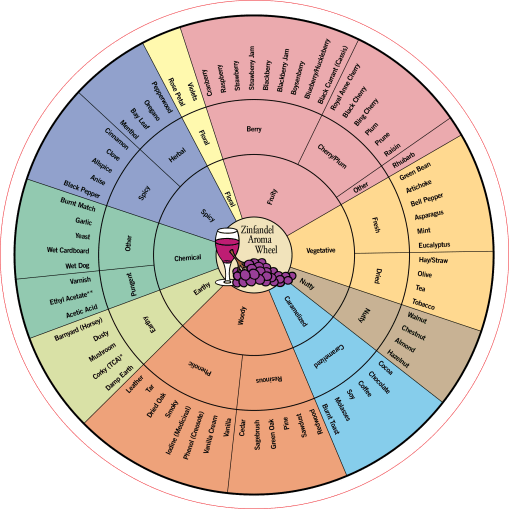
Happy National Zinfandel Day! Although we do not feature many interviews on Pop & Pour, we felt that the chance to publish a Q & A correspondence that I recently had with Joel Peterson of Ravenswood, commonly described as California’s “godfather of Zin”, would be a consummate way to celebrate, especially when paired with tasting notes for one of Ravenswood’s most iconic wines. To me, Zin embodies a key dialectic at play within wine appreciation: that between elegance, austerity and grace on the one hand, and sheer hedonism, richness and bold frivolity on the other. As an avowed disciple of Pinot Noir, you can deduce which pole of the dialectic I might ultimately prefer. However, wine is so immensely enjoyable precisely because there is ample diversity, so many different experiences to chase down and absorb. And I do like having my mind blown by huge flavours as much as the next bon vivant. If I am being honest with myself, a well-crafted Zinfandel may do a better job of resolving this particular dialectical dilemma than almost any other black grape:

Aroma-Wheel

There are some very specific cherry varieties listed here. I approve. (https://zinfandel.org/resources/zinfandel-aroma-wheel/)

The best Zins feature succulent, approachable berry fruit in lockstep with robust secondary flavours of smoke and spice, all festooned on a moderately formidable structure of fresh acidity and fine ripe tannins. They are fun and serious in equal measure: light yet dark, carefree yet intense, simple yet complex. Joel Peterson masterminds just this sort of Zin. Read the rest of this entry »


Global Champagne Day Taittinger Technical Tasting @ Alloy Restaurant

21 10 2018

By Raymond Lamontagne

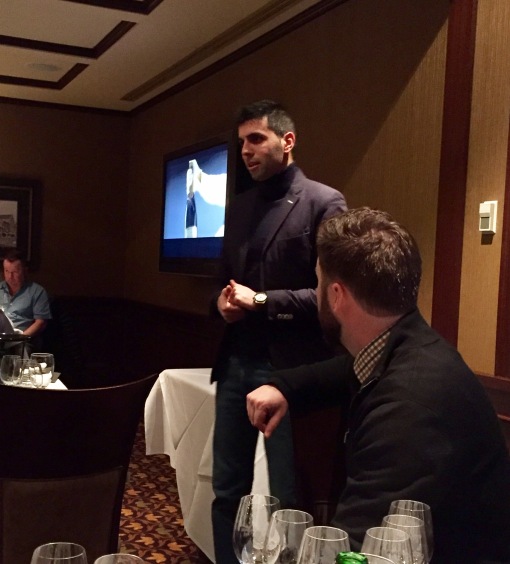
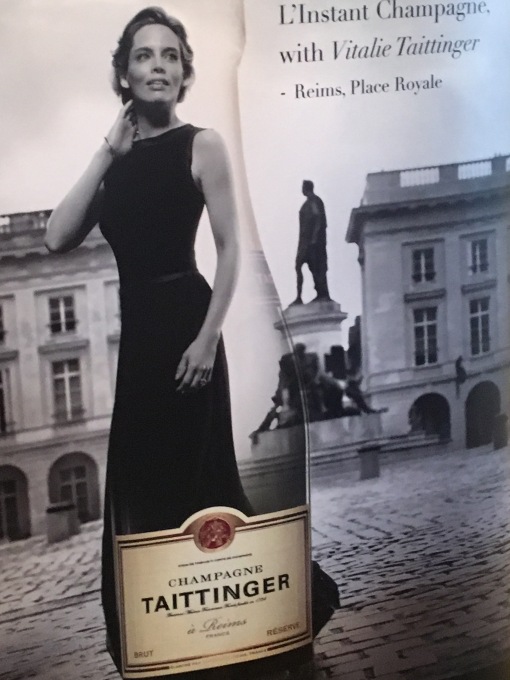
Happy (belated) Global Champagne Day! There is probably no better way than a champagne tasting to shake off what has become a considerable amount of wine writing rust. Tasting bubbles, bantering with a few friends, listening to a knowledgeable and engaging speaker — good for the soul. As usual I arrive at the restaurant too early, a neurosis that rarely extends to other important engagements in my life but one that seems omnipresent where wine events are concerned. I simply do not want to miss anything. Right away there is a glass of Cuvee Brut Reserve NV (non-vintage) in my hand, Taittinger’s entry level offering, and at this point I do not mind waiting. IMG_2148Taittinger’s Mikael Falkman comes highly recommended, although on this occasion he seems more inclined to let these majestic wines speak for themselves. He does come to life near the end of the tasting with an exuberant blend of knowledge and humour.  Mikael makes sure to provide a concise history of this famed house, but I particularly appreciate his expositions of the Taittinger family’s winemaking philosophy. I will provide these gems and nuggets along with my tasting notes for each wine. Read the rest of this entry »


Calgary Wine Life: Veuve Clicquot Release Tasting @ Yellow Door Bistro

23 03 2018

By Peter Vetsch and Raymond Lamontagne

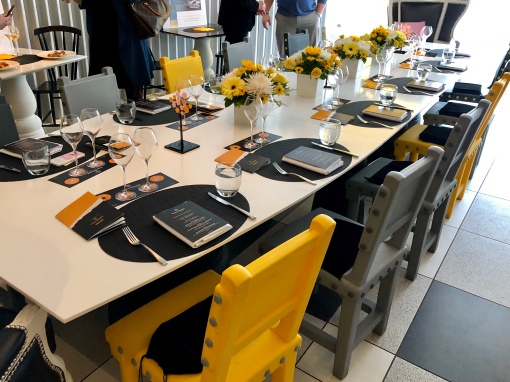
Sometimes the best times to celebrate are the times when there is nothing obvious to celebrate.  It’s a dreary weekday in late March in still-snowy Calgary, but Champagne lifts all spirits and makes all occasions special, and this was no exception.  The eponymous yellow door of the Yellow Door Bistro at Hotel Arts perfectly foreshadowed the array of yellow labels awaiting us inside, including the brand new release from Champagne’s powerhouse (and power-house) Veuve Clicquot.  Winemaker Bertrand Varoquier expertly guided us through a series of Veuve releases, not least of which was the winery’s latest concoction, the Extra Brut Extra Old NV, soon to be available on retail shelves across Calgary.

IMG_7792

Veuve Clicquot is one of the oldest houses in Champagne, founded in 1772 by banker Philippe Clicquot-Muiron, who was then proceeded at the winery by his son Francois.  When Francois suddenly died young in 1805, his widow Barbe-Nicole Clicquot-Ponsardin stepped forward to take over the reins and run the business, a daring decision for a 27 year-old woman in early 19th century France.  The young widow (or veuve, in French) persevered, and her strong vision and fierce entrepreneurial spirit took the winery to new heights, leading to some significant innovations in tradition-laden Champagne.  Madame Clicquot was the first to create a rosé Champagne made from 100% wine (previous renditions of pink Champagne were created by mixing white wine with elderberry juice).  She is also credited with creating the riddling process that allows the dead yeast cells from Champagne’s in-bottle secondary fermentation to slip down into the neck of the bottle so that they can be frozen and disgorged, to keep the finished wine from being cloudy; before this, Champagne was served hazy and decanted to let the leesy sludge settle before pouring.  Clicquot-Ponsardin contributed so much to the region over her lifetime that she was nicknamed “La Grande Dame” of Champagne, a name that since 1872 has also been used for the house’s prestige cuvée.  Her impact on the winery was so significant that the entire brand was renamed in her honour.

IMG_7794

Bertrand Varoquier is a native son of Champagne, born in the heart of the region in the town of Reims; as he puts it, “my blood is bubbly”.  For the past six years of his extensive 18-year wine career, he has been at Veuve Clicquot, where he is currently responsible for all red wine vinification.  Due to the house’s production size, and in order to ensure that its winemaking happens as close as possible to the vineyards where the grapes are harvested, the red grapes that go into Veuve’s cuvées (primarily Pinot Noir, which is at the core of Veuve Clicquot’s identity) are processed and vinified in their own standalone facility in Buzy.  Each discrete parcel of each red vineyard is vinified separately, and after alcoholic fermentation is complete and scores of still wines are created (some with very limited colour due to restricted skin contact, some fully red for use in rosé Champagne creation, all produced solely for future blending), the lots are sent to Veuve HQ in Reims for malolactic fermentation and blending.

IMG_7809

Bertrand Varoquier, winemaker at Veuve Clicquot

Unlike almost any other top wine region in the world, which tends to glorify single-vineyard and single-vintage expressions of time and place, Champagne’s focus is on achieving and maintaining each house’s unique signature style with precision and consistency, year in and year out.  The mammoth challenge of this task is almost unquantifiable, but this will give you a sense of it.  In addition to his winemaking duties, Bertrand is on the Veuve Clicquot tasting committee along with Cellar Master Dominique Demarville and others.  Every year, from the start of November until the start of March, the committee tastes 24 different sample lots of still wines PER DAY out of the roughly 1,200 (!!!) already-vinified non-bubbly base wines aging in full stainless steel tanks in Veuve’s cellars in order to determine which wines will be used to populate each of the house’s different Champagne releases.  These base wines are from the present year’s harvest plus nearly twenty prior vintages, and all are ultimately rolled into a multi-vintage, multi-source patchwork tapestry that the Cellar Master weaves into the emblem of Veuve Clicquot, so that the buying public gets the taste experience they expect out of every single Veuve Champagne, regardless of the year in which they buy it. Read the rest of this entry »


Calgary Wine Life: A Special Evening with Cinzia Merli of Le Macchiole @ Centini

15 03 2018

By Raymond Lamontagne

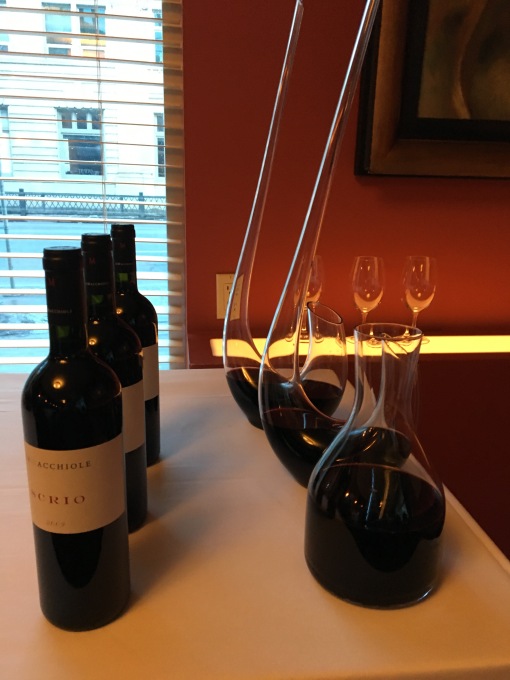
It was while reading my very first book on wine, the 6th edition of Ed McCarthy and Mary Ewing-Mulligan’s “Wine for Dummies”, that I first encountered the term “Super Tuscan”.  I instantly became enamored with the concept.  Some Tuscan producers became wary of traditional wine-making laws that they perceived as stifling innovation. Part of the motivation here was that these producers wanted to experiment with “international varieties”, particularly those famous for yielding Bordeaux blends in France.  Such grapes could be grown.  The kicker was that wines made from them could initially be labelled only as “vino da tavola” (or table wine), as they clearly violated Italian DOC production guidelines which emphasized native varietals.  However, it became apparent that parts of Tuscany were in fact better suited to growing international varieties than native son Sangiovese.  It was absurd to equate quality wines from such areas with the multitude of serviceable but undistinguished table wines found across the country, and thus the marketing concept of the Super Tuscan was born – described on the Italian Wine Central website as “a maverick wine of great breeding but living outside the Establishment”.

IMG_1109

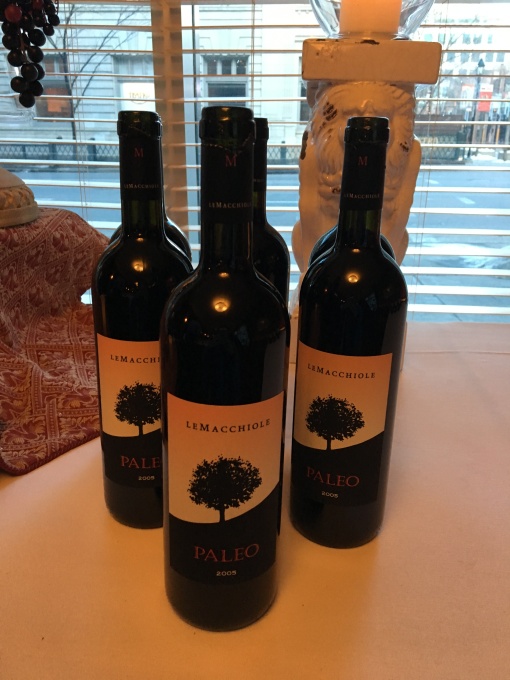
Cinzia Merli does not resemble any stereotype of a maverick.  My initial impression was one of a quiet, conservative, perhaps strict woman, full of resolve and perhaps possessing a keen wit underneath her stolid outward presentation.  She first apologized for her English, which by my reckoning is quite good.  She then provided a fantastic overview of the Bolgheri region and her own wine estate, Le Macchiole, during which her passion and unrelenting dedication to her craft became apparent.  I was already in awe coming into this event:  these wines are legendary.  Cinzia’s presentation only served to stoke the flames.  This evening shall live on in my memory as one of the most fun tastings that I have ever experienced with total strangers (strangers no more!).  I should add that Centini provided exceptional dinner service and perfect ambience.  Read on for my takes on five burly reds (including two vintages of the iconic Paleo), plus a sprinkling of relevant history.

IMG_1110 Read the rest of this entry »


Calgary Wine Life: Tabarrini Montefalco Tasting Seminar @ Model Milk

12 03 2018

By Raymond Lamontagne and Dan Steeves

We have always been impressed by the selection of Austrian and German wines in Salivate Wines’ portfolio, so we were thrilled at the opportunity to sample wines from one of the importer’s Italian producers, Tabarrini.  Hailing from smack dab in the middle of Italy, in Montefalco within the Umbria region (the only wine region in Italy that does not have a coastline or border another country), Tabarrini is a well-respected winery known for its big, brooding single-vineyard reds based on the Sagrantino grape, as well as for an interesting white wine made from the little-known Trebbiano Spoletino. Although maybe not quite as famous as other Umbrians such as Saint Francis of Assisi, Monica Bellucci or black truffles (a full 60% of the world’s supply of the latter originates from the region), there is no doubt that Tabarrini is producing some serious wines that have rightfully been getting global attention.

Tabarrini’s director of sales and marketing, Daniele Sassi, led us through an informative (and entertaining – Daniele is a natural comedian, and the jokes are not always politically correct!) tasting of three of the winery’s offerings:  the Adarmando Bianco (a white Trebbiano Spoletino), the Boccatone Rosso (a Sangiovese and Sagrantino red blend), and the Colle Grimaldesco Sangrantino (one of the estate’s premium single-vineyard dry Sagrantinos).  Read on for our combined thoughts and notes on each bottle. Read the rest of this entry »


Calgary Wine Life: Moet & Chandon Winemaker Tasting @ Ruth’s Chris

24 03 2017

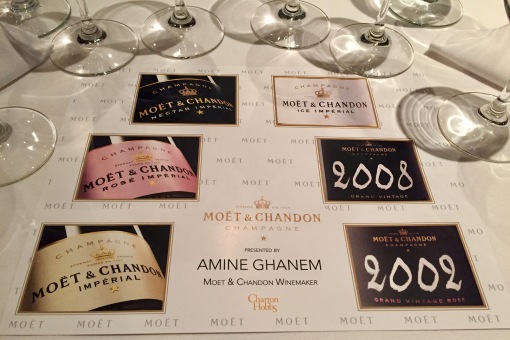
As it turns out, there is no inopportune time for Champagne.  Although the bubbly beverage has built its brand on being the drink of choice for special occasions and other times of celebration, it turns out that it’s equally nice to kick back with a glass of fine bubbles on an otherwise-normal Thursday afternoon.  It’s even better to kick back with six of them, which is what I was fortunate enough to do when Moet & Chandon winemaker Amine Ghanem came to town to lead an attentive and appreciative group through a good portion of the Champagne powerhouse’s portfolio.

FullSizeRender-565

Amine Ghanem, Moet & Chandon.

Ghanem is one of 10 winemakers employed by Moet & Chandon in addition to their cellarmaster, or chef de cave, who directs and decides on the ultimate blend for each of the house’s Champagnes.  Moet has been doing its thing for centuries (since 1743, to be exact – Ghanem informed us that the very first bottle of Moet & Chandon Champagne arrived in Canada in 1839, before we were even a country!), and as such has honed its house style to a fine point, with very clear goals as to the characteristics it seeks to draw out in its Champagnes and specific strategies in place to reach them.  The three pillars of the Moet & Chandon style are, in Ghanem’s words:  (1) “bright fruitiness”, which is attained in part by careful non-oxidative winemaking techniques, even to the point where the house has developed a technique for “jetting” oxygen out of the neck of the bottle after disgorgment to avoid degradation during the maturation process; (2) “seductive palate”, with a welcoming, easy-to-drink texture aided by full malolactic fermentation; and (3) “elegant maturity”, achieved largely through extended lees contact pre-disgorgment, for much longer periods than required by law.  These foundational principles must be working, as we were told that there is currently a bottle of Moet being popped somewhere around the world every second.

FullSizeRender-566

In case the ten full-time winemakers on staff wasn’t a tip-off, Moet & Chandon is a massive undertaking.  It is the biggest house in Champagne and the owner of its largest vineyard holdings, amounting to almost 10% of the entire area under vine in the region.  Since 1962, it has even had its own brand of proprietary yeast, which helps accentuate the characteristics that reflect the house style.  Moet’s primary brand is Imperial, so named in recognition of founder Claude Moet’s 18th century friendship with a certain French emperor, none other than Napoleon Bonaparte.  Napoleon visited the winery many times and was a steadfast consumer of Moet Champagnes, and in 1869 the Imperial brand was christened in recognition of the 100th anniversary of his birth.  The Imperial NV blend starts out as 800 different base wines, which are gradually combined into 3 proposed blends (each featuring solid proportions of all three of Champagne’s grape varieties: Pinot Noir, Pinot Meunier and Chardonnay) before one is selected.  The blending is as much of the artistry as the winemaking itself, and the efforts show in the bottle, which led off our tour-of-Moet tasting. Read the rest of this entry »


PnP – Now on FB!

6 06 2016

After a half decade of technological procrastination, Pop & Pour has finally properly joined the Internet age and now has its very own Facebook page – you can access it here for reviews and other content:

https://www.facebook.com/popandpour

It is still in early development but will be expanded further in the coming weeks.  In the meantime, if you are a fan of the blog, I would be thrilled if you would be willing to Like and Share the page in Facebook – it would be very much appreciated.  New reviews coming this week!

img_08461


FLX: Finger Lakes Extravaganza – Part VI

29 05 2016

Well, we made it.  When I started this trip recap I wasn’t thinking it would be a 15,000-word Greek epic, but that’s what happens when an area has so many stories to tell that so many people may not have heard.  To retrace your steps:

Finger Lakes Intro & Conclusions
Part I – Long Island, Hudson River, Dr. Frank
Part II – Keuka Spring, Chateau Lafayette Reneau
Part III – Red Newt, Knapp Winery
Part IV – Hermann J. Wiemer, Lamoreaux Landing
Part V – Boundary Breaks, Anthony Road

FullSizeRender-366

Our last winery visit was probably also our most anticlimactic, but only because it felt for many reasons like Fox Run Vineyards had been with us all along.  In many ways Fox Run was the catalyst for our whole trip, the Finger Lakes producer with the deepest and most established Alberta presence, to the point where its unoaked Doyle Vineyard Chardonnay was recently selected as the official on-venue house white of the 2016 Calgary Stampede.  A key piece of the winery had literally accompanied us on nearly every stop of our grand FLX winery bus tour:  Sales Manager Dan Mitchell had given us the scoop and filled in the blanks about the region and the wineries who hosted us, never once seeking to undermine any one of them in favour of his own employer, delivering honest yet community-minded feedback that gave us a better sense of what the Finger Lakes were all about than any tasting room.  Winemaker Peter Bell was almost a mythical figure, his impact and his protégées spread across the entire region, his reputation eagerly preceding him even though he is certainly not the kind of person who would revel in it. Read the rest of this entry »


FLX: Finger Lakes Extravaganza – Part V

28 05 2016

Roll call for the previous chapters in this saga:

Finger Lakes Intro & Conclusions
Part I – Long Island, Hudson River, Dr. Frank
Part II – Keuka Spring, Chateau Lafayette Reneau
Part III – Red Newt, Knapp Winery
Part IV – Hermann J. Wiemer, Lamoreaux Landing

FullSizeRender-357

Kees Stapel, Boundary Breaks Vineyard

Ten wineries into our multi-day tasting tour of the Finger Lakes, we continued along the eastern shoreline of Seneca Lake for a different kind of meeting with a different kind of winery.  Rather than gather around a tasting room counter with a winemaker, we were told to head out to the vines at Boundary Breaks Vineyard for a grape-growing lesson with the winery’s conscientious viticulturist, Vineyard Manager Kees Stapel.  He is such an integral part of what Boundary Breaks is all about that he is the very first person listed and pictured in the list of personnel on the winery website; owner and president Bruce Murray doesn’t mention himself at all.  This unusual (but laudable) level of marketing focus on the vineyard team is partly because Boundary Breaks is a winery without a winemaker:  it was founded based on its vineyard, planted in 2008 to four different Riesling clones on an ideal sloped, breezy, sunny, west-facing site arcing gently downward to the lake.  It only makes Riesling and focuses its energies on only five different bottlings, which are presently vinified by Red Newt winemaker and FLX Riesling star Kelby James Russell. Read the rest of this entry »


FLX: Finger Lakes Extravaganza – Part IV

27 05 2016

To start from the start of this tale of adventure, click in order:

Finger Lakes Intro & Conclusions
Part I – Long Island, Hudson River, Dr. Frank
Part II – Keuka Spring, Chateau Lafayette Reneau
Part III – Red Newt, Knapp Winery

IMG_4441

The morning of Tasting Day 3 started at the home of another FLX pioneer.  If you had heard of two Finger Lakes wineries before this travelogue (travelblogue?), I would be willing to bet they were Dr. Konstantin Frank (which we visited in Part I) and Hermann J. Wiemer Vineyard, another winery started by a European immigrant to the FLX with a prescient belief in the potential of vinifera grapes in the region.  In this case, Hermann Wiemer came to New York State from Bernkastel, Germany, about as close to Riesling Mecca as you can get in the world, and he was convinced that both he and his national grape could be successful transplants in the region.  He planted his first Riesling vineyard, the eponymous HJW Vineyard, on the western shores of Seneca Lake in 1976 and established his winery right beside it in 1979.  Thirty-seven years later, there we were. Read the rest of this entry »


FLX: Finger Lakes Extravaganza – Part I

22 05 2016

If you’re a fan of stage-setting or want a little more background info about what the Finger Lakes are all about, start here with this intro post.  Otherwise read on for the first breakdown of what went down over our four days of visiting and tasting in FLX, NY.

FullSizeRender-321

We ironically spent our first actual tasting in the Finger Lakes trying New York State wines from anywhere but.  We disembarked at the beautiful New York Wine and Culinary Center in Canandaigua, on the northern shores of the lake of the same name, which featured a built-in tasting classroom, professional learning kitchen, bistro and wine shop. There we tasted and were educated about a variety of wines from two other major New York AVAs, the Hudson River region due north of NYC and the Long Island AVA on the eastern half of Long Island.  Two winery representatives made a long early-morning trek to guide us through their wares. Read the rest of this entry »


Bargain Bubbles: Prosecco Showdown

7 11 2015

[These bottles were provided as samples for review purposes.]

Bring on the bubbles!

Bring on the bubbles!

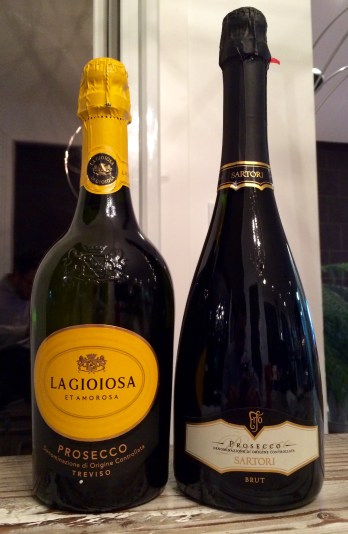
Sparkling wine is instantly celebratory — unless you’re opening two bottles simultaneously, by yourself, at your kitchen table, on a weeknight, like I did.  Even then, the brisk pops of the corks out of the bottles lightened my mood and made my analytical tasting exercise a little more festive.  You almost can’t drink Prosecco and be in a bad mood.

Prosecco is very, very hot right now.  Global sales of this Italian sparkler have increased by double digit percentages every year since 1998 (!), and last year they were up an astonishing 32% (!!) over the year before, five times the sales growth of sparkling wine overall (!!!).  In 2013, global Prosecco sales actually overtook global Champagne sales at over 300 million bottles.  Suffice to say it is on trend, buoyed by its general approachability, fruit-centered flavours and highly attractive price tag.  And yet, before now, Prosecco had never featured on Pop & Pour:

Screen Shot 2015-11-06 at 8.44.02 PM

So since this is uncharted blog territory, allow me to toss out a bit of a primer before we get into the bubbles themselves.  Prosecco is made in the Veneto and Fruili regions of northeast Italy; the Prosecco DOC quality region actually spans and overlaps most of both.  The wine is named after the village of Prosecco (which may have been its birthplace) near Trieste on Italy’s eastern border at the top of the boot.  Its made primary from a grape that used to also be called Prosecco, but as of 2009 is now known as Glera, primarily to annoy you and make it harder for you to remember it.  Just like all quality sparkling wine, it is created by first making a low-alcohol still base wine and then starting a second fermentation of that wine (by adding extra yeast and unfermented juice to it) in an airtight container, such that the carbon dioxide created as a byproduct of the fermentation cannot escape and becomes trapped in the wine, making it bubbly. Read the rest of this entry »


Canada’s Natural Wine Club: Cellar Direct

1 09 2015

[These bottles were provided as samples for review purposes.]

FullSizeRender-118It was not like any other sample box I have received.  This two-bottle sample pack showed up in a container that could have easily fit a full case of wine with room to spare.  Puzzled, I broke into the box to discover the wine inside was surrounded on all sides by multiple inches of insulated styrofoam, like I was being shipped radioactive isotopes instead of a European red and white.  The bottles in the centre of the box were encased in even more styrofoam, and sitting in between them was a liqui-gel cryopack, like the kind you would use to keep your camping cooler cold.  After a multi-day, interprovincial Canada Post voyage, the icepack was still completely frozen.  And the wine?  Precisely at cellar temperature fresh off the delivery truck, a constant, perfect 13 degrees Celsius.  As it turns out, Cellar Direct doesn’t just ship their wines out in a way that ensures temperature stability; it also imports them in from producers in a rigidly temperature-controlled manner too.  They officially had my attention. Read the rest of this entry »