Bricks Wine Advent Calendar 2018: Day 4

4 12 2018

By Peter Vetsch

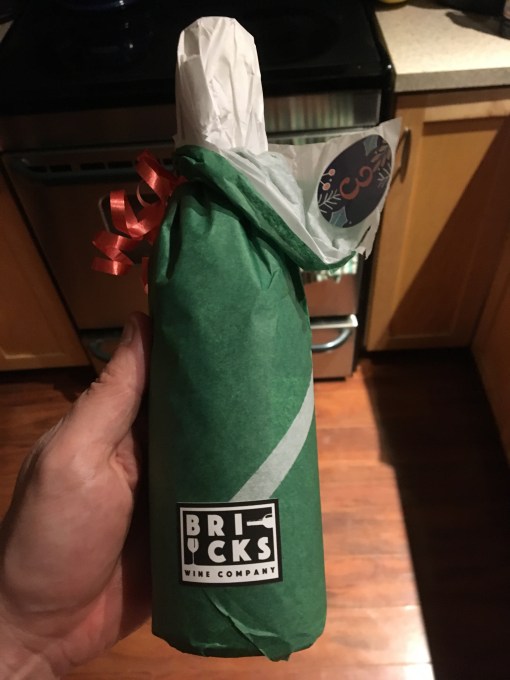
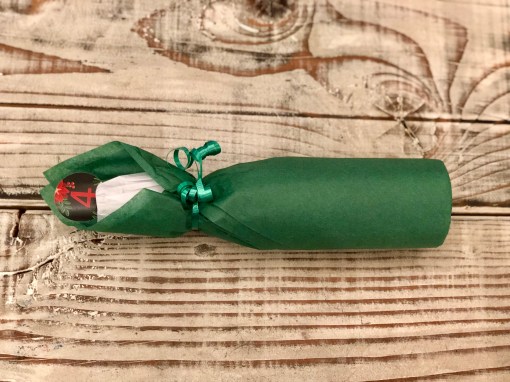
Well, Ray got his blast from Wine Advent past yesterday, continuing his baffling streak of Austrian dominance (which I believe is now at FOUR Austrian calendar wines in a row, somehow).  Mine came today.  Last year, I was a fresh-faced Wine Advent newbie on December 4, 2017 when I pulled a Manoir du Carra Cru Beaujolais from the Bricks calendar.  Tonight, on December 4, 2018, I unwrapped my designated Advent bottle to find…a Manoir du Carra Cru Beaujolais.  I quickly checked my calendar to ensure I had the right year.
IMG_9360

To be clear, it’s a different Manoir du Carra Cru Beaujolais this time around.  This producer is on its fifth generation of family ownership and has accumulated 34 hectares of vineyard land in an astonishing FIFTY different plots scattered throughout Beaujolais. Last year’s wine was from one of the better-known of the 10 Beaujolais Cru subzones, Fleurie; tonight’s option is from the larger but lesser-known (or at least less visible on shelves here) Brouilly, the biggest and southernmost of the Crus which by itself comprises 20% of the Cru vineyard land in the region.  Brouilly is so named for a massive volcanic hill at the heart of the area, Mont Brouilly, which is itself named for Brulius, a lieutenant in the Roman legion who apparently liked naming volcanoes after himself.  This particular wine comes from the Combiaty lieu-dit (or small plot/area bearing a traditional wine) in the village of St. Etienne le Varenne, located in the south of Brouilly and known best for its dry, nutrient-poor pink granite soils.

IMG_9363

I have a strange relationship with Manoir du Carra, in that I have had their wines on at least a dozen different occasions, but NEVER yet in a full-sized bottle — I’ve had a few splits, a number of glass pours, and a strange but incredible 500 mL bottle (which is a remarkably effective size for a bottle of wine and should be produced in greater quantities).  I assume they actually make normal bottles but cannot confirm.  The Terre de Combiaty comes from Gamay vines that average 50 years of age which are hand-harvested (like everything in the Manoir du Carra portfolio), treated with minimal intervention in the cellar and fermented using semi-carbonic maceration, where the intracellular fermentation processes within the individual grape berries from the carbonic maceration process are joined with simultaneous normal alcoholic fermentation from the crushed berries at the bottom of the fermentation tank, resulting in more colour and tannin than pure carbonic maceration and a scaled-back version of the bubble-gummy carbonic flavour set.
IMG_7088

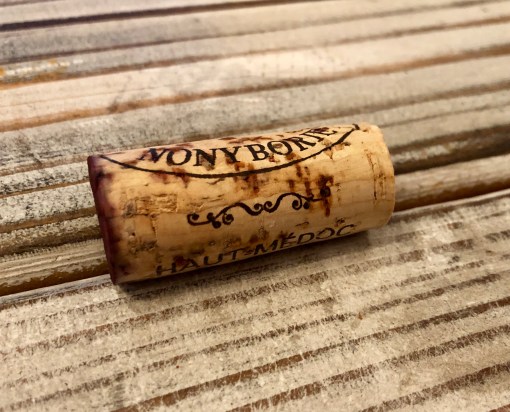
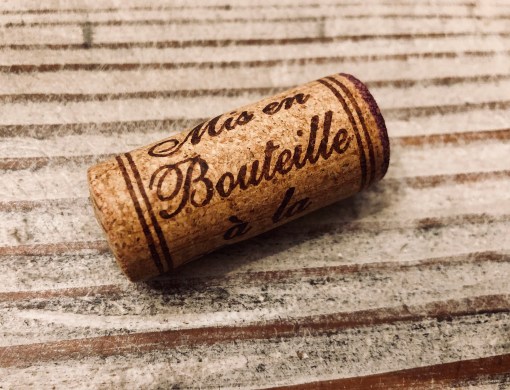
Cork Rating:  1.5/10 (Further deduction from last year’s edition for not changing the nondescript “Mis en Bouteille” nonsense after being blog-warned.)

This sort-of carbonic Brouilly is a sharp purple colour in the glass but thins quite markedly at the rim.  It is initially much darker than expected aromatically, date and slate and dirt emerging first, with black cherry and chalk peeking through underneath.  Over time, a Banana Runts (with banana leaf?) top note emerges, a nod to its carbonic half, as well as the more anticipated raspberry-rooted Gamay sense of joy.  Fresher and plummier on the palate, the wine showcases its clean, squeaky tannins almost immediately, and fairly laissez-faire acidity results in this Gamay seeming more broad and expansive than its standard varietal signature, albeit while retaining a feathery, wispy sort of texture.  The mineral streak noticeable on first smell lasts throughout, iron and rock dust and magnets, but red fruit blooms as you go along to keep anything from seeming severe.  Bricks, I’d say you are 4 for 4.

88 points


Bricks Wine Advent Calendar 2018: Day 3

3 12 2018

By Raymond Lamontagne

I get a strong sense of deja vu. A distinct feeling of coming full circle, of the universe working in mysterious ways, a feeling that perhaps the space-time continuum is not linear but rather cyclic. You see, my very first post on this blog (indeed, my first wine blog, period) detailed a Gruner Veltliner, also on Day 3, in last year’s Bricks Advent calendar. Never mind just that, I also became Pop and Pour’s de facto Austria correspondent for that entire 24-wine run, drawing every bottle from this country in the calendar and becoming an even more ardent fan of Austria’s wines in the process. This just feels right. It is great to be home.

IMG_2367

Gruner Veltliner remains my favourite white wine grape one year later, despite some clear inroads by Riesling: many of these have involved sneaky guerilla actions with accurate laser beam weapons of acid and floral aromatics, while a few have involved full on armoured assaults bearing the insignias of Rheinhessen and the Pfalz. Nevertheless, Gruner remains ascendant (for now). It is safe to say that my view of what constitutes a good Gruner has evolved. Where once I sought sheer weirdness, now I yearn for clarity, distinctiveness, balance, and complexity. I want a sense of place coupled with unambiguous varietal character, although these can sometimes be at loggerheads. Gruner can be high-yielding, leading to blurry tepid wines, or it can deliver a rude slash of acid without enough aromatics to entice or tantalize. It is no longer enough merely to smell like a compost bin or root cellar, although I shall never stop craving the peppery “funk” that is this grape’s signature, the one that initially captivated me. Fortunately, the present wine region has rarely let me down. Read the rest of this entry »


Bricks Wine Advent Calendar 2018: Day 2

2 12 2018

By Peter Vetsch

Day 2.  The spirit is still strong, the Advent joy still coursing through my veins, and now the Christmas decor is up and running in my household, so we are officially in the season.  I’m not sure what I was expecting when peeling back the wrapping paper on the sophomore bottle of this calendar, but Cru Bourgeois Bourdeaux wasn’t it.  This could bode well.  Let’s find out.

IMG_9349

Chateau Caronne Ste. Gemme was THIS close to the big time.  As far as global wine locales go, it is quite nicely situated in Bordeaux’s esteemed Haut-Medoc region, but through a misfortune of cartography it fell a scant 500 metres from where they drew the border for the much more esteemed sub-zone of St. Julien, home of legendary classed-growths Leoville-Las Cases, Ducru-Beaucaillou, Leoville-Barton, Gruaud-Larose, Langoa-Barton and other pricy hyphenated estates.  Its vineyards are actually right beside Gruaud-Larose’s, but on the other side of the appellation tracks and thus on the outside looking in of the 1855 Classification and Bordeaux’s power hierarchy.

IMG_9351

That said, it’s not the legendary estates where the bargains are found; it’s their neighbours.  Caronne Ste. Gemme has been owned by the same family since 1900, but in the last 25 years the current generation of owners has overseen a quality explosion thanks in part to a renewed focus on their 45 hectares of Gruaud-adjacent estate vineyards, planted on a mound of Cabernet Sauvignon-friendly gravel over sandstone.  The wines are fittingly largely Cab (60%), rounded out by Merlot (34%) and Petit Verdot (6%) and see around a year in barrique (20-25% new barrel) and further time in bottle before release.

IMG_1455

Cork Rating:  3/10 (Better idea: put the CHATEAU name on the cork, not the proprietor’s name.)

This is SUCH a textbook, classic Bordeaux.  The 2014 Ste. Gemme is a deep thick ruby-purple colour and smells as though it’s just starting to trace the contours of its aging curve:  blackberry and blackcurrant fruit, tomato leaf, juniper, new pennies (back when those were a thing), pink erasers, campfire embers and topsoil.  An interesting beam of supporting raspberry red joins the chorus once the wine hits the tongue, joined by pipe tobacco, cedar shavings, moss and leather, surrounded by still-scratchy tannins that frame rather than block the flavour symphony.  This is a wine that could simply be nothing else.  It is a dream tasting wine, because it purely and accurately displays exactly what it is without overdoing it; varietal and regional typicity squared.  The Bordeaux that I own I’m trying to age, so I haven’t cracked a bottle of youthful Bordeaux in some time.  This makes the argument that I should, while simultaneously making me mull over what it might taste like in another 5 or 10 years.  Value Bordeaux, I have found you.

89+ points


Bricks Wine Advent Calendar 2018: Day 1

1 12 2018

By Peter Vetsch

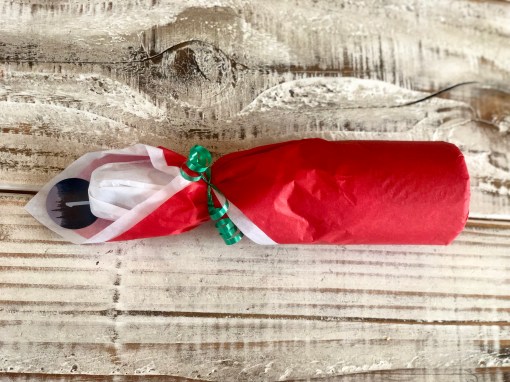
It is again the most wonderful time of the year, and the busiest time in the Pop & Pour blogging calendar — booze Advent.  For the second year in a row, we will be live-blogging every 375 mL day of the Bricks Half-Bottle Wine Advent Calendar, from today until Christmas Eve (following which we will immediately start blogging the 12 Days of Vinebox Christmas beginning Christmas Day…because, well, we’re crazy like that).  Last year, Bricks Advent began with a bubbly bang, so I was wondering if this year might start the same way; I was quite thrilled not only to find out that it did indeed, but that the bubbles in question were already indelibly seared into my memory, a monument to possibly the single greatest moment of my 2018.

IMG_9339

It begins…

I am a Washington Capitals fan.  Always have been.  I don’t know why.  I was born in 1980 in Gretzky-era Edmonton, to Edmonton-area parents, and from the age of 3 or so, from the time I understood what hockey was, Washington was my team.  Those of you with a passing knowledge of NHL hockey will understand that this was not previously a recipe for contentment.  Washington went from being what is still the worst expansion team in the history of the NHL (8-67-5 record in 1974) to being good-but-not-good-enough to being that team whose heart always got broken in a more novel and unbelievable way every playoffs to being that flashy run-and-gun early-Ovechkin squad that “didn’t know how to win” to being clearly the best team in the NHL until it really mattered to being past their window for success.  They pushed all their chips in the season before last, loaded up their team for their last shot at glory – and lost.  To Pittsburgh.  Again.  Last season was supposed to be the start of a slow descent back into irrelevance.  Until it wasn’t.  On June 7th, I watched in tearful disbelief as my team, that I watched fail over and over for 38 years, somehow won it all and raised the Stanley Cup, the culmination of a literal lifetime dream.  I promptly reached for the first bottle — or half-bottle — of bubbles I could find.

IMG_8313

And lo and behold, 6 months later, I peel back the Day 1 2018 Advent wrapping paper, and am greeted with:  my Stanley Cup wine.  I am instantly transported back to watching Ovechkin shrug off the doubt and unfair criticism of the hockey world and hoist the Cup over his head, screaming in triumph.  I remember the stream of excited messages filling my phone, the post-game interviews, the order of players who got their turn to lift the Cup, as soon as I see the label.  Wine, man.  Barone Pizzini and I will forever be connected because of that finally-captured moment of glory. Read the rest of this entry »


The Ultimate Wine & Chip Pairing Showdown

26 11 2018

By Peter Vetsch

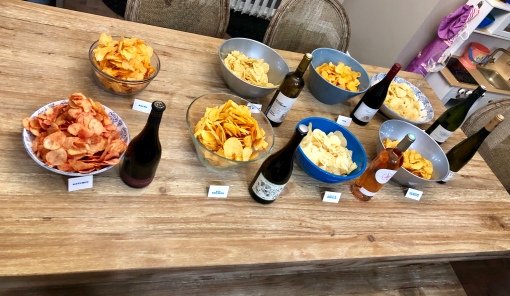
The event was almost a year in the making:  a one-versus-all challenge for pairing supremacy, putting the food-matching skills of eight local wine enthusiasts to the test against a backdrop of one of the more ubiquitous (and delicious) foodstuffs to grace a pantry.  Through extensive research and experimentation, and more than a little trial and error, we sought to answer the question: what wines pair best with the most common flavours of potato chips?  And who could best elevate a chip flavour with a pairing match that ticked all the right boxes?

IMG_6899 2

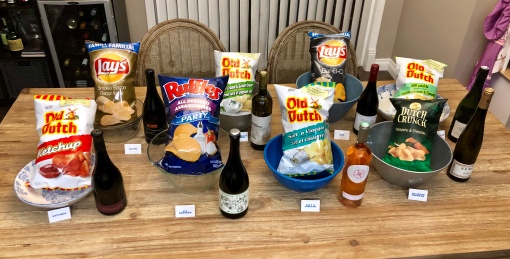
Here’s how our game was played.  After some market research, we first agreed on the top chip flavours that would participate in the competition:  BBQ, Salt & Vinegar, All Dressed, Sour Cream & Onion, Dill Pickle, Ketchup, Jalapeño Cheddar, and Bacon.  (A couple notes on these flavours:  1. “Plain” is not a flavour.  It has to HAVE a flavour to BE a flavour.  2. Americans, I don’t want to hear any complaining about All Dressed – it is a pantheon chip and no chip-based contest is complete without it.)  We were then each randomly assigned a chip flavour as our pairing muse and were tasked with finding the perfect pairing for that chip.  When we gathered together, we tasted through each flavour one at a time (again in randomly drawn order) and graded each potato chip/wine duo out of 10 on the strength of the pairing only:  the individual merit of each wine and each chip were disregarded, and the only question was how well they meshed together.  The top average score out of 10 took home the prize (which was nothing, other than eternal bragging rights and a pervasive sense of wellbeing).

IMG_3242

I should add before diving into the results that potato chip and wine pairing is WAY harder than you might think (and that the bulk of the articles that you can Google on this point almost surely did not go as far as to actually taste their recommended pairings with their chips), as once you put glass to lips with a bowl of chips you realize it does not quite unfold as expected.  With very limited exceptions, potato chips are crammed full of bold, potent, concentrated flavours meant to pack a punch, which can lead to them overwhelming many a potential pairing match that might otherwise be complimentary from a flavour perspective.  Chips also contain an array of particularly exaggerated spicy, sour, sweet and/or salty notes that can pose pairing challenges on their own, let alone in combination (or, in the case of All Dressed, which features ALL of these flavours at once, in accumulation).  A successful chip pairing wine is either one that has the firepower to match the lab-tested amplitude of Old Dutch’s natural and artificial flavours, or one that can do enough to comfortably neutralize them and provide some palate relief without getting lost itself.  Neither are easy targets to hit.

Below I will set out (in the order that the tasting took place) each brave contestant in this inaugural PnP Wine & Chip Pairing Showdown (complete with Twitter handle), their assigned bag of fried potato destiny and their vinous gladiator.  Then I will include a brief explanation of basis for the pairing and the thought process behind it in each competitor’s own words, before assessing how it all worked out in practice.  Finally, I will reveal the outcome of the pairing in question, both on my personal ballot and in the overall official group tally.  You will see that my scores tend to be lower than the group’s across the board, which is more a personal reaffirmation of the difficulty of the mission on my end, a confirmation that a perfect processed potato pairing can be elusive.  Without further ado — let’s eat some chips. Read the rest of this entry »


Spain, Old and New: The Wines of Cune

20 11 2018

By Peter Vetsch

[These bottles were provided as samples for review purposes.]

IMG_9251

Welcome to Cune. Er, CUNE. Er, CVNE.

My love affair with the wines of Spain’s premier wine region of Rioja goes back almost to the time when I first started taking the contents of bottles seriously.  The area, located in north-central Spain and without question the spiritual homeland of the Tempranillo grape, is somewhat unique among the classic regions of the world for producing two very distinct types of wines, depending on the producer in question.  The traditional take on Rioja is more old-school than almost anywhere else, where both reds and whites spend near-shocking lengths of time maturing in flavour-heavy American oak barrels and even more time in bottle before release, leading to a mellowed-out, oxidative, nutty expression of regional identity.  The modern Riojas reduce barrel time (or even eliminate it for whites), focus more on riper, purer fruit and aim for immediate impact as opposed to patient complexity.  I admit to being a total sucker for the former style, largely because it’s unlike anything else produced in the entire world, a whole era unto itself, frozen in time.  That said, it is easy to see how browned, decade-aged, air-exposed wines don’t attract a universal following in this age of pristine winemaking and carefully controlled everything.  Sometimes it can be hard to reconcile the two different sides of this same regional coin.

Cune does the best job of simultaneously representing both the traditional and the modern epochs of Rioja of any winery I’ve ever come across.  Their wines harken back to the old soul of the area and feature many of its wizened delicate characteristics, while still retaining some of the vibrancy and primacy displayed by the region’s vanguard.  They are themselves part of both the history and the new blood of Rioja, founded in 1879 and now run by the fifth generation of the founding brothers.  Cune’s cellars were designed by a famed French architect by the name of Eiffel…perhaps you are familiar with other taller Parisian works of his.  The name “Cune” is more accurately “CUNE” (an acronym), which itself is more accurately “CVNE”:  Compania Vinicola del Norte de Espana, or “the Northern Spanish Wine Company”…calling it Cune (Coo-nay) for short (and giving yourself a nickname) is borderline questionable, but they make it work.

IMG_9267

The Cune universe is actually comprised of 3 different brands, each of which has its own winery and winemaker.  The Cune brand is based in the Rioja Alta subregion and also encompasses the higher-level Imperial bottlings, made only in very good years; the Vina Real label is based in nearby Rioja Alavesa, as is the Contino bodega, which makes wines only from its own estate vineyards.  Tonight’s Cune introduction is focused on a trio of bottlings from the original label’s portfolio, each of which gives a hint of the heights that this marvellous producer can reach. Read the rest of this entry »


National Zinfandel Day: An Interview With Ravenswood Founder Joel Peterson

15 11 2018

By Raymond Lamontagne

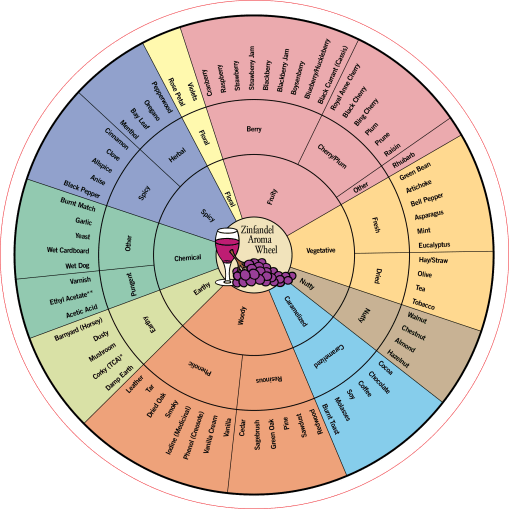
Happy National Zinfandel Day! Although we do not feature many interviews on Pop & Pour, we felt that the chance to publish a Q & A correspondence that I recently had with Joel Peterson of Ravenswood, commonly described as California’s “godfather of Zin”, would be a consummate way to celebrate, especially when paired with tasting notes for one of Ravenswood’s most iconic wines. To me, Zin embodies a key dialectic at play within wine appreciation: that between elegance, austerity and grace on the one hand, and sheer hedonism, richness and bold frivolity on the other. As an avowed disciple of Pinot Noir, you can deduce which pole of the dialectic I might ultimately prefer. However, wine is so immensely enjoyable precisely because there is ample diversity, so many different experiences to chase down and absorb. And I do like having my mind blown by huge flavours as much as the next bon vivant. If I am being honest with myself, a well-crafted Zinfandel may do a better job of resolving this particular dialectical dilemma than almost any other black grape:

Aroma-Wheel

There are some very specific cherry varieties listed here. I approve. (https://zinfandel.org/resources/zinfandel-aroma-wheel/)

The best Zins feature succulent, approachable berry fruit in lockstep with robust secondary flavours of smoke and spice, all festooned on a moderately formidable structure of fresh acidity and fine ripe tannins. They are fun and serious in equal measure: light yet dark, carefree yet intense, simple yet complex. Joel Peterson masterminds just this sort of Zin. Read the rest of this entry »


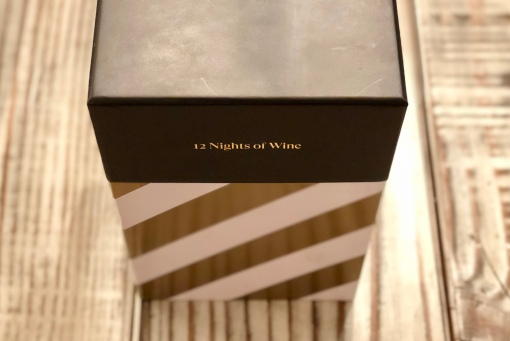
The Vinebox Cometh: 12 Nights of Wine

14 11 2018

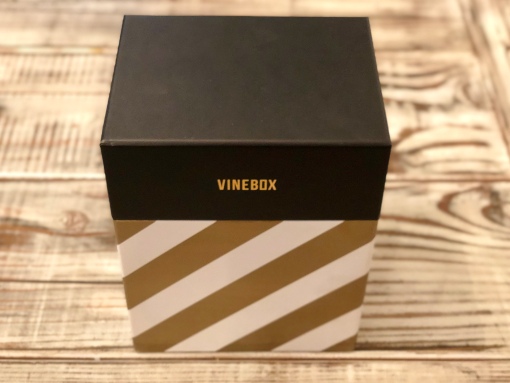
After 7+ years of blogging about and immersing myself in wine, I am in many ways an open book about what I like and don’t like, vinously speaking — there are now over 450 posts on this site, and other musings elsewhere, that spell out exactly what gets me pumped about a new product or wine experience.  Three of the things that rank high on the good side of my ledger, backed up emphatically by past history, are (1) savvy labelling and branding (my love of which is the basis for every Cork Rating I’ve ever done), (2) clever alternative packaging (bring me your wines in cans, your 1L bottles, and everything in between), and (3) Advent calendars.  If you rolled your eyes about the last one, feel free to consult PnP’s 125+ December postings over the past four years and then get back to me…if I’m not a boozy Advent authority by now, I never will be.  As we approach another holiday season, little did I expect to be dumbfounded by a sleek, shiny, downright sexy combination of all three of these things.  Meet Vinebox:

IMG_9197

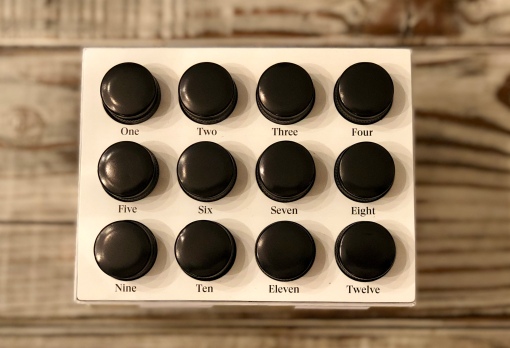
Oh yes.  It gets better.  Take a look inside:

IMG_9200

OH YES.  Bring it.  That’s what I’m talking about.

Vinebox is a San Francisco-based company that, up until right this minute, was a US-only subscription service for by-the-glass-sized portions of new, interesting, high-quality wines.  This special holiday release box marks their first foray into the Canadian market, and luckily for us locals, it is exclusive to Richmond Hill Wines and a select few other boutiques right here in Calgary.  Given my prior history of Advent proselytizing, I would be remiss if I did not point out that Vinebox’s 12 Nights of Wine holiday kit is not technically an Advent calendar, as it offers 12 different holiday wine offerings instead of the classic Advent 24-day December countdown to Christmas.  It is instead intended to mirror the 12 days of Christmas (which, I was shocked to discover, all actually occur AFTER Christmas — they run from December 25th through January 5th, marking the time in Christian lore that it took the three wise men to arrive and visit the newborn Jesus…mind formally blown).  Practically speaking, this means that you can either crack a glass on every even day in December as a sort of quasi-Advent replacement (or get two and create your very own full-scale Advent calendar, with a critical revisit of each offering every second day) or get the coolest Christmas gift ever for somebody to enjoy on Christmas Day and the next eleven following.

IMG_9198

In recent years, because the progress of the species is a real and abiding thing, we have seen a proliferation of wine, beer and spirits-based Advent and holiday calendars in a variety of shapes and sizes.  What sets the Vinebox addition to this growing December lineup apart is the unique and patented way the wines are delivered, in Stelvin-enclosed, test tube-like — yet still amazingly labelled and producer-branded! — 100 mL glass cylinders that make a stunning visual impression. Read the rest of this entry »


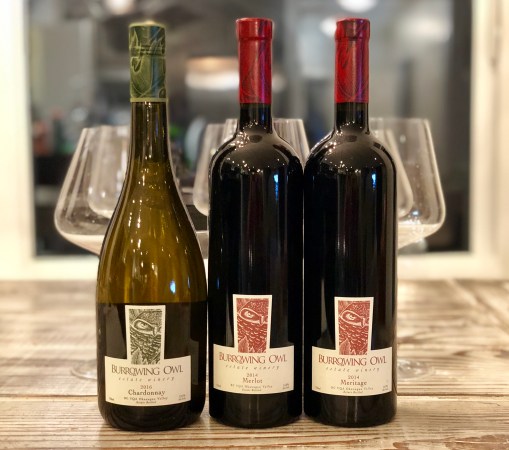
Burrowing Owl Fall Release Trio

8 11 2018

By Peter Vetsch

[These wines were provided as samples for review purposes.]

I have now been receiving and reviewing Burrowing Owl releases since 2015, and in addition to some minor shock about my blogging longevity, this has also given me enough familiarity and enough reps with the wines to truly help me understand the winery’s house style.  The whites tend to be creamy and generous, often buoyed and propelled by oak but not at the expense of the underlying fruit.  The reds are bold and ripe yet not overdone, a strong reflection of the scorching desert-like climate of the estate’s Oliver, BC home.

IMG_9158

Year over year, the releases and the winemaking choices behind them come across as impressively consistent, part of the reason why Burrowing Owl has long been on the short list of top quality wineries in the Okanagan Valley.  Now that the snow on the ground here in Calgary seems permanently settled in until April, it feels like there’s no better time to tuck into this trilogy of warm, rich, classic bottles, which always seem to be best enjoyed with a notable chill in the air, starting with a wine that just might be setting a new PnP record. Read the rest of this entry »


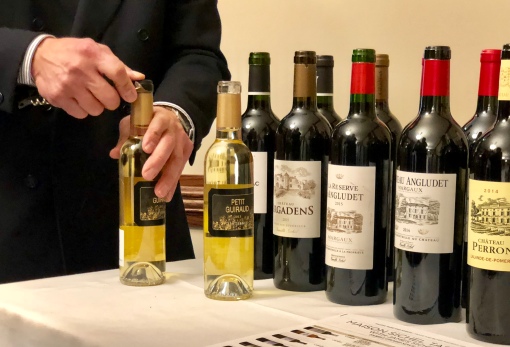
Calgary Wine Life: Maison Sichel Masterclass with James Sichel

3 11 2018
IMG_2336

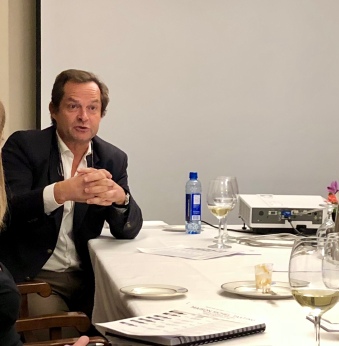
James Sichel of Maison Sichel

James Sichel is on a mission.  One of five brothers who comprise the sixth generation running the family-operated Maison Sichel, born in Margaux to English parents, James grew up among the history and legacy of Bordeaux and is now charged with connecting a whole new generation of wine drinkers with the fruits of his family’s labour, and rekindling the passion of those who think Bordeaux has passed them by.  There is a view among some modern drinkers that the region has ossified, become beholden to ancient classifications and over-reliant on score-chasing, stratospherically priced speculative investment bottles that are detached from the land and the soil and everything human and natural that goes into making great wine.  There are parts of such a criticism that may stick, but there is so much more to Bordeaux than four-figure futures bottlings and producer tiers; it is a massively prolific producing region and has somehow become an under-the-radar source of superb Tuesday night offerings (particularly, in my opinion, on the white side of the ledger) and sub-$100 luxury splurges.  James’ quest is to bring value Bordeaux back to the rest of the world, to steer the focus away from the elitism that can accompany 1st growth price tags and to allow a fresh audience to rediscover the true beating heart of Bordeaux.  The audience seems to be responding:  Bordeaux sales in Alberta are up 24% this year as compared to last.

IMG_9305

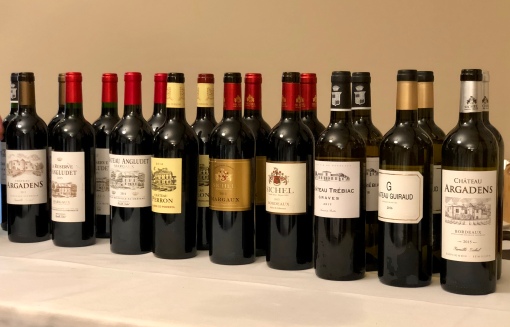
Maison Sichel is a complex entity.  Based in Bordeaux since 1883, they are part estate producer (they own over 350 hectares of vineyards in various different appellations), part winemaking negociant (they work with and source grapes from a series of smaller growers in southern Bordeaux then make wine, including their value flagship Sirius, from the fruit) and part discerning merchant (they sell other hand-selected partner estates’ wines other those estates’ own labels).  On the whole, if you search for the whole Sichel range on its website, you end up with 189 producer results, from straightforward cheap and cheerful offerings all the way up to Chateau Palmer, one of the premier wine estates in the world.  The Sichel family’s pride and joy, however, and James’ current home, is Chateau Angludet, a Margaux estate that is now highly regarded but was on the verge of ruin when the family purchased it in 1961.  It is now their hub and the pinnacle family pursuit.  Aside from Angludet (and a highly savvy prior investment in Palmer in the 1930s), the Sichels own Chateau Argadens in Bordeaux Superieur and Chateau Trillol down in Corbieres.  James’ brother Benjamin Sichel is the winemaker for all three family-owned estates.

IMG_2601

Foreshadowing.

James was on day 10 of a Canadian tour when he took the time (ahead of a sold-out black tie dinner) to lead his Alberta import agent through a portfolio tasting of many of the Maison Sichel offerings available in the province.  I was fortunate enough to sit in on the session and experience my own reacquaintance with a region that too often bypasses my attention.  There were ELEVEN wines poured, so from here on out I will try to be brief.  [Editor’s Note:  I did not succeed.] Read the rest of this entry »


Global Champagne Day Taittinger Technical Tasting @ Alloy Restaurant

21 10 2018

By Raymond Lamontagne

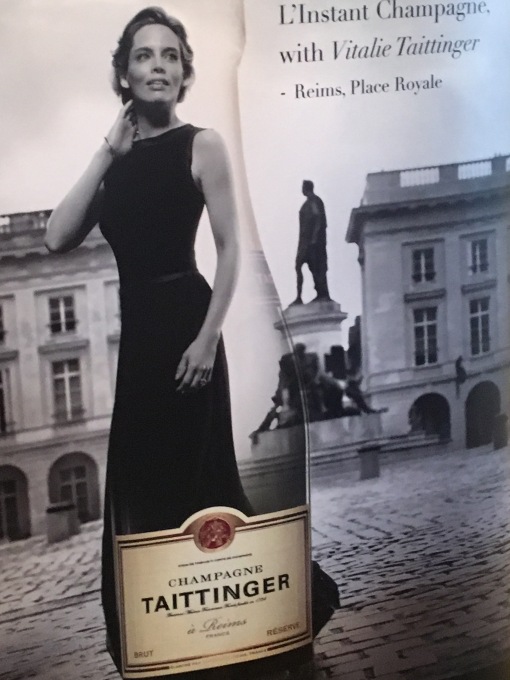
Happy (belated) Global Champagne Day! There is probably no better way than a champagne tasting to shake off what has become a considerable amount of wine writing rust. Tasting bubbles, bantering with a few friends, listening to a knowledgeable and engaging speaker — good for the soul. As usual I arrive at the restaurant too early, a neurosis that rarely extends to other important engagements in my life but one that seems omnipresent where wine events are concerned. I simply do not want to miss anything. Right away there is a glass of Cuvee Brut Reserve NV (non-vintage) in my hand, Taittinger’s entry level offering, and at this point I do not mind waiting. IMG_2148Taittinger’s Mikael Falkman comes highly recommended, although on this occasion he seems more inclined to let these majestic wines speak for themselves. He does come to life near the end of the tasting with an exuberant blend of knowledge and humour.  Mikael makes sure to provide a concise history of this famed house, but I particularly appreciate his expositions of the Taittinger family’s winemaking philosophy. I will provide these gems and nuggets along with my tasting notes for each wine. Read the rest of this entry »


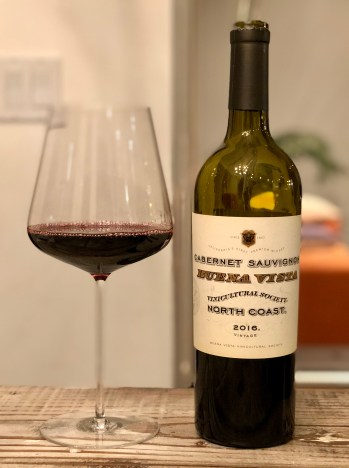
Wine Review: 2016 Buena Vista North Coast Cabernet Sauvignon

17 10 2018

By Peter Vetsch

[This bottle was provided as a sample for review purposes.]

IMG_8980

A rare sighting.

The $25 California Cabernet Sauvignon is an endangered species nowadays; once a stalwart gateway drug for luring novice wine drinkers into a lifetime of vinous enlightenment, it has now been superseded in that endeavour by numerous other New World crowd-pleasers that are managing to offer similarly accessible and overt pleasure at wallet-friendlier prices.  The combination of rising land costs, fire- and drought-inspired production difficulties and the utter shredding of the Canadian dollar as compared to the US greenback on world currency markets has more or less eliminated California as a source of solid value wine in our market.  Buena Vista Winery is trying to change that, but with this series of factors arrayed against it, it’s fighting an uphill battle.

I have previously written about the remarkable, riotous, barely credible but actually true history of Buena Vista, the proud owner of the label “first commercial winery in California”.  It is well worth refreshing your memory about, but the Coles Notes version must at least mention:  (1) Agoston Haraszthy, who may have been the first Hungarian to emigrate to the United States, who founded the winery and who essentially crammed six lifetimes of zaniness and adventure into one shortened 19th century thrill ride; (2) 1857, the year Haraszthy founded Buena Vista, part of a major ambition to establish high-quality vitis vinifera grapes in hospitable California soils; (3) Nicaragua, where Haraszthy fled barely a decade after Buena Vista was first established, with angry and misled company investors potentially at his heels; and (4) alligators, which apparently ate him there.  Never a dull moment at Buena Vista in the 1850s and 60s. Read the rest of this entry »


Cellar Direct: RMW&F Festival Edition!

11 10 2018

By Peter Vetsch

[These bottles were provided as samples for review purposes.]

IMG_8930

Find the booth, for wines like this!

It’s October, and here in Calgary we’ve already been bombarded with two feet of snow in the last week and are craving the spring that’s a winter away, which can only mean one thing:  it’s coming up to Rocky Mountain Wine and Food Festival time.  The massive tasting event, now in its 21st year in the city, is kicking off tomorrow in Calgary (Oct. 12-13) and is heading north to Edmonton the following weekend (Oct. 19-20).  In addition to a massive number of wineries, breweries and restaurants, in attendance for the first time this year will be our blog’s favourite national wine club Cellar Direct, the Old World-focused provider of finely crafted low-intervention traditional-styled wine that ships its offerings across Canada and has been known best on this page for never yet providing a bad bottle over multiple years of tasting experiences.  If you happen to be attending the Festival (which you should, if you can), stop by the Four Corners booth (#309 in YYC, #903 in YEG) to say hi to the founders and brainchildren behind the Cellar Direct venture and sign up for their mailing list, which will give you access to wines like the ones below, which I recently received as a sort of Festival lead-up.  It will likely be the only place you can find these bottles in the country. Read the rest of this entry »


Spirits of Calgary: GlenAllachie @ Buchanan’s Chop House

16 09 2018

By Tyler Derksen

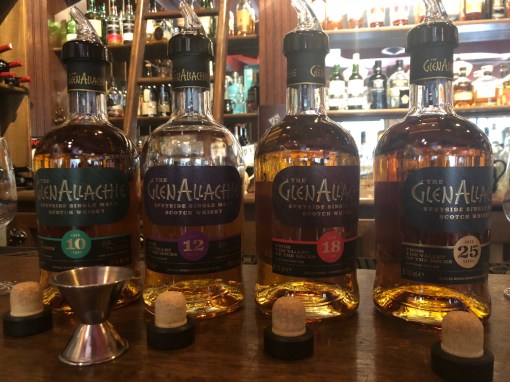
It is not often that I get an opportunity to try whisky that hasn’t hit the local market yet, but when such an opportunity arises, you know I’m going to take it.  This past Wednesday I had the privilege of sampling a group of whiskies from scotch distiller GlenAllachie which will be hitting the Alberta market for the first time this month.  The tasting was hosted at Buchanan’s Chop House, a fitting venue given its substantial whisky collection, and was presented by Alasdair Stevenson of GlenAllachie Distillers Company.

The GlenAllachie Distillery

The “GlenAllachie” lettering was created by a stone-carver and connects the distillery and its brand to the ancient rock formations near which the distillery was built.

GlenAllachie, from the Gaelic for “Valley of the Rocks”, has a relatively short history, especially when compared to its other Scottish cousins.  Located in the heart of Speyside near Aberlour, it was built in 1967 by William Delmé-Evans (who also built Tullibardine, Jura and Macduff) with production commencing in 1968.  The distillery’s design is largely gravity-fed, which allows for the use of far less energy than a conventional distillery; while such an initiative may be more common now in 2018, it was certainly  far less so 40 years ago.  GlenAllachie’s production continued until 1985, at which point it, like so many other casualties of worldwide recession and excess production, was briefly mothballed.  Fortunately, that period of inactivity didn’t last and Campbell Distillers, later part of global beverage behemoth Pernod Ricard, took over and reopened the doors in 1989.  For much of its history, GlenAllachie’s production has contributed to various blends, including Chivas, Ballentines and other prominent blended whiskies.  It is only now, under new ownership, that the distillery is finally releasing a line of single-malt distillery bottlings.

IMG_1103

In 2017, three whisky industry veterans — Billy Walker, Graham Stevenson and Trisha Savage — purchased the distillery, making GlenAllachie independently Scottish owned, which is a far rarer designation than one would guess.  The involvement of entrepreneur Billy Walker is cause for excitement and optimism, as he comes to GlenAllachie after reinvigorating both BenRiach and GlenDronach, which are each amazing distilleries (as those that followed Pop & Pour’s coverage of Kensington Wine Market’s Whisky Advent Calendar the past few years will know).  In addition to the distillery itself, the new owners of GlenAllachie also purchased a considerable library of casks dating back to the 70s, which now permits GlenAllachie to release single malt bottlings with age statements right out of the gate while they find their own signature characteristics and flavour. Read the rest of this entry »


Wine Review: Finca La Linda Malbec Tiers

26 07 2018

By Peter Vetsch

[These bottles were provided as samples for review purposes.]

In some ways, trendy grapes have it tough.  Malbec has a proud and lengthy heritage as one of the six permitted grapes in red Bordeaux (yes, I’m still counting Carmenere, and shall ever continue to do so) and as the dauntingly famous Black Wine of Cahors, and it is almost single-handedly responsible for giving an entire country a vinous identity that has led to the rediscovery and cultivation of astonishingly high-altitude decades-old vineyards and a re-imagination of what grapes are capable of achieving in Argentina.  It is both an Old World stalwart and a New World trailblazer, pulling off both with equal aplomb and giving itself new life in the process.  But with raging-wildfire levels of success comes an inevitable fight against consumer boredom, particularly amongst the more avant-garde and adventurous in the wine world, which creates a sort of quiet undercurrent of peer pressure to steer clear of what is currently painfully a la mode.

IMG_8463

Great labels, but why is one bottle a third taller than the other??

I feel this way quite a bit, pulled away from the customer staple of the day in part because of my own desire to see what else is out there, but in part because of some innate resistance that I see amongst other wine geeks, some refusal to go along with what is everywhere.  So it was with Australian Shiraz; so it is with Argentinian Malbec; so it will be with whatever comes next.  I don’t really have a hard stance on this, but I have recently tried to make sure that my efforts at open-mindedness in wine extend equally to those grapes and styles that are suddenly ubiquitous as to those that remain esoteric.  I have also tried hard to remember that I once relied very heavily on the Shiraz-laden fads of the day as a gateway that set wine’s hooks into me for the first time, and I enjoyed the living hell out of them.  Fifteen years later, I have a WSET Advanced certification and have been publishing reviews on a wine blog for seven years.  Trends can lead somewhere.  So let’s start somewhere. Read the rest of this entry »