Bricks Wine Advent Calendar 2017: Day 16

16 12 2017

By Raymond Lamontagne

Day 16 and we are still in California. Today we leave behind the high ABVs from grapes grown in the hot interior but vinified in Napa, to get a look at what Jon Bonne calls the “new California wine”. Rutherford is considered to be among the finest Napa Valley AVAs. It lies on the valley floor, getting ample sunshine and warm temperatures, two factors that translate into optimally mature grapes that yield opulent, richly-flavored wines. However, a cooling fog also moves northward up the valley from the Bay area, modulating the sunshine that would otherwise napalm the grapes into a watery oblivion. The results are ageworthy wines that display a precise balance of fruit and acidity. Although Cabernet Sauvignon is the undisputed king across the region, more traditional California variety Zinfandel retains a few toeholds here and there. At Frog’s Leap, Zin is the favourite.
IMG_0518

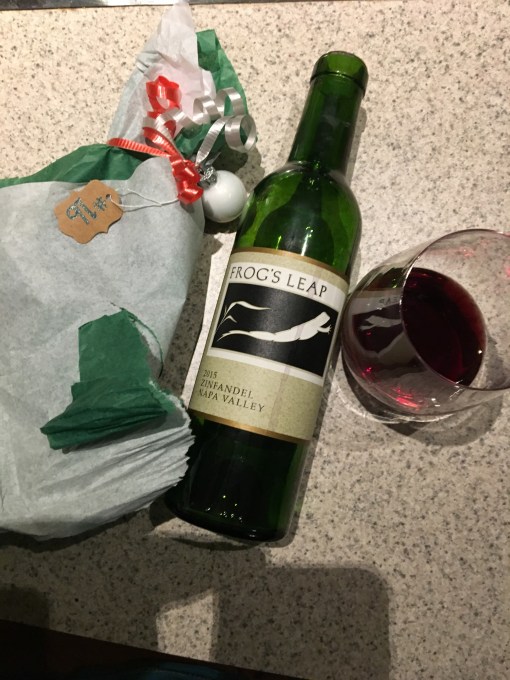
Interestingly enough, the same Riedel varietal tumbler glass is used for Sauvignon Blanc/Riesling on the one hand, and Zinfandel on the other. Maybe they mean white Zinfandel?

John Williams and Larry Turley started Frog’s Leap in 1981, ultimately creating a successful boutique winery that grows only organic grapes and practices dry-farming of vineyards (no irrigation, which many believe leads to sickly vines and bloated grapes that contain less acid, more sugar, and fewer of the  phenolic compounds that make wine worth inspecting, as opposed to crushing). They also incorporate at least certain aspects of biodynamics. Although these guys do not take themselves particularly seriously, stewardship of the land is another matter. Careful attention to yields, the aforementioned dry-farming, and respect for terroir work together to spawn Zins that show restraint, high-toned acids, earthy flavors, and (thankfully for the Advent-soaked liver) more reasonable ABVs. All of this emerges with minimal use of intervention. John Williams believes that nature makes wine, rather than man or woman. Finally, some of Cali’s fascinating grape-growing heritage is reflected in the fact that these old school Zins are often technically field blends: Other black grape varietals grow amongst the Zinfandel vines and are tossed into the pot to round out Zin’s corners and provide additional aromas, flavors, and mouthfeel. These can include various teinturiers (grapes with red flesh, historically used to provide more colour) as well as old warhorses that might be consigned to the dust bin of history were it not for a recent (positive!) trend toward preserving the past. The 2015 Frog’s Leap Napa Valley Zinfandel is 79% Zin, 19% Petit Syrah (or Durif), and 2% Carignan. Let’s delve in.
IMG_0517

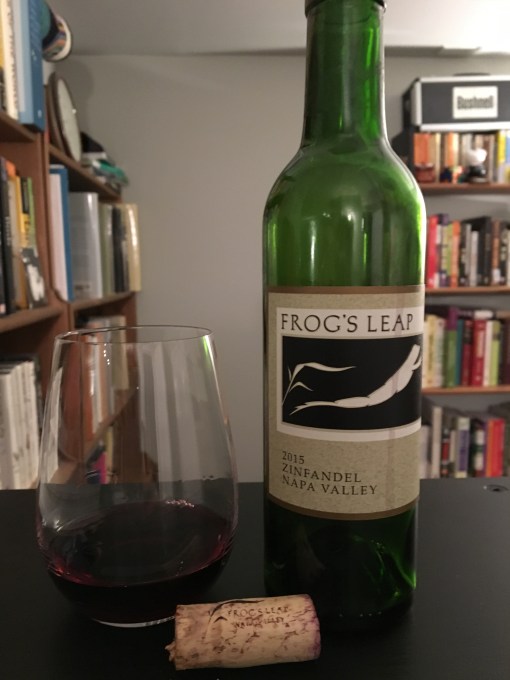
Cork Rating: 6.5/10. I like the Frog’s Leap swoosh, but otherwise this looks a bit like a cigarette butt.

This is a truly smoky, meaty wine upon first impression. One quick sniff yields powerful hickory smoke BBQ sauce and fresh ground beef. A few more sniffs reveal bramble jam, complete with canes and leaves, pumice stones in a sauna, dill seed and weed, allspice (maybe I should just say pickling spices across the board). I taste mealy Saskatoon berries, blackberries purchased in winter when they are rather tart, strawberries, raspberries, maybe a dab of peach conserve and a sprinkle of sweet dried chilli. None of these fruits are overly ripe or cooked, and everything is just a day or two past green. Peter and I exchanged Instagram messages while tasting this wine, and in addition to what turned into a rather wonderful conversation about the twists and turns of life, he helped provide this take on the primary fruit. Somewhat sweet but far from jammy, and every bit as balanced as Rutherford promises to deliver. Fresh acidity lifts everything up, and the tannins have some grip and just enough stem. This is what I absolutely love about an old fashioned Cali Zin: bright fruit but with ample old thorn-bush shrubbery, robust smoke and spice, tons of country character, nothing blowsy. Curry spices (star anise, cumin, coriander) show up late. Finish is persistent and features another perfect symmetry between fruit and aromatics. After last night’s alcoholic explosion, this is a breath of fresh air. Incidentally, some of my favorite wines are those that trigger bittersweet memories. This one takes me back to the raspberry patch in my old backyard in NW suburban Calgary. I do not live there anymore and I am happy in the downtown core. But the memories remain.

92 points


Bricks Wine Advent Calendar 2017: Day 15

15 12 2017

Tonight’s wine might suffer from a disconnect between actual and anticipated identity.  When the first words you note on a label are “California Viognier” and the listed alcohol clocks in above 14%, you think you’re in for a fun, flouncy, slightly provocative stone fruit and flower party.  When the label in question is from an Oakville winery, based in the heart of Napa, which is the heart of big, brash, Cali wine, you doubly brace yourself in anticipation of something raucous.  This bottle is solidly drinkable but has none of that carefree, sultry attitude.  It’s Viognier without joy.

IMG_7256

Miner Family Winery was founded by a husband and wine team in 1996, making this 2015 Miner California Viognier their 20th anniversary vintage bottling.  They make an astonishing array of wines, from Cab and the other Bordeaux varietals to Burgundy’s Pinot Noir and Chardonnay to the reds and whites of the Rhone Valley to Tempranillo and Sangiovese.  There are multiple bottlings of most of these, so their winemaker obviously stays busy.  The winery’s pride and joy is likely its 20,000 square feet of underground cellaring caves carved into a Napa rock face, which were dug at great expense shortly after Miner came to be.  Despite being Napa-based, they source from across the state of California, as evidenced by the straight “California” designation on this particular bottle.  62% of this Viognier comes from a single vineyard in Paso Robles, while the other 38% comes from the Sierra Foothills; since the wine crosses appellations, it has no choice but to revert to the broader state-wide statement of origin on the label.

IMG_7259

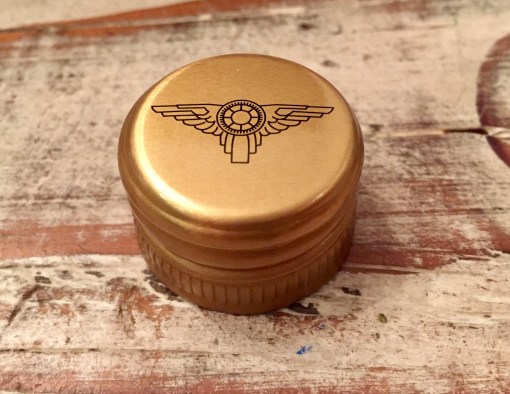
Stelvin Rating:  8/10 (Love the gold, love the sun god logo, love the interest yet simplicity.)

The 2015 Viognier is a surprisingly pale lemon colour coming out of the bottle, partly due to the lack of any oak treatment (which deepens the colour of white wines).  It is almost shockingly lean and citric for a 14+% abv California Viognier, leading with lemon zest and mountain stream aromas backed by frozen honeycomb, Tums and talcum powder.  It broadens slightly in waxy, watery ways on the tongue, adding tart pear fruit and some kind of tropical musk, but retaining an overall sense of distance and a prevailing greenness — fresh leaves and flower stems, grass and baby spinach — finishing with a touch of astringency.  Viognier’s trademark bouncy peachiness and sensual mouthfeel don’t make an appearance, almost like these grapes were picked before those elements got there (harvest dates: August 19th-27th); despite significant sugar ripeness, the phenolics and ultimate character of the wine never quite caught up.  I had no issue crushing the bottle, but this would not be the expression that Viognier sends with its cover letter to land a job interview.

87- points


Bricks Wine Advent Calendar 2017: Day 14

14 12 2017

By Raymond Lamontagne

We’re back in DAC. The Old World classics continue to roll with an Austrian red, and I’m on deck for my third Austrian wine of the blogging campaign. The Calgary wine scene has seen a recent proliferation of Austrian sips, many natural or biodynamic, and the vast majority that I’ve sampled are charming, characterful, and delicious. A few have been stunningly superb. The entry level Krutzler Eisenberg Blaufrankisch is a textbook example that the winemaker describes as a “people’s wine”:  uncomplicated, approachable, congenial, and Krutzler’s best seller, yet still hearty enough to pair with richer meals. This is the Reserve, however.

IMG_0509

I wonder if its Austria??

Blaufrankisch is often deemed “the Pinot Noir of the East” due to its proliferation across Eastern Europe and presumably also its taste characteristics. I can see the analogy, although to my palate, crossing partner St. Laurent often seems more quintessentially “Pinot”. Blaufrankisch can yield densely tannic wines (see Fox Run’s offering from the Finger Lakes, NY, which was sublimely floral but excoriated my tongue). This young impetuosity often gives way to a velvety mouthfeel and deep cherry and woodland berry flavors with age, while retaining a pronounced acidity. So yes … A Pinot relative at least in spirit.

One of Blaufrankisch’s parents is the fascinating Gouais Blanc. Gouais is a vinous Genghis Khan: decried as a barbarian, but sowing its seed far and wide. This white grape was deemed coarse and far too rustic, banished to the hinterlands early in the Middle Ages. This ill will almost rendered it extinct. Gouais did however have ample opportunity to cross with Pinot numerous times, perhaps imbuing the latter with some degree of hybrid vigour, and those crosses live on as some of the top wine grapes in the world today (Gamay and Chardonnay!). Fortunately extinction was forestalled and Gouais persists as a prime source of genetic diversity, if not a stellar offering in the glass. The other parent of Blaufrankisch is the ultra-rare Blaue Zimmettraube, recently re-discovered in the German Rheinhessen region. Most evidence suggests that Blaufrankisch itself originated in Lower Styria (in present day Slovenia), spreading to Germany (where it is called Lemberger, the name also used in NY and other US states), the Czech Republic (where it is called Frankovka), Slovakia, Croatia, Serbia, and even Italy. Finally, Blaufrankisch is a rising star in Hungary, where it goes by the pert handle “Kekfrankos”. Some claim that these names lack market appeal. I say slap on an appropriately Gothic font and let the flavours speak for themselves. Besides, “Lemberger” sounds like a cheese. Read the rest of this entry »


Bricks Wine Advent Calendar 2017: Day 13

13 12 2017

By Dan Steeves

We are now officially into the second half of the Bricks Wine Advent Calendar! It’s been a fun ride so far with some fantastic wines, which for the most part (10 of 12 bottles) have all been from Old World wine regions. Tonight, we go back to the New World (perhaps New World wines will have a larger influence in the second half of the calendar?) with a wine from Sonoma County, California: the 2015 Schug Carneros Estate Winery Pinot Noir.

Day 13 wine was not an unlucky one!

Los Carneros AVA (commonly referred to as just Carneros) spans across the southern part of both Sonoma and Napa counties just north of San Pablo Bay. The region has low hills and relatively low elevation and is known for its moderate climate that is heavily influenced by cool winds blowing in from the Bay. The stress from the cool, windy conditions draws out the growing season which promotes crisp acidity and flavour development in the fruit and makes it an ideal location for growing Chardonnay and Pinot Noir and for sparkling wine production. The region is so well suited for sparkling wine production that a number of famous Champagne houses (Moet & Chandon – Domaine Chandon, Taittinger – Domaine Carneros, and GH Mumm – Mumm Napa) have set up operations in Carneros for producing high quality sparkling wines.

The Schug Winery is a family run operation, started by Walter Schug and his wife Gertrud in 1980, and is now headed by their son Alex Schug although all of their children are involved in the operation. Walter and Gertrud moved to California from Germany in 1961 to start working in the developing California wine industry. In 1966 a position working with the northern California portfolio for E&J Gallo allowed Walter to forge relationships with hundreds of growers in the region and gain insight to the prime vineyards in Napa and Sonoma. This experience was sought by Joseph Phelps in 1973 and Walter started a 10 year tenure as VP and winemaker for the new winery (next time you see a bottle of Insignia or Backus vineyard Cabernet Sauvignon, you now know who was behind it). In 1980, Joseph Phelps ceased production of Pinot Noir but made an arrangement with Walter that he could continue to produce it under his own private label while still the winemaker at Joseph Phelps. A few years later, Schug went out on his own, and in 1989 purchased land in the Carneros appellation and started the Carneros Estate which runs today.

img_4779-1

2015 Schug Carneros Pinot Noir – WS Tribute Vintage – Remembering founder Walter Schug who passed away in 2015.

The 2015 Schug Carneros Pinot Noir has a medium ruby colour and a pronounced nose of cherry, raspberry, bramble, and cranberry along with nutmeg, vanilla, and slight smoky and medicinal aromas. The wine shows its cool climate upbringing with its crisp and earthy aromas, and it is a delight to take in all the scents. On the palate, the wine attacks immediately with a spicy character and nicely balanced crisp acidity and silky tannins. Flavours of dark cherry, cranberry, currant, leaf, tree bark, and clove persist with a rather long finish. I am a big fan of cool climate New World Pinot Noir and this wine most certainly does not disappoint! At the $30 price point it offers tremendous value for a highly regarded region like Carneros and a winery with deep roots in the development of the regional wine industry.

90 Points


“Bliss” by Charles O’Rear 1996

P.S.  If you’ve ever used a PC, there should be a 100% chance you recognize the above picture. The picture of a relaxing green field with the rolling hills on a beautiful sunny blue sky day, which was a default background for Windows XP. The photo, aptly named “Bliss”, was taken on film in 1996 by Charles O’Rear while driving through Carneros. There are no vines in the picture, as they were all ripped out a few years prior due to a Phylloxera outbreak, but this area is now once again under vine.


Bricks Wine Advent Calendar 2017: Day 12

12 12 2017

We are here, my friends:  at the midpoint of Advent, 24 posts in (including this one) and 25 to go, about to hit Advent Hump Day tomorrow (on a Wednesday, natch), with two columns of the Bricks Wine Advent crate vaporized and another two left to go.  I’m late posting this tonight not because I got started late, but because tonight’s bottle is so damn fascinating that I’ve just spent the better part of the last hour reading about it instead of getting down to business.  It’s a Cava, but not really.  It has a history dating back either millions (for the land) or hundreds (for the family) of years, but it’s also so new that it has yet to obtain an official designation.  I looked at the label for a good long time trying to figure out what was going on before resolving to dive deeper on this one.

IMG_7230

The label says “2011 Raventos i Blanc Conca Del Riu Anoia De La Finca”.  I recognize it to be a sparkling wine from eastern Spain, but it doesn’t say “Cava” (the only widely known bubbles appellation in the area) anywhere on the bottle.  It’s also vintage-dated, which a lot of Cava is not.  Um.  Starting with the only one of those label words that I knew, and the only one with its own website, I pulled on that thread and started unravelling the mystery.  Raventos i Blanc is one of the top quality sparkling producers in Spain, an estate that has been family-owned and -run for TWENTY-ONE GENERATIONS, since 1497.  The Raventos family is intimately connected with the creation and rise of Cava:  it was Raventos ancestors who first established the indigenous grapes that would form part of the Cava blend (Macabeu, Xarel-lo and Parellada) and who actually made the very first bottles of Cava in 1872.  The Cava DO has since stretched, however, now encompassing a half-dozen areas that aren’t at all geographically connected and now permitting Champagne grapes Pinot Noir and Chardonnay to also be used in the bubbly blend.  The current generation of the Raventos family were not a fan of these changes.  So in December 2012, they left the Cava appellation and started their own.

IMG_7233

The estate and vineyards are still based in the very heart of classical Cava, of course, in the core of Penedes near Barcelona.  But Raventos pulled the name of the region off its bottles and instead added the name of a proposed new location-focused appellation:  Conca Del Riu Anoia, named for the nearby Anoia River.  Their proposed requirements for this new region are strict, ranging from a commitment to organic viticulture to minimum purchase prices for fruit bought from growers to longer minimum aging periods.  I keep saying “proposed” because the Conca Del Riu Anoia “region” has no legal or formal existence but is still just a vision; but it has some kind of existence, because I see it on the label of this leading light. Read the rest of this entry »


Bricks Wine Advent Calendar 2017: Day 11

11 12 2017

By Raymond Lamontagne

One certainly learns a lot working through an advent calendar. Providing a detailed commentary for each wine puts this learning into hyperdrive. There are producers and methods to investigate. Sometimes there are grape varieties that I need to research further before delving into the tasting per se. This is one of those times, although this grape is far from rare and I know I’ve had it before. Learning a little beforehand or refreshing one’s knowledge base provides scaffolding for those treasured “in the moment” experiences. This enhances memory for what you taste and smell. The act of paying careful attention on purpose is hard work. Although I prefer to share actual tasting impressions with others after I’ve partaken, to avoid (added) sensory bias, I am a firm believer in having this framework of semantic knowledge ready to go beforehand. This allows one to note the expected structural features and aromas quickly, freeing up mental processing resources for focusing on anything that seems out of place. One could debate the merits and drawbacks of this approach. It works well for me.

IMG_0501

Party up top, business below.

In his encyclopedic opus of Italian wine grapes, Ian D’Agata makes a solid case for Verdicchio being Italy’s greatest native white. Versatile, capable of aging, full of aromas described as lemony and almond-like, and showing an affinity for oak, this bright green wonder typically produces lighter and highly floral wines in Verdicchio dei Castelli di Jesi, one of the major DOCGs in the Marche. The latter has been described as producing “cheerful and simple” fare, although this may downplay how good these wines can be. The New York Times recently identified Verdicchio as a “hip varietal”. Yields have dropped and the region is starting to shed its reputation for frivolity due to a previous emphasis on cheesy amphora-shaped containers. These latter vessels look like a cross between King Tut’s scepter and something one could find in an adult novelty store. Circuitous geographical musings and botanical studies of both genetics and morphology have revealed that this grape is identical to the well-regarded Trebbiano di Soave and therefore probably originated in Tuscany, brought to current alternative stronghold the Marche by Tuscan farmers who resettled the land after a severe bout of plague.

IMG_0502

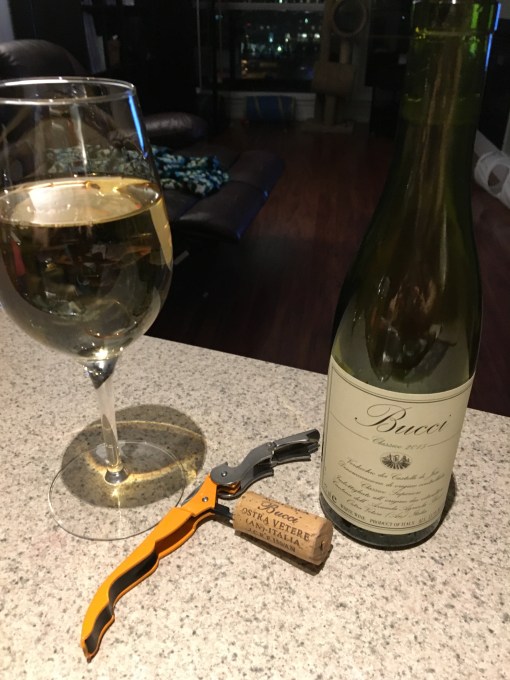
Italian wine label with an f-ton of script. Don’t sweat it. Key details explained below!

D’Agata and myriad wine critics regard Villa Bucci as one of the finest di Jesi producers. Bucci offers age-worthy bottles full of finesse, floral perfume, and primary fruit. “Classico” means the grapes were grown in a traditionally favored hilly area near the town of Cupano. Grapes hail from four organically farmed high altitude vineyards (Villa Bucci, Bellucio, Montefiore, and Baldo), each vinified separately. Vines are about 45 years old. Although DOCG rules allow for up to 15% Malvasia Toscana to be included, this is 100% Verdicchio. Grapes are gently crushed under cold temperatures and aged in large used oak barrels for four months, permitting micro-oxygenation but minimal seepage of flavors into the wine.

IMG_0504

Cork Score = 8.0 … Actual winery is named with decent font. Some empty space but lofts are still “in”, no? Not depicted: A funky graphic intended to evoke a very pleasant farm.

The Villa Bucci Verdicchio dei Castelli di Jesi Classico Superiore 2016! Nose features a stark minerality right out of the gate … Wet gravel with flecks of table salt and potash. Some low key fruits emerge next: Green apple (including a slight whiff of brown apple oxidation), lemon rind, maybe green tangerine, white blossoms (gardenia, a personal favorite scent, or the aforementioned apple). Palate largely echoes the nose but with more tangy fresh fruits: Bitter orange and almonds, lime, lemon, Granny Smith. Like a Five Alive or similar beverage without any sugar, if said beverage featured a few additional flagellations of acid and some serious added calcium. This has more minerals than it does vowels in the entire handle that I typed out above. Crisp, taut, and broad, with enough primary fruit to save it from an experience not far off rock climbing in a glass. I dig. Or rather, I chip away at a frozen orange entombed in gypsum. We’re back, baby.

Amphora-800x524

You cannot deny that it was an effective marketing tool … From http://www.vintuition.net/main/?p=3517

89 points


Bricks Wine Advent Calendar 2017: Day 10

10 12 2017

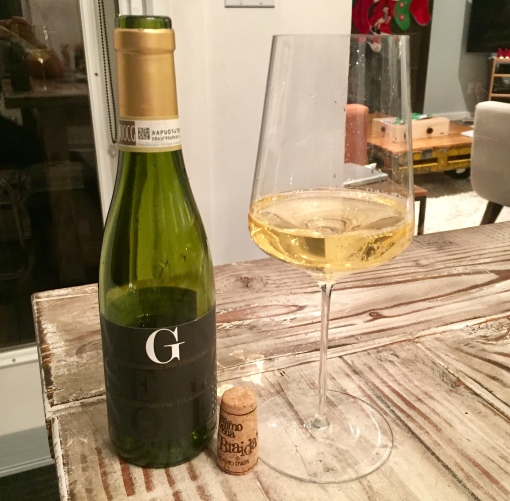
I think it is officially Sugar Coma Weekend in the Bricks Wine Advent Calendar.  When the COMBINED alcohol level of your Saturday and Sunday wines is 12%, you know you’ll be facing an armada of unfermented grape sugar in the bottle.  After last night’s 6.5% abv Auslese Riesling, I thought we had hit our December alcohol floor, but the 2015 Braida “Vigna Senza Nome” Moscato d’Asti will see that 6.5% and raise it (well, technically, lower it), clocking in at an almost juice-like 5.5%.  The wine’s name roughly translates to “Vines Without Names”; the roughly dozen online sources I consulted trying to find out why declined to say so, though most of them noted that the corresponding motto on the front label “Sator Arepo Tenet Opera Rotas” means “the farmer at the plow chooses the path”, which is reflective of this classic producer’s focus on the quality of the vineyard, even if they decline to name the vines in it.

IMG_7219

I love Moscato d’Asti.  At its best it is equally refreshing and luxuriant, searing and delectable, a frozen rope of distilled fruit essence that disappears from the glass before you even notice.  It is made from Moscato Bianco grapes grown around the famed town of Asti, in the heart of Piedmont, which are harvested then crushed and immediately refrigerated before fermentation so that the yeasts don’t immediately kick in.  The cooled must is then transferred to pressurized sealed steel tanks before fermentation is allowed to begin; as the grape sugars are converted to alcohol, carbon dioxide is released as a by-product, which can’t escape the tank and gets dissolved into the wine.  Once the alcohol content clocks above 5% (which is WAY before all of the sugars are fully converted), the whole tank is chilled down to near freezing so that fermentation stops, after which the yeasts are filtered out and the wine is bottled under pressure, leaving an intensely sweet, slightly bubbly bolt of lightning for patio enjoyment.  It is best consumed as early as possible, when acids are crisp and bubbles are buoyant, and there is little to be gained in trying to mature it.

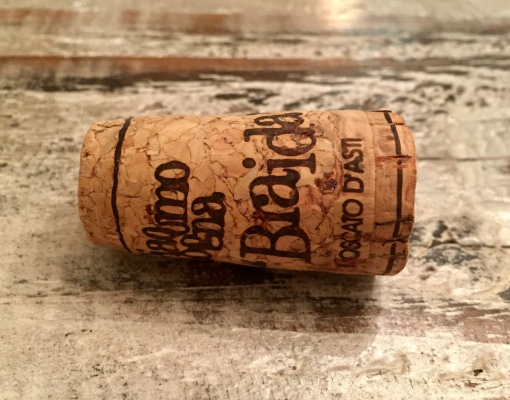
IMG_7220

Cork Rating:  6/10 (The extra expansion and vertical writing are winning somehow, even if the cork as a whole is bland.)

This 2015 Vigna Senza Nome is a surprisingly golden colour for a Moscato and has a slightly syrupy nose of baked pear, bruised apple, honey and caramel to go with brighter tropical and Fuzzy Peach notes.  Some lift remains on the palate in the form of hedonistic melon, lychee, blood orange and bergamot, but much of the life and effervescence that normally characterizes this style and expression has been faded away, whether due to time (it’s only two years old, but Moscato’s probably best at 20 minutes old) or (more likely?) due to storage conditions between its bottling and its insertion into the calendar. I’ve had this exact bottle multiple times before, albeit never in back vintage form, and this is the first time it’s tasted heavy; the bubbles aren’t quite up to the task of scouring away the sweetness, and quiet acidity doesn’t provide enough of a helping hand.  It’s still completely delicious, but it is drained of some of its usual joy and not quite showing at its peak.

86 points


Bricks Wine Advent Calendar 2017: Day 9

9 12 2017

By Raymond Lamontagne

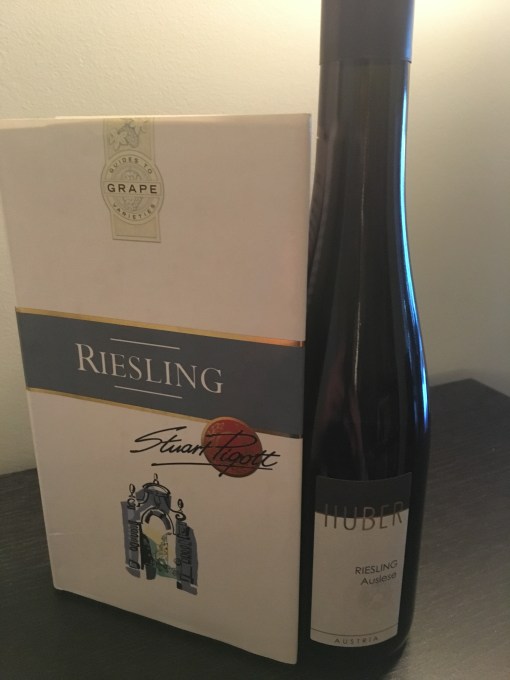
The series of odd coincidences continues during my debut blogging gig, as on day nine I draw a Riesling to complete the “favorite grape triumvirate”, and my second offering from Markus Huber. Perhaps Markus should put me on staff. An Austrian Riesling no less, a curveball tossed just as we were starting to think that we could accurately soothsay this superbly curated array of classic regions and styles. Stuart Pigott (see book in photo, a quaint but scholarly little tome) describes the Austrian persuasion as the most underrated Riesling in the world, stating that these are more crisp and fruity than Alsace, and more full-bodied, aromatic, and balanced than those of Germany. Lofty praise indeed. Although such sweeping generalizations are easy to puncture with counterexamples, particularly where Riesling is concerned, the claim is not entirely without merit. Austria’s warmer climate means that the grapes can reach greater physiological ripeness, a state more challenging to reach in colder northern regions. Less acidic, riper grapes mean that wines can be fermented completely dry, in contrast to many of the sweeter German examples. Or so goes the argument. Dry is far from rare in Germany these days.

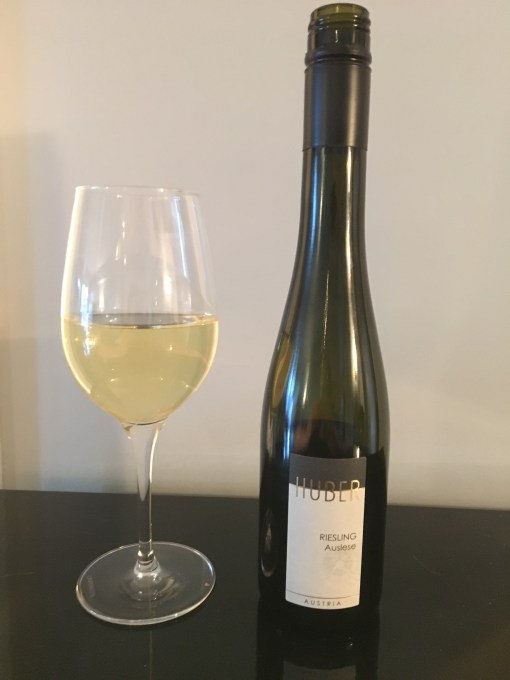
IMG_0496Riesling constitutes 15% of Huber’s production. This one hails from the Berg site, an east facing vineyard with dry gravely and chalky soil stained red by iron and manganese oxides. The vineyard lies at high elevation, allowing a lengthy ripening process, and hot days and cool nights provide a Burgundian type climate, which according to Markus Huber yields “very fine aromas and spicy finesse”. Note that this is an Auslese, the German/Austrian category for a later harvest wine, with grapes picked when they are shrivelled and high in concentrated sugars. Although this means that most Auslese wines contain residual sugar, they can be fermented dry, with dryness representing a typological dimension separate from the Pradikatswein categories that capture ripeness. The Huber website makes mention of botrytis or noble rot being desirable for Auslese wines. I’ve heard and read different musings regarding the issue of botrytis and the Auslese designation. The final word seems to be that while many such wines are free of noble rot, a fair number do contain some botrytized grapes. Rest assured that any Auslese is going to be large and formidable, heedless of the presence or absence of noble rot character.
IMG_0499

Besties hugging it out.

Here we go: 2015 Huber Riesling Auslese. I should note that I have a very low detection threshold for petrol or kerosene notes. I occasionally get these even in non-Riesling white wines, and research on other grape varieties supports the notion that I am not having olfactory hallucinations (in this case). Perhaps atypically for such a sensitive individual, I very much enjoy these diesel tractor aromas caused by 1, 1, 6-trimethyl-1, 2-dihydronaphthalene, or TDN (you can see why the acronym is an absolute must … Just a little vinification pun to keep ya on your toes). Low key to moderate TDN greets me right at the door, and then I am introduced to notes of honeysuckle and yellow asters, elderflower, furtive pink grapefruit and lemon-lime, chalk, Epsom salts, starfruit, a pinch of cinnamon and mace. The nose is mellow but rewards close scrutiny. Take your time here. The aromas are exquisitely fresh and the prominent yellow flower notes evoke a mountain meadow. The amateur botanist in me adores all these weedy wildflowers. A sip provides a sluice of tinned mandarins, fruit cup peaches and pears, dried papaya spears, candied grapefruit, Kraft caramels, a slight drizzling of honey. Not a dry Auslese (as supported by the 6.5% abv). I enjoy switching my focus between the floral nose and the focused sweetness on the palate. Fortunately there is enough acid to prevent this from being cloying. This golden deity features the somewhat clipped Huber professionalism also apparent in the Gruner from the number three spot: very precise, clean, elegant, even somewhat delicate for the style, and full of finesse. I love this winemaker and this region, but surely there isn’t a third hobgoblin of a bottle lurking in that crate, with me in the crosshairs.

IMG_0500

92 points


Bricks Wine Advent Calendar 2017: Day 8

8 12 2017

I feel like I was slightly prescient yesterday when I said that most of the bottle picks in the first week of Bricks Half-Bottle Wine Advent were straight out of a Classic Wine Regions textbook, as today we hit probably the 2nd most likely remaining appellation in France to get the call in a Wine Primer All-Stars competition:  Chateauneuf-du-Pape.  (If Bordeaux shows up anytime in the next 3 days, we will definitely have cracked the code.)  Chateauneuf is the jewel of the Southern Rhone, spiritual birthplace of the GSM (Grenache/Syrah/Mourvedre) blend, and purveyor of bold, brash, rich yet layered wines that are an Old World gateway drug for many a Cali Cab or Aussie Shiraz lover.  The area’s regal approachability arises out of a combination of extensive sunlight, scorching summer temperatures (over 30 degrees Celsius on average) and a whipping northern wind so famous that it has its own name (the mistral), which cools the grapes, prevents rot and allows for longer hang times and prolonged ripening.

IMG_7201

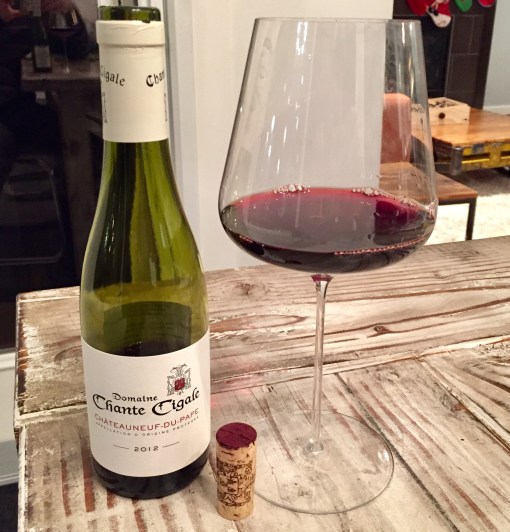
Tonight’s Chateauneuf representative is the 2012 Domaine Chante Cigale, a 100+ year-old winery that recently turned its winemaking duties over to someone barely out of his teens.  In 2002, with his father suffering from health problems, Alexandre Favier, freshly graduated from viticultural studies at the age of 20 (he started wine school when he was 15) took the reins and hasn’t looked back since.  The Domaine owns 40 hectares of vineyards, but they’re not in an orderly square surrounding the winery, instead plastered and scattered throughout FORTY-FIVE different plots all across Chateauneuf-du-Pape.  Favier relies only on ambient native yeasts present in the cellar for fermentation and ages his wines in an oddly endearing array of almost every type and size of oak barrel possible (foudres, demi-muids, barriques, mostly pre-used) as well as concrete tanks.

IMG_7203

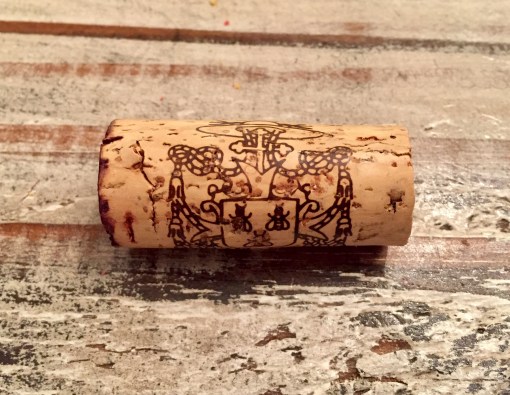
This cork deserves its own picture.  See below.

This particular Chante Cigale is the Domaine’s entry-level CNDP (if there is such a thing), keeping with the classic varietal mix of the region at 65% Grenache, 20% Syrah, 10% Mourvedre and 5% Cinsault.  It is a deep ruby colour and immediately smells like something that has been preserved:  beef jerky, molasses, date, sunbaked earth, hickory and Sultana crackers, if these had been cooked down in an Instant Pot and then set on fire.  The wine’s hefty 15% alcohol is well-contained, but everything in its profile is stewed or baked, leaving it begging for a touch of primary freshness that never comes.  Malty, Port-y, fruitcake-y, it is neither thick nor heavy in body but constantly feels that way due to a dense sluggishness in its flavours.  Like a Wagyu beef burger left too long under the heat lamp before being served, the pedigree is there, but in execution it just hung on a bit too long.  As fellow PnP Advent author Ray Lamontagne puts it, “it’s like an old venison milkshake”.  There are no kind similes.

86+ points

IMG_7204

Cork Rating: 9/10 (What a monster. Coat of arms, complete with cicadas [singing grasshoppers, aka Chante Cigales – nice], killer intricacy and coverage; glorious.)


Bricks Wine Advent Calendar 2017: Day 7

7 12 2017

In the first sign of undeniable Advent progress, we have finished the first six-pack column of the Bricks Wine Advent Calendar crate and are heading into the second.  Hard to believe that Advent is already 25% over, apart from living 12 posts from 4 different people over the last 6 days and thinking about repeating that pattern 3 more times.  The folks who compiled this calendar obviously have a love of the classics, as the first week of half-bottles, apart from the inaugural Canadian-sparkling-Gamay curveball and the glorious interlude into Austrian Gruner on Day 3, has been like reading the chapter titles of a Top Wines of the World textbook:  Brunello, Beaujolais Cru, Marlborough Sauvignon Blanc, Burgundy.  And if you look for the regional chapter title for pink wine, you will probably end up in Provence.  And if you end up in Provence, there is a greater likelihood you will find this wine than any other.

IMG_7191

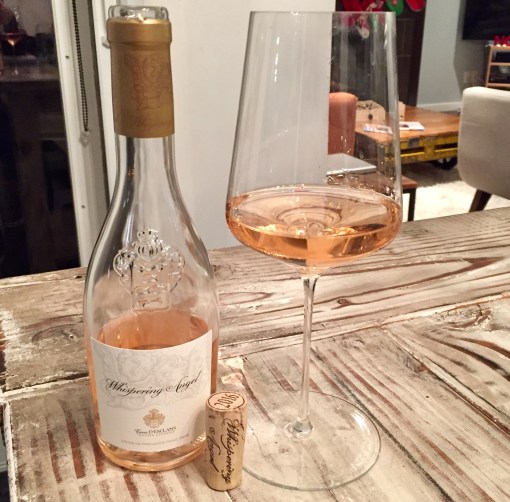
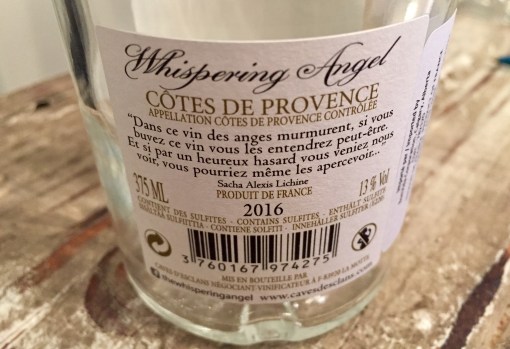
Whispering Angel is a behemoth.  The Chateau d’Esclans estate was struggling when Bordelais Sacha Lichine bought it in 2006, inheriting vineyards in disrepair but featuring 80-90 year-old Grenache vines and a production with no market presence.  Lichine, looking out on the sunny French Riviera from his estate, identified a gap in the market:  heavy, sweeter white-Zinfandel-style rosé could not quench your beachfront thirst on a scorching day.  He conceived of rosé as a serious wine, made clean and light and dry, meant to disappear at resorts and in backyards with the drinkers scarcely noticing, pausing only to reach for the next bottle.  Whispering Angel, released the following vintage, went from 13,000 cases to over 375,000 cases of production within a decade.  If you’re counting at home, that’s 4.6 MILLION BOTTLES of the current 2016 vintage, sourced from a full 500 hectares of grapes from d’Esclans estate fruit as well as a swath of neighbouring vineyards.  To understand just how much of a thing it now is, you can now buy Whispering Angel gummy bears…that is, you could until they all sold out.

IMG_7193

Cork Rating:  5.5/10 (A perfectly cromulent cork.)

Whispering Angel has its formula down cold:  a blend of Grenache, Rolle (a.k.a. Vermentino – a white grape) and Cinsault, crushed and briefly macerated at very cool temperatures to prevent oxidation and preserve fresh flavours, fermented in stainless steel tanks and served icy cold, ideally on a yacht.  It succeeds, and continues to pull in critical acclaim despite becoming its own commercial empire, because the formula works:  it is both tremendously refreshing and carefully unobtrusive, thirst-quenching yet generally unmemorable.  It is a super pale farmed-salmon colour in the glass and delivers up citric aromas of lemon pulp, pink grapefruit and unripe peach, dusted with ginger and an herbal greenness like basil or chives and overlaid with a chalky minerality.  Its lithe, svelte body brings a splash of bracing freshness, like new snow, and ghostly notes of strawberry, tangerine, copper and lemon-lime, finishing tart thanks to straight lines of potent acidity.  It executes its mission to perfection and has spawned a thousand imitators, but for me the rosé category has lost a bit of its sense of interest as a result.

89- points

IMG_7195


Bricks Wine Advent Calendar 2017: Day 6

6 12 2017

By Raymond Lamontagne

Some scenarios just have a way of falling into place, as if the cosmos itself simply knows what must occur from a karmic standpoint. Other times life is total cluster- … errr … bomb. This is fortunately one of the former occasions. After drawing my favorite white grape for my first blogging stint of the Bricks Wine Advent extravaganza, I have now landed my favorite red: the enigmatic, protean, finicky, and sometimes sublime Pinot Noir. Oh, Burgundy. Pinot reaches its loftiest heights here and yet detractors are quick to point out how many “horrible” Burgundies are routinely encountered. Yes, quality is massively variable in this (in)famous region. My view is that a word like horrible drastically overstates the case. A cheap Burgundy is often a pleasant sip, rather like how mediocre pizza is still pretty good hangover food. The allure of Pinot for many (myself included) is correlated with this metaphorical roll of the dice. Will the elegant red liquid in your large-bowled glass be superlatively sophisticated, characterized by a solid core of red or perhaps black fruit, yet earthy and herbaceous, redolent with what the French call “sous bois” or “forest floor”?  Or will it be rustic, crude, elemental and untamed, perhaps reeking of “animale”, another evocative French term that refers to aromas and flavors of funky wild game: well-cured meat with a slight seasoning of fur and bile. You will know this characteristic right away if like me you grew up around hunters and hunting. Or, just maybe, you’ll get a wine that splits the difference between refined and bucolic. These latter offerings can be marvelous from a complexity standpoint. If you do your research, and Burgundy requires more research than any other wine region, you should be able to divine what’s in your bottle. To a point. You might still be surprised.

IMG_0494

Well … What happened here?

Burgundy is about terroir. Unfortunately, making sense of a Burgundian wine label can be daunting (also looking at you, Italy). The only way to untangle the Gordian knot is to study up on the mess of subregions, domaines, villages, premier crus, grand crus, and climats, so that you have some schematic for how these concepts all fit together. Why? I suppose for academic interest. But perhaps more importantly, this will also enable you to gauge potential quality. Let me walk you through this label right here on Advent wine #6. “Vin de Bourgogne” means “wine of Burgundy”, a helpful starting point. “Vendanges” means “harvest” or vintage, right there above “2014”. The absence of the phrase “Bourgogne Rouge” or something similar means that this wine is not at the lowest quality tier. However, seeing “Bourgogne” in such large print is an important clue that you are not looking at a highly prestigious wine from a specific vineyard (a premier or grand cru). These titles speak for themselves, or so goes the logic. If you have managed to memorize the villages and crus, and a hardcore Burgundy lover WILL attempt to do so, you should notice that no such names appear here. At this point you can calibrate your expectations downward but hopefully still keep an open mind.  “Cote Chalonnaise” and the associated appellation text is the key to cracking this case. This is a regional appellation that covers more territory than a village or vineyard, but sitting one tier above generic Burgundy. Voila. You now have a rough indication of quality. I wish we were done. One can now deduce that “Vignerons de Buxy” is the wine producer, and it turns out that “Bussonnier” refers to a range or line of wines from said winemaker, a trade name I suppose, which one could learn only by researching the specific wine in question. An aside: It is rather uncommon to see Pinot Noir named on a Burgundy bottle. Another indirect quality indicator, perhaps? Or maybe just marketing due to the lingering aftershocks of the Sideways effect and the New World’s unmitigated success in selling varieties? Read the rest of this entry »


Bricks Wine Advent Calendar 2017: Day 5

5 12 2017

By Dan Steeves

As a loyal reader and follower of Pop & Pour for the past few years, it is a great honour to have the privilege to contribute to the blog today! I am often reminded of how great the wine community is in YYC; how generous people are, and how so many people enjoy talking, experiencing, and sharing wine with each other. Today marks my first attempt at wine blogging, and I’m hoping the community goes easy on me!

img_4687

The streak of great wines continues on Day 5 of the Bricks Wine Advent Calendar with a delicious Sauvignon Blanc from Spy Valley Wines, based in the Marlborough region of New Zealand. Sauvignon Blanc is the heart of the New Zealand wine industry and the Marlborough region (located at the North end of the South Island) is where the majority of it hails from.  A combination of close proximity to the ocean, protective mountain ranges, high diurnal temperature variation (temperature change between day and night), and plenty of sunlight, all provide the Marlborough vineyards a long ripening time and help preserve the flavours and acidity in the grapes. When it comes to New World SB, there is no doubt that New Zealand is at the top of the podium.

Spy Valley Wines is a relative newcomer in the wine world, choosing to cultivate land in the Waihopai and Wairau valleys of Marlborough back in 1993. The winery gets its name due to its close proximity to an actual spy base (an international satellite communications monitoring facility) and they take their clandestine efforts seriously. It may not be noticeable at first (which is the whole point) but see if you can locate and decipher the secret codes found on the bottle and closure. You won’t need an enigma machine but you might want to use this website for help.

img_4691

Sleek and simple design with integrated Morse code on the label and screw cap! 🙂

Upon opening this wine and taking the first sniff, it is no secret what the wine is and where it is from. The wine has a clean nose with intense aromas of lime, grapefruit, melon, lychee, grass, and the telltale bell pepper. New Zealand Sauvignon Blanc is known for having bright and fresh citrus and tropical aromas as well as a green herbaceous side and this wine displays both, just as it should. On the palate, the wine has crisp acidity that gives a little zing on the tip of your tongue and shows flavours of lemon, lime, grapefruit pith, and green bell pepper. The wine displays a slight creamy texture, perhaps due to the 8% of the wine that is barrel fermented, but it is still light on its toes like a stealthy agent on duty.

88 points

Thanks to Bricks for introducing me to a beautiful wine. Another successful day of the Bricks Wine Advent Calendar completed!

2-Isobutyl-3-methoxypyrazine.svg

3-isobutyl-2-methoxypyrazine – aka Pyrazines – the compound responsible for the bell pepper aroma in wines can be found in many Bordeaux wines (Sauvignon Blanc, Cabernet Sauvignon, Cabernet Franc, Merlot, etc.) and is detectable in very low concentrations


Bricks Wine Advent Calendar 2017: Day 4

4 12 2017

Well, after a riotously successful guest author turn yesterday, you’re stuck back with me tonight.  Thankfully, there seems to be no “stuck” and no neutral gear in the Bricks Wine Advent Calendar, which just keeps churning out half-bottles of interest on the daily like it’s no big thing.  We’re at 4 for 4 in terms of legitimately interesting, well-made, high-quality, non-seat-filler wines, and I get the feeling there’s going to be 20 more where that came from.  I should have known that tonight’s producer would end up in this calendar, as Beaujolais’ Manoir du Carra (at least in my experience with them) seems to be the king of the small-format wine.  My first interaction with the winery was in the form of a highly rare but utterly magnificent (for those solo wine-drinker households like mine) 500 mL bottling of Cru Beaujolais, a format that I would like every winery in the world to emulate, as it ends up being either a glass-and-a-bit-each weeknight dinner almost-bottle for two or a vinous feast less the hangover for one.  Turns out MdC can bring it in 375 mL format too.

IMG_7166

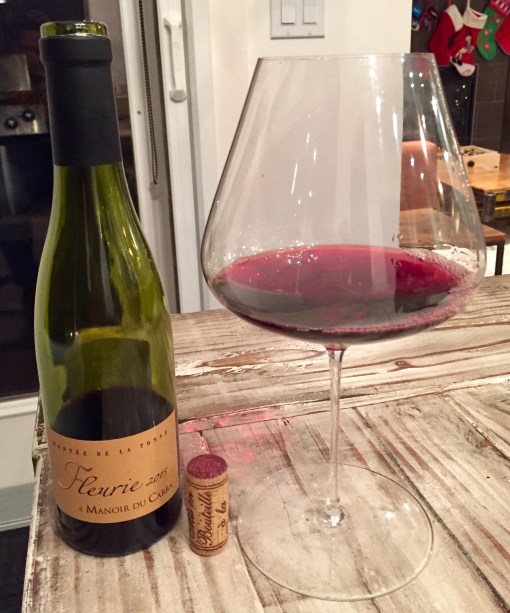
Tonight’s offering is the 2015 “Montee de la Tonne” (which roughly translates to “The Rise Of The Ton”, which I don’t understand) from Fleurie, which is one of 10 top “Cru” sub-regions of Beaujolais, known for its elegant, almost pretty, wines.  Manoir du Carra owns 50 separate vineyard plots within Beaujolais, and Montee de la Tonne is one of them, a 1.5 hectare micro-plot of 50 year-old wines just recently acquired by the producer that it holds in significant esteem.  Like all red Beaujolais, the wine is 100% Gamay, fermented partly through carbonic maceration (an intra-grape fermentation process spurred by CO2 and an absence of oxygen that enhances bubble-gummy fruit flavours) and then aged in large natural oak barrels for 3-4 months before bottling.

IMG_7168

Cork Rating:  2/10 (Can we all agree to eradicate all “Mis En Bouteille” corks from existence?)

First impressions:  this is a surprisingly deep and vivid purple colour, still mostly transparent but pretty amped up for Beaujolais.  The crisp herbal, floral nose evokes roses (complete with stalks and thorns) and potpourri, softened by felt and spiked with pepper, surrounded by a mist of strawberry and raspberry fruit and just a whiff of banana skins, the latter likely a product of the carbonic fermentation process.  Powdery yet poised on the palate, kept haughty by emery board tannin and piercing rivulets of acid, the Montee de la Tonne flashes class and subtlety with a careful flavour mix of dusty currant, sidewalk chalk, dried flowers, rocks and rain, never quite letting you in but letting you admire its sophistication from afar.  Like a black and white movie star, this is cast in hazy heroic tones, admirable but not fully reachable, a true throwback.

88 points

02155077

It’s probably not what led to the banana skin aromas in this wine, but isoamyl acetate can result in banana smells in some bottles.  The chemistry continues…


Bricks Wine Advent Calendar 2017: Day 3

3 12 2017

By Raymond Lamontagne

I should begin by emphasizing just what an honour it is to join Peter and Dan on this Bricks Wine Co. Advent journey. I remain a relative newcomer to the Calgary wine community yet have had the pleasure to meet so many knowledgeable, friendly, and dynamic people over the past year or so. It has been immensely moving and powerful to be welcomed into this community with open arms …  I wish to thank everyone from the bottom of my heart, and beg your continued tolerance as I haunt your shops, standing around the tasting bar, making random comments about terpenes or field blends and almost certainly distracting you from more important business.

IMG_0483

The evidence …

I am ecstatic that my inaugural foray into the world of wine blogging is a Gruner Veltliner. Gruner is likely my favorite white grape. I say likely because Riesling sometimes bumps it from that lofty perch, as a function of day, my mood, producer or region in question, etc. This is a great microcosm for the reality in Austria, where Riesling continues to carry more status and prestige while Gruner toils away, sometimes in the doldrums of plonk for “wine pubs” but also at the pinnacle of age-worthy sips capable of winning prestigious tastings against world-class Chardonnays. I like well-crafted Gruner so much that one of my cats was nearly christened “Veltliner”. My partner swiftly vetoed this notion (but was ultimately OK with “Spatburgunder”). Why the obsession? Simply put, Gruner can get weird. A good tasting wheel will depict all manner of curious aroma attributes rarely experienced elsewhere, including green beans, lentils, root cellar, compost bin, lovage (a savory “old country” herb that vaguely recalls soy sauce or Maggi seasoning), old socks, the less polarizing apples and limes, and above all, white pepper. Peppery aromas in wine are due to a compound called rotundone, also found in a few other varieties (most famously Syrah). Although rotundone levels are notoriously susceptible to various wine-making decisions, Gruner can deliver a zesty, earthy vortex that garners an occasional comparison to Sauvignon Blanc but which in my view is wholly unique.

726bad72-5b6f-40a6-bfc5-d581cd18d287

Rotundone … One of the aforementioned terpenes and a much better molecule than TCA.

So what of this 2016 single vineyard Huber Obere Steigen? Markus Huber has expanded a 250 year-old family operation into a big success story with international reach, seemingly without compromising his focus on precise, elegant wines that express their origins. Huber gives Gruner its just due, with the latter comprising 75% of varieties handled at the winery. The Traisental DAC is a small wine region south of the Danube river, below the famed Wachau, and here terrior reigns supreme. Full of chalk and conglomerate rocks, the soils yield full-bodied wines with firm mineral structure. Gruner from this region is known to be particularly fruity as well, yet not at the sacrifice of that all-important peppery spice. The Obere Steigen site enjoys its own unique microclimate due to its terraced nature. This emphasis on terrior or place is relatively new in Austria. Historically, more emphasis was placed on variety alone. Controversy around this difference in emphasis remains, but Markus Huber appears more than happy to let his DAC flag fly.

IMG_0489This is a pleasing yellow hue with a slight green tint. Nose hints at the crystalline mineral power within. I’m getting yellow apple, fresh parsley, snap peas, mango, and a potent undercurrent of musty white peppercorn. The herbs are more vibrantly green than umami in character. On the palate this is precise and linear, with acids brisk but not punishing … Although hang on, there’s some tangy lemon juice bite after a few sips. A compost bin funk, like old apple cores and lawn clippings, starts to creep in around a fundamentally solid core of green pears and apples, white peach, and lemon-lime zest resting on a chalk and wet slate base. This gentleman is dressed in a dapper suit but there’s something off, perhaps some mud on his dress shoes. Fruit? Check. Minerals? Check. Rotundone? Check. I’ve had Gruners that bounce around a lot more than this one, flopping around like a fish in a boat and always changing their look. This one is less dynamic and more cohesive and laser sharp, with just a slight halo of corruption … Not a bad thing in this case.

IMG_0488

90 points


Bricks Wine Advent Calendar 2017: Day 2

2 12 2017

This Wine Advent is not only historic for PnP as the realization of a longstanding calendar-format dream, but it will also mark the very first time in 400+ reviews that somebody other than me will take up the virtual pen for Pop & Pour.  I am honoured to be joined in this Advent blogging journey by two fellow Calgary students of wine who pair impressive technical knowledge with precise palates and a knack for communicating what they see and taste and feel:  Raymond Lamontagne (follow him on Twitter and Instagram here) and Dan Steeves (follow him on Twitter and Instagram too).  Their authorship journey officially starts tomorrow, as Ray will take the helm of the blog for Day 3 of Bricks’ wonderful (based on early returns) Advent Calendar.  But it turns out they came in handier than I expected earlier than I expected, and their palates and tasting notes were called on sooner…

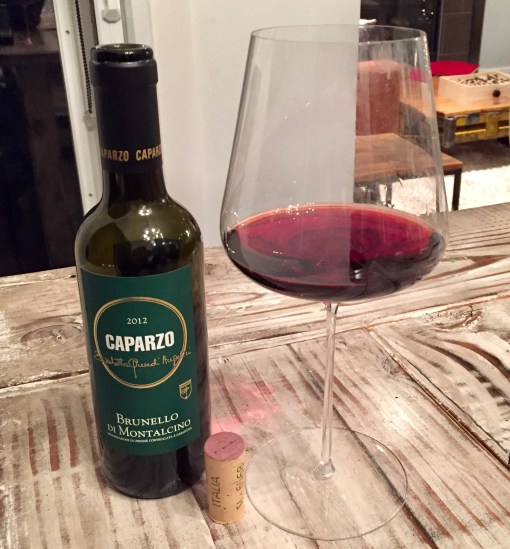
IMG_7156

Not like I needed any more evidence that Bricks was taking this whole half-bottle Advent thing seriously after last night, but I got it the second I peeled back the wrapping paper on Day 2 and “Brunello di Montalcino” stared me back in the face.  Yowza.  More specifically, tonight’s bottle was the 2012 Caparzo Brunello di Montalcino, a traditional-style bottling from an old-school producer recently given new life.  Many know Brunello as Italian wine royalty, and likely the apex of what the Sangiovese grape can do (more specifically, Brunello was once thought to be its own grape varietal but later shown to be a particular clone of Sangiovese called Sangiovese Grosso), but its life as a classified wine region is surprisingly short — it only received formal DOC status in 1968.  Caparzo was founded at almost exactly that time, when there were only a baker’s dozen official Brunello producers in the world.  It was later sold in 1998 to Elisabetti Gnudi Angelini, who had married at age 20 into a pharmaceutical empire, was widowed young, and then took a left turn with her life into the world of Tuscan oenology, where she has become a standout.

IMG_7157

Cork Rating:  1/10 (Real Talk – This is one of the worst corks I have ever seen.  “Italia”??  Really? You’re a Brunello, for god’s sake!)

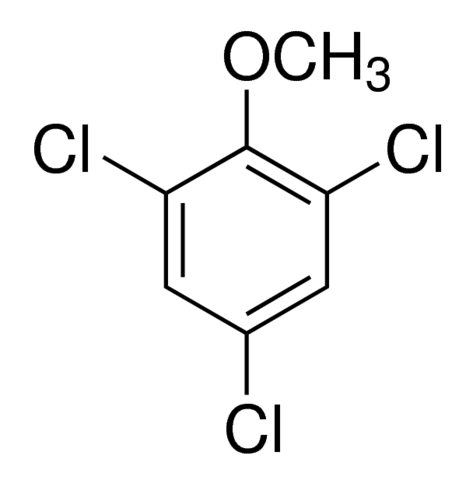
I LOVE Brunello.  I was not expecting to see a half-bottle of it, well, anywhere, let alone in Day TWO of this calendar, but I dove in with great anticipation, especially since 2012 was a highly esteemed vintage.  The wine was a gorgeous silky ruby in the glass and smelled like…mildew?  Old dirty showers?  Wet newspapers?  Oh come on.  I have been on a solid streak of luck when it comes to avoiding wine faults recently, but this bottle was horridly, outrageously corked, infected with the fungal-induced TCA compound from the cork (incidentally, they always say that smelling the cork is a plebeian’s approach to checking for taint, but this cork smelled like a dead giveaway, so maybe check your premises).  Ordinarily, throughout the entire prior history of my blogging career, my review would have been sunk — the wine was ruined.  But ordinarily I did not have TWO other people drinking the exact same wine with pens at the ready!  Raymond and Dan, called in on an emergency basis, sent me the following notes and (agreed) score for this bottle.  You guys are lifesavers.

mfcd00000588-large

Damn you 2,4,6-Trichloroanisole (TCA).  Worst molecule ever.

“Nose of dried red and blue flowers (iris, rose, potpourri), anise, white pepper, a whiff of roasted almond.  Palate is loaded with tart cherry pie, cranberry, tomato, and unripe raspberry smeared on a leather-bound book.  Some orange peel also emerges, along with oily tobacco, walnut, tar, coffee bean, and a handful of iron filings and road dust.”  [Ray]  “I get most of those descriptors as well.  I would say in general it’s not a big Brunello and seems meant for more early drinking but does have solid structure.  Definitely tart cherry and cranberry on the palate and then the leather, thyme, black tea and stone/rock dust flavours take over.  Originally I thought the finish was a bit short but as the wine opens more it lengthens — still not overly long but enough to make you contemplate why Brunello is so good.” [Dan]  I’m sad I missed the experience (mine tasted like mouldy laundry) but remarkably relieved that any readers of this post do not have to.  Fingers crossed for better luck tomorrow!

89 points