PnP Panel Tasting: The Hatch – Library Release

28 05 2018

[These bottles were provided as samples for review purposes.]

IMG_8224

(Re)Entering The Hatch.  In stereo.

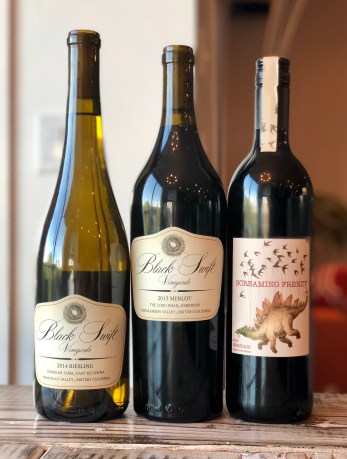
It had been far too long since we last held a panel tasting, and we were missing it – there’s something about tasting outside of the echo chamber of your own brain that is gloriously refreshing and invigorating.  Plus multiple wines and multiple friends is generally a guaranteed recipe for a proper time.  One of us (Ray) wondered about reaching out to his friends at the Okanagan’s weirdest and most interesting winery, The Hatch, for inspiration.  We naturally assumed that we would get some intriguing and tasty wines from this divergent, artistic, even edgy winery (the latter word is drastically overused but still rather works in this case).  The common approach would have been to send a set of current releases, bottles that the reading public could come scoop if they were so inclined.  Well, The Hatch is not common.  PnP’s second ever Panel Tasting turned into a library release celebration, focused on a trio of bottles with a few years on them, from the mysterious and mildly depraved depths of the winery’s cellars.  It not only allowed us to get a sneak peek at what the future might hold for some more recent bottles that we were holding, but it also gave us a chance to answer a question that nags at a number of people in our home and native land just getting into wine:  can Canadian wine age?  Does it improve?

IMG_8240

The answers, in order, are “yes” and “it depends”; in the upper echelons of our national wine industry are scores of producers who are creating layered, complex, long-term wines that easily stand the test of time.  The eye-opening part of this tasting wasn’t so much that ageworthy BC wine was possible, but that it was starting to be accessible even at lower price points, another sign of the province’s rapid progression into a globally competitive wine power.  After this, there will be far more local bottles that spend more cellar time before seeing the light of day.  It made sense for us to each choose a bottle to write up, but rest assured there was much group analysis of everything we were tasting, making the below report a true joint effort. Read the rest of this entry »


Calgary Wine Life: Paul Jaboulet Aine Tasting with Adrien Laurent @ Calgary Petroleum Club, Part II

2 05 2018

By Raymond Lamontagne

To read Part I of this epic tasting write up, click here.

IMG_1356I was attempting to pace myself until the second half of this tasting, wishing to avoid palate fatigue and endeavoring to preserve a fresh mindset for the crown jewels near the end. That delicious St.-Joseph in particular made this sort of patience challenging. I glance to the end of the written materials and there’s even a dessert wine to close things out. Wow. We did move quickly and this was a good thing. There was just enough time to analyze and enjoy some brief discussion about each wine. Part II begins with the “roasted slope”, peaks on Hermitage hill (the big reason we are all here!), and ends in … Beaumes de Venise?! Read on, faithful.

2015 Cote Rotie Domaine des Pierrelles (~$123)

Cote Rotie could serve as the centrepiece in a tasting such as this, and no one in the know would complain much. An appellation short on geographical landmass but long on excitement, some of the steepest viticultural slopes in France are found here, so much so that the region became moribund in the 1970s: The back-breaking labour required did not provide sufficient economic returns. Eventually the folly in this view was recognized once and for all. The vineyards are angled so as to maximize the ripening effects of the sun (thus the moniker), although the wines are not baked in what is still a rather stark and harsh climate, instead evidencing a sublime savoury perfume. These grapes hail from a 1.5 ha biodynamic plot in Cote Blonde, known for graceful wines suitable for early consumption (relatively speaking). The vines are 40+ years old and are rooted in soils composed of mica-schist and dusty old exposures of iron oxide. Read the rest of this entry »


Calgary Wine Life: Paul Jaboulet Aine Tasting with Adrien Laurent @ Calgary Petroleum Club, Part I

29 04 2018

By Raymond Lamontagne

Not a bad way to dust off my blogging chops after a lull. A chance to taste a 100-point wine? Sure thing. The fact that said 100-point wine happens to be the 2015 Paul Jaboulet Aine Hermitage La Chapelle causes my already surging excitement to soar into the stratosphere. Although I am not personally enamoured with the Parker-style point system nor its myriad effects on winemaking and consumer preferences, such a feat STILL means something even to this skeptic. I am truly happy for winemaker Caroline Frey. My sincere congratulations! This was a generous enough spread of wines that two posts are in order. I shall try to do the first set of these marvels justice here, stricken as I have been (by Bacchus himself?) with some sort of virulent bug that makes my bones feel like rheumy old birch twigs stashed away in a mausoleum. And I was hoping to sip something while writing this … Discretion is probably the better part of valour.

IMG_1347

We were greeted with some entry level Jaboulet Parallel 45 Cotes du Rhone bottles … A red, a white, and a rose … I sampled them all, of course. 😉

Our host Adrien Laurent felt like a kindred spirit, keeping things scholarly while occasionally flashing an understated charisma or busting out some hilarious off-colour jokes about the French distaste for monarchies (you had to be there). This tasting featured not just the one legendary new release but THREE Hermitage selections, plus an additional spread of whites and reds in what turned out to be a guided tour of nearly the entire Northern Rhone, through the lens of a single producer. How utterly marvellous. I shall cover them all, after first providing some background on the region and this historic producer. Read the rest of this entry »


Calgary Wine Life: Taylor Fladgate 1968 Single Harvest Port Release

17 03 2018

By Raymond Lamontagne

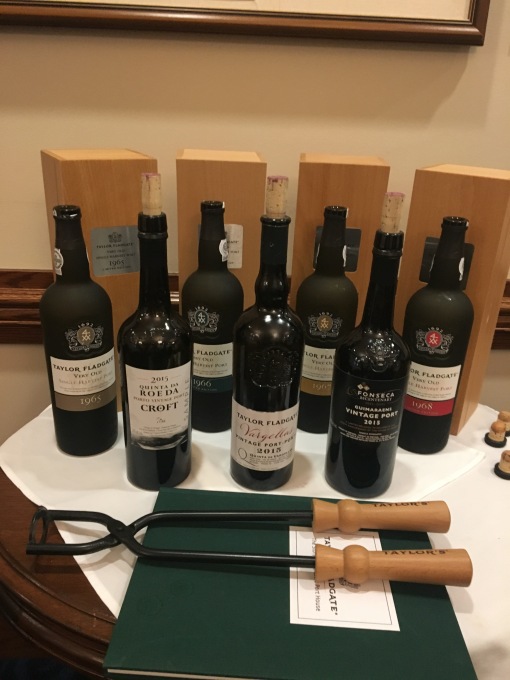
Although I am deathly tired of the evil winter weather that simply will not give up the ghost in this city, I am more than happy to brave one more snowstorm (please, just one more?) in order to carry on the Pop and Pour tradition of covering the annual release of a Taylor Fladgate Single Harvest Port.  These bottles capitalize on Taylor Fladgate’s extensive back catalogue of aged Port stocks.  They are tawny Ports, meaning that they are aged in barrels for many years, exposed to oxygen and thereby mellowed into a resplendent golden brown. They are also Colheitas, or tawnies where all of the bottled grapes hail from a single vintage.  Taylor Fladgate eschews the term Colheita on these labels in favour of a more anglicized approach.  Regardless of the naming convention employed, Port connotes a sense of pageantry, giving off a regal vibe that this self-styled progressive enjoys basking in from time to time. I wander through the fine wooden décor of Calgary’s Ranchmen’s Club, past a litany of taxidermied game, following my nose into the tasting room where fragrant pourings have already sat for some time.

IMG_1123

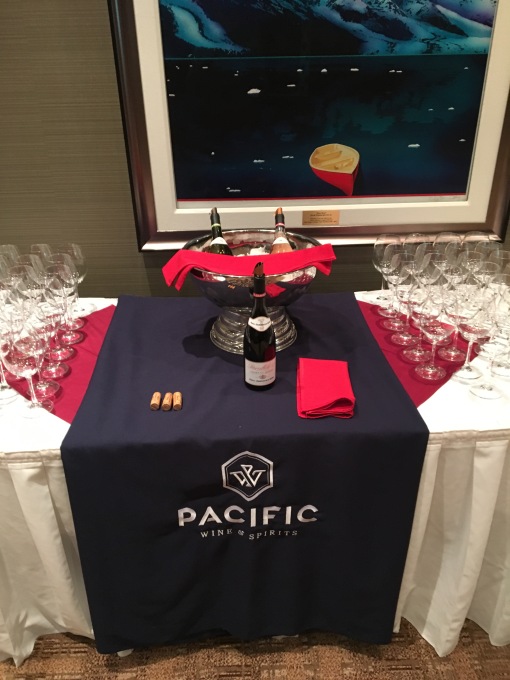
Our host Cynthia Opsal, Brand Manager for The Fladgate Partnership for Pacific Wine & Spirits, leads us off with a video that features an interview with Alistair Robertson, principal shareholder in the Fladgate Partnership.  Robertson explains that terroir is fundamental to good Port.  According to Taylor Fladgate winemaker David Guimaraes, 12 different indigenous grape varieties are planted, with four providing the majority of production.  Some grapes such as the vogue Touriga Nacional provide tannic grip, while others such as Tinta Barroca provide more color and sugar content.  Robertson explains that a day of work on the estate involves eight hours of picking grapes, followed by four hours of foot treading in the case of high quality bottlings.  Production of all Port involves adding grape spirit to stop fermentation just before its midpoint, which at Taylor Fladgate occurs around three days into the fermentation process, when about 5-6% alcohol has been produced.  Enough spirit is added to bring the alcohol up to around 20% (which in turn kills off any remaining yeast).  David Guimaraes has stated that a recent trend toward use of more clean and pure spirits means that vintage Ports are approachable sooner, with more fruity expression.  This latter point seems particularly relevant, as this year we get a welcome break from tradition:  instead of the preliminary offering of blended tawny ports that were tasted in prior Release years, we get to sample three 2015 vintage Ports — Single-Quinta vintages, that is.

Read the rest of this entry »


Calgary Wine Life: A Special Evening with Cinzia Merli of Le Macchiole @ Centini

15 03 2018

By Raymond Lamontagne

It was while reading my very first book on wine, the 6th edition of Ed McCarthy and Mary Ewing-Mulligan’s “Wine for Dummies”, that I first encountered the term “Super Tuscan”.  I instantly became enamored with the concept.  Some Tuscan producers became wary of traditional wine-making laws that they perceived as stifling innovation. Part of the motivation here was that these producers wanted to experiment with “international varieties”, particularly those famous for yielding Bordeaux blends in France.  Such grapes could be grown.  The kicker was that wines made from them could initially be labelled only as “vino da tavola” (or table wine), as they clearly violated Italian DOC production guidelines which emphasized native varietals.  However, it became apparent that parts of Tuscany were in fact better suited to growing international varieties than native son Sangiovese.  It was absurd to equate quality wines from such areas with the multitude of serviceable but undistinguished table wines found across the country, and thus the marketing concept of the Super Tuscan was born – described on the Italian Wine Central website as “a maverick wine of great breeding but living outside the Establishment”.

IMG_1109

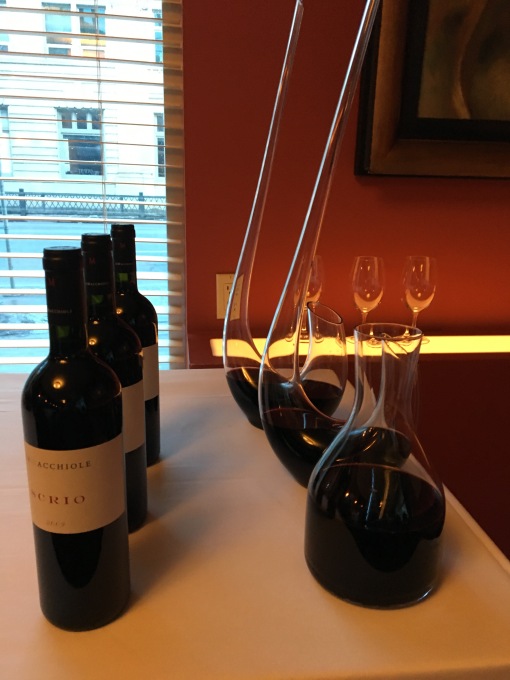
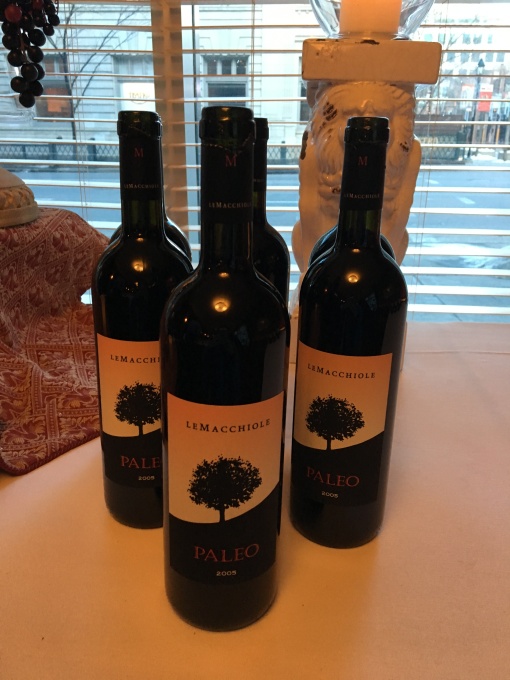
Cinzia Merli does not resemble any stereotype of a maverick.  My initial impression was one of a quiet, conservative, perhaps strict woman, full of resolve and perhaps possessing a keen wit underneath her stolid outward presentation.  She first apologized for her English, which by my reckoning is quite good.  She then provided a fantastic overview of the Bolgheri region and her own wine estate, Le Macchiole, during which her passion and unrelenting dedication to her craft became apparent.  I was already in awe coming into this event:  these wines are legendary.  Cinzia’s presentation only served to stoke the flames.  This evening shall live on in my memory as one of the most fun tastings that I have ever experienced with total strangers (strangers no more!).  I should add that Centini provided exceptional dinner service and perfect ambience.  Read on for my takes on five burly reds (including two vintages of the iconic Paleo), plus a sprinkling of relevant history.

IMG_1110 Read the rest of this entry »


Calgary Wine Life: Tabarrini Montefalco Tasting Seminar @ Model Milk

12 03 2018

By Raymond Lamontagne and Dan Steeves

We have always been impressed by the selection of Austrian and German wines in Salivate Wines’ portfolio, so we were thrilled at the opportunity to sample wines from one of the importer’s Italian producers, Tabarrini.  Hailing from smack dab in the middle of Italy, in Montefalco within the Umbria region (the only wine region in Italy that does not have a coastline or border another country), Tabarrini is a well-respected winery known for its big, brooding single-vineyard reds based on the Sagrantino grape, as well as for an interesting white wine made from the little-known Trebbiano Spoletino. Although maybe not quite as famous as other Umbrians such as Saint Francis of Assisi, Monica Bellucci or black truffles (a full 60% of the world’s supply of the latter originates from the region), there is no doubt that Tabarrini is producing some serious wines that have rightfully been getting global attention.

Tabarrini’s director of sales and marketing, Daniele Sassi, led us through an informative (and entertaining – Daniele is a natural comedian, and the jokes are not always politically correct!) tasting of three of the winery’s offerings:  the Adarmando Bianco (a white Trebbiano Spoletino), the Boccatone Rosso (a Sangiovese and Sagrantino red blend), and the Colle Grimaldesco Sangrantino (one of the estate’s premium single-vineyard dry Sagrantinos).  Read on for our combined thoughts and notes on each bottle. Read the rest of this entry »


Wine Review: Winter Warmers, Part 2

27 02 2018

By Raymond Lamontagne

[These bottles were provided as samples for review purposes.]

Red or white? Before wine became a serious subject of study for me, I gravitated towards whites, and not premium quality ones either, a preference that was likely the product of early learning (e.g., that box of German plonk that was a nigh-permanent fixture on the kitchen counter) coupled with an irrational phobia of such mythological creatures as “tannin-induced hangovers”. As it turns out, there is a general trend in humans towards a greater appreciation for bitter flavors and pucker-inducing sensations that comes with age and experience. Years later, I adore red wine while continuing to appreciate characterful whites. At this point the distinction between red versus white is but a minor factor in my choice of which wine to consume at a given point in time, one that can sometimes influence me at the very early stages of decision-making (“is it a red or a white night?”), but that ultimately carries less weight than varietal, region, style, or what’s for dinner. The Agriculture and Agri-Food Canada webpage indicates that at the national level, Canadians prefer red wine to white, with the exception of British Columbia, where whites are more popular. Heedless of the overall trend, many (myself included) continue to associate winter with hearty reds. Without further ado, let’s launch into part 2 of our robust red reviews, following Dan’s introduction from late last week.

IMG_1038

2011 Montecillo Rioja Reserva ($18)

Spain has more area under vines than any other country and is the third largest producer of wine in the world. Spanish wine on the whole was considered rather rustic and ragged until a major shift towards improved quality occurred in the mid-20th century, before which time it was not unheard of to dilute the wine with lemonade to increase palatability (!). Rioja remains the best-known area for red wine production in Spain, although recently a few upstart regions have made inroads. Tempranillo is Spain’s top indigenous variety, with plantings doubling across the country over the past decade, and is the dominant grape in almost all Rioja reds. I found a great quote from a top Rioja producer in Benjamin Lewin’s book “Wine: Myths and Reality”: “Everywhere in the world, people want to make wine like Burgundy. But it is not in our history, we have  always blended”. Historically, Rioja’s very warm vineyards resulted in full ripening of any given grape varietal, such that blending was necessary to achieve the desired complexity. In a traditional blend, fruitiness came from Tempranillo, while Garnacha (Grenache) provided more color, body, and alcohol, with relative rarity Graciano providing acid to offset the softness of the other two. This classic blend often yielded wines featuring what Lewin calls “savory, almost animal notes of mature red fruits”. Use of American oak for aging has also led some to conclude that Tempranillo is rather neutral flavor-wise, with vanilla and char notes from oak constituting Rioja’s “true” distinctive flavor profile. Regardless, much Rioja is now made in a soft, fruit-forward style. Some producers have decided to split the difference and offer both traditional and modern bottlings. Read the rest of this entry »


Co-op Wines: The Social Collection, Bin 105

17 02 2018

By Raymond Lamontagne

[This bottle was provided as a sample for review purposes.]

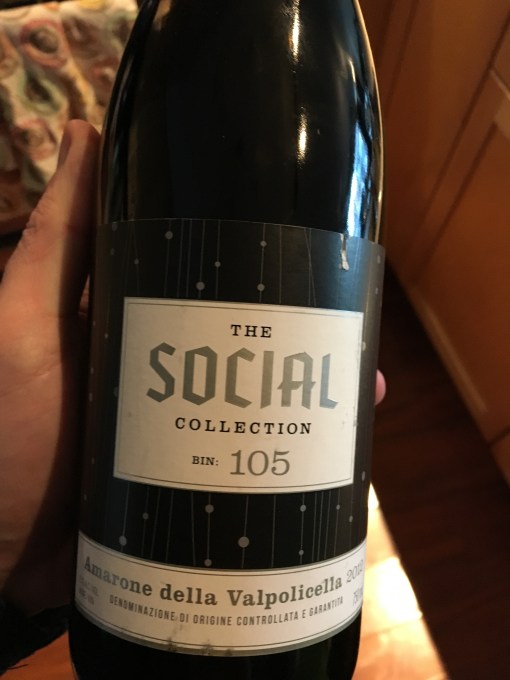
Here is the final installment of our Co-op Social Collection feature, and we are ending with a potentially big wine, one that I would not expect to see in a curated series such as this: the 2015 Bin 105 Amarone della Valpolicella. There is something seemingly incongruous about an Amarone inclusion in a line of negociant wines intended for affordable easy drinking, although with the Social Collection there appears to be a well-intentioned and laudable desire to preserve some degree of regional character and varietal typicity. I’m intrigued. I support the notion of an Amarone “for the people”, or at least an introduction to the style at a lower price point (lower, not low!) for those who are unfamiliar with what can be a daunting, polarizing, but ultimately rather compelling wine. It is worth noting that this bottle won an Alberta Beverage Award for Judges’ Selection in Veneto Blends, as adjudicated by the stellar Culinaire Magazine.

IMG_0844
The Valpolicella region is close to Verona and produces a sequence of red wines that ascend in degree of concentration and power. At the top of the density hierarchy, Amarone is a blend of red grapes, of which Corvina Veronese is typically the most dominant, with DOGC regulations mandating that this thick-skinned grape constitute 45% to 95% of the blend. Partner Corvinone, a grape with larger berries and clusters than Corvina, was long thought to be a clone of the latter but instead turns out to be an entirely distinct variety. This vine can occasionally serve as the foundation of an Amarone, but is more commonly used to provide additional tannic structure to Corvina’s base of cherry-like red fruit. Corvinone can substitute up to 50% of a similar percentage of Corvina. Rondinella, which generally can comprise 5% to 30% of the blend, provides a key seasoning in the form of herbal notes that add a savoury character. Only Corvina and its progeny Rondinella are mandatory in Amarone, but the law permits other native “non-aromatic” red grapes to be included as up to 25% of the blend, with none of these individually exceeding 10%. Some of these grapes are fascinating but fall beyond the scope of the present review. Read the rest of this entry »


Calgary Wine Life: Barone Ricasoli Luncheon @ Alloy Fine Dining

10 02 2018

By Raymond Lamontagne

I spent a lot of time at my grandparents’ growing up. Amongst the many fond memories (including my grandmother’s never-ending tolerance of my boundless energy and predilection for getting into various forms of trouble), I can recall that there were always a few fiascos kicking around the house, those round-bottomed bottles covered with a close-fitting straw basket that shall be forever associated with one of the world’s great wines: Chianti. Although the wine contained in most of these vessels was far from remarkable, over time a serious quality revolution occurred, one that led to the creation of the Chianti Classico DOCG designation. This important development was associated with a renewed commitment to meticulous winemaking as well as the elimination of winemaking techniques that were eventually appreciated to hinder quality (e.g., blending white grapes into a must that was largely red). At the same time, there was a dedication to preserving a unique identity; Chianti was and is a Sangiovese-dominant blend, not a varietal wine (at least usually…it turns out that Chianti Classico can be 100% Sangiovese!). As a newly christened regular contributor to Pop & Pour, I could not have been more keen to draw this tasting assignment, hosted by none other than Francesco Ricasoli. You see, Francesco’s ancestor Bettino actually invented the style.

IMG_0808When Francesco, a professional photographer, finally entered the world of winemaking, Bettino Ricasoli’s beloved Castello di Brolio estate had spent some time being passed from one multinational to the next. Enter a “contractual loophole” that gave Francesco a chance to purchase his family’s legacy from Hardy’s, based in Australia. Although he was initially unsure about whether this was a good idea, some helpful advice and prodding from a friend at Castello di Fonterutoli sealed the deal. Alas, there was much work to do. Francesco wanted to restore his wines to glory. He commissioned a three-year study to clarify the agronomic potential of his property and conducted trial plantings of fifty different Sangiovese clones, eventually determining which would perform best in his vineyard soils. The latter are largely calcareous clay with additional stony components and occur at a wide range of altitudes. Francesco was careful to explain his philosophy of “precision viticulture”. Under this approach, every vineyard parcel is a distinct entity yielding a unique vinous product. Parcels are each farmed according to their individual characters. The wines are all vinified separately to preserve their distinct attributes and are then thoughtfully blended. It became clear that Francesco does not like leaving winemaking to chance. “Why make mistakes that can be avoided?”, he asked, in response to a question about whether he uses selected yeasts for fermentation. However, he is passionate about preserving grape character. This is a highly intelligent man who thinks deeply about his wines, one who has the utmost respect for nature’s raw materials but who is not shy about steering vinification exactly where he wants it to go, according to his vision. Read the rest of this entry »


Bricks Wine Advent Calendar 2017: Day 23

23 12 2017

By Raymond Lamontagne

We have reached the penultimate day of what was occasionally a rather hectic yet still always fun endeavor (for me, in any event … I did not have to write one of these suckers every single day). This is my last advent entry, at least for this year, and our loyal readers (I know there are at least three!) can probably predict the country from which this special wine hails. If it is me writing about Advent wines this year, there’s a solid 50% chance the wine is Austrian. If that were not enough, I have also ended with the same producer with which I started, Gruber Roschitz, neatly closing the circle. Its been a wild ride, if one defines wild as cracking wine books, doing many Google searches, and, you know, drinking. These are three things I do rather frequently anyways, and it was a pleasure to share it with the world. Thank you Peter and Dan. And thank you to everyone who reads our musings.

IMG_0535

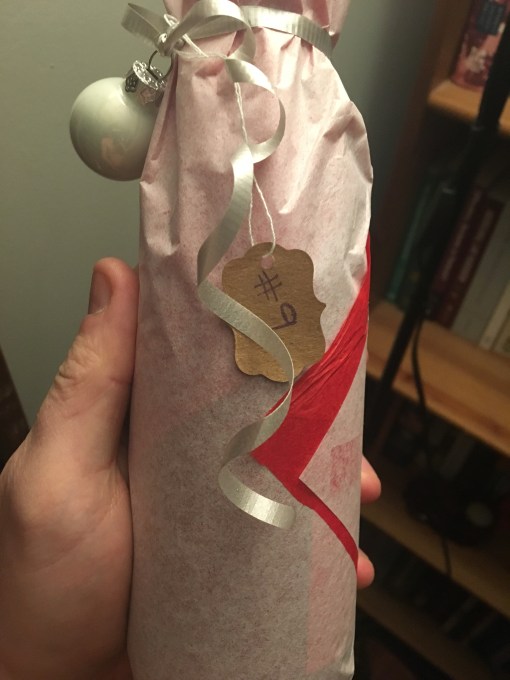
Who me, peek? It was clearly the cat.

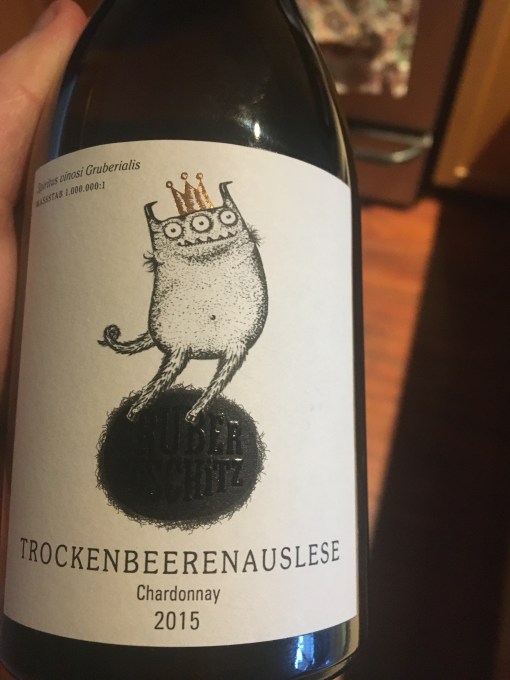
The Grubers are three siblings:  Ewald, Maria, and Christian. Ewald provides the winemaking philosophy and oenological know-how, Maria is the marketing genius, and Christian handles the important work in the vineyards. Gruber Roschitz does not shy away from modern technology, although the winemaking remains anchored in low intervention principles such as moving the liquid as little as possible, using no fining, and no fertilizer in the vineyards except compost. I’ll also admit that I love the critters on the labels. The Grubers offer several theories as to the nature of these goblins or sprites. I prefer the “little children of Bacchus ensuring joy and pleasure” account. YMMV.IMG_0536

Botrytized or noble-rotted Chardonnays are not particularly numerous, although if you go looking you will find a few from around the world. Although some argue that Chardonnay is less susceptible to noble rot than Riesling or Semillon, other sources state that this varietal’s tight clusters make it one of the most susceptible grapes. Regardless, a non-Riesling trockenbeerenauslese is rather intriguing. TBAs are explicitly made from late harvest grapes, all of which are botrytized and painstakingly picked by hand. My powers of deduction lead me to conclude that these grapes hail from the Hinterholz vineyard. Here the soil lies over bedrock and an adjacent woodland helps to regulate temperature, producing a large contrast between day and night and yielding a smooth Chardonnay. Of course, the noble rot is going to be a game changer. Read the rest of this entry »


Bricks Wine Advent Calendar 2017: Day 19

19 12 2017

By Raymond Lamontagne

There had to be a Bordeaux in here somewhere! Due to all kinds of understandable economic, availability, and supplier-based reasons, and maybe just garden-variety sanity, you knew that a 375 mL bottle of Bordeaux in an Advent Calendar was not going to be something prestigious and expensive. Indeed, the best Bordeaux has been priced right out of everyday grasp (for most of us). I have two special bottles (a 2014 Margaux and a 2012 Mouton Rothschild) that together cost about half of what I paid for one of my Magnum Cellars over/under wine coolers, and rest assured they will not be consumed anytime soon. I occasionally have nightmares where one turns out to be corked, or where I take one out to gaze longingly at the label, fantasizing about the glorious bouquet within, only to have it slip out of my clumsy grasp and go full shard all over my hardwood floor. Bordeaux bottles are robust, but still. I’d lick first and get my tongue stitched up later. I also have one 1986 second growth bottle that I purchased on sale (a Ducru-Beaucaillou) and this should be enjoyed soon. Probably now, as I write this. Logically I know it is time to drink up, but emotionally I still succumb to that treacherous wine geek logic of “But should I wait just a weeee bit longer??” … Cheaper options might be less titillating, but they are far simpler to navigate from a drinking perspective. I am a Burgundy lover who nevertheless visits the world of Bordeaux often, and although the chateau model of classification is easier to learn than Burgundy’s tortuous terroir-based system, there are still a galaxy of options to master. In this case, fear not: the Bricks team did their research (of course!). Good value Bordeaux from the lowest ranked Bordeaux Rouge AOC and Bordeaux Superieur Rouge appellations can be found, and Chateau Recougne might just be one of the best of the Bordeaux Superieur wines.IMG_0523

Bordeaux Superieur covers the same huge geographic area as Bordeaux AOC, namely the entire region. However, Superieur must hail from vineyards that are more densely planted than garden variety Bordeaux. Crowded vines are more stressed and yield fewer but better quality grapes. Superieur grapes are also riper at harvest, resulting in higher alcohol levels. Many Superieur are “Right Bank” wines from the areas north and west of St. Emilon and Pomerol. If one wishes to strike a balance between quality and price point (quality as defined within the rubric of “everyday drinking pleasure”), this strikes me as a wonderful option. It turns out I am not alone: one analysis concludes that thirteen bottles of Bordeaux Rouge or Superieur are consumed every SECOND somewhere on the planet.IMG_0525

According to legend, Henry IV visited Chateau Recougne and was extremely impressed by the quality of the wine made there. He declared the land “Terra Recognita” or “recognized land”. Today winemakers Xavier and Agnes teach their children the wine-making art, producing reds, whites, and roses. Recougne falls within Fronsac, an area highly regarded in the 18th century and now sometimes panned for producing Merlot-dominant wines that taste hard and crudely earthy in contrast to the plush offerings of St. Emilon. Fronsac has made a comeback, however, and I’ve recently had a 2004 Chateau Villars that aged marvelously and was top-heavy with notes of “sous bois” (forest floor), plum, spice, and sundry caffeinated beverages, punching well above its weight class. Recougne itself seems to be in good hands, with the family managing several parcels of old vines of 50+ years, using environmentally friendly viticultural techniques including minimal spraying, and working to reduce yields through green harvesting and careful canopy management. Read the rest of this entry »


Bricks Wine Advent Calendar 2017: Day 16

16 12 2017

By Raymond Lamontagne

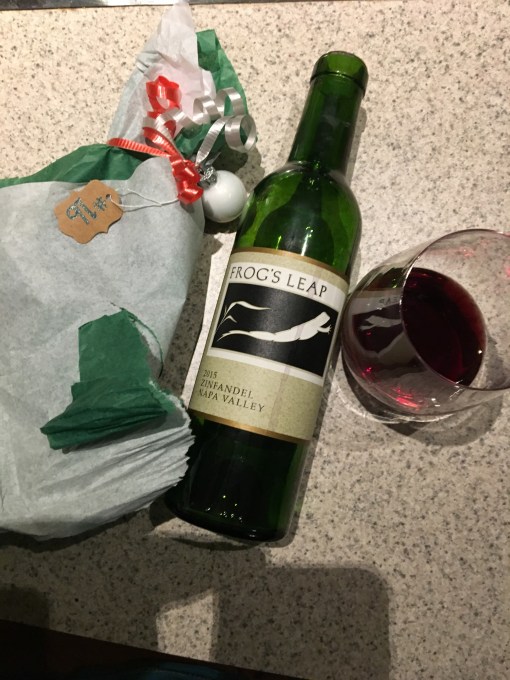
Day 16 and we are still in California. Today we leave behind the high ABVs from grapes grown in the hot interior but vinified in Napa, to get a look at what Jon Bonne calls the “new California wine”. Rutherford is considered to be among the finest Napa Valley AVAs. It lies on the valley floor, getting ample sunshine and warm temperatures, two factors that translate into optimally mature grapes that yield opulent, richly-flavored wines. However, a cooling fog also moves northward up the valley from the Bay area, modulating the sunshine that would otherwise napalm the grapes into a watery oblivion. The results are ageworthy wines that display a precise balance of fruit and acidity. Although Cabernet Sauvignon is the undisputed king across the region, more traditional California variety Zinfandel retains a few toeholds here and there. At Frog’s Leap, Zin is the favourite.
IMG_0518

Interestingly enough, the same Riedel varietal tumbler glass is used for Sauvignon Blanc/Riesling on the one hand, and Zinfandel on the other. Maybe they mean white Zinfandel?

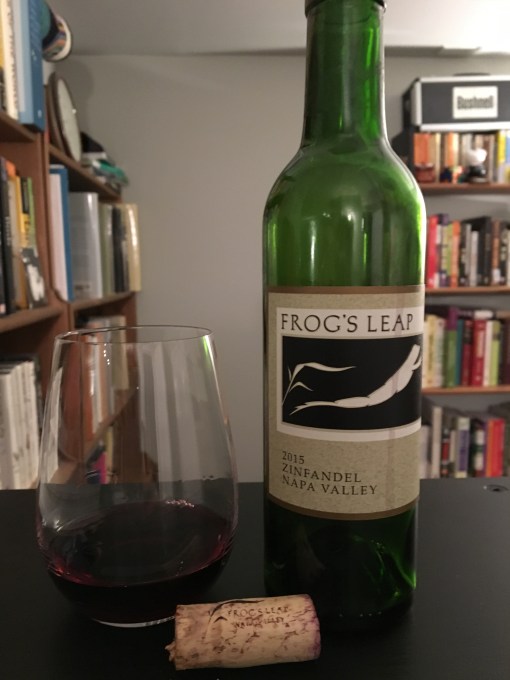
John Williams and Larry Turley started Frog’s Leap in 1981, ultimately creating a successful boutique winery that grows only organic grapes and practices dry-farming of vineyards (no irrigation, which many believe leads to sickly vines and bloated grapes that contain less acid, more sugar, and fewer of the  phenolic compounds that make wine worth inspecting, as opposed to crushing). They also incorporate at least certain aspects of biodynamics. Although these guys do not take themselves particularly seriously, stewardship of the land is another matter. Careful attention to yields, the aforementioned dry-farming, and respect for terroir work together to spawn Zins that show restraint, high-toned acids, earthy flavors, and (thankfully for the Advent-soaked liver) more reasonable ABVs. All of this emerges with minimal use of intervention. John Williams believes that nature makes wine, rather than man or woman. Finally, some of Cali’s fascinating grape-growing heritage is reflected in the fact that these old school Zins are often technically field blends: Other black grape varietals grow amongst the Zinfandel vines and are tossed into the pot to round out Zin’s corners and provide additional aromas, flavors, and mouthfeel. These can include various teinturiers (grapes with red flesh, historically used to provide more colour) as well as old warhorses that might be consigned to the dust bin of history were it not for a recent (positive!) trend toward preserving the past. The 2015 Frog’s Leap Napa Valley Zinfandel is 79% Zin, 19% Petit Syrah (or Durif), and 2% Carignan. Let’s delve in.
IMG_0517

Cork Rating: 6.5/10. I like the Frog’s Leap swoosh, but otherwise this looks a bit like a cigarette butt.

This is a truly smoky, meaty wine upon first impression. One quick sniff yields powerful hickory smoke BBQ sauce and fresh ground beef. A few more sniffs reveal bramble jam, complete with canes and leaves, pumice stones in a sauna, dill seed and weed, allspice (maybe I should just say pickling spices across the board). I taste mealy Saskatoon berries, blackberries purchased in winter when they are rather tart, strawberries, raspberries, maybe a dab of peach conserve and a sprinkle of sweet dried chilli. None of these fruits are overly ripe or cooked, and everything is just a day or two past green. Peter and I exchanged Instagram messages while tasting this wine, and in addition to what turned into a rather wonderful conversation about the twists and turns of life, he helped provide this take on the primary fruit. Somewhat sweet but far from jammy, and every bit as balanced as Rutherford promises to deliver. Fresh acidity lifts everything up, and the tannins have some grip and just enough stem. This is what I absolutely love about an old fashioned Cali Zin: bright fruit but with ample old thorn-bush shrubbery, robust smoke and spice, tons of country character, nothing blowsy. Curry spices (star anise, cumin, coriander) show up late. Finish is persistent and features another perfect symmetry between fruit and aromatics. After last night’s alcoholic explosion, this is a breath of fresh air. Incidentally, some of my favorite wines are those that trigger bittersweet memories. This one takes me back to the raspberry patch in my old backyard in NW suburban Calgary. I do not live there anymore and I am happy in the downtown core. But the memories remain.

92 points


Bricks Wine Advent Calendar 2017: Day 14

14 12 2017

By Raymond Lamontagne

We’re back in DAC. The Old World classics continue to roll with an Austrian red, and I’m on deck for my third Austrian wine of the blogging campaign. The Calgary wine scene has seen a recent proliferation of Austrian sips, many natural or biodynamic, and the vast majority that I’ve sampled are charming, characterful, and delicious. A few have been stunningly superb. The entry level Krutzler Eisenberg Blaufrankisch is a textbook example that the winemaker describes as a “people’s wine”:  uncomplicated, approachable, congenial, and Krutzler’s best seller, yet still hearty enough to pair with richer meals. This is the Reserve, however.

IMG_0509

I wonder if its Austria??

Blaufrankisch is often deemed “the Pinot Noir of the East” due to its proliferation across Eastern Europe and presumably also its taste characteristics. I can see the analogy, although to my palate, crossing partner St. Laurent often seems more quintessentially “Pinot”. Blaufrankisch can yield densely tannic wines (see Fox Run’s offering from the Finger Lakes, NY, which was sublimely floral but excoriated my tongue). This young impetuosity often gives way to a velvety mouthfeel and deep cherry and woodland berry flavors with age, while retaining a pronounced acidity. So yes … A Pinot relative at least in spirit.

One of Blaufrankisch’s parents is the fascinating Gouais Blanc. Gouais is a vinous Genghis Khan: decried as a barbarian, but sowing its seed far and wide. This white grape was deemed coarse and far too rustic, banished to the hinterlands early in the Middle Ages. This ill will almost rendered it extinct. Gouais did however have ample opportunity to cross with Pinot numerous times, perhaps imbuing the latter with some degree of hybrid vigour, and those crosses live on as some of the top wine grapes in the world today (Gamay and Chardonnay!). Fortunately extinction was forestalled and Gouais persists as a prime source of genetic diversity, if not a stellar offering in the glass. The other parent of Blaufrankisch is the ultra-rare Blaue Zimmettraube, recently re-discovered in the German Rheinhessen region. Most evidence suggests that Blaufrankisch itself originated in Lower Styria (in present day Slovenia), spreading to Germany (where it is called Lemberger, the name also used in NY and other US states), the Czech Republic (where it is called Frankovka), Slovakia, Croatia, Serbia, and even Italy. Finally, Blaufrankisch is a rising star in Hungary, where it goes by the pert handle “Kekfrankos”. Some claim that these names lack market appeal. I say slap on an appropriately Gothic font and let the flavours speak for themselves. Besides, “Lemberger” sounds like a cheese. Read the rest of this entry »


Bricks Wine Advent Calendar 2017: Day 11

11 12 2017

By Raymond Lamontagne

One certainly learns a lot working through an advent calendar. Providing a detailed commentary for each wine puts this learning into hyperdrive. There are producers and methods to investigate. Sometimes there are grape varieties that I need to research further before delving into the tasting per se. This is one of those times, although this grape is far from rare and I know I’ve had it before. Learning a little beforehand or refreshing one’s knowledge base provides scaffolding for those treasured “in the moment” experiences. This enhances memory for what you taste and smell. The act of paying careful attention on purpose is hard work. Although I prefer to share actual tasting impressions with others after I’ve partaken, to avoid (added) sensory bias, I am a firm believer in having this framework of semantic knowledge ready to go beforehand. This allows one to note the expected structural features and aromas quickly, freeing up mental processing resources for focusing on anything that seems out of place. One could debate the merits and drawbacks of this approach. It works well for me.

IMG_0501

Party up top, business below.

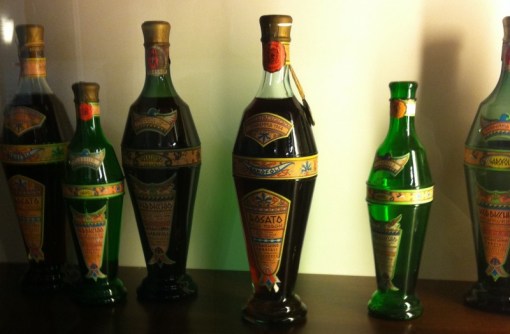
In his encyclopedic opus of Italian wine grapes, Ian D’Agata makes a solid case for Verdicchio being Italy’s greatest native white. Versatile, capable of aging, full of aromas described as lemony and almond-like, and showing an affinity for oak, this bright green wonder typically produces lighter and highly floral wines in Verdicchio dei Castelli di Jesi, one of the major DOCGs in the Marche. The latter has been described as producing “cheerful and simple” fare, although this may downplay how good these wines can be. The New York Times recently identified Verdicchio as a “hip varietal”. Yields have dropped and the region is starting to shed its reputation for frivolity due to a previous emphasis on cheesy amphora-shaped containers. These latter vessels look like a cross between King Tut’s scepter and something one could find in an adult novelty store. Circuitous geographical musings and botanical studies of both genetics and morphology have revealed that this grape is identical to the well-regarded Trebbiano di Soave and therefore probably originated in Tuscany, brought to current alternative stronghold the Marche by Tuscan farmers who resettled the land after a severe bout of plague.

IMG_0502

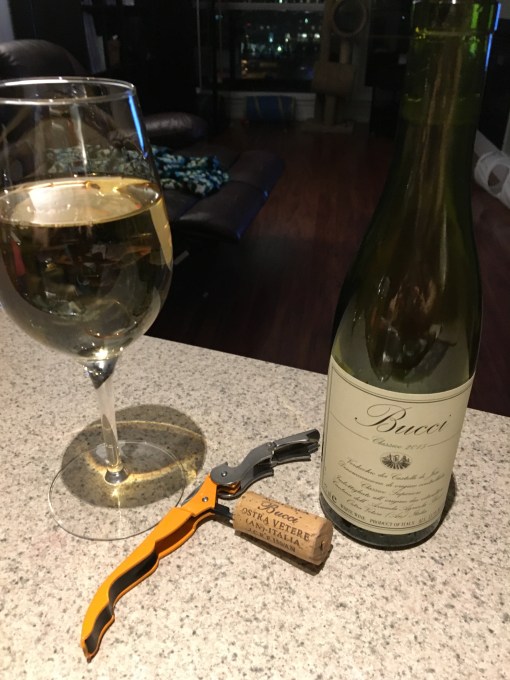
Italian wine label with an f-ton of script. Don’t sweat it. Key details explained below!

D’Agata and myriad wine critics regard Villa Bucci as one of the finest di Jesi producers. Bucci offers age-worthy bottles full of finesse, floral perfume, and primary fruit. “Classico” means the grapes were grown in a traditionally favored hilly area near the town of Cupano. Grapes hail from four organically farmed high altitude vineyards (Villa Bucci, Bellucio, Montefiore, and Baldo), each vinified separately. Vines are about 45 years old. Although DOCG rules allow for up to 15% Malvasia Toscana to be included, this is 100% Verdicchio. Grapes are gently crushed under cold temperatures and aged in large used oak barrels for four months, permitting micro-oxygenation but minimal seepage of flavors into the wine.

IMG_0504

Cork Score = 8.0 … Actual winery is named with decent font. Some empty space but lofts are still “in”, no? Not depicted: A funky graphic intended to evoke a very pleasant farm.

The Villa Bucci Verdicchio dei Castelli di Jesi Classico Superiore 2016! Nose features a stark minerality right out of the gate … Wet gravel with flecks of table salt and potash. Some low key fruits emerge next: Green apple (including a slight whiff of brown apple oxidation), lemon rind, maybe green tangerine, white blossoms (gardenia, a personal favorite scent, or the aforementioned apple). Palate largely echoes the nose but with more tangy fresh fruits: Bitter orange and almonds, lime, lemon, Granny Smith. Like a Five Alive or similar beverage without any sugar, if said beverage featured a few additional flagellations of acid and some serious added calcium. This has more minerals than it does vowels in the entire handle that I typed out above. Crisp, taut, and broad, with enough primary fruit to save it from an experience not far off rock climbing in a glass. I dig. Or rather, I chip away at a frozen orange entombed in gypsum. We’re back, baby.

Amphora-800x524

You cannot deny that it was an effective marketing tool … From http://www.vintuition.net/main/?p=3517

89 points


Bricks Wine Advent Calendar 2017: Day 9

9 12 2017

By Raymond Lamontagne

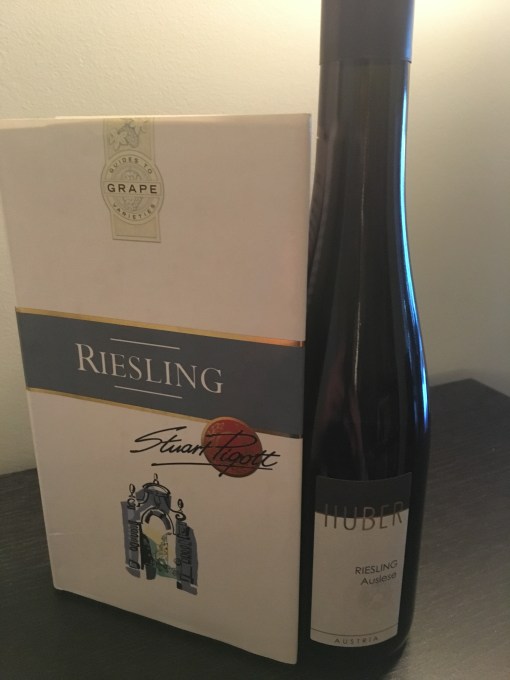
The series of odd coincidences continues during my debut blogging gig, as on day nine I draw a Riesling to complete the “favorite grape triumvirate”, and my second offering from Markus Huber. Perhaps Markus should put me on staff. An Austrian Riesling no less, a curveball tossed just as we were starting to think that we could accurately soothsay this superbly curated array of classic regions and styles. Stuart Pigott (see book in photo, a quaint but scholarly little tome) describes the Austrian persuasion as the most underrated Riesling in the world, stating that these are more crisp and fruity than Alsace, and more full-bodied, aromatic, and balanced than those of Germany. Lofty praise indeed. Although such sweeping generalizations are easy to puncture with counterexamples, particularly where Riesling is concerned, the claim is not entirely without merit. Austria’s warmer climate means that the grapes can reach greater physiological ripeness, a state more challenging to reach in colder northern regions. Less acidic, riper grapes mean that wines can be fermented completely dry, in contrast to many of the sweeter German examples. Or so goes the argument. Dry is far from rare in Germany these days.

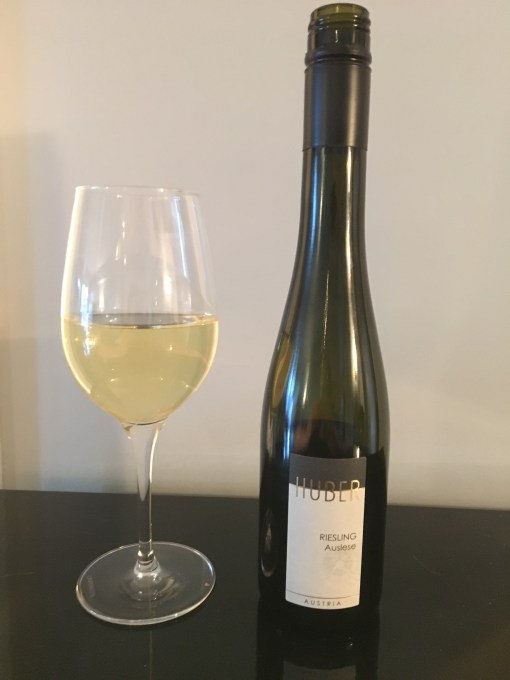
IMG_0496Riesling constitutes 15% of Huber’s production. This one hails from the Berg site, an east facing vineyard with dry gravely and chalky soil stained red by iron and manganese oxides. The vineyard lies at high elevation, allowing a lengthy ripening process, and hot days and cool nights provide a Burgundian type climate, which according to Markus Huber yields “very fine aromas and spicy finesse”. Note that this is an Auslese, the German/Austrian category for a later harvest wine, with grapes picked when they are shrivelled and high in concentrated sugars. Although this means that most Auslese wines contain residual sugar, they can be fermented dry, with dryness representing a typological dimension separate from the Pradikatswein categories that capture ripeness. The Huber website makes mention of botrytis or noble rot being desirable for Auslese wines. I’ve heard and read different musings regarding the issue of botrytis and the Auslese designation. The final word seems to be that while many such wines are free of noble rot, a fair number do contain some botrytized grapes. Rest assured that any Auslese is going to be large and formidable, heedless of the presence or absence of noble rot character.
IMG_0499

Besties hugging it out.

Here we go: 2015 Huber Riesling Auslese. I should note that I have a very low detection threshold for petrol or kerosene notes. I occasionally get these even in non-Riesling white wines, and research on other grape varieties supports the notion that I am not having olfactory hallucinations (in this case). Perhaps atypically for such a sensitive individual, I very much enjoy these diesel tractor aromas caused by 1, 1, 6-trimethyl-1, 2-dihydronaphthalene, or TDN (you can see why the acronym is an absolute must … Just a little vinification pun to keep ya on your toes). Low key to moderate TDN greets me right at the door, and then I am introduced to notes of honeysuckle and yellow asters, elderflower, furtive pink grapefruit and lemon-lime, chalk, Epsom salts, starfruit, a pinch of cinnamon and mace. The nose is mellow but rewards close scrutiny. Take your time here. The aromas are exquisitely fresh and the prominent yellow flower notes evoke a mountain meadow. The amateur botanist in me adores all these weedy wildflowers. A sip provides a sluice of tinned mandarins, fruit cup peaches and pears, dried papaya spears, candied grapefruit, Kraft caramels, a slight drizzling of honey. Not a dry Auslese (as supported by the 6.5% abv). I enjoy switching my focus between the floral nose and the focused sweetness on the palate. Fortunately there is enough acid to prevent this from being cloying. This golden deity features the somewhat clipped Huber professionalism also apparent in the Gruner from the number three spot: very precise, clean, elegant, even somewhat delicate for the style, and full of finesse. I love this winemaker and this region, but surely there isn’t a third hobgoblin of a bottle lurking in that crate, with me in the crosshairs.

IMG_0500

92 points