Calgary Wine Life: Barone Ricasoli Luncheon @ Alloy Fine Dining

10 02 2018

By Raymond Lamontagne

I spent a lot of time at my grandparents’ growing up. Amongst the many fond memories (including my grandmother’s never-ending tolerance of my boundless energy and predilection for getting into various forms of trouble), I can recall that there were always a few fiascos kicking around the house, those round-bottomed bottles covered with a close-fitting straw basket that shall be forever associated with one of the world’s great wines: Chianti. Although the wine contained in most of these vessels was far from remarkable, over time a serious quality revolution occurred, one that led to the creation of the Chianti Classico DOCG designation. This important development was associated with a renewed commitment to meticulous winemaking as well as the elimination of winemaking techniques that were eventually appreciated to hinder quality (e.g., blending white grapes into a must that was largely red). At the same time, there was a dedication to preserving a unique identity; Chianti was and is a Sangiovese-dominant blend, not a varietal wine (at least usually…it turns out that Chianti Classico can be 100% Sangiovese!). As a newly christened regular contributor to Pop & Pour, I could not have been more keen to draw this tasting assignment, hosted by none other than Francesco Ricasoli. You see, Francesco’s ancestor Bettino actually invented the style.

IMG_0808When Francesco, a professional photographer, finally entered the world of winemaking, Bettino Ricasoli’s beloved Castello di Brolio estate had spent some time being passed from one multinational to the next. Enter a “contractual loophole” that gave Francesco a chance to purchase his family’s legacy from Hardy’s, based in Australia. Although he was initially unsure about whether this was a good idea, some helpful advice and prodding from a friend at Castello di Fonterutoli sealed the deal. Alas, there was much work to do. Francesco wanted to restore his wines to glory. He commissioned a three-year study to clarify the agronomic potential of his property and conducted trial plantings of fifty different Sangiovese clones, eventually determining which would perform best in his vineyard soils. The latter are largely calcareous clay with additional stony components and occur at a wide range of altitudes. Francesco was careful to explain his philosophy of “precision viticulture”. Under this approach, every vineyard parcel is a distinct entity yielding a unique vinous product. Parcels are each farmed according to their individual characters. The wines are all vinified separately to preserve their distinct attributes and are then thoughtfully blended. It became clear that Francesco does not like leaving winemaking to chance. “Why make mistakes that can be avoided?”, he asked, in response to a question about whether he uses selected yeasts for fermentation. However, he is passionate about preserving grape character. This is a highly intelligent man who thinks deeply about his wines, one who has the utmost respect for nature’s raw materials but who is not shy about steering vinification exactly where he wants it to go, according to his vision. Read the rest of this entry »


PnP Panel Tasting: Quench! Wines BC Portfolio

1 02 2018

[These bottles were provided as samples for review purposes.]

First, some exciting news:  I’m happy to announce that Pop & Pour Wine Advent 2017 authors Raymond Lamontagne and Dan Steeves are officially going to be sticking around as regular contributors on the blog, bringing their expertise and exuberance to a screen near you and formally making PnP a joint venture from this point forward.  I’m hoping that this will allow the site to be less tied to my schedule and to have a greater presence around events and bottles that interest you (or that interest us, at least – hopefully they will interest you too).  And what better way to go from a solo gig to a group gig than having a panel tasting?

IMG_7474

A highly worthy BC lineup for our first PnP Panel Tasting.

Here’s how we play our game.  Dan, Ray and I got together to jointly taste a (remarkable) set of wines; we discussed while we tried each wine, but we evaluated and scored each bottle separately and independently, without sharing our final assessment until all scores were locked in.  We divvied up the writing duties, but rather than average out the scores or try to come to a numerical consensus, we preserved each person’s score for each bottle to give you a sense as to the level of divergence in the room through the course of the tasting.  Hopefully this will be the first of many such panel reviews, but if you have any thoughts as to the format or results, leave a comment or send me a message and let me know!

The focus of this inaugural Pop & Pour panel tasting was a sextet of offerings from Quench! Wines, a Vancouver Island-based agency exclusively focused on the burgeoning British Columbia production scene.  We got to taste a pair of wines each from three critically acclaimed Okanagan producers:  Terravista, Bella and Fairview Cellars.  You could not have put together three more divergent groups of wines if you tried, a testament to the diversity that is possible in the Okanagan Valley, particularly since each distinct grouping aptly highlighted a different element of the potential of the region.  I got to lead things off. Read the rest of this entry »


Wine Review: It’s Go TIME!

17 01 2018

[These bottles were provided as samples for review purposes.]

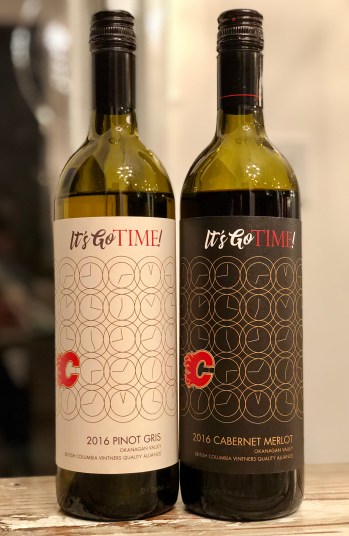
IMG_7405

NHL-licensed wine.  Bring on the themes!

No, that title isn’t me exhorting myself into giving 110% on this wine review, playing for the crest on the front of the jersey and leaving it all out on the ice.  It is in fact the actual, somewhat-punny name of a red and white wine duo made as a commercial and charitable collaboration between the Okanagan’s TIME Winery and my local NHL squad the Calgary Flames, with some of the proceeds from bottle sales going to the team’s philanthropic Flames Foundation.  Having recently been to a WHL Hitmen game, I can confirm that the Saddledome boards themselves officially confirm TIME as the team’s official wine supplier (yes, such a designation is a thing), and the bottles are both served at the arena and sold at a wide array of retailers across town.  TIME is a brand owned by Encore Vineyards, a group led by Harry McWatters, a Canadian wine pioneer who founded Sumac Ridge winery the year I was born (1980) and who already has 50 years of local wine business experience under his belt, perhaps more than any other living person in Canada.  After selling Sumac Ridge, McWatters launched TIME in 2013, basing his winery inside an old movie theatre in Penticton and focusing on grapes from the southern Okanagan for his production.

IMG_7411

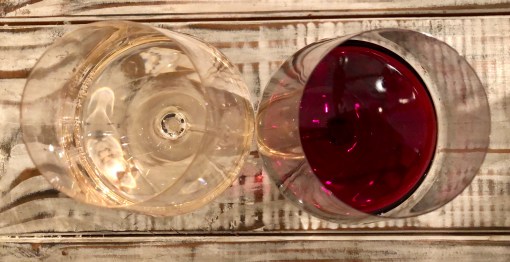
It is a long-standing tenet of this blog that I am fully on board with a good theme wine, as long as the gimmick doesn’t come at the expense of the underlying substance.  When theme bottles are done well, you win twice, augmenting the already-pleasurable experience of drinking well-made juice with the added enjoyment of the marketing cleverness surrounding it.  When they are not done well, not only are you left drinking crappy wine, you end up feeling a bit like you’ve been had while doing it.  These two bottles stake a sort of middle ground between those extremes, but when combined with their inoffensive price tag ($19.99 SRP) and their charitable underpinnings, they take no steps to dampen my theme wine enthusiasm.  Let’s get into them; it’s go t– …well, you know what time it is. Read the rest of this entry »


Wine Review: Taylor Fladgate 325th Anniversary Limited Edition Port

9 01 2018

Happy New Year!  Pop & Pour returns after a lengthy and dearly needed post-Wine-and-Whisky-Advent break with a bottle that would have graced this page last year but for the 49 other calendar-based things that had to do so in December instead.  Rest assured that the delay is no commentary on what’s in the bottle.  2017 would have been a preferable year to write up Taylor Fladgate’s 325th Anniversary special-release Tawny Port, if for no other reason than that it was the actual year of the 325th anniversary in question, thanks to Taylor’s founding way back in 1692.  Thankfully, the juice is just as delicious in 2018, and there are still a number of stores in town that have stock remaining (though this Limited Edition is sold out at the import agent level, so act fast if you want some!).

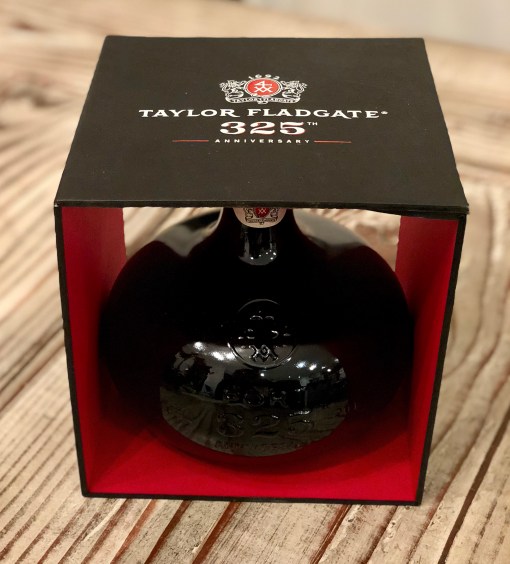
IMG_7381

Happy (belated) anniversary, Taylor Fladgate!  We’re back!!

Unlike most fancy commemorative releases from leading lights in the world of wine, Taylor Fladgate has done something daring and remarkable and borderline audacious with this celebratory flask:  it has made it accessible to the drinking audience at large.  Rather than building this one-off Tawny from ultra-rarified sources and then pricing it into the stratosphere (which it could easily have done, and quite successfully), it instead opted to take the top component lots of wines otherwise destined for its 10 through 40 Year Tawny lineup, blend them to about a 15 Year average, then age them together for 18 months so that it could release this (utterly spectacular looking) bottle at a shade below $50 retail.  Taylor intended this to be celebratory and drinkable at large, a monument for the masses, a conversation piece rather than a museum piece.  If this does not instantly become the next birthday gift you want to buy for the wine lover in your life, I worry for you. Read the rest of this entry »


KWM Whisky Advent Calendar 2017: Day 25

25 12 2017

Merry Christmas!  I am NOT blogging tomorrow.

49 different reviews, covering two totally different types of drinks and written by 4 different people, have now been posted on this site in the month of December.  It has been the most Herculean effort in the history of Pop & Pour and I’m unabashedly thrilled to be at the other end of it, but as these things always are, it has also been rewarding without measure.  It’s been a new experience to blog with others and share this space with alternate viewpoints and different frames of tasting reference, but to also be able to share what goes into getting something down on paper and then up on the site has felt like a weight off my shoulders, and when those other authors contribute as consistently and impressively as Tyler Derksen has, the burden lifts even further.  Massive thanks to Tyler for a killer blogging debut.

IMG_7343

Our Christmas reward.

I usually round off the KWM Whisky Advent experience with two things:  a heartfelt kudos to Andrew Ferguson and the Kensington Wine Market team for somehow making this remain fresh and interesting year after year, and the list of my top whiskies of the calendar.  I emphasize the first even more than usual this year, because the breadth and diversity of whiskies in 2017 surpassed any previous year I’ve tasted through, lacking only (IMO) something from Japan to round out the lineup – maybe next year?  I may de-emphasize the second this time around, because my whisky podium for this calendar ended up decidedly weird.  But I’m sticking with it, because that’s what you do with traditions.  Here goes.

  • Best Value Dram:  Glengoyne 15 Year (Day 21) — An utterly delicious 15 Year Single Malt Scotch, from a distillery that once invaded Islay as a marketing ploy, for $77?  In.
  • Honourable Mention:  Gordon & MacPhail Connoisseurs Choice 2004 Caol Ila (Day 5) — Tyler gave the most props to this out of his lineup of whiskies, and Caol Ila is one of both of our favourite distilleries, somehow managing to balance Islay peat and surrounding flavour just right time and again.
  • Honourable Mention 2:  Ardbeg Corryvreckan (Day 18) — Look.  I may have been in an apocalyptic mood while drinking this whisky; it may also be that this whisky inevitably puts anyone drinking it in an apocalyptic mood.  Ardbeg is decidedly not my thing, but a week later I can objectively recognize that this was the most layered, Ardbeg-est Ardbeg I have come across.  I will never buy it.
  • 3rd Place:  Cadenhead’s Dailuaine-Glenlivet 12 Year (Day 1) — This was as rugged and rustic as a lumberjack living on the beach, but there was something gripping and honest about it that I still remember 24 days later.
  • 2nd Place:  Hyde 1938 No. 6 Black Label Special Reserve (Day 6) — The best Irish whiskey I’ve ever had?  Almost assuredly.  Hyde keeps impressing calendar after calendar, and this was the most complex and noteworthy thing I’ve had from them.
  • 1st Place:  Shelter Point Artisanal Single Malt Whisky (Day 11) — OK, I’m seriously not trying to make this a Whisky Bible/Crown Royal Northern Harvest Rye thing, and I’m not sure I would say that, if I blind-tasted all 24 calendar whiskies side-by-side, I would rate this as objectively the best one.  BUT:  without a shadow of a doubt, it incinerated my expectations far more than anything else I tasted in December, possibly in all of 2017.  Since Day 11 ended, I have gone back to KWM to buy more Shelter Point because it opened my eyes to the promise of Canadian whisky to such a degree.  And that is why it is my winner for 2017.

If you vehemently disagree with the above, just remember that I have no real qualification or standing to be evaluating whiskies.  Let me know what your top 3 was for #KWMWhiskyAdvent 2017! Read the rest of this entry »


Bricks Wine Advent Calendar 2017: Day 24

24 12 2017

Well, the children are tucked all snug in their beds — not sleeping yet, of course, as that would be asking for a miracle — so the time has come to close the curtain on a riotously fun Wine Advent experience and give some kudos to the bottles and people that made it all happen.  The first thank you obviously goes to the remarkable team at Bricks Wine Company, who eagerly took on this half-bottle Advent challenge and then went all out foraging through a not-all-that-overflowing 375 mL market to put together 24 quality bottles reflective of their identity as a shop and their value proposition to their customers.  Way to go — all of your effort clearly showed through over the course of this month.  I would also be remiss not to thank my ultra-awesome co-collaborators Dan Steeves and Ray Lamontagne for their blogging prowess and oh-so-necessary assistance that allowed PnP to forge through two parallel booze Advent calendars at the same time. I’m hoping this won’t be the last time you see their work on this page.

IMG_7333

As for the bottles that shone brightest, I asked each Wine Advent writer to give me their thoughts about their 3 favourite wines of the 2017 calendar and separately made up my own podium of winners for comparison purposes.  There was a lot of jostling in the silver and bronze spots, but the gold medallist was a runaway unanimous victor:

Ray Lamontagne’s Top 3 Wines

1.  2011 Raventos i Blanc “De La Finca” (Day 12):  Buzzsaw acidity is the lens through which all that spiced sourdough and fruit is focused.

2.  2015 Frog’s Leap Zinfandel (Day 15):  A down-home BBQ in a bramble patch.

3.  2010 Bonny Doon Le Cigare Volant (Day 22):  Peppered blueberries baked into a gingersnap, this can hover by anytime.

DARK HORSE – 2014 Domaine Vacheron Sancerre Rouge (Day 20):  Oh look, another Pinot from…Sancerre??  Don’t injure yourself on all those stony outcroppings.

IMG_7334

Dan Steeves’ Top 3 Wines

1.  2011 Raventos i Blanc “De La Finca” (Day 12):  Beautiful acidity with complex layered nutty and toffee flavours with an exceptional finish.

2.  2015 Gruber Roschitz Chardonnay TBA (Day 23):  Great balance for being lusciously sweet, with mouthwatering acidity and an incredibly long and lingering finish.

3.  2015 Schug Carneros Pinot Noir (Day 13):  Beautiful fruits with powerful structural elements that showcases the value that New World Pinot Noir can offer.

DARK HORSE – 2012 Caparzo Brunello di Montalcino (Day 2):  The later wines are fresher in my memory, but this was a beautiful bottle.

IMG_7335

Cork Rating:  7/10 (Score bumped by the awesome shade of blue on the metal cap.)

My Top 3 Wines

1.  2011 Raventos i Blanc “De La Finca” (Day 12):  Just a clear notch above the rest in terms of complexity, structure, power and soul.  A true emotive experience.

2.  2015 Krutzler Eisenberg Reserve Blaufränkisch (Day 14):  So effortlessly refined, luxurious yet precise, an eye-opening reason why you should all be drinking more Blaufränkisch.

3.  2015 Stuhlmuller Vineyards Chardonnay (Day 21):  California Chardonnay is largely responsible for giving itself its own reputation for blowsy, overoaked, overripe, overblown wines, but bottles like this show why everyone made such a fuss about it in the first place.

DARK HORSE – 2016 Bella Sparkling Rose “Westbank” (Day 1):  This showed me something that I hadn’t yet seen in Canadian wine; I can still vividly picture its live-wire energy.  It was our first bottle and I remember it more than most of the others.

The fact that three generally like-minded wine lovers picked nine completely different wines to round out their podiums after all zeroing in on the same winner gives you some indication of the overall quality of the wines in this calendar.  The diversity of great bottles in this 24-day span has been phenomenal.

IMG_7339

Merry Christmas from my family to yours!!

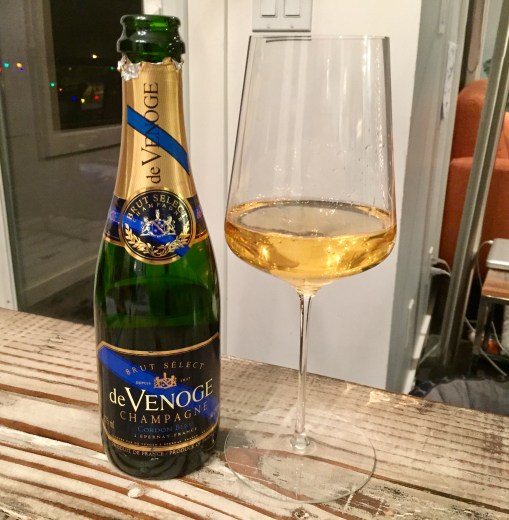
There’s not much time or space left to talk about bottle #24, which was the De Venoge Cordon Bleu Brut Select NV Champagne, an appropriately celebratory finish on the night before Christmas.  That ends up being a blessing in disguise, as my bottle was not showing I expect it should have.  It was a VERY dark gold coming out of the bottle and had almost no mousse or carbonation to speak of, smelling heavily of dulce de leche, Kraft caramels and hot sandpaper and tasting flat and roasted and bitter, like coffee left too long on the burner.  Blowtorched black jellybeans, soggy parchment and molasses rounded out a Guinness-like flavour profile.  If I had to guess, I would say this cork didn’t sufficiently hold its seal as the wine sat for some time after bottling but before sale; it’s not as ragingly faulted as my unlucky Brunello on Day 2, but since I highly doubt it’s in condition, I’m not going to score it.  I will instead set it aside and remember the other remarkable bottles that I enjoyed so much, and hope that we’ll get to do it all again next year.  Until then, thanks for following along!


KWM Whisky Advent Calendar 2017: Day 24

24 12 2017

First of all:  Merry Christmas Eve everyone!  Thanks for following along down this long and windy Whisky Advent road — it’s been a thrill to discover and discuss these incredible whiskies along with you!  Second of all:  UGGGGHHHHHH.  I had thought that I might be able to skate through the 2017 calendar without encountering my nemesis distillery, the one I admire in so many ways but can’t quite wrap my head around hedonistically, the one featured in FIVE prior hopeful but ultimately unhappy PnP whisky reviews from calendars past.  I had thought that by reaching the prestige cardboard door #24 I would be officially safe.  I was wrong.  Kilchoman is BACK.

IMG_7313

Advent cannot escape.

To be clear, this is probably very good news for most calendar drinkers, and certainly most whisky connoisseurs.  Kilchoman is a fascinating new distillery, the first that has opened its doors on Islay in over a century (during which time a great deal many of them shut down or were bulldozed), and one of the only ones that plants and farms its own grains (as noted with respect to Vancouver Island’s Shelter Point and its identical approach on Day 11).  This particular bottling of Kilchoman is also a special, exclusive one:  retailing for $200, it is a KWM-selected 25th Anniversary Single Cask, and also the first 10 Year Kilchoman for sale anywhere in Canada (not a huge surprise, since the producer is only 12 years old).  Only 212 full-size bottles — and obviously 380-odd tiny sample bottles — were made out of Kilchoman Cask 255 of 2007, matured in ex-Bourbon barrels and clocking in at 56.6% abv.  I would be more hopeful were it not for the fact that this is the third straight Advent Calendar with a Kilchoman Single Cask in it, and no prior one has turned me around (see here, here, here, here and here if you’re a masochist).

The Kilchoman 10 Year KWM Single Cask is a strange aromatic mix of the refined and the rugged, peaches and cream on top of oily peat, a delicacy in a longshoreman’s vessel.  Tar, pitch, pepper and dank undergrowth roil around, with some of Bourbon’s friendly maple and vanilla trying to peek through.  That off-putting (to me) cheesy Parmesan-rind funk that I’ve come to associate with Kilchoman is the first thing that hits on the tongue, followed by heavy briny peat, scorched apple, iodine, liniment, charcoal and grime; anise and melted plastic predominate the finish.  The complexity is all there, the flavours impressively layered, and any Kilchoman fan will likely find this their finest hour.  It still just misses me, unfortunately.  It’s not you, Kilchoman, it’s me.


Bricks Wine Advent Calendar 2017: Day 21

21 12 2017

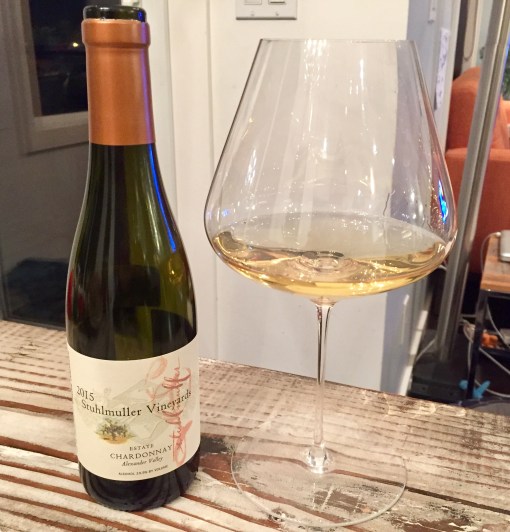
This is my second last wine post of Advent 2017:  the coming two days will see Dan and Ray post their Bricks calendar wrap-ups, and the next time you hear from me will be on Christmas Eve, for the grand half-bottle Advent finale.  It’s almost hard to believe our countdown to Christmas is almost done; it’s almost harder to believe that I actually survived it (though perhaps I shouldn’t say that yet).  And Bricks appears determined to send me off in style, because Day 21’s wrapping comes off to reveal an absolute firecracker of a Chardonnay:  the 2015 Stuhlmuller Vineyards from Sonoma’s Alexander Valley.  I think this grape is still in a down phase when it comes to much of the consumer world, but we seem to be entering a period where many of the regions previously responsible for Chard’s worst oaky boozy excesses have started to dial it in just right, at least on the quality wine side of the spectrum.  And there is no better representative of this evolution than California.

IMG_7307

Stuhlmuller Vineyards was founded by a husband and wife team who got their start in 1982 growing and supplying grapes to neighbouring wineries.  They didn’t become a full-fledged estate winery until 2000 but have already developed a reputation in the crowded California wine scene, particularly for Chardonnay, which makes up over half of its acreage.  The Alexander Valley is in the northeast corner of Sonoma, inland from the coast and due north of the better-known Russian River Ralley; its eponymous Russian River runs up and along the eastern edge of Stuhlmuller’s vineyards in Alexander’s southwest corner, where it and the Russian River Valley come together with Dry Creek Valley.  Much like Napa, the grape-growing conditions in the Alexander Valley are helped by two separate ocean-induced effects:  morning fog coursing in daily through the Chalk Hill gap, and cool nights spurred by ocean breezes, both of which provide the grapes relief from the scorching California heat, help preserve precious acidity and lead to more balanced ripening.  This bottle shows the results of all that climatic effort, clocking in at 13.9% abv.

IMG_7308

Cork Rating:  3/10 (Friendly advice – no phone numbers or websites on corks. This has both.)

This is Stuhlmuller’s “entry-level” Chardonnay, but it’s clear from the start that no shortage of care went into its creation.  It was fermented sur lie (on its spent yeast cells) over 8 months and matured in French oak, mostly small-barrel barriques but only 5% new.  It is a rich golden colour in the glass and finds that perfect harmony between Chardonnay’s careful fruit and oak’s at-times exuberant influence, mixing fresh pear, peach and Granny Smith apple pie with ginger chews, almond shortbread, oatmeal cookies and rubber boots.  Simultaneously full and cutting on the palate, the Stuhlmuller’s oak-aided roundness is run through with a table saw of slicing acidity.  It is beautifully poised on the tongue without losing the weight and body that is a defining feature of Chardonnay, a honeyed swirl of caramel apple, white flowers and a bracing quality on the finish like a cool sea breeze.  Refined and restrained but still California in essence — exactly what New World Chardonnay should be.

92 points


KWM Whisky Advent Calendar 2017: Day 21

21 12 2017

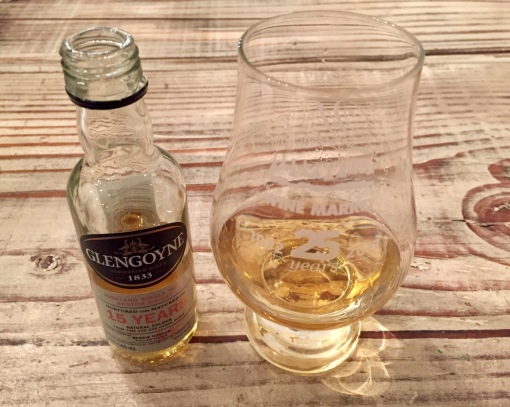
Our 21st day of whisky; our 6th Glen, giving us a Glen percentage of 28.6%.  Not too shabby.  If you’re counting at home, it’s been:  Dailuaine-Glenlivet (Day 1 – sort of a cheater Glen), Glentauchers (Day 8), Glenmorangie (Day 9), Glenfiddich (Day 10), Glenglassaugh (Day 15), and now today’s Glengoyne, a Highland distillery whose 18 Year Single Malt graced last year’s calendar on Day 12.  I wasn’t much of a fan back then, but for tonight’s 15 Year I am much more enthused.  Glengoyne got its start illegally, distilling scotch surreptitiously in the 1820s for tax avoidance purposes before deciding to go legit a decade later.  Around that time, they signed the contract of the (19th) century, lining up a 99-year lease for the pure spring water of the adjacent burn for the measly sum of £8!!  That would be £5,000 or so in today’s currency, but still – that’s a century of water.  They have obviously retained their colourful spirit (no pun intended) into modern times:  in 2004 they rented a pirate ship and landed in the harbour at the Islay Whisky Festival with a hold full of unpeated whisky, just to be contrarian.  You almost have to like them just for that.

IMG_7288

The Glengoyne 15 Year is a gorgeous shimmering amber colour and comes out firing with an aromatic barrage of burnt orange peel, clove, all-spice, carrot cake and tennis balls, immediately announcing itself as more forward and somehow more developed than its 18 Year sibling from last year.  Perhaps it’s the first-fill Bourbon barrel aging before the Glengoyne mandatory sherry cask finish on this bottle, but whatever the reason, it hits the tongue loaded with sweet comfort food flavour, a rich and warm blend of Cabane à Sucre (frozen maple), treacle, butter tarts, Terry’s Chocolate Orange and Golden Grahams.  The decade and a half in barrel left this mellow and loaded with confectionary depth, making it a joyous breeze to drink and a stellar value at $77.  Four more days!!


Bricks Wine Advent Calendar 2017: Day 20

20 12 2017

When the days hit double digits starting in 2s, I know our calendar work is almost done.  I’m not going to lie:  I’m ready not to be writing tasting notes and blogging on a daily basis, at least for a little bit.  But then I unwrap a bit of an Advent mystery and find myself sucked in all over again, pulled once more into the insatiable curiosity that goes with loving wine.  This time it came from revealing a bottle bolding displaying “Sancerre”, likely THE Old World heartland of Sauvignon Blanc and a renowned white region in France’s eastern Loire Valley…but then noticing things that seemed off.  Did it seem kind of dark inside?  Is that a maroon neck foil?  Wait – does that say Sancerre ROUGE?  (Granted, I have already had a white wine in this calendar say that it was a red wine by mistake, but this bottle actually IS one.)

IMG_7300

It turns out that red wine makes up close to 20% of Sancerre’s yearly production, all of which is required by appellation rules to be 100% Pinot Noir.  And there is perhaps no estate in Sancerre that takes its reds more seriously than Domaine Vacheron, which plants 11 hectares of Pinot alongside 34 hectares of Sauvignon Blanc and doesn’t treat it like an afterthought in the cellar.  The Domaine is now in its fourth generation of family ownership and has revamped all of its vineyard practices in the hands of the two young cousins who now direct its operations, Jean-Laurent and Jean-Dominique Vacheron.  They converted the estate to biodynamics in the early 2000s and now only fertilize the chalk and silex soils with composts made on the property, harvest by hand, ferment using only native yeasts and bottle according to the lunar cycle.  Their Pinot Noirs are partly matured in stainless steel tanks to preserve their fruit and partly in large neutral barrels for oxidative effect without oak flavours.

IMG_7301

Cork Rating:  2.5/10 (Not only is it boring as sin, it doesn’t do that great a job at its primary function of holding in liquid.)

This is my first ever bottle of Vacheron, the 2014 Sancerre Rouge, from a property that is almost at the literal centre of France.  I was a little leery from the outset as the cork came out of the bottle completely sodden and squeaky, but the wine inside seemed to bear no ill effects.  It was a fully transparent ruby in the glass and emitted a distinctive and attention-grabbing set of aromas:  beyond the more expected Pinot smells of cranberry, underripe raspberry and violets, there is a pronounced vegetal greenness (dill/pickles; Ray says nettles), a tangy citric bite (tangerine, gooseberry) and a base industrial rockiness (flint, car tire skid marks) that differs markedly from your run-of-the-mill Old World Pinot earthiness.  The palate adds salted watermelon, pomegranate, lava dust and crushed roses on a light, deft body structured mainly by prominent papery tannins.  This is a compelling mirror of its rocky soil and a suggestion that Pinot has the potential to ascend from its eternal Sancerre understudy status.

88- points


KWM Whisky Advent Calendar 2017: Day 20

20 12 2017

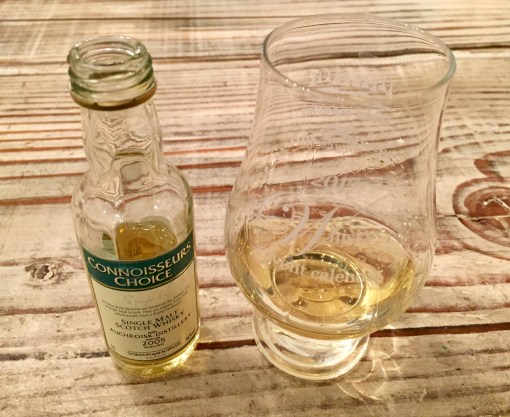
Tyler and I have repeatedly lauded the 2017 version of the KWM Whisky Advent Calendar for its diversity and novelty, for giving new whiskies and new brands who have never before graced the inside of a decorative Christmas countdown box an opportunity to shine.  Tonight’s whisky is – not an example of that.  If there is one label that is a common denominator of every Whisky Advent Calendar I’ve drank my way through, it is most definitely the Connoisseurs Choice line from massive independent bottler Gordon & MacPhail, as seen on Day 5 this year and in at least a half dozen other incarnations in calendars past.  Day 10 of 2015 featured an 18 Year malt from a G&M CC bottling of a relatively obscure distillery called Auchroisk, and tonight we get its younger brother, an 11 Year distilled in 2005 and bottled in 2016 under a highly questionable scrubs-green label colour scheme.  Auchroisk is not often seen bottled under its own name but is generally known to produce fruitier whiskies due to its use of taller, slender-necked stills, which tend to result in a lighter spirit during distillation.

IMG_7271

Totally not sold on the hospital green colour scheme for this CC label.

The 2005 bottling doesn’t appear at all on the comprehensive Gordon & MacPhail website (which shows over 150 different Connoisseurs Choice whiskies), but it appears to have been matured in American hogsheads and retails for around $100 (it’s also not on KWM’s website, making it doubly difficult to research).  It is a friendly Labrador Retriever of a scotch from the get-go, immediately presenting with easy and appealing aromas of bananas foster, cinnamon, rum raisin cake, honey and celery root/lemongrass.  Fresh, rich and floral on the palate, it melds peach and cantaloupe fruit with honeycomb and vanilla bean creaminess, not overly expansive or complex but pleasantly direct and unabashedly charming.  A worthy CC dram, though hopefully the last we’ll see of G&M until 2018.


Bricks Wine Advent Calendar 2017: Day 18

18 12 2017

For those few brave stragglers who have stuck with us through this dual Advent adventure, we are three-quarters of the way there.  This is the last wine of the third of four columns of the Bricks Wine Advent crate:  we are a week from Christmas and six wines from having to pick our own bottles again for dinner.  Tonight’s bottle is a bit of a double-take wine, a Canadian split that is five years back-vintage for an offering that currently retails for around $20 for a full bottle (out east, at least).  It’s not often that I get a chance to see how value-priced local wines stand up to a bit of time, though I would love to hear the story of how Bricks came across this as a calendar opportunity.

IMG_7282

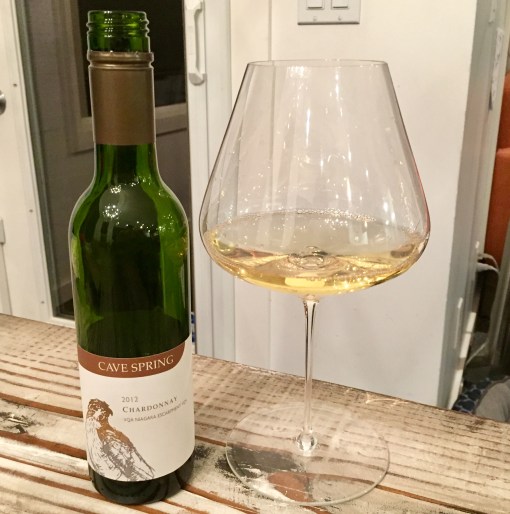
“This” is the 2012 Cave Spring Chardonnay from the Niagara Escarpment region.  The winery was the first to plant vinifera grapes in Niagara and among the first to recognize the vinous potential of the region.  It was also the first in Niagara to tack on its own spa as a tourist attraction, making it an early leader at recognizing the area’s business potential as well.  The Niagara Escarpment line of wines represents the second of four tiers of Cave Spring wines, where grapes are sourced from multiple different vineyards within the subregion; the most interesting part of this wine is that it appears to be a blend of standard Chardonnay grapes with Chardonnay Musqué, an aromatic, floral, spicy mutation of the varietal that adds some olfactory punch to what can otherwise be a fairly neutral grape.

IMG_7280

RED wine???

One thing about half-bottles is that they accelerate a wine’s aging curve, because (1) oxygen is the primary thing that matures (and ultimately degrades) a wine and (2) there is a greater ratio of oxygen to wine in a 375 mL split because the ullage (the space between the wine and the cork at the top of the bottle) is the same for all sizes of wine.  This 2012 is therefore further advanced in its life than a standard bottle would likely be, and it’s starting to show.  The wine is a shimmering lemon-gold colour in the glass and showcases its multi-clone blend in a musky, tutti-frutti nose of honeydew, Meyer lemon and cantaloupe, accented by remnants of once-toasty oak and sulphur-y struck matches.  Medium-bodied, with still-present scruffy barrel tannin and fading acidity, this Chardonnay is not quite sure where it is on the palate:  the fruit has kind of gone to a murky place, the oak has resolved to a pastry crust/vanillin glaze, and the wine overall seems to have one foot each in two different stages of development, clinging to the remains of its youth while also giving in to the inevitability of age.  I think it likely would have stood out more a couple of years ago, but it remains a solid expression of what Niagara Chardonnay can do at a wallet-friendly price.

87+ points

IMG_7281

Steven Rating:  6/10 (Dig the colour, but there’s only so high I can go with two underlined letters.)


KWM Whisky Advent Calendar 2017: Day 18

18 12 2017

The world has ceased to be.  Welcome to oblivion.

That is some approximation of what I felt when I cracked tonight’s calendar door after this particular day and saw Ardbeg Corryvreckan staring me back in the face.  Between and early and constantly stressful workday and other obligations, I was ready for a friendly Labrador retriever of an Irish whiskey or something fun from some other new wacky whisky nation.  Instead I got the Mordor of Scotch whisky, from the producer most commonly associated with near-merciless peat levels in its bottlings.  Before levels of peating in whisky became something people tried to top each other at for no reason (looking at you, Octomore and Supernova, the latter of which is, to no one’s surprise, an Ardbeg), this distillery was probably known as THE foremost purveyor of peat, with most of its offerings featuring 55 ppm of peat phenols, the highest in the calendar to date.

IMG_7250

Nothing means anything.

This particular bottle of Ardbeg, the weirdly named (they’re all weirdly named) Corryvreckan, gets its moniker from a famous whirlpool located just north of the Scottish island of Islay from which this derives.  Even this whisky’s NAME is sliding off into the abyss on the label (welcome to oblivion), in honour of both the marine landmark and my current mood.  Before this gets too depressing, I should point out that the Corryvreckan is actually one seriously decorated whisky:  it was named World’s Best Single Malt (!!) at the World Whisky Awards in 2010 and has received a swath of other critical accolades.  A quick Google search results in much gushing about this French oak-matured monster, which retails for a relatively tame $120 given the buzz around it.

This is like drinking a junkyard:  my first aromatic notes were old rubber hoses, car tires, motor oil, shoe polish, kerosene and leather on fire, plus this weird melting-plastic offgas vibe at the start of every sniff that hammers home the whisky’s identity.  Ardbeg is rugged, fiercely peated, fiercely Islay whisky, and the Corryvreckan shies away from none of that.  There is a sweetness to the back of the palate, an apple cobbler and poached pear pleasantry, but that’s then almost immediately sacked and pillaged by industrial malaise and every conceivable sensory experience arising out of an old factory falling apart while still operating, with a finish like eating still-red fire pit ashes.  Welcome to oblivion.


KWM Whisky Advent Calendar 2017: Day 16

16 12 2017

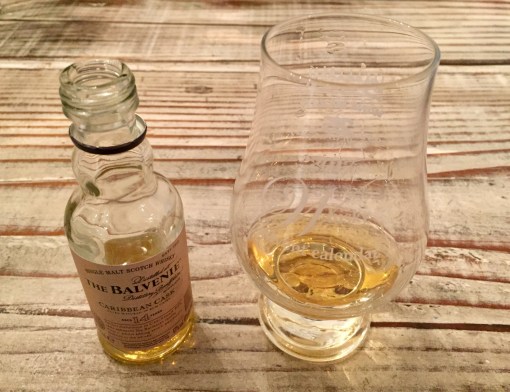
Two important beliefs that help make up my worldview are:  (1) Rum is delicious.  (2) Things soaked or aged in rum invariably taste better.  As such, I’ve wondered why there’s a relative dearth of rum cask whiskies out there, at least in comparison to the Bourbon Barrels and the (continual eternal string of) Oloroso Sherry Casks out there.  Thankfully, tonight, The Balvenie comes to the rescue…well, sort of, at least.  This is the first ever Balvenie calendar whisky that I’ve come across in 4 years, and it’s into the We’re Getting Serious portion of Advent, clocking in at $107 for a full-sized bottle.  It sells its rum influence hard, naming itself the “Caribbean Cask” and trumpeting that it is “Extra Matured In Rum Casks” (yes, “extra-matured” makes a second 2017 calendar appearance); a more careful review both brings that into some question and turns The Balvenie into a modern-day rum runner.

IMG_7239

Why is the rum gone?

This is stated to be a 14 Year Single Malt Scotch Whisky.  The Balvenie’s website states that this whisky was first aged in traditional American oak whisky casks for…14 years before being transferred to Caribbean rum casks for finishing.  I’m no math expert, but obviously the time spent in rum could not be measured in years given the variables before us.  But the actual brevity of the entire marketing core of this whisky is forgiven by the best cask story I’ve come across in 4 years of calendars.  Most whiskies aged in other booze casks obtain used barrels from wine or spirit producers for their new use in whisky maturation.  Instead of obtaining used rum casks (which surely exist), however, The Balvenie opted to take their own American oak casks and FILL THEM UP WITH RUM (a West Indies blend of their own selection), only to then empty out the rum and fill the drained casks back up with the whisky for a brief aging interlude.  The ideal, and completely true, epilogue of the story:  The Balvenie then RE-SOLD the rum at a profit because now it too was extra-matured.

The resulting sort-of-rum-aged concoction is a rich amber colour that certainly suggests extended maturation, and a resplendently rummy nose that makes me feel bad I questioned its Caribbean bona fides above:  cinnamon buns, nutmeg, gingerbread, pumpkin and honey create a combination I could keep smelling for a long time.  Languid yet spicy on the tongue, it prickles the palate with a cedary tangy bite, all the while unfolding confectionary charms in a carefree, leisurely manner.  White chocolate, peach, mocha, treacle and hot sand aren’t quite as rum-influenced as the aromas, but they are no less delicious.  It’s basically impossible to drink this whisky and be unhappy.


Bricks Wine Advent Calendar 2017: Day 15

15 12 2017

Tonight’s wine might suffer from a disconnect between actual and anticipated identity.  When the first words you note on a label are “California Viognier” and the listed alcohol clocks in above 14%, you think you’re in for a fun, flouncy, slightly provocative stone fruit and flower party.  When the label in question is from an Oakville winery, based in the heart of Napa, which is the heart of big, brash, Cali wine, you doubly brace yourself in anticipation of something raucous.  This bottle is solidly drinkable but has none of that carefree, sultry attitude.  It’s Viognier without joy.

IMG_7256

Miner Family Winery was founded by a husband and wine team in 1996, making this 2015 Miner California Viognier their 20th anniversary vintage bottling.  They make an astonishing array of wines, from Cab and the other Bordeaux varietals to Burgundy’s Pinot Noir and Chardonnay to the reds and whites of the Rhone Valley to Tempranillo and Sangiovese.  There are multiple bottlings of most of these, so their winemaker obviously stays busy.  The winery’s pride and joy is likely its 20,000 square feet of underground cellaring caves carved into a Napa rock face, which were dug at great expense shortly after Miner came to be.  Despite being Napa-based, they source from across the state of California, as evidenced by the straight “California” designation on this particular bottle.  62% of this Viognier comes from a single vineyard in Paso Robles, while the other 38% comes from the Sierra Foothills; since the wine crosses appellations, it has no choice but to revert to the broader state-wide statement of origin on the label.

IMG_7259

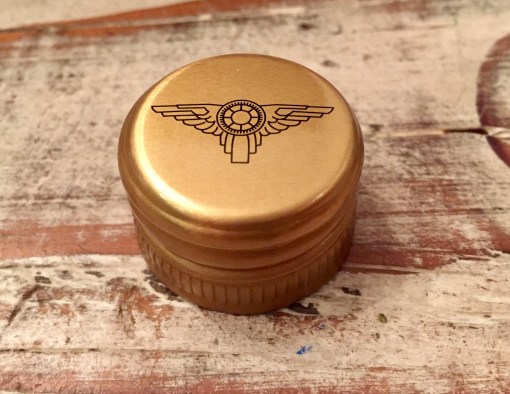
Stelvin Rating:  8/10 (Love the gold, love the sun god logo, love the interest yet simplicity.)

The 2015 Viognier is a surprisingly pale lemon colour coming out of the bottle, partly due to the lack of any oak treatment (which deepens the colour of white wines).  It is almost shockingly lean and citric for a 14+% abv California Viognier, leading with lemon zest and mountain stream aromas backed by frozen honeycomb, Tums and talcum powder.  It broadens slightly in waxy, watery ways on the tongue, adding tart pear fruit and some kind of tropical musk, but retaining an overall sense of distance and a prevailing greenness — fresh leaves and flower stems, grass and baby spinach — finishing with a touch of astringency.  Viognier’s trademark bouncy peachiness and sensual mouthfeel don’t make an appearance, almost like these grapes were picked before those elements got there (harvest dates: August 19th-27th); despite significant sugar ripeness, the phenolics and ultimate character of the wine never quite caught up.  I had no issue crushing the bottle, but this would not be the expression that Viognier sends with its cover letter to land a job interview.

87- points