KWM Whisky Advent Calendar: Day 12

12 12 2017

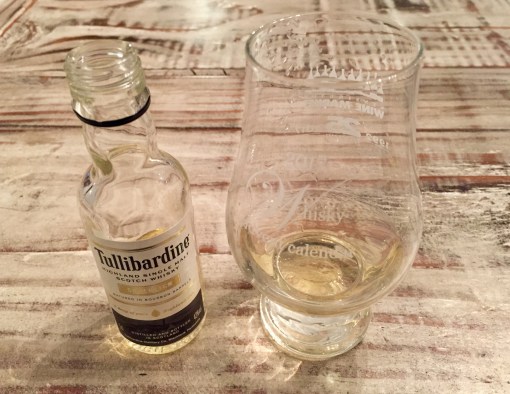
It’s been a frenetic start to Advent, both in terms of the 22 posts that have graced this blog over the past 11 days and in terms of the kaleidoscope of countries and new whisky experiences to which Kensington Wine Market has treated us so far.  Maybe at this point, at the halfway mark of the calendar, we can stop and take a breath and revel in a dose of familiarity before launching ourselves again into the unknown.  Enter the safest low-cost whisky you can buy when you’re stuck somewhere out of town and the only accessible shop is Superstore:  Tullibardine.  I have had the same “hey, this is actually pretty good!” reaction to many a suspiciously cheap Tullibardine scotch and have come to the conclusion that they can deliver on a budget far better than most in the spirit world.  You will often come across a “1488” logo on the distillery’s packaging, and their website hints at their illustrious history…sort of.  It turns out their site was previously a brewery in the 15th century that King James IV once visited, which is impressive, but for the fact that the distillery had nothing to do with the brewery and wasn’t a thing until 1947.  The website does not discuss the intervening 450 years in detail.

IMG_7184

Take a breath.

Through its entire whisky lineup, Tullibardine only uses first-fill casks (barrels that were only previously used once before, so the interior toasting and wood grain is still receptive to liquid contact) for maximum flavour transference.  This Sovereign bottling is the foundation of the portfolio, a Highland Single Malt matured only in first-fill Bourbon casks, at $65 probably the price baseline for a proper single malt scotch.  It is a grainy pale gold colour and comes across somewhat aromatically muted, its baked apple, banana Runts, grass and honey aromas slightly shy and stunted.  Bourbon’s characteristic sweetness wakes it up on the first sip, however. launching flavours of vanilla bean and creme brûlée laced with char and toasted marshmallow skin, those scorched-barrel notes echoing into a smoky finish.  This is not a dynamic whisky, but it is easily an enjoyable weeknight sip, which is all it has to be to justify this price tag.


KWM Whisky Advent Calendar 2017: Day 11

11 12 2017

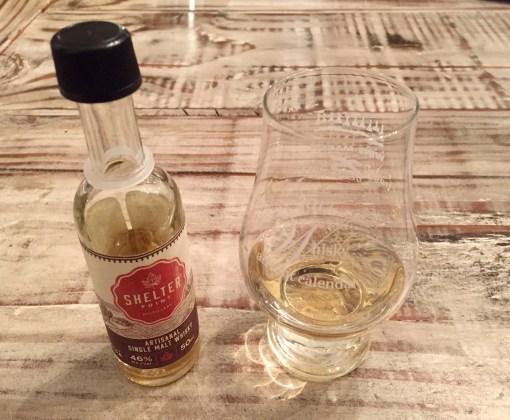
I’m not sure what shocks me more:  that there are not one but TWO Canadian whiskies in this calendar; that they have shown up in the first 11 days of Advent nestled in with offerings from England and The Netherlands; or that this one is from Vancouver Island!! Andrew Ferguson is a madman, the 2017 calendar is officially unhinged and this is by far the most fun Whisky Advent ever.  I used to live on Vancouver Island while in law school, and I never would have expected there would be a renowned distillery there, but as of 2011, there is:  Shelter Point, established across 380 acres running up the eastern coast of the island on land that was previously a UBC research farm.  Why do you need 380 acres to run a distillery, you ask?  You need it if you ALSO want to farm and grow your own environmentally sustainable barley with which to MAKE your whisky.  This sounds like an obvious concept when viewed through the lens of the wine world (the barley is basically Shelter Point’s estate fruit), but it is almost never done in the whisky world; the only other farm distillery that comes to mind off the top of my head is Scotland’s Kilchoman, whose ethos I admire greatly but whose products I can’t seem to get myself to enjoy.  No such problem here.

IMG_7176-1

Shelter Point is heavily committed to the health of its farmlands and the surrounding area, even donating a large chunk of its “estate” to Ducks Unlimited for use as a nature park.  They make vodka and liqueur in addition to multiple different releases of whisky, but tonight’s focus is their Artisanal Single Malt Whisky, all distilled from homegrown barley and then matured for years in a warehouse right alongside the ocean in what is rumoured to be all ex-Jack Daniels casks.  Badass.  At $85, it is roughly double the price of the previous Canadian whisky in this calendar, and it proves itself easily worthy of this price tag.

IMG_7177-1

My first Vancouver Island whisky has a zesty, spicy nose, lemon peels and cinnamon hearts rounded out with almonds, apple pie crust and warm leather.  I can’t remember ever writing this about a whisky before, but it is absolutely linear on the palate, driven and focused, powered ever-forward by an engine of grainy, peppery, malty verve.  There is no meandering here, no stopping for breath, at least not until the sip is long swallowed and a Coffee Crisp sort of finish makes itself apparent.  This is far more cohesive and structured than the Gretzky whisky from Niagara and easily cruises to the Top Canadian Dram crown of both this Advent and my lifetime.  It may in fact be my favourite whisky of the whole calendar so far.  Shelter Point, I’m coming over.


Bricks Wine Advent Calendar 2017: Day 10

10 12 2017

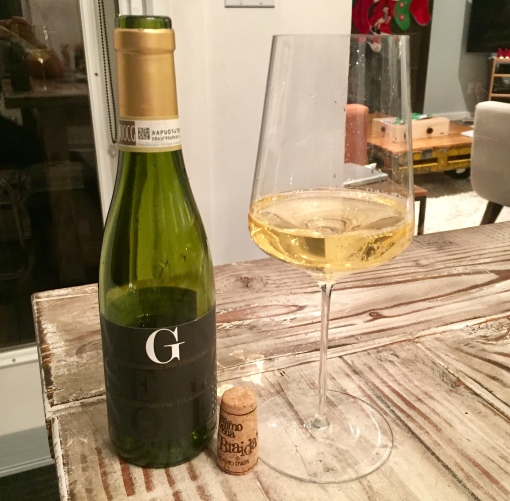
I think it is officially Sugar Coma Weekend in the Bricks Wine Advent Calendar.  When the COMBINED alcohol level of your Saturday and Sunday wines is 12%, you know you’ll be facing an armada of unfermented grape sugar in the bottle.  After last night’s 6.5% abv Auslese Riesling, I thought we had hit our December alcohol floor, but the 2015 Braida “Vigna Senza Nome” Moscato d’Asti will see that 6.5% and raise it (well, technically, lower it), clocking in at an almost juice-like 5.5%.  The wine’s name roughly translates to “Vines Without Names”; the roughly dozen online sources I consulted trying to find out why declined to say so, though most of them noted that the corresponding motto on the front label “Sator Arepo Tenet Opera Rotas” means “the farmer at the plow chooses the path”, which is reflective of this classic producer’s focus on the quality of the vineyard, even if they decline to name the vines in it.

IMG_7219

I love Moscato d’Asti.  At its best it is equally refreshing and luxuriant, searing and delectable, a frozen rope of distilled fruit essence that disappears from the glass before you even notice.  It is made from Moscato Bianco grapes grown around the famed town of Asti, in the heart of Piedmont, which are harvested then crushed and immediately refrigerated before fermentation so that the yeasts don’t immediately kick in.  The cooled must is then transferred to pressurized sealed steel tanks before fermentation is allowed to begin; as the grape sugars are converted to alcohol, carbon dioxide is released as a by-product, which can’t escape the tank and gets dissolved into the wine.  Once the alcohol content clocks above 5% (which is WAY before all of the sugars are fully converted), the whole tank is chilled down to near freezing so that fermentation stops, after which the yeasts are filtered out and the wine is bottled under pressure, leaving an intensely sweet, slightly bubbly bolt of lightning for patio enjoyment.  It is best consumed as early as possible, when acids are crisp and bubbles are buoyant, and there is little to be gained in trying to mature it.

IMG_7220

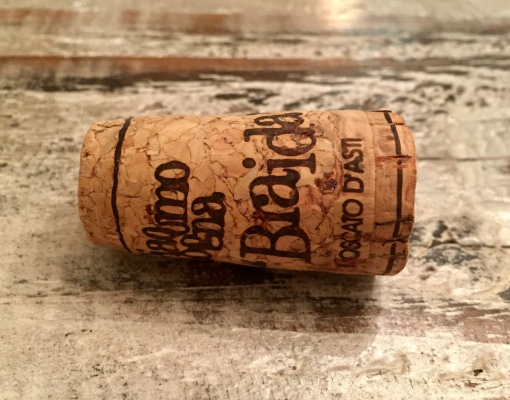
Cork Rating:  6/10 (The extra expansion and vertical writing are winning somehow, even if the cork as a whole is bland.)

This 2015 Vigna Senza Nome is a surprisingly golden colour for a Moscato and has a slightly syrupy nose of baked pear, bruised apple, honey and caramel to go with brighter tropical and Fuzzy Peach notes.  Some lift remains on the palate in the form of hedonistic melon, lychee, blood orange and bergamot, but much of the life and effervescence that normally characterizes this style and expression has been faded away, whether due to time (it’s only two years old, but Moscato’s probably best at 20 minutes old) or (more likely?) due to storage conditions between its bottling and its insertion into the calendar. I’ve had this exact bottle multiple times before, albeit never in back vintage form, and this is the first time it’s tasted heavy; the bubbles aren’t quite up to the task of scouring away the sweetness, and quiet acidity doesn’t provide enough of a helping hand.  It’s still completely delicious, but it is drained of some of its usual joy and not quite showing at its peak.

86 points


KWM Whisky Advent Calendar 2017: Day 10

10 12 2017

By Tyler Derksen

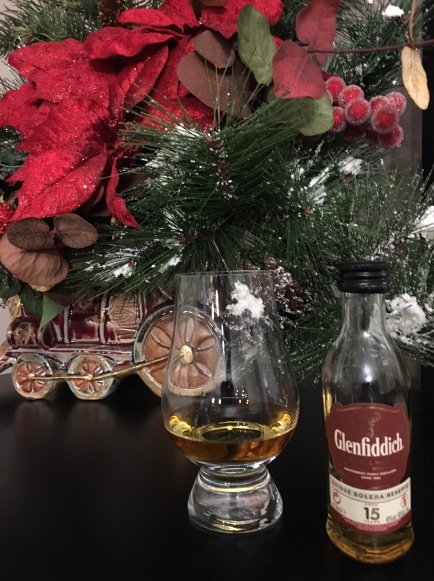
Day 10 brings us a 15-year Glenfiddich.  Glenfiddich was founded near Dufftown, in the heart of Speyside, by William Grant in 1886 when he began building the distillery with the help of his nine children (no wonder he needed a drink).  The name “Glenfiddich” is Gaelic for “Valley of the Deer”, which explains the deer on all of the distillery’s labeling.  Glenfiddich remains in the family and the descendants of William Grant still run it 130 years later.  The distillery has a significant production and accounts for a significant percentage of the single malt whisky sold worldwide.  The whisky is stored and matured on site in one of 43 warehouses, which have a capacity of 800,000 casks!

IMG_4117

Ok, so here’s the thing.  I’m not a huge fan of Glenfiddich. I’ll get that out of the way now.  That’s fine, as not everyone likes peated whisky the way I do.  That does mean, however, that I don’t typically seek out whisky from Glenfiddich when trying something new.  As a result, I was interested to see how this 15 Year Old Solera would compare to the more commonly served 12 Year Old.  The process for producing the 15 Year Old Solera seems quite involved.  The spirit is initially matured in European, American and New American Oak before being put into Glenfiddich’s custom-made Solera vat (built in 1998 by the distillery’s fifth Malt Master, David Stewart).  After aging in the Solera vat, it is then finished in Portuguese oak tuns.

The website for Glenfiddich indicates that the Solera vat is never emptied more than half way before new casks are added, which they tout as a means of achieving consistency in flavour.  When I hear consistency or uniformity of flavour, I become hesitant, as I find that whisky produced with that as a goal tends to have far less character.  That doesn’t make them bad, just uninteresting (at least to me).  C’mon, half the fun is barrel variation.

The nose on this whisky was, unfortunately, difficult to discern, with the intensity muted (potentially as a result of being bottled at 40%).  Hints of apple and spice slowly find their way through a nose that is certainly richer than the Glenfiddich I have had previously.  The palate is similarly muted (again, perhaps because of the 40%) and does not have a burn of any kind.  It is smooth and inoffensive, with flavours of dried fruit, baking spices and honey.  The finish is almost non-existent with the lingering flavour remaining only describable as “generic Speyside”.  One of the great things about whisky is that there is a dram for every palate and a palate for every dram.  This one doesn’t do it for me, but hey, that’s why there are 25 different ones in the calendar.  See you all in a few days!


KWM Whisky Advent Calendar 2017: Day 9

9 12 2017

After a hectic first week and a bit of whisky, where every other day introduced a bottle from a new country (I’m still processing The Netherlands two days later, and I didn’t even write it up!) and every scotch was seemingly snatched from the jaws of obscurity, maybe it’s nice to sort of resettle and catch our collective breath with a Glen- that everyone recognizes (sorry, Glentauchers).  Glenmorangie is the first single malt experience of many fledgling whisky drinkers, and is very widely sold, but that doesn’t mean they don’t try to push the envelope every so often.  I got a firsthand experience of that phenomenon a while back with their floor-malted Tusail, a dynamite dram, and they try to take a step out of the ordinary here as well with their extra-maturation expression Quinta Ruban.  As far as I can tell, “extra-maturation” is just a fancy way of saying “aging something in one thing, then moving it to another thing”, but Glenmorangie has built a whole range out of this relocation, starting off whiskies in ex-Bourbon cask and then transferring them for the final stage of aging to a variety of other types of vessels.  The 12 Year Quinta Ruban gets to spend the last two years of its pre-bottle life in Ruby Port casks, and according to the Glenmorangie site it was the first malt whisky ever to do so.  It almost surely gets its name from this practice:  Quinta = a wine estate in Portugal, and Ruban is close enough to ruby that I’m not even firing up Google Translate to look into it further.

IMG_7149

First things first:  this is one sweet-looking mini-bottle of scotch.  I like the mini-bottles that retain the same sense of proportion as the full-sized bottles, and this one nails those little details.  The Quinta Ruban may be the orangest scotch I have ever seen, thanks to the staining impact of the used Ruby Port barrels.  The nose is spicy and fiery, all pepper, smoke, clove, all-spice and briquettes, forcing you to dig for the orchard fruit beneath.  It is big, rich and brawny, with an accompanying alcoholic burn (even with water added) amping up burly flavours of maple, mandarin orange, cast iron, sandpaper and chestnuts.  Its price is also extra-matured at $92, but I won’t be the one who discourages the big houses in the world of scotch from diversifying their approaches.


Bricks Wine Advent Calendar 2017: Day 8

8 12 2017

I feel like I was slightly prescient yesterday when I said that most of the bottle picks in the first week of Bricks Half-Bottle Wine Advent were straight out of a Classic Wine Regions textbook, as today we hit probably the 2nd most likely remaining appellation in France to get the call in a Wine Primer All-Stars competition:  Chateauneuf-du-Pape.  (If Bordeaux shows up anytime in the next 3 days, we will definitely have cracked the code.)  Chateauneuf is the jewel of the Southern Rhone, spiritual birthplace of the GSM (Grenache/Syrah/Mourvedre) blend, and purveyor of bold, brash, rich yet layered wines that are an Old World gateway drug for many a Cali Cab or Aussie Shiraz lover.  The area’s regal approachability arises out of a combination of extensive sunlight, scorching summer temperatures (over 30 degrees Celsius on average) and a whipping northern wind so famous that it has its own name (the mistral), which cools the grapes, prevents rot and allows for longer hang times and prolonged ripening.

IMG_7201

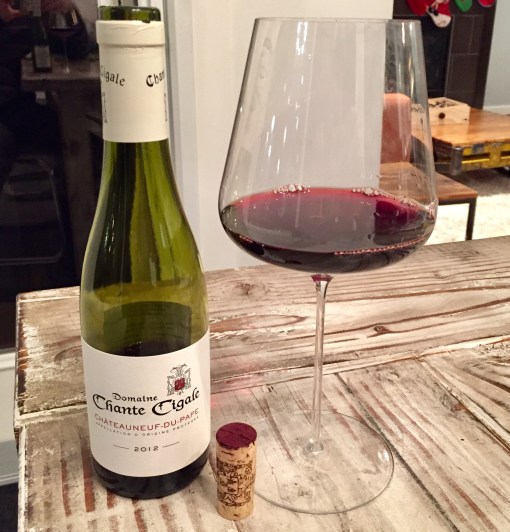
Tonight’s Chateauneuf representative is the 2012 Domaine Chante Cigale, a 100+ year-old winery that recently turned its winemaking duties over to someone barely out of his teens.  In 2002, with his father suffering from health problems, Alexandre Favier, freshly graduated from viticultural studies at the age of 20 (he started wine school when he was 15) took the reins and hasn’t looked back since.  The Domaine owns 40 hectares of vineyards, but they’re not in an orderly square surrounding the winery, instead plastered and scattered throughout FORTY-FIVE different plots all across Chateauneuf-du-Pape.  Favier relies only on ambient native yeasts present in the cellar for fermentation and ages his wines in an oddly endearing array of almost every type and size of oak barrel possible (foudres, demi-muids, barriques, mostly pre-used) as well as concrete tanks.

IMG_7203

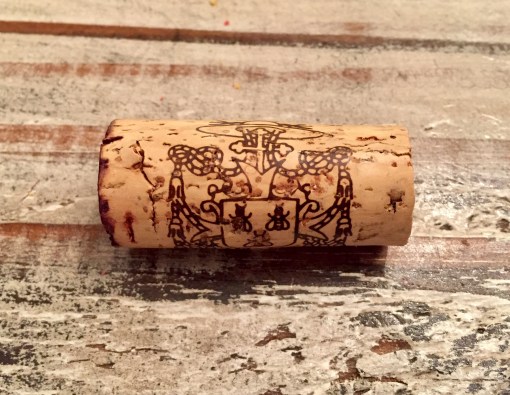
This cork deserves its own picture.  See below.

This particular Chante Cigale is the Domaine’s entry-level CNDP (if there is such a thing), keeping with the classic varietal mix of the region at 65% Grenache, 20% Syrah, 10% Mourvedre and 5% Cinsault.  It is a deep ruby colour and immediately smells like something that has been preserved:  beef jerky, molasses, date, sunbaked earth, hickory and Sultana crackers, if these had been cooked down in an Instant Pot and then set on fire.  The wine’s hefty 15% alcohol is well-contained, but everything in its profile is stewed or baked, leaving it begging for a touch of primary freshness that never comes.  Malty, Port-y, fruitcake-y, it is neither thick nor heavy in body but constantly feels that way due to a dense sluggishness in its flavours.  Like a Wagyu beef burger left too long under the heat lamp before being served, the pedigree is there, but in execution it just hung on a bit too long.  As fellow PnP Advent author Ray Lamontagne puts it, “it’s like an old venison milkshake”.  There are no kind similes.

86+ points

IMG_7204

Cork Rating: 9/10 (What a monster. Coat of arms, complete with cicadas [singing grasshoppers, aka Chante Cigales – nice], killer intricacy and coverage; glorious.)


KWM Whisky Advent Calendar 2017: Day 8

8 12 2017

The unofficial theme of the scotches (that is, Scotland-derived whiskies) from the 2017 calendar so far is giving unsung heroes their moments in the spotlight.  Like at least two other scotches in the 7 days before it — the two that led off Advent this year — this bottle comes from a little-known obscure distillery (in this case, Glentauchers in Speyside) whose substantial production forms the workhorse component of much-better-known blended whiskies (in this case, Ballantine’s) but who almost never gets to release a single malt under its own banner.  Glentauchers was founded in 1897, managed to produce until 1985 before being mothballed for 7 years, was then acquired by Chivas Brothers and has been churning out blend backbones ever since.  Its fleeting solo appearance comes courtesy of independent bottler extraordinaire Gordon & MacPhail, which has a whole range of Distillery Labels that sees them release a hidden-treasure distillery’s whisky under the distillery’s own logo and branding – very cool.  It is not my first Advent encounter with this range:  in fact, my very first KWM Whisky Advent Calendar bottle EVER was a Distillery Label bottling from the Linkwood distillery, followed shortly in the 2014 calendar by another DL bottling from Mortlach.  Neither of those, however, were 20-year malts.  This one is.

IMG_7145

Distilled in 1996 and then aged in sherry casks before being bottled last year in 2016, the Glentauchers has had plenty of time to mature and develop flavours, and it shows in a sweeping nose of carrot cake, wheat fields, tangerine, lemongrass and marzipan, as holidays-ready a set of smells as I can recall.  Luxurious and pure, it spreads out slowly, taking its time to unfurl before hitting on a distinctly prominent Amaretto note about halfway through the midpalate, a double-take hallmark flavour that just continues to emphasize itself even (especially?) after you swallow.  It’s so remarkably vivid.  Wild.  If I had to try to pull out other flavours:  Sap?  Cinnamon toast?  Banana bread?  Nope, forget it, it’s Amaretto all the way.  One of the most fun offerings in the calendar thus far without question.


KWM Whisky Advent Calendar 2017: Day 6

6 12 2017

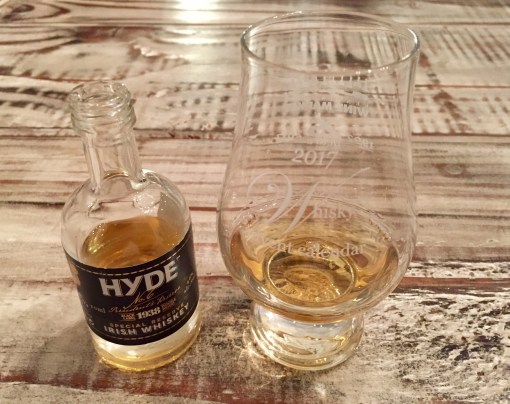
No. 6 for Day #6 — I will give everyone involved the benefit of the doubt and assume that was cleverly intentional.  I was ultra-pumped to pull the extended-name Hyde 1938 No. 6 Sherry Cask Finish Black Label Special Reserve Irish Whiskey (phew) out of the calendar tonight, for two reasons:  (1) after I have (politely) campaigned for years to get more global representation in the KWM Whisky Advent Calendar, 2017 has seen FOUR different countries come out of cardboard box doors in six days; and (2) I absolutely adored the Hyde whiskey from the 2016 calendar, which almost made my top 3 overall from that year.

IMG_7142

Like that bottle (and all of Hyde’s lineup), this one sees time in two different kinds of barrels, starting out in bourbon casks before finishing in my nemesis, Oloroso sherry barrels, which lend salty kernel-y complexity to whiskies but also drive me to the point of near-insanity in their ubiquity.  Hyde’s mantra is “It’s all about the wood!” (actual promoted hashtag:  #itsallaboutthewood), which I would readily make fun of were it not for the fact that their website contains the best discussion of the details and effects of wooden barrel maturation I’ve ever seen.  When you walk the talk, I will grant you your double entendre slogan.

05_Wood_MolecularDance_1-1024x410

Photo credit:  http://hydewhiskey.ie/the-wood/.  They take wood seriously.

Hyde Irish Whiskey is named after Ireland’s first president, Douglas Hyde, and this “1938” bottling is a tribute to his inauguration year, despite having nothing else at all to do with that calendar year.  It’s a special small release (only 5,000 bottles made, as well as at least 384 mini-Advent bottles) that intriguingly combines an 8 year-old grain whiskey with an 18 YEAR single malt whiskey to make a punching-above-its-weight power blend.  The result smells equally sweet and herbal, part honey and vanilla, part lemongrass and fresh leaves, part nutmeg and eucalyptus and creme caramel.  Fruit shows up in spades as soon as the whiskey hits your tongue, buoyant cantaloupe, kiwi and honeydew, backed by seaweed, Dixie Cup spoons and that same lingering trace of minty greenness.  This is really, really impressive, much more layered than your standard expectation of Irish whiskey and a steal at an $80ish retail price.  Keep the Irish coming!!


Bricks Wine Advent Calendar 2017: Day 4

4 12 2017

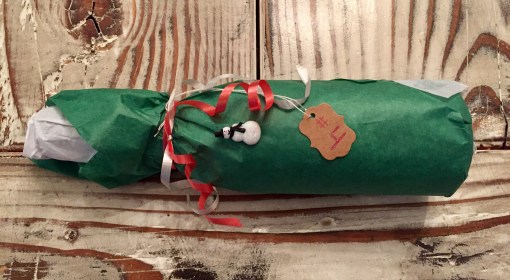
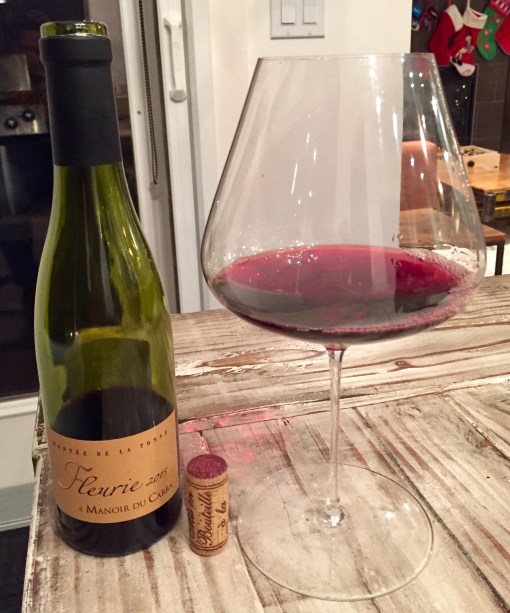
Well, after a riotously successful guest author turn yesterday, you’re stuck back with me tonight.  Thankfully, there seems to be no “stuck” and no neutral gear in the Bricks Wine Advent Calendar, which just keeps churning out half-bottles of interest on the daily like it’s no big thing.  We’re at 4 for 4 in terms of legitimately interesting, well-made, high-quality, non-seat-filler wines, and I get the feeling there’s going to be 20 more where that came from.  I should have known that tonight’s producer would end up in this calendar, as Beaujolais’ Manoir du Carra (at least in my experience with them) seems to be the king of the small-format wine.  My first interaction with the winery was in the form of a highly rare but utterly magnificent (for those solo wine-drinker households like mine) 500 mL bottling of Cru Beaujolais, a format that I would like every winery in the world to emulate, as it ends up being either a glass-and-a-bit-each weeknight dinner almost-bottle for two or a vinous feast less the hangover for one.  Turns out MdC can bring it in 375 mL format too.

IMG_7166

Tonight’s offering is the 2015 “Montee de la Tonne” (which roughly translates to “The Rise Of The Ton”, which I don’t understand) from Fleurie, which is one of 10 top “Cru” sub-regions of Beaujolais, known for its elegant, almost pretty, wines.  Manoir du Carra owns 50 separate vineyard plots within Beaujolais, and Montee de la Tonne is one of them, a 1.5 hectare micro-plot of 50 year-old wines just recently acquired by the producer that it holds in significant esteem.  Like all red Beaujolais, the wine is 100% Gamay, fermented partly through carbonic maceration (an intra-grape fermentation process spurred by CO2 and an absence of oxygen that enhances bubble-gummy fruit flavours) and then aged in large natural oak barrels for 3-4 months before bottling.

IMG_7168

Cork Rating:  2/10 (Can we all agree to eradicate all “Mis En Bouteille” corks from existence?)

First impressions:  this is a surprisingly deep and vivid purple colour, still mostly transparent but pretty amped up for Beaujolais.  The crisp herbal, floral nose evokes roses (complete with stalks and thorns) and potpourri, softened by felt and spiked with pepper, surrounded by a mist of strawberry and raspberry fruit and just a whiff of banana skins, the latter likely a product of the carbonic fermentation process.  Powdery yet poised on the palate, kept haughty by emery board tannin and piercing rivulets of acid, the Montee de la Tonne flashes class and subtlety with a careful flavour mix of dusty currant, sidewalk chalk, dried flowers, rocks and rain, never quite letting you in but letting you admire its sophistication from afar.  Like a black and white movie star, this is cast in hazy heroic tones, admirable but not fully reachable, a true throwback.

88 points

02155077

It’s probably not what led to the banana skin aromas in this wine, but isoamyl acetate can result in banana smells in some bottles.  The chemistry continues…


KWM Whisky Advent Calendar 2017: Day 4

4 12 2017

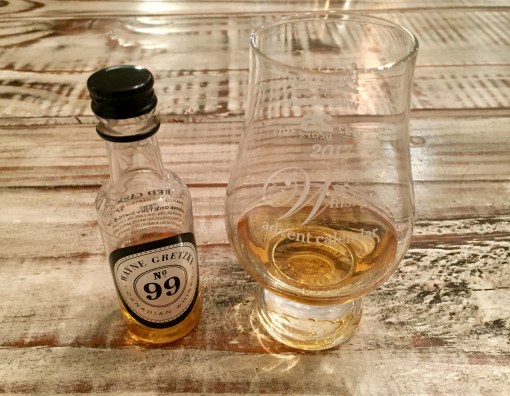
Man, this 2017 calendar just continues its emphatic strides towards difference and individuality and I just keep loving its uniqueness.  We get two new Whisky Advent firsts today (at least in my four years of following along):  (1) first ever CANADIAN whisky, and (2) first ever plastic bottle embedded in the calendar.  I almost dropped it pulling it out of slot #4 it was so light.  This is the very first ever spirit offering from Niagara’s Wayne Gretzky Estate Winery, the Red Cask Premium Crafted Whisky, which is distilled from locally grown grains and then, in a nod to its roots, matured in the winery’s own red wine barrels.  Very cool.  It has to be one of the least expensive whiskies ever to grace the KWM Whisky Advent Calendar as well, tipping the scales at a svelte $44 for a full bottle.

IMG_7141

This inaugural Advent offering from our home and native land is great to look at, a pleasantly burnished amber colour impressively obtained given what I wouldn’t expect to have been an extraordinarily long maturation period.  It smells equal parts spicy and toasty, cinnamon and charcoal, layered with elastic bands, Old Fashioned-style citrus and melon fruit.  The double-take portion of the whisky comes in the form of its ultra-satiny, almost gelatinous texture, like a Jello shot or an alcoholic Jujube.  It billows out on the tongue like a roasting marshmallow and then sits there, inflated and cooked on the edges, hanging out.  I wrote “is this rye-based?” when pepper and sandpaper started biting my tastebuds, and I was at least partially right:  it’s part aged rye, part malted rye and part corn-based whisky, each distilled separately.  The corn comes through in the Bourbon-esque caramel, burnt orange and Creamsicle flavours, lending easy approachability to the whole affair.  On the whole, while the mouthfeel seems slightly exaggerated, this stands up quite well as a solid weeknight sipper.  O Canada.


Bricks Wine Advent Calendar 2017: Day 3

3 12 2017

By Raymond Lamontagne

I should begin by emphasizing just what an honour it is to join Peter and Dan on this Bricks Wine Co. Advent journey. I remain a relative newcomer to the Calgary wine community yet have had the pleasure to meet so many knowledgeable, friendly, and dynamic people over the past year or so. It has been immensely moving and powerful to be welcomed into this community with open arms …  I wish to thank everyone from the bottom of my heart, and beg your continued tolerance as I haunt your shops, standing around the tasting bar, making random comments about terpenes or field blends and almost certainly distracting you from more important business.
IMG_0483

The evidence …

I am ecstatic that my inaugural foray into the world of wine blogging is a Gruner Veltliner. Gruner is likely my favorite white grape. I say likely because Riesling sometimes bumps it from that lofty perch, as a function of day, my mood, producer or region in question, etc. This is a great microcosm for the reality in Austria, where Riesling continues to carry more status and prestige while Gruner toils away, sometimes in the doldrums of plonk for “wine pubs” but also at the pinnacle of age-worthy sips capable of winning prestigious tastings against world-class Chardonnays. I like well-crafted Gruner so much that one of my cats was nearly christened “Veltliner”. My partner swiftly vetoed this notion (but was ultimately OK with “Spatburgunder”). Why the obsession? Simply put, Gruner can get weird. A good tasting wheel will depict all manner of curious aroma attributes rarely experienced elsewhere, including green beans, lentils, root cellar, compost bin, lovage (a savory “old country” herb that vaguely recalls soy sauce or Maggi seasoning), old socks, the less polarizing apples and limes, and above all, white pepper. Peppery aromas in wine are due to a compound called rotundone, also found in a few other varieties (most famously Syrah). Although rotundone levels are notoriously susceptible to various wine-making decisions, Gruner can deliver a zesty, earthy vortex that garners an occasional comparison to Sauvignon Blanc but which in my view is wholly unique.

726bad72-5b6f-40a6-bfc5-d581cd18d287

Rotundone … One of the aforementioned terpenes and a much better molecule than TCA.

So what of this 2016 single vineyard Huber Obere Steigen? Markus Huber has expanded a 250 year-old family operation into a big success story with international reach, seemingly without compromising his focus on precise, elegant wines that express their origins. Huber gives Gruner its just due, with the latter comprising 75% of varieties handled at the winery. The Traisental DAC is a small wine region south of the Danube river, below the famed Wachau, and here terrior reigns supreme. Full of chalk and conglomerate rocks, the soils yield full-bodied wines with firm mineral structure. Gruner from this region is known to be particularly fruity as well, yet not at the sacrifice of that all-important peppery spice. The Obere Steigen site enjoys its own unique microclimate due to its terraced nature. This emphasis on terrior or place is relatively new in Austria. Historically, more emphasis was placed on variety alone. Controversy around this difference in emphasis remains, but Markus Huber appears more than happy to let his DAC flag fly.

IMG_0489This is a pleasing yellow hue with a slight green tint. Nose hints at the crystalline mineral power within. I’m getting yellow apple, fresh parsley, snap peas, mango, and a potent undercurrent of musty white peppercorn. The herbs are more vibrantly green than umami in character. On the palate this is precise and linear, with acids brisk but not punishing … Although hang on, there’s some tangy lemon juice bite after a few sips. A compost bin funk, like old apple cores and lawn clippings, starts to creep in around a fundamentally solid core of green pears and apples, white peach, and lemon-lime zest resting on a chalk and wet slate base. This gentleman is dressed in a dapper suit but there’s something off, perhaps some mud on his dress shoes. Fruit? Check. Minerals? Check. Rotundone? Check. I’ve had Gruners that bounce around a lot more than this one, flopping around like a fish in a boat and always changing their look. This one is less dynamic and more cohesive and laser sharp, with just a slight halo of corruption … Not a bad thing in this case.

IMG_0488

90 points


KWM Whisky Advent Calendar 2017: Day 3

3 12 2017

English whisky!!!  One of the very few improvement suggestions that I’ve had for Whisky Advent Calendars of years past was a slightly heavier global focus, now that world powers like Japan and Taiwan and India are starting to flex their muscles in the whisky arena with impressive results.  I did not previously include England in this category of nations knocking on Scotland’s door, nor did I even know that English whisky was a thing, but The English Whisky Company is here to make it one.  Just established in the latter part of 2006, featuring the new and sparkly St. George’s Distillery in Norfolk, England (which has as many bells and whistles and bistros and gift shops as any Napa winery), the English Whisky Co. produced England’s first single malt whisky in over a century a few years later and remains one of only a handful of active distilleries in the whole country.  Part of the impetus behind the founding of the venture was that Norfolk is a world premier region for barley (who knew those existed) whose crops were often shipped over to Scotland for use in scotch production; since whisky is basically malted barley, yeast and water and Norfolk had all of these things, they ultimately just decided to keep their barley and distill it at home.

IMG_7140

The most troublesome part of English whisky’s entry onto the global scene is that it wrecks the heretofore super-handy how-to-spell-“whisk(e)y” heuristic that I’ve repeated many times on this site:  if the country making the spirit has an E in it (e.g. Ireland), spell its product “whiskey” with an E, but if it doesn’t have an E in it (e.g. Scotland, Japan), spell it “whisky” without the E.  Well, thanks England:  this English Single Malt Whisky puts a big kibosh on that mnemonic.  The funniest thing about this is that they spell the name of this particular peated bottling “Smokey”, with an E, likely just to rub it in.

The Smokey is infiltrated with 45 ppm of peat phenols, which is tangible but not insane on the scale of peated whiskies.  It is pale and watery-looking and has all of the grimy industrial aromas that often attend when burned peat moss embeds itself into liquid:  old rags, mechanic’s shop, turpentine, baseball gloves, floating over wild grasses and canned pear.  The surprisingly viscous texture, round and warm, envelops you in smoothness, making the whisky come across much larger than its 43% abv.  It tastes sweet, to the point where I’m seriously mulling over the use of Splenda as a tasting note, attacking in confection with vanilla bean and icing sugar and cinnamon before the billows of smoke and diesel and moss roll in.  Welcome (back) to the single malt whiskey world, England — it’s good to have you.


Bricks Wine Advent Calendar 2017: Day 2

2 12 2017

This Wine Advent is not only historic for PnP as the realization of a longstanding calendar-format dream, but it will also mark the very first time in 400+ reviews that somebody other than me will take up the virtual pen for Pop & Pour.  I am honoured to be joined in this Advent blogging journey by two fellow Calgary students of wine who pair impressive technical knowledge with precise palates and a knack for communicating what they see and taste and feel:  Raymond Lamontagne (follow him on Twitter and Instagram here) and Dan Steeves (follow him on Twitter and Instagram too).  Their authorship journey officially starts tomorrow, as Ray will take the helm of the blog for Day 3 of Bricks’ wonderful (based on early returns) Advent Calendar.  But it turns out they came in handier than I expected earlier than I expected, and their palates and tasting notes were called on sooner…

IMG_7156

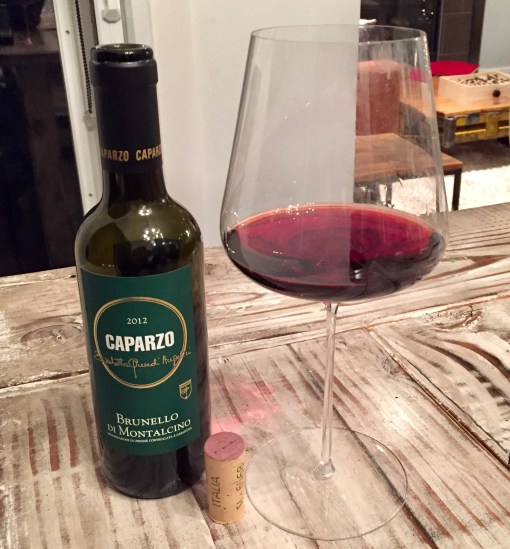
Not like I needed any more evidence that Bricks was taking this whole half-bottle Advent thing seriously after last night, but I got it the second I peeled back the wrapping paper on Day 2 and “Brunello di Montalcino” stared me back in the face.  Yowza.  More specifically, tonight’s bottle was the 2012 Caparzo Brunello di Montalcino, a traditional-style bottling from an old-school producer recently given new life.  Many know Brunello as Italian wine royalty, and likely the apex of what the Sangiovese grape can do (more specifically, Brunello was once thought to be its own grape varietal but later shown to be a particular clone of Sangiovese called Sangiovese Grosso), but its life as a classified wine region is surprisingly short — it only received formal DOC status in 1968.  Caparzo was founded at almost exactly that time, when there were only a baker’s dozen official Brunello producers in the world.  It was later sold in 1998 to Elisabetti Gnudi Angelini, who had married at age 20 into a pharmaceutical empire, was widowed young, and then took a left turn with her life into the world of Tuscan oenology, where she has become a standout.

IMG_7157

Cork Rating:  1/10 (Real Talk – This is one of the worst corks I have ever seen.  “Italia”??  Really? You’re a Brunello, for god’s sake!)

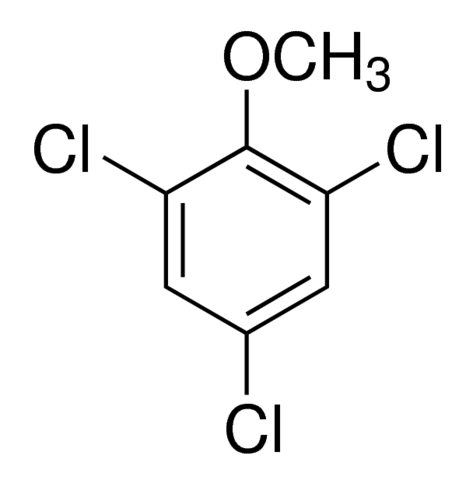
I LOVE Brunello.  I was not expecting to see a half-bottle of it, well, anywhere, let alone in Day TWO of this calendar, but I dove in with great anticipation, especially since 2012 was a highly esteemed vintage.  The wine was a gorgeous silky ruby in the glass and smelled like…mildew?  Old dirty showers?  Wet newspapers?  Oh come on.  I have been on a solid streak of luck when it comes to avoiding wine faults recently, but this bottle was horridly, outrageously corked, infected with the fungal-induced TCA compound from the cork (incidentally, they always say that smelling the cork is a plebeian’s approach to checking for taint, but this cork smelled like a dead giveaway, so maybe check your premises).  Ordinarily, throughout the entire prior history of my blogging career, my review would have been sunk — the wine was ruined.  But ordinarily I did not have TWO other people drinking the exact same wine with pens at the ready!  Raymond and Dan, called in on an emergency basis, sent me the following notes and (agreed) score for this bottle.  You guys are lifesavers.

mfcd00000588-large

Damn you 2,4,6-Trichloroanisole (TCA).  Worst molecule ever.

“Nose of dried red and blue flowers (iris, rose, potpourri), anise, white pepper, a whiff of roasted almond.  Palate is loaded with tart cherry pie, cranberry, tomato, and unripe raspberry smeared on a leather-bound book.  Some orange peel also emerges, along with oily tobacco, walnut, tar, coffee bean, and a handful of iron filings and road dust.”  [Ray]  “I get most of those descriptors as well.  I would say in general it’s not a big Brunello and seems meant for more early drinking but does have solid structure.  Definitely tart cherry and cranberry on the palate and then the leather, thyme, black tea and stone/rock dust flavours take over.  Originally I thought the finish was a bit short but as the wine opens more it lengthens — still not overly long but enough to make you contemplate why Brunello is so good.” [Dan]  I’m sad I missed the experience (mine tasted like mouldy laundry) but remarkably relieved that any readers of this post do not have to.  Fingers crossed for better luck tomorrow!

89 points


KWM Whisky Advent Calendar 2017: Day 2

2 12 2017

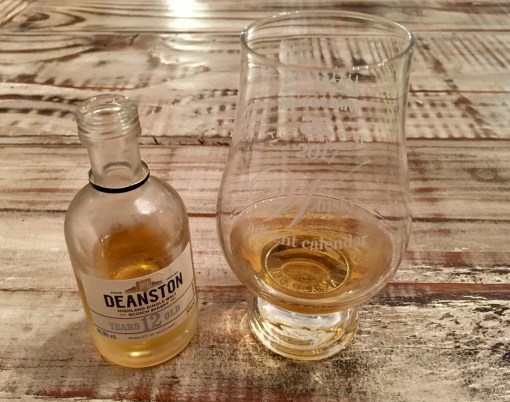
I am loving the confusion-inducing no-frame-of-reference newcomers in the 2017 KWM Calendar.  I am almost certain that this is the second offering in a row that has not even seen a sister bottling or other distant relative in any prior calendar:  the Deanston 12 Year Highland Single Malt rang exactly zero bells for me, although I did note that you could not ask for much more of a presentation contrast as compared to yesterday.  Some graphic designer actually worked on this bottle, and Deanston’s website is so slick that you instantly figure this must be another one-off distillery recently subsumed by a massive beverage giant.  And you would be right.

IMG_7110

As a distillery, Deanston is only a half-century old (and 8 of those years were spent not operating, so they may not count), but the distillery gets its history from its structure, a legendary shuttered cotton mill built in 1785.  After the mill closed in 1965, the distillery used its skeleton to start up business, releasing its very first single malt nine years later in 1974…and then ceasing production eight years after that.  The mill probably had a better track record.  In 1990, Deanston’s sold to a distilling conglomerate that is now part of the Distell Group, a South African-based giant which owns many many many alcoholic things (including the ubiquitous Obikwa and Two Oceans wine brands, among dozens more).  Not quite an old mill story anymore.

Deanston’s 12 Year offering is a beautiful deep amber colour after marinating in ex-bourbon casks.  The normal bourbon-induced sweet vanilla aromatic bounty doesn’t fully show up on the nose though, replaced by salt licks and a grainy mealiness, lightened by honey and flowers and sharpened by oolong tea.  Just like yesterday’s Cadenhead’s 12 Year, this one is gritty and biting on the tongue, almost even tannic, filled with cedar shavings and dust circling around frozen peach, burnt angel food cake, topsoil and butterscotch.  It has a similar blue-collar feel to the Cadenhead’s (or, more accurately, the Dailuaine-Glenlivet bottled by Cadenhead’s), but it’s nowhere near as evocative.  Not a disappointment for its $70 retail price tag, but not an overreacher either.


Bricks Wine Advent Calendar 2017: Day 1

1 12 2017

I am a realist when it comes to the reach and impact of this blog.  Calgary has a remarkable, informed, ambitious, impressive local wine scene, and my only goal in starting up this site years ago was to be a tiny voice in that massive chorus and find an outlet for my passion, whether anything came of it or not.  For the most part, I am simply an observer, experiencer and occasional reporter on the goings-on of Calgary wine life.  However, in this case, it’s at least possible that I was the catalyst for a great idea that Bricks Wine Company has now expertly executed.  About 12 and a half months ago, after seeing another set of annual Advent releases go by absent a particular format that I thought would be perfect for the occasion, I vented into the black void of Twitter…and was shocked to see somebody almost immediately respond and take up the task:

It’s one thing to send a two-word response on social media, and quite another to spend the time and effort to specially source two dozen half bottles of wine to assemble an Advent calendar for the NEXT year, so I didn’t allow my hopes to leap too high at the time, but now here we are, on December 1st, 2017, and I’m looking at a wooden crate filled with 24 beautifully wrapped and meticulously selected 375 mL splits, my Advent dream realized and in the flesh.  I am filled with awe and gratitude, and I haven’t even opened anything yet.  Way to go, Bricks — you really did it.

IMG_7027

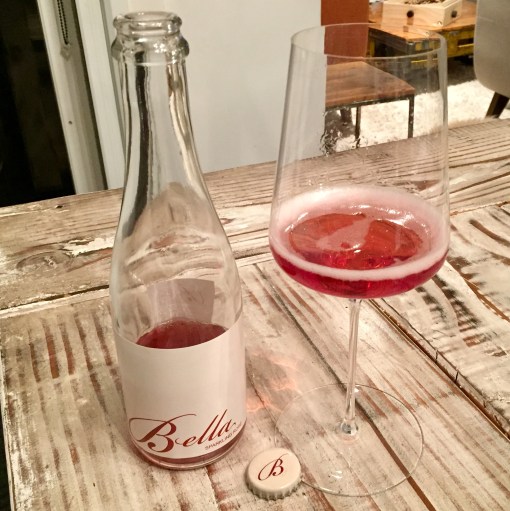
And if I was excited BEFORE peeling back the wrapping on Day #1, my anticipation only intensified after seeing what was on tap for Calgary’s inaugural Half-Bottle Wine Advent Calendar:  wine geek paradise.  Bella Wines is a producer about whom I have heard a ton over the past year, without yet having had the chance to try their wines for myself.  Bella is British Columbia’s only winery that is exclusively devoted to the production of sparkling wine — all bubbles, all the time.  And their approach is brutally uncompromising:  all natural farming, traditional method Champagne-style fermentation (where the secondary fermentation creating the fizz takes place in each individual bottle in which the wine is ultimately sold), all single-vineyard single-varietal expressions, wild yeast fermentation, no additives, no dosage; nowhere to hide, no messing around.  Bella makes multiple different bottlings of both pink and white bubbles, with their pigmented production focused entirely on the Gamay grape, which they believe has unheralded potential in the sparkling world.

IMG_7153

Crown Cap Rating:  8/10 (Stylized and retro, great font, CROWN CAP – I’m all in.)

So if you’re keeping track at home, Day 1 of Wine Advent features an Okanagan traditional-method single-vintage sparkling Gamay natural wine:  the 2016 Bella Sparkling Rosé Brut Natural “Westbank”.  Hot damn.  Bella releases annual sparkling Gamays from vineyards both west and east of Lake Okanagan, and the Westbank hails from the Beaumont Estate Vineyard in West Kelowna, on the slopes of Mount Boucherie. It is a beautifully confident deep watermelon colour in the glass (yay, non-deathly pale rosé!) and makes an emphatically lean, tart and frothy impression, launching aromatic bullets of cranberry, sour cherry and pomegranate fruit laced with grape skins and handfuls of gravel.  The flavours are pure and unforgiving, the lack of any added sugar after secondary fermentation clearly evident, the wine sharp as a razor’s edge on the finish thanks to Ginsu acidity and circular saw bubbles.  This Gamay practically vibrates with energy and electricity from the moment it hits the tongue, and that coiled tension doesn’t ever release:  not when the bubbles burst, not when you hold it in your mouth, not when you swallow.  It’s like watching a thriller movie that never ends.  If this is Day 1, we are in for a SERIOUSLY impressive Advent.  I did not know Okanagan bubbles could be like this.

90+ points

IMG_7151