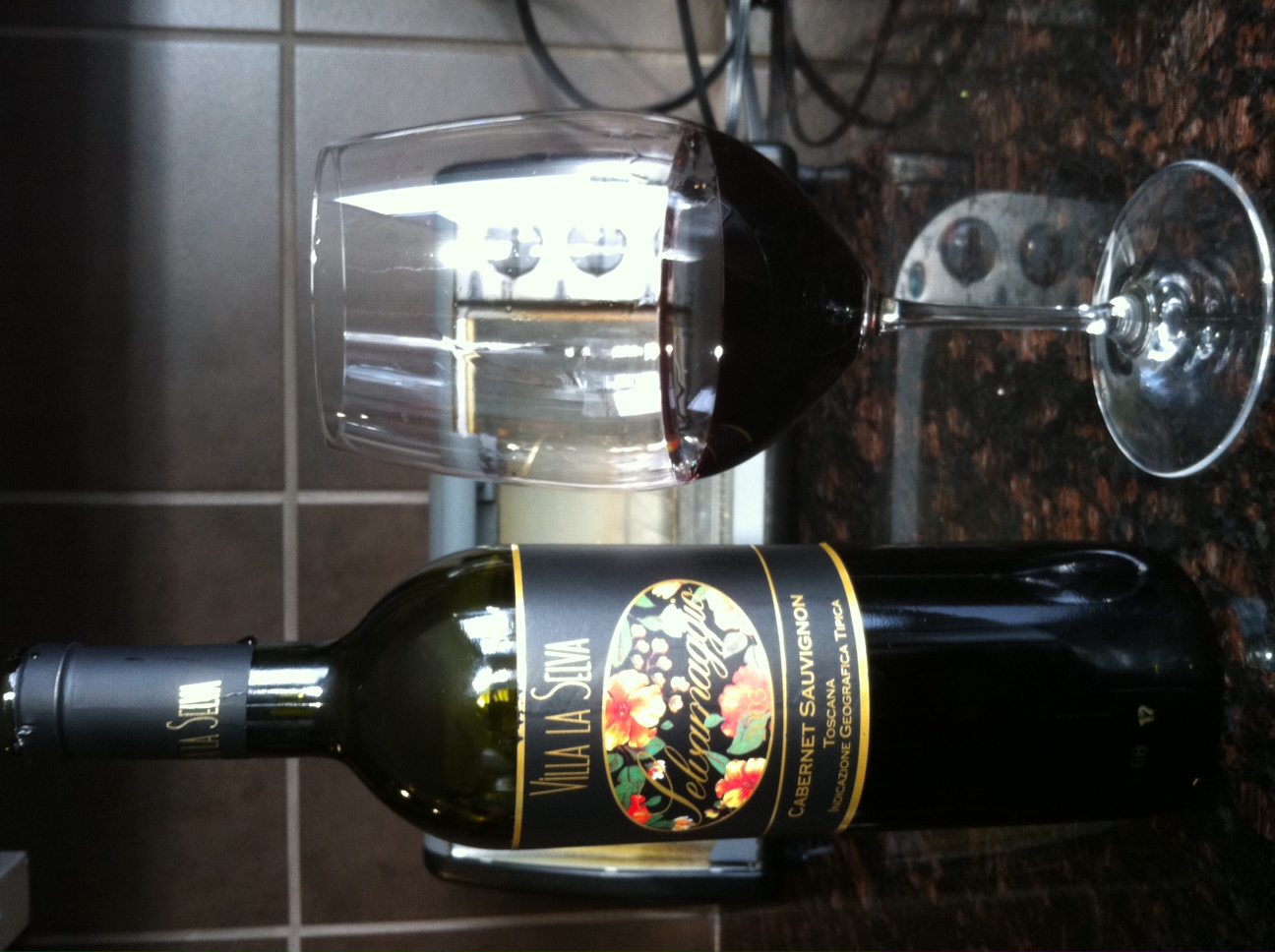
Wine Review: 2003 Villa La Selva Selvamaggio IGT

19 04 2011

Is that old woman or couch on the label?

In order to show Italy that I wasn’t mad at it for my corked Dolcetto last night, I stuck with the red, white and green again tonight, though I moved south to Tuscany, in the centre-west of the country (the upper shin of the boot).  The 2003 Selvamaggio, which I got from the good folks at Highlander Wine & Spirits (thanks Tim & Elliot!), is a Super Tuscan wine, a designation which I described in some detail in this post.   It is 100% Cabernet Sauvignon, which is a non-Italian varietal and thus automatically disqualifies the wine from obtaining the highest official status in the region, though that is by no means an indictment on the Selvamaggio’s underlying quality.  Since the word “Selva” appears in both the producer’s name and the wine’s name, I feel compelled to tell you that “Selva” means “woods” in Italian and refers to the forest growing around the vineyard area.  Now you know.

I shouldn’t ignore the obvious:  this might be the ugliest wine label of all time.  It either looks like an old woman’s sun dress or part of somebody’s sofa (my wife called it “snowbird wine”); either way, some marketing lessons are urgently required in Tuscany. Read the rest of this entry »


Wine Review: 2008 Enzo B–…Er, How to Tell Your Wine is Corked

18 04 2011

This was totally not Enzo's fault.

I had what I’m sure would have been a great wine to share with you tonight:  the 2008 Enzo Boglietti Dolcetto d’Alba from the Piedmont wine region in northwest Italy.  Boglietti is a renowned producer, and Dolcetto (literally, “little sweet one” in Italian) is a grape varietal that probably gets less attention than it should, one that routinely churns out fruity, rustic, soft, food-friendly, value-driven comfort wines.  I had the kind of day that cried out for that kind of armchair-by-the-fireplace wine, and when I poured the first glass, the juicy, vibrant purple colour of the Dolcetto instantly reaffirmed my selection.  I swirled the glass, took a few deep sniffs, and smelled…

Garbage?

It was flat out bad.  Rotting meat, sulphur, a mildewy, musty odour like a full can of garbage that’s been sitting in your garage for a week.  Rest assured, the wine was not supposed to smell like that; it had definitely gone off somehow.  In the interests of science and blog journalism, I had a taste (though it took some internal convincing to drink something that smelled that horrible) and found much less compost-esque flavours but no life at all in the wine.  It was flat, thin and bitter, with faded fruit and significant levels of acid.  For an ultra-fruity varetial like Dolcetto from a vintage as recent as 2008, the wine doesn’t taste like that unless something went wrong.  So what did? Read the rest of this entry »


Wine Review: 2006 RedHeads Studio Esule

16 04 2011

Awesome label, domineering wine.

Here we have a wine with a great back story, a fun concept and a kick-ass label, but which is made in a style that just makes me cringe.  It’s from the McLaren Vale, one of the premium wine regions in Australia located immediately south of Adelaide in the dead centre of the country’s southern coast, and it takes the super-ripe, ultra-concentrated Aussie style to crazy, irrational extremes.  It is probably a well-made wine for its style, but I will take a rather harsh stand and say that there shouldn’t BE any wines of this style.

But let’s rewind to the good stuff first.  RedHeads Studio is a garage wine collective located in south-central Australia.  “Garage wine” is a term used to describe high-quality, small-production artisan wines generally made by winemakers who don’t own vineyard land themselves but who buy grapes from growers and make custom wines in small crushing/fermenting facilities.  Some of the first such facilities in Bordeaux, France were actually in garages, which is what coined the term.  RedHeads is home to a number of such custom winemakers, who are often responsible for creating modern, edgy wines. Read the rest of this entry »


The Basics: How To Taste Wine

15 04 2011

Everybody knows how to taste wine on some level, and most people kicking back with a glass after work or with dinner are probably perfectly happy relaxing with their vino without contaminating the experience with any kind of analytical process.  Totally fair and understandable.  But if you’re interested in taking the next step with your appreciation of wine, it really starts with being able to pick out individual components of a wine, knowing the main characteristics of a particular grape or region, and being able to tell different wines apart.  To do any of this, tasting your wine isn’t enough; you need to TASTE your wine.  Here’s a simplified way how to do it. Read the rest of this entry »


Wine Review: 2007 Tawse Wismer Vineyard Cabernet Franc

14 04 2011

Tonight’s wine review is (very mildly) historic:  the first Canadian wine featured in this Canadian wine blog.  I have probably picked a good inaugural selection, since the Tawse Winery in Ontario’s Niagara region won the  2010 Canadian Winery of the Year Award from Wine Access Magazine.  I picked up this particular wine from Highlander in Marda Loop after being advised that it would “blow my mind”…them’s drinking words!

O Canada!

Despite living in Canada my entire life, I don’t drink a lot of Canadian wine, particularly Canadian red wine, so I approached this one with some degree of trepidation.  But I was excited to open any bottle of Cabernet Franc, which is an underused and underappreciated grape, especially in marginal wine climates like Canada.  Some interesting facts about Cab Franc:  (1) it is believed to be the genetic parent of the much-more-renowned-and-ubiquitous Cabernet Sauvignon (with the white grape Sauvignon Blanc strangely the other parent, as strange a love match as that seems); and (2) it ripens earlier and grows better in cooler areas than Cabernet Sauvignon, which makes Cab Franc an intelligent choice for Canadian winemakers faced with a short growing season (did I mention it snowed in Calgary yesterday?), colder temperatures and a latitude right at the tip of where grapevines can actually grow (they don’t grow much above 50 degrees Latitude, and the northern tip of the Great Lakes in Ontario is at 49 degrees).  Cabernet Franc is commonly found to have some greener herbaceous or vegetal flavours mixed in with its fruit, anything from grass or leaves to olives, asparagus or green peppers, which notes set its flavour profile apart from the riper, lusher Cab Sauvignon.

…But not so much in this case:  this was a plush, silky take on the varietal that almost came across like its warmer-weather cousin. Read the rest of this entry »


Tips & Tricks: How To Preserve Opened Wine

12 04 2011

I am the only wine drinker in my household.  My wife is tragically allergic to wine, and my infant son is, well, an infant, so I’m on my own in terms of wine consumption.  Since I’m not falling down drunk at the end of every night, this inevitably means that I deal with a lot of half-full opened wine bottles which I have to try and preserve somehow…after all, there’s no point spending $30 on a bottle of wine to drink half of it when it’s showing well and the other half when it’s stale and faded.  Here are a few things to think about to make your wine last a little longer once you pop and pour. Read the rest of this entry »


Wine Review: 2006 Brundlmayer Langenloiser Berg-Vogelsang Gruner Veltliner

11 04 2011

GruVee name, groovy wine.

Time for a departure here on PnP:  a white wine that isn’t a Riesling.  Don’t adjust your set, because we haven’t gone that far afield from Germany, Riesling’s ancestral home; we’ve just moved slightly southeast into Austria to look at a prime example of that country’s national grape, Gruner Veltliner.  If you’ve never heard of this varietal before, take note:  not only does it have the coolest grape name in the entire world (“Gruner Veltliner” sounds like a luxury airline) with the best nickname (GruVee — no, I didn’t make that up), but it also has a wild and wacky flavour profile that will leave you (and tonight left me) scrambling for adjectives trying to define it.  It makes tremendously interesting and unique wine that isn’t as delicate as some whites and that drinks well alone or with food, and it’s my suggestion if you’re looking to colour a little out of the lines of the Cabernet/Chardonnay book.  Since Austria isn’t as well-established a wine region as France, Italy, Spain, etc., you can find some great, complex Gruners at excellent prices, like this one, a single-vineyard GV from arguably the best producer of the grape in the country, which I got at Highlander in Marda Loop for under $30. Read the rest of this entry »


Wine Review: 2006 Domaine Les Pallieres Gigondas

10 04 2011

All the CNDP quality, half the price.

There hasn’t been a lot of French wine so far on PnP, not because I’m not a fan, but because I haven’t had a lot of it lately.  But tonight that all changes with authority, as this Gigondas put on quite a show at Sunday night dinner.  Gigondas is a wine region that’s a good bet for killer value wines:  it’s located in the Southern Rhone in the southeast corner of France, very near the much more famous Chateauneuf-de-Pape, and it makes wines that closely resemble those of its more exclusive neighbour.  It has a very similar climate (warm and Mediterranean) as CNDP and uses very similar grapes in its wines (in its reds, predominantly Grenache  with Syrah, Mourvedre and Cinsault the main others in the blend) as CNDP, but since it’s not called “Chateauneuf-de-Pape”, its wines (many of which rival CNDP in quality) are much, much cheaper.  Once you stop paying for the region name on the label, more of your buying dollar goes to pay for the quality of the wine itself.  Case in point:  this Gigondas was only slightly more expensive than this horrible train wreck of a CDNP, but was about a zillion times better made. Read the rest of this entry »


The Basics: When To Decant?

8 04 2011

Good news, casual wine drinkers:  in almost all cases, you will have to remember nothing about this post.  When drinking 95% of the wine currently on the market, decanting will be completely irrelevant, unless you simply enjoy doing it as part of the formal ritual of drinking wine (yeah, I don’t either).  But for that other 5% of wines, it does serve some useful functions. Read the rest of this entry »


Wine Review: 2005 Woodward Canyon Merlot

7 04 2011

Ever watched a movie where only the first half hour was good?

I’ve been trying to drink a little more Merlot.  It’s one of the best known and most classic grape varietals in the world, and it’s responsible for some of the most famous, memorable and expensive wines out there, but compared to Cabernet Sauvignon and Syrah I drink relatively little of it, especially in unblended form.  When I found out that my new wine region man-crush, Washington State, was well known for its high-quality Merlots, I decided to dive in, and I scooped this 2005 Columbia Valley Merlot from an iconic Washington producer, Woodward Canyon.  It was on the pricier end of the wines I usually buy ($30-$40), but being from a pioneer of red wine in this area, I figured it was worth a shot. Read the rest of this entry »


1,000!!

6 04 2011

I don’t know why, but it seems like every time PnP hits a site views milestone, I have a baby sleep crisis at home.  It happened at 500 hits, and it happened again tonight as Pop & Pour clocked over 1,000 hits in the 3 weeks since the site was brought online.  I will teach my son to celebrate these successes the RIGHT way at some point, but for now I just want to thank you all again for reading and supporting the blog — I really appreciate it!  There will be a new wine review or other article up tomorrow (I promise I won’t slack two days in a row), but for tonight I just have to accept that plans are made to be changed…ready for another sleepless night at hit #2,000!


Wine Review: 2010 Kung Fu Girl Riesling

5 04 2011

Don't judge a book by its annoying gimmicky cover.

Since I went higher-end last time and reviewed a wine that was likely too expensive, too uncommon and too mediocre for anyone reading this to ever try it, I thought tonight I would go with a wine that you can find EVERYWHERE and that comes in at under $20 CDN:  the Kung Fu Girl Riesling by Charles Smith Wines in Washington State.  You’ve probably seen the black and white labels of Charles Smith’s line of value wines, which also include the Velvet Devil Merlot and Boom Boom Syrah, in almost every liquor store you’ve been in over the past few years; I got this one at Superstore Liquorstore for $17.  Smith is an icon on the Washington wine scene, partly due to his bizarre background (he was a rock band manager before becoming a winery owner, and still has the hair to prove it), partly because he’s a natural born marketer, and partly because he’s becoming increasingly adept at combining solid quality with value price in a bottle of wine.  He has a few Serious Wine labels like his K Vintners production line, which focuses on pricy and top-quality Syrah from some of the best vineyards in the State, but his main focus seems to be on his more budget-conscious lines.  This Riesling is actually a single-vineyard bottling (quite surprising at this price — usually cheap wines are blends from multiple vineyards), from the Evergreen Vineyard due west of Spokane in eastern Washington. Read the rest of this entry »


The Basics: Do Wine Glasses Matter?

4 04 2011

The short answer:  yes.  The slightly less short answer:  wine glasses do matter, but as long as yours meet a few simple criteria, they will serve your purposes just fine.  It is very easy to get carried away with the finer points of matching a wine to a particular glass — if you don’t believe me, check out this site from the world’s top wine glass maker, Riedel, which showcases multiple unique glasses designed specifically for particular varietals (i.e. Gewurztraminer), regions (i.e. Paulliac, in Bordeaux, France), ripeness levels (i.e. Beerenauslese, a German designation), quality levels (i.e. Beaujolais Cru, higher-end Beaujolais from Burgundy, France) and even non-table-wines (i.e. Cognac, Port).  While this hyper-specific wine/glass matching might pay dividends for a select few wine experts, it is horrendously impractical for the rest of us and likely won’t result in any clearer appreciation of the underlying wine.  However, for anyone enjoying a drink of wine, your glass will help rather than hinder your drinking pleasure if it fits within these guidelines: Read the rest of this entry »


Wine Review: Habla No. 4 (2006)

3 04 2011

The future in a bottle.

I promised to open something worthwhile tonight, so here goes.  I got this bottle of Habla No. 4 for Christmas in 2009 (thanks Josh!) and have been patiently waiting to open it on a special occasion — well, 72 hours without a PnP wine review sounds like occasion enough to me!  Habla’s wines are exclusively carried in Calgary by Kensington Wine Market, and this one retails for around $75 CDN…WAY out of my usual price range, but that’s what Christmas is for, right?  All of Habla’s wines, including the No. 4, come from vineyards located near the town of Trujillo in the Extremadura province of Spain, which is located west and slightly south of Madrid.  If you’re wondering what formal Spanish wine region this falls into, well, it doesn’t:  this area is basically off the grid as far as winemaking goes. Read the rest of this entry »


What’s The Best Way To Learn About Wine?

2 04 2011

So you like wine.  A lot.  You’ve gone from grabbing a bottle at the liquor store every now and then to having a small collection at home so that there’s always something available to open if the need (or desire) arises.  You’ve gone to a few wine tastings at local shops, bought and leafed through a couple wine magazines, tried to talk to sommeliers at restaurants, but there’s a knowledge gap that none of these things can properly fill.  You want to LEARN, build a base of understanding about wine that will give you a greater appreciation of every bottle you open.  How best to go about it? Read the rest of this entry »