Calgary Wine Life: Bin 905 Chateau de Beaucastel Tasting @ Divino, Part II

7 05 2012

[Cross-posted at www.calgaryisawesome.com]
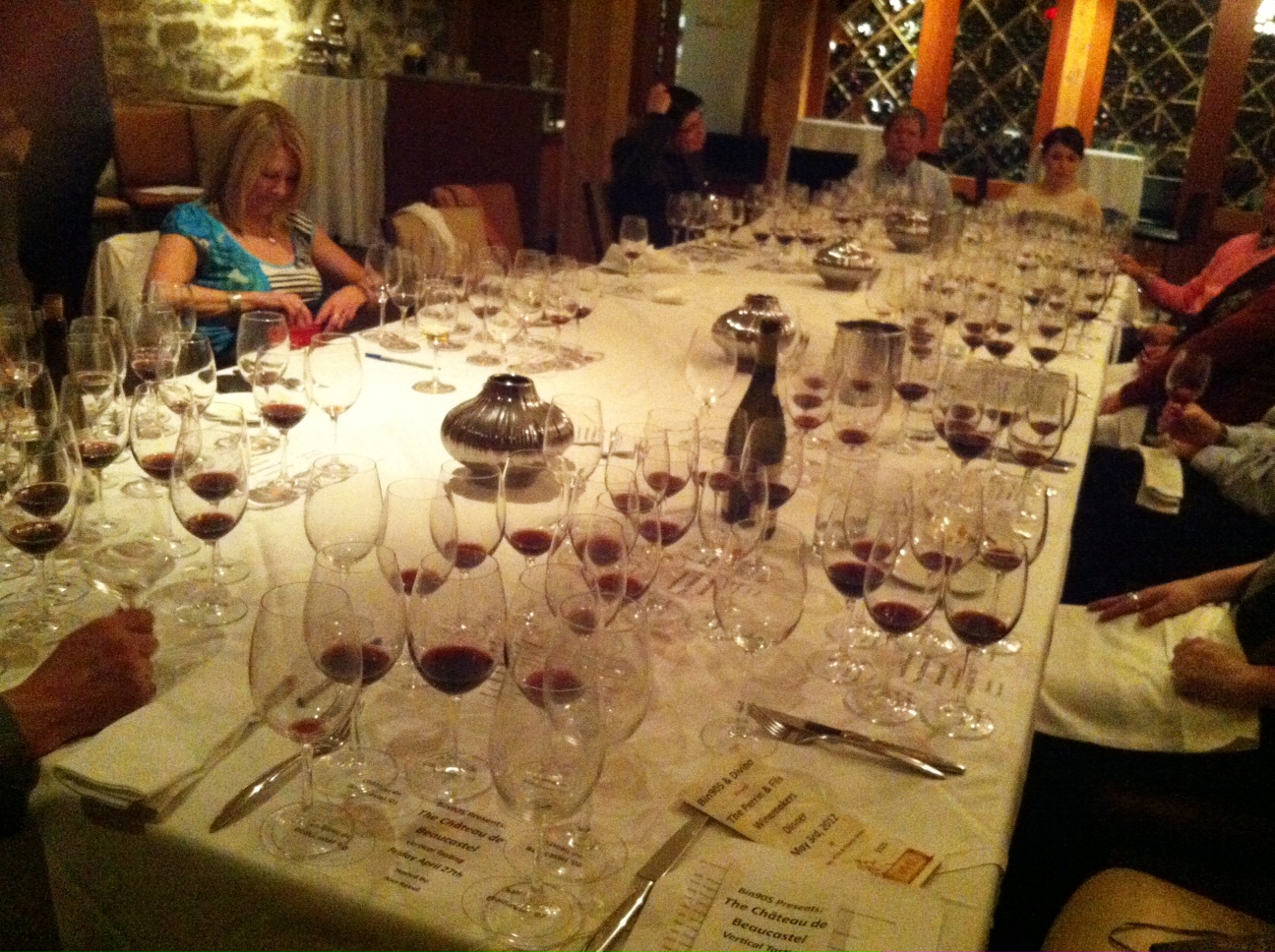
In full swing — there were probably 150 glasses on the table.

For Part I of this mammoth tasting write-up, click here.

After the first half-dozen wines of Bin 905’s Chateau de Beaucastel vertical tasting, spanning six vastly different bottles from 1989 to 1999, we took a 15 minute break to chew on some cheese and cleanse our palates.  After the first 1700 words of my tasting review covering those six bottles, I took a 7 day break to get mentally prepared to delve into another topsy-turvy whirlwind of a decade of Beaucastels.  The second half of the tasting covered six wines from the 2000s and included one of my least favourite wines of the tasting…but also my wine of the night.  First up, tasked with trying to make me forget about the likely-corked 1999, was the Chateau de Beaucastel Chateauneuf-de-Pape from 2000. Read the rest of this entry »


Calgary Wine Life: Bin 905 Chateau de Beaucastel Tasting @ Divino, Part I

30 04 2012

[Cross-posted at www.calgaryisawesome.com]

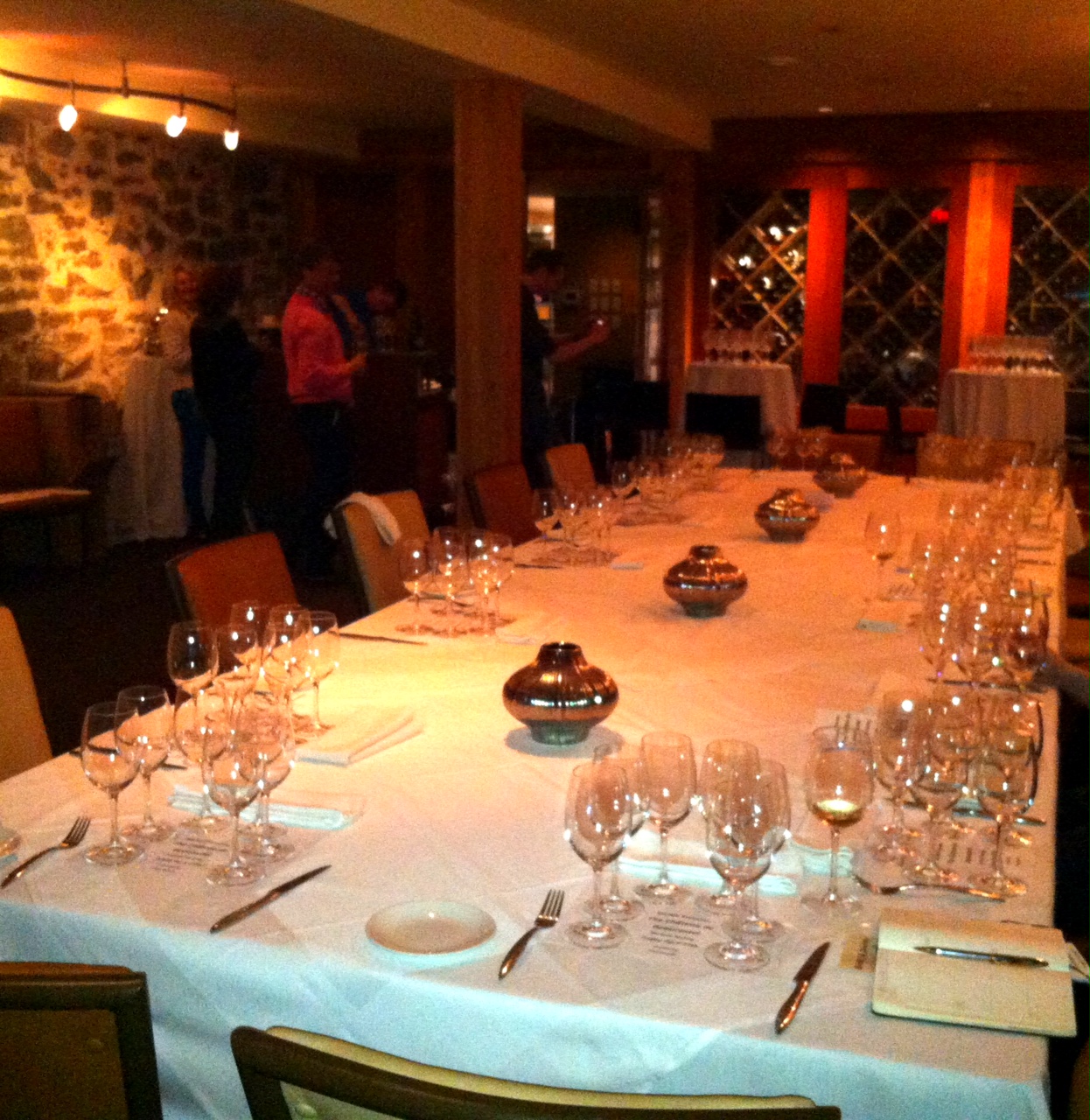
Divino's Stone Cellar, a.k.a. Tasting Central.

I had fully intended that this monthly post would showcase a different player in the Calgary wine scene every month, highlighting the incredible depth of industry talent we have at our disposal locally.  And yet here I am, in CIA post #4, writing about another tasting put on by Bin 905, hosts of the Jim Barry Armagh tasting I covered back in February.  I know we have a remarkable array of wine stores out there, and I know many of them are doing great things with their event schedules, but I can’t say that I feel bad about the Bin 905 duplication because the tasting I went to on Saturday was just that cool.  Held at Divino restaurant’s Stone Cellar, it was a 12-bottle vertical tasting of one of the best and most historic producers of the famed Chateauneuf-de-Pape region in France’s Southern Rhone Valley, Chateau de Beaucastel.  A vertical tasting provides a unique opportunity to track the progress of a wine as it ages and lets you see the impact that a given year has on the style and flavour of a bottle, since you taste the same producer’s wine over a number of vintages; in this case, we tried Beaucastels from the mid-90s through the late-oos (whatever you call that decade), as well as one particularly special bottle from the tremendous vintage of 1989.  The initial tasting program featured far fewer bottles, but Bin 905 had the ingenious idea of offering people a free seat at the tasting if they brought a bottle of Beaucastel from a year that wasn’t yet in the lineup.  Thanks to a number of philanthropic volunteers, we all got treated to the most complete vertical tasting I’ve ever been a part of…which isn’t saying much, since I’ve only been a part of two, but it was still impressive.

Chateau de Beaucastel is a legendary producer in Chateauneuf-de-Pape:  along with a handful of others, it represents the creme de la creme of the region’s growers and winemakers.  CNDP stands out as a wine region because it permits 13 different grape varieties (combined red and white) to be included in its wines, a number that is dramatically higher than most other European wine-growing areas.  Beaucastel in turn stands out as a producer because, in almost all of its bottlings of red CNDP, it incorporates all 13 varietals into the mix, even the whites.  Like most other wineries from Chateauneuf-de-Pape, Beaucastel’s blends rely mostly on the big three red Southern Rhone grapes — Grenache, Syrah and Mourvedre — but Beaucastel again takes a particularly individual approach to its winemaking by incorporating much more Mourvedre (usually around 30%) and much less Syrah (usually around 10%) in its blends as compared to most of its brethren.  The result is a deeper, thicker, more complex wine that ages very well and that spawns a host of secondary flavours after a few years in the bottle.  I had only ever had Chateau de Beaucastel from a recently-released vintage, and it was so knotted and closed upon opening that I couldn’t understand what the fuss was about until about 2 hours later, when I came back to the wine to find an absolute labyrinth of tastes and smells just starting to stretch their legs.  At the time I thought:  how great would it be to try one of these after it has had a proper chance to age?  It turns out I went one better, sitting down to this amazing event that brought a dozen bottles of Beaucastel from 5 to 23 years old into my grasp. Read the rest of this entry »


Calgary Wine Life: Jim Barry “The Armagh” Tasting @ Bin 905

27 02 2012

[Cross-posted at www.calgaryisawesome.com]

In all its glory.

Nothing improves a good bottle of wine more than a good accompanying back-story, and I ended up at the Jim Barry Armagh tasting at Bin 905 in Mission on Friday night due to one of the best wine tales in my recent memory.  The Armagh Shiraz, one of Australia’s rarest, priciest and highest quality bottles, was named after the hamlet of Armagh adjoining the Clare Valley wine region in South Australia, a small village that was initially established by Irish settlers and named after the county of Armagh in Ireland…which in turn is where my friend Fiona was born.  Upon walking into Bin 905 and seeing a sign advertising an “Armagh” wine tasting, Fiona immediately grabbed a ticket for it and also ordered a bottle, not knowing that it cost around $250 and not caring when she found out.  Not one to turn down a chance to drink ludicrously expensive wine for a less-than-ludicrous price, and not being likely ever to come across a wine named after my homeland (the Jim Barry “Edmonton”?), I jumped at the chance to come along to the event. Read the rest of this entry »


WSET Advanced Complete!

14 11 2011

This logo and I have had a good 2011 together.

So how many different wines did you drink over the last three weekends?  I had about 100.  From White Zinfandel to Barolo, Tokaji to Pinotage, Sherry to Port — if it was from a recognizable world wine region, I probably tasted it over 50ish classroom hours in WSET Advanced class.  The wines we tasted in the course retailed for anywhere from $10 to $100, came from 15 different countries and ran the gamut of styles, preparations and flavours.  To top it off, the WSET threw in some spirits for good measure:  in the span of an afternoon this past Saturday, I had Cognac, Armagnac, Calvados (apple-based spirit), Irish Whiskey, Single Malt Scotch, Bourbon, Dark Rum and Tequila (it would have been like a Vegas weekend were it not for the spit cups).

Read the rest of this entry »


Coming Tomorrow: Tasting In Stereo!

29 08 2011

It’s been one of those gruelling, soul-crushing Mondays, and yet I remain upbeat and excited about the week.  There are two reasons for this:  (1) I’m going on vacation in three days, and (2) tomorrow I get the honour of being co-host to a pan-Canadian wine tasting adventure of the kind that only the Internet makes possible.  If you’ve ever read a PnP wine review and immediately wished you had an expert second opinion (and don’t lie — I’m sure there are those times), tomorrow your voice of sober second thought will come in the form of Tyler Philp, an Ontario-based wine blogger and tasting group leader who owns and operates North of 9 Fine Wine just beyond the clutches of Toronto.  Tyler has written on a number of vinous topics and has a clear passion for the world of wine, so he’s an ideal counterpart for this tasting experiment.

My Tasting In Stereo counterpart -- check him out at northof9finewine.blogspot.com.

Tomorrow night Tyler and I will each crack the same bottle, taste it independently, and then simultaneously post our notes, thoughts and impressions on our respective sites at a set time.  You’ll find out at the same time as us whether we felt the same way about the wine or whether we’ll need to have a few words offscreen about it…  🙂  You get two perspectives for the price of one (or, I guess, for the price of a million, since it’s all free), and I get a chance to compare tasting notes with a writer whose thoughts and palate I respect quite a bit.  We’ve picked a bottle that’s easy to find and under $20, so if one or both of us like it, you’ll be able to track it down.  Tasting In Stereo debuts tomorrow — see you then!


Calgary Wine Life: Bin 905 German Riesling Extravaganza

20 08 2011

Despite declaring on the header of this site that Pop & Pour is an “Independent Calgary Wine Blog”, I’ve been guilty of not really focusing many of my posts on the wine scene in Calgary.  I want this blog to be of general interest and not overly localized, but at the same time one of my initial goals in starting up PnP was to draw attention to hometown events and shops and help fellow Calgarians make the most of the wine-related opportunities offered in the city.  Today gave me a perfect opportunity to advance this latter goal:  this afternoon, Bin 905 (located on 4th St. and 23rd Ave SW) held a German Riesling Extravaganza (their title, not mine, although I fully endorse it), where anyone could drop in and sample 5 different German Rieslings from top producers, ranging fully dry to fully sweet, valued at $30 to $50 a bottle, at no charge.  Sorry, did you say free German Riesling tasting?  I’m there!  And so I was. Read the rest of this entry »


Tips & Tricks: How To Come Up With Wine Flavour Descriptions

15 08 2011

If only it were that easy...

Believe me, I used to be at the front of the line making fun of wine folk for picking guava, pomegranate, shoe leather, pencil shavings and innumerable other bizarre tastes and aromas out of a glass of boozy grape juice.  The whole process seemed overwrought and fanciful at best and horribly pretentious at worst — not the kind of thing I’d ever sign off on.  But as I started getting more and more into wine, and then as I started WRITING about being into wine, I began to see the method to the madness (or I drank the Kool-Aid and joined the legions of uptight overanalyzers, depending on your point of view) and understanding the necessity behind the efforts people put into sorting out what’s in their glass.  By far the coolest and most interesting thing about wine is that, unlike almost any other alcoholic beverage that starts out from a piece of fruit, it ends up smelling and tasting like so many other things apart from, or in addition to, its source material.  Apple cider tastes like apples; dark rum tastes like molasses; wine tastes like everything, and the more different wine you try, the more words and comparison references you need to describe it.  This, I’ve learned, is doubly important if you ever want to put this description in writing and give a reader who may have never heard of your wine a flavour impression that sets it apart…suddenly descriptions like “plum” and “cranberry”, and its weirder, more memorable cousins like “Band-Aids” and “pickles”, become totally invaluable. Read the rest of this entry »


Tips & Tricks: Wine’s Building Blocks and How To Detect Them

22 04 2011

For those loyal PnP readers (if such a thing exists), some of this will cover ground trekked out before in previous posts, but I thought it would be useful to get all of this info in one place.  Describing the smells and flavours of wine is inevitably a subjective experience, since we all process aromas and tastes differently, but that doesn’t mean that every description about wine is solely in the eye of the beholder.  Every wine has a number of objectively-discernable components that form the architecture of the overall wine; even if reasonable minds can differ about a wine’s flavour profile, they should generally come to common ground when discussing these vinicultural building blocks.  Here are the key components of a wine and how to pick them out of your glass: Read the rest of this entry »