Wine Review: 2009 Gramercy Cellars Syrah

16 01 2012

If you’ve read this blog for any length of time, you’d think this would be a no-brainer for me.  I pump the tires of Washington wine so hard that you’d think I was born in Tacoma.  (I wasn’t.)  In particular, I love what Washington State does to my favourite red grape of all:  Syrah.  Add in a top notch critically-acclaimed producer and it’s a recipe for a killer review, right?  At the end of the day, that’s definitely where it ended up, but it took a little while for it to get there.

Still just a baby, but clearly on the road to BIG things. Cellar if you can resist.

But let’s back up.  This is another bottle from the wine lineup of Washington’s Gramercy Cellars brought into the province by Highlander Wine & Spirits, cousin to the Third Man GSM blend that I glowingly reviewed back in mid-December.  In case you don’t feel like clicking on the link, here’s the Gramercy story in a nutshell:  young NYC Master Sommelier phenom with high-powered resto-job leaves it all behind to pursue his passion and grow Syrah in Walla Walla.  Gramercy makes other wines too (I still have a Cab and a Tempranillo downstairs waiting to be opened, and the Third Man is mainly Grenache), but Syrah is their heart and their focus.  Did I mention that tonight’s bottle is a Syrah?  And did I mention that Syrah’s my favourite?

Read the rest of this entry »


Wine Review: 2008 Kenneth Volk Enz Vineyard Mourvedre

11 01 2012

The bottle looks exactly like it tastes: black label, black wine.

How many old-vine, single-vineyard, 100% Mourvedre wines have you ever heard of coming out of North America?  Before last month, my number stood at zero.  Then my best friend Marc, a burgeoning wine lover himself (I’m working on it), got me this bottle for Christmas; it was one that he had tried at a party and couldn’t get out of his head, leading him to hunt it down and grab one for each of us.  It was about the most intriguing Christmas gift that I got this year — obviously I do good work in picking friends.

While most California winemakers would shy away from grapes like Mourvedre in favour of Cabernet Sauvignon and Merlot and other varietals more recognizable to the general public (and therefore more sellable), Kenneth Volk seems to immerse himself in them.  While his company Kenneth Volk Vineyards also makes the classics, it produces a special series of “Heirloom Varietals” wines that examines and honours “underappreciated rarities” that don’t often get their day in the sun in the US.  Mourvedre certainly qualifies — while I’ve seen it in a GSM (Grenache/Syrah/Mourvedre) or two from my home continent, I’ve never seen it get the spotlight to itself domestically until now.  This particular Mourvedre is from the Enz Vineyard located in the tiny Lime Kiln Valley AVA in central California:  it can be found just southeast of San Jose, about 1/3 of the way south from San Francisco to LA.  Interestingly (or crazily), Lime Kiln Valley finds itself immediately beside the San Andreas Fault, one of the more tectonically unstable places in the world (you want interesting soils as a winemaker?  Plant in an earthquake zone!).  Even cooler, this bottle comes from one of the oldest grapevine plantings in all of California:  almost 90 years old, the Mourvedre vines in Enz Vineyard were planted in 1922.  Think of all the wines that come out of California.  Now think that, pre-dating almost all of them, before “California wine” meant anything to anyone, there was this lone patch of Mourvedre planted in this obscure valley close to the coast.  Who would plant Mourvedre in California in 1922?  Who knows?  But that decision let me, almost a century later, crack open this mysterious and alluring bottle, because it had previously worked its magic on a great friend.  Wine rocks.

Read the rest of this entry »


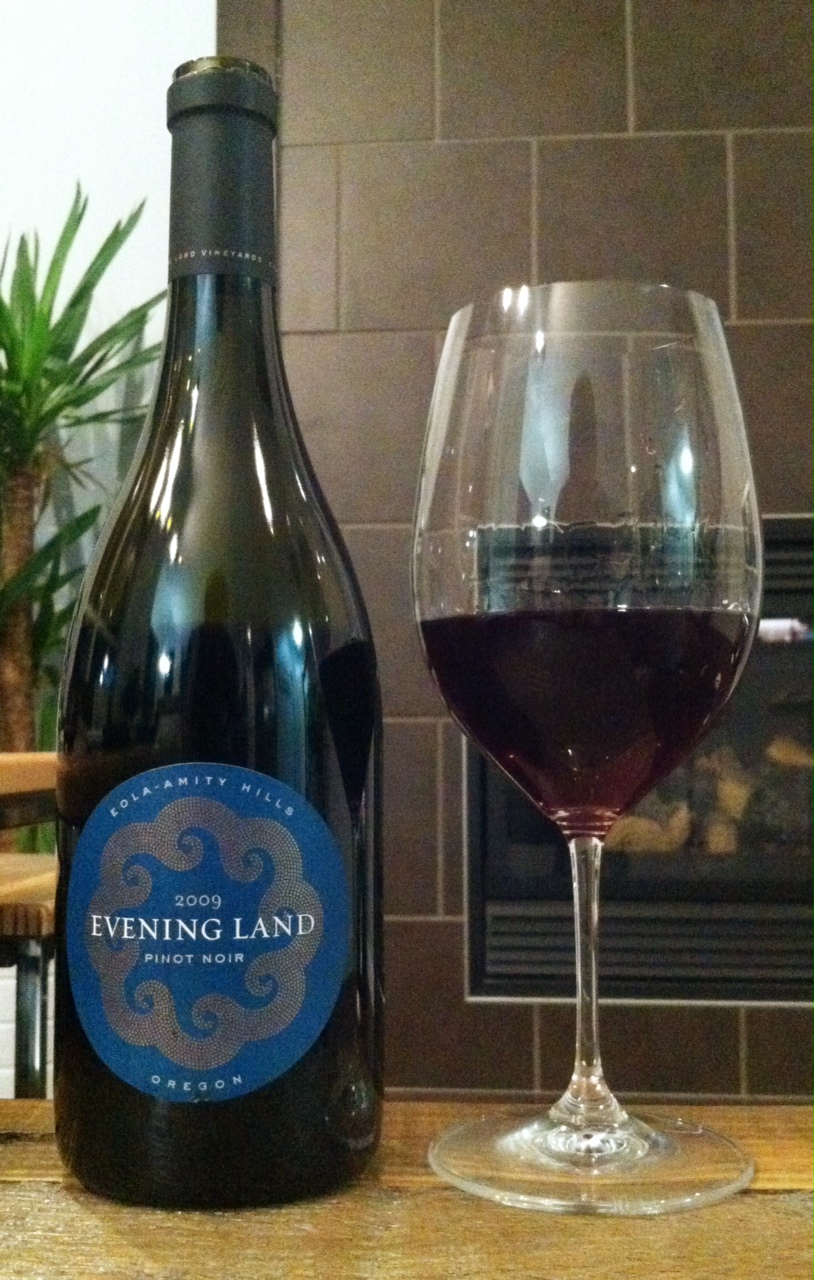
Wine Review: 2009 Evening Land “Blue Label” Pinot Noir

9 01 2012


One of my favourite labels in recent memory, and a great bottle to boot.

As I mentioned last post, although buying and drinking Burgundy is my top mission for (at least the first half of) 2012, in order to go about it the right way and actually learn something, I’m going to be deferring much of my Burgundy tasting/writing for a few weeks while I source wines and firm up a drinking plan.  Since I tasted a 2009 Bourgogne Rouge last week, I thought it would be an interesting contrast to follow it up with what is effectively its New World equivalent:  a 2009 Pinot Noir from Oregon, from the Burgundy-inspired rising stars at Evening Land Vineyards.  Even though Evening Land’s first vintage was in 2007, less than five years ago, it has quickly gained attention and critical acclaim for its lineup of true-to-the-land wines from the classic Burgundian varieties of Pinot Noir and Chardonnay.  I had known them as an Oregon producer (I tried two of their Oregon Pinots in WSET class) and was quite surprised to discover that they actually make wine in 4 different Pinot/Chard heartlands around the world:  Oregon’s Willamette Valley, California’s Sonoma Coast and Santa Rita Hills, and Burgundy itself.  While I’m sure that other wineries must do this too, I can’t think of another one off the top of my head that produces wine from different countries under the same name and label.  Colour me intrigued.

Read the rest of this entry »


Wine Review: 2009 Alex Gambal “Cuvee Les Deux Papis” Bourgogne Rouge

4 01 2012

Burgundy: It begins.

Well, I couldn’t very well write a New Year’s manifesto geared around a promise to drink more Burgundy and then not follow it up with a bottle of Burgundy, so here we are.  However, this might paradoxically be my last bottle from my 2012 classic wine region of choice for a little while.  With some (much-needed) professional help, I am currently formulating a buying and drinking plan for Burgundy that will hopefully maximize my drinking and learning experience within the budget and time window that I have, but since I need to source (and pay for) the wines before this francophilic journey gets underway, you may not hear more about it for a couple weeks.  Even so, rest assured that I have not abandoned my resolution that quickly, and take tonight’s bottle as a symbol of my new Burgundian spirit of adventure.  Or something.

One issue that I and other Burgundy neophytes have to deal with when we’re in that section of the wine shop are the bottle labels:  they’re almost all uniformly boring, and unless you’ve read a few dozen wine books, they almost all contain words that on their surface don’t appear to offer any assistance in telling you what the wine inside is all about.  The key thing to remember when trying to decipher a Burgundian label is that they are first and foremost all about the land:  exactly where the grapes come from and (possibly) how that location has been historically ranked for quality.  The sub-regions of Burgundy are set up as a series of concentric circles, with the smallest ones (top quality single vineyards given the esteemed Premier Cru [very good] or Grand Cru [best] classifications) falling within larger ones (village appellations that include all of the vineyards located by one of the towns in Burgundy like Nuits-St-Georges, Gevrey-Chambertin or Meursault) falling within the general regional appellation of Bourgogne.  Any wines simply labelled “Bourgogne” are made with grapes that can come from anywhere in Burgundy.  Think of it like a dartboard, with Grand Cru/Premier Cru in the middle, village wines the next ring out and Bourgogne the outer border.  Even though the smaller appellations are nested within the larger ones, a wine will always take the narrowest regional name possible (and its prestige and selling price will increase the smaller the sub-region is).  A wine made from grapes from the Grand Cru vineyard of La Tache near the village of Vosne-Romanee in north-central Burgundy will be labelled “La Tache Grand Cru” (and will likely also contain the phrase “Appellation La Tache Controlée” somewhere on the label, confirming that “La Tache” is the name of the appellation in question) instead of “Vosne-Romanee” or “Bourgogne”, even though the grapes are technically from both that village area and that general region.  Make sense?  I almost lost myself in that paragraph, so fingers crossed. Read the rest of this entry »


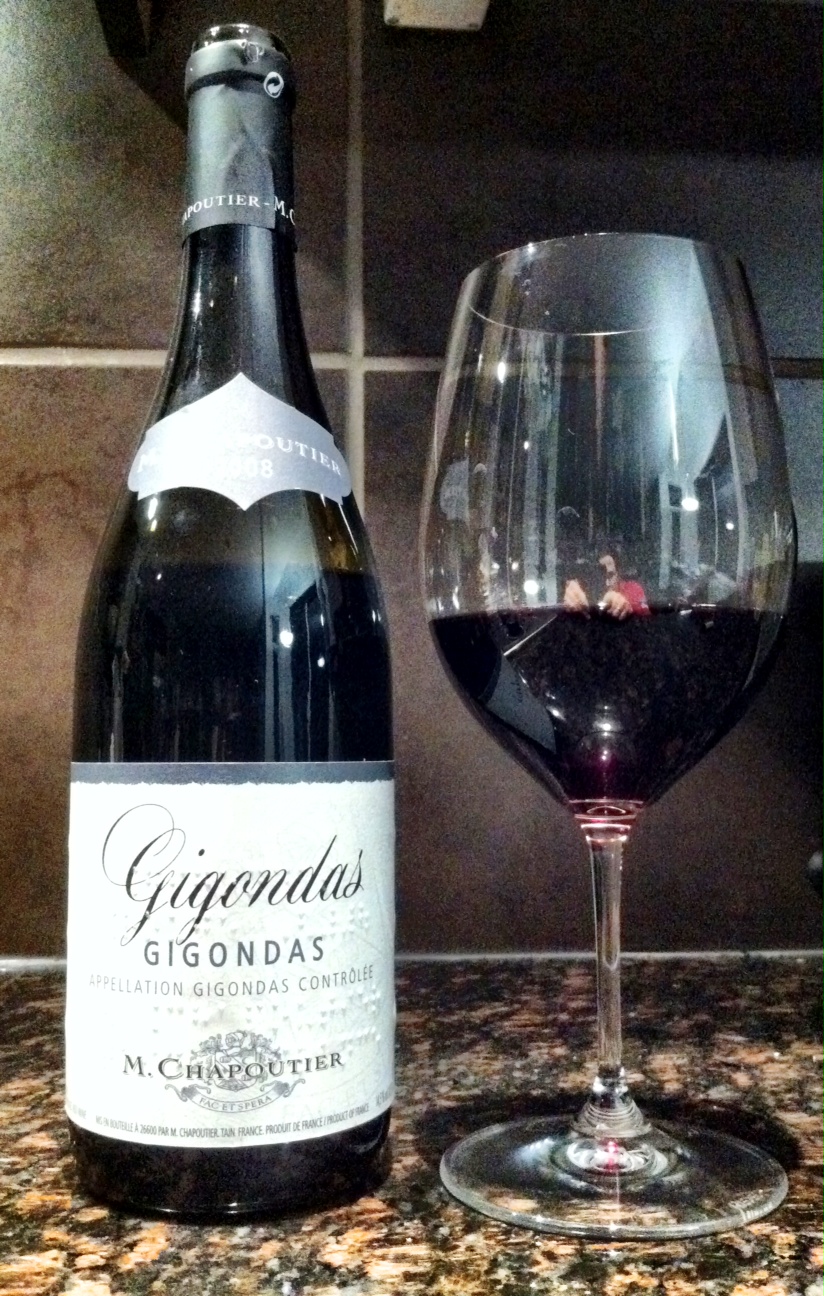
(Foiled) Wine Review: 2008 M. Chapoutier Gigondas

19 12 2011

Cool thing about this bottle: there's Braille translation on the label! Less cool: it's probably corked. Jerk.

I’m not great at detecting cork taint.  I know what the telltale aromas of a corked wine are supposed to be (damp basement, wet newspaper, mildew), but I’ve only come across a couple of bottles in my life that were indisputably corked; who knows how many other bacteria-riddled bottles I’ve downed without knowing any better.  I’ve met people, including my WSET instructor, Marnie, who could instantly detect even the slightest whiff of taint, and I wish somebody like that was over at my house for dinner tonight, because I’m about 70% sure that I opened a corked bottle.  Due to this suspicion, I won’t be giving the Chapoutier Gigondas a score or saying bad things about it, but I figured I’d post the review regardless so that if you ever find yourself in my situation you’ll know what to look for…or at least you’ll be able to self-commiserate and know you’re not alone.

Read the rest of this entry »


Wine Review: 2009 Gramercy Cellars “The Third Man” GSM

17 12 2011

I’ve wanted to try a bottle of Gramercy for over a year.  Last fall I bought Wine & Spirits Magazine’s annual Top 100 issue listing their hundred best wineries in the world for 2010, and there for the first time I read about a Washington producer called Gramercy Cellars, started by Greg Harrington, a Master Sommelier (the youngest to earn the title in the US) who quit his prestigious position as wine director for a group of NYC restaurants in order to move to Washington State and start making Syrah, despite no prior winemaking experience and no connection to the Pacific Northwest.  He was inspired by a chance tasting of Walla Walla wines that he attended, moved by their balance and sense of place to such a degree that he was motivated to drop everything and start a new life.  Gramercy Cellars was born in 2005, and within five years it was officially considered a force on the American wine scene; in addition to the top 100 honour in Wine & Spirits in 2010 (a distinction repeated in 2011) and other awards, Gramercy was named Best New Winery by Food & Wine Magazine in 2010 and promptly celebrated, uh, well, like this:

Since all you have to say to get my vinous attention is “Washington” and “Syrah” in the same sentence, I’ve been waiting and hoping to see a bottle of Gramercy around Calgary somewhere, but until very recently it simply wasn’t available.  So imagine my surprise when one of my go-to wine shops, Highlander Wine & Spirits, announced last month that they had arranged the provincial exclusive to carry Gramercy wines and were making a number of them available for immediate sale…it felt like some kind of strange karmic reward.  This particular bottle was an XMas gift from my friend Elliot (thank you!!), but needless to say I also stocked up on some of Gramercy’s varietal Syrah to enjoy at a later date.

Read the rest of this entry »