By Peter Vetsch
[These bottles were provided as samples for review purposes.]
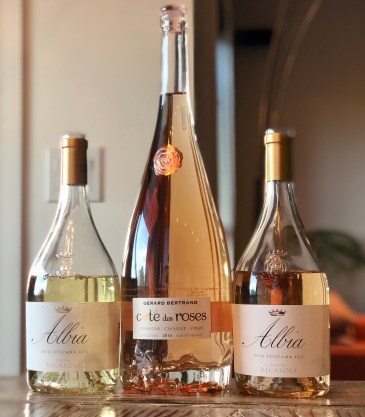 Sometimes you have to force seasonal drinking posts, and other times the season and the drinks just fall right into your lap. Stampede is here in Calgary, the thermometer has just recently clocked over 30C, and we’re well-ensconced into July, which turns my sample pile ponderings to thoughts of whatever I can chill for refreshment most effectively. After landing on an ideal trio of bottles that achieved that lofty goal, I noticed something odd that bound them together: they have all at one time or another previously graced the pages of Pop & Pour. Even though the blog is now 7½ years old and counting, that basically never happens. Sometimes summer is just meant to be. Game on.
2016 Ricasoli Albia Bianco Toscano (~$20)
I believe this is the second ever time that an identical bottle will get two separate reviews on PnP: when Ray had the pleasure of meeting Tuscan winemaker Francesco Ricasoli at a tasting luncheon back in February, this 2016 Albia Bianco was the first bottle they cracked. If you want a detailed backstory on Francesco, the Ricasoli estate and the family’s critical contributions to Chianti Classico as we now know it, click the link above for the whole enthralling narrative. While I don’t have a five-course meal to pair with tonight’s wines, I do have both this Albia Bianco and its sibling the Albia Rose on the menu, both scions of Barone Ricasoli’s “fresh and fragrant” early-drinking Albia label. Both come in gorgeous, hefty, gourd-like bottles that you first admire for making this $20 wine look like it costs double that amount, but then curse effusively once you realize the heavy-punted broad base is about a millimetre away from not fitting at all in any standard wine racking. Suffice to say the labels suffered some mild to medium collateral damage as I reamed the bottles into place with every ounce of strength I had. Read the rest of this entry »

 When Francesco, a professional photographer, finally entered the world of winemaking, Bettino Ricasoli’s beloved Castello di Brolio estate had spent some time being passed from one multinational to the next. Enter a “contractual loophole” that gave Francesco a chance to purchase his family’s legacy from Hardy’s, based in Australia. Although he was initially unsure about whether this was a good idea, some helpful advice and prodding from a friend at Castello di Fonterutoli sealed the deal. Alas, there was much work to do. Francesco wanted to restore his wines to glory. He commissioned a three-year study to clarify the agronomic potential of his property and conducted trial plantings of fifty different Sangiovese clones, eventually determining which would perform best in his vineyard soils. The latter are largely calcareous clay with additional stony components and occur at a wide range of altitudes. Francesco was careful to explain his philosophy of “precision viticulture”. Under this approach, every vineyard parcel is a distinct entity yielding a unique vinous product. Parcels are each farmed according to their individual characters. The wines are all vinified separately to preserve their distinct attributes and are then thoughtfully blended. It became clear that Francesco does not like leaving winemaking to chance. “Why make mistakes that can be avoided?”, he asked, in response to a question about whether he uses selected yeasts for fermentation. However, he is passionate about preserving grape character. This is a highly intelligent man who thinks deeply about his wines, one who has the utmost respect for nature’s raw materials but who is not shy about steering vinification exactly where he wants it to go, according to his vision.



 pop & pour