By Raymond Lamontagne
We begin week 2 of this Advent blogging saga with a bang, at least if you love Port. I will admit to being rather intimidated by this fortified wine style when I first started learning about wine. I had a vague recollection of trying Port for dessert years ago, long before any explicit attempts to develop an educated palate, and thought it tasted like NyQuil. I’m guessing this was a relatively inexpensive ruby example, one blended to match a particular house style and designed for early drinking. Since those dark times, and with the benefit of a few technical tastings under my belt (a few of those are detailed on this very blog), I’ve become an aficionado of good quality vintage Ports and tawnies. They remain a rare treat, but one much appreciated. I unwrap this bottle, see the phrase “10 Year Old Tawny Port”, and my mind is immediately jubilant with associations of toffee, nuts, and other sundry warm and festive sugarplum tastiness.

All Ports are made by fermenting grapes (usually red) for a relatively brief period, typically to the point of around 5-6% ABV, at which point a neutral grape spirit known as aguardente is used to arrest the fermentation, boosting the alcohol content but also leaving residual sugar in the wine. At this juncture the “what type of Port am I making” decision tree becomes more complicated, and here our focus must be on tawny Port. These wines are aged in old wooden barrels called pipes, during which time exposure to oxygen and evaporation occur. This oxidation mellows the wine into a golden brown hue over time, and also imparts nutty flavours that distinguish tawnies from ruby and vintage ports. Although vintage tawny Ports do exist (they are called colheitas and are sublime), entry level tawnies are blends of different vintages, with most of the component wines being aged at least 3 years and then combined to yield a desired house style. Above this quality tier are bottles like the present one that carry an indication of age. Note that the age indication is in fact a “target age” based on desired characteristics in the wine: these aged tawnies still represent a blend of several vintages, and the Port house is looking to provide a wine that tastes characteristically like it has been aging for 10 years in barrel, for instance. Sure, some of the wine in the blend is legitimately quite old, but not necessarily all. It might help to think about the designated age as an “average” age, although technically even that is not correct. The basic notion is that a 10 year old tawny should be fruitier and less complex than a 40 year old tawny.
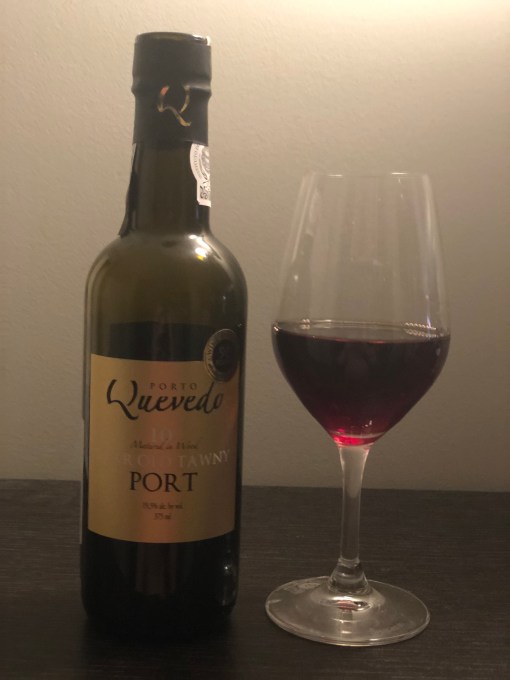
You might now understand why I found this topic daunting when first learning about it. Despair not, for if these technical details threatened to put you to sleep, a half bottle of 19.5% ABV fortified wine should be just the thing to perk you up. Perhaps more compelling is the story of Porto Quevedo, a relatively small family winery based in the Douro. Historically families such as the Quevedos grew grapes and made wine that was sold to merchants based in Vila Nova de Gaia, with such wines likely used as blending components by the larger houses. However, in 1986 legislation changed to allow growers and individual wineries to export their wines directly to the retailer. Oscar, a lawyer and notary by trade, first bought vineyards in 1977. After several years of helping his father João to make Port, in 1990 he built his own winery and was finally able to nurture his true passion, with son Oscar Jr. handling the business side of things and soccer-hating daughter Claudia (I hear ya) formerly handling the winemaking (she still helps with blending). The winery has a wonderful website and even a blog that is imbued with a real down-to-earth, non-pretentious human touch, right down to inviting critical commentary on the wines. Challenge accepted.

Stopper Rating: 1/10 (oh, COME ON!!!)
The Porto Quevedo 10 Year Old Tawny Port is comprised of Touriga Franca (25%), Tinta Roriz (aka Tempranillo; 25%), Touriga Nacional (5%), Tinto Cão (5%), Tinta Barroca (20%), and other grapes (20%; over 100 grapes are sanctioned for Port production, including many rarities). Interestingly, the fermentation is described as “slow”, perhaps relative to other Ports. This is notably brickish in colour for a 10 year old tawny. The nose initially flashes some bright and fruity character, recalling maraschino cherries, raspberry jam, dried apricot, burnt orange peel, and pumpkin pie filling, with some nuttiness (pecans, chestnuts, sesame snap) and caramel that meld into a nice facsimile of Turtles candy. The palate largely echoes this array of aromas but is not purely sweet, with a gritty underlay of graphite, red rubber utility ball, and the ashy white ghosts of charcoal briquettes. With further air over the course of about an hour (hey, it’s a Sunday night, I’m sipping over here!), the palate softens to a more silky fine texture, and further oxidized characters emerge: sultanas/raisin or molasses pie, figs, ginger snaps, and a general deepening of the smooth toffee vibe. I like how this stitches together over time, with the wine showing better if you are patient.
88+ points



 cabernetdialectic (Raymond Lamontagne)
 Dan Steeves
 Peter Vetsch
 tylerderksen
 pop & pour