Wine Review: It’s Go TIME!

17 01 2018

[These bottles were provided as samples for review purposes.]

IMG_7405

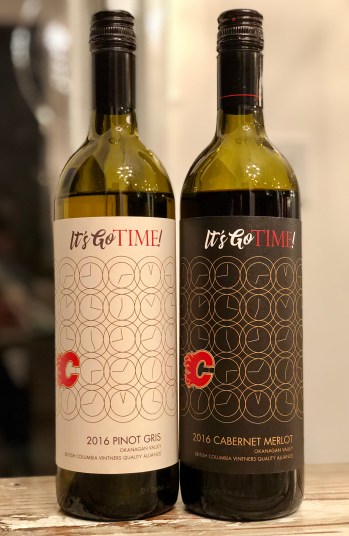
NHL-licensed wine.  Bring on the themes!

No, that title isn’t me exhorting myself into giving 110% on this wine review, playing for the crest on the front of the jersey and leaving it all out on the ice.  It is in fact the actual, somewhat-punny name of a red and white wine duo made as a commercial and charitable collaboration between the Okanagan’s TIME Winery and my local NHL squad the Calgary Flames, with some of the proceeds from bottle sales going to the team’s philanthropic Flames Foundation.  Having recently been to a WHL Hitmen game, I can confirm that the Saddledome boards themselves officially confirm TIME as the team’s official wine supplier (yes, such a designation is a thing), and the bottles are both served at the arena and sold at a wide array of retailers across town.  TIME is a brand owned by Encore Vineyards, a group led by Harry McWatters, a Canadian wine pioneer who founded Sumac Ridge winery the year I was born (1980) and who already has 50 years of local wine business experience under his belt, perhaps more than any other living person in Canada.  After selling Sumac Ridge, McWatters launched TIME in 2013, basing his winery inside an old movie theatre in Penticton and focusing on grapes from the southern Okanagan for his production.

IMG_7411

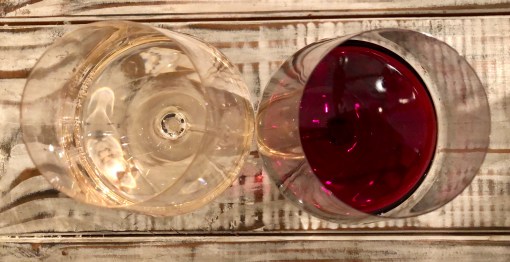
It is a long-standing tenet of this blog that I am fully on board with a good theme wine, as long as the gimmick doesn’t come at the expense of the underlying substance.  When theme bottles are done well, you win twice, augmenting the already-pleasurable experience of drinking well-made juice with the added enjoyment of the marketing cleverness surrounding it.  When they are not done well, not only are you left drinking crappy wine, you end up feeling a bit like you’ve been had while doing it.  These two bottles stake a sort of middle ground between those extremes, but when combined with their inoffensive price tag ($19.99 SRP) and their charitable underpinnings, they take no steps to dampen my theme wine enthusiasm.  Let’s get into them; it’s go t– …well, you know what time it is. Read the rest of this entry »


Wine Review: Taylor Fladgate 325th Anniversary Limited Edition Port

9 01 2018

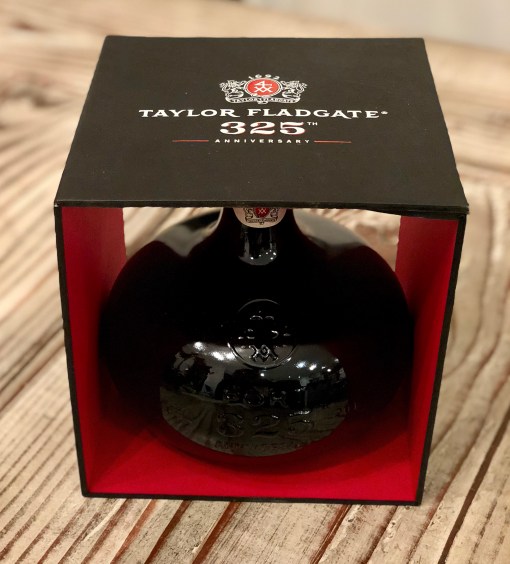
Happy New Year!  Pop & Pour returns after a lengthy and dearly needed post-Wine-and-Whisky-Advent break with a bottle that would have graced this page last year but for the 49 other calendar-based things that had to do so in December instead.  Rest assured that the delay is no commentary on what’s in the bottle.  2017 would have been a preferable year to write up Taylor Fladgate’s 325th Anniversary special-release Tawny Port, if for no other reason than that it was the actual year of the 325th anniversary in question, thanks to Taylor’s founding way back in 1692.  Thankfully, the juice is just as delicious in 2018, and there are still a number of stores in town that have stock remaining (though this Limited Edition is sold out at the import agent level, so act fast if you want some!).

IMG_7381

Happy (belated) anniversary, Taylor Fladgate!  We’re back!!

Unlike most fancy commemorative releases from leading lights in the world of wine, Taylor Fladgate has done something daring and remarkable and borderline audacious with this celebratory flask:  it has made it accessible to the drinking audience at large.  Rather than building this one-off Tawny from ultra-rarified sources and then pricing it into the stratosphere (which it could easily have done, and quite successfully), it instead opted to take the top component lots of wines otherwise destined for its 10 through 40 Year Tawny lineup, blend them to about a 15 Year average, then age them together for 18 months so that it could release this (utterly spectacular looking) bottle at a shade below $50 retail.  Taylor intended this to be celebratory and drinkable at large, a monument for the masses, a conversation piece rather than a museum piece.  If this does not instantly become the next birthday gift you want to buy for the wine lover in your life, I worry for you. Read the rest of this entry »


KWM Whisky Advent Calendar 2017: Day 25

25 12 2017

Merry Christmas!  I am NOT blogging tomorrow.

49 different reviews, covering two totally different types of drinks and written by 4 different people, have now been posted on this site in the month of December.  It has been the most Herculean effort in the history of Pop & Pour and I’m unabashedly thrilled to be at the other end of it, but as these things always are, it has also been rewarding without measure.  It’s been a new experience to blog with others and share this space with alternate viewpoints and different frames of tasting reference, but to also be able to share what goes into getting something down on paper and then up on the site has felt like a weight off my shoulders, and when those other authors contribute as consistently and impressively as Tyler Derksen has, the burden lifts even further.  Massive thanks to Tyler for a killer blogging debut.

IMG_7343

Our Christmas reward.

I usually round off the KWM Whisky Advent experience with two things:  a heartfelt kudos to Andrew Ferguson and the Kensington Wine Market team for somehow making this remain fresh and interesting year after year, and the list of my top whiskies of the calendar.  I emphasize the first even more than usual this year, because the breadth and diversity of whiskies in 2017 surpassed any previous year I’ve tasted through, lacking only (IMO) something from Japan to round out the lineup – maybe next year?  I may de-emphasize the second this time around, because my whisky podium for this calendar ended up decidedly weird.  But I’m sticking with it, because that’s what you do with traditions.  Here goes.

  • Best Value Dram:  Glengoyne 15 Year (Day 21) — An utterly delicious 15 Year Single Malt Scotch, from a distillery that once invaded Islay as a marketing ploy, for $77?  In.
  • Honourable Mention:  Gordon & MacPhail Connoisseurs Choice 2004 Caol Ila (Day 5) — Tyler gave the most props to this out of his lineup of whiskies, and Caol Ila is one of both of our favourite distilleries, somehow managing to balance Islay peat and surrounding flavour just right time and again.
  • Honourable Mention 2:  Ardbeg Corryvreckan (Day 18) — Look.  I may have been in an apocalyptic mood while drinking this whisky; it may also be that this whisky inevitably puts anyone drinking it in an apocalyptic mood.  Ardbeg is decidedly not my thing, but a week later I can objectively recognize that this was the most layered, Ardbeg-est Ardbeg I have come across.  I will never buy it.
  • 3rd Place:  Cadenhead’s Dailuaine-Glenlivet 12 Year (Day 1) — This was as rugged and rustic as a lumberjack living on the beach, but there was something gripping and honest about it that I still remember 24 days later.
  • 2nd Place:  Hyde 1938 No. 6 Black Label Special Reserve (Day 6) — The best Irish whiskey I’ve ever had?  Almost assuredly.  Hyde keeps impressing calendar after calendar, and this was the most complex and noteworthy thing I’ve had from them.
  • 1st Place:  Shelter Point Artisanal Single Malt Whisky (Day 11) — OK, I’m seriously not trying to make this a Whisky Bible/Crown Royal Northern Harvest Rye thing, and I’m not sure I would say that, if I blind-tasted all 24 calendar whiskies side-by-side, I would rate this as objectively the best one.  BUT:  without a shadow of a doubt, it incinerated my expectations far more than anything else I tasted in December, possibly in all of 2017.  Since Day 11 ended, I have gone back to KWM to buy more Shelter Point because it opened my eyes to the promise of Canadian whisky to such a degree.  And that is why it is my winner for 2017.

If you vehemently disagree with the above, just remember that I have no real qualification or standing to be evaluating whiskies.  Let me know what your top 3 was for #KWMWhiskyAdvent 2017! Read the rest of this entry »


Bricks Wine Advent Calendar 2017: Day 24

24 12 2017

Well, the children are tucked all snug in their beds — not sleeping yet, of course, as that would be asking for a miracle — so the time has come to close the curtain on a riotously fun Wine Advent experience and give some kudos to the bottles and people that made it all happen.  The first thank you obviously goes to the remarkable team at Bricks Wine Company, who eagerly took on this half-bottle Advent challenge and then went all out foraging through a not-all-that-overflowing 375 mL market to put together 24 quality bottles reflective of their identity as a shop and their value proposition to their customers.  Way to go — all of your effort clearly showed through over the course of this month.  I would also be remiss not to thank my ultra-awesome co-collaborators Dan Steeves and Ray Lamontagne for their blogging prowess and oh-so-necessary assistance that allowed PnP to forge through two parallel booze Advent calendars at the same time. I’m hoping this won’t be the last time you see their work on this page.

IMG_7333

As for the bottles that shone brightest, I asked each Wine Advent writer to give me their thoughts about their 3 favourite wines of the 2017 calendar and separately made up my own podium of winners for comparison purposes.  There was a lot of jostling in the silver and bronze spots, but the gold medallist was a runaway unanimous victor:

Ray Lamontagne’s Top 3 Wines

1.  2011 Raventos i Blanc “De La Finca” (Day 12):  Buzzsaw acidity is the lens through which all that spiced sourdough and fruit is focused.

2.  2015 Frog’s Leap Zinfandel (Day 15):  A down-home BBQ in a bramble patch.

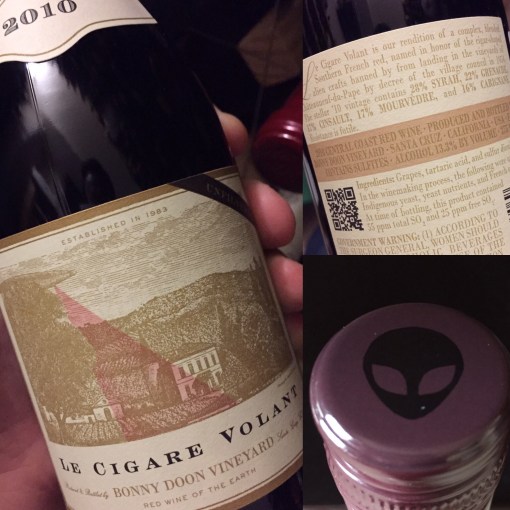
3.  2010 Bonny Doon Le Cigare Volant (Day 22):  Peppered blueberries baked into a gingersnap, this can hover by anytime.

DARK HORSE – 2014 Domaine Vacheron Sancerre Rouge (Day 20):  Oh look, another Pinot from…Sancerre??  Don’t injure yourself on all those stony outcroppings.
IMG_7334

Dan Steeves’ Top 3 Wines

1.  2011 Raventos i Blanc “De La Finca” (Day 12):  Beautiful acidity with complex layered nutty and toffee flavours with an exceptional finish.

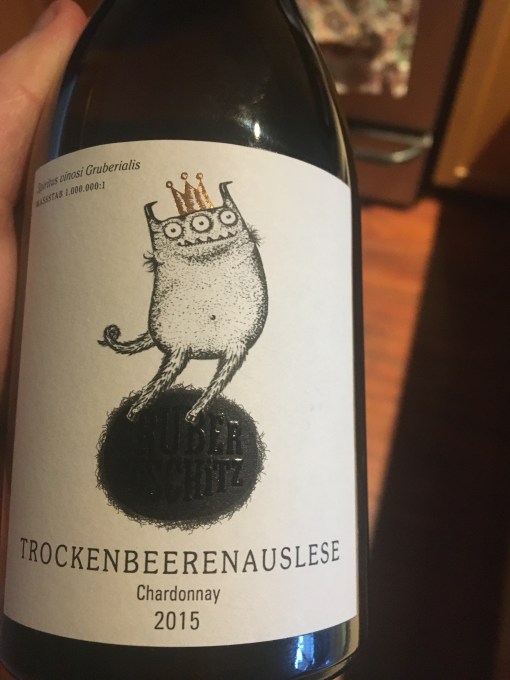
2.  2015 Gruber Roschitz Chardonnay TBA (Day 23):  Great balance for being lusciously sweet, with mouthwatering acidity and an incredibly long and lingering finish.

3.  2015 Schug Carneros Pinot Noir (Day 13):  Beautiful fruits with powerful structural elements that showcases the value that New World Pinot Noir can offer.

DARK HORSE – 2012 Caparzo Brunello di Montalcino (Day 2):  The later wines are fresher in my memory, but this was a beautiful bottle.

IMG_7335

Cork Rating:  7/10 (Score bumped by the awesome shade of blue on the metal cap.)

My Top 3 Wines

1.  2011 Raventos i Blanc “De La Finca” (Day 12):  Just a clear notch above the rest in terms of complexity, structure, power and soul.  A true emotive experience.

2.  2015 Krutzler Eisenberg Reserve Blaufränkisch (Day 14):  So effortlessly refined, luxurious yet precise, an eye-opening reason why you should all be drinking more Blaufränkisch.

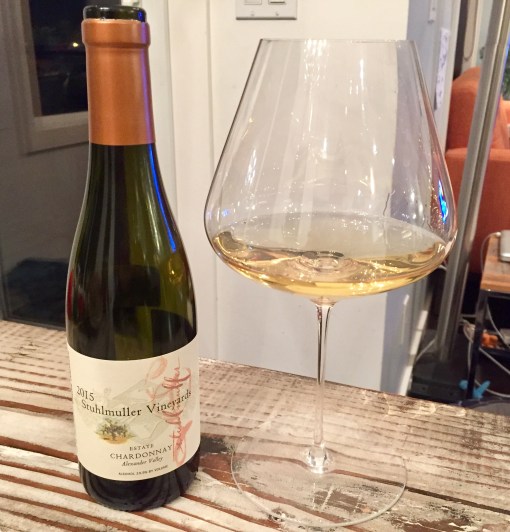
3.  2015 Stuhlmuller Vineyards Chardonnay (Day 21):  California Chardonnay is largely responsible for giving itself its own reputation for blowsy, overoaked, overripe, overblown wines, but bottles like this show why everyone made such a fuss about it in the first place.

DARK HORSE – 2016 Bella Sparkling Rose “Westbank” (Day 1):  This showed me something that I hadn’t yet seen in Canadian wine; I can still vividly picture its live-wire energy.  It was our first bottle and I remember it more than most of the others.

The fact that three generally like-minded wine lovers picked nine completely different wines to round out their podiums after all zeroing in on the same winner gives you some indication of the overall quality of the wines in this calendar.  The diversity of great bottles in this 24-day span has been phenomenal.

IMG_7339

Merry Christmas from my family to yours!!

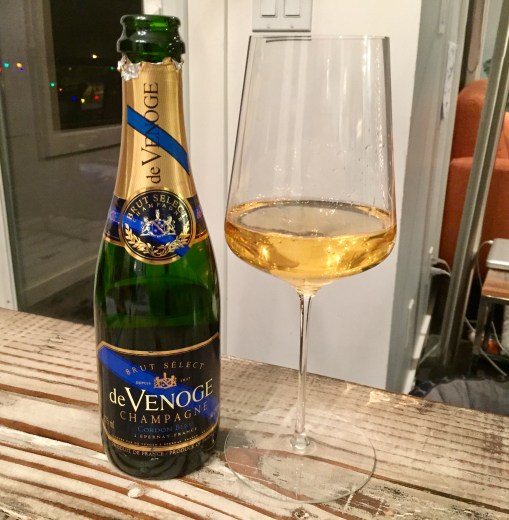
There’s not much time or space left to talk about bottle #24, which was the De Venoge Cordon Bleu Brut Select NV Champagne, an appropriately celebratory finish on the night before Christmas.  That ends up being a blessing in disguise, as my bottle was not showing I expect it should have.  It was a VERY dark gold coming out of the bottle and had almost no mousse or carbonation to speak of, smelling heavily of dulce de leche, Kraft caramels and hot sandpaper and tasting flat and roasted and bitter, like coffee left too long on the burner.  Blowtorched black jellybeans, soggy parchment and molasses rounded out a Guinness-like flavour profile.  If I had to guess, I would say this cork didn’t sufficiently hold its seal as the wine sat for some time after bottling but before sale; it’s not as ragingly faulted as my unlucky Brunello on Day 2, but since I highly doubt it’s in condition, I’m not going to score it.  I will instead set it aside and remember the other remarkable bottles that I enjoyed so much, and hope that we’ll get to do it all again next year.  Until then, thanks for following along!


KWM Whisky Advent Calendar 2017: Day 24

24 12 2017

First of all:  Merry Christmas Eve everyone!  Thanks for following along down this long and windy Whisky Advent road — it’s been a thrill to discover and discuss these incredible whiskies along with you!  Second of all:  UGGGGHHHHHH.  I had thought that I might be able to skate through the 2017 calendar without encountering my nemesis distillery, the one I admire in so many ways but can’t quite wrap my head around hedonistically, the one featured in FIVE prior hopeful but ultimately unhappy PnP whisky reviews from calendars past.  I had thought that by reaching the prestige cardboard door #24 I would be officially safe.  I was wrong.  Kilchoman is BACK.

IMG_7313

Advent cannot escape.

To be clear, this is probably very good news for most calendar drinkers, and certainly most whisky connoisseurs.  Kilchoman is a fascinating new distillery, the first that has opened its doors on Islay in over a century (during which time a great deal many of them shut down or were bulldozed), and one of the only ones that plants and farms its own grains (as noted with respect to Vancouver Island’s Shelter Point and its identical approach on Day 11).  This particular bottling of Kilchoman is also a special, exclusive one:  retailing for $200, it is a KWM-selected 25th Anniversary Single Cask, and also the first 10 Year Kilchoman for sale anywhere in Canada (not a huge surprise, since the producer is only 12 years old).  Only 212 full-size bottles — and obviously 380-odd tiny sample bottles — were made out of Kilchoman Cask 255 of 2007, matured in ex-Bourbon barrels and clocking in at 56.6% abv.  I would be more hopeful were it not for the fact that this is the third straight Advent Calendar with a Kilchoman Single Cask in it, and no prior one has turned me around (see here, here, here, here and here if you’re a masochist).

The Kilchoman 10 Year KWM Single Cask is a strange aromatic mix of the refined and the rugged, peaches and cream on top of oily peat, a delicacy in a longshoreman’s vessel.  Tar, pitch, pepper and dank undergrowth roil around, with some of Bourbon’s friendly maple and vanilla trying to peek through.  That off-putting (to me) cheesy Parmesan-rind funk that I’ve come to associate with Kilchoman is the first thing that hits on the tongue, followed by heavy briny peat, scorched apple, iodine, liniment, charcoal and grime; anise and melted plastic predominate the finish.  The complexity is all there, the flavours impressively layered, and any Kilchoman fan will likely find this their finest hour.  It still just misses me, unfortunately.  It’s not you, Kilchoman, it’s me.


Bricks Wine Advent Calendar 2017: Day 23

23 12 2017

By Raymond Lamontagne

We have reached the penultimate day of what was occasionally a rather hectic yet still always fun endeavor (for me, in any event … I did not have to write one of these suckers every single day). This is my last advent entry, at least for this year, and our loyal readers (I know there are at least three!) can probably predict the country from which this special wine hails. If it is me writing about Advent wines this year, there’s a solid 50% chance the wine is Austrian. If that were not enough, I have also ended with the same producer with which I started, Gruber Roschitz, neatly closing the circle. Its been a wild ride, if one defines wild as cracking wine books, doing many Google searches, and, you know, drinking. These are three things I do rather frequently anyways, and it was a pleasure to share it with the world. Thank you Peter and Dan. And thank you to everyone who reads our musings.

IMG_0535

Who me, peek? It was clearly the cat.

The Grubers are three siblings:  Ewald, Maria, and Christian. Ewald provides the winemaking philosophy and oenological know-how, Maria is the marketing genius, and Christian handles the important work in the vineyards. Gruber Roschitz does not shy away from modern technology, although the winemaking remains anchored in low intervention principles such as moving the liquid as little as possible, using no fining, and no fertilizer in the vineyards except compost. I’ll also admit that I love the critters on the labels. The Grubers offer several theories as to the nature of these goblins or sprites. I prefer the “little children of Bacchus ensuring joy and pleasure” account. YMMV.IMG_0536

Botrytized or noble-rotted Chardonnays are not particularly numerous, although if you go looking you will find a few from around the world. Although some argue that Chardonnay is less susceptible to noble rot than Riesling or Semillon, other sources state that this varietal’s tight clusters make it one of the most susceptible grapes. Regardless, a non-Riesling trockenbeerenauslese is rather intriguing. TBAs are explicitly made from late harvest grapes, all of which are botrytized and painstakingly picked by hand. My powers of deduction lead me to conclude that these grapes hail from the Hinterholz vineyard. Here the soil lies over bedrock and an adjacent woodland helps to regulate temperature, producing a large contrast between day and night and yielding a smooth Chardonnay. Of course, the noble rot is going to be a game changer. Read the rest of this entry »


KWM Whisky Advent Calendar 2017: Day 23

23 12 2017

By Tyler Derksen

As all good things must end, so too does my tenure as guest blogger for Pop & Pour and this year’s KWM Whisky Advent Calendar.  It has been an absolute pleasure and I hope you’ve enjoyed exploring these eight (as of today) whiskies with me.  My final whisky of this calendar, the Gordon & MacPhail’s Collection Highland Park 8 Years Old, ties back to a number of the previous seven I have written up in a number of ways.  First, as with my first write up on Day 5 (the Caol Ila) and Day 13 (the Balblair), this whisky comes to us from independent bottler Gordon & MacPhail (the Balblair was also part of the MacPhail’s Collection).  Second, including today, exactly half of the whisky that I pulled from the Whisky Advent Calendar come from a Scottish island.

Highland Park Distillery is located on one of the Orkney Islands, a collection of over seventy islands north of mainland Scotland (only twenty of which are inhabited).  The Orkneys were conquered by Vikings from Norway in the late 800s and were a staging ground for their raiding efforts in Britain, and they did not become part of Scotland officially again until 1472.  Located where the North Sea meets the Atlantic Ocean, the islands are exposed to such severe weather that no trees grow there.

The main island of the archipelago is fittingly called The Mainland and it is in the burgh of Kirkwall on The Mainland that Highland Park is located.  The distillery smokes its barley over 9000 year-old peat cut from Hobbister Moor (and has done so for over 220 years).   Their newest kiln is over 100 years old!  Highland Park embraces the islands’ Viking heritage and its founder, Magnus Eunson, was a direct Viking descendant and sounds like he could have a show on the History Network as well.  By day, Magnus was a mild-mannered butcher and church officer, but by night he was a smuggler who set up an illicit still at High Park.  The Highland Park distillery claims 1798 as its official date of foundation, but that was merely the year that Magnus was finally caught – whisky was being distilled at High Park before that.  Highland Park’s Viking heritage can also be seen in many of its bottlings, including Valkyrie, Voyage of the Raven, Thor, Freya and Loki – the latter three being part of the Valhalla Collection with phenomenal wood packaging.

IMG_4246

The Highland Park 8 Years Old is a pale straw in the glass and is bottled at a restrained 43%.  The nose smells of malt, apple, vanilla, as well as peat and brine which call back to the whisky’s island birthplace.  The palate is a wonderful combination of leather, wood, smoke, sea salt, pepper and a bit of honey.  For only 8 years of age, this whisky has a remarkable depth and I could definitely see myself drinking it on a longship on the way to sack a coastal English monastery.  Skol!

Merry Christmas everyone!


Bricks Wine Advent Calendar 2017: Day 22

22 12 2017

By Dan Steeves

It’s hard to believe that we are so close to Christmas Day, which means the end of the Advent calendar is also quickly approaching. It has been such a great experience trying so many new wines and being able to share some information and tasting thoughts on Pop & Pour. I didn’t originally think that enjoying (and reviewing) a split bottle every day for 24 days would take much effort, but I must admit it’s harder than you might think! That said, each time I’ve unwrapped a bottle to reveal the treasure contained within, I am overcome with excitement and eagerness to dive in and try it, as was the case again this evening!

Day 22… So close to the end!

Initially, I wasn’t sure what to think when I unwrapped the top of the bottle to see an alien face on the top of a screw cap. With such graphics, is this some gimmicky bottle of wine? Further unwrapping showed a 2010 vintage with an old-looking label with the title Le Cigare Volant, which, from my rusty French, I knew translated to The Flying Cigar. A quick turn of the bottle discloses that the wine is a southern Rhone blend (think Chateauneuf-du-Pape) from Santa Cruz, California, and produced by Bonny Doon Vineyard, a name I have heard of before but never tasted any of their wines. Also included on the back label was an explanation of the name of the wine which is an interesting and surprising story. In 1954, a law was passed in the Chateauneuf-du-Pape region banning unknown alien aircraft known as flying saucers (or, in France, flying cigars) in the area and stating that any such craft landing within the area will be held in custody. Yes, this is an actual law in Chateauneuf-du-Pape! Ok, everything is starting to make sense now, and it definitely has my attention.

A name incorporating UFOs and an alien screw cap is pretty awesome!

Bonny Doon Vineyard was started in 1983 by founder Randall Grahm and is known for pioneering the use of Rhone varietals in California. After purchasing land in the Santa Cruz mountains, Grahm originally sought to follow a dream for creating great Pinot Noir but quickly found Rhone varietals to be much better suited for the area, and the inaugural vintage of the now-flagship blend, Le Cigare Volant (1984), was released in 1986. The winery has embraced biodynamic farming practices and been transparent in labelling the ingredients on every bottle of wine since the mid 2000s, when the winery focused on producing more terroir driven wines. Grapes are grown, or sourced, from regions where achieving optimal ripeness is a struggle each year, allowing the grapes to produce deep flavours while maintaining their acidity. This viticultural approach, combined with non-interventionist winemaking, creates a more pure wine, giving a sense of place or terroir. Read the rest of this entry »


KWM Whisky Advent Calendar 2017: Day 22

22 12 2017

By Tyler Derksen

For those of you that have been following along at home as Peter and I have explored each of the whiskies thus far in the KWM Whisky Advent Calendar, you will note that there has been a wide variety of offerings from a number of different countries.  It is a testament to the hard work of Andrew Ferguson and Kensington Wine Market that there have been no duplicate producers…that is, until tonight.  It was with a sense of excitement and trepidation that I reached through the little cardboard door and found a familiar cylindrical container.  Glenfiddich.  Again.  Of all of the whisky that I have tried this Advent season, it was the Glenfiddich 15 that has most disappointed.  As I said back on Day 10, that is not to say that it is a bad whisky, I just think it tries too hard to appeal to too many people and sacrifices character for such mass appeal.

Just as one must seek out the opinions or views of those with whom they disagree in order to grow intellectually, so too must one be willing to try all kinds of whisky in order to grow as an uisgeophile.  I wouldn’t normally go out of my way to purchase a bottle of Glenfiddich, so I looked forward to sampling a new offering.  Today’s whisky is the Glenfiddich 18 Year Old Small Batch Reserve, which is the most aged whisky I’ve tried from the distillery.

IMG_4222

This Glenfiddich 18 was aged in Spanish Oloroso sherry casks and American oak and each batch is individually numbered (apparently only on full-sized bottles, as the 40 ml sampler doesn’t have a number).  In doing some research on how this whisky was made, Glenfiddich once again uses the word “consistency” in its marketing.  Sigh.

The colour was a golden colour in the glass with a fascinating ring around the outside that looked almost clear.  The nose was much more pronounced than the 15 Year I tried a couple of weeks ago.  The sherry cask influence comes through clearly on the nose, with dried fruit taking centre stage along with oatmeal raisin cookie, cinnamon, vanilla, sawdust and a spritz of citrus.  I needn’t have been so concerned about the looming spectre of “consistency”, as the flavour was actually quite enjoyable.  The palate was brighter than expected, with flavours of vanilla, orange, pear and baking spices.  Despite being bottled at the same 40% as the 15 Year Old Solera, this whisky has a nice slow burn to follow the bright palate, which was unexpected but appreciated.  Overall, this whisky certainly exceeded my (admittedly tempered) expectations and I’m glad of the opportunity to try it.


Bricks Wine Advent Calendar 2017: Day 21

21 12 2017

This is my second last wine post of Advent 2017:  the coming two days will see Dan and Ray post their Bricks calendar wrap-ups, and the next time you hear from me will be on Christmas Eve, for the grand half-bottle Advent finale.  It’s almost hard to believe our countdown to Christmas is almost done; it’s almost harder to believe that I actually survived it (though perhaps I shouldn’t say that yet).  And Bricks appears determined to send me off in style, because Day 21’s wrapping comes off to reveal an absolute firecracker of a Chardonnay:  the 2015 Stuhlmuller Vineyards from Sonoma’s Alexander Valley.  I think this grape is still in a down phase when it comes to much of the consumer world, but we seem to be entering a period where many of the regions previously responsible for Chard’s worst oaky boozy excesses have started to dial it in just right, at least on the quality wine side of the spectrum.  And there is no better representative of this evolution than California.

IMG_7307

Stuhlmuller Vineyards was founded by a husband and wife team who got their start in 1982 growing and supplying grapes to neighbouring wineries.  They didn’t become a full-fledged estate winery until 2000 but have already developed a reputation in the crowded California wine scene, particularly for Chardonnay, which makes up over half of its acreage.  The Alexander Valley is in the northeast corner of Sonoma, inland from the coast and due north of the better-known Russian River Ralley; its eponymous Russian River runs up and along the eastern edge of Stuhlmuller’s vineyards in Alexander’s southwest corner, where it and the Russian River Valley come together with Dry Creek Valley.  Much like Napa, the grape-growing conditions in the Alexander Valley are helped by two separate ocean-induced effects:  morning fog coursing in daily through the Chalk Hill gap, and cool nights spurred by ocean breezes, both of which provide the grapes relief from the scorching California heat, help preserve precious acidity and lead to more balanced ripening.  This bottle shows the results of all that climatic effort, clocking in at 13.9% abv.

IMG_7308

Cork Rating:  3/10 (Friendly advice – no phone numbers or websites on corks. This has both.)

This is Stuhlmuller’s “entry-level” Chardonnay, but it’s clear from the start that no shortage of care went into its creation.  It was fermented sur lie (on its spent yeast cells) over 8 months and matured in French oak, mostly small-barrel barriques but only 5% new.  It is a rich golden colour in the glass and finds that perfect harmony between Chardonnay’s careful fruit and oak’s at-times exuberant influence, mixing fresh pear, peach and Granny Smith apple pie with ginger chews, almond shortbread, oatmeal cookies and rubber boots.  Simultaneously full and cutting on the palate, the Stuhlmuller’s oak-aided roundness is run through with a table saw of slicing acidity.  It is beautifully poised on the tongue without losing the weight and body that is a defining feature of Chardonnay, a honeyed swirl of caramel apple, white flowers and a bracing quality on the finish like a cool sea breeze.  Refined and restrained but still California in essence — exactly what New World Chardonnay should be.

92 points


KWM Whisky Advent Calendar 2017: Day 21

21 12 2017

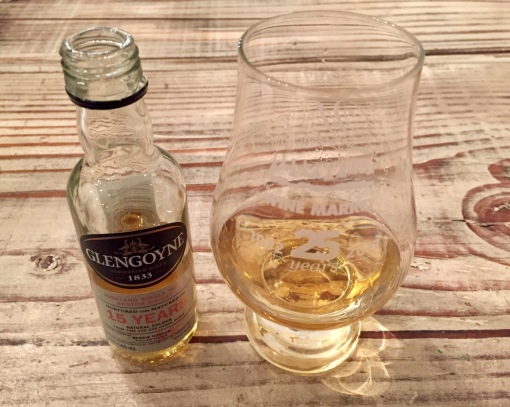
Our 21st day of whisky; our 6th Glen, giving us a Glen percentage of 28.6%.  Not too shabby.  If you’re counting at home, it’s been:  Dailuaine-Glenlivet (Day 1 – sort of a cheater Glen), Glentauchers (Day 8), Glenmorangie (Day 9), Glenfiddich (Day 10), Glenglassaugh (Day 15), and now today’s Glengoyne, a Highland distillery whose 18 Year Single Malt graced last year’s calendar on Day 12.  I wasn’t much of a fan back then, but for tonight’s 15 Year I am much more enthused.  Glengoyne got its start illegally, distilling scotch surreptitiously in the 1820s for tax avoidance purposes before deciding to go legit a decade later.  Around that time, they signed the contract of the (19th) century, lining up a 99-year lease for the pure spring water of the adjacent burn for the measly sum of £8!!  That would be £5,000 or so in today’s currency, but still – that’s a century of water.  They have obviously retained their colourful spirit (no pun intended) into modern times:  in 2004 they rented a pirate ship and landed in the harbour at the Islay Whisky Festival with a hold full of unpeated whisky, just to be contrarian.  You almost have to like them just for that.

IMG_7288

The Glengoyne 15 Year is a gorgeous shimmering amber colour and comes out firing with an aromatic barrage of burnt orange peel, clove, all-spice, carrot cake and tennis balls, immediately announcing itself as more forward and somehow more developed than its 18 Year sibling from last year.  Perhaps it’s the first-fill Bourbon barrel aging before the Glengoyne mandatory sherry cask finish on this bottle, but whatever the reason, it hits the tongue loaded with sweet comfort food flavour, a rich and warm blend of Cabane à Sucre (frozen maple), treacle, butter tarts, Terry’s Chocolate Orange and Golden Grahams.  The decade and a half in barrel left this mellow and loaded with confectionary depth, making it a joyous breeze to drink and a stellar value at $77.  Four more days!!


Bricks Wine Advent Calendar 2017: Day 20

20 12 2017

When the days hit double digits starting in 2s, I know our calendar work is almost done.  I’m not going to lie:  I’m ready not to be writing tasting notes and blogging on a daily basis, at least for a little bit.  But then I unwrap a bit of an Advent mystery and find myself sucked in all over again, pulled once more into the insatiable curiosity that goes with loving wine.  This time it came from revealing a bottle bolding displaying “Sancerre”, likely THE Old World heartland of Sauvignon Blanc and a renowned white region in France’s eastern Loire Valley…but then noticing things that seemed off.  Did it seem kind of dark inside?  Is that a maroon neck foil?  Wait – does that say Sancerre ROUGE?  (Granted, I have already had a white wine in this calendar say that it was a red wine by mistake, but this bottle actually IS one.)

IMG_7300

It turns out that red wine makes up close to 20% of Sancerre’s yearly production, all of which is required by appellation rules to be 100% Pinot Noir.  And there is perhaps no estate in Sancerre that takes its reds more seriously than Domaine Vacheron, which plants 11 hectares of Pinot alongside 34 hectares of Sauvignon Blanc and doesn’t treat it like an afterthought in the cellar.  The Domaine is now in its fourth generation of family ownership and has revamped all of its vineyard practices in the hands of the two young cousins who now direct its operations, Jean-Laurent and Jean-Dominique Vacheron.  They converted the estate to biodynamics in the early 2000s and now only fertilize the chalk and silex soils with composts made on the property, harvest by hand, ferment using only native yeasts and bottle according to the lunar cycle.  Their Pinot Noirs are partly matured in stainless steel tanks to preserve their fruit and partly in large neutral barrels for oxidative effect without oak flavours.

IMG_7301

Cork Rating:  2.5/10 (Not only is it boring as sin, it doesn’t do that great a job at its primary function of holding in liquid.)

This is my first ever bottle of Vacheron, the 2014 Sancerre Rouge, from a property that is almost at the literal centre of France.  I was a little leery from the outset as the cork came out of the bottle completely sodden and squeaky, but the wine inside seemed to bear no ill effects.  It was a fully transparent ruby in the glass and emitted a distinctive and attention-grabbing set of aromas:  beyond the more expected Pinot smells of cranberry, underripe raspberry and violets, there is a pronounced vegetal greenness (dill/pickles; Ray says nettles), a tangy citric bite (tangerine, gooseberry) and a base industrial rockiness (flint, car tire skid marks) that differs markedly from your run-of-the-mill Old World Pinot earthiness.  The palate adds salted watermelon, pomegranate, lava dust and crushed roses on a light, deft body structured mainly by prominent papery tannins.  This is a compelling mirror of its rocky soil and a suggestion that Pinot has the potential to ascend from its eternal Sancerre understudy status.

88- points


KWM Whisky Advent Calendar 2017: Day 20

20 12 2017

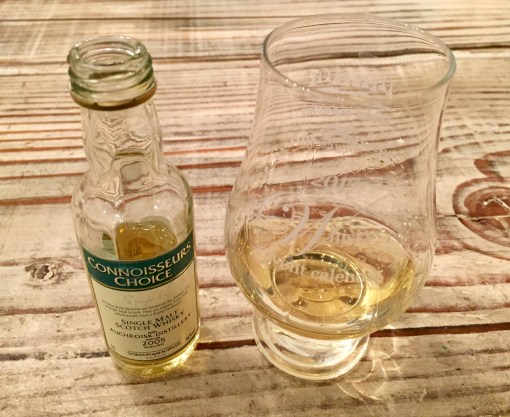
Tyler and I have repeatedly lauded the 2017 version of the KWM Whisky Advent Calendar for its diversity and novelty, for giving new whiskies and new brands who have never before graced the inside of a decorative Christmas countdown box an opportunity to shine.  Tonight’s whisky is – not an example of that.  If there is one label that is a common denominator of every Whisky Advent Calendar I’ve drank my way through, it is most definitely the Connoisseurs Choice line from massive independent bottler Gordon & MacPhail, as seen on Day 5 this year and in at least a half dozen other incarnations in calendars past.  Day 10 of 2015 featured an 18 Year malt from a G&M CC bottling of a relatively obscure distillery called Auchroisk, and tonight we get its younger brother, an 11 Year distilled in 2005 and bottled in 2016 under a highly questionable scrubs-green label colour scheme.  Auchroisk is not often seen bottled under its own name but is generally known to produce fruitier whiskies due to its use of taller, slender-necked stills, which tend to result in a lighter spirit during distillation.

IMG_7271

Totally not sold on the hospital green colour scheme for this CC label.

The 2005 bottling doesn’t appear at all on the comprehensive Gordon & MacPhail website (which shows over 150 different Connoisseurs Choice whiskies), but it appears to have been matured in American hogsheads and retails for around $100 (it’s also not on KWM’s website, making it doubly difficult to research).  It is a friendly Labrador Retriever of a scotch from the get-go, immediately presenting with easy and appealing aromas of bananas foster, cinnamon, rum raisin cake, honey and celery root/lemongrass.  Fresh, rich and floral on the palate, it melds peach and cantaloupe fruit with honeycomb and vanilla bean creaminess, not overly expansive or complex but pleasantly direct and unabashedly charming.  A worthy CC dram, though hopefully the last we’ll see of G&M until 2018.


Bricks Wine Advent Calendar 2017: Day 19

19 12 2017

By Raymond Lamontagne

There had to be a Bordeaux in here somewhere! Due to all kinds of understandable economic, availability, and supplier-based reasons, and maybe just garden-variety sanity, you knew that a 375 mL bottle of Bordeaux in an Advent Calendar was not going to be something prestigious and expensive. Indeed, the best Bordeaux has been priced right out of everyday grasp (for most of us). I have two special bottles (a 2014 Margaux and a 2012 Mouton Rothschild) that together cost about half of what I paid for one of my Magnum Cellars over/under wine coolers, and rest assured they will not be consumed anytime soon. I occasionally have nightmares where one turns out to be corked, or where I take one out to gaze longingly at the label, fantasizing about the glorious bouquet within, only to have it slip out of my clumsy grasp and go full shard all over my hardwood floor. Bordeaux bottles are robust, but still. I’d lick first and get my tongue stitched up later. I also have one 1986 second growth bottle that I purchased on sale (a Ducru-Beaucaillou) and this should be enjoyed soon. Probably now, as I write this. Logically I know it is time to drink up, but emotionally I still succumb to that treacherous wine geek logic of “But should I wait just a weeee bit longer??” … Cheaper options might be less titillating, but they are far simpler to navigate from a drinking perspective. I am a Burgundy lover who nevertheless visits the world of Bordeaux often, and although the chateau model of classification is easier to learn than Burgundy’s tortuous terroir-based system, there are still a galaxy of options to master. In this case, fear not: the Bricks team did their research (of course!). Good value Bordeaux from the lowest ranked Bordeaux Rouge AOC and Bordeaux Superieur Rouge appellations can be found, and Chateau Recougne might just be one of the best of the Bordeaux Superieur wines.IMG_0523

Bordeaux Superieur covers the same huge geographic area as Bordeaux AOC, namely the entire region. However, Superieur must hail from vineyards that are more densely planted than garden variety Bordeaux. Crowded vines are more stressed and yield fewer but better quality grapes. Superieur grapes are also riper at harvest, resulting in higher alcohol levels. Many Superieur are “Right Bank” wines from the areas north and west of St. Emilon and Pomerol. If one wishes to strike a balance between quality and price point (quality as defined within the rubric of “everyday drinking pleasure”), this strikes me as a wonderful option. It turns out I am not alone: one analysis concludes that thirteen bottles of Bordeaux Rouge or Superieur are consumed every SECOND somewhere on the planet.IMG_0525

According to legend, Henry IV visited Chateau Recougne and was extremely impressed by the quality of the wine made there. He declared the land “Terra Recognita” or “recognized land”. Today winemakers Xavier and Agnes teach their children the wine-making art, producing reds, whites, and roses. Recougne falls within Fronsac, an area highly regarded in the 18th century and now sometimes panned for producing Merlot-dominant wines that taste hard and crudely earthy in contrast to the plush offerings of St. Emilon. Fronsac has made a comeback, however, and I’ve recently had a 2004 Chateau Villars that aged marvelously and was top-heavy with notes of “sous bois” (forest floor), plum, spice, and sundry caffeinated beverages, punching well above its weight class. Recougne itself seems to be in good hands, with the family managing several parcels of old vines of 50+ years, using environmentally friendly viticultural techniques including minimal spraying, and working to reduce yields through green harvesting and careful canopy management. Read the rest of this entry »


KWM Whisky Advent Calendar 2017: Day 19

19 12 2017

By Tyler Derksen

One of the things that I love the most about whisky (other than drinking it) is that researching the many and varied distilleries always teaches me something new.  For example, did you know that Arran is an island in Scotland?  I didn’t.  I probably should have, but it was news to me.  The Isle of Arran is located in the Firth of Clyde and, eyeballing it on a map, appears to be slightly smaller than Islay, which is located due west of Arran and is separate by the Kintyre Peninsula, a skinny peninsula extending south off of mainland Scotland.  This is most pertinent news as today’s whisky comes from this very Isle:  the Arran 14 Year Old.

The Isle of Arran Distillers is a relative newcomer to the scotch scene in comparison to many other distilleries in Scotland.  Having been established in 1995, it is the only distillery located on the island.  This was not always the case, as back in the 1800s there were many smaller producers, but they could not compete in an era that valued quantity over quality.  I think that the Arran website puts it best when it says:  “Back in the 1800s there were many small stills to be found across the island.  Not all of them were legal, but all made superlative spirit.”  The Arran distillery is located at the north end of the island and opened its first cask of whisky on July 25, 1998.  Fun fact – the cask was opened that day by actor Ewan McGregor.  In fairness to Arran, The Phantom Menace wouldn’t come out until the following year so I guess it’s OK.

Ch_7_Pic_23_timeline

Taken from the Arran Distillers website to prove that I didn’t make that last part up.

While the distillery releases a large range of product (I have seen bottles aged in various types of wine, bourbon and sherry), apparently all are produced using only Scottish barley (chiefly Optic and Oxbridge) and fermented in washbacks crafted from Oregon pine (I don’t know why they chose Oregon pine over a pine that is native to Scotland, but I’d love to find out).  The water for the spirit is drawn from nearby Loch na Davie which arrives in the lake after traveling through granite and peat and which Arran Distillers claims is the purest in all of Scotland.  I haven’t seen any peer-reviewed scientific studies to back them up, so I’ll assume it’s true (although I have some lingering doubts if it travels through peat).  If any of you really love Arran, you should know that you can actually buy a cask and they will mature it for you (there are even some options as to what type of barrel you want it aged in!).

IMG_4220.JPG

Today’s offering from Arran is the Arran 14 Year Old.  It was aged in first fill Sherry and Bourbon casks and is bottled at 46%.  I would describe the colour in the glass as a pale gold; however, Arran clearly has more paint swatches available and poetically describes the colour as “sunset copper”.  The nose is fruity, with smells of orange zest, cantaloupe and apricot abounding.  Hints of toffee and honey round it out.  The palate is bright, sweet and slightly floral with tastes of apple, citrus and perhaps a bit of sea salt.  The finish is long and takes on a bit of a spice characteristic, kind of like very mellow anise.  If a glass of Ardbeg is perfect for reading in a dark cabin next to a fire (or an apocalyptic wasteland if you’re Peter), the Arran 14 Year Old would be ideal for watching a sunset on a beach after a warm clear day.  KWM has the bottle listed for $79.99 if you’re interested in trying it rather than just reading about it.