[These bottles were provided as samples for review purposes.]
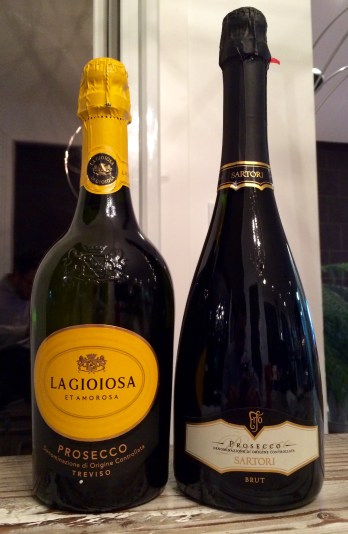
Bring on the bubbles!
Sparkling wine is instantly celebratory — unless you’re opening two bottles simultaneously, by yourself, at your kitchen table, on a weeknight, like I did. Even then, the brisk pops of the corks out of the bottles lightened my mood and made my analytical tasting exercise a little more festive. You almost can’t drink Prosecco and be in a bad mood.
Prosecco is very, very hot right now. Global sales of this Italian sparkler have increased by double digit percentages every year since 1998 (!), and last year they were up an astonishing 32% (!!) over the year before, five times the sales growth of sparkling wine overall (!!!). In 2013, global Prosecco sales actually overtook global Champagne sales at over 300 million bottles. Suffice to say it is on trend, buoyed by its general approachability, fruit-centered flavours and highly attractive price tag. And yet, before now, Prosecco had never featured on Pop & Pour:

So since this is uncharted blog territory, allow me to toss out a bit of a primer before we get into the bubbles themselves. Prosecco is made in the Veneto and Fruili regions of northeast Italy; the Prosecco DOC quality region actually spans and overlaps most of both. The wine is named after the village of Prosecco (which may have been its birthplace) near Trieste on Italy’s eastern border at the top of the boot. Its made primary from a grape that used to also be called Prosecco, but as of 2009 is now known as Glera, primarily to annoy you and make it harder for you to remember it. Just like all quality sparkling wine, it is created by first making a low-alcohol still base wine and then starting a second fermentation of that wine (by adding extra yeast and unfermented juice to it) in an airtight container, such that the carbon dioxide created as a byproduct of the fermentation cannot escape and becomes trapped in the wine, making it bubbly. Read the rest of this entry »

 cabernetdialectic (Raymond Lamontagne)
 Dan Steeves
 Peter Vetsch
 tylerderksen
 pop & pour