Burgundy: White Tasting, Part IV

26 04 2012

OK, time to bring this long and winding road of a tasting review to a close.  I had set this up so that we’d end on a high note with the most prestigious bottles in the tasting, the illustrious Grand Crus, but for reasons outside their control, the drinking experience ended up being somewhat anticlimactic.  And no, it wasn’t because we were 10 bottles in by this point.  That’s what made the next morning anticlimactic.

FOURTH FLIGHT

A.k.a. over $300 worth of wine that really shouldn't be open yet.

Grand Cru vineyards are the rarest, best-positioned, most historic, highest-quality growing areas in all of Burgundy…or at least their classification is meant to reflect as much.  As you might expect, Grand Crus come in very limited numbers (only 32 in the Cote d’Or, according to my friend the Internet) and they produce minute quantities of wine each year with prices to match their prestige and scarcity.  I didn’t have the overflowing bank account to go too crazy and delve into the elite of white Burgundian GCs — the series of adjoining Grand Crus bearing the “Montrachet” name, including Le Montrachet, Batard-Montrachet, Bienvenues-Batard-Montrachet, etc. are almost certainly the creme de la creme of white Burgundy, but they’re also a hilarious pipe dream in my current circumstances — so instead I turned my focus to two wines from the well-regarded but much cheaper Grand Cru of Corton-Charlemagne.  Unfortunately, both bottles were from relatively recent vintages, and we quickly discovered that, with great white Burgundy, time is your ally. Read the rest of this entry »



Burgundy: White Tasting, Part I

12 04 2012

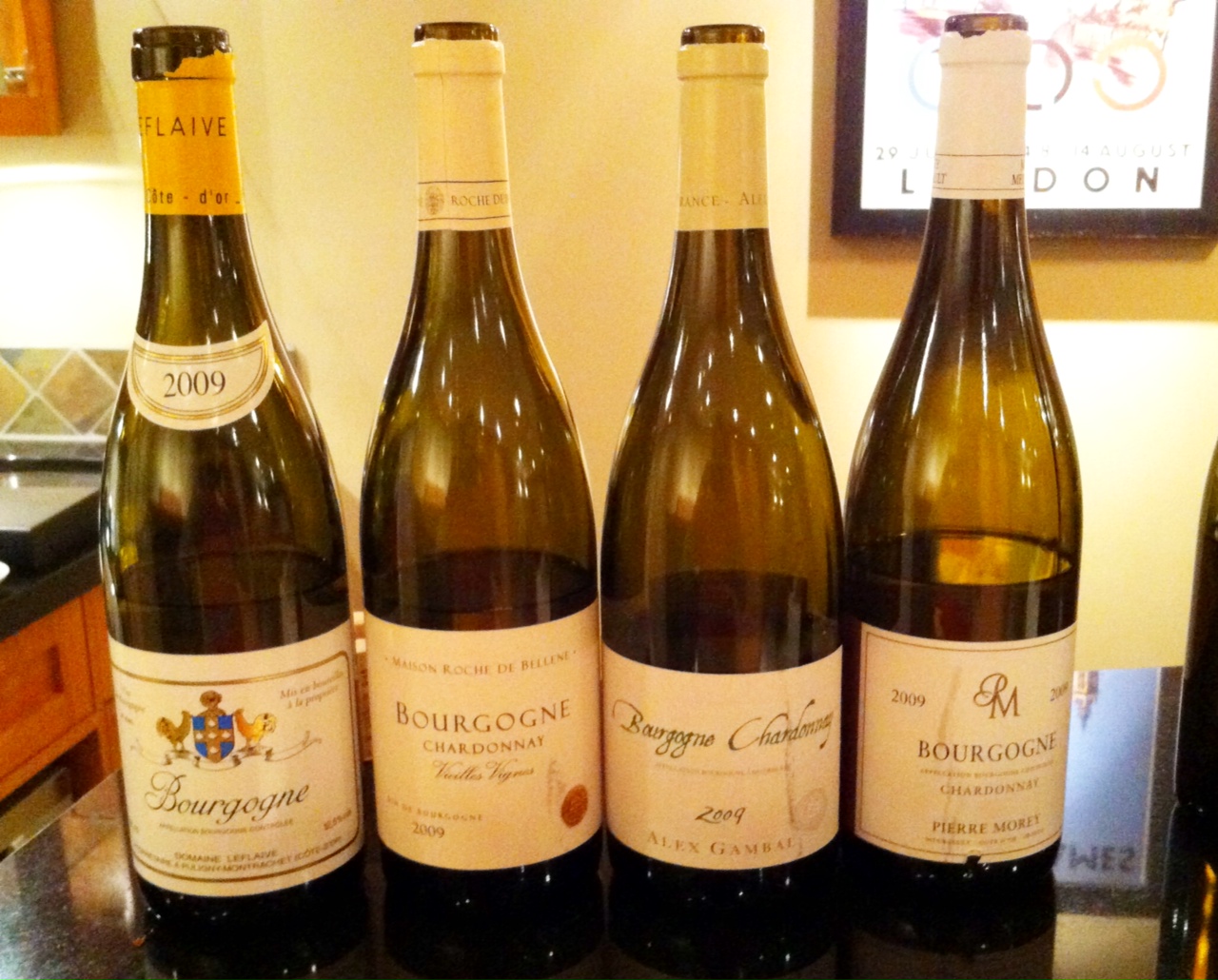
It begins: the first 4 of a dozen hopefully-representative white Burgundies.

I acknowledge that it’s definitely been awhile.  I spent my evenings last week cleaning out my basement, then took the Easter weekend off, then faced a total loss of home Internet for a few days, all of which added up to a blog-less streak of epic proportions…sorry about that.  To make it up to you, instead of posting a lonely wine review tonight, I’m diving back into action with the first instalment of a multi-part writeup showcasing the results of the long-planned white Burgundy tasting that I’ve had in the works since January and that fulfills a 2012 New Year’s Resolution of mine.  More on the planning behind the tasting and the rationale for the various wines selected here.

To summarize for those of you who don’t feel like clicking on the link above, the goal of the tasting was to open bottles from the four main Burgundy quality classifications (Bourgogne Blanc, village level, Premier Cru, Grand Cru), spanning  some of the key sub-regions for Burgundian whites (Puligny-Montrachet, Chassagne-Montrachet, Meursault, Corton-Charlemagne), to see how the wines from each of the sub-areas differed from those from others and how the wines from the same sub-areas varied from producer to producer and between quality levels.  I will vouch from experience that delving to the bottom of these analytical quandaries required a lot of drinking.  Such is life.

Cork Ratings for wines 1-3: 2.5/10, 6.5/10, 5/10. Meh.

There were 12 bottles open for the tasting and an esteemed panel of four judges with glasses at the ready; we tried the wines in four flights grouped by quality classification, going in ascending order from the base Bourgogne Blancs to the Grand Crus.  My actual tasting notes from the first flight are below, and the write-ups of the other three flights will be coming soon to an Internet near you.  At the end of the day, while the tasting didn’t instantly reveal the inner mysteries of Burgundy to me, it was a useful (and highly entertaining) crash course on a region that I haven’t spent nearly enough time getting to know. Read the rest of this entry »


Wine Review: 2009 Alex Gambal “Cuvee Les Deux Papis” Bourgogne Rouge

4 01 2012

Burgundy: It begins.

Well, I couldn’t very well write a New Year’s manifesto geared around a promise to drink more Burgundy and then not follow it up with a bottle of Burgundy, so here we are.  However, this might paradoxically be my last bottle from my 2012 classic wine region of choice for a little while.  With some (much-needed) professional help, I am currently formulating a buying and drinking plan for Burgundy that will hopefully maximize my drinking and learning experience within the budget and time window that I have, but since I need to source (and pay for) the wines before this francophilic journey gets underway, you may not hear more about it for a couple weeks.  Even so, rest assured that I have not abandoned my resolution that quickly, and take tonight’s bottle as a symbol of my new Burgundian spirit of adventure.  Or something.

One issue that I and other Burgundy neophytes have to deal with when we’re in that section of the wine shop are the bottle labels:  they’re almost all uniformly boring, and unless you’ve read a few dozen wine books, they almost all contain words that on their surface don’t appear to offer any assistance in telling you what the wine inside is all about.  The key thing to remember when trying to decipher a Burgundian label is that they are first and foremost all about the land:  exactly where the grapes come from and (possibly) how that location has been historically ranked for quality.  The sub-regions of Burgundy are set up as a series of concentric circles, with the smallest ones (top quality single vineyards given the esteemed Premier Cru [very good] or Grand Cru [best] classifications) falling within larger ones (village appellations that include all of the vineyards located by one of the towns in Burgundy like Nuits-St-Georges, Gevrey-Chambertin or Meursault) falling within the general regional appellation of Bourgogne.  Any wines simply labelled “Bourgogne” are made with grapes that can come from anywhere in Burgundy.  Think of it like a dartboard, with Grand Cru/Premier Cru in the middle, village wines the next ring out and Bourgogne the outer border.  Even though the smaller appellations are nested within the larger ones, a wine will always take the narrowest regional name possible (and its prestige and selling price will increase the smaller the sub-region is).  A wine made from grapes from the Grand Cru vineyard of La Tache near the village of Vosne-Romanee in north-central Burgundy will be labelled “La Tache Grand Cru” (and will likely also contain the phrase “Appellation La Tache Controlée” somewhere on the label, confirming that “La Tache” is the name of the appellation in question) instead of “Vosne-Romanee” or “Bourgogne”, even though the grapes are technically from both that village area and that general region.  Make sense?  I almost lost myself in that paragraph, so fingers crossed. Read the rest of this entry »