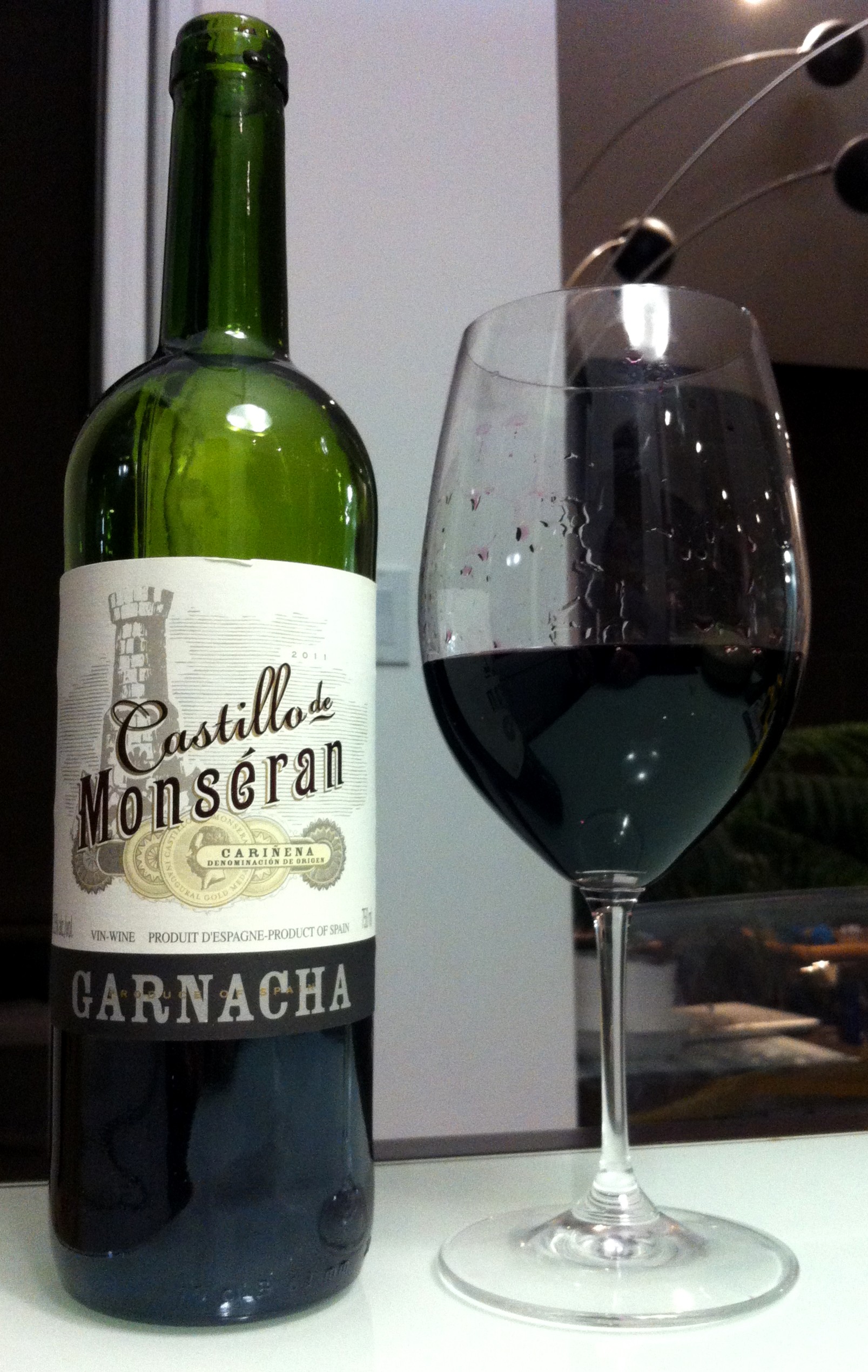
Wine Review: 2011 Castillo de Monseran Garnacha

17 10 2012

Did I mention that this was $7? $7!

I am reasonably sure that this is the cheapest bottle of wine I’ve ever purchased.  I drank some horribly inexpensive swill back when I was a student, but even then I almost always paid double digits for a bottle (it didn’t help that I went to school in BC, one of the more price-inflationary places to buy wine in the country).  This bottle was $7.  Seven dollars!  I got it on sale from Highlander Wine & Spirits, but even at regular price this barely straddles $10.  Needless to say, paying three times less for this Garnacha than I usually pay for an average bottle of wine made me almost morbidly curious about what was inside, which made this review almost a necessity.  Even better, this is not going to be a tale of woe — believe me when I say that the next time I see this wine on for a $5 and a toonie, I’ll be buying a LOT more of it.

This Garnacha comes from the value wine capital of the Old World (Spain) and from a somewhat lesser-known region, Carinena, where I have found a plethora of stunning bargains over the past couple of years.  Carinena is located in northeast inland Spain and produces wines made from both local Spanish grapes (like Garnacha, which is the same grape as the French Grenache) and international varieties like Cabernet Sauvignon.  This particular wine reveals some pretty clever marketing if you look closely:  unlike most European wines, which place the producer’s name front and centre on their bottle labels, in this case “Castillo de Monseran” is simply a brand, not the entity that made the wine.  In 4-point font on the back of the bottle, the Castillo states that it was bottled by “Bodegas San Valero Soc. COOP”, a local cooperative and the wine’s true producer.  Cooperatives are wineries that are jointly owned by a number of small producers or farmers, who share the (significant) costs of facilities, cellars, technology and equipment and are therefore able to produce wine together that it would be much more difficult to make apart.  By spreading costs widely amongst numerous owners, cooperatives are also able to offer wines to market at very competitive prices…not usually $7, but still highly affordable.  They can be hit and miss on quality, but many of them have grown quite large and are consistent and reliable major producers. Read the rest of this entry »


Wine Review: 2010 Prospect Winery Major Allan Merlot

3 10 2012

[This bottle was provided as a sample for review purposes.]

Prospect Winery, colour me impressed…again.

After being quite pleasantly shocked by the first bottle of red wine that the Prospect Winery sent my way (the 2009 Red Willow Shiraz, written up here), I opened the second and final red they had provided last night thinking that it was fighting against a strong precedent.  I wasn’t heading into this bottle with the lowered expectations with which I had traditionally approached inexpensive Canadian wine; instead, after Prospect’s dynamic Shiraz, I was looking for big things, at least as far as sub-$20 BC Merlot goes.  And while I’m still trying to figure out whether I was satisfied or disappointed with the outcome, I continue to be refreshed and enthused by the fact that I’m starting to approach my own country’s wines with something resembling optimism…because of that alone, Prospect Winery has already succeeded in its mission to showcase the various varietals of the Okanagan in an affordable way.

Since I covered the winery’s corporate ancestral lineage in detail in my previous PW post, I won’t rehash it here other than to say that the Prospect lineup is part of the Mission Hill family once removed, with its own winemaker and plans to create a stand-alone winery.  Of the various brands falling under the umbrella of MH affiliate Artisan Wine Co., it may be the one with the brightest prospects (pun only half intended), putting out dependable, varietally-correct wines at very reasonable prices.  Each of Prospect’s bottlings is named for a different ecological or historical feature of the Okanagan Valley; the Major Allan Merlot is an homage to Allan Brooks, a prolific wildlife artist whose wildlife paintings are known across North America (and on this bottle’s label, which showcases one of them).  I was particularly interested to try this wine, because, as far as I could tell, unlike many of Prospect’s other offerings, the Major Allan is not currently available in Alberta.  In other words, unless my research is wrong, my home province may just have to take my word for this. Read the rest of this entry »


Calgary Wine Life: St. Urbans-Hof Riesling Tasting @ Co-op Crowfoot

25 09 2012

[Cross-posted at www.calgaryisawesome.com]

Consider this less of a blog post and more of a public service announcement.  If you’re going to remember a single message out of everything I’ve ever written about wine, make it this little piece of advice:  DO NOT BE AFRAID OF GERMAN RIESLING.  I wish I could tell you that this was self-evident information, but there remains this persistent and lingering seed of doubt planted deep in the brains of casual wine drinkers in North America irrationally warning them that German wine in general, and German Riesling in particular, is something to be wary of.  Even (or rather, especially) people who haven’t tried it tend to avoid it, looking askance at its tall tapered bottles and Gothic multisyllabic labels, spouting the well-worn syllogism:  “I don’t like sweet wines.  German Riesling is sweet.  Therefore, I don’t like German Riesling.”  Most people who say this probably don’t realize that:

1.  NOT all German Riesling is sweet — in fact, there has been a concerted movement towards drier (“Trocken”) styles of wine in Germany over the past decade or so; and

2.  Even sweeter German Riesling isn’t sweet like other wines are sweet.  To me, the best expressions of Riesling are those where there is a little residual sugar left in the wine after fermentation, because that hint of sweetness is a necessary counterpart to the firestorm of acidity usually present in good German wines.  The delicate razor’s-edge dance between sweet and tart is the very essence of what German Riesling is all about, and to dismiss a key component of that ballet as something akin to what you find in a $6 bottle of insipid white Zinfandel is to do both yourself and these amazing wines a disservice.  Most people who say they don’t like “sweet wines” actually don’t like UNBALANCED sweet wines, wines with a bunch of leftover sugar and nothing else to level it out.  German Riesling is the antithesis of these kinds of bottles, and the best illustration that not all “sweet” wines are created equal.

If you get past the stereotypes and try a bottle of German Riesling for yourself, I predict you will quickly fall in love; to me they are the most individual, remarkable and memorable wines in the world.  And the best part about joining the German Riesling Revolution is that the wines usually offer remarkable levels of quality for a bargain price.  Many top producers make entry-level bottles that are widely available for under $20 CDN, some of the most impressive of which come from the well-known Mosel Valley winery of St. Urbans-Hof, instantly recognizable for its striking black and copper label design (see the bottle pics below).  Last Thursday, a lucky few of us attended at the Crowfoot location of Co-op Wine & Spirits to hear Urbans-Hof owner and winemaker Nik Weis talk about his property and share a half-dozen of his recent wines.

Read the rest of this entry »


Wine Review: 2010 19 Crimes Shiraz Durif

19 09 2012

Looks like a Deadwood episode, tastes a fair bit better.

I’ve seen this bottle in every wine store I’ve been in over the past couple of months, so I presume it’s attracted some critical mass of popularity and is doing well for itself.  I didn’t buy it for that reason, however, or because of its admittedly compelling bottle frosting and showstopper labelling.  I bought it because I felt sure that the makeup of this red blend was some sort of elaborate winemaker’s pun.  19 Crimes is a mixture of Shiraz and Durif.  Shiraz, as I discussed in my last review, is the same grape as Syrah.  Durif also has a more commonly known alias; in North America and elsewhere, it’s usually called Petite Sirah.  So this wine is actually a Syrah/Petite Sirah blend…Syrahs of all sizes?  Not quite.  Petite Sirah is not a type or class of Syrah but a stand-alone grape variety…and while we’re at it, nothing about it is petite at all once it hits the glass:  its diminutive first name refers to the size of its grapes on the vine rather than its flavours or structure.  Since Petite Sirah’s grapes are smaller, this creates a larger ratio of skins to juice, and since the skins are where a red wine’s colour and tannin resides, this makes most Petite Sirahs deep, thick, opaque and massive.  But still not Syrahs.  Who said learning about wine was hard? Read the rest of this entry »


Wine Review: 2009 Prospect Winery Red Willow Shiraz

13 09 2012

[This bottle was provided as a sample for review purposes.]

They (thankfully) don’t make inexpensive Canadian wine like they used to.

Another day, another foray into the once-nebulous-and-terrifying world of inexpensive Canadian wine.  My connotations of this corner of the market harken back to my university days in Victoria a decade ago, when my roommate and I would stop by the nearest government-run liquor store to pick up a $17 magnum of something local and atrocious before having friends over for drinks.  I have only recently started to get over the stigma that built up in my brain due to the bad-wine headaches that ensued from those bottles, and I remain a touch leery whenever I see a bottle from BC or Ontario that dips below the $20 mark.  Thankfully for me, I recently received a vinous intervention in the form of a half-case sample of wines from the Okanagan’s Ganton & Larsen Prospect Winery, all of which clock in under the $20 threshold, and one of which particularly intrigued me:  this bottle of 2009 Red Willow Shiraz. Read the rest of this entry »


Wine Review: 2010 Pheasant’s Tears Kisi

5 09 2012

One of the strangest (and most captivating) bottles you’ll ever try. And it’s orange!

When I interviewed Tim Hendrickson of Wine Ink for last week’s PnP/CIA dual feature, I asked him what was the single weirdest bottle in his unique and eclectic collection of wares, knowing full well that I would likely be buying his response.  The answer was this bottle, the 2010 Kisi from producer Pheasant’s Tears.  What makes it weird?  Well, what doesn’t?  It’s made in Georgia (the country, not the state, although both would be equally weird, I suppose), which is no longer a known winemaking power but is the area of the world with the longest-known history of winemaking, dating back 8000+ years.  It’s a single-varietal wine from a grape, Kisi, that neither I nor the dozens of reference books in my house had ever heard of, a white grape indigenous to the Kakheti province of eastern Georgia, located near the Azerbaijan border.  However, as you can see in the picture at left, the wine is not really white at all, but a rather lurid shade of orange.  And oh yes — it’s fermented and aged by being buried in the ground in a giant clay egg.  Intrigued yet?  Just wait till you taste it. Read the rest of this entry »


Calgary Wine Life: Meet Tim Hendrickson @ Wine Ink

31 08 2012

[Cross-posted at www.calgaryisawesome.com]

Whether it’s wine or cheese, Tim has you covered.

The first time I met Tim Hendrickson, he was selling me cheese.  In between stints as co-owner of some of Calgary’s most interesting and eclectic wine shops, Hendrickson was the resident cheese guru at Blush Lane Organic Market in Aspen Woods, and every time I saw him it turned into an educational experience about cow vs. sheep vs. goat milk, aging and ripening techniques, the nuances and subtle differences between the products of different countries.  The man straight up knows his cheese, and his knowledge and enthusiasm about his wares led me to try things I never would have picked out for myself.  This earnest desire to serve the customer and teach them new ways to appreciate their favourite indulgences translates seamlessly to his current venture at Wine Ink, where he gets to engage with people about his foremost passion. Read the rest of this entry »


Wine Review: 2010 Mission Hill Martin’s Lane Pinot Noir

22 08 2012

[This bottle was provided as a sample for review purposes.]

As aptly pointed out by my 19 month old son: P!!!

It was with great sadness that I uncorked (OK, unscrewed) the last of the sample bottles that the Okanagan’s Mission Hill winery had sent my way.  When MH sent me their small-batch limited edition Martin’s Lane Riesling a few weeks ago, they included with it the Riesling’s vineyard twin, the inaugural release of the Martin’s Lane Pinot Noir.  This bottle of Pinot was many years in the making (the vineyard was planted in 1995), but MH held back on releasing it as a single-vineyard offering until the vines and the grapes were fully ready to show their stuff.  I laid out the story behind Martin’s Lane in my Riesling review, but to quickly recap, it’s a high-quality, steeply-sloped vineyard located right by Mission Hill’s winery property just outside of Kelowna, and it’s named as a tribute to MH proprietor Anthony von Mandl’s late father Martin.  Only 485 cases of this Pinot were produced, and this is the first bottle I’ve seen in this province, so unless you live near the winery, this bottle is probably hard to come by.  All the more reason to enjoy it if you have it! Read the rest of this entry »


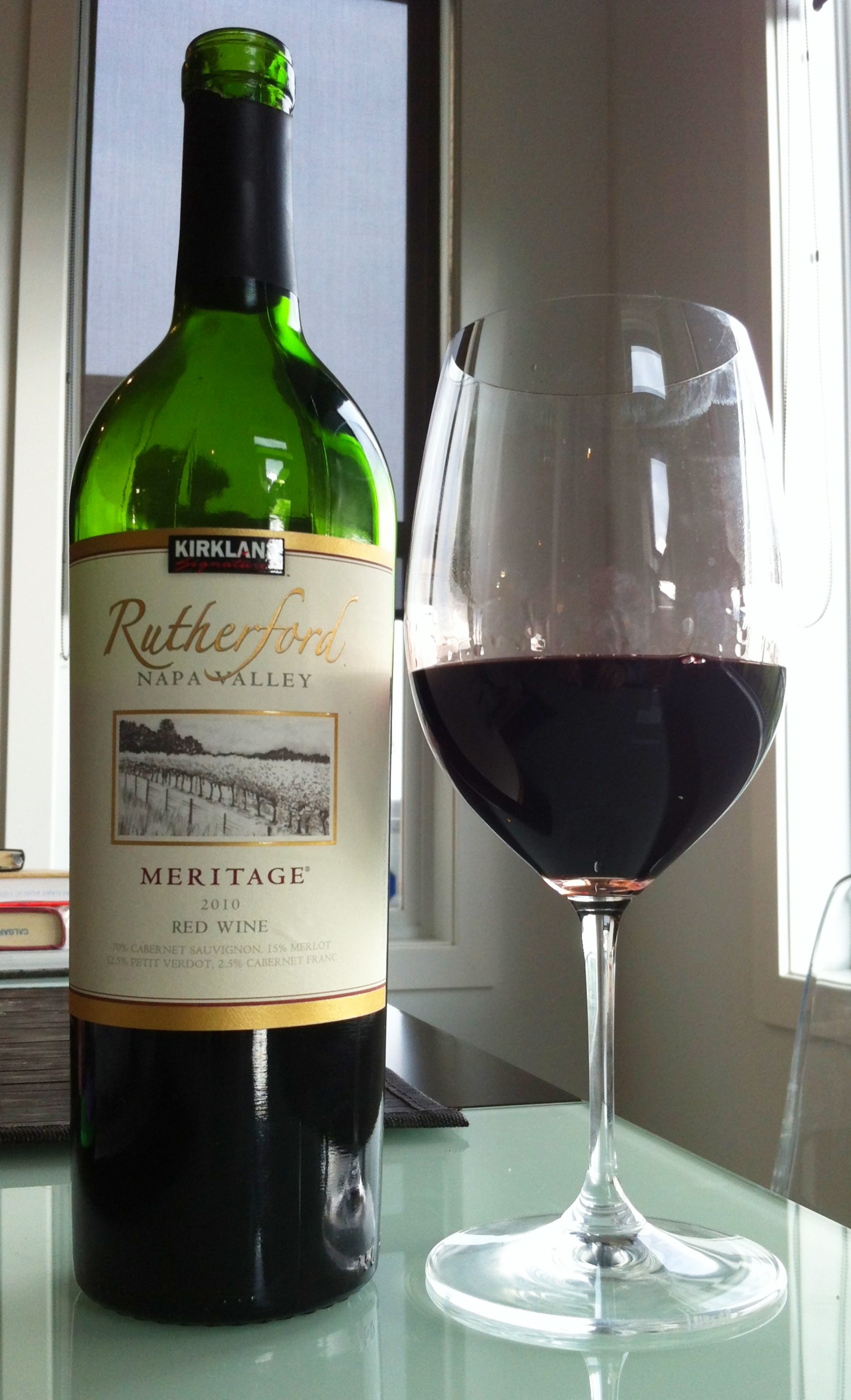
Wine Review: 2010 Kirkland Rutherford Meritage

15 08 2012

Not just wine FROM Costco, wine BY Costco. Too weird.

I had to.  Every time I’ve gone into Costco to grab a bottle or two, my eyes always linger for a moment with morbid curiosity on the various Kirkland bottles for sale.  I can wrap my head around Costco-brand ketchup or Costco-brand paper towel, but I have no idea what to make of Costco-brand wine, particularly since Kirkland (Costco’s proprietary label) keeps spitting out offerings from a vast array of well-to-do regions like Chateauneuf-de-Pape, Champagne, and, as seen here, Napa Valley.  These areas have an established pedigree in the wine world:  this particular bottle comes from Rutherford, arguably Napa’s most prestigious, highest-quality and most expensive sub-region.  Rutherford is a tiny area in the heart of the Valley — when I went to Napa it took about 3 minutes for us to drive from one end of it to the other — and is one of the best places in the world to grow the Cabernet Sauvignon grape, and its name on a label usually signifies that you’re going to be shelling out at least $50-$60 (and often much more) for the privilege of the bottle.  This bottle was $17.  The utter dichotomy in my head between “Rutherford wine” and “produced by Costco” made me have to see what was inside.  One disturbingly inexpensive Napa Cab later, I cracked the Kirkland tonight feeling equal parts anticipation and dread. Read the rest of this entry »


Wine Review: 2010 Mission Hill Martin’s Lane Riesling

6 08 2012

[This bottle was provided as a sample for review purposes.]

R is for Riesling.

Time to issue the first official correction in PnP history.  When I reviewed Mission Hill’s Reserve-level Riesling back in June, I stated that the Reserve (the 2nd lowest of 4 quality levels of MH wines) was Mission Hill’s top-level Riesling, and I openly pined for the winery to put together a high-end single-vineyard Riesling that would really showcase what my favourite grape could do in Okanagan soil.  I said that if MH ever decided to release such a wine, I would be lining up to try it.  Shortly after posting, I received an e-mail from a representative at the winery that said something like:  “Well, actually, we already DO have a Riesling exactly like that…”, and a week later, this bottle showed up at my door.  In my defence, this particular Riesling doesn’t show up in the official portfolio of wines on the MH website, but as a devoted Riesling disciple, I still feel bad about not being aware of it, and I feel particularly bad about suggesting that it didn’t exist in front of an online audience.

Sorry Mission Hill — time to set the record straight. Read the rest of this entry »


Calgary Wine Life: The YYC Corkage Primer

25 07 2012

[Cross-posted at www.calgaryisawesome.com]

Time to BYOW, YYC. OK?

Corkage has been a hot topic in Canada recently, thanks to last week’s announcement from the British Columbia government (finally) allowing diners to bring their own bottles of wine into participating BC restaurants.  Here in Alberta, restaurants already have the ability to establish Bring Your Own Wine (BYOW) policies, and many have done so, generally charging a set per-bottle fee (called the corkage fee) in exchange for letting their guests arrive with their vino of choice.  Although this option is widely available in Calgary, it seems like it’s only rarely exercised, as most people either don’t know about the possibility of corkage or would prefer to trust in the carefully-selected wines that a restaurant puts on its own list.  While I usually fall into the latter category, there are certain times — when I have a certain bottle that I’ve been dying to open, when I’ve had a less-than-stellar past wine experience somewhere, or when I want to bring a Wine For An Occasion to celebrate something special — where corkage comes in really handy.  If you’re not sure about how the corkage process works, what the etiquette is around bringing your own bottle, and which places in Calgary offer BYOW service (and for how much), all your answers await below. Read the rest of this entry »


Wine Review: 2010 Domaines Andre Aubert “Le Devoy”

23 07 2012

There are two compelling reasons why you should track down and drink this wine:

  1. It is a tremendously good value wine that offers depth, intrigue and tons of flavour at a bargain price.
  2. It may give you superpowers.  Or radiation poisoning.  Or both.  It’s tough to predict.

You see, Andre Aubert’s Le Devoy comes from the bucolic Grignan-Les-Adhemar region in France’s Southern Rhone valley.  Before Grignan-Les-Adhemar adopted its almost-impossibly-French appellation name in 2010, it was previously known as the AOC region of Coteaux de Tricastin, named for the French city of Tricastin found within its borders.  Unfortunately for Tricastin, on top of vineyards, it was also home to a series of 4 nuclear reactors, and unfortunately for the nuclear reactors, in 2008 this happened:

Shortly after this questionable incident, a number of employees at the Tricastin plant were exposed to radioactive particles that escaped from a reactor pipe that was supposed to be shut down.  Then a 3 year-old previously-unnoticed nuclear waste leak led to another spill.  Not surprisingly, these terrifying events did little to draw the public towards bottles of wine with “Tricastin” plastered all over their labels, so the growers there petitioned France’s governing wine body to let them change the name of their region, and Grignan-Les-Adhemar (which translates to “Land of the Geiger Counters”) was born.  I have never before heard of a French wine appellation changing its name, especially just so that it could escape from bad PR, but as a result, Le Devoy will now forever be known to me as “nuclear wine”.

But it’s good!  Really!  You should buy it! Read the rest of this entry »


The Mission Hill Pinot Olympics

17 07 2012

[The bottles below were provided as samples for review purposes.]

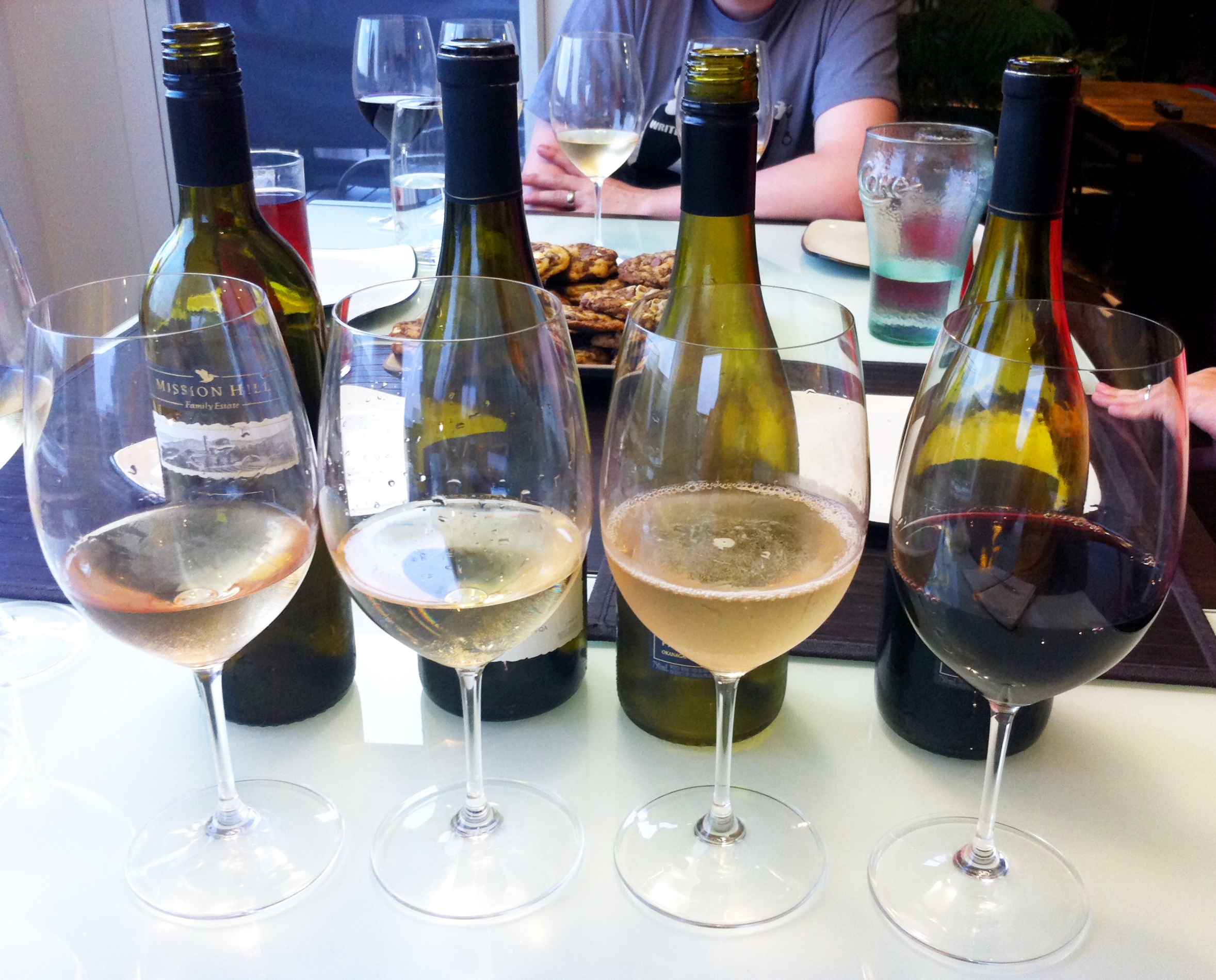
As tactfully mentioned by the disclaimer above, I recently received a mixed six-pack of sampler bottles from the good folks at Mission Hill Family Estate winery in the Okanagan Valley.  Two of these bottles, the 2011 Reserve Riesling and the 2011 Five Vineyards Sauvignon Blanc, have received separate PnP review treatment over the past couple of weeks:  see here and here for the full write-ups.  But I couldn’t bring myself to split up the other four bottles and rate them separately, because it was clear that they belonged together, bound as they were by a common provenance:  the family name Pinot.  Pinot Grigio, Pinot Gris, Pinot Blanc and Pinot Noir all sat side by side in the MH sample box like a monochromatic grape rainbow, their shared forename a reminder of their common genetic ancestor (Pinots Grigio and Gris are the same grape, and both PG and Pinot Blanc are mutations of Pinot Noir, which is well-known for being genetically unstable).  Since the fortunes of these bottles were clearly tied together, and since it’s July 2012 and our athletes are preparing to head off to London for the Summer Games, I did the only thing I could do and hosted the inaugural Mission Hill Pinot Olympiad at my house over the weekend.

In order: Grigio, Gris, Blanc, Noir. Let the Games begin.

Here’s how our game was played:  I invited over a couple of fellow wine enthusiasts, opened all four bottles of MH Pinot, and we tasted through the lineup and separately ranked each of the wines as against its peers, individually coming up with our gold, silver, bronze, and, um, whatever’s below bronze (lead? aluminum? tungsten?) medal choices.  I then added all of the placements together to come up with a cumulative judges’ score (for example, a wine ranked 1st, 2nd and 3rd by the three different judges would get a total score of 1 + 2 + 3 = 6); the lower the score, the better.  The lowest total score won the overall prize, which basically meant that the bottle was emptied the fastest.  We tasted the wines from whites to red, lightest to heaviest, and my notes below are in the same order.  Who emerged victorious?  Read on! Read the rest of this entry »


Wine Review: 2011 Kung Fu Girl Riesling

9 07 2012

Best served chilled (as shown by my glass), especially when it’s 30C in Calgary.

New KFG!!  Mid-year is an exciting time for oenophiles, because that’s when many white wines from the previous year’s vintage start appearing on store shelves, and since this particular white is one of my all-time favourite value wines, its release turned an otherwise-mundane outing to Superstore into a cause for celebration.  My love for Kung Fu Girl is partly predicated on my adoration for both Riesling (my all-time favourite grape) and Washington State (one of my go-to wine regions, still criminally underrated despite producing world-class wines) and partly just due to the fact that it’s an awesome bottle of wine for under $20 CDN.  And my excitement obviously not an isolated phenomenon:  my review of last year’s 2010 Kung Fu Girl Riesling is Pop & Pour’s second most popular post of all time, with 2,444 unique views and counting.  I guess when you make something of high quality that doesn’t take itself too seriously and is priced to sell, people pay attention.  Charles Smith, I salute you. Read the rest of this entry »


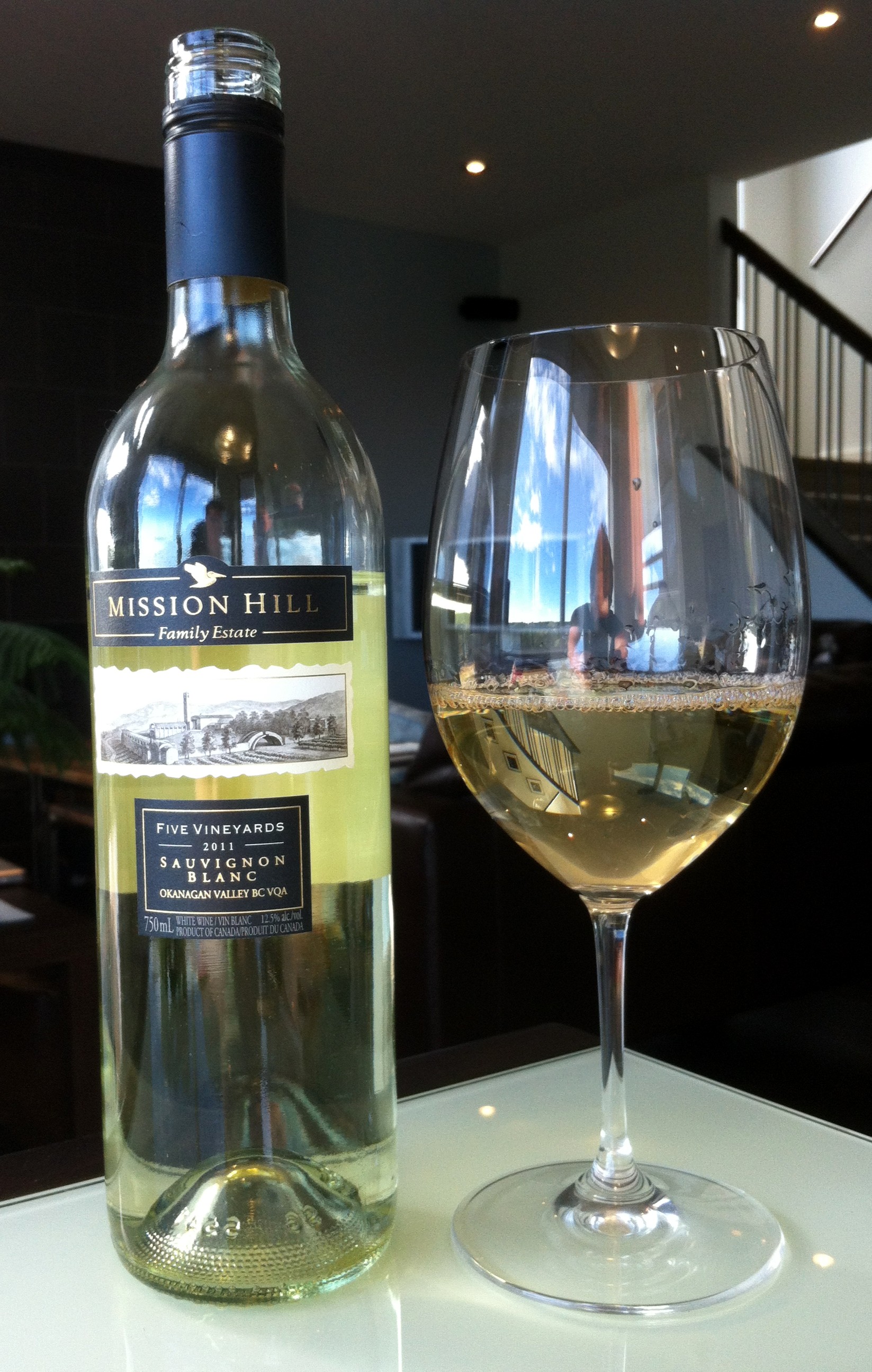
Wine Review: 2011 Mission Hill Five Vineyards Sauvignon Blanc

5 07 2012

[This bottle was provided as a sample for review purposes.]

General tip: clear bottle = open soon!

You know it’s officially summer when I can sit outside on my deck and write up a review of a crisp white patio sipper.  The sun is shining, there’s a slight breeze blowing through the trees, and it’s almost-but-not-quite-scorching hot — perfect Sauvignon Blanc weather.  This is the second white I’ve written up recently from the good folks at Mission Hill — I took a look at their Reserve Riesling just over a week ago.   This bottle will be an interesting contrast, because not only are we dealing with a different grape, one with somewhat less of a track record in Canada, but we’re also taking a step down Mission Hill’s quality hierarchy to their introductory level bottlings, which retail for $15ish in Alberta.  The Five Vineyards line of MH wines are sourced from (guess how many) five different estate vineyards scattered across BC’s Okanagan Valley:  Osoyoos and Oliver in the south (just north of the Washington State border), Pinehill and Naramata slightly further north, and the aptly-named Mission Hill Road vineyard surrounding MH’s winery just outside of Kelowna in the northern part of the region.  Each vineyard features differing soils, altitudes and microclimates — Oliver and Osoyoos are near-desert conditions, while the other vineyards along the shoreline of the vast Lake Okanagan, which cools and moderates the growing temperatures — all of which makes it easier to grow grapes with a variety of different characteristics to facilitate the creation of a blended wine that is fairly consistent year over year.  I was surprised to note that the two vineyards that Mission Hill’s website mention specifically for Sauvignon Blanc production are the two hottest ones, Osoyoos and Oliver, although I would guess that some of the grapes in this bottle come from other locations as well. Read the rest of this entry »