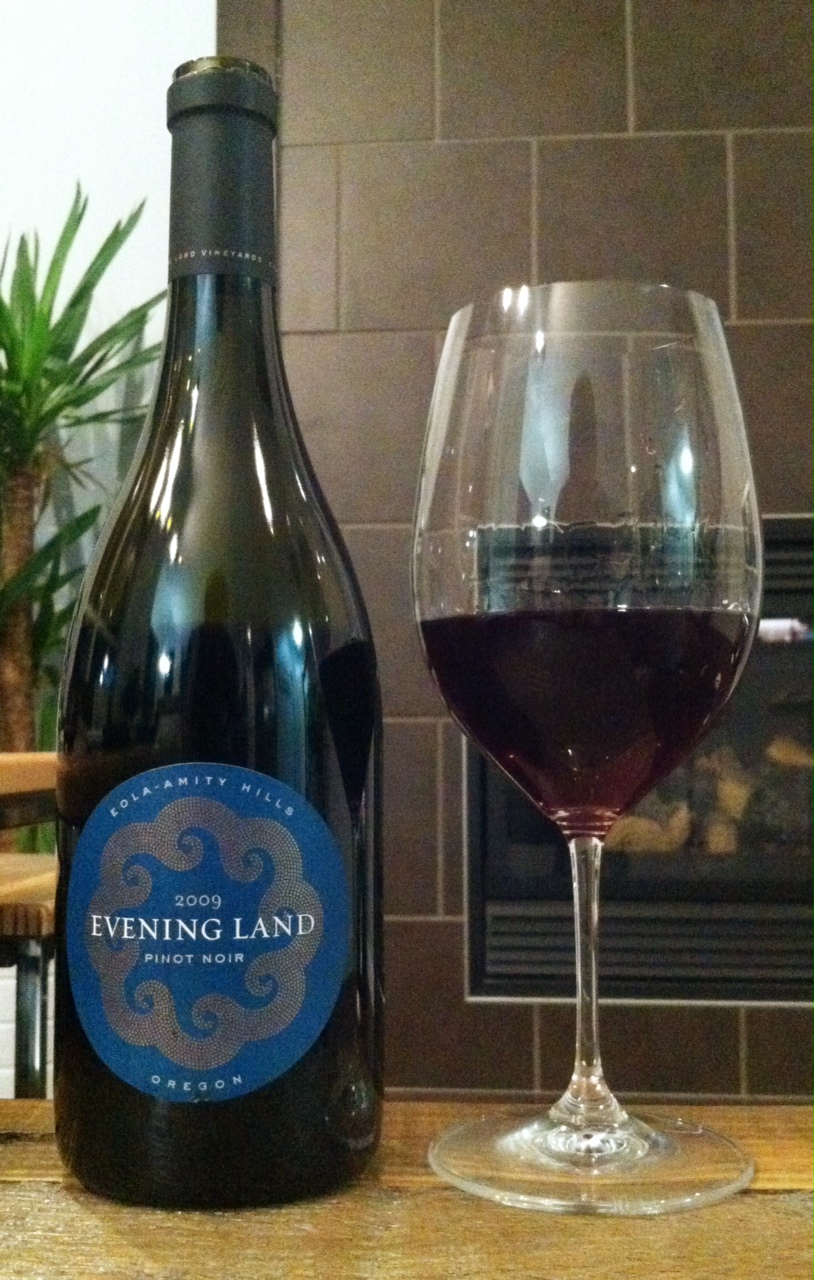
Wine Review: 2009 Evening Land “Blue Label” Pinot Noir

9 01 2012


One of my favourite labels in recent memory, and a great bottle to boot.

As I mentioned last post, although buying and drinking Burgundy is my top mission for (at least the first half of) 2012, in order to go about it the right way and actually learn something, I’m going to be deferring much of my Burgundy tasting/writing for a few weeks while I source wines and firm up a drinking plan.  Since I tasted a 2009 Bourgogne Rouge last week, I thought it would be an interesting contrast to follow it up with what is effectively its New World equivalent:  a 2009 Pinot Noir from Oregon, from the Burgundy-inspired rising stars at Evening Land Vineyards.  Even though Evening Land’s first vintage was in 2007, less than five years ago, it has quickly gained attention and critical acclaim for its lineup of true-to-the-land wines from the classic Burgundian varieties of Pinot Noir and Chardonnay.  I had known them as an Oregon producer (I tried two of their Oregon Pinots in WSET class) and was quite surprised to discover that they actually make wine in 4 different Pinot/Chard heartlands around the world:  Oregon’s Willamette Valley, California’s Sonoma Coast and Santa Rita Hills, and Burgundy itself.  While I’m sure that other wineries must do this too, I can’t think of another one off the top of my head that produces wine from different countries under the same name and label.  Colour me intrigued.

Read the rest of this entry »


Wine Review: 2007 Boedecker Cellars Stewart Pinot Noir

3 08 2011

Just smell this wine once...then keep on smelling.

Oregon!  By now you know that Washington State, especially Washington State Syrah, has a big piece of my wine-loving heart, but my affections actually spread further across the Pacific Northwest, even though Oregon’s wine scene is considerably different from its northern neighbour’s.  Most of Washington’s wines are grown in the southeast part of the state, which is in the rain shadow of the Cascade Mountain range and is almost desert-like:  dry and hot during the day and quite a bit cooler at night.  The heat allows thicker-skinned, warmer-weather grapes like Cabernet Sauvignon and Syrah to ripen fully, while the nightly colder spells give the resulting wines a little restraint and keep them from becoming alcoholic fruit bombs.  Oregon is totally different, with a climate that more closely resembles what you’d expect from the northern Pacific coast (and I lived in Victoria BC for three years, so I know):  cooler, more continental, less sunny and quite a lot rainier.  The big powerful red grapes would struggle to ripen fully here, but their more delicate, thinner-skinned, colder-climate brethren absolutely thrive, especially Pinot Noir.  In my (only partially-informed) opinion and (fairly limited) experience, I would venture to say that Oregon has more promise as a Pinot Noir region than anywhere else on Earth other than Burgundy, France, the grape’s ancestral homeland — it’s better suited for the grape than established Pinot zones like California; more impressive than other up-and-coming areas like Central Otago, New Zealand or Yarra Valley/Mornington Peninsula, Australia; and more intriguing than long-time European growing zones like Germany or Austria.  Oregon has only been noticed as a serious wine region in the last 50 years, but its affinity for Pinot Noir has seen it gain an astronomical amount of international respect in a very short time.  It has since started branching out with some of the white grapes from Alsace, France (Pinot Gris and Pinot Blanc), but Pinot Noir is its meal ticket and its justified claim to fame.  I’m not a huge Pinot fan, but (possibly because I don’t find myself drinking $150+ Burgundy all that often) Oregon’s renditions of the grape are probably my favourite. Read the rest of this entry »