The Great Coravin Test, Part 4: Final Thoughts (For Now)

26 08 2015
No Girls Grenache by the glass?  Don't mind if I do!

No Girls Grenache by the glass? Don’t mind if I do!

The sun has shone a little less brightly this week (and not just due to wildfire smoke blocking out the sky) – I had to return my borrowed Coravin, leaving an empty spot on my counter and a needle-sized hole in my heart.  Apart from testing out the device on the three bottles of wine the agent provided to me (adventures catalogued in Part 1, Part 2 and Part 3 of this post miniseries), I also went to town last week on a few bottles from my cellar, including a couple of the pricy variety in case you were wondering about my level of Coravin confidence.  Most importantly, I re-accessed the 2012 Tabali Pinot Noir from Chile that acted so strangely I last time I Coravinned my bottle samples just to make sure that all was still well, and it was fresh as a daisy and exactly how I remembered it on first opening, confirming that the Coravin’s preservation record remained fully intact.

I thought I’d end my Coravin saga with a few closing thoughts on the pros and cons of scooping the device for yourself and on whether the amazing features of this wine access wonder-machine justifies its hefty $400ish price tag, particularly for individual wine lovers.  First, the most obvious pro:  there is nothing like this anywhere.  It is literally in a class of its own in the wine preservation game, to the point where it’s almost not fair to call it a preservation device at all:  you don’t have to worry about preserving the wine when you never expose it to the elements in the first place.  You’re not using it to stave off inevitable oxygen decay for a few days or a couple weeks; you’re using it to stop the oxygen time clock from even starting, so that you can drink a bottle from your cellar a glass at a time over any length of time that you want, even years.  That’s just mind-blowing.  Even after using the thing for a month, it’s hard to wrap my head around just how much of a game-changer it is. Read the rest of this entry »




The Great Coravin Test, Part 1

19 07 2015
Ladies and gentlemen:  the future.

Ladies and gentlemen: the future.

It is an age-old problem:  what to do with the rest of a bottle of wine if it isn’t all consumed in an evening?  Unless being used to let tight young wines breathe, oxygen is generally the enemy of wine, and once the atmosphere gets its claws on the liquid in a bottle, the results aren’t pretty:  the wine gets flat and stale, brightness and flavours fade, and any distinguishing characteristics are quickly lost.  You can help slow this aerobic inevitability by putting the wine in the fridge overnight, but I always still noticed a difference in the bottle the next day, a slight but undeniable decline.

There have been a few standard approaches invented for dealing with the leftover wine oxygen problem, each effective to different extents.  You can buy a vacuum pump that fits into the opening of the bottle and (at least theoretically) manually sucks out the offending oxygen, leaving a decay-free zone inside the bottle.  This may sort of work at times for short durations IF the pump actually makes an airtight seal with the bottle, which it often doesn’t.  You can instead opt for a separate narrow storage vessel that has a sort of buoy-like floatation device engineered to exactly match the interior circumference of the container; you pour your wine in, plop the float on top and add a lid for good measure, keeping the surface of the wine from any immediate interaction with oxygen.  This is better and more consistent than the vacuum for short stints (I have one, the Savino, which I use for weeknight wines) but not that trustworthy for more than a day or two.  Then there’s the gold standard:  argon.  You pump a little argon gas into the heel of your bottle (from a purchased canister or a fancier system like my Pek Preservino) and, since it’s inert but heavier than air, it forms a harmless protective layer over top of the wine that prevents oxygen from accessing it.  I have left a wine under argon in the fridge for a week and it’s been good as new.

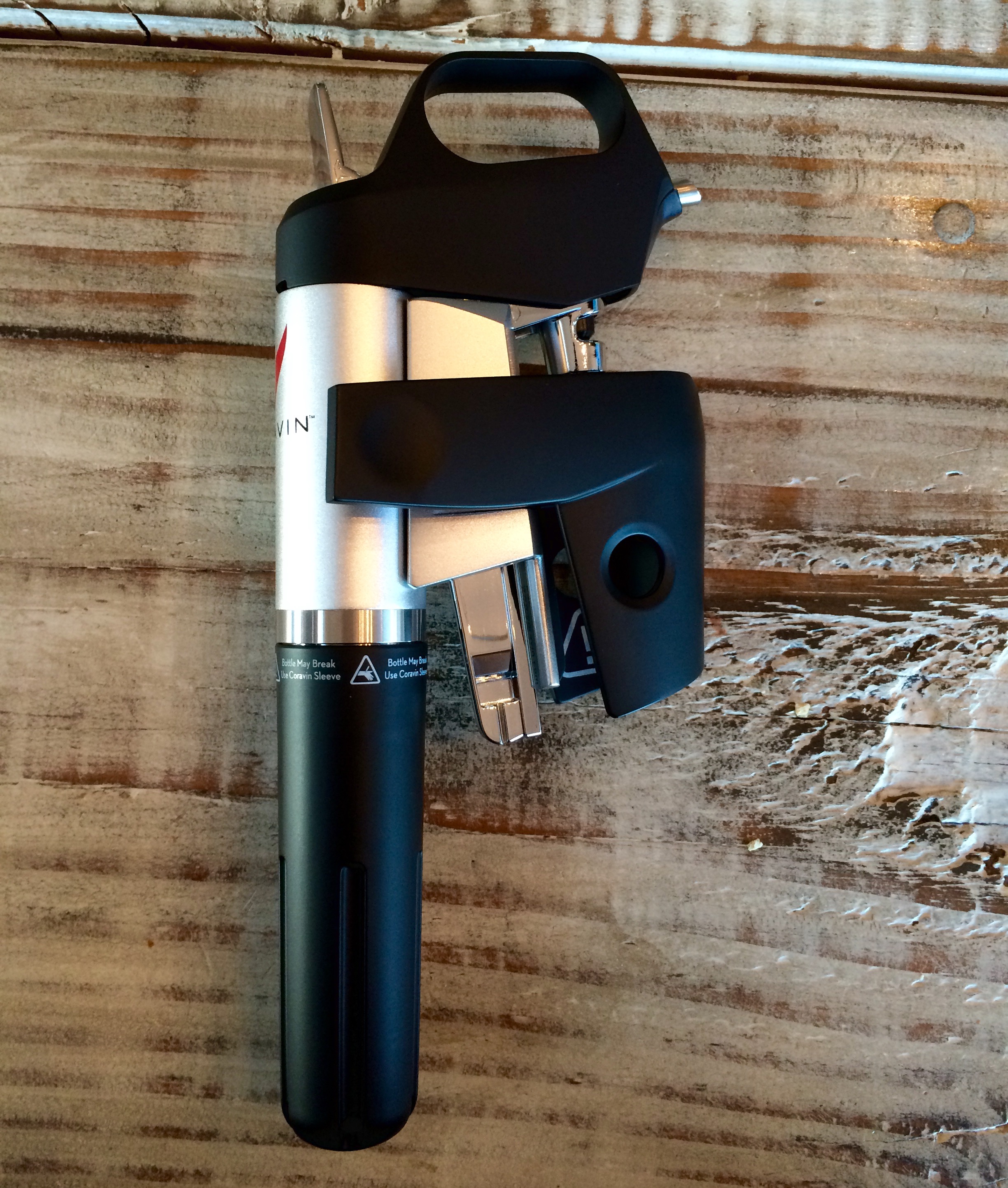
FullSizeRender-71These preservation systems all tackle the problem of wine degradation from different angles, and yet they all share one key thing in common that puts a ceiling on their effectiveness:  they all start with an open bottle of wine.  No matter what tricks you try to keep oxygen away from your precious liquid, once you pop that cork and pour that first glass, you have exposed your wine to the air and the decay clock starts ticking.

But what if you didn’t HAVE to open the bottle?  Could wine be preserved indefinitely if you could somehow access it while keeping its bottle fortress intact?  Enter the Coravin. Read the rest of this entry »