KWM Whisky Advent Calendar 2017: Day 10

10 12 2017

By Tyler Derksen

Day 10 brings us a 15-year Glenfiddich.  Glenfiddich was founded near Dufftown, in the heart of Speyside, by William Grant in 1886 when he began building the distillery with the help of his nine children (no wonder he needed a drink).  The name “Glenfiddich” is Gaelic for “Valley of the Deer”, which explains the deer on all of the distillery’s labeling.  Glenfiddich remains in the family and the descendants of William Grant still run it 130 years later.  The distillery has a significant production and accounts for a significant percentage of the single malt whisky sold worldwide.  The whisky is stored and matured on site in one of 43 warehouses, which have a capacity of 800,000 casks!

IMG_4117

Ok, so here’s the thing.  I’m not a huge fan of Glenfiddich. I’ll get that out of the way now.  That’s fine, as not everyone likes peated whisky the way I do.  That does mean, however, that I don’t typically seek out whisky from Glenfiddich when trying something new.  As a result, I was interested to see how this 15 Year Old Solera would compare to the more commonly served 12 Year Old.  The process for producing the 15 Year Old Solera seems quite involved.  The spirit is initially matured in European, American and New American Oak before being put into Glenfiddich’s custom-made Solera vat (built in 1998 by the distillery’s fifth Malt Master, David Stewart).  After aging in the Solera vat, it is then finished in Portuguese oak tuns.

The website for Glenfiddich indicates that the Solera vat is never emptied more than half way before new casks are added, which they tout as a means of achieving consistency in flavour.  When I hear consistency or uniformity of flavour, I become hesitant, as I find that whisky produced with that as a goal tends to have far less character.  That doesn’t make them bad, just uninteresting (at least to me).  C’mon, half the fun is barrel variation.

The nose on this whisky was, unfortunately, difficult to discern, with the intensity muted (potentially as a result of being bottled at 40%).  Hints of apple and spice slowly find their way through a nose that is certainly richer than the Glenfiddich I have had previously.  The palate is similarly muted (again, perhaps because of the 40%) and does not have a burn of any kind.  It is smooth and inoffensive, with flavours of dried fruit, baking spices and honey.  The finish is almost non-existent with the lingering flavour remaining only describable as “generic Speyside”.  One of the great things about whisky is that there is a dram for every palate and a palate for every dram.  This one doesn’t do it for me, but hey, that’s why there are 25 different ones in the calendar.  See you all in a few days!


KWM Whisky Advent Calendar 2017: Day 9

9 12 2017

After a hectic first week and a bit of whisky, where every other day introduced a bottle from a new country (I’m still processing The Netherlands two days later, and I didn’t even write it up!) and every scotch was seemingly snatched from the jaws of obscurity, maybe it’s nice to sort of resettle and catch our collective breath with a Glen- that everyone recognizes (sorry, Glentauchers).  Glenmorangie is the first single malt experience of many fledgling whisky drinkers, and is very widely sold, but that doesn’t mean they don’t try to push the envelope every so often.  I got a firsthand experience of that phenomenon a while back with their floor-malted Tusail, a dynamite dram, and they try to take a step out of the ordinary here as well with their extra-maturation expression Quinta Ruban.  As far as I can tell, “extra-maturation” is just a fancy way of saying “aging something in one thing, then moving it to another thing”, but Glenmorangie has built a whole range out of this relocation, starting off whiskies in ex-Bourbon cask and then transferring them for the final stage of aging to a variety of other types of vessels.  The 12 Year Quinta Ruban gets to spend the last two years of its pre-bottle life in Ruby Port casks, and according to the Glenmorangie site it was the first malt whisky ever to do so.  It almost surely gets its name from this practice:  Quinta = a wine estate in Portugal, and Ruban is close enough to ruby that I’m not even firing up Google Translate to look into it further.

IMG_7149

First things first:  this is one sweet-looking mini-bottle of scotch.  I like the mini-bottles that retain the same sense of proportion as the full-sized bottles, and this one nails those little details.  The Quinta Ruban may be the orangest scotch I have ever seen, thanks to the staining impact of the used Ruby Port barrels.  The nose is spicy and fiery, all pepper, smoke, clove, all-spice and briquettes, forcing you to dig for the orchard fruit beneath.  It is big, rich and brawny, with an accompanying alcoholic burn (even with water added) amping up burly flavours of maple, mandarin orange, cast iron, sandpaper and chestnuts.  Its price is also extra-matured at $92, but I won’t be the one who discourages the big houses in the world of scotch from diversifying their approaches.


KWM Whisky Advent Calendar 2017: Day 8

8 12 2017

The unofficial theme of the scotches (that is, Scotland-derived whiskies) from the 2017 calendar so far is giving unsung heroes their moments in the spotlight.  Like at least two other scotches in the 7 days before it — the two that led off Advent this year — this bottle comes from a little-known obscure distillery (in this case, Glentauchers in Speyside) whose substantial production forms the workhorse component of much-better-known blended whiskies (in this case, Ballantine’s) but who almost never gets to release a single malt under its own banner.  Glentauchers was founded in 1897, managed to produce until 1985 before being mothballed for 7 years, was then acquired by Chivas Brothers and has been churning out blend backbones ever since.  Its fleeting solo appearance comes courtesy of independent bottler extraordinaire Gordon & MacPhail, which has a whole range of Distillery Labels that sees them release a hidden-treasure distillery’s whisky under the distillery’s own logo and branding – very cool.  It is not my first Advent encounter with this range:  in fact, my very first KWM Whisky Advent Calendar bottle EVER was a Distillery Label bottling from the Linkwood distillery, followed shortly in the 2014 calendar by another DL bottling from Mortlach.  Neither of those, however, were 20-year malts.  This one is.

IMG_7145

Distilled in 1996 and then aged in sherry casks before being bottled last year in 2016, the Glentauchers has had plenty of time to mature and develop flavours, and it shows in a sweeping nose of carrot cake, wheat fields, tangerine, lemongrass and marzipan, as holidays-ready a set of smells as I can recall.  Luxurious and pure, it spreads out slowly, taking its time to unfurl before hitting on a distinctly prominent Amaretto note about halfway through the midpalate, a double-take hallmark flavour that just continues to emphasize itself even (especially?) after you swallow.  It’s so remarkably vivid.  Wild.  If I had to try to pull out other flavours:  Sap?  Cinnamon toast?  Banana bread?  Nope, forget it, it’s Amaretto all the way.  One of the most fun offerings in the calendar thus far without question.


KWM Whisky Advent Calendar 2017: Day 7

7 12 2017

By Tyler Derksen

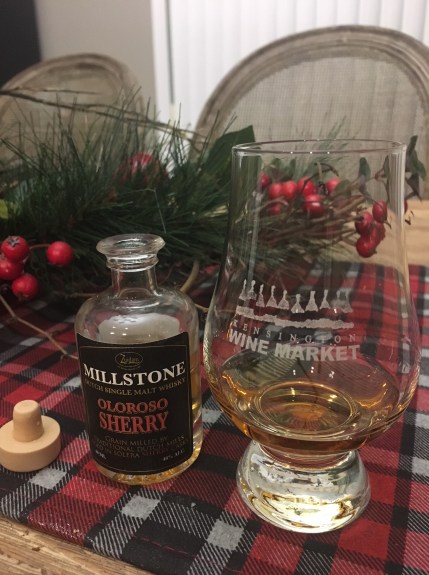
One of the true joys of opening a new day on the KWM Whisky Advent Calendar is that you never know what you’re going to get (insert Forrest Gump joke here).  In all seriousness, Andrew Ferguson of KWM does a phenomenal job of sourcing interesting whisky from Scotland and abroad (something Peter rightfully lauded yesterday).  Even with all this in mind, I was thoroughly surprised to pull out today’s bottle and see that it is from the Netherlands!  That’s right folks: Dutch whisky.

Zuidam Distillers is a family-owned and -run distillery which makes gin, Genever (a traditional Dutch juniper liquor from which gin evolved), liqueurs and even rum in addition to its Millstone Whisky, with recipes created by father and son duo Fred and Patrick van Zuidam.  The distillery was started by Fred in 1975 and began as a very small operation, with a space of only 300 square meters and one copper still.  The business grew slowly, but now boasts of a 3600 square meter distillery and four new copper stills.  Zuidam, however, remains true to its Dutch roots and uses windmills to mill its malted barley.

IMG_4103

I love the little rubber stopper instead of a screw-top.

Today’s bottle was less than forthcoming in terms of detail, so I had to do some digging (which would have been far easier if I could read Dutch).  From what I can tell, this whisky appears to have been aged for three years in Oloroso sherry casks (OK, that last part I got from the bottle) which I believe were constructed of American oak.

The colour of the whisky is a stunning deep gold, looking almost like honey in the glass.  The influence of the sherry is evident on the nose, with scents of dried fruit, hazelnut, vanilla, old paper (think opening a 15-20 year old paperback book) and honey dominating.  The palate is bold and the flavours teased by the nose are certainly realized, along with oatmeal cookie and nutmeg.  Although the whisky is a pretty standard 46%, it can seem stronger and slightly viscous if tasted without water.  That said, I found that adding water dulled the palate, with the trade-off not being quite worth it.  If adding water, use very little.  The finish is dry with a hint of something almost rubbery.

Before today, if you had asked me to name whisky-producing countries, I’m not sure I would have come up with the Netherlands, but I will now.  This offering appears to be one of a number in Zuidam’s Millstone line of whisky, many of which are available at Kensington Wine Market (this one is $83) and I’d certainly be interested in trying more Dutch whisky to see how it compares.


KWM Whisky Advent Calendar 2017: Day 6

6 12 2017

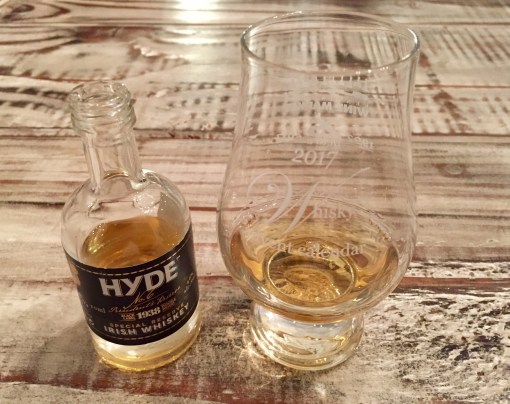
No. 6 for Day #6 — I will give everyone involved the benefit of the doubt and assume that was cleverly intentional.  I was ultra-pumped to pull the extended-name Hyde 1938 No. 6 Sherry Cask Finish Black Label Special Reserve Irish Whiskey (phew) out of the calendar tonight, for two reasons:  (1) after I have (politely) campaigned for years to get more global representation in the KWM Whisky Advent Calendar, 2017 has seen FOUR different countries come out of cardboard box doors in six days; and (2) I absolutely adored the Hyde whiskey from the 2016 calendar, which almost made my top 3 overall from that year.

IMG_7142

Like that bottle (and all of Hyde’s lineup), this one sees time in two different kinds of barrels, starting out in bourbon casks before finishing in my nemesis, Oloroso sherry barrels, which lend salty kernel-y complexity to whiskies but also drive me to the point of near-insanity in their ubiquity.  Hyde’s mantra is “It’s all about the wood!” (actual promoted hashtag:  #itsallaboutthewood), which I would readily make fun of were it not for the fact that their website contains the best discussion of the details and effects of wooden barrel maturation I’ve ever seen.  When you walk the talk, I will grant you your double entendre slogan.

05_Wood_MolecularDance_1-1024x410

Photo credit:  http://hydewhiskey.ie/the-wood/.  They take wood seriously.

Hyde Irish Whiskey is named after Ireland’s first president, Douglas Hyde, and this “1938” bottling is a tribute to his inauguration year, despite having nothing else at all to do with that calendar year.  It’s a special small release (only 5,000 bottles made, as well as at least 384 mini-Advent bottles) that intriguingly combines an 8 year-old grain whiskey with an 18 YEAR single malt whiskey to make a punching-above-its-weight power blend.  The result smells equally sweet and herbal, part honey and vanilla, part lemongrass and fresh leaves, part nutmeg and eucalyptus and creme caramel.  Fruit shows up in spades as soon as the whiskey hits your tongue, buoyant cantaloupe, kiwi and honeydew, backed by seaweed, Dixie Cup spoons and that same lingering trace of minty greenness.  This is really, really impressive, much more layered than your standard expectation of Irish whiskey and a steal at an $80ish retail price.  Keep the Irish coming!!


KWM Whisky Advent Calendar 2017: Day 5

5 12 2017

By Tyler Derksen

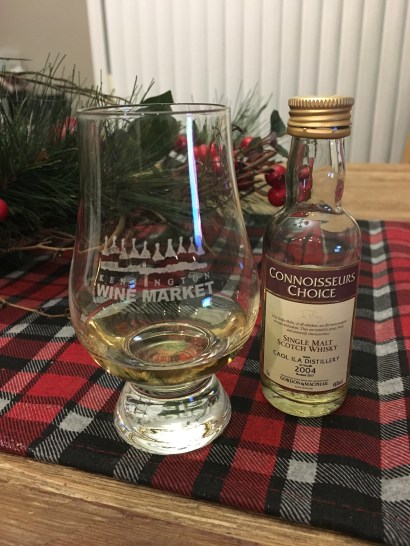
As a reader of Pop & Pour from its inception, and a lucky participant in many tastings written up here, it is a thrill to be a guest-writer this Advent season.  While I am a big fan of wine, scotch is my first love when it comes to alcoholic beverages and it was a with enthusiasm that I accepted the opportunity to assist in writing up the whisky offerings in this year’s Kensington Wine Market’s Whisky Advent Calendar. I will certainly do my best to try to keep my personal biases out of these reviews; however, today is an unfortunate day for such an attempt, as the whisky du jour is the Gordon & Macphail Connoisseurs Choice bottling of 2004 Caol Ila.  Caol Ila (pronounced “cull-eela”) comes from the island of Islay, my favourite scotch region – so much so that I may have named my daughter after the island due to my love of the scotches produced there.

The Caol Ila distillery is located on the northeast coast of Islay overlooking the Sound of Islay, for which the distillery was named.  From the distillery one can look across the sound and see the island of Jura close by.  The distillery was founded in 1846 and is now part of the global spirit powerhouse Diageo.  Although Caol Ila makes remarkable single malt scotch, much of its significant production is used for blending, including in Johnny Walker.

IMG_4100

Today’s whisky is the younger (but more aged) sibling of the Connoisseurs Choice 2003 Caol Ila from the 2015 KWM Whisky Advent Calendar.  Judging by those tasting notes, however, this bottle is quite different.  The whisky was aged in first and refill bourbon barrels and is a light golden colour in the glass, characteristic of Caol Ila which is typically lighter in colour than many of its Islay cousins.  On the nose, the 2004 Caol Ila has the characteristic Islay peat, pronounced but not overpowering.  Mixing with the peat are aromas of fresh baked bread, caramel, banana and a subtle citrus note.  On the palate, the smoky peat remains well-balanced and does not obscure flavours of orchard fruit, vanilla, banana and baking spice with a hint of citrus zest lightening things up.  The finish is long and surprisingly it is the baking spices, not the peat, that stick with you.  I have yet to try a Caol Ila that I did not enjoy, and this offering is no different.  An auspicious start to my blogging career!


KWM Whisky Advent Calendar 2017: Day 4

4 12 2017

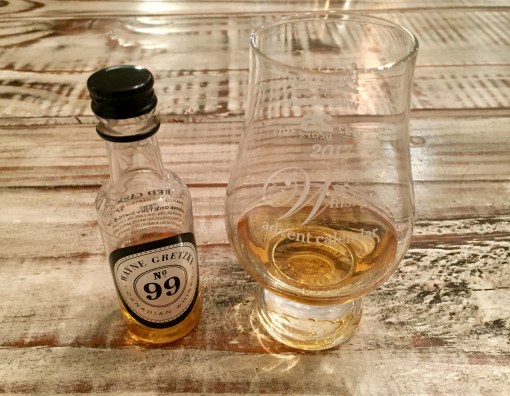
Man, this 2017 calendar just continues its emphatic strides towards difference and individuality and I just keep loving its uniqueness.  We get two new Whisky Advent firsts today (at least in my four years of following along):  (1) first ever CANADIAN whisky, and (2) first ever plastic bottle embedded in the calendar.  I almost dropped it pulling it out of slot #4 it was so light.  This is the very first ever spirit offering from Niagara’s Wayne Gretzky Estate Winery, the Red Cask Premium Crafted Whisky, which is distilled from locally grown grains and then, in a nod to its roots, matured in the winery’s own red wine barrels.  Very cool.  It has to be one of the least expensive whiskies ever to grace the KWM Whisky Advent Calendar as well, tipping the scales at a svelte $44 for a full bottle.

IMG_7141

This inaugural Advent offering from our home and native land is great to look at, a pleasantly burnished amber colour impressively obtained given what I wouldn’t expect to have been an extraordinarily long maturation period.  It smells equal parts spicy and toasty, cinnamon and charcoal, layered with elastic bands, Old Fashioned-style citrus and melon fruit.  The double-take portion of the whisky comes in the form of its ultra-satiny, almost gelatinous texture, like a Jello shot or an alcoholic Jujube.  It billows out on the tongue like a roasting marshmallow and then sits there, inflated and cooked on the edges, hanging out.  I wrote “is this rye-based?” when pepper and sandpaper started biting my tastebuds, and I was at least partially right:  it’s part aged rye, part malted rye and part corn-based whisky, each distilled separately.  The corn comes through in the Bourbon-esque caramel, burnt orange and Creamsicle flavours, lending easy approachability to the whole affair.  On the whole, while the mouthfeel seems slightly exaggerated, this stands up quite well as a solid weeknight sipper.  O Canada.


KWM Whisky Advent Calendar 2017: Day 3

3 12 2017

English whisky!!!  One of the very few improvement suggestions that I’ve had for Whisky Advent Calendars of years past was a slightly heavier global focus, now that world powers like Japan and Taiwan and India are starting to flex their muscles in the whisky arena with impressive results.  I did not previously include England in this category of nations knocking on Scotland’s door, nor did I even know that English whisky was a thing, but The English Whisky Company is here to make it one.  Just established in the latter part of 2006, featuring the new and sparkly St. George’s Distillery in Norfolk, England (which has as many bells and whistles and bistros and gift shops as any Napa winery), the English Whisky Co. produced England’s first single malt whisky in over a century a few years later and remains one of only a handful of active distilleries in the whole country.  Part of the impetus behind the founding of the venture was that Norfolk is a world premier region for barley (who knew those existed) whose crops were often shipped over to Scotland for use in scotch production; since whisky is basically malted barley, yeast and water and Norfolk had all of these things, they ultimately just decided to keep their barley and distill it at home.

IMG_7140

The most troublesome part of English whisky’s entry onto the global scene is that it wrecks the heretofore super-handy how-to-spell-“whisk(e)y” heuristic that I’ve repeated many times on this site:  if the country making the spirit has an E in it (e.g. Ireland), spell its product “whiskey” with an E, but if it doesn’t have an E in it (e.g. Scotland, Japan), spell it “whisky” without the E.  Well, thanks England:  this English Single Malt Whisky puts a big kibosh on that mnemonic.  The funniest thing about this is that they spell the name of this particular peated bottling “Smokey”, with an E, likely just to rub it in.

The Smokey is infiltrated with 45 ppm of peat phenols, which is tangible but not insane on the scale of peated whiskies.  It is pale and watery-looking and has all of the grimy industrial aromas that often attend when burned peat moss embeds itself into liquid:  old rags, mechanic’s shop, turpentine, baseball gloves, floating over wild grasses and canned pear.  The surprisingly viscous texture, round and warm, envelops you in smoothness, making the whisky come across much larger than its 43% abv.  It tastes sweet, to the point where I’m seriously mulling over the use of Splenda as a tasting note, attacking in confection with vanilla bean and icing sugar and cinnamon before the billows of smoke and diesel and moss roll in.  Welcome (back) to the single malt whiskey world, England — it’s good to have you.


KWM Whisky Advent Calendar 2017: Day 2

2 12 2017

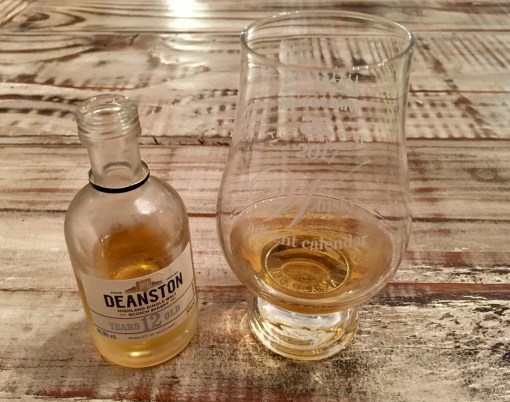
I am loving the confusion-inducing no-frame-of-reference newcomers in the 2017 KWM Calendar.  I am almost certain that this is the second offering in a row that has not even seen a sister bottling or other distant relative in any prior calendar:  the Deanston 12 Year Highland Single Malt rang exactly zero bells for me, although I did note that you could not ask for much more of a presentation contrast as compared to yesterday.  Some graphic designer actually worked on this bottle, and Deanston’s website is so slick that you instantly figure this must be another one-off distillery recently subsumed by a massive beverage giant.  And you would be right.

IMG_7110

As a distillery, Deanston is only a half-century old (and 8 of those years were spent not operating, so they may not count), but the distillery gets its history from its structure, a legendary shuttered cotton mill built in 1785.  After the mill closed in 1965, the distillery used its skeleton to start up business, releasing its very first single malt nine years later in 1974…and then ceasing production eight years after that.  The mill probably had a better track record.  In 1990, Deanston’s sold to a distilling conglomerate that is now part of the Distell Group, a South African-based giant which owns many many many alcoholic things (including the ubiquitous Obikwa and Two Oceans wine brands, among dozens more).  Not quite an old mill story anymore.

Deanston’s 12 Year offering is a beautiful deep amber colour after marinating in ex-bourbon casks.  The normal bourbon-induced sweet vanilla aromatic bounty doesn’t fully show up on the nose though, replaced by salt licks and a grainy mealiness, lightened by honey and flowers and sharpened by oolong tea.  Just like yesterday’s Cadenhead’s 12 Year, this one is gritty and biting on the tongue, almost even tannic, filled with cedar shavings and dust circling around frozen peach, burnt angel food cake, topsoil and butterscotch.  It has a similar blue-collar feel to the Cadenhead’s (or, more accurately, the Dailuaine-Glenlivet bottled by Cadenhead’s), but it’s nowhere near as evocative.  Not a disappointment for its $70 retail price tag, but not an overreacher either.


KWM Whisky Advent Calendar 2016: Day 25

25 12 2016

Well, another Christmas is in the books, another Advent officially over, and another Whisky Advent Calendar now sadly, mercifully empty.  Over the past 3 Decembers I have written 74 different whisky reviews on 74 consecutive Advent days, expanding my whisky knowledge and probably seriously irritating all of the blog’s wine readers in the process, and while I’m not sad the mandatory daily reporting experience is over for another 12 months, I always look back on this calendar and appreciate all the work that must have gone into it.  Andrew Ferguson and the Kensington Wine Market do yeoman’s work every year to source a whole new set of never-used miniature whiskies so that every Whisky Advent experience can be fresh and interesting; it must be extraordinarily demanding and tiring, but every year it pays off.  Well done.

fullsizerender-519

I’d be curious to know what your favourite bottles were in the 2016 calendar and how closely they line up with my list of Whisky Advent award-winners, the creme de la creme of this year’s Advent for me:

  • Best Value Dram:  BenRiach 12 Year (Day 4) — BenRiach is starting to own this spot, as its 10 Year won this same award last year.  $80 may be stretching the value whisky category to its limit, but this bottle delivered magic for that price and tasted like it cost well into the three digits, so I’m sticking to it.
  • Honourable Mention:  Hyde 10 Year Irish Whiskey (Day 9) — I loved this bottle and had it on the podium until the very end of deliberations.  Probably the best Irish whiskey I’ve ever tasted, and one that shows just how much potential that category has.
  • 3rd Place:  Ardbeg Uigeadail (Day 7) — Can I look you in the eye and say that this tastes “good”, by any traditional description?  No.  But it has depth and soul and identity, and it draws you in and leaves its mark on you, which is both rare and worthy of recognition.
  • 2nd Place:  Kavalan ex-Bourbon (Day 19) — Predictable, perhaps, but no less deserving.  An absolutely beautiful dram giving a glimpse into how Asia may soon be rising to the pole position in the whisky world.
  • 1st Place:  Gordon & MacPhail’s Connoisseurs Choice Tomatin 1997 (Day 1) — Since when does the very first whisky in the calendar end up being the best?  It may be a bit anticlimactic on Day 25, but I liked the choice to start strong back then and I like it now.  This was absolutely the most enjoyable whisky of the month, with sneaky quality to back it up, made most evident by its amazing length and flavour development.  Amazing stuff.

Not sure why the first 10 days of the calendar seemed to dominate this year (last year’s picks were from all over the place), but these conclusions in retrospect match what I’ve felt contemporaneously while opening the calendar each day – a great start, a bit of a momentum lag in the middle third of Advent, and a recovery heading into the finish.  Thankfully the calendar ends on a high (and large) note, with a double-sized cask-strength monster offering from the Scotch Malt Whisky Society (SMWS), who obviously understood that what we needed most after 24 days of Whisky Advent was a stiff drink.

fullsizerender-518

The SMWS is like an independent bottler crossed with a subscription whisky club:  they buy hand-picked single casks of whisky from a variety of top distillers, bottle them under their own labels (always with eye-catchingly descriptive names) and then sell them only to their own members at club-level prices.  If you’re not a SMWS subscriber, the only way you may be able to taste these whiskies is through this very calendar, so bring it on.  This year’s Christmas whisky is Society Single Cask No. 41.78, “Poker Night Whisky”, bottled at an abjectly terrifying 60.4% in an attempt to murder us all.  It has been aged for 11 years, but I know nothing else about it, not even the area in Scotland where it was made.  I can confirm that it smells incredible, however, a near-tropical mixture of cantaloupe, watermelon, sweet peas and honey.  If you don’t add water to this your throat will likely implode, but once you do you’ll be able to look beyond the alcoholic hellfire and notice the layers of lime zest, bakers’ chocolate, burnt orange and cinnamon, laid over dirtier notes of topsoil and sweat.  The finish is a little raspy, but if you were 61% alcohol you’d be a little raspy too.

Merry Christmas to all, thank you so much for reading this month, and I am DEFINITELY not blogging tomorrow!


KWM Whisky Advent Calendar 2016: Day 24

24 12 2016

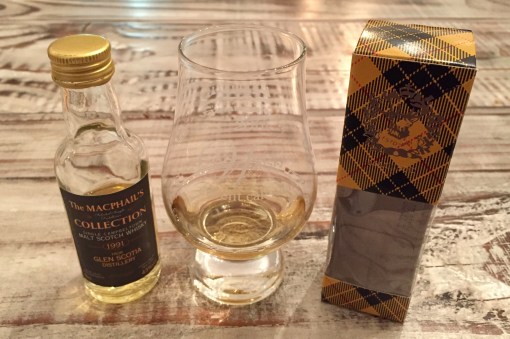
Merry Christmas Eve, everybody!  Hopefully by now the stockings have been hung and the parents can start turning their attention to more important things, like booze.  Back in my first year of KWM Whisky Advent, the December 24th bottle was the end of the line and thus the one everyone waited for the whole month.  This year we get an extra bonus whisky tomorrow, but it’s a special Scotch Malt Whisky Society bottling and is double-miniature-sized, leaving tonight the final standard-format calendar bottle. And it delivers, at least in packaging (every scotch should be sold in a bright tartan box) and age designation (distilled 25 years ago in 1991!).  It is yet another Gordon & MacPhail offering, but from a heretofore unseen line:  The MacPhail’s Collection, a small range from a select line of distilleries (7 in all at the moment).  One of them is Glen Scotia, an ancient distillery located at the tip of the Campbeltown peninsula in southwest Scotland.  Campbeltown isn’t a huge scotch area, known mainly for Springbank and its sister distilleries, so it’s no massive surprise that this is the first whisky from the region we’ve seen in Advent 2016.  One of Glen Scotia’s claims to fame, other than being sold a trillion times and failing in the early 20th century like basically every other whisky producer, is that it’s haunted by the ghost of a prior owner, who drowned himself in Campbeltown Loch after losing everything he had in a bad business deal (hopefully not the purchase of the distillery itself, but you can’t rule that out).

fullsizerender-517

The full title of this bottle is The MacPhail’s Collection 1991 Single Campbeltown Malt Scotch Whisky from Glen Scotia Distillery, but unlike every other whisky so far in 2016 Whisky Advent, there is no other information about it anywhere.  It is only for sale at KWM in mini-bottle format (for $24, suggesting that it would be a $300+ full-sized bottle) and not otherwise available; it is not mentioned on the Gordon & MacPhail site; and it is not available for sale at any online shops I could find, even in the UK, except in miniature form.  Weird.  It’s not as dark as you might think for a 25 year old whisky (although it may not be a 25 Year whisky for age designation purposes if it was bottled a while ago, as age labelling is based on time from distillation to bottling) but carries a pure, malty nose of golden raisin, plum, fresh pear, sourdough bread and trail mix, with a hint of fitting Christmas fruitcake.  However, it then takes a left turn and goes surprisingly sharp, rubbery and industrial, filling the mouth with not-altogether-enjoyable tastes of tennis balls, permanent marker, elastic bands and shoe treads; these factory-floor notes and the whisky’s spiky alcohol combine to nearly overwhelm spicy underlying notes of rock salt, caraway and fennel.  Interesting?  Yes.  Pleasant?  Not entirely.  See you at the 2016 calendar finale, and at Christmas!!


KWM Whisky Advent Calendar 2016: Day 23

23 12 2016

GlenDronach!  Peated!  I’m always fascinated by peated expressions of traditionally non-peated whiskies (which encompass almost all whiskies distilled anywhere other than the Islay region of Scotland), particularly when the whisky in question is one with which I am otherwise very familiar.  My old calendar friend GlenDronach, as recently covered in Day 18, is an Advent stalwart, having shown up (quite successfully) four previous times in the last three years; those prior releases unveiled the bulk of GlenDronach’s core range, but all of them are entirely unpeated, making tonight’s further core entry a category of its own for the distillery.  GlenDronach decided to release a Peated expression fairly recently as a nod to how the distillery used to make whisky back in the 19th century, although since its founding in 1826 it’s been a sort of rocky road until recently.  Stop me if you’ve seen this kind of Scottish distillery timeline before:  sold 1830, sold 1920 (to the son of the founder of Glenfidditch), sold 1962, mothballed 1996-2002 (not that long ago!!), taken over 2005 (by Chivas), taken over 2008 (by BenRiach, who makes some pretty awesome whisky in its own right and has presided over a highly impressive GlenDronach resurgence in the past 8 years), taken over (along with BenRiach) earlier this year (although so far the same folks have been left in charge).  No job security in whisky-making.

fullsizerender-516

The peating in GlenDronach’s first ever (modern-day) peated offering is done…pleasantly?  Is that a thing?  The peat effect is definitely noticeable, but far from in-your-face, adding aromatic traces of lantern oil, sweet compost, old leather and moss to GlenDronach’s stone fruit and florals, which are otherwise not lost or mellowed in maturation in this younger non-age-designated malt.  The palate is similar, part oily and part sweet, either adding perfumed refinement to the peat’s underlying funk or adding some necessary grime to an otherwise potentially too-pristine Highland whisky, depending on how you look at it.  The result is a little bit of everything:  pistachio pudding, suede jackets, distress flares, car exhaust, marmalade, apple crisp…I could keep going.  What a value at $83.  Can’t wait to see what Christmas Eve has in store!


KWM Whisky Advent Calendar 2016: Day 22

22 12 2016

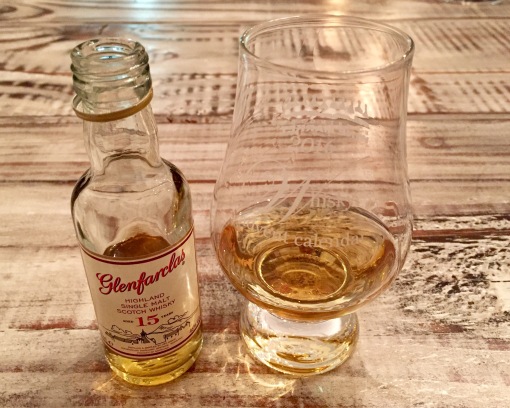
I have started to think of Glenfarclas as the official mascot scotch (mascotch?) of the KWM Whisky Advent Calendar, after 2014’s special Christmas Eve 40 Year and 2015’s Christmas Eve redux 25 Year, not to mention two other entries in calendars past.  I was sort of wondering if we’d see a third straight December 24th whisky from the distillery, but I also suspected we were starting to run out of super-old Glenfarclas releases to slot in that esteemed end-of-calendar spot.  Well, it got Day 22 this year, with the notably younger $95 15 Year Single Malt – still a respectable position if not an exalted one.  Glenfarclas is one of the few pre-20th century distilleries not to be shut down or sold to a gigantic beverage empire in modern times, owned by the Grant family since 1865 when patriarch John Grant bought it for just shy of £512.  That sounds astoundingly cheap even in 1865 money, and it is:  it equates to around £59,000 today, or around $98,000 CAD.  Nice buy, John.  We are now six generations of Grants (all of whom have been named either John or George) into the family’s stewardship of Glenfarclas, which is known for producing one of the classic examples of Speyside whisky out of the region’s largest stills.

fullsizerender-515

To obtain the legal designation of “scotch whisky”, a spirit has to (1) be aged in oak casks (2) which are no larger than 700L (3) for at least three years (4) in Scotland.  Glenfarclas uses both plain new oak casks (which we haven’t heard much of in this year’s calendar) and ex-Sherry casks (with which we have been bombarded by this year’s calendar, and by the whisky industry in general), and it is definitely known for its emphatic use of the latter.  The 15 Year is a glimmering dark amber colour reflective of its barrel time and has a few different aromatic identities:  confectionary (butterscotch chips, and nougat, like the inside of a Three Musketeers bar), nutty (almonds, oatmeal), herbaceous (corn husks, grass).  Bold and fiery as soon as it touches the tongue, this is not messing around, slinging toast and spice, banana Runts, mandarin orange, Americano, char and vegetal flavours with authority and powering into a lacquered finish.  It is punchy and powerfully concentrated, coming across like a cask strength whisky despite its 46% abv.  Mammoth scotch.


KWM Whisky Advent Calendar 2016: Day 21

21 12 2016

Into the 20s, guys.  Five days left – and we start the final countdown to Christmas with a mystery.  I pulled out an old-school-looking bottle of Stronachie 18 Year Small Batch Release and thought:  “Cool, another lesser-known distillery find.”  Then I saw the A.D. Rattray logo, last seen in Day 14 with the independent bottler’s Cask Islay release, and thought:  “Cool, this must be like their Distillery Label series”, similar to fellow independent bottler Gordon & MacPhail’s collaborative set of releases with smaller producers tasted in Day 8 and Day 16.  Then I saw the tiny notation in the top right corner: “Distilled at Benrinnes Distillery”.  Um, what?  That’s one label headliner too many.

fullsizerender-514

Here’s the story.  Stronachie IS a lesser-known distillery…but it’s lesser-known because it was mothballed in 1928 and destroyed in 1930.  It was first built in the 1890s in a (questionably chosen, in hindsight) remote, nearly inaccessible mountain location that required the construction of a 5-mile private railway just to get the spirit to a transportation route.  The initial distributor of Stronachie was actually a relative of A.D Rattray, and in the early 2000s, consumed by curiosity about the distillery, Rattray’s present owner bought at auction a bottle of Stronachie that was distilled a century prior, in 1904, one of only 4 bottles left in the world.  After tasting it (props to them for actually opening it), Rattray then embarked on a project to try to re-create the historic distillery’s flavour profile using spirit from a similarly situated high-altitude producer.  It’s one part honourable and one part creepy, like going from trying to commune with your dead aunt via seance to building your own effigy of her for your living room, but it is certainly bold and unique, two things I don’t get to say enough about the whisky world.

Benrinnes is another distillery that often does its work anonymously, not often receiving the single malt attention, which makes me feel sort of bad that it’s getting this particular star treatment as a sort of tribute cover band for another producer that’s been closed for 88 years and a pile of rubble for 86.  Its faux-Stronachie 18 Year was aged in a combination of ex-Bourbon and ex-Sherry casks (which is becoming the main maturation theme of Whisky Advent 2016) and smelled as pleasantly old-fashioned as it was probably supposed to, mixing saltwater taffy, unsweetened licorice, smoke and bitter orange.  Smouldering and long-acting on the palate, its flavours are almost on delayed release, starting spicy and peppery but then blooming into vast florals, citrus fruits, hickory, creme brulee and candied ginger.  In spite of that it never gets away from itself, staying straight-laced and minding its manners, like the quiet distillery up on the mountain that’s now nothing but a ghost, kept alive through loving tribute.


KWM Whisky Advent Calendar 2016: Day 20

20 12 2016

As we near the finish line of 2016 Whisky Advent, we’re coming a bit full circle, back to the distillery (if not the bottler) that brought us Day 1.  We started off Advent with Gordon & MacPhail’s take on a Tomatin whisky, and tonight we let the distillery speak for itself, continuing the calendar’s now-three-year streak of Tomatin releases, after 2014’s blasé 18 Year on Day 12 and 2015’s awesome Port-aged 14 Year on Day 17.  The difference between those bottles and this one is twofold:  this one is cask strength, as the largest capitalized letters on the front label tell you, and it also has no age designation whatsoever, suggesting that it’s probably too young to market as a number.  The $73 price tag would go along with that theory.  (Incidentally, if you’re a whisky spendthrift, you should probably focus your scotch dollars on cask strength whiskies — you get the same volume of whisky at up to 50% higher alcohol, without a price premium in many cases, and when you pour yourself a serving you have to add water to it, something the distillery does itself to get its non-cask strength releases down to 40% or 46%.  In other words, you often pay the same price for post-dilution bottles as for pre-dilution bottles which you then dilute yourself, giving you way more whisky concentrate for your money at cask strength.)

fullsizerender-513

This bottle’s packaging is an exercise in earnest oxymorons:  lilting italic script informs you that this whisky represents “The Softer Side of the Highlands”, immediately below the double-sized block letters stating “CASK STRENGTH” and immediately above the 57.5% abv listing.  I could describe this whisky in many different ways and it would not end up on the softer side of anything.

This is Tomatin’s first cask strength bottling in its core range of whiskies and saw (an unknown amount of) time in a combination of Bourbon and Oloroso Sherry casks before being bottled.  It was a fairly eye-catching dark golden wheat colour for a bottle coy about its age, yet unlike most whiskies which are aromatically the sum of its parts, this one just smelled like the parts, like barley and barrel and fermentation:  malt, grain, yeast, spice, salt, seawater.  You then completely forget about that, and everything else, once this Tomatin hits your tongue and your brain starts bubbling like it’s on a griddle.  The whisky is massive, overwhelmingly lush and nearly gelatinous in texture, to the point where it almost doesn’t even feel like a liquid.  A strange mixture of honey, baby oil, firewood, shortbread, spackle, flaxseed and rye bread, it is a raging beast of decidedly cautious flavours, a meek monster.  On an oddly bitter yet sweet-tinged finish, it leaves me with no other concluding thought than:  this is just so weird.