Whisky Advent Calendar 2015: Day 8

8 12 2015

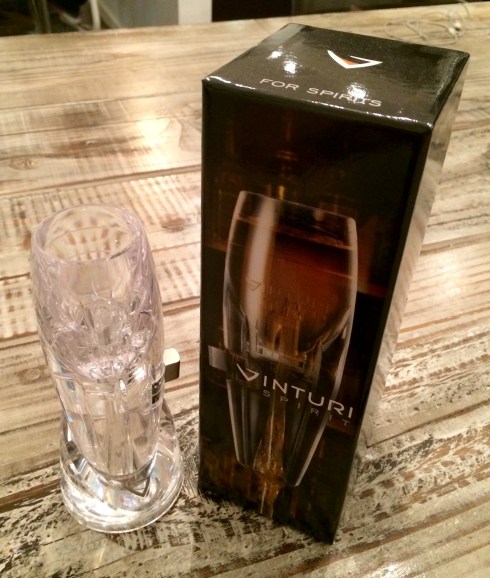
Time for a twist to start Week 2 of whisky Advent.  I was recently asked if I did whisky reviews, responded something to the effect of “um, sort of” and was given a spirit aerator from Vinturi for use with this year’s calendar.  You may know the Vinturi from the wine side:  it’s that intricate hard plastic funnel that insta-aerates any liquid that passes through it and into your glass, a sort of hyper-decant to open up tight wines in seconds rather than hours.  It’s one of the few wine gadgets that I actually use semi-regularly, not for the special occasion good stuff (which I like to see unfurl gradually), but for weeknight bottles that seem closed off when I first crack them.  I get why it works for wine, a drink that is highly susceptible to, and highly influenced by, oxygen from the second it is first exposed to it, at first in a good way (some air time softens and opens wine and releases packed-in flavours) and then in a very not-good way (too much air flattens and oxidizes wine and ultimately ruins it).  But spirits?  Once something is distilled and cranked up to 50% alcohol like tonight’s scotch, wouldn’t oxygen exposure cease to matter to it?  Once its maturation is done and it is freed from barrel and bottled, isn’t its flavour development over?  You never protect your whisky bottles from oxygen once you open them, and they never seem change even after months or years in an unstoppered bottle, so I was unsure how the wine-based premise of the Vinturi would carry over.
FullSizeRender-182
The guinea pig whisky for this aeration experiment was the Glenglassaugh Evolution, a Highland Single Malt from a distillery that was shut down and mothballed in 1986, only to be surprisingly salvaged and re-opened in 2008.  For the second day in a row we have a repeat producer from last year’s calendar; Day 7 of 2014 featured the Glenglassaugh Revival, the first scotch released after the distillery’s (literal) renaissance.  Weirdly, the 2015 offering from yesterday’s first repeat calendar producer, GlenDronach (Day 7 of 2015!), was also called Revival.  I’m hoping that was intentional.  Tonight’s Glenglassaugh is the SECOND scotch released after the distillery re-opened its doors, called Evolution, which holds the distinction of being the first whisky I’ve tried that was matured in ex-Tennessee Whisky barrels.  Seeing “Tennessee” displayed on a bottle of scotch takes some getting used to.

Read the rest of this entry »


Whisky Advent Calendar 2015: Day 7

7 12 2015

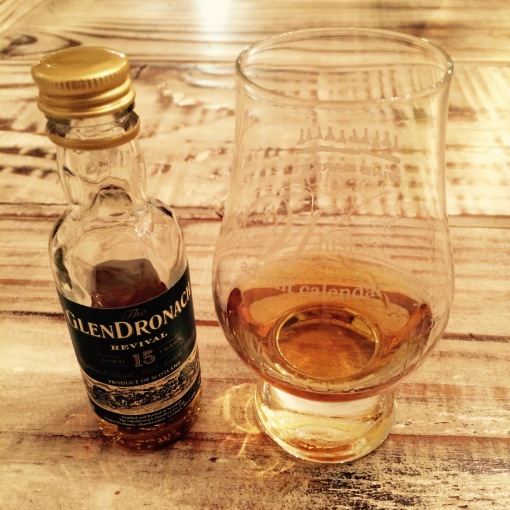
Fresh off a tasting of 13 Austrian and other Gruner Veltliners in 2 hours, I am doing an alcoholic 180 and re-centering on scotch, at least far enough to get 400 words out.  Ah, the trials and tribulations of a booze geek.  I believe tonight’s Advent scotch marks the first time that the 2015 Kensington Wine Market Advent Calendar has repeated distillers from the 2014 Advent Calendar.  Last year featured two different whiskies from the GlenDronach distillery:  the 18 Year Allardice, which I didn’t like too much, and the 21 Year Parliament, which was my favourite whisky of the whole calendar and which I promptly went out and bought after Christmas.  (You should too – it’s obscenely good.)  This is the younger brother of those two, the 15 Year Revival, and its relative youth is reflected in its sticker price, an impressively affordable $102.  GlenDronach is a Highland distillery that has been owned by BenRiach since 2008 and is known, at least according to itself on its website, for richly sherried malts.  You may or may not remember this from last year, but the 2014 calendar was so overloaded with Oloroso sherry cask-aged whiskies that it almost drove me to violence and left me with a massive case of Oloroso fatigue (until the Parliament came along and all was forgiven).  I think this is the first Oloroso-aged whisky of 2015; one a week is fine, so consider the allotment filled for Week 1.

FullSizeRender-180

This might be the most singularly delicious whisky I have ever tasted.  It’s not necessarily the most complex (although it does still have layers to it), but it is just so, so fantastically tasty, like every treat you love in the holidays packed together.  It is an incredible deep burnt amber colour — an Oloroso trait — and just radiates sweet treacle, gingerbread, cabane a sucre, brown sugar and clove, all Christmas baking all the time.  Weighty and soft on the palate, with alcohol that gently warms instead of obliterates, it rounds out the alluring flavour parade with orange zest, nectarine, toffee and coffee beans added to the warm embrace of sweet caramel glory.  There is just no reason not to buy this scotch; I want more right now.  KWM, save me some!


Whisky Advent Calendar: Day 6

6 12 2015

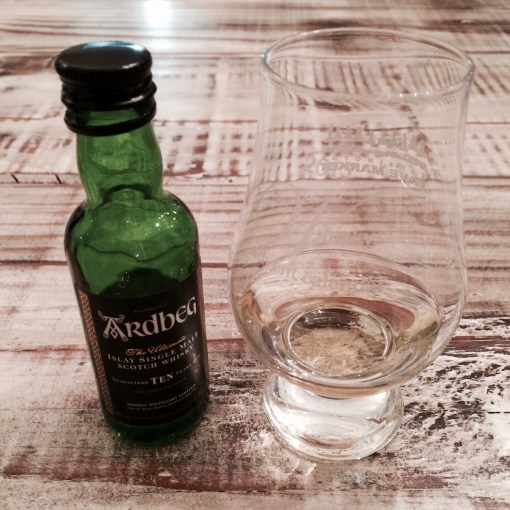
OK, fair warning.  I was out until 4 in the morning at an office Christmas party last night.  There was wine involved.  If there was ever a night to question the integrity of my palate and the quality of my insights, this is it; however, I felt bound by advent duty to forge onward with my whisky calendar mission and not be steamrolled by circumstance in week 1.  I just hoped I would open the little cardboard door and find a nice, mild, demure whisky to let my system off easy.  I got Ardbeg Ten instead.  F***.

I believe this is the 2015 calendar’s first visit to the notorious island of Islay, world Mecca of peated whisky and home to many distilleries unafraid to unleash it.  Ardbeg may be the most brazen of the lot, a producer that does not lack for confidence (their website says they are “unquestionably the greatest distillery on earth”) and has been accelerating the recent arms race to develop peatier and peatier whiskies with their borderline absurd Supernova.  Even this base 10 Year bottling (which goes for $80 and which the label calls “The Ultimate Islay Single Malt Scotch Whisky”, so again with the self-belief) is peated to between 55 and 65 parts per million, which is a whole hell of a lot; see here for a peat concentration scale for various distilleries, and you will note Ardbeg at the very top.

FullSizeRender-179

You can smell the peat leaching out of the Ten Year as you’re pouring it into the glass.  It is a rather nondescript light straw colour but radiates powerful, greasy, non-nondescript (descript?) aromas of leather, moss, shoe polish, sesame oil and seaweed, with a hint of citrus peeking through underneath.  There is a surprisingly sweet honey-maple attack on every sip that lasts for a millisecond before the peat hammer drops and layers on iodine, liniment, campfire, tar and struck matches, one after another after another.  At the end of that crescendo you get some baked apple and lemon curd fruit and anise and cinnamon spice, but they’re in the chorus line and not fronting the cast.  I will say that this isn’t the total blunt instrument that I partly expected and feared, holding back a bit on the brute force in approach and demonstrating some level of dexterity with how the peat is presented.  That said, there’s basically no way that people who dislike this style of whisky will enjoy this scotch; there’s really no unwinding peat from Ardbeg.  Please have some pity on me tomorrow, calendar.


Whisky Advent Calendar 2015: Day 5

5 12 2015

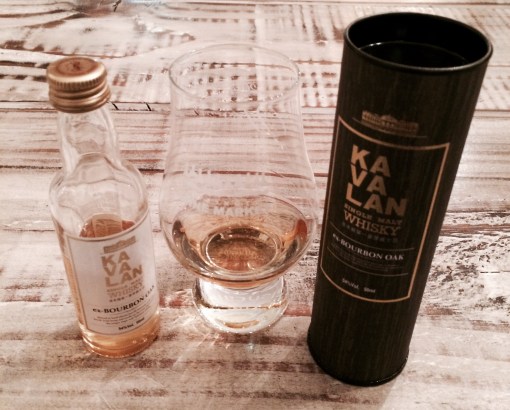
I have to head out of town overnight so I’m posting early, which means that I may be one of the first to alert you that Day 5 of the KWM Whisky Advent Calendar is a showstopper.  When it was first announced that this year’s calendar would contain an offering from Taiwan, I knew that could (literally) only mean one thing:  Kavalan, the first and only distillery in this small Asian nation.  Kavalan has only been around for 10 years, since 2005, but in that short span of time it has basically set the whisky world on fire and danced on the smouldering ruins, culminating in this year’s announcement that its Vinho Barrique malt (which I own and is spectacular) had been named the world’s best single malt whisky by the World Whisky Awards.  How can a distillery that just hit the decade mark be churning out world elite scotches so quickly?  (Remember, single malt whiskies have to be distilled solely by their producer.)  Don’t top whiskies usually need a long time to mature and develop their complex flavours?  Not in Taiwan.  Like the roasting hot Bourbon aging warehouses in Kentucky on warp speed, Kavalan gets extreme flavour transference and development during maturation in record time due to the heat and humidity almost always prevalent in the country, which speeds up both water evaporation and the reaction between spirit and barrel wood, resulting in concentrated, deeply coloured, layered whiskies after only a few years.  That sounds too good to be true for the distillery, but it’s real.  You have to taste it to believe it.

FullSizeRender-178

This is a cask-strength (54% abv) rendition of the Kavalan ex-Bourbon Oak Single Malt Whisky.  I have to start by noting that the (stunning) packaging tube for this whisky identifies its colour as “Cattle egret”.  Cow heron!  I would have said “deep golden”, but sure.  You almost have to add water to drink this dram pleasurably, lest it otherwise Novocaine your entire tongue and eradicate your stomach lining.  This is one of those whiskies you can smell all day, due less to incredible complexity than to an immediate and easy, almost languid appeal:  brown sugar, white flowers, honey, Amaretto, fresh peach, kettle corn.  You feel like you should be floating down the Mississippi on a raft in the summer sniffing it.  That emotion only elevates when you taste it, as the unabashed sweetness from the bourbon barrels lend instant pleasure to the downright delicious flavours of coconut, baked apple, Corn Pops, vanilla bean and what I’ll call “caramel macchiato”, part burnt sugar, part creamy steamed milk, part roasted coffee.  This is pure joy in a (cask-strength) bottle.  We’re treading into premium territory now in the $140 range, but damned if you don’t get premium results for the price tag.  This is just achingly good.


Whisky Advent Calendar 2015: Day 4

4 12 2015

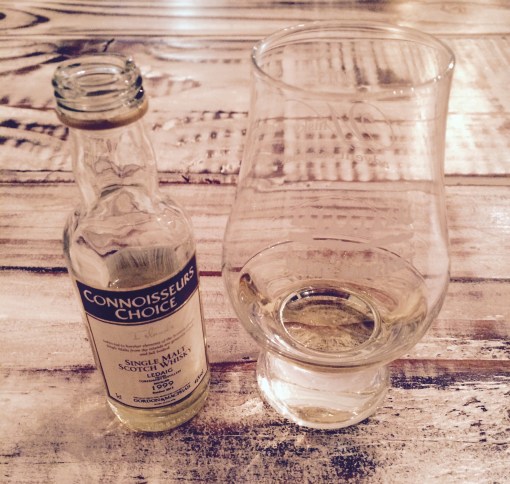
It’s times like this that I sympathize with people who think whisky is confusing.  The full title of tonight’s scotch is:  Gordon & Macphail Connoisseurs Choice 1999 Ledaig (from Tobermory Distillery) Single Malt Scotch Whisky.  Good luck with that.  Let’s unpack.  Remember when I said yesterday that whisky from any particular distillery in Scotland gets around and how some companies act as negociants sourcing pre-made whisky from elsewhere and then bottling it themselves?  The Ubermensch version of those companies are the independent bottlers, whisky brokers extraordinaire, who release from dozens to hundreds of different whiskies under their own labels, but who (unlike the artisan blenders like Wemyss from yesterday) also provide the details of the source distillery on the label.  So you might be able to get a 12 Year malt from a certain distillery’s own label but then also get a 12 Year malt from that same distillery under an independent bottler’s label.  It’s weird.  Gordon & Macphail is one of the pre-eminent independent bottlers of scotch whisky, with over 300 single malts in its lineup, and its Connoisseurs Choice portfolio is an array of rare single malt whiskies from various distilleries, many of which would not otherwise offer a single malt expression.  This particular bottle comes from the lesser-known Ledaig distillery, which changed its name to Tobermory Distillery a few decades back.  So the label name above reads [Independent Bottler] [Portfolio Name] [Vintage Date] [Old Distillery Name] [Current Distillery Name] Single Malt Scotch Whisky.  Good thing it’s tasty.

FullSizeRender-177

This is the first unabashedly peaty scotch in the calendar, to the point where you might think it comes from the peat haven of Islay, but Tobermory is in fact located on another island just north called the Isle of Mull (which I’m secretly hoping is where mulled wine comes from).  The label just says “Islands”, possibly because the Isle of Mull isn’t trendy enough to get its own mention.  The Ledaig was a disarmingly pale greenish colour that displayed no visual hints of the power to come.  However, the first sniff brought an immediate blast of peat-induced scents:  mechanic’s shop, diesel oil, catcher’s mitt, shoe polish, funk, but also hints of sweet tropical fruit that kept the whisky from coming across as harsh or dirty.  The taste was both beautiful and old school; charred, smoky and medicinal, reminiscent of cigars and old leather armchairs, but also bright and spicy, with candied pineapple, crystallized ginger and Bananas Foster.  There’s almost some furriness to the texture too (from the wood tannin of the aging barrels, I would guess), which adds to the whole sensory experience.  The priciest whisky to date at $120, it’s worth every penny.  Currently in the calendar pole position, without question.


Whisky Advent Calendar 2015: Day 3

3 12 2015

Third day of the calendar, second whisky I have never heard of, first blended malt.  You may remember from yesterday that a single malt scotch means one whose component spirits have been distilled in a single distillery; it may therefore not come as a surprise to learn that blended whiskies are those whose component spirits hail from different distilleries and are blended together.  Blended malt whiskies are blends whose components are entirely whiskies made from malted barley as opposed to other grains and are generally seen (not always rightly) as superior to “blended whiskies”, which can be a mix of malt and grain whisky.  Phew.  Some producers, like tonight’s, don’t make their own spirits at all, but instead act sort of like wine negociants, sourcing whiskies made from various distilleries and then using them to create and bottle their own custom blends.  As whiskies seem to transfer and flow across producers much more often in the scotch world than in the wine world, this is neither a bad nor an uncommon idea, and many of these blending specialists create killer drams at highly reasonable prices.  A bottle of the Wemyss (pronounced “Weems”) Malts The Hive 12 Year Blended Malt Scotch Whisky will set you back $77 at KWM; not too shabby for a scotch of that age.

FullSizeRender-176

Wemyss Malts have a trio of blended malts in their profile which they have set up to meet three different flavour profiles:  Spicy, Peaty, and Honeyed.  Guess which one The Hive is meant to represent?  The bee on the label pretty much says it all.  Yes, this is the Honeyed Malt, made from a variety of malts from Speyside, and apart from a questionable dalliance with sherry casks (who tastes sherry and thinks “honey”?), it accomplishes its flavour mission fairly well.  It is a gorgeously dark, burnished amber colour and smells immediately of honeycomb (natch, though I swear I wrote that note before reading about the whole Honeyed Malt thing), salt lick, Brie cheese (thanks, sherry) and cedar, with a hint of leafiness on the fringes.  Despite being by far the lowest abv whisky in the calendar so far at 40% the alcohol flares almost immediately on the palate, somewhat obscuring the viscous, almost oily texture and sweet flavours of the scotch; I’m not sure why it can’t keep itself in check better or if the balance is off somehow.  Once you get past the boozy heat there’s a pleasing confectionary array of maple, butterscotch ripple, cream soda and, yes, honey, with layers of celery salt, mesquite and tree bark lurking underneath.  It’s unquestionably tasty, but due to its inability to successfully harness the lowest alcohol level you will commonly see in a whisky, I have to think it’s a bit of a step down in quality from the last two days.  Rocking label though.


Whisky Advent Calendar 2015: Day 2

2 12 2015

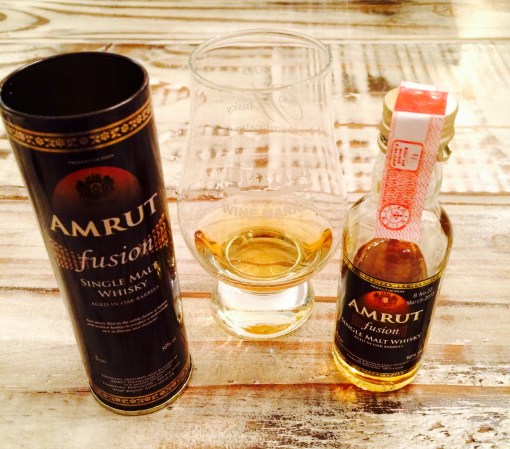
Yesssssss!!!  I have literally been waiting a year for this day.  In my closing comments about the 2014 KWM Whisky Advent Calendar, I humbly suggested that the 2015 edition include more international whiskies:  “I’d love to see Japan, Taiwan, and even India show up in next year’s edition.”  Day 2, 2015?  Bam.  Amrut.  That’s what I’m talking about.  Amrut is a brand (basically THE brand) of single malt whisky from India, home of the very first malt whisky ever made in that country.  The name Amrut comes from a Sanskrit word meaning “nectar of the gods”, which, I mean, exactly, right?  This particular bottling from Amrut, called Fusion, is the first intercontinental whisky I have ever come across:  it’s made from a mixture of barley from India and peated barley from Scotland, which is separately distilled in Amrut’s facilities in Bangalore, aged in American oak barrels and then blended for bottling.  If you’re wondering, it can still be called a single malt whisky despite its multinational origins because the “single” in “single malt” refers to a single distillery rather than a single site, grain or production year.  The “west west west” and “east east east” emanating out of opposite sides of the word “fusion” on the label and tube is just priceless.

FullSizeRender-175

Amrut Fusion gained some fame and notoriety in 2010 when Jim Murray’s Whisky Bible named it the 3rd best whisky in the world.  Of course, that same publication just named Crown Royal Northern Harvest Rye the best whisky in the world this year, so do with that as you will.  There is something to be said for this Fusion, however.  It is a beautifully deep, lush golden colour and smells undeniably pleasant, mixing honey, wheat, blood orange, apple crisp and toffee beneath a slight whiff of mossiness.  At 50% abv, it is immediately fiery on the palate and needs a few drops of water to open it up, after which it comes out rich, round and spicy, even peppery, but bursting with vanilla, lemon drop, pineapple and almonds.  I didn’t get as much peat as I was expecting from the Scottish half of the Fusion equation, just a lingering sense of smoke after I swallowed.  At a bargain $76, I could definitely see myself buying this.  Cross Amrut off the bucket list!


Whisky Advent Calendar 2015: Day 1

1 12 2015

Alright team, let’s do this.  December 1st has arrived, and that means a daily invasion of whisky on this blog until Christmas.  For those of you who frequent Pop & Pour for wine reviews and insights, (1) thank you!, and (2) I am so, so sorry…it’s about to get a little spirit-y up in here for most of the rest of 2015.  Yes, it’s KWM Whisky Advent Calendar time, my second year in a row partaking in the magnificent scotch-soaked creation of Kensington Wine Market and its resident whisky guru (and now owner!) Andrew Ferguson.  Every night you count one more day closer to Christmas, open a little cardboard door, pull out a new and exciting mini-bottle of distilled glory (all different from last year’s calendar, I might add), and turn to drink – the true essence of the holidays.

Bring on December.

Bring on December.

This year’s calendar starts on a note of intrigue:  a scotch I have never heard of before.  Balblair Distillery, based in the Highlands, was established in 1790 but has successfully escaped my notice for 225 years.  Their signature move appears to be releasing vintage-dated scotches, so instead of seeing a more general age designation on the bottle (10 Year, 12 Year, etc., which number indicates the age of the youngest whisky in the bottle’s multi-vintage blend) you get wine-style labels with single calendar years on them, presumably meaning that all of the whisky in the bottle was distilled in that same year.  Tonight’s lead-off bottle is the Balblair 2003 Highland Single Malt Scotch Whisky, a 12 year old malt that Balblair’s distiller released concurrently with the 1990 and 1993 – no whisky goes out to market until he says it’s ready.

FullSizeRender-174

I would call this highly pleasant (I just finished my glass and I immediately want more) without being highly memorable (I just finished my glass and if I hadn’t written tasting notes I wouldn’t be able to tell you what this tasted like).  It’s an interesting greenish lemon-straw colour, not overly deep, and initially smelled predominantly of spice — and not just cinnamon and baking spice, but cayenne and other savoury spices — before calming down and opening up to more approachable salted caramel, vanilla bean and candy corn peeking through the grainy, mealy, grassy surface.  This same contrast of restraint and generosity continued on the palate, which starts out green celery and spearmint before blooming to melon, orange peel and honey and finishing soft and sweet.  At $88, I could see this being somebody’s house scotch.  Not sure I’ll remember much about it come Day 7 or 8 though.  Onward!


Whisky Advent Calendar: Day 24

24 12 2014

Well, the stockings have been hung by the natural gas fireplace with care, and I have officially completed whisky Advent.  Thanks to all those of you who have read along to date – I can quite confidently say that you will not be seeing a post on PnP tomorrow, so enjoy this one!  The KWM Whisky Advent Calendar comes to a close with a bang, delivering the promised 40 year old dram in the form of Glenfarclas’ 40 Year Highland Single Malt.  This scotch comes with a $720 price tag (actually a strong value for the age of the whisky involved) and with a number of critical accolades, having been hailed Whisky of the Year by Malt Advocate.  It’s Glenfarclas’ second appearance in the calendar; it previously tried to destroy your mind with its 60% abv bottling Glenfarclas 105 on Day 6.

The one you've been waiting for.  First calendar whisky older than me.

The one you’ve been waiting for. First calendar whisky older than me.

The GF 40 certainly delivers, albeit not in a way that will embed itself on your psyche for years (or even weeks) afterward.  It is a deep amber in colour, although not deep enough to immediately give away that it has spent four decades in a barrel.  The aromas are mellow and meandering, maple syrup and marzipan, smoke, apple cider and Meyer lemon.  It is soft and warming on the palate, opening up discernibly with a couple drops of water and featuring a complex yet subtle array of flavours:  honey, vanilla and florals, orange zest, green grapes, dark rum and a dry heated wood note I can best describe as “sauna”.  It isn’t life-changing, but it’s extremely well put-together, an experience to drink if not a lasting memory. Read the rest of this entry »


Whisky Advent Calendar: Day 23

23 12 2014

Three posts in less than 24 hours?  I’m officially on Christmas holidays, so why not?  Kensington Wine Market’s Whisky Advent Calendar advertises on the box that one of the included whiskies is more than 40 years old; I haven’t seen it yet and it wasn’t behind door #23 tonight, so I know what awaits on Christmas Eve!  Unfortunately, the penultimate whisky in the calendar is nowhere near as exciting, and it kills any buzz that might have been built up by the incredible GlenDronach Parliament yesterday.  Not that it’s horrible or anything; it just…is.  It’s a Day 6 whisky instead of a Day 23 whisky.

Not necessarily the way to bring it home.

Not necessarily the way to bring it home.

“It” is the Auchentoshan 18 Year Single Malt, matured entirely in American oak bourbon casks.  This is Auchentoshan’s second appearance on the calendar, having previously underwhelmed with the triple-distilled, triple-matured 3 Wood on three-saturated Day 3.  The 18 Year isn’t going to make me run out and buy Auchentoshan anytime soon, but I will say that they have the absolute best website of any scotch producer I’ve come across this month.  Check out their stellar graphic (scroll down) explaining the ins and outs behind their unique triple distillation process (they are the only scotch producer to triple distill full-time) – that’s more info on distillation than my WSET textbook had.  Good stuff. Read the rest of this entry »


Whisky Advent Calendar: Day 22

22 12 2014

With a scant two days left in Advent after this, I feel like we’re finally hitting our stride scotch name-wise.  Three days ago I drank The Antiquary.  Yesterday I feasted on the gladiatorial glory of SEPTENDECIM!!!  And tonight it’s back to aristocratic class with GlenDronach’s 21 Year Highland single malt, simply called Parliament.  If you’re not going Latin, go governmental – I approve.  I hope GlenDronach has a Senate, Cabinet and Supreme Court in the lineup somewhere.

Just look at that colour.  #nofilter

Just look at that colour. #nofilter

This is the second GlenDronach whisky in the KWM Advent Calendar, following up Day 9’s disappointing (and disappointingly named) Allardice.  Believe me, after tonight, all is forgiven.  This is a top 3 calendar whisky for sure, maybe even higher.  It’s sherry-based and I don’t even care.  It’s fantastic.  And at $130, it is an absurdly smoking deal.  If any of you are my Secret Santa this year, I know what you can get me.  (Quick tip:  add a bit of water to your dram – at 48%, it’s a little much to have on its own.) Read the rest of this entry »


Whisky Advent Calendar: Day 21

21 12 2014

Last night I delicately expressed some annoyance at the third appearance of a distillery (Springbank) in a 24-day Advent calendar.  Consider that foreshadowing for tonight, when it happened again.  At least the Springbank whiskies were split between three different sub-labels, but tonight’s whisky completed a one-label BenRiach trilogy:  first there was BenRiach 16 back on Day 2, then there was BenRiach 20 on Day 11, and now there’s the hilariously named BenRiach Septendecim, a 17 Year Single Malt from Speyside.  “Septendecim” is Latin for “17” and continues a calendar tradition of whiskies being given extraordinarily wordy and complex names for no particular reason.  It certainly got my attention.

Everything looks more impressive in Latin.

Everything looks more impressive in Latin.

The coolest thing about the Septendecim (which feels like it should be written in capital letters at all times – SEPTENDECIM!!) is that its a (heavily) peated whisky from Scotland’s Speyside region, an area that is almost never known for peat.  The other two BenRiachs in the calendar are much more typical Speyside, light and sweet and clean as a whistle.  This one is flat out dirty:  you can smell the peat even as you’re pouring the first glass.  It also has my eternal gratitude for not letting a single drop of whisky touch a sherry cask — this is all ex-Bourbon barrels all the way.  Finally. Read the rest of this entry »


Whisky Advent Calendar: Day 20

20 12 2014

Well, whisky friends (and long-suffering wine readers who are just dying for Advent to be over – hang in there), we’ve reached Day 20 of the KWM Whisky Advent Calendar.  Only 4 more whiskies left until Christmas, which means we’re on the home stretch, gaining momentum to go out with a bang…right?  Maybe not so fast.  When I opened tonight’s calendar window and saw a familiar black cardboard box staring back at me, my thoughts could entirely be summed up with:  “Again?”

Not the little black box again.  (Sorry Campbeltown.)

Not the little black box again. (Sorry Campbeltown.)

Yep, it’s scotch #3 from the Springbank distillery in Campbeltown, completing the collector’s set of whiskies from the producer’s 3 sub-labels:  first came the Hazelburn 12 on Day 13, then came the Springbank 10 two freaking days ago, and now we get the Longrow N.V. Peated Single Malt, a whisky with no age designation at all (meaning that at least a chunk of it was made from quite young malts).  If you’re wondering how many whiskies from one producer is too many in a 24-day calendar, the answer is 3.  The Longrow retails for $64 and is a solid value for that price, but I can’t see myself coming back to it. Read the rest of this entry »


Whisky Advent Calendar: Day 19

19 12 2014

With a scant five days left until the last calendar door swings open, we’re setting a new age record today with a whisky whose name is about as hilariously British as they come:  The Antiquary 21 Year Rare Old Blend.  (And Scotland:  you voted to stay in the UK, so you can’t get mad at me when I say “British”.)  The Antiquary is a sub-label of the Tomatin distillery which was featured here back on Day 12 — if you start researching scotch you’ll realize just how much a seeming multiplicity of brands and labels are consolidated under a very limited number of owners.

Did Jane Austen come up with this name?

Did Jane Austen come up with this name?

“Rare Old Blend” is an accurate description for this calendar, as I believe this is is just the 4th blend out of 18 scotch whiskies so far; it’s a single malt world out there in terms of consumer demand, although high-quality blends are probably the place to look for near-equal character and complexity at a way better price.  This 21 year old blend comes in at $115, extremely reasonable for a whisky of that age.  It’s a mixture of whiskies from all over Scotland, primarily Speyside and Highland but with a “splash” of Islay and Lowland scotch thrown in.  Campbeltown apparently failed to make the cut. Read the rest of this entry »


Whisky Advent Calendar: Day 18

18 12 2014

Deja vu all over again?  I did a bit of a double take as I pulled the black box surrounding this whisky out of the calendar tonight.  Day 18 of the KWM Whisky Advent Calendar is located right beside Day 13, and Day 13 was home to an identical little black box, belonging to Springbank distillery’s Hazelburn 12 Year Single Malt.  Tonight’s neighbour box decided to forego the sister label and stick to the heart of the core brand, containing Springbank’s “benchmark whisky” (as KWM puts it), the 10 Year Single Malt.  As you already know if you tuned in 5 days ago, Springbank is interesting because it’s one of only three distilleries left in the scotch region of Campbeltown, and by far the best known of the three.  The Hazelburn label’s distinguishing features was that it was unpeated and triple-distilled; I don’t think either of those factors apply to the Springbank 10, which seemed to me to contain a bit of peat and which does not feature the hyper-literal three stills on its label like its sibling does.

Should sister labels look identical in the package?  My vote is "no".

Should sister labels look identical in the package? My vote is “no”.

My big issue with the Hazelburn was that I came out of it not really knowing how I was supposed to feel about it.  It’s a little bit easier to align myself with the Springbank, which seems to have more of a confident identity to it, although the two whiskies are quite alike in many ways in terms of smell and taste.  I wrote the tasting notes below for the Springbank 10 without going back and re-reading my Hazelburn writeup first — go back and cross-compare and the similarities will jump right out at you. Read the rest of this entry »