KWM Whisky Advent Calendar 2017: Day 4

4 12 2017

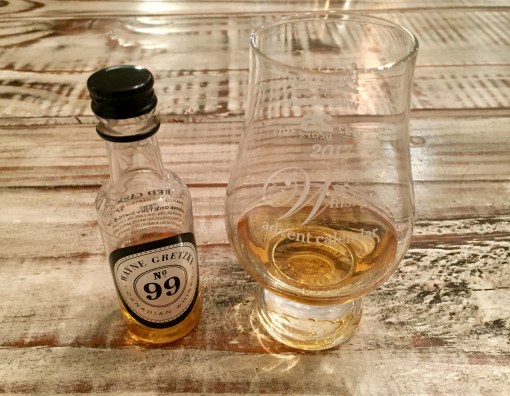
Man, this 2017 calendar just continues its emphatic strides towards difference and individuality and I just keep loving its uniqueness.  We get two new Whisky Advent firsts today (at least in my four years of following along):  (1) first ever CANADIAN whisky, and (2) first ever plastic bottle embedded in the calendar.  I almost dropped it pulling it out of slot #4 it was so light.  This is the very first ever spirit offering from Niagara’s Wayne Gretzky Estate Winery, the Red Cask Premium Crafted Whisky, which is distilled from locally grown grains and then, in a nod to its roots, matured in the winery’s own red wine barrels.  Very cool.  It has to be one of the least expensive whiskies ever to grace the KWM Whisky Advent Calendar as well, tipping the scales at a svelte $44 for a full bottle.

IMG_7141

This inaugural Advent offering from our home and native land is great to look at, a pleasantly burnished amber colour impressively obtained given what I wouldn’t expect to have been an extraordinarily long maturation period.  It smells equal parts spicy and toasty, cinnamon and charcoal, layered with elastic bands, Old Fashioned-style citrus and melon fruit.  The double-take portion of the whisky comes in the form of its ultra-satiny, almost gelatinous texture, like a Jello shot or an alcoholic Jujube.  It billows out on the tongue like a roasting marshmallow and then sits there, inflated and cooked on the edges, hanging out.  I wrote “is this rye-based?” when pepper and sandpaper started biting my tastebuds, and I was at least partially right:  it’s part aged rye, part malted rye and part corn-based whisky, each distilled separately.  The corn comes through in the Bourbon-esque caramel, burnt orange and Creamsicle flavours, lending easy approachability to the whole affair.  On the whole, while the mouthfeel seems slightly exaggerated, this stands up quite well as a solid weeknight sipper.  O Canada.


KWM Whisky Advent Calendar 2017: Day 2

2 12 2017

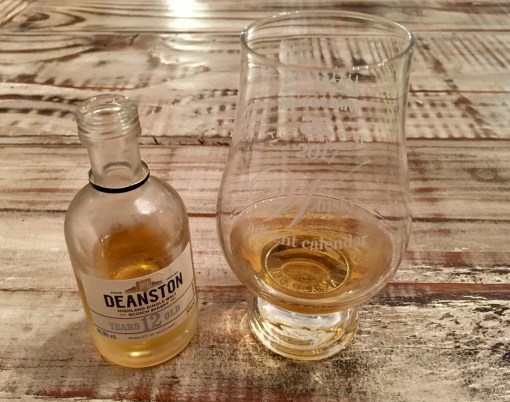
I am loving the confusion-inducing no-frame-of-reference newcomers in the 2017 KWM Calendar.  I am almost certain that this is the second offering in a row that has not even seen a sister bottling or other distant relative in any prior calendar:  the Deanston 12 Year Highland Single Malt rang exactly zero bells for me, although I did note that you could not ask for much more of a presentation contrast as compared to yesterday.  Some graphic designer actually worked on this bottle, and Deanston’s website is so slick that you instantly figure this must be another one-off distillery recently subsumed by a massive beverage giant.  And you would be right.

IMG_7110

As a distillery, Deanston is only a half-century old (and 8 of those years were spent not operating, so they may not count), but the distillery gets its history from its structure, a legendary shuttered cotton mill built in 1785.  After the mill closed in 1965, the distillery used its skeleton to start up business, releasing its very first single malt nine years later in 1974…and then ceasing production eight years after that.  The mill probably had a better track record.  In 1990, Deanston’s sold to a distilling conglomerate that is now part of the Distell Group, a South African-based giant which owns many many many alcoholic things (including the ubiquitous Obikwa and Two Oceans wine brands, among dozens more).  Not quite an old mill story anymore.

Deanston’s 12 Year offering is a beautiful deep amber colour after marinating in ex-bourbon casks.  The normal bourbon-induced sweet vanilla aromatic bounty doesn’t fully show up on the nose though, replaced by salt licks and a grainy mealiness, lightened by honey and flowers and sharpened by oolong tea.  Just like yesterday’s Cadenhead’s 12 Year, this one is gritty and biting on the tongue, almost even tannic, filled with cedar shavings and dust circling around frozen peach, burnt angel food cake, topsoil and butterscotch.  It has a similar blue-collar feel to the Cadenhead’s (or, more accurately, the Dailuaine-Glenlivet bottled by Cadenhead’s), but it’s nowhere near as evocative.  Not a disappointment for its $70 retail price tag, but not an overreacher either.


KWM Whisky Advent Calendar 2017: Day 1

1 12 2017

Aaaaaand we’re back.  I am almost flabbergasted to say that this is the FOURTH straight year I will be live-blogging through Whisky Advent, all thanks to the near-superhuman efforts of Andrew Ferguson and the Kensington Wine Market, whose Whisky Advent Calendar has quickly gone from quirky daily education and liver damage to can’t-miss holiday imbibing and has sucked me further into the world of whisky than I could have expected.  By the end of Advent there will be over 100 whisky reviews on Pop & Pour, which is not something I had envisioned when the site first started up, but an experience I will never forget (especially on Advent Day 17 when I’m ready to die).  One big change this year is that I’m sadistic enough to have also acquired a Wine Advent Calendar this year (which you’ll hear much more about in a couple of hours) and will thus be calling on expert whisky assistance to help me traverse the Advent trail:  frequent PnP tasting collaborator and awesome spirit aficionado Tyler Derksen will be contributing his first whisky reviews on the site over the course of these 25 days.  Give him a Twitter follow so as not to miss his posts!

IMG_7101

Take 4.  Bring it.

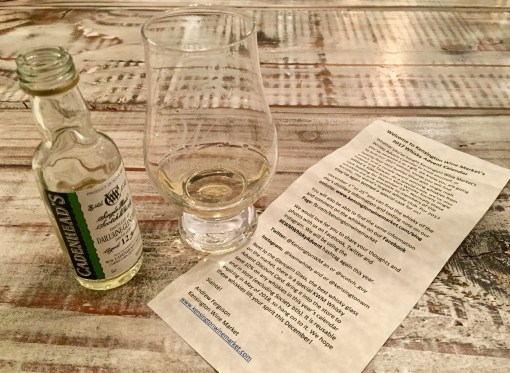
After opening 74-odd little cardboard doors and drinking 74-odd KWM calendar whiskies, you wouldn’t think there would be much room left for surprise, let alone confusion, but tonight there was plenty of both.  The first thing I saw on the whisky label was “Campbeltown”, a once-happening but now nearly abandoned distilling region (something I know due to Past Calendar Knowledge) currently home to only 3 distilleries.  The thing is, the names on this label were none of those three.  It turns out, as far as I can tell, that this is a release from an independent bottler called WM Cadenhead’s, who acquires pre-made whisky from distilleries and releases it under its own branding, a common Scottish practice.  The bottler is based in Campbeltown; the distillery from which the whisky came, not so much.  It is the extraordinarily unknown Dailuaine-Glenlivet Distillery in Speyside, founded back in 1853 and now, like so many others, part of the Diageo empire.  Despite its significant annual production, it doesn’t even have its own website and only the tiniest fraction of its creations get released under the D-G label — most of it ends up as part of the Johnnie Walker blend.  I’m not sure how Cadenhead’s got this, but it may be as much a peek behind the Dailuaine curtain as we ever get.

IMG_7102

First impressions:  this is 55.9% alcohol.  Welcome to Advent.  It is an almost eerily pale straw colour, and even with water added it still emits crusty cheese-rind and dried shoe polish aromas layered over hard toffee candy and smacks of salt sea air.  As you might expect of something of this concentration, it is both explosively fiery and pleasantly gut-warming, starting almost gritty but leaving glowing embers of contentment after you swallow.  It reminds me of an old abandoned log cabin on the beach, powered by kerosene, with bear pelt rugs and traces of fish skins lingering, matchsticks and Neo Citran.  It’s rustic, rough around the edges, but full of soul, and the more I had the more I enjoyed.  But again, 55.9%.  Onward!


KWM Whisky Advent Calendar 2016: Day 25

25 12 2016

Well, another Christmas is in the books, another Advent officially over, and another Whisky Advent Calendar now sadly, mercifully empty.  Over the past 3 Decembers I have written 74 different whisky reviews on 74 consecutive Advent days, expanding my whisky knowledge and probably seriously irritating all of the blog’s wine readers in the process, and while I’m not sad the mandatory daily reporting experience is over for another 12 months, I always look back on this calendar and appreciate all the work that must have gone into it.  Andrew Ferguson and the Kensington Wine Market do yeoman’s work every year to source a whole new set of never-used miniature whiskies so that every Whisky Advent experience can be fresh and interesting; it must be extraordinarily demanding and tiring, but every year it pays off.  Well done.

fullsizerender-519

I’d be curious to know what your favourite bottles were in the 2016 calendar and how closely they line up with my list of Whisky Advent award-winners, the creme de la creme of this year’s Advent for me:

  • Best Value Dram:  BenRiach 12 Year (Day 4) — BenRiach is starting to own this spot, as its 10 Year won this same award last year.  $80 may be stretching the value whisky category to its limit, but this bottle delivered magic for that price and tasted like it cost well into the three digits, so I’m sticking to it.
  • Honourable Mention:  Hyde 10 Year Irish Whiskey (Day 9) — I loved this bottle and had it on the podium until the very end of deliberations.  Probably the best Irish whiskey I’ve ever tasted, and one that shows just how much potential that category has.
  • 3rd Place:  Ardbeg Uigeadail (Day 7) — Can I look you in the eye and say that this tastes “good”, by any traditional description?  No.  But it has depth and soul and identity, and it draws you in and leaves its mark on you, which is both rare and worthy of recognition.
  • 2nd Place:  Kavalan ex-Bourbon (Day 19) — Predictable, perhaps, but no less deserving.  An absolutely beautiful dram giving a glimpse into how Asia may soon be rising to the pole position in the whisky world.
  • 1st Place:  Gordon & MacPhail’s Connoisseurs Choice Tomatin 1997 (Day 1) — Since when does the very first whisky in the calendar end up being the best?  It may be a bit anticlimactic on Day 25, but I liked the choice to start strong back then and I like it now.  This was absolutely the most enjoyable whisky of the month, with sneaky quality to back it up, made most evident by its amazing length and flavour development.  Amazing stuff.

Not sure why the first 10 days of the calendar seemed to dominate this year (last year’s picks were from all over the place), but these conclusions in retrospect match what I’ve felt contemporaneously while opening the calendar each day – a great start, a bit of a momentum lag in the middle third of Advent, and a recovery heading into the finish.  Thankfully the calendar ends on a high (and large) note, with a double-sized cask-strength monster offering from the Scotch Malt Whisky Society (SMWS), who obviously understood that what we needed most after 24 days of Whisky Advent was a stiff drink.

fullsizerender-518

The SMWS is like an independent bottler crossed with a subscription whisky club:  they buy hand-picked single casks of whisky from a variety of top distillers, bottle them under their own labels (always with eye-catchingly descriptive names) and then sell them only to their own members at club-level prices.  If you’re not a SMWS subscriber, the only way you may be able to taste these whiskies is through this very calendar, so bring it on.  This year’s Christmas whisky is Society Single Cask No. 41.78, “Poker Night Whisky”, bottled at an abjectly terrifying 60.4% in an attempt to murder us all.  It has been aged for 11 years, but I know nothing else about it, not even the area in Scotland where it was made.  I can confirm that it smells incredible, however, a near-tropical mixture of cantaloupe, watermelon, sweet peas and honey.  If you don’t add water to this your throat will likely implode, but once you do you’ll be able to look beyond the alcoholic hellfire and notice the layers of lime zest, bakers’ chocolate, burnt orange and cinnamon, laid over dirtier notes of topsoil and sweat.  The finish is a little raspy, but if you were 61% alcohol you’d be a little raspy too.

Merry Christmas to all, thank you so much for reading this month, and I am DEFINITELY not blogging tomorrow!


KWM Whisky Advent Calendar 2016: Day 24

24 12 2016

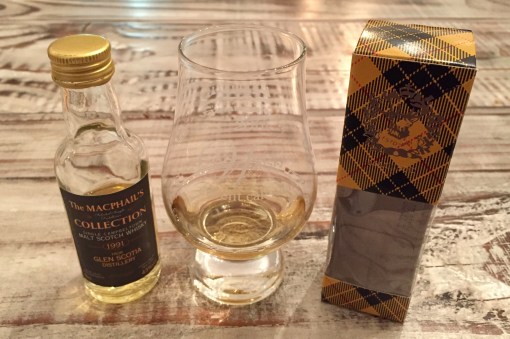
Merry Christmas Eve, everybody!  Hopefully by now the stockings have been hung and the parents can start turning their attention to more important things, like booze.  Back in my first year of KWM Whisky Advent, the December 24th bottle was the end of the line and thus the one everyone waited for the whole month.  This year we get an extra bonus whisky tomorrow, but it’s a special Scotch Malt Whisky Society bottling and is double-miniature-sized, leaving tonight the final standard-format calendar bottle. And it delivers, at least in packaging (every scotch should be sold in a bright tartan box) and age designation (distilled 25 years ago in 1991!).  It is yet another Gordon & MacPhail offering, but from a heretofore unseen line:  The MacPhail’s Collection, a small range from a select line of distilleries (7 in all at the moment).  One of them is Glen Scotia, an ancient distillery located at the tip of the Campbeltown peninsula in southwest Scotland.  Campbeltown isn’t a huge scotch area, known mainly for Springbank and its sister distilleries, so it’s no massive surprise that this is the first whisky from the region we’ve seen in Advent 2016.  One of Glen Scotia’s claims to fame, other than being sold a trillion times and failing in the early 20th century like basically every other whisky producer, is that it’s haunted by the ghost of a prior owner, who drowned himself in Campbeltown Loch after losing everything he had in a bad business deal (hopefully not the purchase of the distillery itself, but you can’t rule that out).

fullsizerender-517

The full title of this bottle is The MacPhail’s Collection 1991 Single Campbeltown Malt Scotch Whisky from Glen Scotia Distillery, but unlike every other whisky so far in 2016 Whisky Advent, there is no other information about it anywhere.  It is only for sale at KWM in mini-bottle format (for $24, suggesting that it would be a $300+ full-sized bottle) and not otherwise available; it is not mentioned on the Gordon & MacPhail site; and it is not available for sale at any online shops I could find, even in the UK, except in miniature form.  Weird.  It’s not as dark as you might think for a 25 year old whisky (although it may not be a 25 Year whisky for age designation purposes if it was bottled a while ago, as age labelling is based on time from distillation to bottling) but carries a pure, malty nose of golden raisin, plum, fresh pear, sourdough bread and trail mix, with a hint of fitting Christmas fruitcake.  However, it then takes a left turn and goes surprisingly sharp, rubbery and industrial, filling the mouth with not-altogether-enjoyable tastes of tennis balls, permanent marker, elastic bands and shoe treads; these factory-floor notes and the whisky’s spiky alcohol combine to nearly overwhelm spicy underlying notes of rock salt, caraway and fennel.  Interesting?  Yes.  Pleasant?  Not entirely.  See you at the 2016 calendar finale, and at Christmas!!


KWM Whisky Advent Calendar 2016: Day 23

23 12 2016

GlenDronach!  Peated!  I’m always fascinated by peated expressions of traditionally non-peated whiskies (which encompass almost all whiskies distilled anywhere other than the Islay region of Scotland), particularly when the whisky in question is one with which I am otherwise very familiar.  My old calendar friend GlenDronach, as recently covered in Day 18, is an Advent stalwart, having shown up (quite successfully) four previous times in the last three years; those prior releases unveiled the bulk of GlenDronach’s core range, but all of them are entirely unpeated, making tonight’s further core entry a category of its own for the distillery.  GlenDronach decided to release a Peated expression fairly recently as a nod to how the distillery used to make whisky back in the 19th century, although since its founding in 1826 it’s been a sort of rocky road until recently.  Stop me if you’ve seen this kind of Scottish distillery timeline before:  sold 1830, sold 1920 (to the son of the founder of Glenfidditch), sold 1962, mothballed 1996-2002 (not that long ago!!), taken over 2005 (by Chivas), taken over 2008 (by BenRiach, who makes some pretty awesome whisky in its own right and has presided over a highly impressive GlenDronach resurgence in the past 8 years), taken over (along with BenRiach) earlier this year (although so far the same folks have been left in charge).  No job security in whisky-making.

fullsizerender-516

The peating in GlenDronach’s first ever (modern-day) peated offering is done…pleasantly?  Is that a thing?  The peat effect is definitely noticeable, but far from in-your-face, adding aromatic traces of lantern oil, sweet compost, old leather and moss to GlenDronach’s stone fruit and florals, which are otherwise not lost or mellowed in maturation in this younger non-age-designated malt.  The palate is similar, part oily and part sweet, either adding perfumed refinement to the peat’s underlying funk or adding some necessary grime to an otherwise potentially too-pristine Highland whisky, depending on how you look at it.  The result is a little bit of everything:  pistachio pudding, suede jackets, distress flares, car exhaust, marmalade, apple crisp…I could keep going.  What a value at $83.  Can’t wait to see what Christmas Eve has in store!


KWM Whisky Advent Calendar 2016: Day 22

22 12 2016

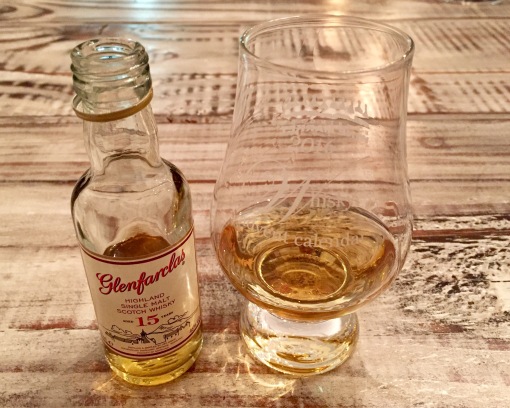
I have started to think of Glenfarclas as the official mascot scotch (mascotch?) of the KWM Whisky Advent Calendar, after 2014’s special Christmas Eve 40 Year and 2015’s Christmas Eve redux 25 Year, not to mention two other entries in calendars past.  I was sort of wondering if we’d see a third straight December 24th whisky from the distillery, but I also suspected we were starting to run out of super-old Glenfarclas releases to slot in that esteemed end-of-calendar spot.  Well, it got Day 22 this year, with the notably younger $95 15 Year Single Malt – still a respectable position if not an exalted one.  Glenfarclas is one of the few pre-20th century distilleries not to be shut down or sold to a gigantic beverage empire in modern times, owned by the Grant family since 1865 when patriarch John Grant bought it for just shy of £512.  That sounds astoundingly cheap even in 1865 money, and it is:  it equates to around £59,000 today, or around $98,000 CAD.  Nice buy, John.  We are now six generations of Grants (all of whom have been named either John or George) into the family’s stewardship of Glenfarclas, which is known for producing one of the classic examples of Speyside whisky out of the region’s largest stills.

fullsizerender-515

To obtain the legal designation of “scotch whisky”, a spirit has to (1) be aged in oak casks (2) which are no larger than 700L (3) for at least three years (4) in Scotland.  Glenfarclas uses both plain new oak casks (which we haven’t heard much of in this year’s calendar) and ex-Sherry casks (with which we have been bombarded by this year’s calendar, and by the whisky industry in general), and it is definitely known for its emphatic use of the latter.  The 15 Year is a glimmering dark amber colour reflective of its barrel time and has a few different aromatic identities:  confectionary (butterscotch chips, and nougat, like the inside of a Three Musketeers bar), nutty (almonds, oatmeal), herbaceous (corn husks, grass).  Bold and fiery as soon as it touches the tongue, this is not messing around, slinging toast and spice, banana Runts, mandarin orange, Americano, char and vegetal flavours with authority and powering into a lacquered finish.  It is punchy and powerfully concentrated, coming across like a cask strength whisky despite its 46% abv.  Mammoth scotch.


KWM Whisky Advent Calendar 2016: Day 21

21 12 2016

Into the 20s, guys.  Five days left – and we start the final countdown to Christmas with a mystery.  I pulled out an old-school-looking bottle of Stronachie 18 Year Small Batch Release and thought:  “Cool, another lesser-known distillery find.”  Then I saw the A.D. Rattray logo, last seen in Day 14 with the independent bottler’s Cask Islay release, and thought:  “Cool, this must be like their Distillery Label series”, similar to fellow independent bottler Gordon & MacPhail’s collaborative set of releases with smaller producers tasted in Day 8 and Day 16.  Then I saw the tiny notation in the top right corner: “Distilled at Benrinnes Distillery”.  Um, what?  That’s one label headliner too many.

fullsizerender-514

Here’s the story.  Stronachie IS a lesser-known distillery…but it’s lesser-known because it was mothballed in 1928 and destroyed in 1930.  It was first built in the 1890s in a (questionably chosen, in hindsight) remote, nearly inaccessible mountain location that required the construction of a 5-mile private railway just to get the spirit to a transportation route.  The initial distributor of Stronachie was actually a relative of A.D Rattray, and in the early 2000s, consumed by curiosity about the distillery, Rattray’s present owner bought at auction a bottle of Stronachie that was distilled a century prior, in 1904, one of only 4 bottles left in the world.  After tasting it (props to them for actually opening it), Rattray then embarked on a project to try to re-create the historic distillery’s flavour profile using spirit from a similarly situated high-altitude producer.  It’s one part honourable and one part creepy, like going from trying to commune with your dead aunt via seance to building your own effigy of her for your living room, but it is certainly bold and unique, two things I don’t get to say enough about the whisky world.

Benrinnes is another distillery that often does its work anonymously, not often receiving the single malt attention, which makes me feel sort of bad that it’s getting this particular star treatment as a sort of tribute cover band for another producer that’s been closed for 88 years and a pile of rubble for 86.  Its faux-Stronachie 18 Year was aged in a combination of ex-Bourbon and ex-Sherry casks (which is becoming the main maturation theme of Whisky Advent 2016) and smelled as pleasantly old-fashioned as it was probably supposed to, mixing saltwater taffy, unsweetened licorice, smoke and bitter orange.  Smouldering and long-acting on the palate, its flavours are almost on delayed release, starting spicy and peppery but then blooming into vast florals, citrus fruits, hickory, creme brulee and candied ginger.  In spite of that it never gets away from itself, staying straight-laced and minding its manners, like the quiet distillery up on the mountain that’s now nothing but a ghost, kept alive through loving tribute.


KWM Whisky Advent Calendar 2016: Day 20

20 12 2016

As we near the finish line of 2016 Whisky Advent, we’re coming a bit full circle, back to the distillery (if not the bottler) that brought us Day 1.  We started off Advent with Gordon & MacPhail’s take on a Tomatin whisky, and tonight we let the distillery speak for itself, continuing the calendar’s now-three-year streak of Tomatin releases, after 2014’s blasé 18 Year on Day 12 and 2015’s awesome Port-aged 14 Year on Day 17.  The difference between those bottles and this one is twofold:  this one is cask strength, as the largest capitalized letters on the front label tell you, and it also has no age designation whatsoever, suggesting that it’s probably too young to market as a number.  The $73 price tag would go along with that theory.  (Incidentally, if you’re a whisky spendthrift, you should probably focus your scotch dollars on cask strength whiskies — you get the same volume of whisky at up to 50% higher alcohol, without a price premium in many cases, and when you pour yourself a serving you have to add water to it, something the distillery does itself to get its non-cask strength releases down to 40% or 46%.  In other words, you often pay the same price for post-dilution bottles as for pre-dilution bottles which you then dilute yourself, giving you way more whisky concentrate for your money at cask strength.)

fullsizerender-513

This bottle’s packaging is an exercise in earnest oxymorons:  lilting italic script informs you that this whisky represents “The Softer Side of the Highlands”, immediately below the double-sized block letters stating “CASK STRENGTH” and immediately above the 57.5% abv listing.  I could describe this whisky in many different ways and it would not end up on the softer side of anything.

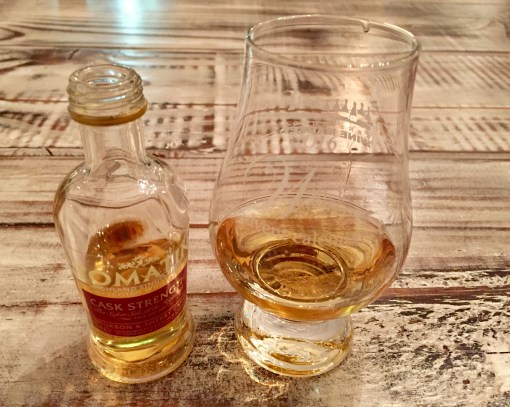
This is Tomatin’s first cask strength bottling in its core range of whiskies and saw (an unknown amount of) time in a combination of Bourbon and Oloroso Sherry casks before being bottled.  It was a fairly eye-catching dark golden wheat colour for a bottle coy about its age, yet unlike most whiskies which are aromatically the sum of its parts, this one just smelled like the parts, like barley and barrel and fermentation:  malt, grain, yeast, spice, salt, seawater.  You then completely forget about that, and everything else, once this Tomatin hits your tongue and your brain starts bubbling like it’s on a griddle.  The whisky is massive, overwhelmingly lush and nearly gelatinous in texture, to the point where it almost doesn’t even feel like a liquid.  A strange mixture of honey, baby oil, firewood, shortbread, spackle, flaxseed and rye bread, it is a raging beast of decidedly cautious flavours, a meek monster.  On an oddly bitter yet sweet-tinged finish, it leaves me with no other concluding thought than:  this is just so weird.


KWM Whisky Advent Calendar 2016: Day 19

19 12 2016

To say that things are heating up in the last week of Advent would be a massive understatement.  Yesterday we hit upon my favourite calendar whisky distiller in GlenDronach, and today we meet up with the only other producer that has managed to reach similar Advent highs, Taiwan’s Kavalan, which took second AND third place in last year’s calendar for me and which seems to do nothing but produce show-stopping whiskies in what on its face seems like one of the least likely locations on Earth.  But here’s the secret:  Taiwan is much, much hotter year-round than Scotland is, and massively more humid.  So?  So when you’re freshly distilled whisky spirit, sitting in a barrel and waiting for maturation magic to happen, those climatic conditions make the aging dance between cask and liquid go into hyperdrive, accelerating evaporation (which speeds up oxidation) and allowing the wood grain to penetrate into and flavour the whisky much more quickly.  The result:  a distillery that’s barely 10 years old with products on the shelf that you would taste blind and swear they’ve been aging for well over 20.  In the whisky world, you can’t ask for a better and more distinct advantage than that.

fullsizerender-512

This is a particularly interesting bottling because it is ALMOST, but not quite, identical to the Kavalan from Day 5 of 2015.  Like this one, that was also an ex-Bourbon cask bottling, but it was a cask-strength offering (like most of Kavalan’s lineup), whereas this is the first Kavalan whisky I’ve had that isn’t, bottled at 46% to give Kavalan a sort of “entry-level” whisky in its lineup.  Those words are in scare quotes because the bottle still costs $140, but I am here to tell you that it’s worth it.  It was bottled in mid-2015 (at 11:16 a.m., according to the hyper-specific back label info) and likely only spent a few years in Bourbon barrels, but the Taiwan time warp effect made it deep and rich and gold in the glass, albeit more yellow than amber.  It smells like the most delicious confection you could ever come up with:  part toasted marshmallow and vanilla bean, part wafer cookie and whipped cream, with some Corn Pops and hickory on the edges for good measure.  It then beams out the most outrageously tropical set of fruit flavours I have seen in a whisky.  Cantaloupe?  OK.  But guava?  Papaya?  WATERMELON?  What is happening??  Coconut flakes and Rice Krispie squares round out an absurdly delicious six-days-till-Christmas whisky:  exotic and playful, complex but oh so hedonistic.  I sense another podium finish, Kavalan.


KWM Whisky Advent Calendar 2016: Day 18

18 12 2016

PSA:  I am told that not everybody will be receiving the same whisky in their calendars tonight.  Some, like me, will end up with the intended calendar whisky, the GlenDronach 8 Year The Hielan Single Malt, but due to unexpected shipping issues, there wasn’t enough of it available when the calendar had to be finalized, so the remaining calendars were filled with BenRiach’s 10 Year Curiositas, the Day 16 whisky from 2015.  The shipping problems have now been rectified and the full supply of The Hielan has now arrived in town, so if you ended up with the Curiositas, you can come by KWM anytime and pick up a complementary mini-bottle of The Hielan as a bonus 26th Day whisky – they have a list of everyone affected.  Now back your regularly scheduled whisky programming.

One more week!  It is Day 18 and there are only seven more days until Christmas and until the end of another string of marathon blogging.  Man was I happy to open the calendar today and see a GlenDronach starting back at me – I was starting to wonder if one was going to be included in Whisky Advent this year, or if KWM felt that two straight years of utter calendar dominance from this distillery was enough and that somebody else deserved a fair shake.  My top whisky from the 2014 calendar was the unspeakably excellent GlenDronach Parliament 21 Year, which is close to my favourite scotch ever; my top whisky from 2015 was the nearly-as-good GlenDronach Revival 15 Year, which officially crowned this producer as the only atomic superpower of the Whisky Advent scene.  This year it may be a bit much to ask for GlenDronach to complete the trifecta, as its representative for 2016 was the $64 8 Year The Hielan, the youngest and most entry-level whisky in its core lineup.  But if I was going to believe in miracles from anybody…

fullsizerender-511

It’s hard to believe this scotch is less than a decade old; by eye, it looks like one of the older whiskies in the calendar, coming out of the bottle a gorgeous deep orange-gold.  Whatever they did with the mixture of bourbon and sherry casks to mature this worked fast, and its magic extended aromatically as well, creating a symphony of oxidative notes streaked with citrus, toffee and Caramilk bars and marzipan and lemon peel that weaved together beautifully.  But The Hielan was a little forward and impetuous on the palate, its flavours a touch jumpy and its alcohol slightly jagged without the benefit of time to settle in.  Burnt sugar, carrot cake, butter tart and tonic water were cut short by sandpaper and a streak of woody tannin, although still carried a hint of the resonance of GlenDronachs past.  This doesn’t quite carry the same level of majesty as its predecessors, but it’s on its way somewhere, and the smell alone is well worth the sub-$65 price tag.


KWM Whisky Advent Calendar 2016: Day 17

17 12 2016

Balblair!  Immediately recognizable thanks to its awesome squat flask-shaped bottle (complete with etching, even in the mini version) and standout modern labels, these guys have their branding right on point.  This is the third Balblair whisky to grace the pages of the Advent Calendar (and the third one I’ve had an obscenely hard time getting out of the calendar), after 2015’s lead-off Day 1 and denouement Day 22.  The distillery’s path to the present was a windy and interesting one, reflective of how difficult it must have been to be a whisky producing facility in the 20th Century:  founded 1790, sold 1894, moved 1895, mothballed 1911, run totally dry 1934, OCCUPIED BY THE ARMY 1939, sold 1948 (to a lawyer from Banff, no less, though presumably the one in Scotland), sold 1970, sold 1996.  Thankfully it’s stayed steady for the last 20 years, and in 2007 it made the decision that has become its rallying cry in the marketplace:  to produce and release only vintage-dated whiskies.  I don’t mean “10 Year”, “12 Year”, “18 Year”, etc.; I mean 1990, 2003, and tonight’s 2005.  The difference is that the former age designation only indicates the youngest whisky in what can be a blend of multiple different production years (what in wine would be called “non-vintage”), whereas Balblair’s choice commits them to only using whisky distilled in a single specific year in every bottling, which is proudly displayed on the front label.  Is that better?  Not necessarily, but it’s different, and the whisky world needs some different.

fullsizerender-510

This bottle was distilled in 2005 and just bottled this year, making it an 11 year-old dram.  It was happily matured in ex-bourbon casks (w00t – sherry break), which explained its ludicrously friendly nose, overflowing with maple and brown sugar, crushed pecans, cinnamon sticks, nectarines and smoke.  I’ve noted that many whiskies in this year’s calendar start quieter aromatically but then are more exuberant to taste; well, this one is the opposite, not shutting down but taking on more sour lemon and bitters flavours, leathery tinges and chemical/petroleum notes (almost like Vaseline) on the tongue to go with the still-present vanilla and butterscotch sweetness.  Like a nice guy made more complex by a darker side – I like it.


KWM Whisky Advent Calendar 2016: Day 16

16 12 2016

I’m learning.  I half-pulled tonight’s mini-bottle out of its cardboard home, saw the uber-Scottish name of a distillery I had never previously seen or heard of, and immediately hunted for the tiny Gordon & MacPhail logo tucked discreetly on the bottom of the label.  Another Distillery Label G&M Whisky?  You betcha.  On Day 8 it was the gleefully Scottish Miltonduff that got its quasi-day in the sun, and 8 days later it’s the equally blue-and-white Glenburgie 10 Year Single Malt (another Glen for the roster!) that has its turn.  As mentioned a week or so ago, the Distillery Label series is Gordon & MacPhail’s collaborative effort with a series of lesser-known distilleries to bottle a whisky that’s as close as possible to the producer’s own release through the invisible hand of G&M’s independent bottling empire.  The effort goes right down to the packaging, which is made to look like it came right from the distillery’s own marketing department; you almost need a magnifying glass on these mini-bottles to see that Gordon & MacPhail had anything to do with them.

fullsizerender-509

Glenburgie is a Speyside-based distiller and yet another scotch producer that’s mainly used as feedstock for the Ballantine’s blend (a trait it shares with the last Distillery Label, Miltonduff, each of whom deserve a better fate).  This bottle was matured in multiple types of sherry casks and threw off some impressive depth of colour for a 10 Year whisky.  It began fairly understated, a careful combo of fruit, spice and herbaceous aromas:  peach iced tea, pepper, wood grain, celery root.  Then things ramped up on the palate, mostly thanks to the Glenburgie’s honeyed and almost waxy texture, mouth-coating even at 40% abv and bolstering more intense flavours of sweet orange Lifesavers, almond brittle, celery and peanut butter (together), sultana crackers and anise.  I don’t think this is a scotch I’m going to remember in two whisky days, but it’s definitely an enjoyable weeknight whisky.  It and Miltonduff are two peas in a pod that way; I could probably do without a third one in 8 more days, but we shall see.


KWM Whisky Advent Calendar 2016: Day 15

15 12 2016

A couple days ago I whined excessively in my daily whisky write-up that my family had gone through a particularly horrible run of consecutive sickness that was making the blog feel like a bit of a grind.  In the two days since, my son has gotten the flu and my wife has gotten a sinus infection for the fourth time in the last two months.  Far from dreading Whisky Advent anymore, I’m now starting to think it’s the only thing keeping me healthy, so let’s keep it going.

One fairly consistent theme of this year’s calendar posts has been me railing against the relative lack of originality employed by most distilleries in selecting their maturation vessels.  Like wineries and their coin flip of French vs. American oak, distilleries seem to make their choice dichotomous as well:  bourbon cask or sherry cask.  However, since (unlike wine) whisky gets many of its flavours not from the vessel itself but from what was previously aged in it, this opens up so many avenues of alchemy for distillers to coax new expressions out of the same duly processed malted barley.  Most appear either oblivious or uninterested in the challenge, but one distillery that has embraced the multiplicity of available aging options with élan is tonight’s calendar star:  the Arran distillery, named after the tiny round Isle of Arran sandwiched between the western shores of mainland Scotland and the peninsula housing the whisky region of Campbeltown, both due east of Islay.

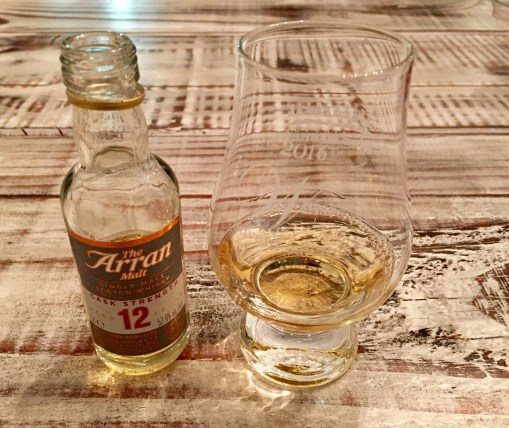
fullsizerender-508Arran is a traditional distillery with modern foresight, which releases a wide array of scotches aged in practically everything possible — current highlights include a Sauternes cask, a Port barrel and (!!!) an Amarone cask bottling.  I love it.  If you’re so inclined, you can also BUY YOUR OWN CASK OF SCOTCH and then come visit it while they mature it for you.  I’m not even kidding.  £1,850 for 200L of ex-Bourbon glory – who’s in with me?  Of course, now that I’ve raved about how cool Arran is, I have to report that tonight’s whisky, from the 5th batch release of their 12 Year Cask Strength Single Malt limited edition, is aged in the boring-est ever combo of first-fill sherry butts, refill sherry hogsheads and first-fill bourbon barrels.  At 52.9% and only $80, though, it’s a lot of scotch for the money.  It smelled exactly like a cereal I’d eaten as a kid but had to Google search to remember the name of (Corn Bran, it turns out), mixed with cantaloupe, barley, corn husks and spice, but then ramped up on the palate and tasted like something out of a Christmas catalogue:  Bailey’s and eggnog, gingerbread, canned peaches, whipped cream and coconut milk.  Super friendly for a cask-strength whisky, it brought the fun and the charm in spades even if it wasn’t an intellectual heavyweight.  Time to buy a cask.


KWM Whisky Advent Calendar 2016: Day 14

14 12 2016

Back-to-back Islay for the first time in Advent 2016, but this particular bottling is shrouded in mystery!  Day 14’s dram marked the biggest unknown for me coming out of the calendar to date, with a label that looked like a film noir movie poster and that did not contain any immediately identifying marks or distillery names, only the opaque moniker “Cask Islay”.  Cask Islay from where?  Whose casks?  A closer look revealed that this was a scotch released by independent bottler A.D. Rattray that intentionally does not reveal the distillery that made it — but we know that there’s only one and that this isn’t a blend, as it still states itself to be a single malt.  Rattray’s website advises that for each batch of Cask Islay, they hand-select a few casks (5 to 10 at most) from the stealth distiller; these are then matured in a combination of bourbon and sherry casks for somewhere less than 10 years before bottling.  KWM’s rumour is that the black box producer of this whisky is Laphroaig, but no one’s talking.  The benefit that you get from all the secrecy is that the bottle only costs $75, a massive value play if the quality is there.

fullsizerender-507And it is, in spades, if you’re a fan of the Islay style of peated whisky.  The Cask Islay contains 35 ppm of peat phenols, chemicals released in the smoke of burning peat moss used in the distillery’s kilns while drying malted barley which are absorbed by the barley itself.  35 ppm is not overly high as far as peated scotch goes; the peat bombs that push the issue can get all the way up to 200 ppm (at which point they basically taste like solid charcoal).  But even the lower figure is enough to establish peaty dominance in the Cask Islay’s nose, all oily smoke, seawater brine, clamshells, beach fire pits, iodine and (weirdly) Comet cleaning powder.  Happily, it is more personable to taste than to smell, adding warm peach cobbler and baked apple fruitiness to the swirling peat mass of shoe polish, diesel, sulphur and topsoil, finishing hearty and rich.  This is a great fireside malt, although it would certainly not make a good pick for a whisky neophyte’s scotch initiation.  Frankly a spectacular buy for any Islay lover at this price point.  I’m in.