Whisky Advent Calendar 2015: Day 21

21 12 2015

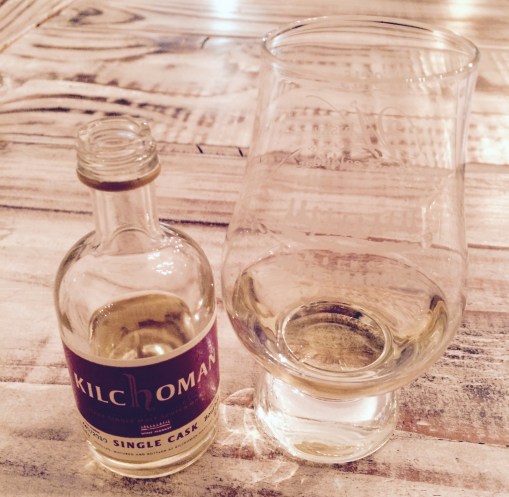
Aaaaaaaghh.  That was my admitted reaction when I opened the door to Day 21, one of four whiskies left in this year’s calendar before the Christmas Day finale from the Single Malt Whisky Society, and came face to face with Kilchoman again.  These last few days before the finish line in the 2014 calendar were home to some real zingers, including my favourite whisky of last year (and one of my favourites ever), the GlenDronach Parliament; to see this coveted calendar spot taken up by a distillery I can’t quite bring myself around to like was a bit painful.  Now, to be clear, as discussed on Day 11 when Kilchoman showed up the first time in 2015:  they are a very highly regarded distillery with a super cool story (the farm-to-table equivalent of the scotch world, Islay’s first new distillery in forever), and I have whisky-savvy friends that go nuts for them, so there’s nothing wrong with them whatsoever, but they just don’t match my taste for whatever reason.  However, if I decipher the label correctly, there seems to be some reason for excitement with this particular bottling, which may only be available in the singular place from which I got the calendar.  The tiny Kilchoman bottle features an even tinier Kensington Wine Market logo right on the official label, which I’m guessing means that this was from a cask purchased by and bottled for the store only.  (Further research just undertaken confirms the theory – cool!)  This Single Cask whisky is from a bourbon barrel identified only as cask #440, from the year 2010.  That means we’re dealing with, at most, a 5 Year malt, one of the youngest whiskies in the whole calendar.
FullSizeRender-200

The KWM Single Cask was bottled at cask strength (meaning that no water was added to it to dilute it and reduce the alcohol to a standard 40%, 43% or 46% level).  In this case that means the scotch is at a mind-melting 60.4% abv, meaning that adding water is imperative to this one unless you’re using it for sterilizing wounds.  This ultra-special Calgary-only version of Kilchoman smelled like, well, Kilchoman, a must-be-from-Islay combination of moccasins, smoky peat, solvent, tennis balls, kelp, orange zest and melted cheese.  A little more fruit shone through on the palate, banana and cantaloupe, but the Islay grime still carried the day, with tons of old shoe leather, burnt tires and exhaust, maltiness and toast, with a glycerol-laden viscosity from the elevated alcohol and a sweet smoothness on the finish – the bourbon cask coming through at last.  This was certainly my favourite Kilchoman that I’ve had so far, although also the most expensive at $140, making it one of the pricier 5 year-old scotches on the shelf.  There is certainly a lot going on here for a spirit a half a decade old, but I still can’t say it’s my thing.  I feel legitimately bad about it, Kilchoman.


Whisky Advent Calendar 2015: Day 20

20 12 2015

We’re getting close to being able to call this the #GandMCCWhiskyAdvent calendar:  tonight is the FOURTH offering from independent bottler Gordon & Macphail’s Connoisseurs Choice portfolio to come out of the 2015 KWM calendar, after Day 4’s Ledaig 1999, Day 10’s Auchroisk 1996, and just two days ago, Day 18’s Caol Ila 2003.  Thankfully G&M has sufficient options in its insanely huge lineup of whiskies not to have to repeat a distillery, so Day 20’s Connoisseurs Choice has a brand new origin, the Inchgower Distillery…which I can confirm I’ve never heard of before tonight.  This is because almost nothing it makes is bottled under its own name:  less than 1% of its production is labelled and sold as an Inchgower malt, with the bulk of its whisky being routed for major blends like Bell’s, Johnny Walker and White Horse.  Inchgower was somewhat optimistically founded as “The Great Distillery of Inchgower” in 1871, but it won’t surprise you if you’ve been reading along this season that it was liquidated in 1903, sold in 1936, sold again in 1938 and sold at least once more in the 1980s.  It was apparently near-impossible to keep a distillery open and belonging to its original owner in the 20th century.  Inchgower is now part of the Diageo empire, and Gordon & Macphail are one of the very few independent bottlings showcasing it on its own.

FullSizeRender-199

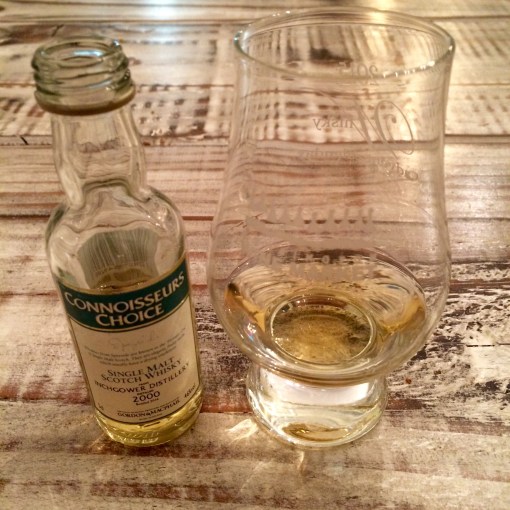
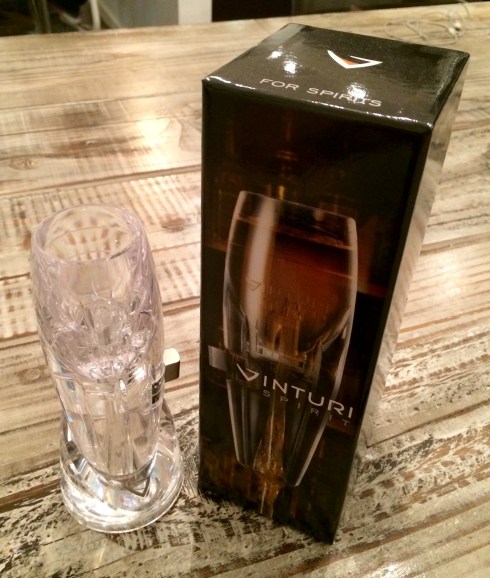
G&M are famous for their absolutely impeccable wood cask selection and whisky maturation program (a massive focus since they don’t make the spirit themselves), to the point where they have an entire separate website devoted only to their cask matching program, which is actually found at wood.gordonandmacphail.com.  You can’t make this stuff up.  They chose refill sherry casks for this Inchgower, a vintage whisky distilled in 2000 and bottled in 2014; the re-used nature of the casks definitely tones any sherried notes way down in the scotch, to the point where the type of barrel didn’t really stand out at all for me.  In fact, not much stood out, in a good or bad way:  the Inchgower had a grassy, stalky, cream soda- and maple-tinged but otherwise very quiet nose, to the point where I got out my Vinturi Spirit aerator to see if it could coax something more out of it.  Post hyper-decant, the aromas may have come across as rounder, but they were still subtle and subdued.  Things brightened up somewhat on the palate, a more energetic mixture of honeycomb, pancakes, whipped cream and vanilla bean, without the vegetal edge I had been smelling.  All in all, though, a pretty straightforward whisky, with a mouth-drying finish.  After some of the incredible values we saw last week sub-$90, I’d be pretty choked to shell out $108 for this unless I was a true whisky connoisseur (maybe the G&M range name is onto something) seeking out a solo Inchgower effort.  That would be some serious scotch dedication.


Whisky Advent Calendar 2015: Day 18

18 12 2015

It is exactly one week until Christmas.  Seven more days, team.  Seven more whiskies, after this one.  Hang in there.  My mild-to-medium annoyance at opening the Day 18 window and pulling out yet another Gordon & Macphail Connoisseurs Choice bottling (the third of the calendar, after Day 4 and Day 10) turned to instant excitement once I saw the name of the featured distillery on the bottle:  Caol Ila, one of my favourites, and one of the best Islay distilleries at managing that delicate but critical balance of peat influence within a whisky’s flavour profile.  Having talked about Connoisseurs Choice twice now, I will avoid repeating (three-peating) myself and talk about Caol Ila instead.  Its name is pronounced “cull-eela”, meaning that I actually was almost saying it right before looking it up, a name that means “Sound of Islay” (referring to the body of water of the same name, not an actual sound, although that would be cooler).  Owned by global spirit behemoth Diageo, Caol Ila is, surprisingly to me, by far Islay’s biggest distillery, churning out more than double the production of the other distilleries on the island.  Much of this whisky is designated for use in blends — like the 2014 calendar’s super-awesome Big Peat, which champions its Caol Ila content on its label — but a smaller percentage of it is bottled in the distillery’s name, either under its own label or by independent bottlers like this.

FullSizeRender-197

This particular bottle of Caol Ila is from a single vintage, 2003, and was bottled this year, making it a 12 Year malt.  It is classic Islay on the nose, a combination of rawhide, old catcher’s mitt, seaweed, liniment and salty sea air, but in a way that smells far nicer than that sounds, using those aromas in the most comfortable way possible.  The depth of flavour and sheer intensity of both the peat-induced and the other notes is just remarkable.  The peatiness has layers, descending from briny/herbal at first to campfire and ash down to something more dank, like tar and pitch.  This ominous progression somehow doesn’t interfere with the development of equally potent notes of peanut brittle, celery sticks, ginger, oiled leather, poached pear, shoe polish…I could go on.  There’s a lot happening in this whisky, especially at only a dozen years of age.  For me it’s one of the best of the calendar so far without question.  I actually wrote at the end of my tasting notes:  “If this is under $100 it’s a screaming deal.”  Well, guess what?  It’s $99.99.  Scream away.


Whisky Advent Calendar 2015: Day 12

12 12 2015

Halfway there!  Well, almost.  At this calendar milestone, it was fitting to pull out a scotch from a distillery that was the focal point of an even bigger milestone last year, when the Glenfarclas 40 Year  was the culmination of 2014 Advent on Christmas Eve.  Since this is only the halfway point of 2015 Advent, we got a scotch about half as old, but the Glenfarclas 21 Year Highland Single Malt is still the oldest whisky pulled from the calendar to date.  The Glenfarclas distillery is located in Speyside, in the northeastern Scottish Highlands, and has been owned by the same family since 1865, when it was purchased for a shade over £511.  If you really want to make something out of your investment portfolio, buy a scotch distillery 150 years ago.

FullSizeRender-186

As you might expect from a spirit that spent 21 years inside of a (I’m guessing Oloroso sherry – that’s Week 2’s quota) oak barrel, the Glenfarclas was a gorgeous polished amber colour, one of those whiskies whose visual appearance is a central part of its drinking pleasure and not just an afterthought.  The nose was part confectionary (carrot cake, burnt sugar, sticky toffee pudding) and part sherried (brine, nuttiness, vegetal hints, dates), with the former aromas giving the latter some life and approachability and the latter keeping the former in check.  The scotch was a little fiery to taste, its alcohol asserting itself even at a relatively tame 43% abv, and even after I added water, but it still delivered flavours of toasted marshmallow, pumpkin spice, cedar, coffee grounds and cinnamon sticks ahead of a slightly salty finish.  All in all a well put-together dram at a solid price for its age ($143), but for whatever reason I couldn’t quite forge any emotional connection with it, so it probably won’t leave any lasting memory.  It was clinically good, but not in a way that would make me scramble to get more.  It’s all downhill from here for the next 13 days…


Whisky Advent Calendar 2015: Day 11

11 12 2015

This is the kind of impact two years of this Advent Calendar has had on me:  I opened the cardboard door to Day 11, saw the top of a squat, bulbous bottle, and immediately said aloud:  “Kilchoman”.  And so it was.  I remembered the low, round bottle shape from last year’s KWM calendar, when Kilchoman’s entry-level Machir Bay might have been my least favourite whisky of December 2014, an opinion based on personal taste rather than anything in particular wrong with the scotch.  I really wanted to like it too, because Kilchoman is one of the best stories in Scotland, the first new distillery to open on the island of Islay in 125-odd years and one committed to all parts of the whisky production cycle, including growing its own barley to malt and distill, something that basically nobody does.  As a traditional-minded producer (especially for one that just celebrated its 10th birthday), it is also committed to the near-extinct practice of floor-malting, which I’ve strangely discussed before on this blog here and which is also featured in possibly the greatest cartoon whisky-making video ever made on Kilchoman’s website.  Tonight’s attractively named Loch Gorm bottling, named after the peaty lake (bog?) overlooking the distillery, is higher up the food chain than the Machir Bay, on the shelf for $118.  Despite its sherry-based maturation, I hoped that this one would appeal to me a bit more than the last one.

FullSizeRender-185

Alas, ’twas not to be.  The Loch Gorm smelled oily in more than one way, both diesel and Vaseline, but wasn’t overly aromatic otherwise, a surprise for an Islay whisky.  Shoe polish, leather, tomato leaf and celery stalks rounded out a fruit-free aromatic profile.  Both Islay’s characteristic peat and the flavour volume generally turned up the volume on the palate, layering tar, moss, smoke and wet pavement on top of bakers’ chocolate, dried fruit and rubber balls, but things tapered off again on the finish, which seemed papery and a touch bitter.  I’m sorry, Kilchoman; I have friends who love you and I know you’re making waves in the industry, but you’re just not my thing.  Onto the weekend, and the halfway point of this spirit adventure!


Whisky Advent Calendar 2015: Day 10

10 12 2015

My immediate thought upon pulling out tonight’s whisky was:  “Again?”  Hadn’t I just seen this bottle before?  Well, yes and no.  Day 4 featured another scotch from independent bottler Gordon & Macphail’s Connoisseurs Choice range, the 1999 Ledaig.  Tonight’s bottle, six days and five whiskies later, featuring a slightly differently shaded but otherwise identical label, was the 1996 Auchroisk, at 18 years the oldest whisky of the calendar to date (quick tangent: the age figure on a whisky denotes its period of maturation and ends at bottling, so this whisky, bottled in 2014, is an 18-year rather than a 19-year in whisky-speak).  As this is a totally different scotch from a totally different distillery and region (the Ledaig was from the Isle of Mull, while the Auchroisk is from Speyside), I suppose I have no grounds to have felt a twinge of disappointment at seeing the familiar label come out of the box, but I think I would try to keep any and all similar bottlings as far apart from each other in the Advent order as possible.  That said, don’t think the presence of both the Ledaig and the Auchroisk in the Connoisseurs Choice lineup makes them kindred spirits or anything; the Gordon & Macphail website lists 152 different CC whiskies, so it’s not exactly an exclusive club.

FullSizeRender-184

Auchroisk (actually pronounced “oth-rusk”) was built rather recently in distillery terms, in 1974, and is found in the northeast of Speyside, which itself is in the northern part of Scotland.  This bottle states that whiskies from Speyside “are known as the ‘Premier Cru’ of Single Malt Scotch”, which I have literally never heard anyone say, and which might well cause a revolt in the other regions, but who am I to doubt a label slogan?  The ’96 oth-rusk was a pale watery lemon colour and went through an instant metamorphosis on each sip from nose to palate.  It smelled flowery, like potpourri, and soapy, like Thrills gum, with clear vegetal notes, sharp salinity and a lingering Brie cheese aroma (the latter two of which made me write down:  “sherry casks?”  Answer:  yes.).  But it was much more approachable, comforting and pleasurable once you tasted it, sweet and spicy, balancing cornbread, orange and tangerine fruit flavours with charred oak, smoke and pepper, but finishing deft and pure rather than bitter.  I can’t decide if the two-faced nature of the whisky made it more interesting or more annoying or both, but at $140 even that uncertainty is a problem.  Quite happy to have it in 50 mL form, however.  40% done the spirit blogging marathon!


Whisky Advent Calendar: Day 9

9 12 2015

Compass Box!!  I was quite excited to pop open door #9 and find one of my favourite value plays staring back at me.  This blended scotch whisky clocks in at a scant $53, making it the cheapest bottle in this year’s Advent lineup to date by a wide margin, yet it has the substance and dexterity to become the weeknight warrior whisky of your dreams.  Don’t like blends, you say?  Get over yourself.  Our collective manic obsession over single malts (whiskies made only from malted barley made from a single distillery) has turned well-made blended whiskies (made from a mix of malted barley whisky and grain whisky from multiple distilleries) into the prime values of the spirit world, and Compass Box does blends up right.  CB is a boutique blender that obtains spirits from a variety of top distilleries and crafts its own distinctive lineup of bottlings, known to me for sporting some of the best labels in the industry.  This bottle, the Glasgow Blend from their Great King St. line of whiskies, uses a high proportion of malt whisky and ages all of the grain whisky it uses in first-fill American oak barrels, which beefs up the body of the grain spirit and adds fullness and sweetness to it.  I defy anyone to try this and say that it deserves to be priced at half the cost of an equivalent single malt.

FullSizeRender-183

The Glasgow Blend is a peated and sherry cask-aged scotch, but each of these potentially powerful flavour influences is held carefully in check.  There is brine (sherry) and iodine (peat) on the nose, but as supporting players to an otherwise bright and friendly aroma set of beeswax, baked apple, golden raisin, Cinnamon Toast Crunch and maple walnut.  Smooth yet zesty, it livens up the tongue with sweet honeycomb and lemon meringue balanced by ocean spray and a smoky, burnt-wax note like blown out birthday candles.  The sweetness lingers on the finish along with a subtle warmth from the 43% alcohol.  This isn’t the most complex and esoteric whisky on the market and it isn’t trying to be, but it is a highly satisfying dram, carefully made, and it costs a shade over $50.  Sign me up.


Whisky Advent Calendar 2015: Day 8

8 12 2015

Time for a twist to start Week 2 of whisky Advent.  I was recently asked if I did whisky reviews, responded something to the effect of “um, sort of” and was given a spirit aerator from Vinturi for use with this year’s calendar.  You may know the Vinturi from the wine side:  it’s that intricate hard plastic funnel that insta-aerates any liquid that passes through it and into your glass, a sort of hyper-decant to open up tight wines in seconds rather than hours.  It’s one of the few wine gadgets that I actually use semi-regularly, not for the special occasion good stuff (which I like to see unfurl gradually), but for weeknight bottles that seem closed off when I first crack them.  I get why it works for wine, a drink that is highly susceptible to, and highly influenced by, oxygen from the second it is first exposed to it, at first in a good way (some air time softens and opens wine and releases packed-in flavours) and then in a very not-good way (too much air flattens and oxidizes wine and ultimately ruins it).  But spirits?  Once something is distilled and cranked up to 50% alcohol like tonight’s scotch, wouldn’t oxygen exposure cease to matter to it?  Once its maturation is done and it is freed from barrel and bottled, isn’t its flavour development over?  You never protect your whisky bottles from oxygen once you open them, and they never seem change even after months or years in an unstoppered bottle, so I was unsure how the wine-based premise of the Vinturi would carry over.

FullSizeRender-182
The guinea pig whisky for this aeration experiment was the Glenglassaugh Evolution, a Highland Single Malt from a distillery that was shut down and mothballed in 1986, only to be surprisingly salvaged and re-opened in 2008.  For the second day in a row we have a repeat producer from last year’s calendar; Day 7 of 2014 featured the Glenglassaugh Revival, the first scotch released after the distillery’s (literal) renaissance.  Weirdly, the 2015 offering from yesterday’s first repeat calendar producer, GlenDronach (Day 7 of 2015!), was also called Revival.  I’m hoping that was intentional.  Tonight’s Glenglassaugh is the SECOND scotch released after the distillery re-opened its doors, called Evolution, which holds the distinction of being the first whisky I’ve tried that was matured in ex-Tennessee Whisky barrels.  Seeing “Tennessee” displayed on a bottle of scotch takes some getting used to.

Read the rest of this entry »