I have started to think of Glenfarclas as the official mascot scotch (mascotch?) of the KWM Whisky Advent Calendar, after 2014’s special Christmas Eve 40 Year and 2015’s Christmas Eve redux 25 Year, not to mention two other entries in calendars past. I was sort of wondering if we’d see a third straight December 24th whisky from the distillery, but I also suspected we were starting to run out of super-old Glenfarclas releases to slot in that esteemed end-of-calendar spot. Well, it got Day 22 this year, with the notably younger $95 15 Year Single Malt – still a respectable position if not an exalted one. Glenfarclas is one of the few pre-20th century distilleries not to be shut down or sold to a gigantic beverage empire in modern times, owned by the Grant family since 1865 when patriarch John Grant bought it for just shy of £512. That sounds astoundingly cheap even in 1865 money, and it is: it equates to around £59,000 today, or around $98,000 CAD. Nice buy, John. We are now six generations of Grants (all of whom have been named either John or George) into the family’s stewardship of Glenfarclas, which is known for producing one of the classic examples of Speyside whisky out of the region’s largest stills.
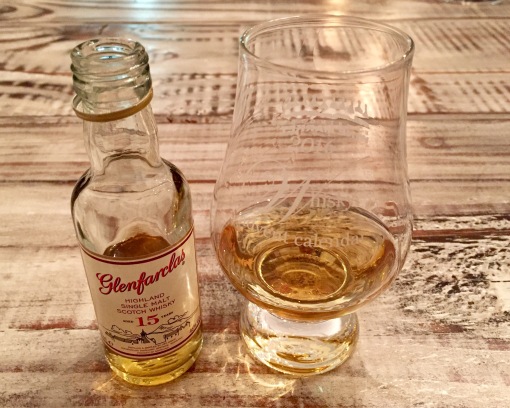
To obtain the legal designation of “scotch whisky”, a spirit has to (1) be aged in oak casks (2) which are no larger than 700L (3) for at least three years (4) in Scotland. Glenfarclas uses both plain new oak casks (which we haven’t heard much of in this year’s calendar) and ex-Sherry casks (with which we have been bombarded by this year’s calendar, and by the whisky industry in general), and it is definitely known for its emphatic use of the latter. The 15 Year is a glimmering dark amber colour reflective of its barrel time and has a few different aromatic identities: confectionary (butterscotch chips, and nougat, like the inside of a Three Musketeers bar), nutty (almonds, oatmeal), herbaceous (corn husks, grass). Bold and fiery as soon as it touches the tongue, this is not messing around, slinging toast and spice, banana Runts, mandarin orange, Americano, char and vegetal flavours with authority and powering into a lacquered finish. It is punchy and powerfully concentrated, coming across like a cask strength whisky despite its 46% abv. Mammoth scotch.




 Arran is a traditional distillery with modern foresight, which releases a wide array of scotches aged in practically everything possible — current highlights include a Sauternes cask, a Port barrel and (!!!) an Amarone cask bottling. I love it. If you’re so inclined, you can also
 And it is, in spades, if you’re a fan of the Islay style of peated whisky. The Cask Islay contains 35 ppm of peat phenols, chemicals released in the smoke of burning peat moss used in the distillery’s kilns while drying malted barley which are absorbed by the barley itself. 35 ppm is not overly high as far as peated scotch goes; the peat bombs that push the issue can get all the way up to 200 ppm (at which point they basically taste like solid charcoal). But even the lower figure is enough to establish peaty dominance in the Cask Islay’s nose, all oily smoke, seawater brine, clamshells, beach fire pits, iodine and (weirdly) Comet cleaning powder. Happily, it is more personable to taste than to smell, adding warm peach cobbler and baked apple fruitiness to the swirling peat mass of shoe polish, diesel, sulphur and topsoil, finishing hearty and rich. This is a great fireside malt, although it would certainly not make a good pick for a whisky neophyte’s scotch initiation. Frankly a spectacular buy for any Islay lover at this price point. I’m in.






 cabernetdialectic (Raymond Lamontagne)
 Dan Steeves
 Peter Vetsch
 tylerderksen
 pop & pour