Whisky Advent Calendar 2015: Day 19

19 12 2015

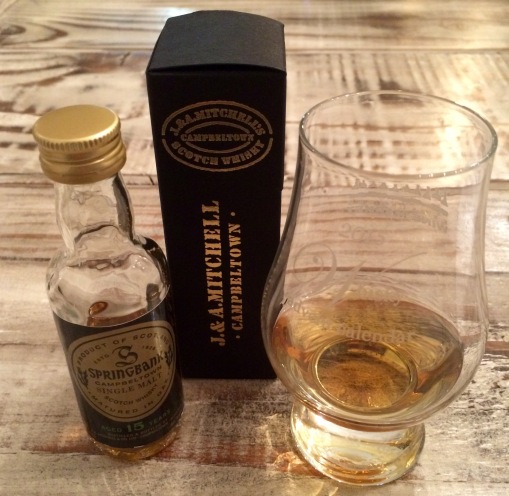
The last weekend of 2015 whisky writing is upon me.  I can smell the end of this December blogging marathon; it smells like scotch.  This is the fifth time in the past two years that I’ve opened a calendar door to see a black cardboard box wedged inside, which can mean only one thing:  a trip back to Campbeltown and its dominant Springbank distillery.  This time it’s the main label whisky as opposed to its sister labels, the triple-distilled Hazelburn (as seen in Day 13 this year and weirdly also in Day 13 last year) and the heavily peated Longrow (as seen in Day 20 last year, and with five more days to make an appearance this time around).  Last year the KWM Whisky Advent Calendar completed the triumvirate with the Springbank 10 Year on Day 18; this year we graduate to the Springbank 15 Year, the staple of the distillery’s core lineup, which runs for $112 at KWM.  Springbank distillery was established in 1828 on the site of an illicit still run by an Archibald Mitchell, and four generations later it remains run by Mitchell’s great great grandson, remaining in the family for close to 200 years.  100% of the whisky-making process for each label’s lineup occurs on site at Springbank, an extreme rarity in the scotch world.  The distillery’s website describes its 15 Year Single Malt in a way that requires remedial English lessons:  “Like a storm gathering off the Kintyre coast, our 15 year-old Springbank is dark and ominous, yet delicious.”  Um.  OK.  How is a gathering storm delicious??  Simile police APB – calling all units.  This sentence was a train wreck from about the third word in.
FullSizeRender-198

Grammatical terror aside, this is a beautiful dram that should please all comers, regardless of their flavour preferences and sensibilities.  It is a rich amber, almost orange in colour, and (especially without water added) smells strongly sherried at first, salt and seashells and yeast added on top of leather, raw pumpkin and Elastoplast aromas.  A few drops of water bring out softer, more welcoming baking spice notes like brown sugar, gingerbread and clove.  Like a storm gathering off the Kintyre coast, this Springbank is concentrated and fiery on the palate, yet delicious, with a viscous mouthfeel and a lingering set of flavours crossing multiple taste groupings.  There’s a sweet honeyed wheatiness to it, like breakfast cereal, a hint of peaty mossiness and smoke, a touch of sherry nuttiness and brine, and a dollop of caramel and fig maturity, all in roughly equal proportions.  This is the Goldilocks whisky, likely to come across as just right to a host of different palates.  Clearly a way better metaphor than the storm thing.  Into the 20s tomorrow!


Whisky Advent Calendar 2015: Day 18

18 12 2015

It is exactly one week until Christmas.  Seven more days, team.  Seven more whiskies, after this one.  Hang in there.  My mild-to-medium annoyance at opening the Day 18 window and pulling out yet another Gordon & Macphail Connoisseurs Choice bottling (the third of the calendar, after Day 4 and Day 10) turned to instant excitement once I saw the name of the featured distillery on the bottle:  Caol Ila, one of my favourites, and one of the best Islay distilleries at managing that delicate but critical balance of peat influence within a whisky’s flavour profile.  Having talked about Connoisseurs Choice twice now, I will avoid repeating (three-peating) myself and talk about Caol Ila instead.  Its name is pronounced “cull-eela”, meaning that I actually was almost saying it right before looking it up, a name that means “Sound of Islay” (referring to the body of water of the same name, not an actual sound, although that would be cooler).  Owned by global spirit behemoth Diageo, Caol Ila is, surprisingly to me, by far Islay’s biggest distillery, churning out more than double the production of the other distilleries on the island.  Much of this whisky is designated for use in blends — like the 2014 calendar’s super-awesome Big Peat, which champions its Caol Ila content on its label — but a smaller percentage of it is bottled in the distillery’s name, either under its own label or by independent bottlers like this.

FullSizeRender-197

This particular bottle of Caol Ila is from a single vintage, 2003, and was bottled this year, making it a 12 Year malt.  It is classic Islay on the nose, a combination of rawhide, old catcher’s mitt, seaweed, liniment and salty sea air, but in a way that smells far nicer than that sounds, using those aromas in the most comfortable way possible.  The depth of flavour and sheer intensity of both the peat-induced and the other notes is just remarkable.  The peatiness has layers, descending from briny/herbal at first to campfire and ash down to something more dank, like tar and pitch.  This ominous progression somehow doesn’t interfere with the development of equally potent notes of peanut brittle, celery sticks, ginger, oiled leather, poached pear, shoe polish…I could go on.  There’s a lot happening in this whisky, especially at only a dozen years of age.  For me it’s one of the best of the calendar so far without question.  I actually wrote at the end of my tasting notes:  “If this is under $100 it’s a screaming deal.”  Well, guess what?  It’s $99.99.  Scream away.


Whisky Advent Calendar 2015: Day 17

17 12 2015

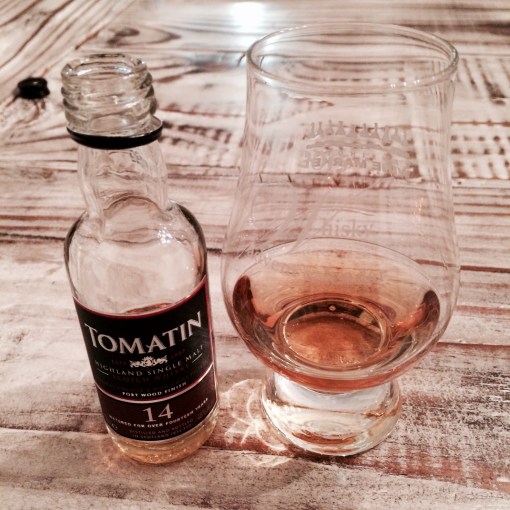
Two value hits in a row!  With the last week of whisky on the horizon, the KWM Whisky Advent Calendar is heating up.  Tonight’s bottle is a bit of an oddity, as you don’t see a whole lot of 14 Year Single Malts on the market:  if it doesn’t end in 5 or 10 and isn’t divisible by 3, it isn’t usually a whisky age designation.  This is particularly intriguing because the distillery, Tomatin, also has 12 year AND 15 Year malts on the market.  But 14 it is, and it also has another characteristic that doesn’t show up a ton:  Port cask aging.  More of this please, whisky.  Technically speaking, the Tomatin was only finished in Port casks, spending the last 18 months of its maturation in Port pipes after a lengthy initial aging period in bourbon casks, but I am on board regardless.  Three excellent bits of trivia about Tomatin:  1.  It has the best website cover picture of any distillery in Scotland.  Just go to tomatin.com and see.  I’ll wait.  See?  Worth it, right?  2.  Its name means “Hill of the Juniper Bush”, because juniper is one wood that gives off no smoke while burning, making it a top choice for secret distillers back in the 15th century, when whisky production was illegal but Tomatin’s spiritual predecessors in the area did it anyway.  3.  Due to its relatively isolated location in the Highland mountains, 80% of Tomatin’s employees live at houses built at the distillery!  That’s a new one.

FullSizeRender-196

Other than riveting trivia, the thing that caught my attention the most about this Tomatin was its incredible dark bronze colour, very clearly influenced by its year and a half braise in Port barrels.  There was instant orange zest, peach iced tea and nectarine on the nose, filled in with sunbaked earth, hot grill and coconut, like an aromatic summer vacation.  However, the texture on this 14 Year was the true story, rich and round and smooth and mouth-filling, like melted caramel.  As soon as you swallow you just want to hold it in your mouth again (an excellent recipe for drinking a lot of scotch too quickly, by the way).  The orange-y citrus notes persist on the palate, along with an interesting rootiness (like burdock, if you’ve had it, or fresh carrots), nutmeg and cinnamon spice, butter tart, chocolate almonds and a twinge of herbaceousness on the finish.  I would be very happy with this for $87, its KWM sticker price.  Considering I wasn’t a massive fan of last calendar’s Tomatin, this is a highly impressive comeback.


Whisky Advent Calendar 2015: Day 16

16 12 2015

BenRiach!  Finally!  After dominating last year’s Advent calendar with a whopping trio of entries (the 16 Year, the 20 Year, and the hilariously named 17 Year Septendicim), BR had been conspicuously absent from the 2015 edition, but I was happy to see it back, with a bottling younger than any of the 2014s:  the 10 Year Peated Single Malt Curiositas (they can’t stay away from the Latin, apparently).  The showy name is accurate, however, as a peated malt from the Speyside region of Scotland is certainly a curiosity, to the point of being a near-oxymoron; you almost never see a Speyside scotch make use of peat-kilned malted barley.  Not that this stops BenRiach, which has FIVE such peated whiskies in its lineup!  BenRiach may have the craziest history of any distillery I’ve come across:  it was opened in 1898 but mothballed just 2 years later, and it stayed non-operational as a distiller for SIXTY-FIVE YEARS before re-opening in 1965.  Even then, it didn’t bottle and sell whisky under its own brand name, instead providing its product to other distillers and blends.  It wasn’t sold as a standalone bland until 1994…and then it was promptly mothballed AGAIN in 2002.  In 2004 it was sold (for not the first time) to a group of individual entrepreneurs led by scotch industry vet Billy Walker, after which, 106 years after initially opening, it first hit its stride, and it’s never looked back.  Scotch is nuts sometimes.

FullSizeRender-195

The Curiositas is not fooling around with its peat content, which you can smell as soon as the screw cap seal cracks.  BenRiach’s website notes the “wonderful overtones of peat reek” on its 10 Year – mmm.  Cigar box, tanned leather, burnt grass and new football smell puts a measured weight on the intensity of said reek, but there’s no doubting its volume.  But there’s more than just peat on the palate, a sweet, spicy and mossy symphony with smooth smoke, chocolate orange, candied ginger and suede flavours, a lovely balance of peat-induced and other notes.  This is an impressively complex dram for a 10 Year, and just an obscene value for $64, a price that made me do a complete double-take.  If you don’t mind a bit of smokiness, this is an absolute can’t-lose proposition.  It’s even cheaper than The Maritime Malt!  Value whisky squared.


Whisky Advent Calendar 2015: Day 15

15 12 2015

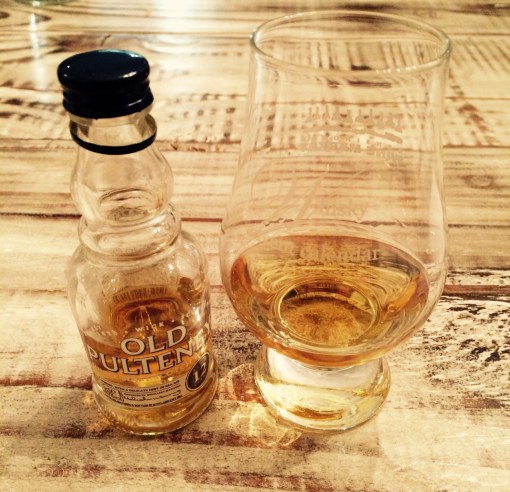
Only 10 days and 2 statutory holidays until I get to stop writing about whisky on a continual basis!  We have reached the 60% mark of whisky Advent, and what better way to celebrate than to crack something that looks and sounds like it would be at home being cracked on the streets of a little Scottish town:  Old Pulteney 12 Year Single Malt, possibly better known as The Maritime Malt.  Nestled in the coastal town of Wick (“once known as the herring capital of Europe”) on the very northeastern tip of Scotland, this is the most northerly distillery on the mainland, in the far reaches of the Highlands.  Old Pulteney was established back in 1826 and is known, at least to itself, for producing whiskies that have a whiff of the sea about them.

FullSizeRender-194

The colour of old sap, the Old Pulteney 12 Year had a baffling series of aromas given that it was matured in ex-bourbon casks, which usually impart sweet flavours.  Not so much:  this whisky smelled funky, grimy, cheesy and salty, like the inside of an old boat (not the whiff of the sea I was expecting, let’s just say).  Casting about (damn it, maritime metaphors!) for aroma descriptors, I settled in my notes for “locker room, Sharpie, bouncy balls, Cheetos bag, pretzels”, so do with that what you will.  There was a surprising and immediate alcohol burn on the first sip despite the whisky being diluted to the usual minimum 40% abv, and some harshness remained in the spirit even after I (begrudgingly) added water.  It tasted more along expected scotch lines, but its lemon and grilled pear fruit was surrounded by hot rocks/sauna, hickory bark and shoe leather, and it was almost tannic in its textural dustiness.  I summed up my thinking by writing:  “This is cheap, right?”  Yes it is:  at $65, possibly the cheapest single malt in the calendar.  This all sounds predominantly negative, but I didn’t have that bad a drinking experience with this scotch; I just felt that it lacked some of the finesse and style of the other malts.  It’s a blue-collar fishing village dram…what else from The Maritime Malt?


Whisky Advent Calendar 2015: Day 13

13 12 2015

I could have sworn that I had read or heard somewhere that the 2015 KWM Whisky Advent Calendar would contain no duplicate whiskies from the 2014 calendar, which I’m sure was a logistical challenge due to the so-so availability of mini-bottles, but which I thought was an excellent choice to maintain the intrigue for repeat buyers.  So far this year we’ve had a couple of distillery overlaps, but zero identical bottles, as was expected.  But that ended tonight, as 2015’s Day 13 whisky was strangely the exact same as 2014’s Day 13 whisky:  the Hazelburn 12 Year Single Malt from Campbeltown, Scotland’s least prevalent whisky region in the southwest corner of the country.  I will not try to hide my disappointment at this development, particularly since I was sort of meh about this scotch last year; of all the ones to repeat in the calendar, why this one?  Hazelburn is a relatively new line of whiskies from the Springbank Distillery, which is by far the largest and most important remaining in Campbeltown.  This lineup was first distilled in 1997 and features triple distillation as its calling card:  the whisky is run through old copper stills three separate times during distillation, with each run removing more and more impurities and heightening the proof level of the spirit.  Removing impurities isn’t exactly the distilling goal of scotch whisky (if you removed almost all of them and ended up with a nearly pure spirit, you’d basically have vodka), as what keeps the spirit impure is the flavour and character of the land and grain, but the extra distillation results in a lighter, more subtle dram that is Hazelburn’s signature style.

FullSizeRender-192

The 12-year maturation in sherry casks gives this scotch a lovely deep golden colour, and I am an admitted fan of the Oakland Raider-style silver and black label design (with the aforementioned three stills front and centre).  The nose was a swirling melange of rubber, chemical, peaches and cream, popcorn kernels, char and citrus, with the fruit notes mostly overtaken by the industrial ones.  As I remembered from last year, the Hazelburn 12 comes across as heavily wooded when you taste it, like the barrels used were strongly toasted or something, as smoke, hickory and ash are at the flavour forefront, with banana and cantaloupe fruit, honey, vanilla and varnish sneaking through the oak wall at various points ahead of a dusty, papery, fiery finish.  Looking back at the tasting notes in last year’s writeup, I see a number of similarities emerge, although my notes are clearly less identical than the bottles are.  Let us hope this will be the last time we’re able to do this kind of head-to-head 2014 vs. 2015 comparison.  Bit of a letdown night overall, I have to say.


Whisky Advent Calendar 2015: Day 12

12 12 2015

Halfway there!  Well, almost.  At this calendar milestone, it was fitting to pull out a scotch from a distillery that was the focal point of an even bigger milestone last year, when the Glenfarclas 40 Year  was the culmination of 2014 Advent on Christmas Eve.  Since this is only the halfway point of 2015 Advent, we got a scotch about half as old, but the Glenfarclas 21 Year Highland Single Malt is still the oldest whisky pulled from the calendar to date.  The Glenfarclas distillery is located in Speyside, in the northeastern Scottish Highlands, and has been owned by the same family since 1865, when it was purchased for a shade over £511.  If you really want to make something out of your investment portfolio, buy a scotch distillery 150 years ago.

FullSizeRender-186

As you might expect from a spirit that spent 21 years inside of a (I’m guessing Oloroso sherry – that’s Week 2’s quota) oak barrel, the Glenfarclas was a gorgeous polished amber colour, one of those whiskies whose visual appearance is a central part of its drinking pleasure and not just an afterthought.  The nose was part confectionary (carrot cake, burnt sugar, sticky toffee pudding) and part sherried (brine, nuttiness, vegetal hints, dates), with the former aromas giving the latter some life and approachability and the latter keeping the former in check.  The scotch was a little fiery to taste, its alcohol asserting itself even at a relatively tame 43% abv, and even after I added water, but it still delivered flavours of toasted marshmallow, pumpkin spice, cedar, coffee grounds and cinnamon sticks ahead of a slightly salty finish.  All in all a well put-together dram at a solid price for its age ($143), but for whatever reason I couldn’t quite forge any emotional connection with it, so it probably won’t leave any lasting memory.  It was clinically good, but not in a way that would make me scramble to get more.  It’s all downhill from here for the next 13 days…


Whisky Advent Calendar 2015: Day 11

11 12 2015

This is the kind of impact two years of this Advent Calendar has had on me:  I opened the cardboard door to Day 11, saw the top of a squat, bulbous bottle, and immediately said aloud:  “Kilchoman”.  And so it was.  I remembered the low, round bottle shape from last year’s KWM calendar, when Kilchoman’s entry-level Machir Bay might have been my least favourite whisky of December 2014, an opinion based on personal taste rather than anything in particular wrong with the scotch.  I really wanted to like it too, because Kilchoman is one of the best stories in Scotland, the first new distillery to open on the island of Islay in 125-odd years and one committed to all parts of the whisky production cycle, including growing its own barley to malt and distill, something that basically nobody does.  As a traditional-minded producer (especially for one that just celebrated its 10th birthday), it is also committed to the near-extinct practice of floor-malting, which I’ve strangely discussed before on this blog here and which is also featured in possibly the greatest cartoon whisky-making video ever made on Kilchoman’s website.  Tonight’s attractively named Loch Gorm bottling, named after the peaty lake (bog?) overlooking the distillery, is higher up the food chain than the Machir Bay, on the shelf for $118.  Despite its sherry-based maturation, I hoped that this one would appeal to me a bit more than the last one.

FullSizeRender-185

Alas, ’twas not to be.  The Loch Gorm smelled oily in more than one way, both diesel and Vaseline, but wasn’t overly aromatic otherwise, a surprise for an Islay whisky.  Shoe polish, leather, tomato leaf and celery stalks rounded out a fruit-free aromatic profile.  Both Islay’s characteristic peat and the flavour volume generally turned up the volume on the palate, layering tar, moss, smoke and wet pavement on top of bakers’ chocolate, dried fruit and rubber balls, but things tapered off again on the finish, which seemed papery and a touch bitter.  I’m sorry, Kilchoman; I have friends who love you and I know you’re making waves in the industry, but you’re just not my thing.  Onto the weekend, and the halfway point of this spirit adventure!


Whisky Advent Calendar 2015: Day 10

10 12 2015

My immediate thought upon pulling out tonight’s whisky was:  “Again?”  Hadn’t I just seen this bottle before?  Well, yes and no.  Day 4 featured another scotch from independent bottler Gordon & Macphail’s Connoisseurs Choice range, the 1999 Ledaig.  Tonight’s bottle, six days and five whiskies later, featuring a slightly differently shaded but otherwise identical label, was the 1996 Auchroisk, at 18 years the oldest whisky of the calendar to date (quick tangent: the age figure on a whisky denotes its period of maturation and ends at bottling, so this whisky, bottled in 2014, is an 18-year rather than a 19-year in whisky-speak).  As this is a totally different scotch from a totally different distillery and region (the Ledaig was from the Isle of Mull, while the Auchroisk is from Speyside), I suppose I have no grounds to have felt a twinge of disappointment at seeing the familiar label come out of the box, but I think I would try to keep any and all similar bottlings as far apart from each other in the Advent order as possible.  That said, don’t think the presence of both the Ledaig and the Auchroisk in the Connoisseurs Choice lineup makes them kindred spirits or anything; the Gordon & Macphail website lists 152 different CC whiskies, so it’s not exactly an exclusive club.

FullSizeRender-184

Auchroisk (actually pronounced “oth-rusk”) was built rather recently in distillery terms, in 1974, and is found in the northeast of Speyside, which itself is in the northern part of Scotland.  This bottle states that whiskies from Speyside “are known as the ‘Premier Cru’ of Single Malt Scotch”, which I have literally never heard anyone say, and which might well cause a revolt in the other regions, but who am I to doubt a label slogan?  The ’96 oth-rusk was a pale watery lemon colour and went through an instant metamorphosis on each sip from nose to palate.  It smelled flowery, like potpourri, and soapy, like Thrills gum, with clear vegetal notes, sharp salinity and a lingering Brie cheese aroma (the latter two of which made me write down:  “sherry casks?”  Answer:  yes.).  But it was much more approachable, comforting and pleasurable once you tasted it, sweet and spicy, balancing cornbread, orange and tangerine fruit flavours with charred oak, smoke and pepper, but finishing deft and pure rather than bitter.  I can’t decide if the two-faced nature of the whisky made it more interesting or more annoying or both, but at $140 even that uncertainty is a problem.  Quite happy to have it in 50 mL form, however.  40% done the spirit blogging marathon!


Whisky Advent Calendar: Day 9

9 12 2015

Compass Box!!  I was quite excited to pop open door #9 and find one of my favourite value plays staring back at me.  This blended scotch whisky clocks in at a scant $53, making it the cheapest bottle in this year’s Advent lineup to date by a wide margin, yet it has the substance and dexterity to become the weeknight warrior whisky of your dreams.  Don’t like blends, you say?  Get over yourself.  Our collective manic obsession over single malts (whiskies made only from malted barley made from a single distillery) has turned well-made blended whiskies (made from a mix of malted barley whisky and grain whisky from multiple distilleries) into the prime values of the spirit world, and Compass Box does blends up right.  CB is a boutique blender that obtains spirits from a variety of top distilleries and crafts its own distinctive lineup of bottlings, known to me for sporting some of the best labels in the industry.  This bottle, the Glasgow Blend from their Great King St. line of whiskies, uses a high proportion of malt whisky and ages all of the grain whisky it uses in first-fill American oak barrels, which beefs up the body of the grain spirit and adds fullness and sweetness to it.  I defy anyone to try this and say that it deserves to be priced at half the cost of an equivalent single malt.

FullSizeRender-183

The Glasgow Blend is a peated and sherry cask-aged scotch, but each of these potentially powerful flavour influences is held carefully in check.  There is brine (sherry) and iodine (peat) on the nose, but as supporting players to an otherwise bright and friendly aroma set of beeswax, baked apple, golden raisin, Cinnamon Toast Crunch and maple walnut.  Smooth yet zesty, it livens up the tongue with sweet honeycomb and lemon meringue balanced by ocean spray and a smoky, burnt-wax note like blown out birthday candles.  The sweetness lingers on the finish along with a subtle warmth from the 43% alcohol.  This isn’t the most complex and esoteric whisky on the market and it isn’t trying to be, but it is a highly satisfying dram, carefully made, and it costs a shade over $50.  Sign me up.


Whisky Advent Calendar 2015: Day 8

8 12 2015

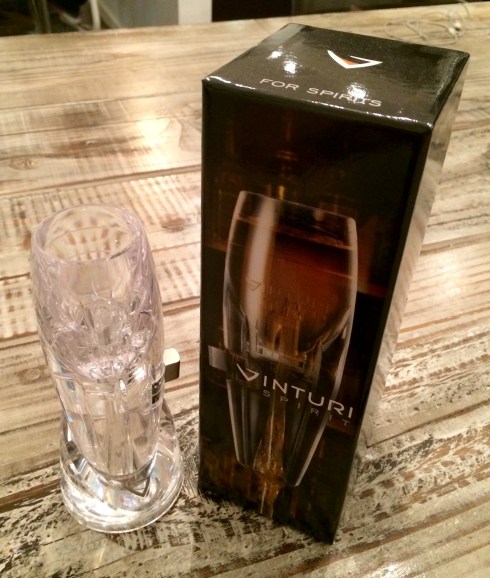
Time for a twist to start Week 2 of whisky Advent.  I was recently asked if I did whisky reviews, responded something to the effect of “um, sort of” and was given a spirit aerator from Vinturi for use with this year’s calendar.  You may know the Vinturi from the wine side:  it’s that intricate hard plastic funnel that insta-aerates any liquid that passes through it and into your glass, a sort of hyper-decant to open up tight wines in seconds rather than hours.  It’s one of the few wine gadgets that I actually use semi-regularly, not for the special occasion good stuff (which I like to see unfurl gradually), but for weeknight bottles that seem closed off when I first crack them.  I get why it works for wine, a drink that is highly susceptible to, and highly influenced by, oxygen from the second it is first exposed to it, at first in a good way (some air time softens and opens wine and releases packed-in flavours) and then in a very not-good way (too much air flattens and oxidizes wine and ultimately ruins it).  But spirits?  Once something is distilled and cranked up to 50% alcohol like tonight’s scotch, wouldn’t oxygen exposure cease to matter to it?  Once its maturation is done and it is freed from barrel and bottled, isn’t its flavour development over?  You never protect your whisky bottles from oxygen once you open them, and they never seem change even after months or years in an unstoppered bottle, so I was unsure how the wine-based premise of the Vinturi would carry over.

FullSizeRender-182
The guinea pig whisky for this aeration experiment was the Glenglassaugh Evolution, a Highland Single Malt from a distillery that was shut down and mothballed in 1986, only to be surprisingly salvaged and re-opened in 2008.  For the second day in a row we have a repeat producer from last year’s calendar; Day 7 of 2014 featured the Glenglassaugh Revival, the first scotch released after the distillery’s (literal) renaissance.  Weirdly, the 2015 offering from yesterday’s first repeat calendar producer, GlenDronach (Day 7 of 2015!), was also called Revival.  I’m hoping that was intentional.  Tonight’s Glenglassaugh is the SECOND scotch released after the distillery re-opened its doors, called Evolution, which holds the distinction of being the first whisky I’ve tried that was matured in ex-Tennessee Whisky barrels.  Seeing “Tennessee” displayed on a bottle of scotch takes some getting used to.

Read the rest of this entry »


Whisky Advent Calendar 2015: Day 7

7 12 2015

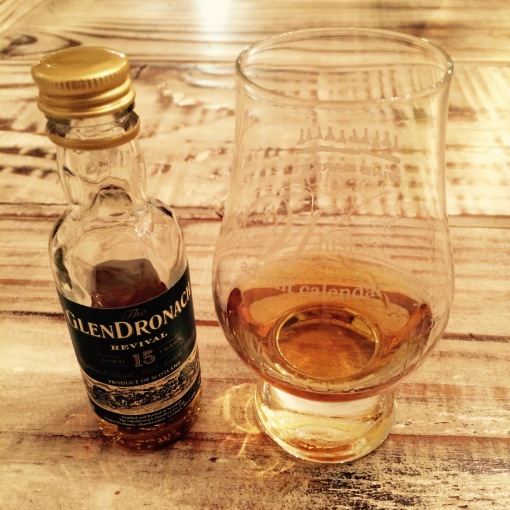
Fresh off a tasting of 13 Austrian and other Gruner Veltliners in 2 hours, I am doing an alcoholic 180 and re-centering on scotch, at least far enough to get 400 words out.  Ah, the trials and tribulations of a booze geek.  I believe tonight’s Advent scotch marks the first time that the 2015 Kensington Wine Market Advent Calendar has repeated distillers from the 2014 Advent Calendar.  Last year featured two different whiskies from the GlenDronach distillery:  the 18 Year Allardice, which I didn’t like too much, and the 21 Year Parliament, which was my favourite whisky of the whole calendar and which I promptly went out and bought after Christmas.  (You should too – it’s obscenely good.)  This is the younger brother of those two, the 15 Year Revival, and its relative youth is reflected in its sticker price, an impressively affordable $102.  GlenDronach is a Highland distillery that has been owned by BenRiach since 2008 and is known, at least according to itself on its website, for richly sherried malts.  You may or may not remember this from last year, but the 2014 calendar was so overloaded with Oloroso sherry cask-aged whiskies that it almost drove me to violence and left me with a massive case of Oloroso fatigue (until the Parliament came along and all was forgiven).  I think this is the first Oloroso-aged whisky of 2015; one a week is fine, so consider the allotment filled for Week 1.

FullSizeRender-180

This might be the most singularly delicious whisky I have ever tasted.  It’s not necessarily the most complex (although it does still have layers to it), but it is just so, so fantastically tasty, like every treat you love in the holidays packed together.  It is an incredible deep burnt amber colour — an Oloroso trait — and just radiates sweet treacle, gingerbread, cabane a sucre, brown sugar and clove, all Christmas baking all the time.  Weighty and soft on the palate, with alcohol that gently warms instead of obliterates, it rounds out the alluring flavour parade with orange zest, nectarine, toffee and coffee beans added to the warm embrace of sweet caramel glory.  There is just no reason not to buy this scotch; I want more right now.  KWM, save me some!


Whisky Advent Calendar: Day 6

6 12 2015

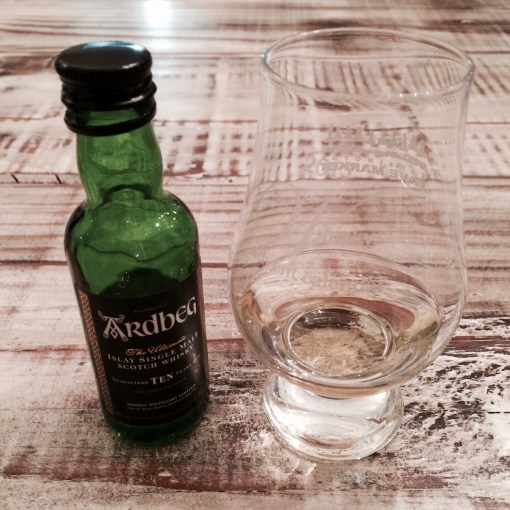
OK, fair warning.  I was out until 4 in the morning at an office Christmas party last night.  There was wine involved.  If there was ever a night to question the integrity of my palate and the quality of my insights, this is it; however, I felt bound by advent duty to forge onward with my whisky calendar mission and not be steamrolled by circumstance in week 1.  I just hoped I would open the little cardboard door and find a nice, mild, demure whisky to let my system off easy.  I got Ardbeg Ten instead.  F***.

I believe this is the 2015 calendar’s first visit to the notorious island of Islay, world Mecca of peated whisky and home to many distilleries unafraid to unleash it.  Ardbeg may be the most brazen of the lot, a producer that does not lack for confidence (their website says they are “unquestionably the greatest distillery on earth”) and has been accelerating the recent arms race to develop peatier and peatier whiskies with their borderline absurd Supernova.  Even this base 10 Year bottling (which goes for $80 and which the label calls “The Ultimate Islay Single Malt Scotch Whisky”, so again with the self-belief) is peated to between 55 and 65 parts per million, which is a whole hell of a lot; see here for a peat concentration scale for various distilleries, and you will note Ardbeg at the very top.

FullSizeRender-179

You can smell the peat leaching out of the Ten Year as you’re pouring it into the glass.  It is a rather nondescript light straw colour but radiates powerful, greasy, non-nondescript (descript?) aromas of leather, moss, shoe polish, sesame oil and seaweed, with a hint of citrus peeking through underneath.  There is a surprisingly sweet honey-maple attack on every sip that lasts for a millisecond before the peat hammer drops and layers on iodine, liniment, campfire, tar and struck matches, one after another after another.  At the end of that crescendo you get some baked apple and lemon curd fruit and anise and cinnamon spice, but they’re in the chorus line and not fronting the cast.  I will say that this isn’t the total blunt instrument that I partly expected and feared, holding back a bit on the brute force in approach and demonstrating some level of dexterity with how the peat is presented.  That said, there’s basically no way that people who dislike this style of whisky will enjoy this scotch; there’s really no unwinding peat from Ardbeg.  Please have some pity on me tomorrow, calendar.


Whisky Advent Calendar 2015: Day 4

4 12 2015

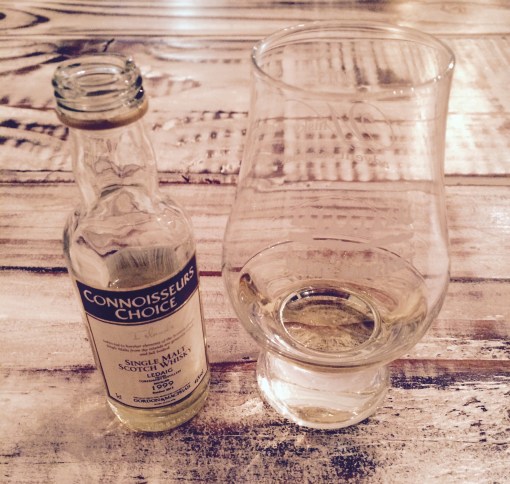
It’s times like this that I sympathize with people who think whisky is confusing.  The full title of tonight’s scotch is:  Gordon & Macphail Connoisseurs Choice 1999 Ledaig (from Tobermory Distillery) Single Malt Scotch Whisky.  Good luck with that.  Let’s unpack.  Remember when I said yesterday that whisky from any particular distillery in Scotland gets around and how some companies act as negociants sourcing pre-made whisky from elsewhere and then bottling it themselves?  The Ubermensch version of those companies are the independent bottlers, whisky brokers extraordinaire, who release from dozens to hundreds of different whiskies under their own labels, but who (unlike the artisan blenders like Wemyss from yesterday) also provide the details of the source distillery on the label.  So you might be able to get a 12 Year malt from a certain distillery’s own label but then also get a 12 Year malt from that same distillery under an independent bottler’s label.  It’s weird.  Gordon & Macphail is one of the pre-eminent independent bottlers of scotch whisky, with over 300 single malts in its lineup, and its Connoisseurs Choice portfolio is an array of rare single malt whiskies from various distilleries, many of which would not otherwise offer a single malt expression.  This particular bottle comes from the lesser-known Ledaig distillery, which changed its name to Tobermory Distillery a few decades back.  So the label name above reads [Independent Bottler] [Portfolio Name] [Vintage Date] [Old Distillery Name] [Current Distillery Name] Single Malt Scotch Whisky.  Good thing it’s tasty.

FullSizeRender-177

This is the first unabashedly peaty scotch in the calendar, to the point where you might think it comes from the peat haven of Islay, but Tobermory is in fact located on another island just north called the Isle of Mull (which I’m secretly hoping is where mulled wine comes from).  The label just says “Islands”, possibly because the Isle of Mull isn’t trendy enough to get its own mention.  The Ledaig was a disarmingly pale greenish colour that displayed no visual hints of the power to come.  However, the first sniff brought an immediate blast of peat-induced scents:  mechanic’s shop, diesel oil, catcher’s mitt, shoe polish, funk, but also hints of sweet tropical fruit that kept the whisky from coming across as harsh or dirty.  The taste was both beautiful and old school; charred, smoky and medicinal, reminiscent of cigars and old leather armchairs, but also bright and spicy, with candied pineapple, crystallized ginger and Bananas Foster.  There’s almost some furriness to the texture too (from the wood tannin of the aging barrels, I would guess), which adds to the whole sensory experience.  The priciest whisky to date at $120, it’s worth every penny.  Currently in the calendar pole position, without question.


Whisky Advent Calendar 2015: Day 3

3 12 2015

Third day of the calendar, second whisky I have never heard of, first blended malt.  You may remember from yesterday that a single malt scotch means one whose component spirits have been distilled in a single distillery; it may therefore not come as a surprise to learn that blended whiskies are those whose component spirits hail from different distilleries and are blended together.  Blended malt whiskies are blends whose components are entirely whiskies made from malted barley as opposed to other grains and are generally seen (not always rightly) as superior to “blended whiskies”, which can be a mix of malt and grain whisky.  Phew.  Some producers, like tonight’s, don’t make their own spirits at all, but instead act sort of like wine negociants, sourcing whiskies made from various distilleries and then using them to create and bottle their own custom blends.  As whiskies seem to transfer and flow across producers much more often in the scotch world than in the wine world, this is neither a bad nor an uncommon idea, and many of these blending specialists create killer drams at highly reasonable prices.  A bottle of the Wemyss (pronounced “Weems”) Malts The Hive 12 Year Blended Malt Scotch Whisky will set you back $77 at KWM; not too shabby for a scotch of that age.

FullSizeRender-176

Wemyss Malts have a trio of blended malts in their profile which they have set up to meet three different flavour profiles:  Spicy, Peaty, and Honeyed.  Guess which one The Hive is meant to represent?  The bee on the label pretty much says it all.  Yes, this is the Honeyed Malt, made from a variety of malts from Speyside, and apart from a questionable dalliance with sherry casks (who tastes sherry and thinks “honey”?), it accomplishes its flavour mission fairly well.  It is a gorgeously dark, burnished amber colour and smells immediately of honeycomb (natch, though I swear I wrote that note before reading about the whole Honeyed Malt thing), salt lick, Brie cheese (thanks, sherry) and cedar, with a hint of leafiness on the fringes.  Despite being by far the lowest abv whisky in the calendar so far at 40% the alcohol flares almost immediately on the palate, somewhat obscuring the viscous, almost oily texture and sweet flavours of the scotch; I’m not sure why it can’t keep itself in check better or if the balance is off somehow.  Once you get past the boozy heat there’s a pleasing confectionary array of maple, butterscotch ripple, cream soda and, yes, honey, with layers of celery salt, mesquite and tree bark lurking underneath.  It’s unquestionably tasty, but due to its inability to successfully harness the lowest alcohol level you will commonly see in a whisky, I have to think it’s a bit of a step down in quality from the last two days.  Rocking label though.