To say that things are heating up in the last week of Advent would be a massive understatement. Yesterday we hit upon my favourite calendar whisky distiller in GlenDronach, and today we meet up with the only other producer that has managed to reach similar Advent highs, Taiwan’s Kavalan, which took second AND third place in last year’s calendar for me and which seems to do nothing but produce show-stopping whiskies in what on its face seems like one of the least likely locations on Earth. But here’s the secret: Taiwan is much, much hotter year-round than Scotland is, and massively more humid. So? So when you’re freshly distilled whisky spirit, sitting in a barrel and waiting for maturation magic to happen, those climatic conditions make the aging dance between cask and liquid go into hyperdrive, accelerating evaporation (which speeds up oxidation) and allowing the wood grain to penetrate into and flavour the whisky much more quickly. The result: a distillery that’s barely 10 years old with products on the shelf that you would taste blind and swear they’ve been aging for well over 20. In the whisky world, you can’t ask for a better and more distinct advantage than that.

This is a particularly interesting bottling because it is ALMOST, but not quite, identical to the Kavalan from Day 5 of 2015. Like this one, that was also an ex-Bourbon cask bottling, but it was a cask-strength offering (like most of Kavalan’s lineup), whereas this is the first Kavalan whisky I’ve had that isn’t, bottled at 46% to give Kavalan a sort of “entry-level” whisky in its lineup. Those words are in scare quotes because the bottle still costs $140, but I am here to tell you that it’s worth it. It was bottled in mid-2015 (at 11:16 a.m., according to the hyper-specific back label info) and likely only spent a few years in Bourbon barrels, but the Taiwan time warp effect made it deep and rich and gold in the glass, albeit more yellow than amber. It smells like the most delicious confection you could ever come up with: part toasted marshmallow and vanilla bean, part wafer cookie and whipped cream, with some Corn Pops and hickory on the edges for good measure. It then beams out the most outrageously tropical set of fruit flavours I have seen in a whisky. Cantaloupe? OK. But guava? Papaya? WATERMELON? What is happening?? Coconut flakes and Rice Krispie squares round out an absurdly delicious six-days-till-Christmas whisky: exotic and playful, complex but oh so hedonistic. I sense another podium finish, Kavalan.


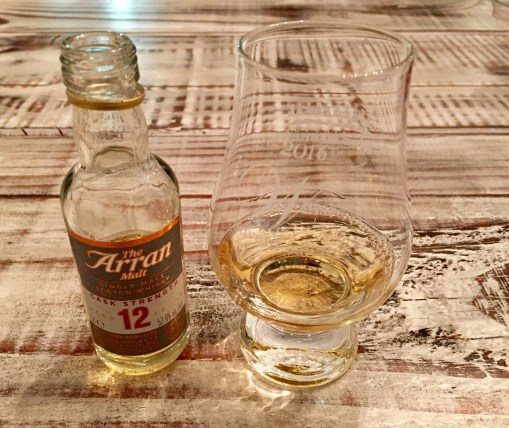 Arran is a traditional distillery with modern foresight, which releases a wide array of scotches aged in practically everything possible — current highlights include a Sauternes cask, a Port barrel and (!!!) an Amarone cask bottling. I love it. If you’re so inclined, you can also
 And it is, in spades, if you’re a fan of the Islay style of peated whisky. The Cask Islay contains 35 ppm of peat phenols, chemicals released in the smoke of burning peat moss used in the distillery’s kilns while drying malted barley which are absorbed by the barley itself. 35 ppm is not overly high as far as peated scotch goes; the peat bombs that push the issue can get all the way up to 200 ppm (at which point they basically taste like solid charcoal). But even the lower figure is enough to establish peaty dominance in the Cask Islay’s nose, all oily smoke, seawater brine, clamshells, beach fire pits, iodine and (weirdly) Comet cleaning powder. Happily, it is more personable to taste than to smell, adding warm peach cobbler and baked apple fruitiness to the swirling peat mass of shoe polish, diesel, sulphur and topsoil, finishing hearty and rich. This is a great fireside malt, although it would certainly not make a good pick for a whisky neophyte’s scotch initiation. Frankly a spectacular buy for any Islay lover at this price point. I’m in.









 cabernetdialectic (Raymond Lamontagne)
 Dan Steeves
 Peter Vetsch
 tylerderksen
 pop & pour