I’m learning. I half-pulled tonight’s mini-bottle out of its cardboard home, saw the uber-Scottish name of a distillery I had never previously seen or heard of, and immediately hunted for the tiny Gordon & MacPhail logo tucked discreetly on the bottom of the label. Another Distillery Label G&M Whisky? You betcha. On Day 8 it was the gleefully Scottish Miltonduff that got its quasi-day in the sun, and 8 days later it’s the equally blue-and-white Glenburgie 10 Year Single Malt (another Glen for the roster!) that has its turn. As mentioned a week or so ago, the Distillery Label series is Gordon & MacPhail’s collaborative effort with a series of lesser-known distilleries to bottle a whisky that’s as close as possible to the producer’s own release through the invisible hand of G&M’s independent bottling empire. The effort goes right down to the packaging, which is made to look like it came right from the distillery’s own marketing department; you almost need a magnifying glass on these mini-bottles to see that Gordon & MacPhail had anything to do with them.

Glenburgie is a Speyside-based distiller and yet another scotch producer that’s mainly used as feedstock for the Ballantine’s blend (a trait it shares with the last Distillery Label, Miltonduff, each of whom deserve a better fate). This bottle was matured in multiple types of sherry casks and threw off some impressive depth of colour for a 10 Year whisky. It began fairly understated, a careful combo of fruit, spice and herbaceous aromas: peach iced tea, pepper, wood grain, celery root. Then things ramped up on the palate, mostly thanks to the Glenburgie’s honeyed and almost waxy texture, mouth-coating even at 40% abv and bolstering more intense flavours of sweet orange Lifesavers, almond brittle, celery and peanut butter (together), sultana crackers and anise. I don’t think this is a scotch I’m going to remember in two whisky days, but it’s definitely an enjoyable weeknight whisky. It and Miltonduff are two peas in a pod that way; I could probably do without a third one in 8 more days, but we shall see.

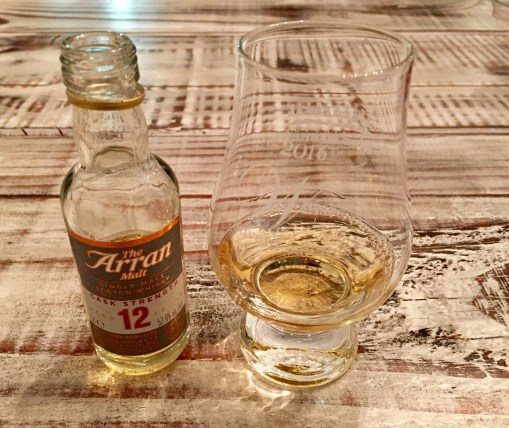 Arran is a traditional distillery with modern foresight, which releases a wide array of scotches aged in practically everything possible — current highlights include a Sauternes cask, a Port barrel and (!!!) an Amarone cask bottling. I love it. If you’re so inclined, you can also
 And it is, in spades, if you’re a fan of the Islay style of peated whisky. The Cask Islay contains 35 ppm of peat phenols, chemicals released in the smoke of burning peat moss used in the distillery’s kilns while drying malted barley which are absorbed by the barley itself. 35 ppm is not overly high as far as peated scotch goes; the peat bombs that push the issue can get all the way up to 200 ppm (at which point they basically taste like solid charcoal). But even the lower figure is enough to establish peaty dominance in the Cask Islay’s nose, all oily smoke, seawater brine, clamshells, beach fire pits, iodine and (weirdly) Comet cleaning powder. Happily, it is more personable to taste than to smell, adding warm peach cobbler and baked apple fruitiness to the swirling peat mass of shoe polish, diesel, sulphur and topsoil, finishing hearty and rich. This is a great fireside malt, although it would certainly not make a good pick for a whisky neophyte’s scotch initiation. Frankly a spectacular buy for any Islay lover at this price point. I’m in.












 cabernetdialectic (Raymond Lamontagne)
 Dan Steeves
 Peter Vetsch
 tylerderksen
 pop & pour