KWM Whisky Advent Calendar 2016: Day 20

20 12 2016

As we near the finish line of 2016 Whisky Advent, we’re coming a bit full circle, back to the distillery (if not the bottler) that brought us Day 1.  We started off Advent with Gordon & MacPhail’s take on a Tomatin whisky, and tonight we let the distillery speak for itself, continuing the calendar’s now-three-year streak of Tomatin releases, after 2014’s blasé 18 Year on Day 12 and 2015’s awesome Port-aged 14 Year on Day 17.  The difference between those bottles and this one is twofold:  this one is cask strength, as the largest capitalized letters on the front label tell you, and it also has no age designation whatsoever, suggesting that it’s probably too young to market as a number.  The $73 price tag would go along with that theory.  (Incidentally, if you’re a whisky spendthrift, you should probably focus your scotch dollars on cask strength whiskies — you get the same volume of whisky at up to 50% higher alcohol, without a price premium in many cases, and when you pour yourself a serving you have to add water to it, something the distillery does itself to get its non-cask strength releases down to 40% or 46%.  In other words, you often pay the same price for post-dilution bottles as for pre-dilution bottles which you then dilute yourself, giving you way more whisky concentrate for your money at cask strength.)
fullsizerender-513

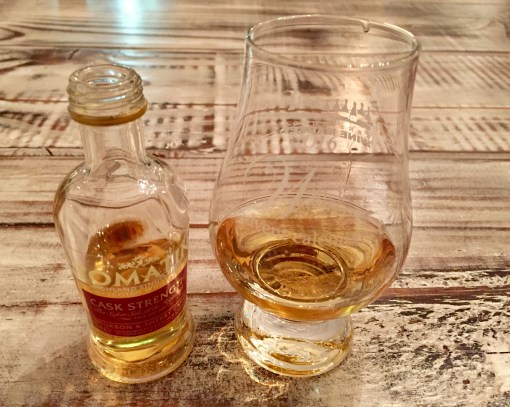
This bottle’s packaging is an exercise in earnest oxymorons:  lilting italic script informs you that this whisky represents “The Softer Side of the Highlands”, immediately below the double-sized block letters stating “CASK STRENGTH” and immediately above the 57.5% abv listing.  I could describe this whisky in many different ways and it would not end up on the softer side of anything.

This is Tomatin’s first cask strength bottling in its core range of whiskies and saw (an unknown amount of) time in a combination of Bourbon and Oloroso Sherry casks before being bottled.  It was a fairly eye-catching dark golden wheat colour for a bottle coy about its age, yet unlike most whiskies which are aromatically the sum of its parts, this one just smelled like the parts, like barley and barrel and fermentation:  malt, grain, yeast, spice, salt, seawater.  You then completely forget about that, and everything else, once this Tomatin hits your tongue and your brain starts bubbling like it’s on a griddle.  The whisky is massive, overwhelmingly lush and nearly gelatinous in texture, to the point where it almost doesn’t even feel like a liquid.  A strange mixture of honey, baby oil, firewood, shortbread, spackle, flaxseed and rye bread, it is a raging beast of decidedly cautious flavours, a meek monster.  On an oddly bitter yet sweet-tinged finish, it leaves me with no other concluding thought than:  this is just so weird.


KWM Whisky Advent Calendar 2016: Day 15

15 12 2016

A couple days ago I whined excessively in my daily whisky write-up that my family had gone through a particularly horrible run of consecutive sickness that was making the blog feel like a bit of a grind.  In the two days since, my son has gotten the flu and my wife has gotten a sinus infection for the fourth time in the last two months.  Far from dreading Whisky Advent anymore, I’m now starting to think it’s the only thing keeping me healthy, so let’s keep it going.

One fairly consistent theme of this year’s calendar posts has been me railing against the relative lack of originality employed by most distilleries in selecting their maturation vessels.  Like wineries and their coin flip of French vs. American oak, distilleries seem to make their choice dichotomous as well:  bourbon cask or sherry cask.  However, since (unlike wine) whisky gets many of its flavours not from the vessel itself but from what was previously aged in it, this opens up so many avenues of alchemy for distillers to coax new expressions out of the same duly processed malted barley.  Most appear either oblivious or uninterested in the challenge, but one distillery that has embraced the multiplicity of available aging options with élan is tonight’s calendar star:  the Arran distillery, named after the tiny round Isle of Arran sandwiched between the western shores of mainland Scotland and the peninsula housing the whisky region of Campbeltown, both due east of Islay.

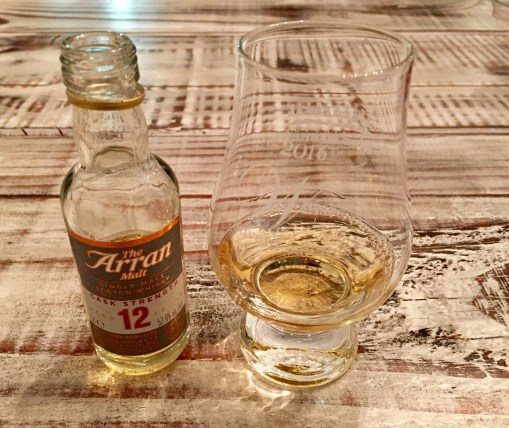
fullsizerender-508Arran is a traditional distillery with modern foresight, which releases a wide array of scotches aged in practically everything possible — current highlights include a Sauternes cask, a Port barrel and (!!!) an Amarone cask bottling.  I love it.  If you’re so inclined, you can also BUY YOUR OWN CASK OF SCOTCH and then come visit it while they mature it for you.  I’m not even kidding.  £1,850 for 200L of ex-Bourbon glory – who’s in with me?  Of course, now that I’ve raved about how cool Arran is, I have to report that tonight’s whisky, from the 5th batch release of their 12 Year Cask Strength Single Malt limited edition, is aged in the boring-est ever combo of first-fill sherry butts, refill sherry hogsheads and first-fill bourbon barrels.  At 52.9% and only $80, though, it’s a lot of scotch for the money.  It smelled exactly like a cereal I’d eaten as a kid but had to Google search to remember the name of (Corn Bran, it turns out), mixed with cantaloupe, barley, corn husks and spice, but then ramped up on the palate and tasted like something out of a Christmas catalogue:  Bailey’s and eggnog, gingerbread, canned peaches, whipped cream and coconut milk.  Super friendly for a cask-strength whisky, it brought the fun and the charm in spades even if it wasn’t an intellectual heavyweight.  Time to buy a cask.


Whisky Advent Calendar 2015: Day 23

23 12 2015

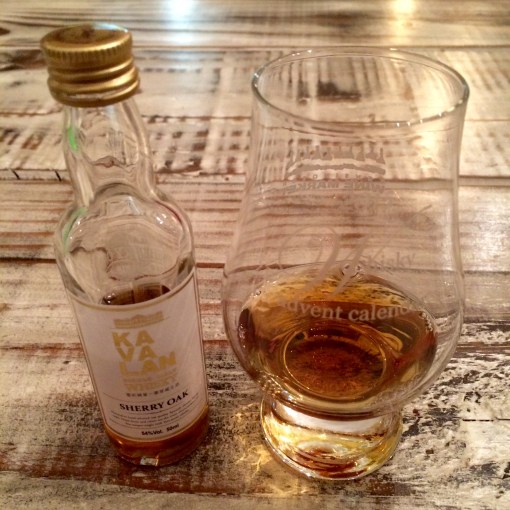
Well, I’m officially on Christmas holidays from work…but not from this blog or my daily whisky spirit quest, which is now three days away from completion.  So close.  The Whisky Advent Calendar usually finishes with a flourish, and tonight did not disappoint in that regard, as we returned to Taiwan and a producer that’s quickly becoming a podium distillery for me, the world-renowned Kavalan.  Taiwan’s only distillery first showed up in the calendar on Day 5 with its superb cask strength ex-Bourbon bottling, a whisky so good that my father-in-law promptly (and quite properly) went out and grabbed the last bottle in the province after trying it.  That whisky was a pale transparent gold in colour.  This one, not so much.  Same cask strength series, same base spirit, likely a similar aging period (that is:  not that long a one, as Taiwan’s heat and humidity supercharges the maturation period and allows for maximum barrel character transfer in a minimal time window), but different aging vessels, as we go from Bourbon’s brightness to the colourful depths of Oloroso Sherry casks.  Oloroso is an oxidative style of sherry where the wine is aged with full exposure to oxygen for many years, giving it a deep tawny colour like fresh coffee, and that hue obviously sticks with the barrels, because tonight’s Kavalan cask strength (54%) Sherry Oak Single Malt was easily the darkest whisky yet, an amazing shadowy bronze.  It’s clearly darker than yesterday’s Balblair 1990, and that one aged in oak for 24 years; Kavalan’s only been in existence for 10, and I bet this malt only saw barrel for half that or less.  How crazy is that??

FullSizeRender-202

This whisky smells EXACTLY like fresh pancakes and maple syrup, almost to the extent that I don’t want to write another aroma note about it.  It’s eerie.  If I must expand, I would go with French Toast Crunch (Cinnamon Toast Crunch’s lesser-known cousin, which also smells like pancakes and maple syrup), cinnamon twists, cabane a sucre, raisins and mincemeat.  You will not be surprised after looking at this that it was hearty and warming on the palate, with mind-warping depth of flavour for a whisky so young.  There was a purity to it, like tasting French press coffee as compared to office coffeemaker coffee (particularly since it actually did taste like coffee), with warm accompanying notes like marzipan, salted caramel and walnuts mixed with toasty oak, elastic bands, fruitcake and suntan lotion.  The finish was extended and all Oloroso – deep, rich and sherried.  I would call this a value for $160, even though stylistically I may prefer the ex-Bourbon slightly; the margin between the two is razor thin for me.  Kavalan just can’t lose.


Whisky Advent Calendar 2015: Day 21

21 12 2015

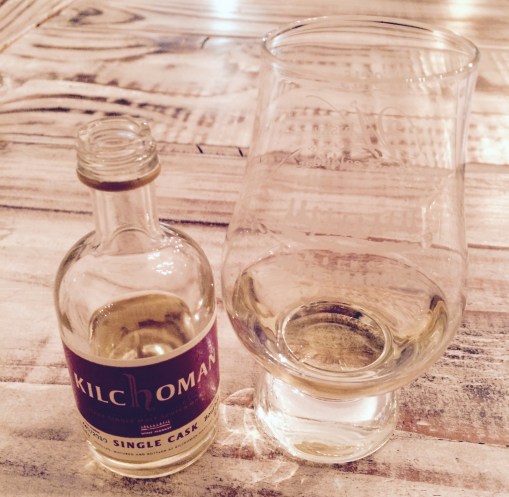
Aaaaaaaghh.  That was my admitted reaction when I opened the door to Day 21, one of four whiskies left in this year’s calendar before the Christmas Day finale from the Single Malt Whisky Society, and came face to face with Kilchoman again.  These last few days before the finish line in the 2014 calendar were home to some real zingers, including my favourite whisky of last year (and one of my favourites ever), the GlenDronach Parliament; to see this coveted calendar spot taken up by a distillery I can’t quite bring myself around to like was a bit painful.  Now, to be clear, as discussed on Day 11 when Kilchoman showed up the first time in 2015:  they are a very highly regarded distillery with a super cool story (the farm-to-table equivalent of the scotch world, Islay’s first new distillery in forever), and I have whisky-savvy friends that go nuts for them, so there’s nothing wrong with them whatsoever, but they just don’t match my taste for whatever reason.  However, if I decipher the label correctly, there seems to be some reason for excitement with this particular bottling, which may only be available in the singular place from which I got the calendar.  The tiny Kilchoman bottle features an even tinier Kensington Wine Market logo right on the official label, which I’m guessing means that this was from a cask purchased by and bottled for the store only.  (Further research just undertaken confirms the theory – cool!)  This Single Cask whisky is from a bourbon barrel identified only as cask #440, from the year 2010.  That means we’re dealing with, at most, a 5 Year malt, one of the youngest whiskies in the whole calendar.

FullSizeRender-200

The KWM Single Cask was bottled at cask strength (meaning that no water was added to it to dilute it and reduce the alcohol to a standard 40%, 43% or 46% level).  In this case that means the scotch is at a mind-melting 60.4% abv, meaning that adding water is imperative to this one unless you’re using it for sterilizing wounds.  This ultra-special Calgary-only version of Kilchoman smelled like, well, Kilchoman, a must-be-from-Islay combination of moccasins, smoky peat, solvent, tennis balls, kelp, orange zest and melted cheese.  A little more fruit shone through on the palate, banana and cantaloupe, but the Islay grime still carried the day, with tons of old shoe leather, burnt tires and exhaust, maltiness and toast, with a glycerol-laden viscosity from the elevated alcohol and a sweet smoothness on the finish – the bourbon cask coming through at last.  This was certainly my favourite Kilchoman that I’ve had so far, although also the most expensive at $140, making it one of the pricier 5 year-old scotches on the shelf.  There is certainly a lot going on here for a spirit a half a decade old, but I still can’t say it’s my thing.  I feel legitimately bad about it, Kilchoman.


Whisky Advent Calendar: Day 6

6 12 2014

Whatever your views on whether or not adding water to whisky helps unlock and open up its flavours, we can probably all get together on the fact that when a whisky clocks in at 60% ABV it’s probably a good idea to hydrate that bad boy, right?  I made a big deal previously when the Advent scotch lineup jumped from 43% to 46% from one day to the next; in contrast to that jump, today’s almost seems like sensory obliteration.  Day 6’s whisky is the Glenfarclas 105 Cask Strength (no kidding) Highland Single Malt Scotch.  Any whisky labelled as “cask strength” means that the finished whisky was not diluted with water down to a set alcohol level after barrel aging is complete.  The aging process results in varying levels of evaporation and concentration of the distilled liquid in cask, which is how you can end up with substantially advanced levels of alcohol, although 60% is close to the highest I’ve seen.  The Glenfarclas website suggests that “the smoothness makes the 105 drinkable at cask strength”, but the smoothness I got pre-dilution was somewhere between motor oil and fire, so in went the water.  Obviously not quite a scotch drinker’s palate yet…maybe on Day 24.

Day Six…ty?  Percent?

Day Six…ty? Percent?

Once I got the booze in check to a point where it didn’t feel like pure ethanol, I was able to appreciate the deep burnished gold colour and the vegetal nuance of this scotch.  There isn’t a whole ton going on, and the flavours are fairly laid back and mellow, but I coaxed out notes of grain/barley and brine, with an herbal undertone and a touch of honey lemon Halls on the nose.  The green, grassy undercurrent continued on the palate, shot through with vanilla, honey, toast and a notable hit of spiciness to go with a pleasant heat that lingered long after the scotch was gone.  Probably a middle-of-the-pack calendar whisky at the end of the day, one that I didn’t dislike but won’t remember much about in three days.